REVIEW 3 major objections 6 minor 17 references
A frozen diffusion transformer's intermediate noisy latents already encode final-image quality; small learnable register tokens extract dense reward gradients that enable cheaper training-time alignment and inference-time guidance.
Reviewed by Pith at T0; open to challenge. T0 means a machine referee read the full paper against a public rubric. the ladder, T0–T4 →
Prepending learnable register tokens to a frozen DiT yields dense latent reward estimates, enabling faster on-policy distillation and training-free guided sampling that improve preference alignment.
T0 review reviewed 2026-08-05 challenge →
load-bearing objection Novel register mechanism on a frozen DiT makes latent rewards cheap and dense; the core gap is that the register is validated on forward-noised latents, not the reverse trajectories it steers. the 3 major comments →
Latent Reward Registers for Diffusion Preference Alignment
The pith
A machine-rendered reading of the paper's core claim, the machinery that carries it, and where it could break.
The reading
Core claim
Central claim: a frozen diffusion transformer's internal representations already encode enough about final output quality that expected terminal preference can be read from intermediate noisy latents. Latent Reward Registers implement this as learnable, position-free tokens prepended to the frozen backbone's input; they accumulate evidence through a side-stream reusing frozen key/value projections without altering hidden states or the velocity field. Fused with pooled backbone features, reward-specific heads are trained by a noise-aware pairwise-ranking objective that preserves endpoint rankings. At u=0.8 the registers lead latent reward models; RG-OPD beats online RL baselines with 33x fewe
What carries the argument
Load-bearing object: the Latent Reward Register — K=32 learnable, position-free tokens prepended to a frozen DiT's input. Over the first L blocks they attend to native image/text tokens using the backbone's frozen key, value, output and noise-gating modules plus one trainable query projection, and skip the feed-forward networks, so the velocity field stays invariant. Reward-specific heads (HPS, ImageReward, PickScore) read fused register states, trained with a noise-aware pairwise-ranking loss in which paired images share noise level and the same Gaussian draw, preserving endpoint-reward rankings rather than calibrated values. Both alignment strategies consume the same artifact — the score g
Load-bearing premise
Everything rests on the assumption that a reward register trained on deliberately noised clean images stays accurate on the different kind of noisy states the generator actually visits while sampling — states that already carry the register's own corrections.
What would settle it
Run the frozen register on actual reverse-sampling states, with and without prior RGS corrections, at training noise levels; compare its pairwise preference accuracy and gradient-reward correlation against forward-noised pairs at the same noise level. If accuracy on sampling states approaches chance while forward-noised accuracy holds, the dense reward signal is a training-distribution artifact — and a magnitude-matched random-direction control would then show whether the reward direction itself (rather than the extra displacement) drives the RG-OPD and RGS gains.
If this is right
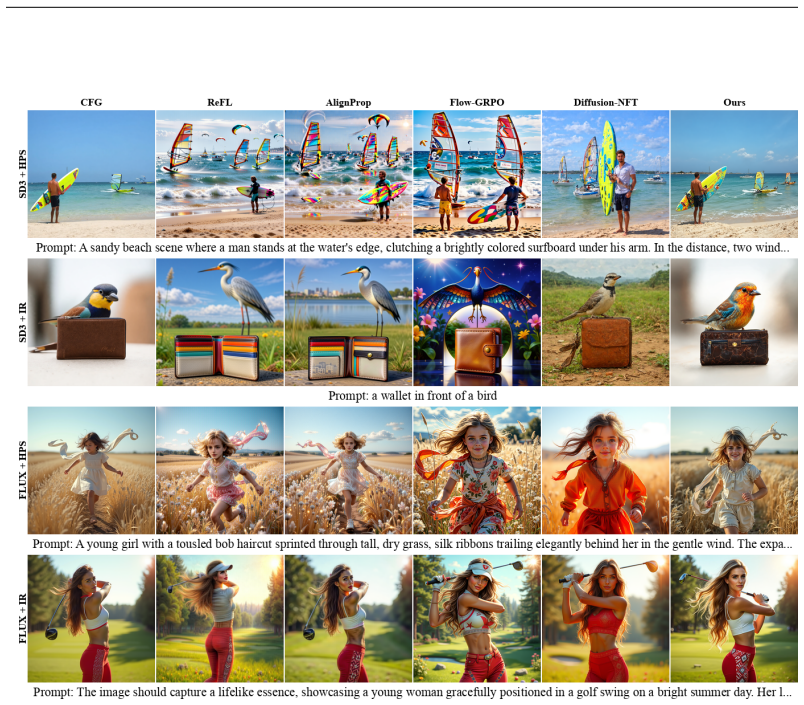
- Training-time alignment bypasses both full-chain backpropagation (which tends to over-optimize reward) and rollout-level policy gradients (which have high variance): RG-OPD's detached one-step targets reach Flow-GRPO-equivalent HPSv3 levels 14x-33x faster in GPU hours on both SD3-Medium and FLUX.1-dev.
- Preference alignment can be applied at inference time without retraining: RGS improves target HPSv3 and ImageReward scores while holding MUSIQ and CLIP-IQA at or above the CFG baseline, and equal-RMS multi-head aggregation balances competing objectives.
- Because the generator stays frozen and the reward correction is matched in magnitude to the solver step's own displacement, the same register works with higher-order ODE integrators (Adams-Bashforth, midpoint, Heun, RK4) without per-solver retuning.
- The register is a standalone latent reward model: at u=0.8 it ranks above prior latent reward baselines (LRM, PA VRM, Diffusion Probe, DiNa-LRM) on most of four preference benchmarks, and its rank agreement with endpoint models stays stable (Spearman 0.76-0.83) across noise levels.
- The high-noise band carries most of the signal, so the three-band guidance schedule (alpha 0.30 early, 0.05-0.10 mid, zero in the low-noise tail) gives users a direct trade-off between reward gain and fine-detail preservation.
Where Pith is reading between the lines
- Editorial extension: the register is trained on forward-noised clean latents that share a noise draw, yet RG-OPD and RGS apply it to reverse-sampler states carrying accumulated corrections; a cheap check is to measure register rank accuracy and gradient-reward correlation on buffers of actual sampling states per noise level, with and without prior corrections.
- Editorial extension: if early latents are this informative about terminal preference, the same readout could drive compute allocation decisions - adaptively stopping or refining trajectories whose predicted reward has saturated - a use the paper does not explore.
- Editorial extension: because the mechanism is agnostic to what the endpoint reward measures, a natural test is training the same register architecture on an objective verifier (factual consistency, structural constraints) and checking whether dense latent rewards accelerate convergence there as they do for human preferences.
- Editorial extension: the paper isolates whether direction matters only against a CFG-direction control; a stronger control would replace the reward gradient with a magnitude-matched random or perturbed unit vector, testing whether the guidance signal itself - not just the extra displacement - drives the gains.
Editorial analysis
A structured set of objections, weighed in public.
Referee Report
Summary. The paper proposes Latent Reward Registers, a side-stream of learnable, position-free register tokens inserted into a frozen Diffusion Transformer (DiT). The registers are trained with a pairwise ranking objective to predict terminal image-preference scores directly from intermediate noisy latents, yielding a dense, differentiable reward field. This field is then used in two alignment strategies: RG-OPD, which distills reward-tilted one-step targets along on-policy student trajectories, and RGS, which applies magnitude-matched reward-gradient corrections at inference time on a frozen generator. Experiments report pairwise preference accuracy at noise level u=0.8 on four benchmarks, training-time alignment results on SD3-Medium and FLUX.1-dev versus reward-backpropagation and online RL baselines, and inference-time results versus DNO and Demon, together with ablations, efficiency analyses, and a multi-solver ODE study.
Significance. If the central claim holds—that a frozen DiT's intermediate representations already contain enough terminal-preference evidence for a lightweight register to yield reliable dense reward gradients—this would be a valuable contribution to diffusion-model alignment. The paper targets a real credit-assignment problem, introduces a non-intrusive mechanism that preserves the generative dynamics, and demonstrates both training-time and inference-time applications. It also ships code, gives detailed cost measurements (Table 10), and includes a high-order-ODE-solver robustness analysis (Table 11), all of which are strengths. However, the load-bearing empirical support is weakened by a train/deploy distribution shift, a partially circular evaluation loop, and the absence of uncertainty quantification. The core claim is plausible and important, but the current evidence does not fully establish it.
major comments (3)
- [Sec. 3.1, Eq. (4), Eq. (7)] The register is trained and validated on paired clean latents forward-noised as z_u=(1-u)z_clean+uε with a shared Gaussian realization (Sec. 3.1). RG-OPD and RGS, however, evaluate and differentiate the register score at states produced by the student or guided reverse sampler: finite-step Euler/CFG integration plus accumulated reward corrections (Eq. 4, Eq. 7). These states are not draws from the forward-corruption marginal used in training. The paper never directly validates register ranking accuracy or gradient reliability on this deployment distribution. Appendix E.4 / Figure 11 tracks register-head z-scores along the guided trajectory, but that is self-evaluation by the very function whose reliability is in question; it cannot establish that a high register score at z_i corresponds to high terminal preference. Please add a direct validation on actual deployment states—for example, c
- [Tables 1–3 and Fig. 6] The central empirical claims—register achieves the highest latent-model accuracy, RG-OPD outperforms online RL, RGS 'strictly enhances both alignment and perceptual metrics'—are supported only by point estimates. Differences such as Table 1 average accuracy 68.32 (register) versus 66.47 (DiNa-LRM), or Table 3 MUSIQ 73.2 versus 73.0, could be within evaluation noise. Without confidence intervals, hypothesis tests, or per-seed/per-prompt breakdowns, these claims are not fully supported. Moreover, 'strictly enhancing both alignment and perceptual metrics' is contradicted by the RGS+IR row in Table 3 on SD3-Medium, where MUSIQ decreases (73.2→73.0) and CIQA is unchanged (0.694). Please report uncertainty and qualify such claims accordingly.
- [Sec. 3.1, Sec. 4.3, Table 3] The evaluation loop is partly closed. The register heads are trained to reproduce the rankings of endpoint reward models (HPSv3, ImageReward, and, in the design ablation, PickScore), and the main RGS/OPD results are then evaluated largely on those same endpoint reward models. Gains on HPSv3/ImageReward therefore conflate true preference improvement with optimization of a differentiable surrogate trained by the same teacher. The no-reference quality metrics (MUSIQ, CLIP-IQA) are a useful independent check, but they are not preference metrics. The paper should evaluate RG-OPD and RGS on held-out preference benchmarks that were not used as optimization objectives—for example HPDv2 or GenAI-Bench—and, if feasible, on a small human-study subset.
minor comments (6)
- [Abstract and Sec. 4.3] The phrase 'strictly enhancing both alignment and perceptual metrics' is too strong given Table 3; see major comment. Suggest rewording to 'improving target rewards while preserving or improving perceptual quality in most configurations.'
- [Sec. 4.4, Fig. 6] The efficiency claim '14.0×–33.2× faster' is based on a 256-prompt validation subset, while Table 2 uses 400/800 prompt–seed sets. Please clarify that these are different evaluation sets in the main text, not only in the analysis paragraph.
- [Appendix E.4, Fig. 11] The legend uses λ for guidance strength while the method section uses α; this notation inconsistency should be fixed.
- [Table 11] The FID values are reported relative to a reference set (Euler CFG for CFG rows, same-solver CFG for RGS rows). This is unusual and potentially misleading; the definition should be stated explicitly in the main text or table caption.
- [Sec. 4.1, Table 1] LRM-SD1.5 and LRM-SDXL use different backbones from the SD3-Medium latent baselines. The text says 'fair comparison' but should more explicitly state that these rows are cross-backbone references, not matched comparisons.
- [Figure 2] The overview figure is extremely dense and difficult to parse. Consider simplifying or splitting into separate panels for the architecture and the attention/module details.
Circularity Check
The register is trained on endpoint reward models and then evaluated on those same models; Appendix E.4's reward-progression plot measures the very objective RGS optimizes.
specific steps
-
fitted input called prediction
[Sec. 3.1 (Reward prediction and learning); Tables 2 and 3]
"The learned score preserves the rankings induced by the endpoint reward models rather than estimating a calibrated reward value."
The register is trained to reproduce the rankings of endpoint reward models (HPSv3, ImageReward) via the pairwise ranking objective. RG-OPD (Eq. 4) and RGS (Eq. 7) then use gradients of this learned score to maximize those same endpoint reward models, and Tables 2 and 3 evaluate on HPSv3 and ImageReward as 'optimization targets.' Thus a large part of the reported alignment gain is a closed loop: the surrogate is optimized with gradients from its own teacher, and the metric is the teacher itself. The gain is partially forced by construction, though not entirely, because the gradient of a ranking-trained surrogate need not perfectly align with the teacher's gradient off-distribution.
-
self definitional
[Appendix E.4, Figure 11]
"Figure 11 tracks the register-head scores for HPSv3, PickScore, and ImageReward through the denoising process. The correction raises the scores by 2–3.3 standard deviations relative to the CFG baseline mean."
RGS updates latents by Eq. 7: z_{i+1} = mu_ref_i + alpha_i * RMS(delta z_ref_i) * unitRMS(g_i), where g_i = grad_z r_phi(z_i) is the gradient of the register score. Therefore the register score is the exact objective being greedily increased at each step; its increase is a first-order Taylor consequence of the update rule, not independent evidence of terminal-preference improvement. The figure is a self-evaluation by the very function whose reliability is in question.
full rationale
The paper's central mechanism—a frozen-DiT register readout trained with a pairwise ranking loss against endpoint reward models, then used as a dense reward for training-time distillation and inference-time guidance—is not circular in its construction. The register's pairwise accuracy is also evaluated on human-preference benchmarks (HPDv2, HPDv3, GenAI-Bench) that are not the training teachers, and the CFG-direction control (Appendix E.1) isolates the learned gradient direction from mere magnitude effects. However, two evaluation loops are partially closed. First, RG-OPD and RGS are evaluated largely on HPSv3 and ImageReward, which are the same endpoint reward models used to supervise the register; improvement on those metrics is partly a fit-transfer sanity check rather than an independent demonstration of preference alignment. Second, Appendix E.4's 'reward along the trajectory' analysis uses the register's own score as evidence of alignment, but that score is the objective being optimized by Eq. 7, so its increase is expected by construction. These issues do not invalidate the central claim—there is independent human-preference and perceptual-quality evidence—but they indicate partial circularity in the evaluation chain, warranting a score of 4.
Axiom & Free-Parameter Ledger
free parameters (6)
- Number of register tokens K =
32
- Register-equipped blocks L =
12 (SD3), 8 (FLUX)
- RG-OPD reward tilt schedule alpha_i =
SD3: {0.20,0.40,0.50} for sigma>0.2, 0 otherwise; FLUX: 0.80
- RGS guidance schedule alpha_early/alpha_mid =
0.30 early, 0.05 (SD3) or 0.10 (FLUX) mid, 0 low-noise
- Feature-snapshot blocks for fusion =
{4,8,12} (SD3), {9,19,28} (FLUX)
- Sampling steps and CFG scale =
42 steps / CFG 4.5 (SD3), 40 steps / CFG 3.5 (FLUX)
axioms (5)
- domain assumption Frozen DiT representations encode enough terminal-preference evidence from intermediate noisy latents
- domain assumption Endpoint reward models HPSv3 and ImageReward provide valid preference labels for training the register
- domain assumption Register gradients applied to reverse-sampling latents point toward higher-quality images and remain near the natural image manifold
- domain assumption Paired forward-noising with shared Gaussian noise and noise level controls pairwise confounds
- standard math Standard flow-matching ODE discretization is faithful for the frozen generator
invented entities (1)
-
Latent reward register tokens
independent evidence
Cite this review
Pith. "Pith review of Latent Reward Registers for Diffusion Preference Alignment." pith.science (2026). https://pith.science/paper/35Z74LHN
@misc{pith2026260803929,
  author       = {Pith},
  title        = {Pith review of: Latent Reward Registers for Diffusion Preference Alignment},
  year         = {2026},
  howpublished = {\url{https://pith.science/paper/35Z74LHN}},
  note         = {Machine review of arXiv:2608.03929}
}
read the original abstract
Aligning diffusion models with human preferences usually relies on a sparse terminal reward evaluated on the final generated samples, presenting a severe temporal credit-assignment challenge across the multi-step denoising process. We propose Latent Reward Registers, a mechanism that estimates terminal preference directly from intermediate noisy latents by prepending learnable, position-free register tokens to the input sequence of a frozen Diffusion Transformer (DiT). This independent readout mechanism extracts latent reward evidence without altering the generator's hidden states or velocity field. The resulting dense, differentiable reward signal throughout the full denoising process facilitates two alignment strategies. For training, Reward-Gradient On-Policy Distillation (RG-OPD) distills reward-guided updates along on-policy trajectories, bypassing the computationally expensive rollouts of standard policy gradients. For inference, Reward-Guided Sampling (RGS) steers trajectories via magnitude-matched reward gradients without parameter updates. Empirically, at high noise levels (u = 0.8), the registers reach the highest pairwise accuracy among the evaluated latent reward models. Furthermore, RG-OPD outperforms online reinforcement learning baselines while reducing GPU hours by up to 33x, and RGS establishes a new state-of-the-art among training-free methods, strictly enhancing both alignment and perceptual metrics. Code and weights are available at https://github.com/Guanys-dar/latent-reward-register
Figures




Reference graph
Works this paper leans on
-
[1]
Training diffusion models with reinforcement learning.arXiv preprint arXiv:2305.13301,
Kevin Black, Michael Janner, Yilun Du, Ilya Kostrikov, and Sergey Levine. Training diffusion models with reinforcement learning.arXiv preprint arXiv:2305.13301,
-
[6]
Yuval Kirstain, Adam Polyak, Uriel Singer, Shahbuland Matiana, Joe Penna, and Omer Levy. Pick-a-pic: An open dataset of user preferences for text-to-image generation.arXiv preprint arXiv:2305.01569,
-
[7]
Aligning text-to-image models using human feedback.arXiv preprint arXiv:2302.12192,
Kimin Lee, Hao Liu, Moonkyung Ryu, Olivia Watkins, Yuqing Du, Craig Boutilier, Pieter Abbeel, Mohammad Ghavamzadeh, and Shixiang Shane Gu. Aligning text-to-image models using human feedback.arXiv preprint arXiv:2302.12192,
-
[8]
Baiqi Li, Zhiqiu Lin, Deepak Pathak, Jiayao Li, Yixin Fei, Kewen Wu, Tiffany Ling, Xide Xia, Pengchuan Zhang, Graham Neubig, and Deva Ramanan. GenAI-Bench: Evaluating and improv- ing compositional text-to-visual generation.arXiv preprint arXiv:2406.13743,
-
[9]
Beyond VLM-based rewards: Diffusion-native latent reward modeling.arXiv preprint arXiv:2602.11146,
Gongye Liu, Bo Yang, Yida Zhi, Zhizhou Zhong, Lei Ke, Didan Deng, Han Gao, Yongxiang Huang, Kaihao Zhang, Hongbo Fu, and Wenhan Luo. Beyond VLM-based rewards: Diffusion-native latent reward modeling.arXiv preprint arXiv:2602.11146,
-
[11]
Video generation models are good latent reward models.arXiv preprint arXiv:2511.21541,
Xiaoyue Mi, Wenqing Yu, Jiesong Lian, Shibo Jie, Ruizhe Zhong, Zijun Liu, Guozhen Zhang, Zixiang Zhou, Zhiyong Xu, Yuan Zhou, Qinglin Lu, and Fan Tang. Video generation models are good latent reward models.arXiv preprint arXiv:2511.21541,
-
[12]
Xiaoshi Wu, Yiming Hao, Keqiang Sun, Yixiong Chen, Feng Zhu, Rui Zhao, and Hongsheng Li. Human preference score v2: A solid benchmark for evaluating human preferences of text-to- image synthesis.arXiv preprint arXiv:2306.09341,
-
[14]
DanceGRPO: Unleashing GRPO on visual generation
Zeyue Xue, Jie Wu, Yu Gao, Fangyuan Kong, Lingting Zhu, Mengzhao Chen, Zhiheng Liu, Wei Liu, Qiushan Guo, Weilin Huang, et al. DanceGRPO: Unleashing GRPO on visual generation. arXiv preprint arXiv:2505.07818,
-
[15]
Shentao Yang, Tianqi Chen, and Mingyuan Zhou. A dense reward view on aligning text-to-image diffusion with preference.arXiv preprint arXiv:2402.08265,
-
[16]
Variant ImageReward HPDv2 HPDv3 GenAI-Bench Avg +HPS62.12 81.1873.3061.75 69.59 +ImageReward63.13 78.84 65.8663.4267.81 +Raw score-sum63.46 81.2072.36 62.9670.00 0.00 0.25 0.50 0.75 1.00 u = 0.2 Register Ranking Pct. top-k bottom-k =0.82 HPS ideal ranking top-k bottom-k =0.80 ImageReward top-k bottom-k =0.78 PickScore 0.00 0.25 0.50 0.75 1.00 u = 0.5 Regi...
-
[17]
Each method runs in its own process and is averaged over ten runs after ten warm-up runs. In the standard deployment the register shares the frozen denoiser and text encoders of the sampler, so the memory overhead is limited to the147.6M trainable param- eters of the read path and reward head: peak memory rises only from16.9GiB to17.6GiB versus unguided C...
work page 2023
-
[1993]
doi: 10.1007/978-3-540-78862-1. Jonathan Ho and Tim Salimans. Classifier-free diffusion guidance.arXiv preprint arXiv:2207.12598,
-
[2021]
Stitched Value Model for Diffusion Alignment
Hyojun Go, Hyungjin Chung, Prune Truong, Goutam Bhat, Li Mi, Zhaochong An, Zixiang Zhao, Dominik Narnhofer, Serge Belongie, Federico Tombari, and Konrad Schindler. Stitched value model for diffusion alignment.arXiv preprint arXiv:2605.19804,
work page internal anchor Pith review Pith/arXiv arXiv
-
[2023]
Directly fine-tuning diffusion models on differentiable rewards
Kevin Clark, Paul Vicol, Kevin Swersky, and David Fleet. Directly fine-tuning diffusion models on differentiable rewards. InInternational Conference on Learning Representations, volume 2024, pp. 4793–4822,
work page 2024
-
[2024]
Imagereward: Learning and evaluating human preferences for text-to-image generation
Jiazheng Xu, Xiao Liu, Yuchen Wu, Yuxuan Tong, Qinkai Li, Ming Ding, Jie Tang, and Yuxiao Dong. Imagereward: Learning and evaluating human preferences for text-to-image generation. arXiv preprint arXiv:2304.05977,
-
[2025]
HPSv3: Towards wide-spectrum human preference score.arXiv preprint arXiv:2508.03789,
Yuhang Ma, Xiaoshi Wu, Keqiang Sun, and Hongsheng Li. HPSv3: Towards wide-spectrum human preference score.arXiv preprint arXiv:2508.03789,
-
[2026]
Timoth´ee Darcet, Maxime Oquab, Julien Mairal, and Piotr Bojanowski
URLhttps://arxiv.org/abs/2602.23783. Timoth´ee Darcet, Maxime Oquab, Julien Mairal, and Piotr Bojanowski. Vision transformers need registers. InInternational Conference on Learning Representations,
This paper was first reviewed by deepseek-v4-flash on August 5, 2026.
discussion (0)
Sign in with ORCID, Apple, or X to comment. Anyone can read and Pith papers without signing in.