REVIEW 5 major objections 7 minor 29 references
Spline-based KAN heads and forward-activation heatmaps improve chest X-ray localization and VLM explanations by about 10%.
Reviewed by Pith at T0; open to challenge. T0 means a machine referee read the full paper against a public rubric. the ladder, T0–T4 →
T0 review · grok-4.5
2026-07-31 06:35 UTC pith:35ZHM664
load-bearing objection Useful KAN-head + forward-CAM pipeline with real table gains, but absolute IoU is near floor and the trustworthiness story outruns the frozen-backbone design. the 5 major comments →
KANEx: Translating Kolmogorov-Arnold Networks' Interpretability to Medical Explainability
The pith
A machine-rendered reading of the paper's core claim, the machinery that carries it, and where it could break.
Core claim
Replacing the MLP head of a frozen ResNet or ViT with a KAN, then building heatmaps directly from forward spline activations over spatial features, yields more faithful localizations and higher-quality VLM radiology explanations on MIMIC-CXR than gradient or attention baselines, improving visual localization and downstream reasoning quality by about 10%.
What carries the argument
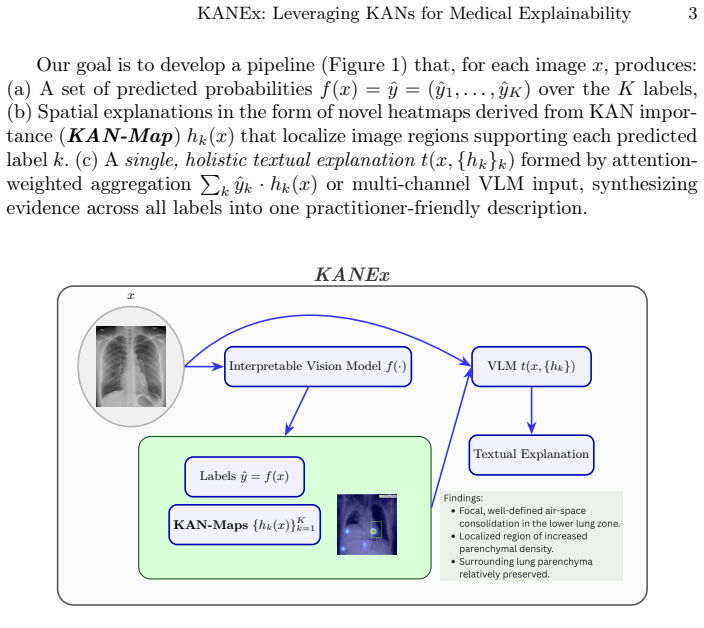
KAN-Map: for each spatial location, the feature vector is passed through the trained KAN spline layers to obtain class-specific scores hk(x,y)=ϕ2,k(ϕ1(Fx,y)), producing a heatmap without gradients; those maps plus labels are fed to a VLM for text.
Load-bearing premise
That putting interpretable splines only in the final head of a frozen pretrained backbone is enough for the visual model’s transparency to drive better heatmaps and trustworthy explanations.
What would settle it
Retrain or unfreeze the full backbone with ordinary MLP heads versus KAN heads on the same MIMIC-CXR split and check whether KAN-Map’s IoU, faithfulness, and LExT gains over Grad-CAM disappear once the feature extractor is no longer frozen or is itself a KAN.
If this is right
- Clinical pipelines can generate both compact pathology heatmaps and structured radiology text from one KAN-headed classifier without a separate gradient pass.
- Faithfulness audits of VLM reports can be anchored to the same spline activations that produced the diagnosis rather than post-hoc saliency.
- GroupKAN and RationalKAN offer different localization–compactness trade-offs that can be chosen per finding type.
- Explanation quality metrics such as LExT become more diagnostic when the visual evidence is spline-derived rather than gradient-derived.
Where Pith is reading between the lines
- If the gains truly come from spline transparency rather than head capacity, similar forward-activation maps should transfer to other multi-label medical imaging tasks that already use frozen CNN or ViT features.
- Clinician-in-the-loop studies planned by the authors would be most informative if they score whether spline-grounded reports reduce over-trust in hallucinated findings compared with Grad-CAM prompts.
- End-to-end KAN vision backbones, not only heads, remain an open test of whether the architectural claim scales beyond the classification layer.
Editorial analysis
A structured set of objections, weighed in public.
Referee Report
Summary. The manuscript proposes KANEx, a pipeline for explainable chest X-ray diagnosis in which the MLP classification head of a frozen pretrained ResNet-50 or ViT is replaced by a Kolmogorov-Arnold Network (Vanilla, Group, or Rational KAN). Because the KAN head is a composition of univariate spline functions, the authors derive a forward-only saliency method, KAN-Map, that evaluates the trained splines on per-location feature vectors to produce class-specific heatmaps without gradients. These heatmaps are then supplied, together with the image and predicted diagnosis, to a LLaVA-based VLM to generate textual explanations. On a custom 20k-case MIMIC-CXR/MIMIC-IV derived dataset (with MS-CXR bounding boxes for evaluation), the authors report that KAN heads plus KAN-Map improve IoU, Energy@10, Area@50, insertion/deletion Faithfulness, and LExT-C text quality over Grad-CAM and attention-rollout baselines, with a Friedman test (p<0.001) on IoU distributions.
Significance. If the claims hold, the contribution is meaningful: a principled, cheap (forward-only) alternative to gradient-based saliency that is naturally paired with KAN classifiers, plus an end-to-end pipeline connecting visual attribution to VLM-generated explanations — a clinically relevant problem. Positive aspects that should be credited: a controlled head-replacement design (frozen backbones, identical training settings), a systematic comparison of three KAN variants across two backbone families, evaluation on external bounding-box annotations (MS-CXR) rather than only proxy metrics, and a public codebase. However, the absolute localization numbers are near floor, key evaluation details are missing or internally inconsistent, and the statistics are thin, so the practical significance is not yet established.
major comments (5)
- [Table 2 / §3] Table 2 / §3: All reported IoU values lie between 0.060 and 0.079, i.e., the heatmaps overlap MS-CXR pathology boxes almost not at all in absolute terms, and chest-X-ray findings are strongly center-biased. The headline claim of '~25% higher IoU' and 'functionally grounded spatial attributions' (Abstract; §1) is therefore a relative gain between near-floor methods. A trivial spatial-prior baseline (fixed center Gaussian; per-class average heatmap) must be reported for the IoU claim to be interpretable; if such a prior matches KAN-Map, the central localization claim does not hold as stated.
- [Table 1 (Faithfulness) vs. Table 2] Table 1 defines Faithfulness as 'the difference between Deletion AUC and Insertion AUC'. Since each AUC lies in [0,1], their difference lies in [-1,1], yet Table 2 reports values such as 9.789 (RN50-rKAN) and 7.500 (ViT-rKAN). The metric as defined cannot produce the numbers as reported; the scaling/normalization is unexplained and the values are not comparable across rows without it. Separately, KAN-Map is the forward spatial logit map of the same head whose confidence drives the insertion/deletion curves, giving it a structural advantage over Grad-CAM in this metric that is never acknowledged. The Faithfulness column cannot currently support the '>20% faithfulness gains' claim.
- [§3, Table 2, Fig. 3] No error bars, confidence intervals, or per-comparison significance tests are reported anywhere in Table 2 or Figure 3; the only statistic is a Friedman test (p<0.001) on IoU distributions across models, which does not establish that any specific KAN-Map vs. Grad-CAM gap is significant. Given that several IoU differences are in the third decimal place (e.g., RN50(KAN): 0.060 Grad-CAM vs. 0.069 KAN-Map; ViT(gKAN): 0.074 Attn-R vs. 0.077 KAN-Map), within-seed noise could plausibly reorder the table. Multi-seed runs or bootstrap CIs on the held-out set are needed.
- [§2.1 vs. §3 Experimental Setup] The design freezes the pretrained ResNet/ViT backbone and replaces only the final MLP head (§3, Experimental Setup), yet the narrative attributes the improved localization to KANs' 'architectural transparency' and 'intrinsic interpretability' (Abstract, §2.1). Because all spatial features come from the frozen, non-interpretable backbone, the paper's own controlled design isolates only the head; nothing shown establishes that spline interpretability, rather than head-capacity or training-dynamics differences, is the causal driver. At minimum the text should be rewritten to claim only what the ablation supports, and ideally a control with a comparably-sized MLP head trained identically (and KAN-Map-style forward-logit heatmaps computed from that MLP head) should be added to separate method-from-architecture effects.
- [§3 Experiments] No diagnostic classification performance (e.g., per-label AUROC) of the KAN heads versus the original MLP heads is reported. The pipeline's stated goal is trustworthy diagnosis plus explanation (Abstract; §4); if replacing the head degrades accuracy, the explanation-quality gains are moot for clinical use. A small table of head-level classification metrics on the held-out 30% is required.
minor comments (7)
- [Table 1] Table 1 (IoU): IoU is defined between 'predicted heatmaps and ground-truth bounding boxes', but a continuous heatmap has no intersection with a box until binarized; the thresholding rule (e.g., top-k% pixels, or threshold at 0.5 after normalization) is not specified and materially changes the numbers.
- [§1, Fig. 3] Intro and §1 claim '~23% LExT improvement' and 'up to ~20%' LExT gains, but no numeric LExT table appears; Figure 3 is a bar plot without values. Please tabulate LExT-C per model x heatmap condition.
- [Table 2] Table 2: Area@50 for ViT rows (0.008-0.025) differs from ResNet rows (0.151-0.197) by an order of magnitude; this is presumably a resolution/normalization artifact of ViT patch grids and should be explained, since it makes Area@50 incomparable across families.
- [Table 1] Energy@10 and Area@50 are cited to the Grad-CAM paper [19], which does not define these metrics; please cite the correct source (e.g., pointing-game / energy-based XAI evaluation literature) and define the energy normalization.
- [Throughout] Typos and copyediting: 'fraemwork' (Table 1 caption), 'accurazy' and 'alighment' (§3.1), 'Kolmogrov' (keywords); broken inline math in §2.1 (the MLP and KAN layer equations); 'first ever' (Abstract) should be toned down to 'to our knowledge, the first'.
- [§2.2] §2.2: the B-spline hyperparameters (G=5, p=3) are stated without sensitivity analysis; since KAN-Map reads out spline activations directly, heatmap quality may depend on grid resolution — a small ablation over G would strengthen the method section.
- [§3, Fig. 2] The MS-CXR-derived evaluation subset size, the number of labels K, and which findings are evaluated are not stated; Figure 2 heatmaps are too low-resolution to verify the claimed compactness visually. Please report subset statistics and provide higher-resolution qualitative figures.
Circularity Check
Mild circularity: KAN-Map faithfulness is largely by construction (map = spatial forward logits of the scored head), and text-quality gains rest on the authors' own LExT metric; IoU vs external boxes is not circular.
specific steps
-
self definitional
[§2.2 KAN-Map eq. hk(x,y)=ϕ2,k(ϕ1(Fx,y)); Table 1 Faithfulness; Table 2 Faithfulness columns]
"The class-k heatmap value is obtained as hk(x, y) = ϕ2,k(ϕ1(Fx,y)) ... This forward-only procedure requires no gradients or linear approximations and directly reflects the learned spline mappings. ... Faithfulness We assess explanation faithfulness as the difference between Deletion AUC ... and Insertion AUC ..."
KAN-Map is the classifier head's own spatial forward map (per-location logits). Faithfulness then measures how much the same head's confidence drops/rises when regions ranked by that map are deleted/inserted. Agreement with model behavior is therefore largely guaranteed by construction for KAN-Map and only approximated for Grad-CAM/Attn-R. The large Faithfulness jumps (e.g. 1.05→9.79) are not an independent empirical prediction; they largely restate that the explanation is the model.
-
self citation load bearing
[§3 Evaluation Metrics / Table 1 LExT-C; Ref [20]; Abstract '~10%' reasoning quality]
"LExT-C The correctness subset of LExT measures clinical alignment and correctness between generated explanations and reports through lexical and factual overlap [20]. ... KAN architectures improve visual localization and downstream reasoning quality by ∼10%."
The load-bearing claim that KAN-Map/KAN heads improve 'downstream reasoning quality' and 'semantic similarity' is quantified primarily with LExT, introduced by the same lead author and overlapping coauthors (Shailya, Krishnan, Ravindran). The metric is not machine-checked external mathematics; it is the authors' own NER/embedding overlap protocol. Text gains therefore rest on a self-cited yardstick plus GT rationales synthesized from the same note corpus, not on an independent external standard alone.
full rationale
The paper is an empirical methods paper, not a first-principles derivation, so most of the chain is non-circular: KAN-Map is defined as a forward spline evaluation over spatial features, then scored against external MS-CXR boxes (IoU) and against VLM text overlap. That external-box comparison does not reduce to the method's inputs. Two milder issues remain. (1) Faithfulness is insertion/deletion of 'salient' regions measured by the same model's confidence; KAN-Map is exactly the per-location class logit through that head (hk=ϕ2,k(ϕ1(Fx,y))), so high Faithfulness vs Grad-CAM is structurally favored rather than an independent discovery. (2) Downstream 'reasoning quality' is primarily reported via LExT-C from Shailya et al. (same lead author/group), and GT rationales are synthesized from the same clinical-note corpus. Neither collapses the localization claim into a tautology, but both inflate the trustworthiness narrative. No uniqueness-theorem import, ansatz-via-self-cite, or renamed known law. Score 3 reflects real but partial circularity confined to faithfulness and the text metric, not the core IoU experiment.
Axiom & Free-Parameter Ledger
free parameters (5)
- B-spline grid size G =
5
- B-spline order p =
3
- KAN head width / intermediate dimension D
- Heatmap post-processing (ReLU + min-max to [0,1]) =
ReLU + [0,1] norm
- Train/test split and 20k case synthesis rules =
20k cases, 30% test
axioms (6)
- ad hoc to paper Kolmogorov–Arnold edge-spline parameterizations yield intrinsically more interpretable vision decisions than MLP heads when only the classifier head is replaced.
- ad hoc to paper Forward activation magnitude of KAN splines on local feature vectors is a faithful measure of spatial contribution to the class score.
- domain assumption MS-CXR bounding boxes and CheXpert-style labels are adequate ground truth for localization and multi-label diagnosis evaluation.
- domain assumption LExT-C lexical/factual overlap with synthesized rationales measures clinical explanation quality.
- domain assumption General-purpose LLaVA prompted as a physician is an appropriate generator for comparing heatmap-conditioning quality.
- standard math B-spline and grouped/rational KAN variants are well-defined function classes usable as drop-in classifier heads.
invented entities (2)
-
KANEx
no independent evidence
-
KAN-Map
no independent evidence
read the original abstract
Computer vision models have become highly effective for medical applications, yet their black-box nature continues to undermine clinician trust. In clinical workflows, chest X-ray classifiers are increasingly paired with Vision-Language Models (VLMs) to generate natural-language explanations. However, these systems add linguistic fluency without addressing the underlying opacity of the visual model. With the emergence of Kolmogorov-Arnold Networks (KANs), whose spline-based components provide inherently interpretable functional units, we investigate whether this architectural transparency can be leveraged to produce more trustworthy textual explanations. We introduce KANEx, the first ever framework that leverages the symbolic transparency of KANs to ground VLM reasoning. This interpretability also made it possible to design KAN-Map, a novel heatmap generation method derived directly from KAN models rather than gradient approximations. We feed these grounded contexts into downstream VLMs for enhanced explainability. Benchmarked on the MIMIC-CXR dataset, we demonstrate that KAN-based architectures with ResNet/ViT baselines demonstrate improved semantic similarity while producing significantly more faithful saliency maps. KAN architectures improve visual localization and downstream reasoning quality by 10%. Our findings suggest that grounding linguistic explanations and visual attributions in mathematically interpretable units is a necessary step toward trustworthy medical AI.
Figures


Reference graph
Works this paper leans on
-
[1]
In: Proceedings of the 32nd International Conference on Neural Information Processing Systems
Adebayo, J., Gilmer, J., Muelly, M., Goodfellow, I., Hardt, M., Kim, B.: Sanity checks for saliency maps. In: Proceedings of the 32nd International Conference on Neural Information Processing Systems. p. 9525–9536. NIPS’18, Curran Associates Inc., Red Hook, NY, USA (2018)
2018
-
[2]
Neural Networks p
Aghaei, A.A., Hosseinzadeh, M., Parand, K.: rkan: Rational kolmogorov-arnold networks. Neural Networks p. 108888 (2026)
2026
-
[3]
Boecking, B., Usuyama, N., Bannur, S., Coelho de Castro, D., Schwaighofer, A., Hyland, S., Sharma, H., Wetscherek, M.T., Naumann, T., Nori, A., Alvarez Valle, J., Poon, H., Oktay, O.: MS-CXR: Making the Most of Text Seman- tics to Improve Biomedical Vision-Language Processing. PhysioNet (Nov 2024). https://doi.org/10.13026/9g2z-jg61, https://doi.org/10.13...
-
[4]
Deperrois, N., Matsuo, H., Ruipérez-Campillo, S., Vandenhirtz, M., Laguna, S., Ryser, A., Fujimoto, K., Nishio, M., Sutter, T.M., Vogt, J.E., et al.: Radvlm: A multitask conversational vision-language model for radiology (2025)
2025
-
[5]
Di Marino, A., Bevilacqua, V., Ciaramella, A., De Falco, I., Sannino, G.: Ante- hoc methods for interpretable deep models: A survey. ACM Comput. Surv.57(10) (May 2025). https://doi.org/10.1145/3728637
-
[6]
In: 9th International Conference on Learning Representations, ICLR 2021, Virtual Event, Austria, May 3-7, 2021
Dosovitskiy, A., Beyer, L., Kolesnikov, A., Weissenborn, D., Zhai, X., Un- terthiner, T., Dehghani, M., Minderer, M., Heigold, G., Gelly, S., Uszkoreit, J., Houlsby, N.: An image is worth 16x16 words: Transformers for image recog- nition at scale. In: 9th International Conference on Learning Representations, ICLR 2021, Virtual Event, Austria, May 3-7, 202...
2021
-
[7]
The Lancet Digital Health3(11), e745–e750 (Nov 2021)
Ghassemi, M., Oakden-Rayner, L., Beam, A.L.: The false hope of current approaches to explainable artificial intelligence in health care. The Lancet Digital Health3(11), e745–e750 (Nov 2021). https://doi.org/10.1016/S2589- 7500(21)00208-9
doi:10.1016/s2589- 2021
-
[8]
In: International Con- ference on Medical Image Computing and Computer-Assisted Intervention
Gu, D., Gao, Y., Zhou, Y., Zhou, M., Metaxas, D.: Radalign: Advancing radiology report generation with vision-language concept alignment. In: International Con- ference on Medical Image Computing and Computer-Assisted Intervention. pp. 484–494. Springer (2025)
2025
-
[9]
In: Proceedings of the IEEE conference on computer vision and pattern recognition (2016)
He, K., Zhang, X., Ren, S., Sun, J.: Deep residual learning for image recognition. In: Proceedings of the IEEE conference on computer vision and pattern recognition (2016)
2016
-
[10]
In: 2025 IEEE International Conference on Image Processing (ICIP)
Jo, S., Jang, G., Park, H.: Gmar: gradient-driven multi-head attention rollout for vision transformer interpretability. In: 2025 IEEE International Conference on Image Processing (ICIP). pp. 582–587. IEEE (2025)
2025
-
[11]
Johnson, A., Pollard, T., Mark, R., Berkowitz, S., Horng, S.: MIMIC-CXR Database. PhysioNet (Jul 2024). https://doi.org/10.13026/4jqj-jw95, version 2.1.0
-
[12]
Scientific Data6(1), 317 (Dec 2019)
Johnson, A.E.W., Pollard, T.J., Berkowitz, S.J., Greenbaum, N.R., Lungren, M.P., Deng, C.y., Mark, R.G., Horng, S.: Mimic-cxr, a de-identified publicly available database of chest radiographs with free-text reports. Scientific Data6(1), 317 (Dec 2019). https://doi.org/10.1038/s41597-019-0322-0
-
[13]
arXiv preprint arXiv:2511.05477 (2025)
Li, G., Majeed, A.P., Ateeq, M., Nguyen, A., Zhang, F.: Groupkan: Rethinking nonlinearity with grouped spline-based kan modeling for efficient medical image segmentation. arXiv preprint arXiv:2511.05477 (2025)
Pith/arXiv arXiv 2025
-
[14]
Radiology: Artificial Intelligence6(4), e240225 (2024)
Linguraru, M.G., Bakas, S., Aboian, M., Chang, P.D., Flanders, A.E., Kalpathy- Cramer, J., Kitamura, F.C., Lungren, M.P., Mongan, J., Prevedello, L.M., Sum- mers, R.M., Wu, C.C., Adewole, M., Kahn, C.E.: Clinical, cultural, computa- tional, and regulatory considerations to deploy ai in radiology: Perspectives of rsna and miccai experts. Radiology: Artific...
-
[15]
Liu, H., Li, C., Wu, Q., Lee, Y.J.: Visual instruction tuning. vol. 36, pp. 34892– 34916 (2023)
2023
-
[16]
In: Yue, Y., Garg, A., Peng, N., Sha, F., Yu, R
Liu, Z., Wang, Y., Vaidya, S., Ruehle, F., Halverson, J., Soljacic, M., Hou, T., Tegmark, M.: Kan: Kolmogorov–arnold networks. In: Yue, Y., Garg, A., Peng, N., Sha, F., Yu, R. (eds.) International Conference on Learning Representations. vol. 2025, pp. 70367–70413 (2025)
2025
-
[17]
Computers in Biology and Medicine157, 106791 (2023)
Manzari, O.N., Ahmadabadi, H., Kashiani, H., Shokouhi, S.B., Ayatollahi, A.: Medvit: a robust vision transformer for generalized medical image classification. Computers in Biology and Medicine157, 106791 (2023)
2023
-
[18]
Applied Soft Computing p
Manzari, O.N., Asgariandehkordi, H., Koleilat, T., Xiao, Y., Rivaz, H.: Medical image classification with kan-integrated transformers and dilated neighborhood attention. Applied Soft Computing p. 114045 (2025)
2025
-
[19]
In: Proceedings of the IEEE international conference on computer vision (2017)
Selvaraju, R.R., Cogswell, M., Das, A., Vedantam, R., Parikh, D., Batra, D.: Grad- cam: Visual explanations from deep networks via gradient-based localization. In: Proceedings of the IEEE international conference on computer vision (2017)
2017
-
[20]
In: Proceedings of the 2025 ACM Conference on Fairness, Accountability, and Transparency
Shailya, K., Rajpal, S., Krishnan, G.S., Ravindran, B.: Lext: Towards eval- uating trustworthiness of natural language explanations. In: Proceedings of the 2025 ACM Conference on Fairness, Accountability, and Transparency. FAccT ’25, Association for Computing Machinery, New York, NY, USA (2025). https://doi.org/10.1145/3715275.3732104 KANEx: Leveraging KA...
arXiv 2025
-
[21]
https://doi.org/10.48550/arXiv.2407.15851, http://arxiv.org/abs/2407.15851, arXiv:2407.15851 [cs]
Shi, C., Rezai, R., Yang, J., Dou, Q., Li, X.: A Survey on Trustwor- thiness in Foundation Models for Medical Image Analysis (Oct 2024). https://doi.org/10.48550/arXiv.2407.15851, http://arxiv.org/abs/2407.15851, arXiv:2407.15851 [cs]
-
[22]
ACM Computing Surveys58(2) (2025)
Somvanshi, S., Javed, S.A., Islam, M.M., Pandit, D., Das, S.: A survey on kolmogorov-arnold network. ACM Computing Surveys58(2) (2025)
2025
-
[23]
Sun, Q., Akman, A., Schuller, B.W.: Explainable artificial intelligence for med- ical applications: A review. ACM Trans. Comput. Healthcare6(2) (Feb 2025). https://doi.org/10.1145/3709367
doi:10.1145/3709367 2025
-
[24]
In: Proceedings of the 23rd workshop on biomedical natural language processing
Thawakar, O.C., Shaker, A.M., Mullappilly, S.S., Cholakkal, H., Anwer, R.M., Khan, S., Laaksonen, J., Khan, F.: Xraygpt: Chest radiographs summarization using large medical vision-language models. In: Proceedings of the 23rd workshop on biomedical natural language processing. pp. 440–448 (2024)
2024
-
[25]
The Ultrasound Journal17(1), 32 (Jul 2025)
Wong, A., Roslan, N.L., McDonald, R., Noor, J., Hutchings, S., D’Costa, P., Via, G., Corradi, F.: Clinical obstacles to machine-learning pocus adoption and system- wide ai implementation (the compass-ai survey). The Ultrasound Journal17(1), 32 (Jul 2025). https://doi.org/10.1186/s13089-025-00436-2
-
[26]
Computer Methods and Programs in Biomedicine240, 107660 (Oct 2023), https://www.sciencedirect.com/science/article/pii/S0169260723003255
Xu, W., Fu, Y.L., Zhu, D.: Resnet and its application to medi- cal image processing: Research progress and challenges. Computer Methods and Programs in Biomedicine240, 107660 (Oct 2023), https://www.sciencedirect.com/science/article/pii/S0169260723003255
2023
-
[27]
In: Fleet, D., Pajdla, T., Schiele, B., Tuytelaars, T
Zeiler, M.D., Fergus, R.: Visualizing and understanding convolutional networks. In: Fleet, D., Pajdla, T., Schiele, B., Tuytelaars, T. (eds.) Computer Vision – ECCV
-
[28]
In: Proceedings of the IEEE conference on computer vision and pattern recognition (2016)
Zhou, B., Khosla, A., Lapedriza, A., Oliva, A., Torralba, A.: Learning deep features for discriminative localization. In: Proceedings of the IEEE conference on computer vision and pattern recognition (2016)
2016
-
[2014]
pp. 818–833. Springer International Publishing, Cham (2014)
2014
discussion (0)
Sign in with ORCID, Apple, or X to comment. Anyone can read and Pith papers without signing in.