REVIEW 2 major objections 7 minor 4 cited by
LaDi-WM: A Latent Diffusion-based World Model for Predictive Manipulation
T0 review · 2 major / 7 minor · reviewed 2026-08-15 · deepseek-v4-flash
Pith's one-line read Latent-diffusion imagination lifts long-horizon robot success by 27.9 percent.
desk verdict Strong empirical results on manipulation benchmarks with a latent diffusion world model over DINO and SigLIP features, but the causal role of the imagined states is not fully isolated and the closest baseline is missing. read the letter →
The pith
A machine-rendered reading of the paper's core claim, the machinery that carries it, and where it could break.
The reading
What carries the argument
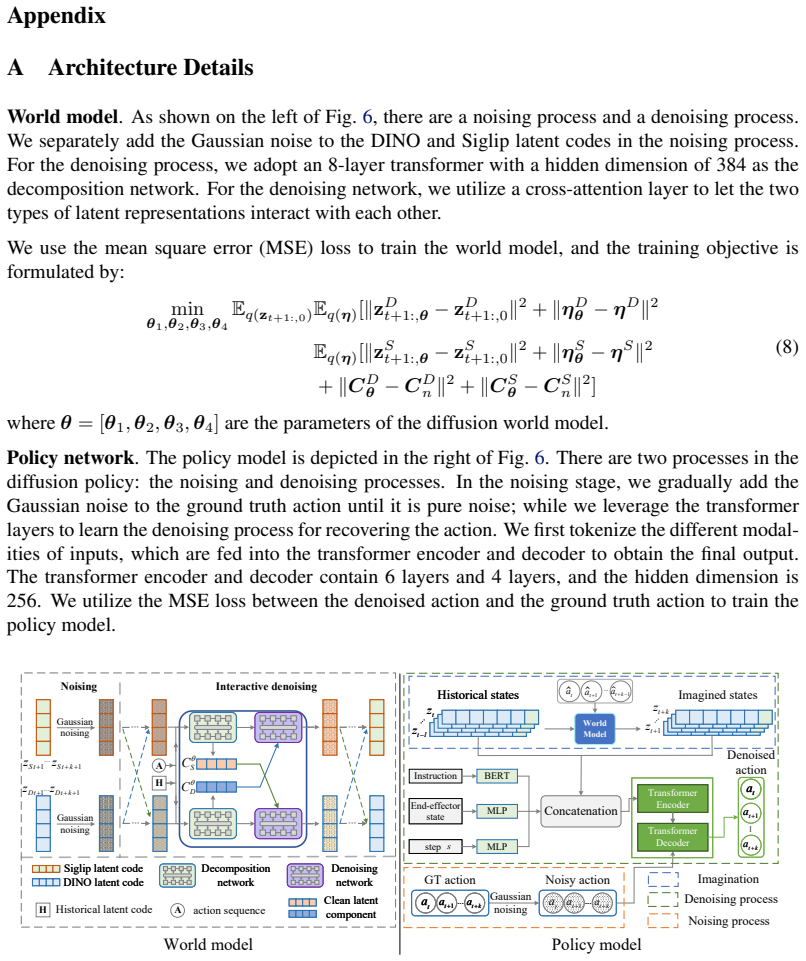
The load-bearing object is the interactive latent diffusion world model. It runs a diffusion process separately on the DINO and SigLIP latent codes, but couples the two streams by first decomposing each noisy code into a clean latent component using the analytic attenuation diffusion formulation, then feeding the clean component of one modality into the denoising network of the other via cross-attention, together with the action sequence. This lets geometric and semantic dynamics shape each other during denoising, which the paper argues aligns the two latent distributions and makes future-state prediction easier to learn. The second mechanism is the imagination-guided diffusion policy, which takes the imagined future latent states as extra conditioning and refines the action sequence in a closed loop with the world model; the paper attributes the gains to this iterative refinement, which progressively lowers the entropy of the predicted action distribution.
What would settle it
A concrete falsifier: train the same policy pipeline but replace the imagined future latent states with a random latent vector, or with the current frame's latent code repeated, and measure success on LIBERO-LONG; if the gain over vanilla behavior cloning persists, the world model's future prediction is not the source of the improvement. A second check is to test a task whose success depends on sub-patch contact or object-in-hand state that DINO and SigLIP codes plausibly ignore, and see whether iterative refinement still adds the reported improvement.
Extended reading notes
Core claim
The central discovery is that the dynamics of robot-object interaction are learnable and generalizable in the frozen latent space of visual foundation models, and that predicting those latent dynamics with diffusion beats predicting pixels. The paper concatenates DINO and SigLIP codes into a state $z_t=[f_{dino}(I_t); f_{sigl}(I_t)]$, trains an interactive latent diffusion process to sample future latent states conditioned on a history of latent states and an action sequence, and then feeds the imagined future states into a transformer-based diffusion policy that outputs actions. At inference, the policy's first action sequence is used to imagine a future, the imagined future is used to refine the action sequence, and the loop repeats until convergence, which the paper reports is reached in about two iterations. On LIBERO-LONG with ten demonstrations per task the method reports 68.7 percent average success against 40.8 percent for behavior cloning and 53.6 percent for the previous state of the art; on CALVIN D-D it reports an average sequence length of 3.63; in real-world trials it reports 60 percent versus 40 percent for vanilla behavior cloning.
Load-bearing premise
The load-bearing premise is that the concatenation of frozen DINO and SigLIP codes is a sufficient state description for predicting the future of robot-object interaction; if those features discard task-relevant detail such as contact state or small displacements, the imagined states used to refine the policy carry no useful signal.
Editorial extensions
If this is right
- A world model trained on task-agnostic clips can improve a policy on tasks whose dynamics were never seen during world-model training, as on LIBERO-LONG where the world model had access only to LIBERO-90 clips.
- Iterative action refinement with imagined latent states yields a monotonic gain up to two iterations and then plateaus, so the closed-loop policy-world-model loop is practical at test time without many calls.
- The same latent-space formulation transfers across scenes: a LIBERO-trained world model improves CALVIN policy learning, reaching an average sequence length of 3.05 even though the scenes differ.
- Scaling either world-model data or policy data improves success, and the gap over the prior state of the art persists across data scales.
- A policy using a copy of the current observation as imagination gains nothing over vanilla behavior cloning, suggesting the predicted future, not the extra conditioning channel, is what produces the gains.
Reading between the lines
- Beyond the paper, the same recipe could extend to other frozen features, such as depth, object identity, or language-grounded embeddings, whenever those latent spaces are stable enough to learn dynamics over.
- The method suggests a modular division of labor: one general latent-dynamics model shared across tasks, with a lightweight policy that queries it, which could enable larger shared world models trained on diverse robot data.
- A natural testable extension is to use the imagined latent states as rollout sources for model-predictive control or reinforcement learning, where the low-entropy refinement behavior observed here might reduce the need for dense reward shaping.
- The paper itself notes that long-horizon prediction suffers from compounding error; a testable extension would be to add memory or temporal consistency mechanisms to the latent world model and measure whether refinement gains continue beyond two iterations on longer tasks.
Signed reviews
Editorial analysis
A structured set of objections, weighed in public.
Referee Report
Summary. LaDi-WM proposes a latent diffusion world model that predicts future latent states in the concatenated feature space of frozen DINO and SigLIP encoders, conditioned on historical latent states and action sequences. A diffusion policy is trained to output action sequences, and at inference the policy's initial actions are fed to the world model to generate imagined future latent states, which are then used as additional conditioning for iterative action refinement. Experiments on LIBERO-LONG, CALVIN D-D, and a real 7-DOF robot setup report large gains: 27.9 percentage points over behavior cloning on LIBERO-LONG (40.8 to 68.7), improved CALVIN average sequence length (2.44 to 3.63), 15.1 points over Seer on LIBERO-LONG, and 20 points on real-world tasks. Ablations cover the diffusion module, SigLIP features, interactive cross-attention, number of refinement iterations, number of imagined frames, and diffusion space.
Significance. If the causal attribution holds, the paper makes a useful contribution: it shows that diffusion in a frozen VFM latent space can serve as a task-agnostic world model for manipulation and that iterative refinement with imagined latent states can substantially improve imitation learning. The paper is careful in several respects: the world model is trained on tasks distinct from policy training in both benchmarks, the ablations isolate architecture choices, the copy-model control shows that simply adding tokens is not sufficient, and the cross-scene transfer experiment (LIBERO-trained world model used for CALVIN policy) supports generalization claims. The code release is promised. The main reservation is that the core causal mechanism, predicted future states as opposed to added conditioning or iterative compute, is not isolated by the current experiments.
major comments (2)
- [Section 4.2, Tables 4 and 9, Appendix F] The central claim that the 27.9-point gain over behavior cloning on LIBERO-LONG is caused by the predictive content of the imagined future states is not isolated. The 'without imagination' row in Table 4 is a policy that outputs actions directly; moving to '1-iter imagination' changes three things at once: the policy receives additional latent tokens, an extra action-refinement pass is inserted, and the world model contributes a forward computation. The copy-model control in Table 9 is a step in the right direction, but it is not matched to the experimental protocol: the policy is trained with copied current states as input, so it can learn to ignore them, and the condition still differs from 'without imagination' in the same confounding way. No experiment holds the conditioning format and inference compute fixed while varying the predictive accuracy of the future states (e.g., an oracle condition using ground-truth future latents, a corrupted-future condition, or a fixed non-predictive feature baseline). Without such a control, the 19.9-point gain from 0 to 1 iterations and the additional 8.0 points from 1 to 2 iterations cannot be unambiguously attributed to world-model prediction quality. I recommend adding an oracle future-state condition and at least one non-predictive future-state baseline trained under the same protocol.
- [Section 3.1, Eq. (1); Appendix F] The world model's state representation is the concatenation of frozen DINO and SigLIP features of the current image, and the paper never directly evaluates whether this representation is sufficient for the robot-object dynamics it must predict. The only quantitative support is downstream task success, which is exactly what the causal claim is trying to explain. No prediction error metric (e.g., latent MSE or cosine similarity between predicted and ground-truth future latents on held-out tasks) is reported; Figure 3(a) mentions test MSE only qualitatively. If the VFM latents discard task-relevant information such as object pose, contact state, or small displacements, the imagined states could not plausibly drive the reported gains, and the results would not establish the proposed mechanism. Please report direct world-model prediction quality as a function of horizon and action conditioning, and ideally ablate with oracle versus corrupted future states.
minor comments (7)
- [Appendix A, Eq. (8)] The training objective has unbalanced brackets and parentheses; as printed it is not a well-formed expression. Please rewrite it with matched delimiters.
- [Table 1] In the Seer row, the entry for Task 3 and Task 4 is printed as '48.351.7', which should be '48.3 51.7'.
- [Section 4.2, Table 3] The text says 'our method outperforms the transformer-only architecture by 7.8%', but the stated averages are 60.7 and 52.1, a difference of 8.6 percentage points. Please correct the value or clarify the computation.
- [Section 2] 'World modes can interact' should read 'World models can interact'.
- [Section 4.3, Table 5] The real-world results report only average success rates without the number of rollouts per task or any variance measure. If the 'same metric as LIBERO-LONG' implies 20 rollouts per task, state this explicitly; otherwise report the trial counts and, where feasible, confidence intervals.
- [Section 3.1, Eqs. (3)-(6)] The paper should state explicitly which equations are imported from Huang et al. [23] and what is new (the interactive cross-attention between the two latent streams), since Eqs. (3)-(6) currently appear as a restatement of the cited derivation with added subscripts.
- [Appendix E] The 'convergence analysis' reports an empirical entropy reduction over iterations, not a formal convergence guarantee. I suggest rephrasing 'convergence' to 'empirical stabilization' to avoid overclaiming.
Circularity Check
No significant circularity; only a minor, non-load-bearing self-citation for the diffusion formulation.
full rationale
The paper's central claims are benchmark performance gains (LIBERO-LONG 40.8 to 68.7, CALVIN D-D Avg.Len. 2.44 to 3.63, real-world 40.0 to 60.0) established by external comparisons against Vanilla BC, DreamerV3, TDMPC2, ATM, and Seer, plus controlled ablations such as the copy model, pixel diffusion, and iteration count. No fitted parameter is renamed as a prediction, and no reported success rate is an output of the world-model equations. The latent state definition in Eq. (1) is an input representation, not derived from the policy outcome. The world model is trained on task-agnostic clips (LIBERO-90 or half of CALVIN) that exclude the policy evaluation tasks, so the evaluation is not self-referential. The only self-citation is Huang et al. [23], used for the analytical diffusion/attenuation formulation in both the world model and the diffusion policy. That citation supplies mathematical machinery rather than the empirical result, and the paper does not invoke it to forbid alternatives or to define the benchmark outcome. Appendix E's entropy-reduction analysis is an empirical observation about predicted action distributions, not a derivation from a fitted quantity. Under the hard rule requiring a quotable reduction of a claim to its own inputs, no circular step can be exhibited.
Assumptions & free parameters
free parameters (5)
- Denoising steps (policy diffusion) =
2
- Imagined future frames k =
6
- Refinement iterations =
2
- Historical context length l =
4
- Network sizes =
world model 8 layers hidden 384; policy encoder 6, decoder 4, hidden 256
assumptions (4)
- domain assumption Frozen DINO and SigLIP features, concatenated, form a sufficient latent state for predicting future robot-object interaction.
- domain assumption The interactive diffusion formulation of Huang et al. [23] remains valid when two heterogeneous latent streams exchange clean components through cross-attention.
- domain assumption A world model trained on LIBERO-90 task-agnostic clips transfers to LIBERO-LONG and CALVIN policy-evaluation scenes.
- domain assumption Iterative refinement converges to lower-entropy, more accurate action distributions.
Cite this review
Pith. "Pith review of LaDi-WM: A Latent Diffusion-based World Model for Predictive Manipulation." pith.science (2026). https://pith.science/paper/3CJDADMC
@misc{pith2026250511528,
  author       = {Pith},
  title        = {Pith review of: LaDi-WM: A Latent Diffusion-based World Model for Predictive Manipulation},
  year         = {2026},
  howpublished = {\url{https://pith.science/paper/3CJDADMC}},
  note         = {Machine review of arXiv:2505.11528}
}
read the original abstract
Predictive manipulation has recently gained considerable attention in the Embodied AI community due to its potential to improve robot policy performance by leveraging predicted states. However, generating accurate future visual states of robot-object interactions from world models remains a well-known challenge, particularly in achieving high-quality pixel-level representations. To this end, we propose LaDi-WM, a world model that predicts the latent space of future states using diffusion modeling. Specifically, LaDi-WM leverages the well-established latent space aligned with pre-trained Visual Foundation Models (VFMs), which comprises both geometric features (DINO-based) and semantic features (CLIP-based). We find that predicting the evolution of the latent space is easier to learn and more generalizable than directly predicting pixel-level images. Building on LaDi-WM, we design a diffusion policy that iteratively refines output actions by incorporating forecasted states, thereby generating more consistent and accurate results. Extensive experiments on both synthetic and real-world benchmarks demonstrate that LaDi-WM significantly enhances policy performance by 27.9\% on the LIBERO-LONG benchmark and 20\% on the real-world scenario. Furthermore, our world model and policies achieve impressive generalizability in real-world experiments.
Figures


Figures from the paper (6 more)




Forward citations
Cited by 4 Pith papers
-
DREAMSTEER: Latent World Models Can Steer VLA Policies During Deployment Without Any Finetuning
A frozen VLA plus latent world-model rollouts and a value model can raise real-robot OOD manipulation success from 23.75% to 66.25% without any target-environment finetuning.
-
LDA-1B: Scaling Latent Dynamics Action Model via Universal Embodied Data Ingestion
A 1B-parameter robot policy co-trained as a latent dynamics model on 30k+ hours of heterogeneous embodied data outperforms behavior-cloning baselines and uses low-quality data that hurts them.
-
Quantum-Structured World Models (QSWMs) for Predictive Latent Dynamics
A quantum-inspired world model with complex-valued latents beats matched classical baselines on one-step cellular-automaton prediction, but its advantage decays in long-horizon rollout.
-
StemVLA:An Open-Source Vision-Language-Action Model with Future 3D Spatial Geometry Knowledge and 4D Historical Representation
StemVLA supervises a GPT-2-based VLA with predicted future 3D-geometry features (VGGT) and temporally aggregated history, reporting 86.0% on LIBERO-Long - but its CALVIN results and equations are placeholders.
Reference graph
Works this paper leans on
-
[1]
C. Wen, X. Lin, J. I. R. So, K. Chen, Q. Dou, Y . Gao, and P. Abbeel. Any-point trajectory modeling for policy learning. InRobotics: Science and Systems, 2024
work page 2024
-
[2]
P. Ko, J. Mao, Y . Du, S. Sun, and J. B. Tenenbaum. Learning to act from actionless videos through dense correspondences. InInternational Conference on Learning Representations, ICLR, 2024
work page 2024
-
[3]
S. Yang, Y . Du, S. K. S. Ghasemipour, J. Tompson, L. P. Kaelbling, D. Schuurmans, and P. Abbeel. Learning interactive real-world simulators. InInternational Conference on Learning Representations, ICLR, 2024
work page 2024
-
[4]
G. Zhou, H. Pan, Y . LeCun, and L. Pinto. Dino-wm: World models on pre-trained visual features enable zero-shot planning.arXiv preprint arXiv:2411.04983, 2024
arXiv 2024
- [5]
-
[6]
V . Micheli, E. Alonso, and F. Fleuret. Transformers are sample-efficient world models. InThe Eleventh International Conference on Learning Representations, ICLR, 2023
work page 2023
- [7]
- [8]
Show all 32 references
-
[9]
S. Liu, Z. Zeng, T. Ren, F. Li, H. Zhang, J. Yang, Q. Jiang, C. Li, J. Yang, H. Su, et al. Grounding dino: Marrying dino with grounded pre-training for open-set object detection. In European Conference on Computer Vision, pages 38–55. Springer, 2024
2024
-
[10]
Oquab, T
M. Oquab, T. Darcet, T. Moutakanni, H. V o, M. Szafraniec, V . Khalidov, P. Fernandez, D. Haz- iza, F. Massa, A. El-Nouby, et al. Dinov2: Learning robust visual features without supervision. Trans. Mach. Learn. Res., 2024, 2024
2024
-
[11]
S. Goel, H. Bansal, S. Bhatia, R. Rossi, V . Vinay, and A. Grover. Cyclip: Cyclic contrastive language-image pretraining.Advances in Neural Information Processing Systems, 35:6704– 6719, 2022. 9
2022
-
[12]
J. Li, D. Li, C. Xiong, and S. Hoi. Blip: Bootstrapping language-image pre-training for uni- fied vision-language understanding and generation. InInternational conference on machine learning, pages 12888–12900. PMLR, 2022
2022
-
[13]
X. Zhai, B. Mustafa, A. Kolesnikov, and L. Beyer. Sigmoid loss for language image pre- training. InProceedings of the IEEE/CVF International Conference on Computer Vision, pages 11975–11986, 2023
2023
- [14]
-
[15]
Schmidhuber
J. Schmidhuber. An on-line algorithm for dynamic reinforcement learning and planning in reactive environments. InIJCNN international joint conference on neural networks, pages 253–258. IEEE, 1990
1990
-
[16]
Schmidhuber
J. Schmidhuber. Reinforcement learning in markovian and non-markovian environments.Ad- vances in neural information processing systems, 3, 1990
1990
-
[17]
Racani `ere, T
S. Racani `ere, T. Weber, D. Reichert, L. Buesing, A. Guez, D. Jimenez Rezende, A. Puig- dom`enech Badia, O. Vinyals, N. Heess, Y . Li, et al. Imagination-augmented agents for deep reinforcement learning. InAdvances in neural information processing systems, 2017
2017
-
[18]
Z. Ding, A. Zhang, Y . Tian, and Q. Zheng. Diffusion world model: Future modeling beyond step-by-step rollout for offline reinforcement learning.arXiv preprint arXiv:2402.03570, 2024
2024 arXiv
-
[19]
Alonso, A
E. Alonso, A. Jelley, V . Micheli, A. Kanervisto, A. J. Storkey, T. Pearce, and F. Fleuret. Dif- fusion for world modeling: Visual details matter in atari.Advances in Neural Information Processing Systems, 37:58757–58791, 2024
2024
-
[20]
Hafner, J
D. Hafner, J. Pasukonis, J. Ba, and T. Lillicrap. Mastering diverse domains through world models.arXiv preprint arXiv:2301.04104, 2023
2023 arXiv
-
[21]
Schulman, F
J. Schulman, F. Wolski, P. Dhariwal, A. Radford, and O. Klimov. Proximal policy optimization algorithms.arXiv preprint arXiv:1707.06347, 2017
2017 arXiv
-
[22]
Haarnoja, A
T. Haarnoja, A. Zhou, P. Abbeel, and S. Levine. Soft actor-critic: Off-policy maximum entropy deep reinforcement learning with a stochastic actor. InInternational conference on machine learning, pages 1861–1870. Pmlr, 2018
2018
-
[23]
Huang, Z
Y . Huang, Z. Qin, X. Liu, and K. Xu. Simultaneous image-to-zero and zero-to-noise: Diffusion models with analytical image attenuation.arXiv preprint arXiv:2306.13720, 2023
2023 arXiv
-
[24]
Peebles and S
W. Peebles and S. Xie. Scalable diffusion models with transformers. InProceedings of the IEEE/CVF international conference on computer vision, pages 4195–4205, 2023
2023
-
[25]
B. Liu, Y . Zhu, C. Gao, Y . Feng, Q. Liu, Y . Zhu, and P. Stone. Libero: Benchmarking knowl- edge transfer for lifelong robot learning.Advances in Neural Information Processing Systems, 36, 2024
2024
-
[26]
O. Mees, L. Hermann, E. Rosete-Beas, and W. Burgard. Calvin: A benchmark for language- conditioned policy learning for long-horizon robot manipulation tasks.IEEE Robotics and Automation Letters (RA-L), 7(3):7327–7334, 2022
2022
-
[27]
Y . Tian, S. Yang, J. Zeng, P. Wang, D. Lin, H. Dong, and J. Pang. Predictive inverse dynamics models are scalable learners for robotic manipulation. InInternational Conference on Learning Representations, 2025
2025
-
[28]
O’Neill, A
A. O’Neill, A. Rehman, A. Maddukuri, A. Gupta, A. Padalkar, A. Lee, A. Pooley, A. Gupta, A. Mandlekar, A. Jain, et al. Open x-embodiment: Robotic learning datasets and rt-x models: Open x-embodiment collaboration 0. In2024 IEEE International Conference on Robotics and Automati...
2024
-
[29]
Khazatsky, K
A. Khazatsky, K. Pertsch, S. Nair, A. Balakrishna, S. Dasari, S. Karamcheti, S. Nasiriany, M. K. Srirama, L. Y . Chen, K. Ellis, et al. Droid: A large-scale in-the-wild robot manipulation dataset.arXiv preprint arXiv:2403.12945, 2024
2024 arXiv
-
[30]
B. Tang, I. Akinola, J. Xu, B. Wen, A. Handa, K. V . Wyk, D. Fox, G. S. Sukhatme, F. Ramos, and Y . S. Narang. Automate: Specialist and generalist assembly policies over diverse geome- tries. In D. Kulic, G. Venture, K. E. Bekris, and E. Coronado, editors,Robotics: Science and...
2024
-
[31]
M. J. Kim, K. Pertsch, S. Karamcheti, T. Xiao, A. Balakrishna, S. Nair, R. Rafailov, E. P. Foster, P. R. Sanketi, Q. Vuong, T. Kollar, B. Burchfiel, R. Tedrake, D. Sadigh, S. Levine, P. Liang, and C. Finn. Openvla: An open-source vision-language-action model. InConference on R...
2024
-
[256]
ta ta 1ta +
We utilize the MSE loss between the denoised action and the ground truth action to train the policy model. ta ta 1ta + ... tka + ta 1ta +... tka + Instruction MLP MLP GT action Noisy action Gaussian noising Denoised action Concatenation tlz − tz Historical states tlz − tzHisto...
Reviewed August 15, 2026 · model on record in the stance chip above.
Discussion (0). Continue with ORCID to comment.