Physics-guided Convolutional Neural Network for Domain Growth Prediction in Systems with Conserved Kinetics
Pith reviewed 2026-06-27 13:44 UTC · model grok-4.3
The pith
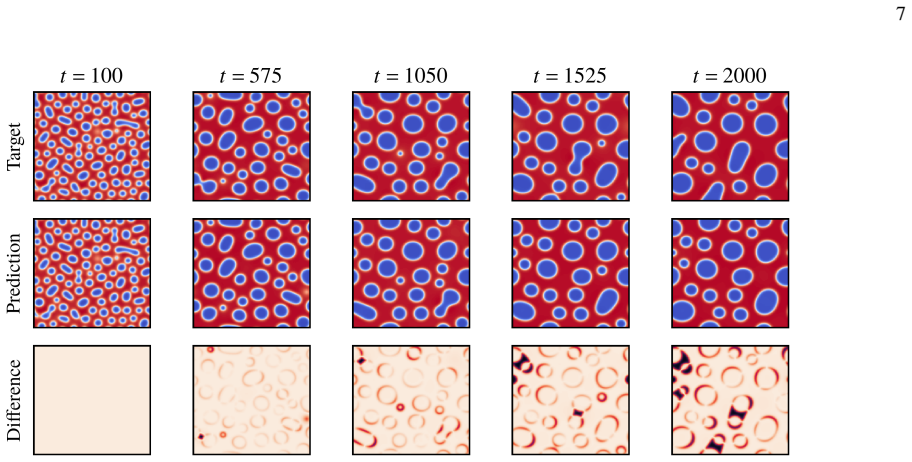
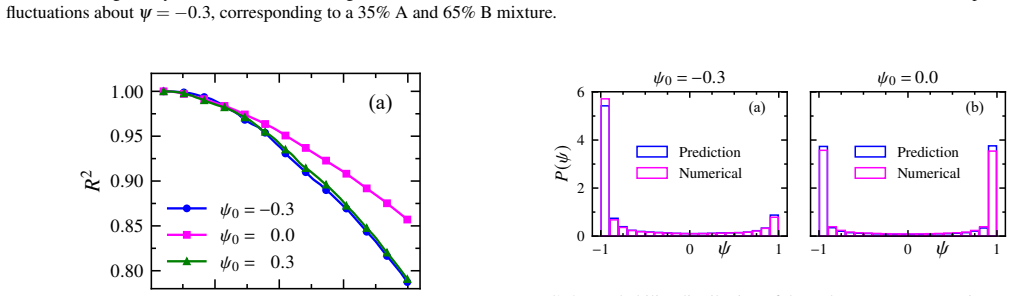
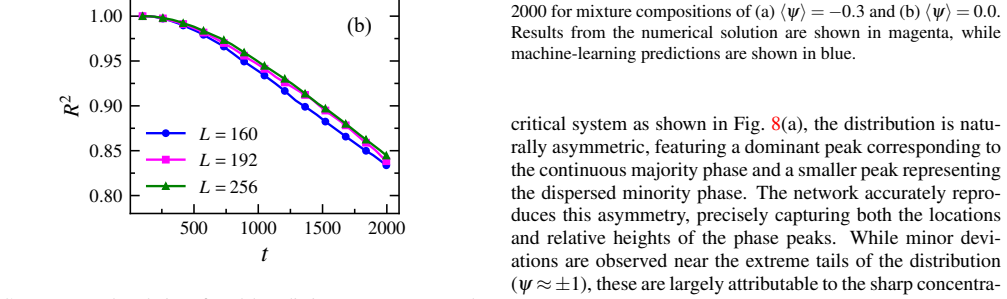
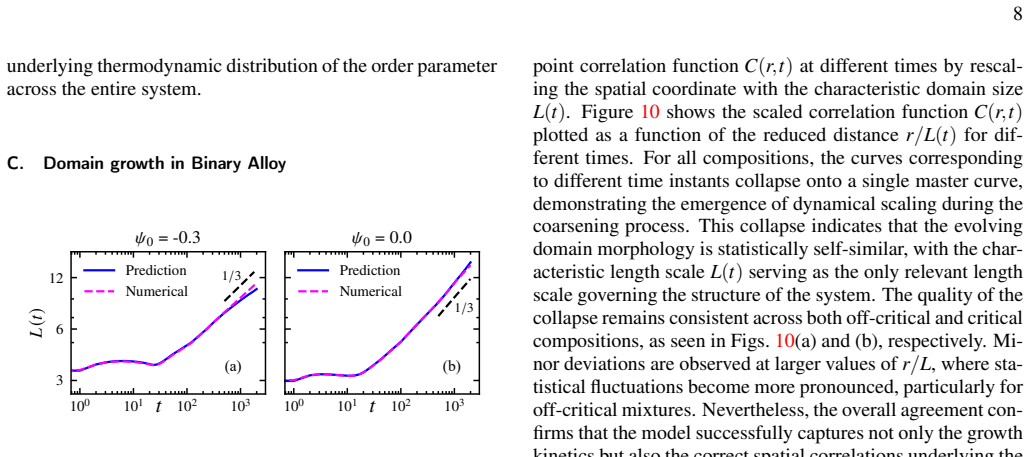
A physics-guided convolutional network predicts stable long-time phase separation while conserving mixture composition and reproducing the expected domain growth law.
A machine-rendered reading of the paper's core claim, the machinery that carries it, and where it could break.
Core claim
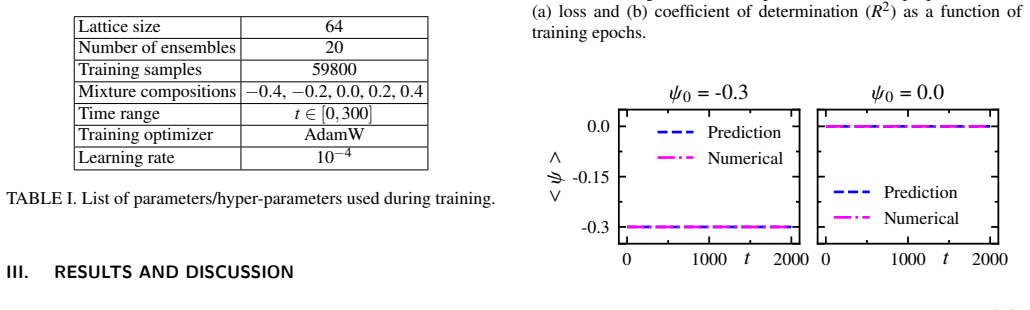
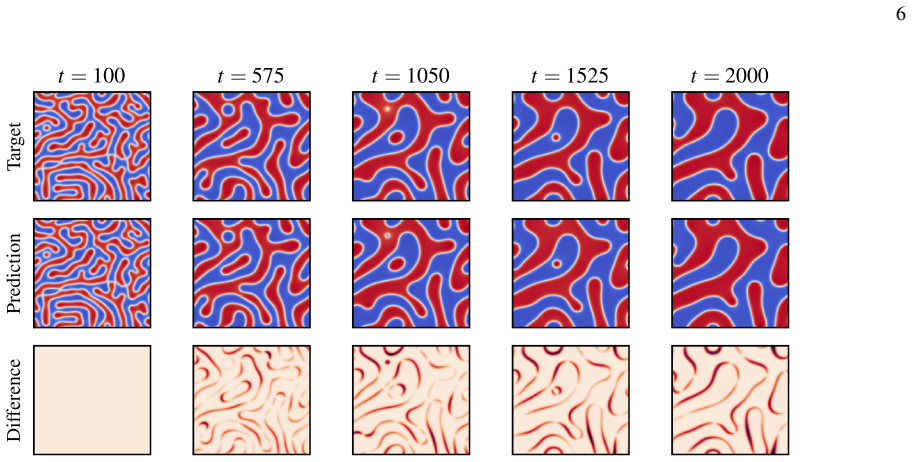
An attention-based physics-guided convolutional neural network, trained to map current microstructure to the next time step under Cahn-Hilliard kinetics, yields stable multi-step forecasts that maintain the global integral of the order parameter for both critical and off-critical quenches and produce domain-size growth consistent with the Lifshitz-Slyozov t to the one-third law.
What carries the argument
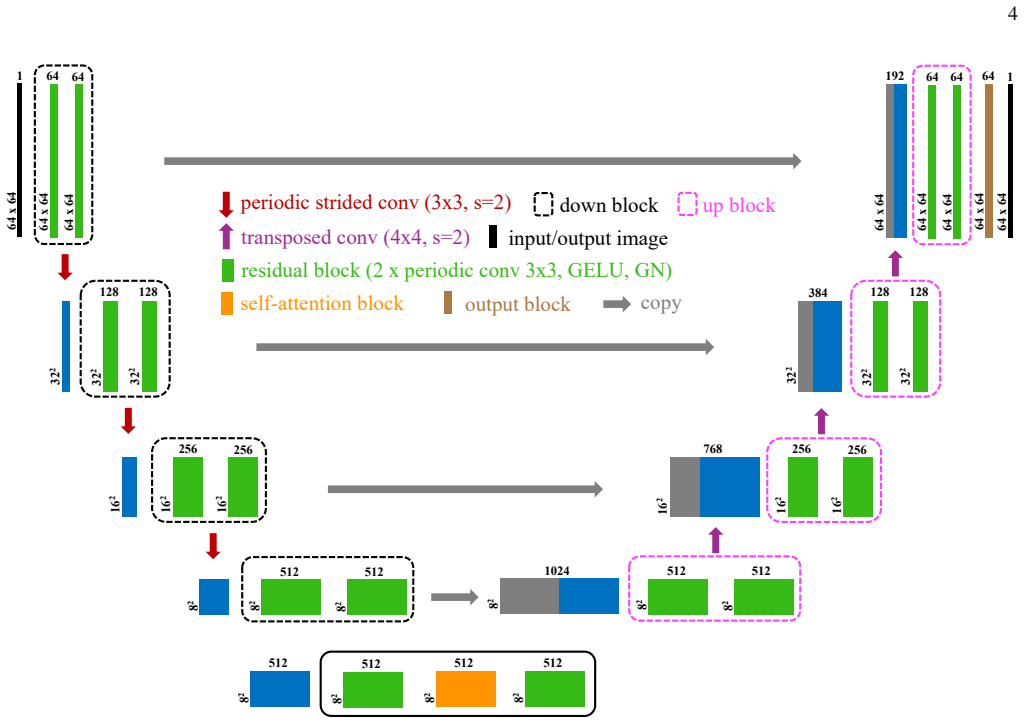
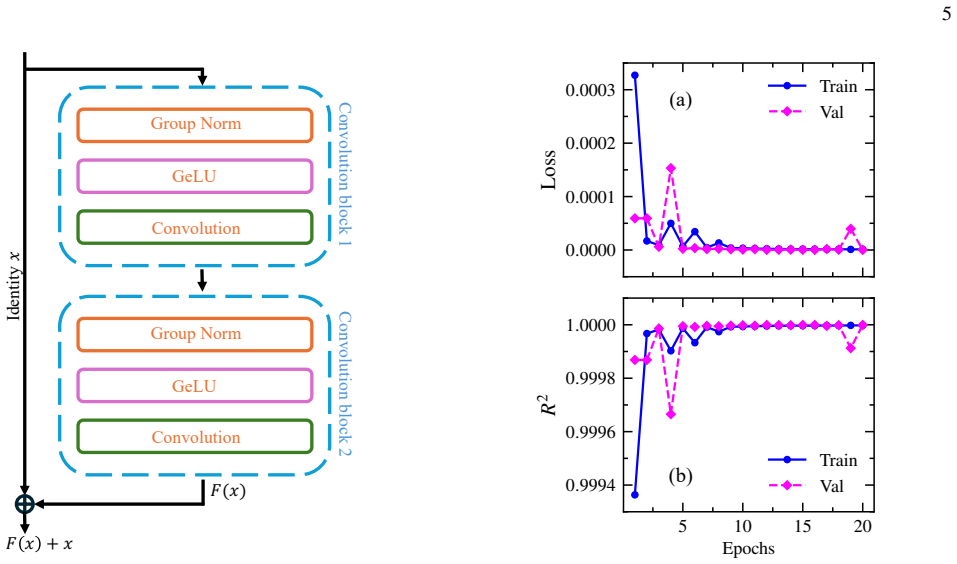
Attention-based physics-guided convolutional neural network that embeds conservation of the order-parameter integral into the architecture and loss to guide learning of the evolution operator.
If this is right
- The surrogate replaces costly PDE integration for extended simulations of phase separation in conserved systems.
- Domain-size evolution follows the classical scaling law without separate enforcement of the growth exponent.
- The same architecture handles both symmetric 50-50 and asymmetric off-critical initial mixtures.
- Predictions remain accurate across the full coarsening regime once trained on short trajectories.
Where Pith is reading between the lines
- The same physics-guided structure might transfer to other conserved-order-parameter equations such as those in binary fluid mixtures or certain biological aggregation models.
- If the conservation property holds without explicit penalty terms, similar guidance could reduce data requirements for training on related dynamical systems.
- Extending the model to three spatial dimensions would test whether the attention mechanism continues to stabilize rollouts at higher computational cost.
Load-bearing premise
The physics guidance built into the network is enough by itself to keep the predicted composition fixed and to prevent instability during long rollouts, without needing extra explicit constraints or post-processing.
What would settle it
Running the trained model on an unseen initial condition for thousands of time steps and measuring either a drift larger than numerical tolerance in the spatially averaged order parameter or a domain-growth exponent clearly different from one-third would falsify the central claim.
Figures
read the original abstract
The spatiotemporal evolution of many physical, chemical, and biological systems is described by nonlinear partial differential equations (PDEs). Recently, deep neural network-based surrogate models have gained increasing interest as efficient alternatives to computationally expensive traditional numerical solvers. In this work, we propose an attention-based, physics-guided convolutional neural network as a surrogate model to learn the microstructural evolution of such systems. We train the model to accurately predict the full time-evolution of phase separation in binary mixtures governed by the Cahn-Hilliard equation. We show that predictions from our trained surrogate model remain stable and accurate over long-time rollouts for both critical and off-critical mixtures and preserve the mixture composition throughout evolution. We also show that our model accurately captures the growth of domain size and is consistent with the Lifshitz-Slyozov domain-growth law. The prediction results demonstrate the effectiveness of the proposed framework for modeling systems with conserved kinetics and can be extended to other complex dynamical systems.
Editorial analysis
A structured set of objections, weighed in public.
Referee Report
Summary. The manuscript proposes an attention-based physics-guided convolutional neural network (CNN) surrogate for the Cahn-Hilliard equation describing phase separation in binary mixtures. The central claims are that the trained model produces stable, accurate long-time rollouts for both critical and off-critical compositions, strictly preserves mixture composition without drift, and yields domain-size growth consistent with the Lifshitz-Slyozov scaling law.
Significance. If the quantitative results and conservation properties hold under the reported training regime, the work would provide a concrete empirical demonstration that physics-guided attention mechanisms can enforce conservation constraints in long-horizon PDE surrogates without post-hoc corrections. This would be a useful data point for the design of stable neural surrogates in materials modeling and other conserved-order-parameter systems.
major comments (2)
- [Abstract, §3] Abstract and §3 (model description): no quantitative error metrics, training hyperparameters, or ablation results are supplied to support the claims of stability, composition preservation, and Lifshitz-Slyozov consistency; without these, it is impossible to assess whether the reported agreement is load-bearing or post-hoc.
- [§4] §4 (results): the manuscript must demonstrate that the physics-guidance term (whatever its precise form) is the causal factor preventing composition drift, rather than implicit regularization from the training data distribution; a controlled ablation removing the guidance term is required to substantiate the weakest assumption.
minor comments (2)
- [§2] Notation for the attention mechanism and the precise form of the physics loss should be introduced with an equation number in §2 or §3 for reproducibility.
- [Figures] Figure captions should explicitly state the time horizon (in dimensionless units) and the number of independent rollouts shown.
Simulated Author's Rebuttal
We thank the referee for their constructive comments. We address each major point below and will incorporate the requested clarifications and experiments in the revised manuscript.
read point-by-point responses
-
Referee: [Abstract, §3] Abstract and §3 (model description): no quantitative error metrics, training hyperparameters, or ablation results are supplied to support the claims of stability, composition preservation, and Lifshitz-Slyozov consistency; without these, it is impossible to assess whether the reported agreement is load-bearing or post-hoc.
Authors: We agree that quantitative support should be more prominent in the abstract and model description. Although §4 presents the long-time rollout results, we will revise the abstract to include explicit quantitative metrics (e.g., composition drift bounds and domain-growth exponent agreement) and add the key training hyperparameters and a concise summary of supporting ablations to §3. revision: yes
-
Referee: [§4] §4 (results): the manuscript must demonstrate that the physics-guidance term (whatever its precise form) is the causal factor preventing composition drift, rather than implicit regularization from the training data distribution; a controlled ablation removing the guidance term is required to substantiate the weakest assumption.
Authors: The referee correctly notes that an explicit ablation is needed to isolate the effect of the physics-guidance term. The current §4 shows conservation only with the term present; we will add a controlled ablation in the revised manuscript that trains an otherwise identical architecture without the guidance term and reports the resulting composition drift, thereby confirming causality. revision: yes
Circularity Check
No significant circularity identified
full rationale
The paper presents an empirical surrogate model (attention-based physics-guided CNN) trained to reproduce Cahn-Hilliard evolution and then validates long-time rollouts for stability, composition preservation, and consistency with the external Lifshitz-Slyozov t^{1/3} growth law. No derivation chain, uniqueness theorem, or ansatz is invoked that reduces by construction to fitted parameters or self-citations; the reported agreement is an external benchmark check rather than a tautological renaming or self-definition. The central claim therefore remains self-contained against independent physical knowledge.
Axiom & Free-Parameter Ledger
Reference graph
Works this paper leans on
-
[1]
Hohenberg and Bertrand I
Pierre C. Hohenberg and Bertrand I. Halperin , title =. Reviews of Modern Physics , volume =. 1977 , doi =
1977
-
[2]
Evans , title =
Lawrence C. Evans , title =. 2010 , edition =
2010
-
[3]
Cahn and John E
John W. Cahn and John E. Hilliard , title =. Journal of Chemical Physics , volume =. 1958 , doi =
1958
-
[4]
Keller and Lee A
Evelyn F. Keller and Lee A. Segel , title =. Journal of Theoretical Biology , volume =. 1970 , doi =
1970
-
[5]
Painter , title =
Thomas Hillen and Kevin J. Painter , title =. Journal of Mathematical Biology , volume =. 2009 , doi =
2009
-
[6]
Machine learning based prediction of phase ordering dynamics , volume =. Chaos , author =. 2023 , pages =. doi:10.1063/5.0156611 , number =
-
[7]
Graph neural network for prediction of phase-ordering kinetics , volume =. Chaos , author =. 2025 , pages =. doi:10.1063/5.0273728 , number =
-
[8]
2024 , eprint=
Mass-preserving Spatio-temporal adaptive PINN for Cahn-Hilliard equations with strong nonlinearity and singularity , author=. 2024 , eprint=
2024
-
[9]
Jagtap, A. D. and Kharazmi, E. and Karniadakis, G. E. , year =. Conservative physics-informed neural networks on discrete domains for conservation laws: Applications to forward and inverse problems , volume =. doi:10.1016/j.cma.2020.113028 , journal =
-
[10]
An Improved Causal Physics-Informed Neural Network Solution of the One-Dimensional Cahn--Hilliard Equation , volume =. Appl. Sci. , author =. 2025 , pages =. doi:10.3390/app15168863 , number =
-
[11]
Mattey, R. and Ghosh, S. , year =. A novel sequential method to train physics informed neural networks for Allen Cahn and Cahn Hilliard equations , volume =. doi:10.1016/j.cma.2021.114474 , journal =
-
[12]
Geng, Y. and Teng, Y. and Wang, Z. and Ju, L. , year =. A deep learning method for the dynamics of classic and conservative Allen--Cahn equations based on fully-discrete operators , volume =. doi:10.1016/j.jcp.2023.112589 , journal =
-
[13]
Machine-learning-based data-driven discovery of nonlinear phase-field dynamics , volume =. Phys. Rev. E , author =. 2022 , pages =. doi:10.1103/PhysRevE.106.065303 , number =
-
[14]
An improved data-free surrogate model for solving partial differential equations using deep neural networks , volume =. Sci. Rep. , author =. 2021 , pages =. doi:10.1038/s41598-021-99037-x , number =
-
[15]
Physics-informed machine learning , volume =. Nat. Rev. Phys. , author =. 2021 , pages =. doi:10.1038/s42254-021-00314-5 , number =
-
[16]
Geng, Y. and Burkovska, O. and Ju, L. and Zhang, G. and Gunzburger, M. , year =. An end-to-end deep learning method for solving nonlocal Allen--Cahn and Cahn--Hilliard phase-field models , volume =. doi:10.1016/j.cma.2024.117721 , journal =
-
[17]
Accelerating phase-field-based microstructure evolution predictions via surrogate models trained by machine learning methods , volume =. npj Comput. Mater. , author =. 2021 , pages =. doi:10.1038/s41524-020-00471-8 , number =
-
[18]
Simulating the Cahn--Hilliard--Hele--Shaw system via a deep neural operator framework , volume =. J. Mech. Sci. Technol. , author =. 2025 , pages =. doi:10.1007/s12206-025-1026-3 , number =
-
[19]
He, J. and Li, X. and Zhu, H. , year =. An adaptive discrete physics-informed neural network method for solving the Cahn--Hilliard equation , volume =. doi:10.1016/j.enganabound.2023.06.031 , journal =
-
[20]
Sun, L. and Gao, H. and Pan, S. and Wang, J.-X. , year =. Surrogate modeling for fluid flows based on physics-constrained deep learning without simulation data , volume =. doi:10.1016/j.cma.2019.112732 , journal =
-
[21]
Dwivedi, V. and Srinivasan, B. , year =. Physics Informed Extreme Learning Machine (PIELM)–A rapid method for the numerical solution of partial differential equations , volume =. doi:10.1016/j.neucom.2019.12.099 , journal =
-
[22]
Raissi, M. and Perdikaris, P. and Karniadakis, G. E. , year =. Physics-informed neural networks: A deep learning framework for solving forward and inverse problems involving nonlinear partial differential equations , volume =. doi:10.1016/j.jcp.2018.10.045 , journal =
-
[23]
2009 , doi =
Kinetics of. 2009 , doi =
2009
-
[24]
Theory of phase-ordering kinetics , author=. Advances in Physics , volume=. 2002 , publisher=. doi:https://doi.org/10.1080/00018739400101505 , number=
-
[25]
Onuki, Akira , year =. Phase
-
[26]
Prediction of aerodynamic flow fields using convolutional neural networks , volume =. Comput. Mech. , author =. 2019 , pages =. doi:10.1007/s00466-019-01740-0 , number =
-
[27]
Deep Fluids: A Generative Network for Parameterized Fluid Simulations , volume =. Comput. Graph. Forum , author =. 2019 , pages =. doi:10.1111/cgf.13619 , number =
-
[28]
Zhu, Y. and Zabaras, N. and Koutsourelakis, P.-S. and Perdikaris, P. , year =. Physics-constrained deep learning for high-dimensional surrogate modeling and uncertainty quantification without labeled data , volume =. doi:10.1016/j.jcp.2019.05.024 , journal =
-
[29]
Predictions of turbulent shear flows using deep neural networks , volume =. Phys. Rev. Fluids , author =. 2019 , pages =. doi:10.1103/PhysRevFluids.4.054603 , number =
-
[30]
Recurrent neural networks for dynamical systems: Applications to ordinary differential equations, collective motion, and hydrological modeling , volume =. Chaos , author =. 2023 , pages =. doi:10.1063/5.0088748 , number =
-
[31]
Latent Space Physics: Towards Learning the Temporal Evolution of Fluid Flow , volume =. Comput. Graph. Forum , author =. 2019 , pages =. doi:10.1111/cgf.13620 , number =
-
[32]
International Conference on Learning Representations , year=
Fourier Neural Operator for Parametric Partial Differential Equations , author=. International Conference on Learning Representations , year=
-
[33]
Learning nonlinear operators via DeepONet based on the universal approximation theorem of operators , volume =. Nat. Mach. Intell. , author =. 2021 , pages =. doi:10.1038/s42256-021-00302-5 , number =
-
[34]
Temporal neural operator for modeling time-dependent physical phenomena , volume =. Sci. Rep. , author =. 2025 , pages =. doi:10.1038/s41598-025-16922-5 , number =
-
[35]
When and why PINNs fail to train: A neural tangent kernel perspective
Wang, S. and Yu, X. and Perdikaris, P. , year =. When and why PINNs fail to train: A neural tangent kernel perspective , volume =. doi:10.1016/j.jcp.2021.110768 , journal =
-
[36]
Krishnapriyan, A. S. and Gholami, A. and Zhe, S. and Kirby, R. M. and Mahoney, M. W. , year =. Characterizing possible failure modes in physics-informed neural networks , doi =. 2109.01050 , archivePrefix =
-
[37]
Understanding and mitigating gradient flow pathologies in physics-informed neural networks , volume =. SIAM J. Sci. Comput. , author =. 2021 , pages =. doi:10.1137/20M1318043 , number =
-
[38]
Ronneberger, Olaf and Fischer, Philipp and Brox, Thomas , month = may, year =. U-. doi:10.48550/arXiv.1505.04597 , urldate =
work page internal anchor Pith review Pith/arXiv arXiv doi:10.48550/arxiv.1505.04597
-
[39]
Jha, D. and Smedsrud, P. H. and Riegler, M. A. and Johansen, D. and de Lange, T. and Halvorsen, P. and Johansen, H. D. , year =. ResUNet++: An Advanced Architecture for Medical Image Segmentation , doi =. 1911.07067 , archivePrefix =
arXiv 1911
discussion (0)
Sign in with ORCID, Apple, or X to comment. Anyone can read and Pith papers without signing in.