REVIEW 4 major objections 6 minor 59 references
Geometric Contact Flows: Contactomorphisms for Dynamics and Control
T0 review · 4 major / 6 minor · reviewed 2026-08-15 · deepseek-v4-flash
Pith's one-line read Geometric Contact Flows claims that contactomorphisms, by preserving the contact form, let a latent contact Hamiltonian dynamics reconstruct dissipative second-order systems and steer generalization toward the data manifold.
desk verdict Genuinely new contact-geometric learning framework with real robot demos, but the headline gains are not yet controlled because the latent action coordinate s is underdetermined and withheld from baselines; send to review with a request to fix the s-lift and the Eq. (8) sign. read the letter →
The pith
A machine-rendered reading of the paper's core claim, the machinery that carries it, and where it could break.
The reading
What carries the argument
The load-bearing object is the contact Hamiltonian vector field on the canonically coordinated contact manifold $T^*\mathbb{R}^d\times\mathbb{R}$ with state $\{q,p,s\}$, whose local equations are $\dot q=\partial H/\partial p$, $\dot p=-\partial H/\partial q-p\,\partial H/\partial s$, and $\dot s=p^\top\partial H/\partial p-H$; here $s$ is the Lagrangian action and $H$'s dependence on $s$ controls energy dissipation through Eq. (8). A contactomorphism is a diffeomorphism preserving the contact form up to a positive factor, and the paper builds each one as the time-$T$ composition of flows of learned contact Hamiltonians $H_{r_{\theta_k}}=\tfrac12 p^\top M_{\theta_k}(p)p+V_{\theta_k}(q)+F_{\theta_k}(q)s$, integrated with an analytically invertible contact splitting integrator. This machinery does two jobs: it transfers the latent system's stability or safety properties to the observed dynamics, and it supplies an ensemble whose disagreement defines an uncertainty metric that reshapes the latent geodesic problem, steering trajectories away from high-uncertainty, data-poor regions.
What would settle it
Run GCF on a damped mechanical system with a known non-unit-mass Hamiltonian, compute the $s$ series from Eq. (43), and compare it to the true mechanical action; if the reconstructed $s$ diverges from the true action and reconstruction error nonetheless stays low, the method is fitting the invented coordinate rather than the physics. A cleaner test: give the baselines the same estimated $s$ as input and see whether the reported 57% and 60% dynamic-time-warping margins survive.
Extended reading notes
Core claim
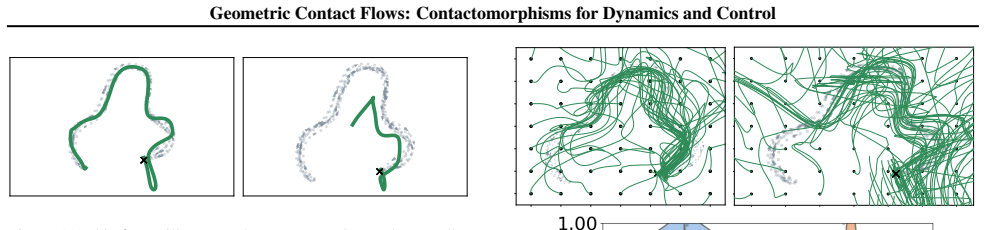
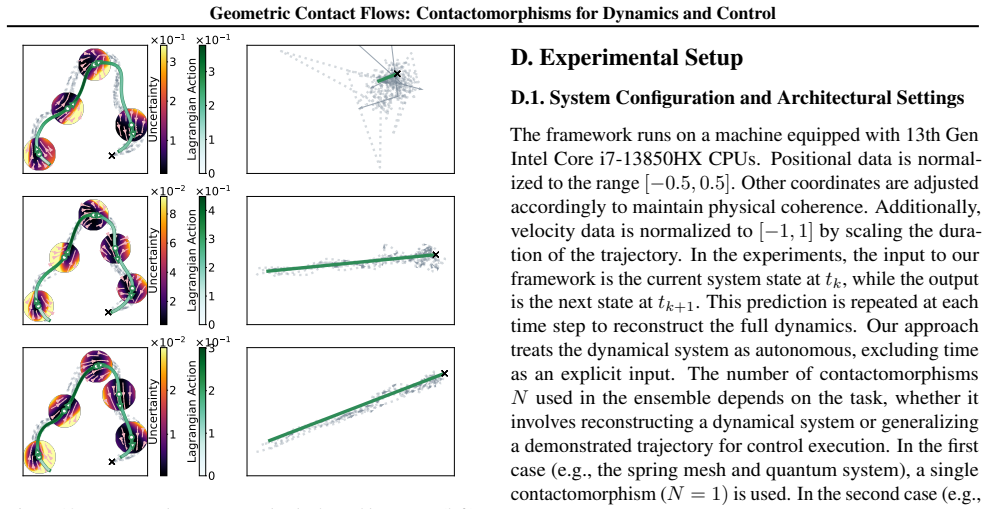
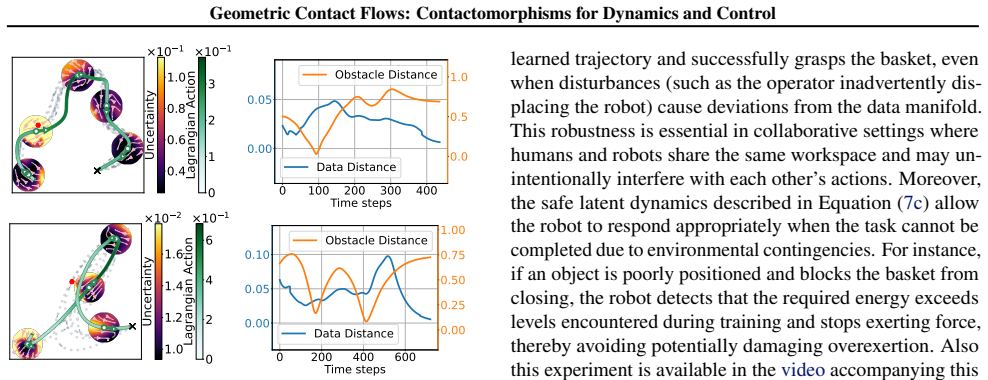
The core claim is that composing a latent contact Hamiltonian flow with an ensemble of learned contactomorphisms yields a model of non-conservative, second-order dynamics that is both accurate on the data support and stable outside it. In the paper's construction, the latent dynamics $\dot{z}=Z_{H_g}$ is chosen to encode desired behavior, such as periodic, stable, or safe motion, and the learned maps $\phi_{r_n}$ carry that behavior to the observed coordinates through $x(t)=\phi_r^{-1}\circ \phi_g(t)\circ \phi_r(x_0)$, so a long-horizon prediction needs only one forward and one inverse mapping. The paper argues that preserving the contact form is what keeps the ambient dynamics physically interpretable: the damping coefficient $\partial H_m/\partial s$ and the action $s$ retain their mechanical meaning, and the ensemble's variance, injected into the latent metric as an extra traversal cost, makes off-manifold predictions bend toward the data. On the evidence offered, this yields the reported error reductions and convergence rates, and on the robot tasks it produces a stable energy-consumption profile and a safety stop when the Lagrangian action reaches zero under unexpected loading.
Load-bearing premise
The argument depends on the unmeasured 'Lagrangian action' coordinate $s$ being faithfully reconstructed from the observed positions and velocities; if that reconstructed coordinate does not represent real energy exchange, the comparisons against methods that never receive $s$ are not controlled.
Editorial extensions
If this is right
- If the central claim is right, geometry alone, rather than hand-tuned losses, can bias a learned dynamics toward dissipative and even odd-dimensional phase spaces, since the action variable $s$ is part of the state.
- A model trained once with stable latent dynamics can reproduce a demonstrated robot skill under loading never seen during training at roughly the same energy expenditure, because the contact structure keeps the energy bookkeeping physically consistent.
- Ensemble uncertainty is not just a diagnostic but an active control signal, so predictions started outside the data support can be expected to converge back to the manifold rather than diverge.
- The reported reductions of 57% and 60% in dynamic-time-warping distance imply that on spring-mesh and quantum-dynamics benchmarks, the structure-preserving map extracts more usable signal from the same trajectories than the best baselines compared in the paper.
Reading between the lines
- Because the action variable $s$ is estimated from $(\mathbf{q},\dot{\mathbf{q}})$ rather than measured, a fair stress test would feed the same estimated $s$ to symplectic-style baselines or train GCF without it; the paper does not run this control, so part of the reported margin could reflect the extra input channel.
- The same uncertainty-as-cost construction could be repurposed for costs other than ensemble variance, such as predicted collision risk, actuator limits, or time-to-contact, without changing the optimization scheme in Eq. (18).
- If the contactomorphism ansatz behaves like a normal form, skills learned on one robot platform might transfer to another by re-estimating only the inertia-scaled momentum map, a conjecture the paper does not test.
- The sensitivity of the learned dynamics to the unspecified initial value $s_0$ in Eq. (44) is a natural ablation: on datasets with non-unit mass, if reconstruction error depends strongly on this constant, the latent action should be treated as an additional learned variable rather than a fixed preprocessing outcome.
Signed reviews
Editorial analysis
A structured set of objections, weighed in public.
Referee Report
Summary. The paper introduces Geometric Contact Flows (GCF), a framework for learning dissipative second-order dynamical systems from data. GCF couples a latent contact Hamiltonian model, chosen to encode properties such as stability or energy depletion, to the observed dynamics through an ensemble of learned contactomorphisms. The ensemble provides predictive uncertainty, which is used to reshape a Riemannian metric and guide trajectories toward the data manifold. Experiments are reported on a 60-dimensional spring mesh, a single-mode bosonic quantum system, two handwriting datasets (LASA and DigiLeTs), and two robotic manipulation tasks, with comparisons against EF, NCDS, HNN, DHNN, and MLP baselines. The paper claims a 57% DTWD reduction on the spring mesh, a 60% reduction on the quantum system, superior convergence to the data manifold on handwriting generalization, and successful energy-aware robot task execution.
Significance. The core idea is attractive and potentially significant for the learning-dynamics community: it brings the odd-dimensional contact Hamiltonian formalism, with its physically meaningful action variable, into a neural-network framework that supports uncertainty quantification and control via metric reshaping. The paper is also honest in its reporting: error bars, ablations (contactomorphism vs diffeomorphism, latent loss weight, ensemble vs single map), and architectural details are provided, and the flow-based contactomorphisms are analytically invertible. If the empirical claims survive scrutiny, the framework would be a meaningful advance over first-order diffeomorphism-based methods and over Hamiltonian networks lacking a dissipation coordinate. However, the current validation is undermined by the underdetermined construction of the canonical-coordinate lift, by an internal sign inconsistency in the theoretical energy law, and by at least one headline claim that is contradicted by the paper's own tables. These issues are fixable within the scope of the manuscript, but they must be addressed before the central claims can be accepted.
major comments (4)
- [App. D.3, Eqs. (43)–(44)] The canonical-coordinate lift used in every experiment is underdetermined and internally inconsistent. Equation (43) is a second-order ODE for s, so a well-posed initial value problem requires both s0 and sdot0. The paper lists sdot0 = qdot0^T qdot0 and imposes sddot0 = 0, but does not specify s0; conversely, if s0 is chosen freely, then sddot0 is determined by Eq. (43) and cannot be imposed independently. Moreover, with the stated sdot0 the first term in Eq. (43) vanishes identically, so the condition sddot0 = 0 reduces to 2 qdot0^T qddot0 = 0, which is not satisfied by generic trajectories. In addition, the parametrization beta(q) = T - t introduces explicit time dependence into the 'Hamiltonian' (38) and makes s a time-to-go proxy, which conflicts with the autonomy assumption stated in App. D.1. Because the baselines EF, NCDS, and DHNN never receive s, the headline 57% and 60% DTWD reductions may reflect the presence of this extra input rather than contact geometry. The contactomorphism-versus-diffeomorphism ablation does not resolve this, since both variants receive s. This issue is load-bearing for the central empirical claim of the paper.
- [Sec. 3, Eq. (8)] Equation (8) has a sign error. For the contact Hamiltonian vector field written in Eq. (31), a direct computation gives dH/dt = -H * dH/ds, so the correct energy law is H(t) = H(0) * exp(-∫ dH/ds dτ). Equation (8) displays the opposite sign, and it is also contradicted by the paper's own Eq. (40) in App. D.3, which uses the negative sign. The text immediately after Eq. (8) uses the displayed expression to argue that the '+s' term in Eq. (7b) depletes the system energy; with the sign as written, the opposite behavior would follow. This internal inconsistency affects the theoretical motivation for the latent Hamiltonians HgB and HgC and should be corrected.
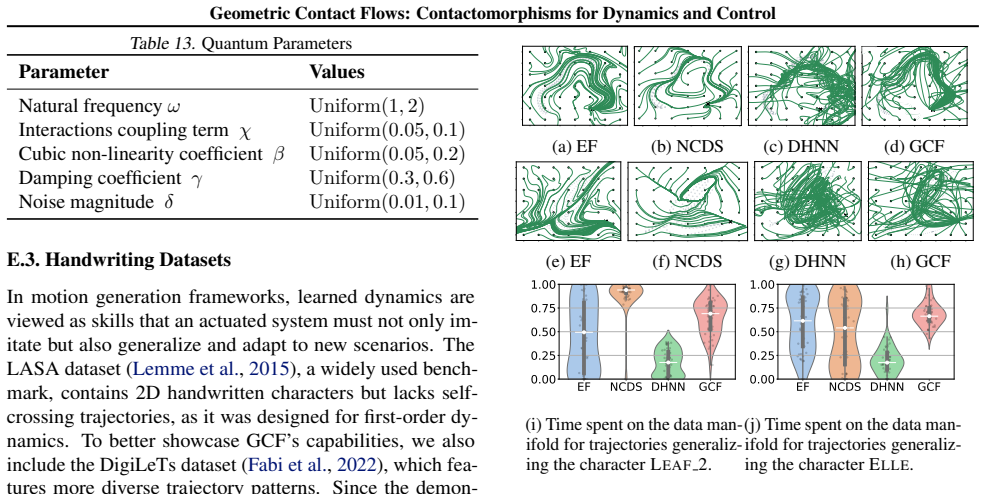
- [Sec. 6, Table 4 and Fig. 6] The claim that GCF achieves 'the highest average convergence ratio and lowest variance' on the handwriting generalization tests is not supported by the reported numbers. In Table 4, on LEAF 2, NCDS achieves 0.94 ± 0.19 while GCF achieves 0.69 ± 0.19; on ELLE, GCF achieves 0.66 ± 0.12, which is within one standard deviation of EF's 0.61 ± 0.30. The conclusion in the text that 'GCF shows greater reliability, ensuring all the dynamics predictions for the two characters converge to the data manifold' is too strong given these overlapping values. The authors should either restrict the claim to the cases where the advantage is statistically meaningful or add the appropriate significance tests.
- [Sec. 5, Eq. (18)] The uncertainty-aware control mechanism is not operationalized. The text states that trajectories are steered by a control input u obtained from the optimal control problem (18), but no solver, discretization scheme, cost weight for sigma_z, or stopping criteria are provided, and no algorithm is given in the appendix. The generalization experiments in App. E.3 and the ensemble ablation in Table 16 depend on this mechanism, since the ensemble's uncertainty is claimed to reshape the latent metric. Without a precise specification, the convergence-to-data-manifold results are not reproducible, and the contribution of the uncertainty-aware geodesics cannot be separated from the behavior of the latent dynamics alone.
minor comments (6)
- [Throughout] The acronym is inconsistent: the abstract uses 'GFC' while the main text uses 'GCF'; please choose one spelling and use it consistently.
- [Sec. 6, Table 3] The two rows in Table 3 are not labeled with the character names; the corresponding rows in Table 14 of App. E.3 should be reproduced or referenced so the reader knows which characters are being compared.
- [App. D.3] The notation beta(q) = T - t is misleading because T - t is a function of time, not of q; this should be clarified and reconciled with the statement in App. D.1 that the model treats the dynamical system as autonomous.
- [App. D.3, Eqs. (39)–(41)] The derivation of Eq. (41) by substituting Eq. (39) into Eq. (40) is hard to follow and appears circular as written; please spell out the substitution and the role of H0, or add a reference for this step.
- [Sec. 6] The baselines enumeration lists EF, NCDS, HNN, and DHNN but Tables 1 and 2 also report MLP; MLP should be included in the enumeration for completeness.
- [Fig. 5] The caption says 'From top to bottom rows, EF, NCDS, DHNN and GCF methods' but the figure is arranged as a 4-row-by-2-column grid; please clarify what the two columns represent.
Circularity Check
No significant circularity: GCF's reconstructions are supervised fits benchmarked externally; the s-lift and uncertainty-guided convergence are design choices, not circular reductions.
full rationale
The paper's derivation chain does not reduce to its inputs by construction. The central reconstruction claims are produced by a supervised loss (Eq. 12) that compares predicted ambient and latent trajectories against the training data, and the paper explicitly decouples the latent dynamics choice from reconstruction quality: 'The choice of the latent dynamics does not affect the reconstruction of the target dynamics on the data support, but instead serves as an inductive bias to guide the generalization' (Sec. 4). The contactomorphism implementation is validated against external contact-transformation conditions from Bravetti et al. (2017) (App. B.3), and no load-bearing uniqueness theorem or fitted parameter is renamed as a prediction. The flagged weaknesses are real but are not circularity: App. D.3 defines the Lagrangian action by integrating Eq. (43) with initial conditions (Eq. 44) that list 's0' without specifying its value, making the s-lift underdetermined, and the handwriting potential β(q)=T−t makes s a time-to-go proxy that baselines never receive; this is an identifiability and experimental-control risk, not a derived quantity that equals an input. Similarly, the uncertainty-aware geodesic objective (Eq. 18) explicitly minimizes ensemble variance, and Table 4's convergence-to-data-manifold metric is aligned with that objective; this is a self-consistent controller evaluation, not a circular derivation. A sign inconsistency between Eq. (8) (positive exponent) and Eq. (40) (negative exponent) is a correctness issue, not circularity. Overall, the main experimental claims are self-contained supervised fits against external benchmarks, so no circular step meets the quote-and-reduction standard.
Assumptions & free parameters
free parameters (6)
- Latent loss weight wz =
0.01
- Contactomorphism flow duration tau and number of flows K =
tau = 0.2, K = 12
- RFF network hidden units nf =
200 (bandwidth 1, tanh bound [-2, 2])
- Ensemble size N =
5 for handwriting and robot, 1 for spring mesh and quantum
- Initial Lagrangian action s0 =
Not specified (Eq. 44)
- Potential parametrization beta(q) = T - t =
beta decreases linearly to zero over demonstration time
assumptions (5)
- standard math Contact Hamiltonian vector field (Eq. 31) with energy law \dot H = -H \partial H/\partial s, so H(t) = H(0) e^{-\int \partial H/\partial s dt}
- domain assumption Existence of a learned contactomorphism phi_r in the class of flows of Hamiltonians (11) mapping latent to target dynamics
- ad hoc to paper Data lift to canonical coordinates with unit mass, beta(q) = T - t, and s from Eq. (43) with initial conditions (44)
- domain assumption Ensemble disagreement across N networks is a calibrated uncertainty signal sigma_z
- domain assumption Optimal control (18)-(19) with implicit unit cost weights yields geodesics that avoid uncertainty and obstacles
Cite this review
Pith. "Pith review of Geometric Contact Flows: Contactomorphisms for Dynamics and Control." pith.science (2026). https://pith.science/paper/3F5FYRZ7
@misc{pith2026250617868,
  author       = {Pith},
  title        = {Pith review of: Geometric Contact Flows: Contactomorphisms for Dynamics and Control},
  year         = {2026},
  howpublished = {\url{https://pith.science/paper/3F5FYRZ7}},
  note         = {Machine review of arXiv:2506.17868}
}
read the original abstract
Accurately modeling and predicting complex dynamical systems, particularly those involving force exchange and dissipation, is crucial for applications ranging from fluid dynamics to robotics, but presents significant challenges due to the intricate interplay of geometric constraints and energy transfer. This paper introduces Geometric Contact Flows (GFC), a novel framework leveraging Riemannian and Contact geometry as inductive biases to learn such systems. GCF constructs a latent contact Hamiltonian model encoding desirable properties like stability or energy conservation. An ensemble of contactomorphisms then adapts this model to the target dynamics while preserving these properties. This ensemble allows for uncertainty-aware geodesics that attract the system's behavior toward the data support, enabling robust generalization and adaptation to unseen scenarios. Experiments on learning dynamics for physical systems and for controlling robots on interaction tasks demonstrate the effectiveness of our approach.
Figures


Figures from the paper (18 more)








Reference graph
Works this paper leans on
-
[1]
write newline
" write newline "" before.all 'output.state := FUNCTION n.dashify 't := "" t empty not t #1 #1 substring "-" = t #1 #2 substring "--" = not "--" * t #2 global.max substring 't := t #1 #1 substring "-" = "-" * t #2 global.max substring 't := while if t #1 #1 substring * t #2 global.max substring 't := if while FUNCTION format.date year duplicate empty "emp...
-
[2]
Abraham, R. and Marsden, J. E. Foundations of mechanics. Number 364. American Mathematical Soc., 2008
work page 2008
-
[3]
Arnold, V. Sur la g \'e om \'e trie diff \'e rentielle des groupes de lie de dimension infinie et ses applications \`a l'hydrodynamique des fluides parfaits. In Annales de l'institut Fourier, volume 16, pp.\ 319--361, 1966
work page 1966
-
[4]
Reactive motion generation on learned R iemannian manifolds
Beik-Mohammadi, H., Hauberg, S., Arvanitidis, G., Neumann, G., and Rozo, L. Reactive motion generation on learned R iemannian manifolds. The International Journal of Robotics Research (IJRR), 42 0 (10): 0 729--754, 2023
work page 2023
-
[5]
Representation learning: A review and new perspectives
Bengio, Y., Courville, A., and Vincent, P. Representation learning: A review and new perspectives. IEEE transactions on pattern analysis and machine intelligence, 35 0 (8): 0 1798--1828, 2013
2013
-
[6]
Berndt, D. J. and Clifford, J. Using dynamic time warping to find patterns in time series. In Proceedings of the 3rd international conference on knowledge discovery and data mining, pp.\ 359--370, 1994
work page 1994
-
[7]
Blair, D. E. and Blair, D. Riemannian geometry of contact and symplectic manifolds, volume 203. Springer, 2010
work page 2010
-
[8]
Contact geometry and thermodynamics
Bravetti, A. Contact geometry and thermodynamics. International Journal of Geometric Methods in Modern Physics, 16 0 (supp01): 0 1940003, 2019
work page 2019
Show all 59 references
-
[9]
Contact H amiltonian mechanics
Bravetti, A., Cruz, H., and Tapias, D. Contact H amiltonian mechanics. Annals of Physics, 376: 0 17--39, 2017
2017
-
[10]
Symplectic neural flows for modeling and discovery
Canizares, P., Murari, D., Sch \"o nlieb, C.-B., Sherry, F., and Shumaylov, Z. Symplectic neural flows for modeling and discovery. arXiv preprint arXiv:2412.16787, 2024
2024
-
[11]
T., Rubanova, Y., Bettencourt, J., and Duvenaud, D
Chen, R. T., Rubanova, Y., Bettencourt, J., and Duvenaud, D. Neural ordinary differential equations. In Neural Information Processing Systems (NeurIPS), pp.\ 6572--6583, 2018
2018
-
[12]
Neural symplectic form: Learning hamiltonian equations on general coordinate systems
Chen, Y., Matsubara, T., and Yaguchi, T. Neural symplectic form: Learning hamiltonian equations on general coordinate systems. In Neural Information Processing Systems (NeurIPS), volume 34, pp.\ 16659--16670, 2021. URL https://proceedings.neurips.cc/paper_files/paper/2021/file...
2021
-
[13]
Finsler geometry is just R iemannian geometry without the quadratic equation
Chern, S.-S. Finsler geometry is just R iemannian geometry without the quadratic equation. Notices of the American Mathematical Society, 43 0 (9): 0 959--963, 1996
1996
-
[14]
M., Cruz, H., and Marmo, G
Ciaglia, F. M., Cruz, H., and Marmo, G. Contact manifolds and dissipation, classical and quantum. Annals of Physics, 398: 0 159--179, 2018
2018
-
[15]
Contact H amiltonian mechanics
Cruz, H. Contact H amiltonian mechanics. an extension of symplectic H amiltonian mechanics. In Journal of Physics: Conference Series, volume 1071, pp.\ 012010. IOP Publishing, 2018
2018
-
[16]
Coherent R iemannian-geometric description of H amiltonian order and chaos with J acobi metric
Di Cairano, L., Gori, M., and Pettini, M. Coherent R iemannian-geometric description of H amiltonian order and chaos with J acobi metric. Chaos: An Interdisciplinary Journal of Nonlinear Science, 29 0 (12), 2019
2019
-
[17]
Fabi, S., Otte, S., Scholz, F., W \"u hrer, J., Karlbauer, M., and Butz, M. V. Extending the omniglot challenge: Imitating handwriting styles on a new sequential data set. IEEE Transactions on Cognitive and Developmental Systems, 15 0 (2): 0 896--903, 2022
2022
-
[18]
and Billard, A
Fichera, B. and Billard, A. Learning dynamical systems encoding non-linearity within space curvature. arXiv preprint arXiv:2403.11948, 2024
2024 arXiv
-
[19]
Necessary conditions for stability of diffeomorphisms
Franks, J. Necessary conditions for stability of diffeomorphisms. Transactions of the American Mathematical Society, 158 0 (2): 0 301--308, 1971
1971
-
[20]
A brief history of contact geometry and topology
Geiges, H. A brief history of contact geometry and topology. Expositiones Mathematicae, 19 0 (1): 0 25--53, 2001. ISSN 0723-0869. doi:https://doi.org/10.1016/S0723-0869(01)80014-1
2001 doi
-
[21]
An introduction to contact topology
Geiges, H. An introduction to contact topology. Cambridge Studies in Advanced Mathematics, 109, 2008
2008
-
[22]
Hamiltonian neural networks
Greydanus, S., Dzamba, M., and Yosinski, J. Hamiltonian neural networks. In Neural Information Processing Systems (NeurIPS), pp.\ 15379--15389, 2019
2019
-
[23]
Only B ayes should learn a manifold (on the estimation of differential geometric structure from data)
Hauberg, S. Only B ayes should learn a manifold (on the estimation of differential geometric structure from data). arXiv preprint arXiv:1806.04994, 2018
2018 arXiv
-
[24]
and Waldron, A
Herczeg, G. and Waldron, A. Contact geometry and quantum mechanics. Physics Letters B, 781: 0 312--315, 2018
2018
-
[25]
Learning neural contracting dynamics: Extended linearization and global guarantees
Jaffe, S., Davydov, A., Lapsekili, D., Singh, A., and Bullo, F. Learning neural contracting dynamics: Extended linearization and global guarantees. In Conference on Neural Information Processing Systems (NeurIPS), 2024. URL https://openreview.net/forum?id=YYnP3Xpv3y
2024
-
[26]
Jin, P., Zhang, Z., Zhu, A., Tang, Y., and Karniadakis, G. E. Sympnets: Intrinsic structure-preserving symplectic networks for identifying H amiltonian systems. Neural Networks, 132: 0 166--179, 2020
2020
-
[27]
Kholodenko, A. L. Applications of contact geometry and topology in physics. World Scientific, 2013
2013
-
[28]
T., Guo, M., Duijkeren, N
Le, A. T., Guo, M., Duijkeren, N. v., Rozo, L., Krug, R., Kupcsik, A. G., and Bürger, M. Learning forceful manipulation skills from multi-modal human demonstrations. In IEEE/RSJ International Conference on Intelligent Robots and Systems (IROS), pp.\ 7770--7777, 2021
2021
-
[29]
Lemme, A., Meirovitch, Y., Khansari-Zadeh, M., Flash, T., Billard, A., and Steil, J. J. Open-source benchmarking for learned reaching motion generation in robotics. Paladyn, Journal of Behavioral Robotics, 6 0 (1), 2015. URL http://doi.org/10.1515/pjbr-2015-0002
2015 doi
-
[30]
Neural canonical transformation with symplectic flows
Li, S.-H., Dong, C.-X., Zhang, L., and Wang, L. Neural canonical transformation with symplectic flows. Physical Review X, 10 0 (2): 0 021020, 2020
2020
-
[31]
and Mart \' nez, E
L \'o pez, C. and Mart \' nez, E. Sub-finslerian metric associated to an optimal control system. SIAM Journal on Control and Optimization, 39 0 (3): 0 798--811, 2000
2000
-
[32]
B., Hauberg, S., Arvanitidis, G., Figueroa, N., Neumann, G., and Rozo, L
Mohammadi, H. B., Hauberg, S., Arvanitidis, G., Figueroa, N., Neumann, G., and Rozo, L. Neural contractive dynamical systems. In International Conference on Learning Representations (ICLR), 2024. URL https://openreview.net/forum?id=iAYIRHOYy8
2024
-
[33]
Invariant variations problems
Noether, E. Invariant variations problems. Translation in Transport Theory and Statistical Physics, 1(3): 0 186--207, 1918. doi:https://doi.org/10.1080/00411457108231446
1918 doi
-
[34]
An extensible benchmark suite for learning to simulate physical systems
Otness, K., Gjoka, A., Bruna, J., Panozzo, D., Peherstorfer, B., Schneider, T., and Zorin, D. An extensible benchmark suite for learning to simulate physical systems. In Neural Information Processing Systems, Datasets and Benchmarks Track (Round 1), 2021. URL https://openrevie...
2021
-
[35]
and Schlehuber-Caissier, P
Perrin, N. and Schlehuber-Caissier, P. Fast diffeomorphic matching to learn globally asymptotically stable nonlinear dynamical systems. Systems & Control Letters, 96: 0 51--59, 2016
2016
-
[36]
Learning mesh-based simulation with graph networks
Pfaff, T., Fortunato, M., Sanchez-Gonzalez, A., and Battaglia, P. Learning mesh-based simulation with graph networks. In International Conference on Learning Representations (ICLR), 2021. URL https://openreview.net/forum?id=roNqYL0_XP
2021
-
[37]
The geometry of the group of symplectic diffeomorphism
Polterovich, L. The geometry of the group of symplectic diffeomorphism. Birkh \"a user, 2012
2012
-
[38]
and Recht, B
Rahimi, A. and Recht, B. Random features for large-scale kernel machines. In eural Information Processing Systems (NeurIPS), volume 20, 2007. URL https://proceedings.neurips.cc/paper_files/paper/2007/file/013a006f03dbc5392effeb8f18fda755-Paper.pdf
2007
-
[39]
A., Li, A., Fox, D., Boots, B., Ramos, F., and Ratliff, N
Rana, M. A., Li, A., Fox, D., Boots, B., Ramos, F., and Ratliff, N. Euclideanizing flows: Diffeomorphic reduction for learning stable dynamical systems. In Learning for Dynamics & Control Conference (L4DC), pp.\ 630--639. PMLR, 2020
2020
-
[40]
Contact skill imitation learning for robot-independent assembly programming
Scherzinger, S., Roennau, A., and Dillmann, R. Contact skill imitation learning for robot-independent assembly programming. In IEEE/RSJ International Conference on Intelligent Robots and Systems (IROS), pp.\ 4309--4316. IEEE, 2019
2019
-
[41]
Shafiullah, N. M. M., Rai, A., Etukuru, H., Liu, Y., Misra, I., Chintala, S., and Pinto, L. On bringing robots home. arXiv preprint arXiv:2311.16098, 2023
2023 arXiv
-
[42]
Silva, A. C. d. Lectures on symplectic geometry. Lecture Notes in Mathematics, 1764, 2001
2001
-
[43]
Diffeomorphic obstacle avoidance for contractive dynamical systems via implicit representations
Simmoteit, K.-J., Schillinger, P., and Rozo, L. Diffeomorphic obstacle avoidance for contractive dynamical systems via implicit representations. In Robotics: Science and Systems (R:SS), 2025
2025
-
[44]
A., de Le \'o n, M., Valc \'a zar, M
Simoes, A. A., de Le \'o n, M., Valc \'a zar, M. L., and de Diego, D. M. Contact geometry for simple thermodynamical systems with friction. Proceedings of the Royal Society A, 476 0 (2241): 0 20200244, 2020
2020
-
[45]
and Greydanus, S
Sosanya, A. and Greydanus, S. Dissipative H amiltonian neural networks: Learning dissipative and conservative dynamics separately. arXiv preprint arXiv:2201.10085, 2022
2022 arXiv
-
[46]
Decoder ensembling for learned latent geometries
Syrota, S., Moreno-Munoz, P., and Hauberg, S. Decoder ensembling for learned latent geometries. arXiv preprint arXiv:2408.07507, 2024
2024 arXiv
-
[47]
and Pickl, P
Tokasi, S. and Pickl, P. Symplectic reduction of classical mechanics on shape space. Foundations of Physics, 52 0 (5): 0 106, 2022
2022
-
[48]
Symplectic neural networks in T aylor series form for H amiltonian systems
Tong, Y., Xiong, S., He, X., Pan, G., and Zhu, B. Symplectic neural networks in T aylor series form for H amiltonian systems. Journal of Computational Physics, 437: 0 110325, 2021
2021
-
[49]
Geometric dynamics
Udri s te, C. Geometric dynamics. Southeast Asian Bulletin of Mathematics, 24: 0 313--322, 2000
2000
-
[50]
Finsler-Lagrange-Hamilton Structures Associated to Control Systems , pp.\ 233--243
Udri s te, C. Finsler-Lagrange-Hamilton Structures Associated to Control Systems , pp.\ 233--243. Springer Netherlands, Dordrecht, 2003. ISBN 978-94-017-0405-2. doi:10.1007/978-94-017-0405-2_26. URL https://doi.org/10.1007/978-94-017-0405-2_26
2003 doi
-
[51]
and Udriste, A
Udriste, C. and Udriste, A. From flows and metrics to dynamics. arXiv preprint math/0007059, 2000
2000 arXiv
-
[52]
Towards physics-informed deep learning for turbulent flow prediction
Wang, R., Kashinath, K., Mustafa, M., Albert, A., and Yu, R. Towards physics-informed deep learning for turbulent flow prediction. In International conference on knowledge discovery & data mining (KDD), pp.\ 1457--1466, 2020
2020
-
[53]
Quantum theory, groups and representations, volume 4
Woit, P., Woit, and Bartolini. Quantum theory, groups and representations, volume 4. Springer, 2017
2017
-
[54]
and Wang, R
Yu, R. and Wang, R. Learning dynamical systems from data: An introduction to physics-guided deep learning. Proceedings of the National Academy of Sciences, 121 0 (27): 0 e2311808121, 2024
2024
-
[55]
Topics in contact H amiltonian systems: analytical and numerical perspectives
Zadra, F. Topics in contact H amiltonian systems: analytical and numerical perspectives . PhD thesis, University of Groningen, 2023
2023
-
[56]
B., and Rozo, L
Zhang, J., Mohammadi, H. B., and Rozo, L. Learning R iemannian stable dynamical systems via diffeomorphisms. In Conference on Robot Learning (CoRL), 2022
2022
-
[57]
Diffeomorphic transforms for generalised imitation learning
Zhi, W., Lai, T., Ott, L., and Ramos, F. Diffeomorphic transforms for generalised imitation learning. In Learning for Dynamics & Control Conference (L4DC), pp.\ 508--519, 2022
2022
-
[58]
D., Dey, B., and Chakraborty, A
Zhong, Y. D., Dey, B., and Chakraborty, A. Symplectic ODE-Net : Learning H amiltonian dynamics with control. In International Conference on Learning Representations (ICLR), 2020 a . URL https://openreview.net/forum?id=ryxmb1rKDS
2020
-
[59]
D., Dey, B., and Chakraborty, A
Zhong, Y. D., Dey, B., and Chakraborty, A. Dissipative symoden: Encoding H amiltonian dynamics with dissipation and control into deep learning. arXiv preprint arXiv:2002.08860, 2020 b
2002 arXiv
Reviewed August 15, 2026 · model on record in the stance chip above.
Discussion (0). Continue with ORCID to comment.