REVIEW 2 major objections 4 minor 60 references
Mirror learning turns third-person observation into first-person training data: watch a demonstrator, synthesize its viewpoint, infer the actions, and behavior-clone from the result.
Reviewed by Pith at T0; open to challenge. T0 means a machine referee read the full paper against a public rubric. the ladder, T0–T4 →
T0 review · deepseek-v4-flash
2026-08-03 00:32 UTC pith:3KG5URAO
load-bearing objection A genuinely new geometry-free mirror-learning pipeline with careful splits, but the action-labeling step under distribution shift is unmeasured and Table 1 conflates data quantity with mirror value. the 2 major comments →
Mirror Learning
The pith
A machine-rendered reading of the paper's core claim, the machinery that carries it, and where it could break.
Core claim
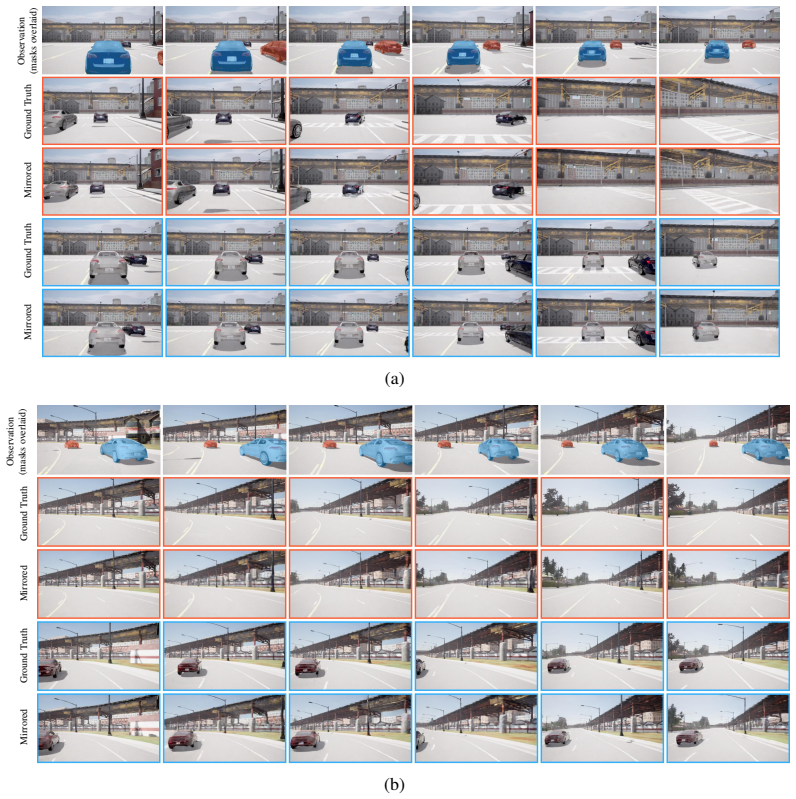
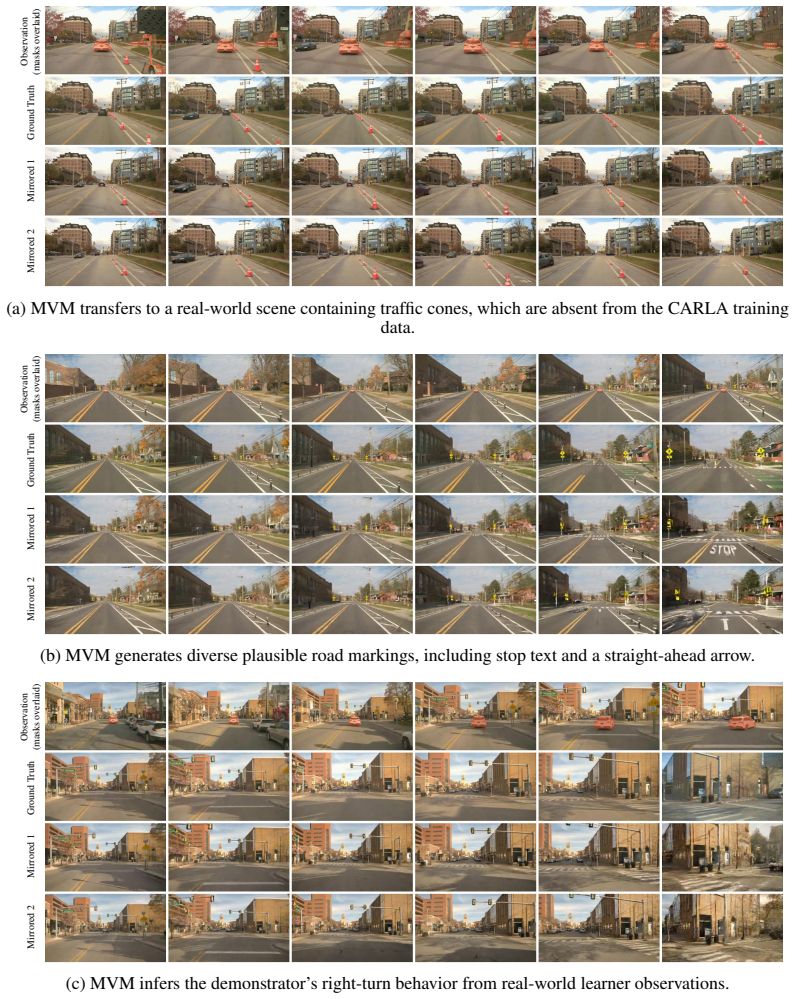
The central claim is that a fine-tuned video diffusion model can place a learner 'in the shoes' of a demonstrator: conditioned on the learner's own ego-view video plus a binary mask identifying the demonstrator, it generates a plausible first-person video from the demonstrator's viewpoint, without any known camera pose or explicit geometry. A separately trained inverse dynamics model then turns that generated video into action labels in the learner's control space, by predicting the actions the learner would take to produce those observations. The paper argues that these two stages compose into 'mirror data' — synthetic first-person expert demonstrations — and that this data is sufficient by
What carries the argument
The key machinery is the composition of two learned components. The mirror video model (MVM) is a pretrained video diffusion model, fine-tuned with a flow-matching objective, that generates the demonstrator's ego-view video from the learner's video and a per-frame binary attention mask identifying the demonstrator; the three temporally aligned input streams (mask, learner video, noised target) are encoded together and share aligned positional embeddings so the model can transform viewpoint while preserving scene motion. The inverse dynamics model (IDM) is a deterministic neural head trained on the learner's own observation-action pairs to predict the action between frames from a short observ
Load-bearing premise
The load-bearing premise is that the inverse dynamics model, trained on the learner's real first-person observation-action pairs, assigns correct action labels to the synthesized demonstrator-view videos; no evaluation in the paper measures IDM accuracy on MVM outputs, so if generation errors mislead the IDM, the mirror data's action labels are wrong and behavior cloning from it degrades.
What would settle it
Take the trained IDM and apply it to MVM-generated videos of held-out simulator scenarios where the demonstrator's true executed actions are known; compare predicted actions against those ground-truth actions. If the IDM's error on mirrored video is close to its reported validation error (about 0.42 ADE), the pipeline's label quality is confirmed; if it degrades toward or beyond the 0.67 ADE seen after only 1k-sample fine-tuning, the central claim that mirror data is trustworthy training signal is not supported.
If this is right
- If the claim holds, a physical system can acquire new behaviors by watching other agents, eliminating the need to instrument or teleoperate the demonstrator; the paper estimates each mirror sample is worth roughly half a ground-truth first-person sample.
- In geographic expansion, augmenting a small ground-truth set with mirror data improves open-loop policy metrics both in the training environment and in a zero-shot held-out town, and beats style-transfer augmentation at matched ratios.
- A view-transformation model trained only in simulation transfers zero-shot to real-world footage, so synthetic paired data may suffice to elicit the capability in new domains.
- Because the policy is trained entirely from observation, mirror learning offers a safer route to data collection for high-cost tasks where trial-and-error or teleoperation is dangerous.
Where Pith is reading between the lines
- A natural test the paper leaves open is measuring IDM error specifically on MVM-generated videos against simulator ground-truth actions; the reported validation error is on real learner observations, so label noise on synthetic video is unquantified and determines how far mirror data can be trusted.
- The IDM also predicts an aleatoric variance, which is discarded when taking the mean action as the label; an extension is to use that uncertainty to weight or reject low-confidence mirror samples, potentially improving downstream behavior cloning.
- The approach is demonstrated on low-dimensional action spaces (steering and acceleration); applying it to high-degree-of-freedom embodiments, where inverse dynamics ambiguity is much larger, is the most direct stress test of the watch-and-learn principle.
- Because the MVM inpaints unobserved content such as occluded vehicles, buildings, and player appearance, policies may learn implicitly from imagined scene structure; distinguishing beneficial generalization under occlusion from harmful sensitivity to generative hallucinations is a targeted next experiment.
Editorial analysis
A structured set of objections, weighed in public.
Referee Report
Summary. The paper introduces mirror learning, a pipeline for behavior cloning from third-person demonstrations. A fine-tuned video diffusion model (MVM), conditioned on a learner's egocentric video and an instance mask of a demonstrator, synthesizes the demonstrator's first-person video; an inverse dynamics model (IDM) trained on the learner's own observation-action pairs then labels the synthesized video with actions (Eq. 1). The resulting 'mirror data' is used to train BC policies. Experiments in CARLA show (i) BC from mirror data alone can produce non-trivial policies, and (ii) adding mirror data to ground-truth data improves open-loop minADE5, outperforming style-transfer augmentation in a geographic-expansion setting. Additional results include zero-shot MVM transfer to real May Mobility data and qualitative/quantitative MVM results in CARLA and Minecraft, together with a release plan.
Significance. If the central claim holds, the paper makes a valuable step: it demonstrates that pretrained video diffusion priors plus a mask can approximate cross-agent viewpoint transfer without camera geometry, and that the resulting synthetic first-person data can support policy learning. The paper is careful about data splits: scenario-level splits, disjoint mirror-generation split, held-out town, and separated evaluation conditions (App. A.1.1, A.5). It also ships quantitative MVM metrics and a reproducibility plan. The main reservation is that the composition in Eq. (1) is not validated where it matters: IDM accuracy on MVM-generated frames is never measured, so the policy-learning results rest on an untested distribution-shift assumption.
major comments (2)
- [§3.2, Eq. (1), App. A.5] The load-bearing step is p_phi(a | o_hat) with o_hat drawn from the MVM. The IDM is trained exclusively on real learner observation-action pairs and achieves ADE 0.42 on its real-frame validation split; after fine-tuning on 1k Town03 samples the ADE rises to 0.67 (App. A.5). MVM outputs are not real frames: they can contain hallucinated buildings, altered lane markings, invented traffic (Fig. 10), and arbitrary avatar appearance (Fig. 4). Because actions are regressed from pixels, systematic visual artifacts could bias the IDM labels. No experiment measures IDM label accuracy on MVM outputs, and open-loop minADE5 cannot separate label bias from label quality. I request a direct evaluation: run the MVM on held-out paired learner-demonstrator clips, apply the IDM to the MVM-generated video, and compare predicted actions with the true actions (or with IDM predictions on the ground-truth dem
- [Table 1 (caption and rows)] The caption states that the GT+mirror rows have approximately the same number of samples (33.6k) and were formed by replacing part of the ground-truth data with mirror data. The rows, however, show GT only at 23.5k and 27.9k and GT+mirror at 23.5+10.0=33.5k and 27.9+5.6=33.5k. Thus mirror data is added on top of the same GT amounts rather than replacing GT data. The observed improvement could therefore be due simply to increased training data, not to mirror data quality. Either re-run with fixed total budgets (e.g., 33.5k GT-only vs 23.5k GT + 10k mirror) or revise the caption and the 'replacing' claim.
minor comments (4)
- [§3.1 vs App. A.1.1] The main text says 'around twenty-two thousand paired demonstrator/learner videos (8.5 seconds each)' while the appendix says 37,000 paired videos at six seconds, and Table 2 totals 21,966 clips. Please reconcile these numbers and the frame counts.
- [Fig. 5(a)] The caption claims mirror-only data leads to 'equivalent performance' with GT data. At each data size the mirror curve is visibly worse (e.g., 1.23 vs 1.04 at 2k), so the wording overstates the result. Suggest 'approaches GT performance' or quantify the gap.
- [§3.1, App. A.4] The MVM evaluation reports absolute FVD/PSNR/SSIM but no quantitative comparison to existing third-to-first baselines such as EgoX or WorldWander. A baseline row would help contextualize the claims and support the related-work discussion.
- [App. A.1.1] There is a typographical inconsistency in the split rationale: the appendix at one point refers to 'MWM' instead of 'MVM'. Minor, but should be fixed.
Circularity Check
No material circularity: mirror-data labels are not the policy target by construction, and downstream policy evaluation is held out.
full rationale
The derivation chain is compositional, not self-referential. The MVM (Sec. 2.1) is trained to predict a demonstrator ego-video from a learner video and mask; the IDM is trained on real learner observation-action pairs with Eq. (2). Mirror data is then formed by Eq. (1), sampling an MVM output and labeling it with the IDM. The downstream BC policy is trained on these tuples and evaluated with minADE5 on disjoint test splits (App. A.1.1, A.5). No fitted parameter is renamed as a prediction: the IDM validation ADE (0.42, or 0.67 after Town03 fine-tuning) is a label-quality diagnostic, not the policy evaluation metric, and the policy itself is not used to generate the mirror labels. The paper's self-citations ([20], [23], [34], [60]) are dataset/tooling references, not load-bearing uniqueness theorems or ansatz sources; the central capability claim is supported by the paper's own held-out-town and real-world zero-shot experiments. The concern that the IDM is validated on real frames but applied to MVM-synthesized frames is a distribution-shift and correctness risk, not a circularity, because the downstream result is not equal to an input by construction.
Axiom & Free-Parameter Ledger
free parameters (2)
- CARLA pair visibility thresholds =
70° FOV, 24 m range, ≥30-timestep visible window, speed >0.1 m/s
- Mirror augmentation ratio =
1× and 2× relative to ground truth
axioms (5)
- domain assumption A binary instance segmentation mask of the demonstrator is sufficient conditioning for cross-view synthesis; no camera pose, intrinsics, or geometry is required.
- domain assumption The IDM trained on a learner's own first-person observation-action pairs generalizes to synthetic MVM-generated videos from the demonstrator's viewpoint.
- domain assumption All vehicles in CARLA share an egocentric camera convention, so mirrored videos can be interpreted in a common action space.
- domain assumption Cosmos-Predict2.5's pretrained representations are rich enough to support mirror synthesis after fine-tuning on modest simulation data.
- domain assumption Simulated CARLA data with a learned behavior model is representative enough for zero-shot transfer to real robotaxi scenes.
read the original abstract
We investigate imitation learning through the lens of third-person observation and propose a framework for mirror learning: acquiring actionable policies from passive observation. While behavior cloning (BC) excels under dense, well-aligned first-person data, it fundamentally fails to leverage the rich observational signals arising from third-person demonstrations that humans and animals routinely exploit. We introduce a method that composes (i) a learned perspective transformation that places learners in demonstrators' shoes using a fine-tuned video diffusion model and (ii) an inverse dynamics model that infers action trajectories in the learners' control space. This enables the synthesis of mirror data, pseudo first-person expert data generated from third-person observations of demonstrator behavior. Empirically, we show that mirror data alone can train effective policies, and that augmenting first-person BC training with mirror data further improves downstream policy performance. Our results suggest that modern generative world models implicitly encode sufficient structure to enable a scalable and safe alternative to teleoperation-heavy data collection.
Figures






Reference graph
Works this paper leans on
-
[1]
Learning to poke by poking: Experiential learning of intuitive physics.Advances in neural information processing systems, 29, 2016
Pulkit Agrawal, Ashvin V Nair, Pieter Abbeel, Jitendra Malik, and Sergey Levine. Learning to poke by poking: Experiential learning of intuitive physics.Advances in neural information processing systems, 29, 2016
2016
-
[2]
World simulation with video foundation models for physical ai.arXiv preprint arXiv:2511.00062, 2025
Arslan Ali, Junjie Bai, Maciej Bala, Yogesh Balaji, Aaron Blakeman, Tiffany Cai, Jiaxin Cao, Tianshi Cao, Elizabeth Cha, Yu-Wei Chao, et al. World simulation with video foundation models for physical ai.arXiv preprint arXiv:2511.00062, 2025
Pith/arXiv arXiv 2025
-
[3]
Alisson Azzolini, Junjie Bai, Hannah Brandon, Jiaxin Cao, Prithvijit Chattopadhyay, Huayu Chen, Jinju Chu, Yin Cui, Jenna Diamond, Yifan Ding, et al. Cosmos-reason1: From physical common sense to embodied reasoning.arXiv preprint arXiv:2503.15558, 2025
Pith/arXiv arXiv 2025
-
[4]
Video pretraining (vpt): Learning to act by watching unlabeled online videos.Advances in Neural Information Processing Systems, 35:24639–24654, 2022
Bowen Baker, Ilge Akkaya, Peter Zhokov, Joost Huizinga, Jie Tang, Adrien Ecoffet, Brandon Houghton, Raul Sampedro, and Jeff Clune. Video pretraining (vpt): Learning to act by watching unlabeled online videos.Advances in Neural Information Processing Systems, 35:24639–24654, 2022
2022
-
[5]
Prentice-hall Englewood Cliffs, NJ, 1977
Albert Bandura and Richard H Walters.Social learning theory, volume 1. Prentice-hall Englewood Cliffs, NJ, 1977
1977
-
[6]
Florent Bartoccioni, Elias Ramzi, Victor Besnier, Shashanka Venkataramanan, Tuan-Hung Vu, Yihong Xu, Loick Chambon, Spyros Gidaris, Serkan Odabas, David Hurych, et al. Vavim and vavam: Autonomous driving through video generative modeling.arXiv preprint arXiv:2502.15672, 2025
Pith/arXiv arXiv 2025
-
[7]
Andreas Blattmann, Tim Dockhorn, Sumith Kulal, Daniel Mendelevitch, Maciej Kilian, Do- minik Lorenz, Yam Levi, Zion English, Vikram V oleti, Adam Letts, et al. Stable video diffusion: Scaling latent video diffusion models to large datasets.arXiv preprint arXiv:2311.15127, 2023
Pith/arXiv arXiv 2023
-
[8]
End to end learning for self-driving cars.arXiv preprint arXiv:1604.07316, 2016
Mariusz Bojarski, Davide Del Testa, Daniel Dworakowski, Bernhard Firner, Beat Flepp, Prasoon Goyal, Lawrence D Jackel, Mathew Monfort, Urs Muller, Jiakai Zhang, et al. End to end learning for self-driving cars.arXiv preprint arXiv:1604.07316, 2016
Pith/arXiv arXiv 2016
-
[9]
Video generation models as world simulators
Tim Brooks, Bill Peebles, Connor Holmes, Will DePue, Yufei Guo, Li Jing, David Schnurr, Joe Taylor, Troy Luhman, Eric Luhman, et al. Video generation models as world simulators. 2024. URL https://openai. com/research/video-generation-models-as-world-simulators, 3(1):3, 2024
2024
-
[10]
Language models are few-shot learners.Advances in neural information processing systems, 33:1877–1901, 2020
Tom Brown, Benjamin Mann, Nick Ryder, Melanie Subbiah, Jared D Kaplan, Prafulla Dhariwal, Arvind Neelakantan, Pranav Shyam, Girish Sastry, Amanda Askell, et al. Language models are few-shot learners.Advances in neural information processing systems, 33:1877–1901, 2020
1901
-
[11]
Sam 3: Segment anything with concepts, 2025
Nicolas Carion, Laura Gustafson, Yuan-Ting Hu, Shoubhik Debnath, Ronghang Hu, Didac Suris, Chaitanya Ryali, Kalyan Vasudev Alwala, Haitham Khedr, Andrew Huang, Jie Lei, Tengyu Ma, Baishan Guo, Arpit Kalla, Markus Marks, Joseph Greer, Meng Wang, Peize Sun, Roman Rädle, Triantafyllos Afouras, Effrosyni Mavroudi, Katherine Xu, Tsung-Han Wu, Yu Zhou, Liliane ...
Pith/arXiv arXiv 2025
-
[12]
Learning from all vehicles
Dian Chen and Philipp Krähenbühl. Learning from all vehicles. InProceedings of the IEEE/CVF conference on computer vision and pattern recognition, pages 17222–17231, 2022
2022
-
[13]
CARLA: An open urban driving simulator
Alexey Dosovitskiy, German Ros, Felipe Codevilla, Antonio Lopez, and Vladlen Koltun. CARLA: An open urban driving simulator. InProceedings of the 1st Annual Conference on Robot Learning, pages 1–16, 2017
2017
-
[14]
Rap: 3d rasterization augmented end-to-end planning.arXiv preprint arXiv:2510.04333, 2025
Lan Feng, Yang Gao, Eloi Zablocki, Quanyi Li, Wuyang Li, Sichao Liu, Matthieu Cord, and Alexandre Alahi. Rap: 3d rasterization augmented end-to-end planning.arXiv preprint arXiv:2510.04333, 2025. 10
arXiv 2025
-
[15]
Whye Kit Fong, Rohit Mohan, Juana Valeria Hurtado, Lubing Zhou, Holger Caesar, Oscar Beijbom, and Abhinav Valada. Panoptic nuscenes: A large-scale benchmark for lidar panoptic segmentation and tracking.arXiv preprint arXiv:2109.03805, 2021
Pith/arXiv arXiv 2021
-
[16]
Efros, and Xiaolong Wang
Yang Fu, Sifei Liu, Amey Kulkarni, Jan Kautz, Alexei A. Efros, and Xiaolong Wang. Colmap- free 3d gaussian splatting. InProceedings of the IEEE/CVF Conference on Computer Vision and Pattern Recognition (CVPR), pages 20796–20805, June 2024
2024
-
[17]
A survey for foundation models in autonomous driving
Haoxiang Gao, Zhongruo Wang, Yaqian Li, Kaiwen Long, Ming Yang, and Yiqing Shen. A survey for foundation models in autonomous driving. In2025 6th International Conference on Computer Vision and Data Mining (ICCVDM), pages 63–71. IEEE, 2025
2025
-
[18]
A comprehensive survey on safe reinforcement learning
Javier Garcıa and Fernando Fernández. A comprehensive survey on safe reinforcement learning. Journal of Machine Learning Research, 16(1):1437–1480, 2015
2015
-
[19]
Shortcut learning in deep neural networks.Nature Machine Intelligence, 2(11):665–673, 2020
Robert Geirhos, Jörn-Henrik Jacobsen, Claudio Michaelis, Richard Zemel, Wieland Brendel, Matthias Bethge, and Felix A Wichmann. Shortcut learning in deep neural networks.Nature Machine Intelligence, 2(11):665–673, 2020
2020
-
[20]
Dylan Green, William Harvey, Saeid Naderiparizi, Matthew Niedoba, Yunpeng Liu, Xiaoxuan Liang, Jonathan Lavington, Ke Zhang, Vasileios Lioutas, Setareh Dabiri, et al. Semantically consistent video inpainting with conditional diffusion models.arXiv preprint arXiv:2405.00251, 2024
Pith/arXiv arXiv 2024
-
[21]
Learning latent dynamics for planning from pixels
Danijar Hafner, Timothy Lillicrap, Ian Fischer, Ruben Villegas, David Ha, Honglak Lee, and James Davidson. Learning latent dynamics for planning from pixels. InInternational conference on machine learning, pages 2555–2565. PMLR, 2019
2019
-
[22]
Flexible diffusion modeling of long videos.Advances in neural information processing systems, 35:27953–27965, 2022
William Harvey, Saeid Naderiparizi, Vaden Masrani, Christian Weilbach, and Frank Wood. Flexible diffusion modeling of long videos.Advances in neural information processing systems, 35:27953–27965, 2022
2022
-
[23]
Yingchen He, Christian D Weilbach, Martyna E Wojciechowska, Yuxuan Zhang, and Frank Wood. Plaicraft: Large-scale time-aligned vision-speech-action dataset for embodied ai.arXiv preprint arXiv:2505.12707, 2025
arXiv 2025
-
[24]
Automatic imitation.Psychological bulletin, 137(3):463, 2011
Cecilia Heyes. Automatic imitation.Psychological bulletin, 137(3):463, 2011
2011
-
[25]
Eight problems for the mirror neuron theory of action understanding in monkeys and humans.Journal of cognitive neuroscience, 21(7):1229–1243, 2009
Gregory Hickok. Eight problems for the mirror neuron theory of action understanding in monkeys and humans.Journal of cognitive neuroscience, 21(7):1229–1243, 2009
2009
-
[26]
Video diffusion models.Advances in neural information processing systems, 35: 8633–8646, 2022
Jonathan Ho, Tim Salimans, Alexey Gritsenko, William Chan, Mohammad Norouzi, and David J Fleet. Video diffusion models.Advances in neural information processing systems, 35: 8633–8646, 2022
2022
-
[27]
Cortical mechanisms of human imitation.science, 286(5449):2526–2528, 1999
Marco Iacoboni, Roger P Woods, Marcel Brass, Harold Bekkering, John C Mazziotta, and Giacomo Rizzolatti. Cortical mechanisms of human imitation.science, 286(5449):2526–2528, 1999
1999
-
[28]
Taewoong Kang, Kinam Kim, Dohyeon Kim, Minho Park, Junha Hyung, and Jaegul Choo. Egox: Egocentric video generation from a single exocentric video.arXiv preprint arXiv:2512.08269, 2025
arXiv 2025
-
[29]
Somatosensation in social perception
Christian Keysers, Jon H Kaas, and Valeria Gazzola. Somatosensation in social perception. Nature Reviews Neuroscience, 11(6):417–428, 2010
2010
-
[30]
Deep learning.nature, 521(7553):436–444, 2015
Yann LeCun, Yoshua Bengio, and Geoffrey Hinton. Deep learning.nature, 521(7553):436–444, 2015
2015
-
[31]
End-to-end training of deep visuomotor policies.Journal of Machine Learning Research, 17(39):1–40, 2016
Sergey Levine, Chelsea Finn, Trevor Darrell, and Pieter Abbeel. End-to-end training of deep visuomotor policies.Journal of Machine Learning Research, 17(39):1–40, 2016
2016
-
[32]
Diffueraser: A diffusion model for video inpainting.arXiv preprint arXiv:2501.10018, 2025
Xiaowen Li, Haolan Xue, Peiran Ren, and Liefeng Bo. Diffueraser: A diffusion model for video inpainting.arXiv preprint arXiv:2501.10018, 2025. 11
Pith/arXiv arXiv 2025
-
[33]
Multiagent multitraversal multimodal self-driving: Open mars dataset
Yiming Li, Zhiheng Li, Nuo Chen, Moonjun Gong, Zonglin Lyu, Zehong Wang, Peili Jiang, and Chen Feng. Multiagent multitraversal multimodal self-driving: Open mars dataset. In Proceedings of the IEEE/CVF Conference on Computer Vision and Pattern Recognition, pages 22041–22051, 2024
2024
-
[34]
Control-itra: Controlling the behavior of a driving model.arXiv preprint arXiv:2501.12408, 2025
Vasileios Lioutas, Adam Scibior, Matthew Niedoba, Berend Zwartsenberg, and Frank Wood. Control-itra: Controlling the behavior of a driving model.arXiv preprint arXiv:2501.12408, 2025
Pith/arXiv arXiv 2025
-
[35]
Exocentric- to-egocentric video generation.Advances in Neural Information Processing Systems, 37: 136149–136172, 2024
Jia-Wei Liu, Weijia Mao, Zhongcong Xu, Jussi Keppo, and Mike Zheng Shou. Exocentric- to-egocentric video generation.Advances in Neural Information Processing Systems, 37: 136149–136172, 2024
2024
-
[36]
Imitation from observation: Learning to imitate behaviors from raw video via context translation
YuXuan Liu, Abhishek Gupta, Pieter Abbeel, and Sergey Levine. Imitation from observation: Learning to imitate behaviors from raw video via context translation. In2018 IEEE international conference on robotics and automation (ICRA), pages 1118–1125. IEEE, 2018
2018
-
[37]
Repaint: Inpainting using denoising diffusion probabilistic models
Andreas Lugmayr, Martin Danelljan, Andres Romero, Fisher Yu, Radu Timofte, and Luc Van Gool. Repaint: Inpainting using denoising diffusion probabilistic models. InProceedings of the IEEE/CVF conference on computer vision and pattern recognition, pages 11461–11471, 2022
2022
-
[38]
Mohammad Mahdi, Yuqian Fu, Nedko Savov, Jiancheng Pan, Danda Pani Paudel, and Luc Van Gool. Exo2egosyn: Unlocking foundation video generation models for exocentric-to- egocentric video synthesis.arXiv preprint arXiv:2511.20186, 2025
arXiv 2025
-
[39]
Human-level control through deep reinforcement learning.nature, 518(7540):529–533, 2015
V olodymyr Mnih, Koray Kavukcuoglu, David Silver, Andrei A Rusu, Joel Veness, Marc G Bellemare, Alex Graves, Martin Riedmiller, Andreas K Fidjeland, Georg Ostrovski, et al. Human-level control through deep reinforcement learning.nature, 518(7540):529–533, 2015
2015
-
[40]
Policy invariance under reward transforma- tions: Theory and application to reward shaping
Andrew Y Ng, Daishi Harada, and Stuart Russell. Policy invariance under reward transforma- tions: Theory and application to reward shaping. InIcml, volume 99, pages 278–287. Citeseer, 1999
1999
-
[41]
Physicalai autonomous vehicles, 2025
NVIDIA. Physicalai autonomous vehicles, 2025. URL https://huggingface.co/ datasets/nvidia/PhysicalAI-Autonomous-Vehicles . Dataset card, created October 28, 2025; accessed April 8, 2026
2025
-
[42]
Curiosity-driven exploration by self-supervised prediction
Deepak Pathak, Pulkit Agrawal, Alexei A Efros, and Trevor Darrell. Curiosity-driven exploration by self-supervised prediction. InInternational conference on machine learning, pages 2778–
-
[43]
Alvinn: An autonomous land vehicle in a neural network.Advances in neural information processing systems, 1, 1988
Dean A Pomerleau. Alvinn: An autonomous land vehicle in a neural network.Advances in neural information processing systems, 1, 1988
1988
-
[44]
Simlingo: Vision-only closed-loop autonomous driving with language-action alignment
Katrin Renz, Long Chen, Elahe Arani, and Oleg Sinavski. Simlingo: Vision-only closed-loop autonomous driving with language-action alignment. InConference on Computer Vision and Pattern Recognition (CVPR), 2025
2025
-
[45]
Premotor cortex and the recognition of motor actions.Cognitive brain research, 3(2):131–141, 1996
Giacomo Rizzolatti, Luciano Fadiga, Vittorio Gallese, and Leonardo Fogassi. Premotor cortex and the recognition of motor actions.Cognitive brain research, 3(2):131–141, 1996
1996
-
[46]
Time-contrastive networks: Self-supervised learning from video
Pierre Sermanet, Corey Lynch, Yevgen Chebotar, Jasmine Hsu, Eric Jang, Stefan Schaal, Sergey Levine, and Google Brain. Time-contrastive networks: Self-supervised learning from video. In2018 IEEE international conference on robotics and automation (ICRA), pages 1134–1141. IEEE, 2018
2018
-
[47]
Self-supervised disentangled representation learning for third-person imitation learning
Jinghuan Shang and Michael S Ryoo. Self-supervised disentangled representation learning for third-person imitation learning. In2021 IEEE/RSJ International Conference on Intelligent Robots and Systems (IROS), pages 214–221. IEEE, 2021
2021
-
[48]
Extranerf: Visibility-aware view extrapolation of neural radiance fields with diffusion models
Meng-Li Shih, Wei-Chiu Ma, Lorenzo Boyice, Aleksander Holynski, Forrester Cole, Brian Curless, and Janne Kontkanen. Extranerf: Visibility-aware view extrapolation of neural radiance fields with diffusion models. InProceedings of the IEEE/CVF Conference on Computer Vision and Pattern Recognition, pages 20385–20395, 2024. 12
2024
-
[49]
Quanjian Song, Yiren Song, Kelly Peng, Yuan Gao, and Mike Zheng Shou. Worldwander: Bridg- ing egocentric and exocentric worlds in video generation.arXiv preprint arXiv:2511.22098, 2025
Pith/arXiv arXiv 2025
-
[50]
Third person imitation learning
Bradly C Stadie, Pieter Abbeel, and Ilya Sutskever. Third person imitation learning. In International Conference on Learning Representations, 2017
2017
-
[51]
Behavioral cloning from observation.arXiv preprint arXiv:1805.01954, 2018
Faraz Torabi, Garrett Warnell, and Peter Stone. Behavioral cloning from observation.arXiv preprint arXiv:1805.01954, 2018
Pith/arXiv arXiv 2018
-
[52]
From image to video: An empirical study of diffusion representations
Pedro Vélez, Luisa F Polanía, Yi Yang, Chuhan Zhang, Rishabh Kabra, Anurag Arnab, and Mehdi SM Sajjadi. From image to video: An empirical study of diffusion representations. In Proceedings of the IEEE/CVF International Conference on Computer Vision, pages 16948– 16958, 2025
2025
-
[53]
Wan: Open and advanced large-scale video generative models.arXiv preprint arXiv:2503.20314, 2025
Team Wan, Ang Wang, Baole Ai, Bin Wen, Chaojie Mao, Chen-Wei Xie, Di Chen, Feiwu Yu, Haiming Zhao, Jianxiao Yang, et al. Wan: Open and advanced large-scale video generative models.arXiv preprint arXiv:2503.20314, 2025
Pith/arXiv arXiv 2025
-
[54]
Yan Wang, Wenjie Luo, Junjie Bai, Yulong Cao, Tong Che, Ke Chen, Yuxiao Chen, Jenna Dia- mond, Yifan Ding, Wenhao Ding, et al. Alpamayo-r1: Bridging reasoning and action prediction for generalizable autonomous driving in the long tail.arXiv preprint arXiv:2511.00088, 2025
Pith/arXiv arXiv 2025
-
[55]
Knowledge of results and motor learning—implications for physical therapy
Carolee J Winstein. Knowledge of results and motor learning—implications for physical therapy. Physical therapy, 71(2):140–149, 1991
1991
-
[56]
Trajectory-guided control prediction for end-to-end autonomous driving: A simple yet strong baseline
Penghao Wu, Xiaosong Jia, Li Chen, Junchi Yan, Hongyang Li, and Yu Qiao. Trajectory-guided control prediction for end-to-end autonomous driving: A simple yet strong baseline. InNeurIPS, 2022
2022
-
[57]
Runsheng Xu, Hubert Lin, Wonseok Jeon, Hao Feng, Yuliang Zou, Liting Sun, John Gorman, Ekaterina Tolstaya, Sarah Tang, Brandyn White, et al. Wod-e2e: Waymo open dataset for end-to-end driving in challenging long-tail scenarios.arXiv preprint arXiv:2510.26125, 2025
arXiv 2025
-
[58]
Learning by watching
Jimuyang Zhang and Eshed Ohn-Bar. Learning by watching. InProceedings of the IEEE/CVF conference on computer vision and pattern recognition, pages 12711–12721, 2021
2021
-
[59]
Unipc: A unified predictor- corrector framework for fast sampling of diffusion models.Advances in Neural Information Processing Systems, 36:49842–49869, 2023
Wenliang Zhao, Lujia Bai, Yongming Rao, Jie Zhou, and Jiwen Lu. Unipc: A unified predictor- corrector framework for fast sampling of diffusion models.Advances in Neural Information Processing Systems, 36:49842–49869, 2023
2023
-
[60]
Berend Zwartsenberg, Adam ´Scibior, Matthew Niedoba, Vasileios Lioutas, Yunpeng Liu, Justice Sefas, Setareh Dabiri, Jonathan Wilder Lavington, Trevor Campbell, and Frank Wood. Conditional permutation invariant flows.arXiv preprint arXiv:2206.09021, 2022. 13 Multi-agent Behavior Model LearnerDemonstrator Replay with different weather and time of the day Mi...
Pith/arXiv arXiv 2022
discussion (0)
Sign in with ORCID, Apple, or X to comment. Anyone can read and Pith papers without signing in.