REVIEW 3 minor 8 references
Sound waves move matter
T0 review · 0 major / 3 minor · reviewed 2026-08-14 · deepseek-v4-flash
Pith's one-line read In a Hooke's-law solid, a sound wave packet permanently shifts material backward and carries negative mass 9/8 E/c_L^2.
desk verdict A clean perturbative derivation that yields 9/8 for the sound-wave mass, but the paper never fully explains the discrepancy with the PRL's density-derivative formula. read the letter →
The pith
A machine-rendered reading of the paper's core claim, the machinery that carries it, and where it could break.
The reading
What carries the argument
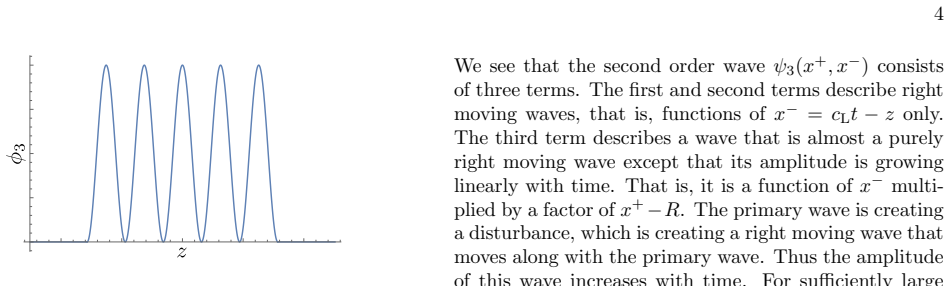
The central machinery is the Lagrangian field theory of continuum mechanics: atoms carry labels $R^a(x)$, the current $J^\mu$ and strain $s_{ab}$ are built from $\partial_\alpha R^a$, and a Hooke's-law potential $U = \frac{1}{2n}[\lambda(s_{aa})^2 + 2\mu s_{ab}s_{ab}]$ fixes the elastic response. Expanding $R^a = x^a + \phi^a + \psi^a$ and using momentum conservation $\partial_0 T^{30} + \partial_3 T^{33} = f^3$ in the symmetric plane-wave geometry gives linear wave equations for $\phi^3$ and a driven wave equation for $\psi^3$. In coordinates $x_\pm = c_L t \pm z$, the second-order field evaluates after the packet to $\psi_3 = \frac{9}{8}\int dx^3\,(\partial_3\phi_3)^2$, the identity that carries the argument. This is the mechanism: quadratic terms in the stress produce a secular, time-independent second-order displacement rather than a momentum transfer.
What would settle it
Send a calibrated longitudinal sound pulse down a long rod of known cross-section $A$, density $\rho$, sound speed $c_L$, and total energy $E_{\mathrm{tot}}$, and measure the net displacement of the far end after the pulse has left; the $9/8$ claim predicts a permanent backward displacement of $\frac{9}{8}\frac{E_{\mathrm{tot}}}{A\rho c_L^2}$, so a measured displacement clearly different from this would rule out the claim.
Extended reading notes
Core claim
The paper's central claim is that a plane sound wave packet in a Hooke's-law solid, with amplitude independent of $x$ and $y$ and traveling in the $+z$ direction, produces a small net backward motion of the material. Writing the displacement as $R^a = x^a + \phi^a + \psi^a$, where $\phi$ is first order in the source and $\psi$ is second order, the author solves the momentum-conservation equation exactly to that order and finds that after the packet has passed, $\psi_3$ approaches a nonzero constant, $\psi_3 = \frac{9}{8 mn c_L^2}\int dx^3\,T^{00}$. Consequently, the mass per unit area associated with the packet is $M = -mn\psi_3 = -(9/8)E/c_L^2$. The paper also computes the corresponding average material velocity inside the packet and notes that this $9/8$ coefficient disagrees with the earlier Letter's $C = d\log c_L/d\log\rho = (13\lambda+14\mu)/(6(\lambda+2\mu))$ for arbitrary $\mu/\lambda$.
Load-bearing premise
The load-bearing premise is the Hooke's-law form of the elastic energy, Eq. (6), which fixes the nonlinear coefficients that produce the $9/8$; with any other stress-strain relation the coefficient changes, so the specific number is not universal.
Editorial extensions
If this is right
- A longitudinal sound pulse of energy per unit area $E$ carries a negative mass per unit area $-(9/8)E/c_L^2$, so a sound-bearing solid behaves as if its mass were reduced while the pulse is inside it.
- The second-order displacement is permanent: after the packet passes, the material is at rest but shifted in the $-z$ direction, so no net momentum is left behind.
- The result is independent of the detailed shape of the packet once its total energy is fixed, at least for source profiles satisfying the paper's zero-net-force condition.
- For a 100 W/m$^2$ sound pulse in a water-like gel, the average material velocity inside the packet is about $-5\times10^{-8}$ m/s, fixing the scale of the effect.
Reading between the lines
- Because the coefficient $9/8$ comes from the harmonic elastic energy, measuring the backward shift of a rod after a sound pulse could serve as a probe of anharmonic elastic constants, with departures from $9/8$ signalling non-Hooke behavior.
- Repeated pulses should make the per-pulse displacement accumulate, so a train of pulses or a resonant cavity could amplify the effect enough for precision displacement measurements.
- Since $E/c_L^2$ exceeds $E/c^2$ by roughly $(c/c_L)^2$, the negative mass associated with sound is much larger than the relativistic rest-mass equivalent of its energy; if sound sources gravity, this enhancement may be testable in torsion-balance or optomechanical experiments.
Signed reviews
Editorial analysis
A structured set of objections, weighed in public.
Referee Report
Summary. The paper presents a direct second-order perturbative analysis of longitudinal sound wave packets in a homogeneous isotropic Hooke's law solid. Using the Lagrangian formulation of continuum mechanics, the author solves the equations of motion to second order in the wave amplitude and finds a net backward displacement of the material after the packet passes, corresponding to a negative effective mass per unit area M = -(9/8) E/c_L^2 carried by the wave. The paper also compares the result with Ref. [1], finds a different coefficient, and attributes the discrepancy to Ref. [1]'s time-averaging procedure.
Significance. This is a clean, self-contained derivation of a surprising effect. The calculation is explicitly parameter-free: the coefficient 9/8 emerges from the Hooke's law Lagrangian rather than being fitted. The paper gives a concrete physical picture (atoms return to rest but are displaced backward) and provides a quantitative estimate for a gel-like material. It serves as an important check on the recent claim that sound waves carry gravitational mass, although the coefficient differs from Ref. [1]. The main limitations, restriction to Hooke's law and to plane-wave geometry, are clearly stated in the abstract and Section 2.
minor comments (3)
- [RESULT OF REF. [1]] The critique of Ref. [1]'s time-averaging is stated qualitatively ('I am not able to justify this method of attack') but the paper does not identify the precise step in Ref. [1] where a term is incorrectly dropped. Since this section explicitly aims to explain the difference in coefficients, please provide a more detailed diagnosis or state clearly that the source of the discrepancy remains unresolved.
- [SOLUTION OF THE EQUATIONS OF MOTION] In Eq. (29), the notation θ(-R < x+ < R) is ambiguous; it should be written as a product of step functions, e.g., θ(x+ + R) θ(R - x+), to avoid confusion.
- [CONNECTION TO GRAVITY] The leap from the nonrelativistic mass deficit to the gravitational coupling is asserted rather than derived. A short explanation of why the nonrelativistic treatment suffices for the gravitational mass claim would help the reader.
Circularity Check
Derivation is self-contained; coefficient 9/8 follows from the stated Hooke's-law Lagrangian with no fitted input.
full rationale
The central claim, Eq. (65), is obtained by direct perturbation theory: the paper states the Hooke's-law potential in Eq. (6), expands the displacement as phi = O(f) + psi = O(f^2) in Eq. (14), solves the resulting linear and quadratic equations of motion (Eqs. (20)-(21)), and integrates the second-order displacement to get Eqs. (46) and (64). The coefficient 9/8 emerges algebraically from the cubic terms contained in the stated Lagrangian; it is not a fitted parameter and is not assumed from any prior result. The only self-citation, Ref. [3], is to the author's textbook for the standard Lagrangian formulation of continuum mechanics, but the subsequent field equations, stress tensor, and energy-momentum components are written out and solved in the paper rather than imported as the result. The paper explicitly notes the discrepancy with Ref. [1] and gives its own coefficient without relying on Ref. [1] for the derivation. The Hooke's-law assumption is an explicit scope condition stated in the abstract and Section 2, not an input that trivially reproduces the output. No step reduces by construction or by definition to the claim, so there is no significant circularity.
Assumptions & free parameters
assumptions (4)
- domain assumption The material is an isotropic Hooke's law solid with potential energy density ~U = (1/(2n))[λ(s_aa)^2 + 2μ s_ab s_ab].
- domain assumption The displacement field and force are invariant under translations in x and y and rotations about z, so only the z-component depends on t and z.
- domain assumption The non-relativistic Lagrangian is used, dropping time derivatives in the deformation matrix ~G_ab.
- domain assumption The external force f obeys ∫ d x− f(x+, x−) = 0, so no net momentum is injected.
Cite this review
Pith. "Pith review of Sound waves move matter." pith.science (2026). https://pith.science/paper/3L6VZ6NE
@misc{pith2026190807823,
  author       = {Pith},
  title        = {Pith review of: Sound waves move matter},
  year         = {2026},
  howpublished = {\url{https://pith.science/paper/3L6VZ6NE}},
  note         = {Machine review of arXiv:1908.07823}
}
abstract
A recent Letter has reported that sound waves can carry gravitational mass. I analyze this effect in a Hooke's law solid, considering a wave packet moving in the $z$ direction with an amplitude that is independent of $x$ and $y$. The analysis shows that, at second order in an expansion around small amplitude vibrations, there is a small net motion of material, and thus mass, in the direction opposite to the wave packet propagation. This is a straightforward consequence of Newton's laws.
Figures
Reference graph
Works this paper leans on
-
[1]
A. Esposito, R. Krichevsky and A. Nicolis, Gravitational Mass Carried by Sound Waves , http://dx.doi.org/10.1103/PhysRevLett.122.084501 Phys.\ Rev.\ Lett.\ 122 , 084501 (2019) [ http://inspirehep.net/search?p=find+doi+10.1103/PhysRevLett.122.084501 inSPIRE ]
-
[2]
A. Nicolis and R. Penco, Mutual Interactions of Phonons, Rotons, and Gravity , http://dx.doi.org/10.1103/PhysRevB.97.134516 Phys.\ Rev.\ B 97 , 134516 (2018) [ http://inspirehep.net/search?p=find+doi+10.1103/PhysRevB.97.134516 inSPIRE ]
-
[3]
D. E. Soper, Classical Field Theory , (John Wiley & Sons, New York, 1976; republished by Dover Publications, Mineola, NY, 2008)
work page 1976
-
[4]
S. Dubovsky, T. Gregoire, A. Nicolis and R. Rattazzi, Null energy condition and superluminal propagation , http://dx.doi.org/10.1088/1126-6708/2006/03/025 JHEP 0603 , 025 (2006) [ http://inspirehep.net/search?p=find+doi+10.1088/1126-6708/2006/03/025 inSPIRE ]
-
[5]
S. Endlich, A. Nicolis, R. Rattazzi and J. Wang, The Quantum mechanics of perfect fluids , http://dx.doi.org/10.1007/JHEP04(2011)102 JHEP 1104 , 102 (2011) [ http://inspirehep.net/search?p=find+doi+10.1007/JHEP04(2011)102 inSPIRE ]
-
[6]
S. Endlich, A. Nicolis and J. Wang, Solid Inflation , http://dx.doi.org/10.1088/1475-7516/2013/10/011 J. Cosmol. Astropart. Phys. 1310 , 011 (2013) [ http://inspirehep.net/search?p=find+doi+10.1088/1475-7516/2013/10/011 inSPIRE ]
-
[7]
D. R. Gulevich and F. V. Kusmartsev, Comment on ``Gravitational Mass Carried by Sound Waves'' arXiv:1903.04770 [ http://inspirehep.net/search?p=find+ARXIV:1903.04770 inSPIRE ]
work page Pith review arXiv 1903
-
[8]
Z. Nagy and D. E. Soper, TITLE , http://dx.doi.org/xxx Journal Ref [ http://inspirehep.net/search?p=find+doi+xxx inSPIRE ]
Reviewed August 14, 2026 · model on record in the stance chip above.
Discussion (0). Continue with ORCID to comment.