REVIEW 3 major objections 2 minor 1 cited by
Gauging nonlocal monodromy symmetries filters erratic large-N observables and leaves a wormhole Hilbert subspace whose filtered partition function is an ensemble average over entangling gates.
Reviewed by Pith at T0; open to challenge. T0 means a machine referee read the full paper against a public rubric. the ladder, T0–T4 →
T0 review · grok-4.5
2026-07-12 15:46 UTC pith:3MVFHWBP
load-bearing objection Abstract-only: clean algebraic story for wormholes via monodromy completion and gauging=filtering, but positivity cut is the uncheckable linchpin. the 3 major comments →
Filtering out Erratic Observables: Wormholes from Gauging Nonlocal Symmetries
The pith
A machine-rendered reading of the paper's core claim, the machinery that carries it, and where it could break.
Core claim
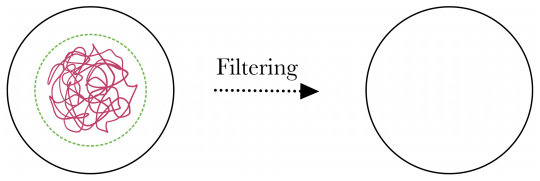
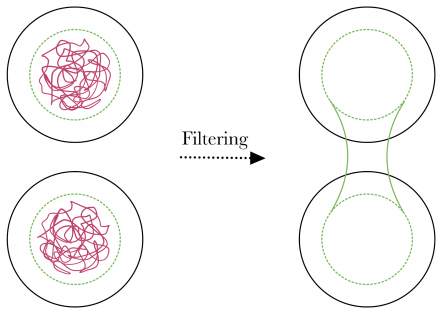
In (2+1)-dimensional gravity the algebra of one-sided boundary gravitons is intrinsically incomplete, possessing a nontrivial center independent of boundary conditions. Its simplest completion is generated by monodromy observables that describe one-sided black holes. Restricting those monodromy data by a positivity condition produces emergent erratic large-N observables; filtering them out by restricting to the subspace on which they act trivially is equivalent to gauging the nonlocal symmetries they generate. For two CFTs the global part of this gauging leaves a Hilbert subspace of wormholes whose filtered partition function is an ensemble average over entangling quantum gates, with the res
What carries the argument
The monodromy observable algebra (the commutant of the completed boundary-graviton algebra) together with the positivity restriction that selects the Lorentzian multi-boundary sector; gauging the nonlocal symmetries it generates is identical to projecting out the erratic observables.
Load-bearing premise
The claim rests on the premise that monodromy data cut by a positivity restriction are all that is needed to describe Lorentzian multi-boundary wormholes, and that this cut is what creates the erratic large-N behaviors that must then be filtered.
What would settle it
An explicit computation of the two-CFT filtered partition function (or of the spectrum of the residual wormhole Hilbert space) that fails to reproduce the known gravitational wormhole contribution, or a demonstration that a different completion of the boundary-graviton algebra yields no positivity-induced erratic sector.
If this is right
- For a single CFT, gauging the nonlocal monodromy symmetries removes every black-hole microstate from the spectrum.
- The filtered two-CFT partition function is exactly an ensemble average over quantum gates that entangle the monodromy degrees of freedom of the two sides.
- The correlation between the erratic observables of the two CFTs is preserved by the filter and appears directly as the wormhole contribution.
- Apparent ensemble averaging of CFT partition functions can be reinterpreted as the result of projecting out the erratic sector rather than averaging over an external ensemble of theories.
Where Pith is reading between the lines
- The same monodromy-gauging construction may supply a microscopic origin for the factorisation puzzle in higher-dimensional AdS/CFT.
- Because the residual wormhole subspace is defined by a positivity cut on monodromy data, the construction suggests a natural order parameter that distinguishes connected and disconnected geometries already at the level of the dual CFT Hilbert space.
- If the nonlocal symmetries can be realised as ordinary gauge symmetries after a suitable extension of the CFT, the wormhole contribution would become an ordinary projection rather than an ad-hoc filter.
Editorial analysis
A structured set of objections, weighed in public.
Referee Report
Summary. The manuscript argues that, in (2+1)-dimensional gravity, the algebra of one-sided boundary gravitons is intrinsically incomplete (nontrivial center independent of boundary conditions). Completions are constructed by bootstrapping a Poisson bracket from asymptotic symmetries; the simplest completion has a commutant consisting of monodromy data, interpreted as an effective description of one-sided black holes. A positivity restriction on the monodromy data is claimed to be necessary and sufficient for Lorentzian multi-boundary wormholes and to induce emergent erratic large-N observables. Filtering those observables (restriction to the subspace on which they act trivially) is asserted to be equivalent to gauging the nonlocal symmetries generated by the monodromy observables. For a single CFT this removes all black-hole states and produces an apparent ensemble average; for two CFTs a wormhole Hilbert subspace survives after gauging the global part of the symmetries, and the filtered partition function becomes an ensemble average over entangling quantum gates on the monodromy degrees of freedom, with residual correlations of the erratic observables supplying the wormhole term.
Significance. If the claimed equivalence between gauging monodromy-generated nonlocal symmetries and filtering erratic observables holds, and if the positivity cut cleanly isolates the Lorentzian multi-boundary sector while generating the erratic operators that must be filtered, the work would supply a concrete, algebraically controlled mechanism for the appearance of wormhole contributions as remnants of large-N correlations in AdS3/CFT2. That would be a useful addition to the growing literature that seeks to derive ensemble averaging and wormhole saddles from the structure of boundary observable algebras rather than from an a-priori gravitational path integral. The construction is potentially falsifiable once the explicit Poisson brackets, the spectrum of the monodromy algebra, and the quantum implementation of the gauging are written down.
major comments (3)
- The entire logical chain rests on the assertion (abstract and implied body) that monodromy data subject to a positivity restriction are the only data needed for Lorentzian multi-boundary wormholes and that this same restriction is what produces the erratic large-N observables. No derivation, classical phase-space argument, or explicit check that non-positive monodromy cannot appear in Lorentzian multi-boundary geometries is supplied in the provided text. Without that step the subsequent identification of erratic operators, the filtering procedure, and the claimed equivalence to gauging all remain unanchored.
- The bootstrap of a general Poisson bracket from asymptotic symmetries that completes the boundary-graviton algebra is announced but never exhibited. The resulting monodromy algebra, its center, and the precise sense in which it is the commutant are therefore unavailable for inspection; the claim that one-sided boundary gravitons are intrinsically incomplete cannot be verified.
- The quantum implementation of the gauging (especially the distinction between local and global parts of the nonlocal symmetries, and the statement that for one CFT all black-hole states are removed while for two CFTs a wormhole subspace survives) is stated without any Hilbert-space construction, representation theory of the monodromy algebra, or explicit projector onto the filtered subspace. The ensemble-of-gates form of the two-CFT filtered partition function and the identification of the residual wormhole term likewise lack supporting formulae.
minor comments (2)
- The manuscript body is absent from the review package; only the abstract is available. All technical claims therefore remain unchecked.
- Notation for the monodromy observables, the positivity restriction, and the nonlocal symmetries is introduced in the abstract without definitions that would allow a reader to reconstruct the algebra even at the classical level.
Circularity Check
No circularity identifiable; abstract presents a constructive chain (incompleteness → monodromy completion → positivity cut → filter=gauge) without self-definitional reduction or load-bearing self-citation visible in the supplied text.
full rationale
The supplied material consists solely of the abstract (full manuscript body is empty). From that text the logical steps are presented as sequential constructions rather than tautologies: (i) one-sided boundary-graviton algebras are claimed incomplete by a nontrivial-center argument independent of later choices; (ii) a Poisson bracket is bootstrapped from asymptotic symmetries to complete them, with monodromy data appearing as the commutant; (iii) a positivity restriction is then imposed to select Lorentzian multi-boundary geometries, after which erratic large-N observables emerge and are filtered by restriction to a trivial-action subspace; (iv) the same monodromy generators are said to produce nonlocal symmetries whose gauging is asserted equivalent to the filtering. None of these steps reduces, by the abstract’s own wording, to a definition of the target result, a fitted parameter renamed as prediction, or a uniqueness theorem imported solely from the author’s prior work. Without equations, section numbers or explicit self-citations in a body text, no concrete circular reduction (Eq. X = Eq. Y by construction, or self-citation chain) can be exhibited. Per the hard rules, absence of quotable circular steps yields score 0 and empty steps list. The positivity cut is load-bearing for the physical interpretation but is not, on the given text, circular.
Axiom & Free-Parameter Ledger
axioms (4)
- domain assumption Wormhole contributions to the gravitational path integral may be interpreted as smooth remnants of correlations among erratic large-N behaviors of dual CFTs
- ad hoc to paper Asymptotic symmetries determine a general Poisson bracket that can be bootstrapped to complete the boundary-graviton algebra
- domain assumption The observable algebra of one-sided boundary gravitons has a nontrivial center independent of boundary conditions
- ad hoc to paper Monodromy data with a positivity restriction is sufficient to describe Lorentzian multi-boundary wormholes
invented entities (3)
-
Monodromy-data observable algebra as effective description of one-sided black holes
no independent evidence
-
Nonlocal symmetries generated by monodromy observables that lack corresponding local currents
no independent evidence
-
Filtering procedure that restricts to the subspace on which erratic observables act trivially
no independent evidence
read the original abstract
The wormhole contribution to the gravitational path integral may be interpreted as smooth remnant of correlations among the erratic large-$N$ behaviors of dual CFTs. In this work, we investigate this idea in (2+1)-dimensional gravity. We show that one-sided boundary gravitons are intrinsically incomplete in the sense that the associated observable algebra has a nontrivial center regardless of choices of boundary conditions. Based on asymptotic symmetries, we bootstrap a general Poisson bracket to construct completions of the boundary gravitons. In the simplest completion, the commutant of the boundary graviton observable algebra is given by an observable algebra of monodromy data which we interpret as an effective description of one-sided black holes. We show that, to describe Lorentzian multi-boundary wormholes, only the monodromy data with a positivity restriction is needed. The positivity restriction results in emergent erratic large-$N$ behaviors for some observables. We filter out the erratic observables by restricting to a subspace on which they act trivially. The monodromy observables generate nonlocal symmetries lack of corresponding local currents. We show that gauging the nonlocal symmetries is equivalent to filtering out the erratic observables. For one CFT, gauging the nonlocal symmetries at the quantum level removes all black hole states. Filtering the partition function of CFTs leads to an apparent ensemble averaging. For two CFTs, a Hilbert subspace describing wormholes survives after gauging global part of the nonlocal symmetries. The filtered partition function of the two CFTs is an ensemble average over quantum gates entangling the monodromy degrees of freedom of the two CFTs. The correlation between the erratic observables of the two CFTs is preserved, which contributes to the filtered partition function as a wormhole term.
Figures
Forward citations
Cited by 1 Pith paper
-
A Holographic Map from AdS$_3$ to CFT$_2$
Semiclassical pure AdS3 gravity states, labelled by fixed-area geodesic networks, are mapped to CFT2 primary states whose wavefunctions are networks of OPE coefficients.
discussion (0)
Sign in with ORCID, Apple, or X to comment. Anyone can read and Pith papers without signing in.