REVIEW 3 major objections 7 minor 84 references
A new conservative flux lets a discontinuous Galerkin code handle cratering and mass transfer in dust collisions.
Reviewed by Pith at T0; open to challenge. T0 means a machine referee read the full paper against a public rubric. the ladder, T0–T4 →
T0 review · deepseek-v4-flash
2026-08-02 03:51 UTC pith:3NKT2HGK
load-bearing objection A real new conservative flux formulation for DG fragmentation with delta-function kernels, but the coupled mass-transfer validation is weaker than the 'good convergence' claim. the 3 major comments →
GRACE-DG: A Discontinuous Galerkin method-based code for general non-linear coagulation-fragmentation equations
The pith
A machine-rendered reading of the paper's core claim, the machinery that carries it, and where it could break.
Core claim
The paper claims a new conservative formulation of the non-linear fragmentation term, Ffrag[g](x,t) = ∫₀ˣdu ∫_{x−u}^∞dv ∫_{u+v}^x dw [w/(v(u+v))] Kfrag(u,v) b(w,u,v) g(u,t)g(v,t) − ∫_x^∞du ∫₀^∞dv ∫₀^x dw [w/(v(u+v))] Kfrag(u,v) b(w,u,v) g(u,t)g(v,t). The key achievement is writing the flux so that the innermost integral is over the fragment mass w, allowing it to be evaluated analytically for the physically common breakage kernel that is a power law plus a Dirac delta remnant, b(x,y,z) = A x^α + δ(x − m_left). This removes the need to numerically integrate over the delta function, which had blocked previous DG formulations from handling cratering and mass-transfer events. The paper also deri
What carries the argument
The central object is the new conservative fragmentation flux of Equation 9, which reorders the classical flux so that the innermost integration is performed over the fragment mass w rather than over the collider masses. This reordering, combined with the piecewise analytic evaluation of the fragment-mass integral for the power-law-plus-delta kernel, lets the scheme accommodate Dirac-delta breakage kernels that represent a surviving remnant particle. The derivation also relies on the symmetry of the breakage kernel under exchange of the two colliding masses, and the scheme is built on the conservative mass-density form of the Smoluchowski equations, solved with a discontinuous Galerkin discr
Load-bearing premise
The derivation of the new conservative flux assumes the breakage kernel is symmetric under exchange of the two colliding masses, and the analytic flux evaluation assumes the fragment distribution has the power-law-plus-delta-remnant form; if a physical model uses an asymmetric breakage prescription or a tabulated fragment distribution, the flux formulation and numerical scheme would need to be re-examined.
What would settle it
Run the scheme on a coupled coagulation-fragmentation problem with an asymmetric breakage kernel (e.g., projectile and target break differently) and compare against a well-resolved reference solution; if total mass is not conserved or the solution deviates, the symmetry assumption is essential for the claimed generality.
If this is right
- The DG fragmentation solver can now represent cratering and mass transfer, where a large remnant survives the collision and mass can be transferred to the larger grain, going beyond pure destructive fragmentation.
- The new flux formulation permits breakage kernels with Dirac delta terms, such as the power-law-plus-remnant form, which are common in models of fragmenting dust collisions.
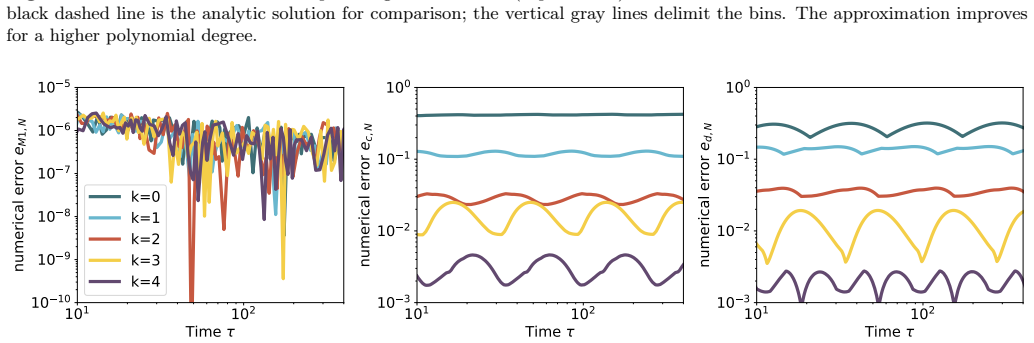
- The scheme demonstrates an experimental order of convergence of k+1 for pure coagulation and pure fragmentation benchmarks, and it reproduces the expected analytical equilibrium power-law slope g(x) ~ x^{-0.748} in the coupled aggregation-breakage test.
- By working with the conservative mass-density equation and using high-order Legendre polynomials within each mass bin, the method mitigates over-diffusion and numerical cancellation, enabling accurate evolution over about 18 orders of magnitude in mass with relatively few bins.
- The computational cost scales as N^3 for polynomial order k≥1 and N^2 for k=0, which is moderate enough for operator splitting in hydrodynamic codes.
Where Pith is reading between the lines
- If the conservation proof is general, the same reordering-and-analytic-integral trick may extend to multidimensional population-balance equations, helping to address the steep O(N^{2d}) scaling with tensor-product DG bases.
- A key hidden assumption is the symmetry of the breakage kernel under exchange of the two colliding masses; a testable extension is to check the scheme on asymmetric breakage prescriptions, where conservation might be violated.
- The paper's convergence demonstration uses a toy setup with constant root-mean-square relative velocity; a more demanding test would be to repeat it with realistic size-dependent relative velocities to see if the high-order accuracy holds in a physically evolving collision environment.
- Enabling mass transfer may change predictions of maximum grain size in protoplanetary disks, because high-velocity collisions between very unequal grains can deposit mass onto large particles and let them grow past the standard fragmentation barrier.
Editorial analysis
A structured set of objections, weighed in public.
Referee Report
Summary. The paper presents GRACE-DG, a discontinuous Galerkin (DG) solver for the general non-linear coagulation–fragmentation equation with a conservative mass-density formulation. Its central claimed contribution is a new conservative fragmentation flux (Eq. 9) that permits DG to treat breakage kernels containing Dirac delta functions, i.e., cratering and mass-transfer collisions of the form given in Eq. 46, which could not be handled by the existing Lombart et al. (2024) DG fragmentation solver. The paper validates the scheme on pure coagulation (constant and additive kernels), pure fragmentation, and a coupled aggregation–breakage problem with a mass-transfer/cratering prescription. Pure-process benchmarks reproduce expected k+1 order of convergence, while the coupled test is compared only against a high-resolution run of the same scheme.
Significance. If the new flux formulation is correct and robust, it is a meaningful extension of DG-based dust growth codes: it removes the delta-function limitation of Lombart et al. (2024) and enables high-order, conservative treatment of cratering and mass transfer, which are important for dust evolution in protoplanetary disks. The analytic derivation in Appendix A is a genuine contribution and appears internally consistent under the stated symmetry and local-mass-conservation assumptions. The paper also provides open-source code (Zenodo citation), which is a reproducible resource for the community. The pure coagulation and pure fragmentation benchmarks are clean and successfully demonstrate the expected k+1 convergence and bounded errors over many orders of magnitude in mass. However, the central claim that the solver exhibits good convergence for coupled aggregation–breakage and mass-transfer is not yet supported by the quantitative evidence presented: the only coupled test is a self-convergence test against the same scheme, and the paper itself acknowledges that increasing polynomial order does not substantially improve the high-mass end, where mass transfer acts. The result is therefore
major comments (3)
- [§4.5, Fig. 10] The only demonstration of the new mass-transfer capability is a self-convergence test. The paper explicitly states there is no known analytical solution, and the reference solution is N=300, k=4 of the same scheme. No quantitative error norms, EOC, or comparison against an independent method are reported for the coupled case. Moreover, the text states that increasing k 'does not substantially enhance the accuracy of the mass distribution at the high-mass end', while mass-transfer/cratering deposits remnant mass precisely in that high-mass region (m_left close to y+z). Thus the very quantity the new scheme is designed to capture is the least-controlled part of the solution. I request an independent reference (e.g., a well-resolved non-DG method, a manufactured solution, or a dedicated convergence study with error tables separated for the power-law and remnant channels), or a clearly softe
- [Appendix A, Eq. A6] The derivation of the conservative flux uses the symmetry of the integrand K(y-z,z)b(x,y-z,z)f(y-z)f(z) under exchange (y-z)<->z. This is not stated as an assumption on the breakage kernel. For an arbitrary non-linear breakage kernel b(x,u,v), especially projectile/target-asymmetric prescriptions, the equality in Eq. A6 may fail, and Eq. 9 would not be equivalent to Eq. 6. The specific kernel in Eq. 46 is symmetric, so the paper's numerical examples are not affected, but the claim of 'general non-linear fragmentation' is overstated unless this symmetry condition is stated explicitly and its domain of validity is delineated. If asymmetric or tabulated breakage kernels are intended for future use, the paper should explain how the flux formulation must be modified.
- [§3.3 and §4.5] The default flux choice (Δx=0, non-conservative) is adopted 'unless explicitly stated', but the coupled aggregation–breakage test of §4.5 does not state which flux type is used. Since mass conservation is a central advertised feature and the test aims to demonstrate mass transfer, the paper should specify the flux type for this test and report the evolution of total mass or the mass-conservation error. This would also clarify how the upper boundary is handled when remnant masses approach y+z.
minor comments (7)
- [Figure 1] 'Fragmantation' should be 'Fragmentation'.
- [Figure 4 caption] 'consatnt kernel' should be 'constant kernel'.
- [Keywords] 'physcis' should be 'physics'.
- [§4.1] 'relatve errors' should be 'relative errors'.
- [§4.5] The values Δv_rms=0.5, v_b=0.1, v_f=1 are described as chosen for illustration, but the section still calls the setup a 'toy model' in the text; please state clearly in the main text that this is an illustrative test with no direct physical calibration, and do not call it a benchmark in the section title or abstract.
- [Acknowledgments] The acknowledgment thanks 'the anonymous referee' before the review process; this is premature in a submitted manuscript and should be removed or deferred.
- [§3.3] The observation that optimal quadrature order is Q=k+1 rather than Q=k is interesting but is only stated without explanation; a brief justification or reference would improve clarity.
Circularity Check
No significant circularity: the new fragmentation flux is derived from the governing equation; validation is self-referential but not circular.
full rationale
The central derivation is self-contained analytic manipulation, not a fit or a renamed input. Starting from the non-conservative general fragmentation equation (Eq. 6 / Eq. A1), Appendix A postulates the conservative flux form (Eq. A3), applies the Leibniz rule (Eq. A4), uses local mass conservation ∫_0^{x+v} w b(w,x,v)dw = x+v, and invokes symmetry of the two colliding masses (Eq. A6) to recover exactly the original equation (Eq. A7). No fitted parameter, no external 'prediction' target, and no self-cited uniqueness theorem is inserted into this derivation. The delta-function breakage kernel (Eq. 46) is an adopted physical model from Kobayashi & Tanaka (2010) and Hirashita et al. (2021); Appendix B only evaluates the innermost integral analytically, producing the piecewise cases B9-B10, which are not used to force a desired answer. The coupled aggregation-breakage test in Section 4.5 is benchmarked only against a higher-resolution run of the same scheme, and the paper explicitly concedes that increasing polynomial order does not substantially improve the high-mass end and defers the issue to future work; this is a validation gap, not a circular reduction of the claim. Self-citations (Yang et al. 2026 code release; Huang & Bai 2022; Chen & Bai 2026 as hydrodynamic host codes) are pointer references and are not load-bearing evidence. Therefore, no specific circular step can be exhibited.
Axiom & Free-Parameter Ledger
free parameters (5)
- Δv_rms =
0.5
- v_b =
0.1
- v_f =
1
- α =
-1.83
- Q (quadrature order) =
k+1
axioms (4)
- domain assumption The collision-induced coagulation-fragmentation process is governed by the Smoluchowski equation and the non-linear fragmentation equation (Eq. 6).
- domain assumption The breakage kernel b(x,y,z) is symmetric under exchange of the colliding masses y and z, and satisfies local mass conservation.
- ad hoc to paper The fragment mass distribution can be written as a power law plus a single remnant delta function (Eq. 46).
- standard math The DG scheme with the linear scaling limiter (Eq. 18-19) preserves positivity and accuracy.
read the original abstract
Dust plays a crucial role in protoplanetary disks (PPDs) evolution and planet formation, influencing disk dynamics through gas-dust coupling, regulating disk temperature by dominating continuum opacity, and altering disk ionization fraction by capturing free electrons. In this work, we develop a high-order discontinuous Galerkin (DG) method-based open-source code GRACE-DG to solve the collision-induced coagulation-fragmentation equations. In particular, we have derived a new conservative formulation for the non-linear fragmentation term, which enables the DG method to capture the mass transfer process. The new solver exhibits good convergence in coupled aggregation and breakage simulations, making it highly suitable for future integration into hydrodynamic codes.
Figures




Reference graph
Works this paper leans on
-
[1]
Bai , X.-N., & Stone , J. M. 2010, , 722, 1437, 10.1088/0004-637X/722/2/1437
-
[2]
2024, , 62, 157, 10.1146/annurev-astro-071221-052705
Birnstiel , T. 2024, , 62, 157, 10.1146/annurev-astro-071221-052705
-
[3]
Birnstiel , T., Dullemond , C. P., & Brauer , F. 2009, , 503, L5, 10.1051/0004-6361/200912452
-
[4]
2010, , 513, A79, 10.1051/0004-6361/200913731
---. 2010, , 513, A79, 10.1051/0004-6361/200913731
-
[5]
2012, , 539, A148, 10.1051/0004-6361/201118136
Birnstiel , T., Klahr , H., & Ercolano , B. 2012, , 539, A148, 10.1051/0004-6361/201118136
-
[6]
Birnstiel , T., Ormel , C. W., & Dullemond , C. P. 2011, , 525, A11, 10.1051/0004-6361/201015228
-
[7]
Bodenheimer , P., & Pollack , J. B. 1986, , 67, 391, 10.1016/0019-1035(86)90122-3
-
[8]
Brauer , F., Dullemond , C. P., & Henning , T. 2008, , 480, 859, 10.1051/0004-6361:20077759
-
[9]
2017, , 834, 145, 10.3847/1538-4357/834/2/145
Bukhari Syed , M., Blum , J., Wahlberg Jansson , K., & Johansen , A. 2017, , 834, 145, 10.3847/1538-4357/834/2/145
-
[10]
2012, , 753, 119, 10.1088/0004-637X/753/2/119
Charnoz , S., & Taillifet , E. 2012, , 753, 119, 10.1088/0004-637X/753/2/119
-
[11]
2026, , 283, 48, 10.3847/1538-4365/ae4723
Chen , Z., & Bai , X.-N. 2026, , 283, 48, 10.3847/1538-4365/ae4723
-
[12]
2001, Journal of Scientific Computing, 16, 173, 10.1023/A:1012873910884
Cockburn, B., & Shu, C.-W. 2001, Journal of Scientific Computing, 16, 173, 10.1023/A:1012873910884
-
[13]
N., Okuzumi , S., Flock , M., Pinilla , P., & Dzyurkevich , N
Delage , T. N., Okuzumi , S., Flock , M., Pinilla , P., & Dzyurkevich , N. 2022, , 658, A97, 10.1051/0004-6361/202141689
-
[14]
Dohnanyi , J. S. 1969, , 74, 2531, 10.1029/JB074i010p02531
-
[15]
Growth of Dust as the Initial Step Toward Planet Formation
Dominik , C., Blum , J., Cuzzi , J. N., & Wurm , G. 2007, in Protostars and Planets V, ed. B. Reipurth , D. Jewitt , & K. Keil , 783, 10.48550/arXiv.astro-ph/0602617
work page internal anchor Pith review Pith/arXiv arXiv doi:10.48550/arxiv.astro-ph/0602617 2007
-
[16]
Dominik , C., & Dullemond , C. P. 2024, , 682, A144, 10.1051/0004-6361/202347716
-
[17]
Dullemond , C. P., & Dominik , C. 2004, , 421, 1075, 10.1051/0004-6361:20040284
-
[18]
2005, , 434, 971, 10.1051/0004-6361:20042080
---. 2005, , 434, 971, 10.1051/0004-6361:20042080
-
[19]
Eriksson , L. E. J., Pfeil , T., Kaufmann , N., & Vaikundaraman , V. 2026, arXiv e-prints, arXiv:2603.22550, 10.48550/arXiv.2603.22550
-
[20]
2001, SIAM Review, 43, 89, 10.1137/S003614450036757X
Gottlieb , S., Shu , C.-W., & Tadmor , E. 2001, SIAM Review, 43, 89, 10.1137/S003614450036757X
-
[21]
B., Pagani , L., & Lef \`e vre , C
Hirashita , H., Il'in , V. B., Pagani , L., & Lef \`e vre , C. 2021, , 502, 15, 10.1093/mnras/staa4018
-
[22]
Ho , K. W., Li , H., & Li , S. 2024, , 975, L34, 10.3847/2041-8213/ad8655
-
[23]
A., Okuzumi , S., Arakawa , S., & Fukai , R
Homma , K. A., Okuzumi , S., Arakawa , S., & Fukai , R. 2024, , 10.1093/pasj/psae052
-
[24]
2022, , 262, 11, 10.3847/1538-4365/ac76cb
Huang , P., & Bai , X.-N. 2022, , 262, 11, 10.3847/1538-4365/ac76cb
-
[25]
Ida , S., & Lin , D. N. C. 2004, , 604, 388, 10.1086/381724
doi:10.1086/381724 2004
-
[26]
Ivlev , A. V., Akimkin , V. V., & Caselli , P. 2016, , 833, 92, 10.3847/1538-4357/833/1/92
-
[27]
Johansen , A., Oishi , J. S., Mac Low , M.-M., et al. 2007, , 448, 1022, 10.1038/nature06086
-
[28]
Jones , A. P., Tielens , A. G. G. M., & Hollenbach , D. J. 1996, , 469, 740, 10.1086/177823
doi:10.1086/177823 1996
-
[29]
L., Pfeil , T., Stammler , S., et al
Kaufmann , N. L., Pfeil , T., Stammler , S., et al. 2025, arXiv e-prints, arXiv:2511.20764, 10.48550/arXiv.2511.20764
-
[30]
2010, , 206, 735, 10.1016/j.icarus.2009.10.004
Kobayashi , H., & Tanaka , H. 2010, , 206, 735, 10.1016/j.icarus.2009.10.004
-
[31]
Kostoglou , M., & Konstandopoulos , A. G. 2001, Journal of Aerosol Science, 32, 1399, 10.1016/S0021-8502(01)00056-8
-
[32]
2010, , 725, 1242, 10.1088/0004-637X/725/1/1242
Kothe , S., G \"u ttler , C., & Blum , J. 2010, , 725, 1242, 10.1088/0004-637X/725/1/1242
-
[33]
Krijt , S., Ciesla , F. J., & Bergin , E. A. 2016, , 833, 285, 10.3847/1538-4357/833/2/285
-
[34]
Li , R., Chen , Y.-X., & Lin , D. N. C. 2022, , 510, 5246, 10.1093/mnras/stab3677
-
[35]
Li , R., & Youdin , A. N. 2021, , 919, 107, 10.3847/1538-4357/ac0e9f
-
[36]
2020, , 892, L19, 10.3847/2041-8213/ab7fb2
Li , Y.-P., Li , H., Li , S., et al. 2020, , 892, L19, 10.3847/2041-8213/ab7fb2
-
[37]
2019, SIAM Journal on Scientific Computing, 41, B448, 10.1137/17M1150360
Liu , H., Gr \"o pler , R., & Warnecke , G. 2019, SIAM Journal on Scientific Computing, 41, B448, 10.1137/17M1150360
-
[38]
2024, , 533, 4410, 10.1093/mnras/stae2039
Lombart , M., Br \'e hier , C.-E., Hutchison , M., & Lee , Y.-N. 2024, , 533, 4410, 10.1093/mnras/stae2039
-
[39]
2022, , 517, 2012, 10.1093/mnras/stac2232
Lombart , M., Hutchison , M., & Lee , Y.-N. 2022, , 517, 2012, 10.1093/mnras/stac2232
-
[40]
2021, , 501, 4298, 10.1093/mnras/staa3682
Lombart , M., & Laibe , G. 2021, , 501, 4298, 10.1093/mnras/staa3682
-
[41]
2026, arXiv e-prints, arXiv:2601.07088, 10.48550/arXiv.2601.07088
Lombart , M., Lebreuilly , U., & Maury , A. 2026, arXiv e-prints, arXiv:2601.07088, 10.48550/arXiv.2601.07088
-
[42]
2023, , 670, A61, 10.1051/0004-6361/202244291
Marchand , P., Lebreuilly , U., Mac Low , M.-M., & Guillet , V. 2023, , 670, A61, 10.1051/0004-6361/202244291
-
[43]
2016 a , , 818, 16, 10.3847/0004-637X/818/1/16
Musiolik , G., Teiser , J., Jankowski , T., & Wurm , G. 2016 a , , 818, 16, 10.3847/0004-637X/818/1/16
-
[44]
2016 b , , 827, 63, 10.3847/0004-637X/827/1/63
---. 2016 b , , 827, 63, 10.3847/0004-637X/827/1/63
-
[45]
2019, , 873, 58, 10.3847/1538-4357/ab0428
Musiolik , G., & Wurm , G. 2019, , 873, 58, 10.3847/1538-4357/ab0428
-
[46]
1981, , 45, 517, 10.1016/0019-1035(81)90018-X
Nakagawa , Y., Nakazawa , K., & Hayashi , C. 1981, , 45, 517, 10.1016/0019-1035(81)90018-X
-
[47]
2009, , 698, 1122, 10.1088/0004-637X/698/2/1122
Okuzumi , S. 2009, , 698, 1122, 10.1088/0004-637X/698/2/1122
-
[48]
2012, , 753, L8, 10.1088/2041-8205/753/1/L8
Okuzumi , S., & Hirose , S. 2012, , 753, L8, 10.1088/2041-8205/753/1/L8
-
[49]
2016, , 821, 82, 10.3847/0004-637X/821/2/82
Okuzumi , S., Momose , M., Sirono , S.-i., Kobayashi , H., & Tanaka , H. 2016, , 821, 82, 10.3847/0004-637X/821/2/82
-
[50]
2012, , 752, 106, 10.1088/0004-637X/752/2/106
Okuzumi , S., Tanaka , H., Kobayashi , H., & Wada , K. 2012, , 752, 106, 10.1088/0004-637X/752/2/106
-
[51]
2009, , 707, 1247, 10.1088/0004-637X/707/2/1247
Okuzumi , S., Tanaka , H., & Sakagami , M.-a. 2009, , 707, 1247, 10.1088/0004-637X/707/2/1247
-
[52]
Ormel , C. W., & Cuzzi , J. N. 2007, , 466, 413, 10.1051/0004-6361:20066899
-
[53]
Ormel , C. W., & Klahr , H. H. 2010, , 520, A43, 10.1051/0004-6361/201014903
-
[54]
W., Spaans , M., & Tielens , A
Ormel , C. W., Spaans , M., & Tielens , A. G. G. M. 2007, , 461, 215, 10.1051/0004-6361:20065949
-
[55]
2024, , 691, A45, 10.1051/0004-6361/202449337
Pfeil , T., Birnstiel , T., & Klahr , H. 2024, , 691, A45, 10.1051/0004-6361/202449337
-
[56]
A Neural Network Subgrid Model of the Early Stages of Planet Formation
Pfeil , T., Cranmer , M., Ho , S., et al. 2022, arXiv e-prints, arXiv:2211.04160, 10.48550/arXiv.2211.04160
work page internal anchor Pith review Pith/arXiv arXiv doi:10.48550/arxiv.2211.04160 2022
-
[57]
2021, , 652, A106, 10.1051/0004-6361/202140601
Pillich , C., Bogdan , T., Landers , J., Wurm , G., & Wende , H. 2021, , 652, A106, 10.1051/0004-6361/202140601
-
[58]
B., Hubickyj , O., Bodenheimer , P., et al
Pollack , J. B., Hubickyj , O., Bodenheimer , P., et al. 1996, , 124, 62, 10.1006/icar.1996.0190
arXiv 1996
-
[59]
2025, arXiv e-prints, arXiv:2507.06298, 10.48550/arXiv.2507.06298
Qian , Y., & Wu , Y. 2025, arXiv e-prints, arXiv:2507.06298, 10.48550/arXiv.2507.06298
-
[60]
Robinson , A., Booth , R. A., & Owen , J. E. 2024, , 529, 1524, 10.1093/mnras/stae624
-
[61]
2016, , 589, A15, 10.1051/0004-6361/201527069
Sato , T., Okuzumi , S., & Ida , S. 2016, , 589, A15, 10.1051/0004-6361/201527069
-
[62]
Scott , W. T. 1968, Journal of the Atmospheric Sciences, 25, 54, 10.1175/1520-0469(1968)025<0054:ASOCDC>2.0.CO;2
-
[63]
Shu, C.-W. 2008. https://api.semanticscholar.org/CorpusID:52027743
2008
-
[64]
Smoluchowski , M. V. 1916, Zeitschrift fur Physik, 17, 557
1916
-
[65]
Stammler , S. M., & Birnstiel , T. 2022, , 935, 35, 10.3847/1538-4357/ac7d58
-
[66]
M., Birnstiel , T., Pani \'c , O., Dullemond , C
Stammler , S. M., Birnstiel , T., Pani \'c , O., Dullemond , C. P., & Dominik , C. 2017, , 600, A140, 10.1051/0004-6361/201629041
-
[67]
Stone , J. M., Tomida , K., White , C. J., & Felker , K. G. 2020, , 249, 4, 10.3847/1538-4365/ab929b
-
[68]
2018, , 863, 97, 10.3847/1538-4357/aad1f4
Tamfal , T., Dr a \.z kowska , J., Mayer , L., & Surville , C. 2018, , 863, 97, 10.3847/1538-4357/aad1f4
-
[69]
1996, , 123, 450, 10.1006/icar.1996.0170
Tanaka , H., Inaba , S., & Nakazawa , K. 1996, , 123, 450, 10.1006/icar.1996.0170
arXiv 1996
-
[70]
Terquem , C. E. J. M. L. J. 2008, , 689, 532, 10.1086/592597
-
[71]
2025, arXiv e-prints, arXiv:2507.21239, 10.48550/arXiv.2507.21239
Vaikundaraman , V., Gurrutxaga , N., & Dr a \.z kowska , J. 2025, arXiv e-prints, arXiv:2507.21239, 10.48550/arXiv.2507.21239
-
[72]
Vericel , A., Gonzalez , J.-F., Price , D. J., Laibe , G., & Pinte , C. 2021, , 507, 2318, 10.1093/mnras/stab2263
-
[73]
I., Akimkin , V., Stoyanovskaya , O., Pavlyuchenkov , Y., & Liu , H
Vorobyov , E. I., Akimkin , V., Stoyanovskaya , O., Pavlyuchenkov , Y., & Liu , H. B. 2018, , 614, A98, 10.1051/0004-6361/201731690
-
[74]
Watanabe , T. K., & Kataoka , A. 2026, arXiv e-prints, arXiv:2605.18353. 2605.18353
Pith/arXiv arXiv 2026
-
[75]
Weidenschilling , S. J. 1980, , 44, 172, 10.1016/0019-1035(80)90064-0
-
[76]
Wetherill , G. W. 1990, , 88, 336, 10.1016/0019-1035(90)90086-O
-
[77]
2012, , 540, A73, 10.1051/0004-6361/201118475
Windmark , F., Birnstiel , T., G \"u ttler , C., et al. 2012, , 540, A73, 10.1051/0004-6361/201118475
-
[78]
Woitke , P., Kamp , I., & Thi , W. F. 2009, , 501, 383, 10.1051/0004-6361/200911821
-
[79]
2005, , 178, 253, 10.1016/j.icarus.2005.04.002
Wurm , G., Paraskov , G., & Krauss , O. 2005, , 178, 253, 10.1016/j.icarus.2005.04.002
-
[80]
Yang , J., Chen , Z., & Bai , X.-N. 2026, GRACE-DG: A Discontinuous Galerkin code for GRAin Collisional Evolution , v1.0, Zenodo, 10.5281/zenodo.21023229
discussion (0)
Sign in with ORCID, Apple, or X to comment. Anyone can read and Pith papers without signing in.