REVIEW 3 major objections 4 minor 114 references
This paper proposes exact three-point functions for N=2 Liouville theory on the sphere, derived through its mirror duality with the SL(2)/U(1) supercoset.
Reviewed by Pith at T0; open to challenge. T0 means a machine referee read the full paper against a public rubric. the ladder, T0–T4 →
T0 review · deepseek-v4-flash
2026-08-01 01:50 UTC pith:3P7O3AR2
load-bearing objection First explicit AMV structure constants for N=2 Liouville, with real pole and semiclassical checks, but the key WNV integrals in Appendix B are corrupted as printed and the derivation cannot be verified until they are restored. the 3 major comments →
Toward the Structure Constants of mathcal{N}=2 Liouville Theory
The pith
A machine-rendered reading of the paper's core claim, the machinery that carries it, and where it could break.
Core claim
Central claim: the three-point structure constants of spacelike N=2 Liouville theory on the sphere are eq. (3.27) (angular-momentum preserving, with the integral W unevaluated) and eq. (3.35) (angular-momentum violating, explicit in Ypsilon and Gamma functions). The derivation bypasses the broken b<->b^{-1} symmetry by using the exact mirror duality to the SL(2)_k/U(1) supercoset, the 2d fermionic black hole, translating its winding-preserving and violating correlators into Liouville's angular-momentum-preserving and violating ones. The paper verifies that the formulas reproduce the perturbative poles from a zero-mode path-integral treatment, and that their b->0 semiclassical limit agrees wi
What carries the argument
The load-bearing object is the mirror-symmetry dictionary between N=2 Liouville and the SL(2)_k/U(1) supercoset (Table 1 / eq. 3.23), which reverses the roles of winding and angular momentum. The dictionary identifies Liouville momenta (alpha, alpha-tilde, eta) with coset labels (j, m, n), and maps the coset's winding-number-violating correlators, built from a degenerate operator with h=q_R=0, into angular-momentum-violating correlators of Liouville. The explicit structures are the Ypsilon-function ratios, which encode the double-lattice pole structure; the complex Mellin transforms that diagonalize the J^3 charge; and the unevaluated integral W of eq. (3.27). The paper also relies on the co
Load-bearing premise
The mirror-symmetry dictionary is exact and complete, and in particular the anti-holomorphic R-charge is mapped without its mirror-automorphism sign flip; if that sign flip is actually required, the angular-momentum-violating formula (3.35) would violate its own charge-conservation constraints.
What would settle it
Compute a four-point function on the Liouville side with one degenerate external field, impose the null-state equation, and require crossing symmetry between the two OPE channels built from the proposed three-point functions (3.27)/(3.35) and the known conformal blocks. Any mismatch in the residues, or a direct evaluation of W that fails to reproduce the required pole structure, would falsify the proposal.
If this is right
- Equations (3.27) and (3.35) provide the three-point building blocks from which higher-point correlators on the sphere can in principle be assembled by conformal-block decomposition.
- The pole structure of both sectors is governed by the same Ypsilon-function double lattice, with the angular-momentum-violating poles shifted by half-integers, matching a Coulomb-gas analysis with unequal screening numbers.
- The chiral-chiral ring coefficient of 1/2-BPS operators is protected: it equals b times a momentum-conservation delta and receives no quantum corrections.
- The semiclassical match requires summing over all complex saddles and rotating a negative mode; this points to the integration cycle of the N=2 Liouville path integral.
- The angular-momentum-violating formula (3.35) is fully explicit, allowing direct analytic continuation and numerical evaluation, while (3.27) leaves the single integral W to be evaluated case by case.
Where Pith is reading between the lines
- Because the dictionary is bijective, the same two formulas should also cover R-sector correlators after spectral flow by half-integers; this is a direct, testable extension the paper does not work out.
- The unevaluated W integral in (3.27) likely admits an explicit closed form for generic momenta; if found, crossing symmetry of the four-point function would provide a nontrivial consistency check of the whole proposal.
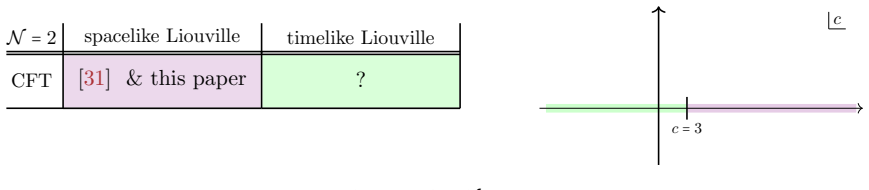
- If the mirror duality survives analytic continuation to c<3, the same derivation gives exact correlators for timelike N=2 Liouville, making concrete the de Sitter supergravity interpretation the paper motivates.
- Combining these bulk structure constants with the available boundary data should yield a complete boundary-bulk dictionary; since the boundary data are already fixed by modular bootstrap, any mismatch would single out the bulk proposal rather than the boundary.
Editorial analysis
A structured set of objections, weighed in public.
Referee Report
Summary. The paper proposes exact three-point structure constants for spacelike N=2 Liouville theory on the sphere, relying on the mirror duality with the SL(2)_k/U(1) supercoset (fermionic cigar). In the angular-momentum-preserving (AMP) sector the proposal is eq. (3.27), which contains an unevaluated two-dimensional integral W; in the angular-momentum-violating (AMV) sector the proposal is eq. (3.35), which is fully explicit in Ypsilon and Gamma functions. The paper tests these formulas against the zero-mode pole structure of the path integral (§4.1) and against a one-loop semiclassical expansion of non-BPS three-point functions (§4.2–4.5), finding agreement up to undetermined normalization factors. It also computes the chiral–chiral ring coefficient of 1/2-BPS operators (§5). The central claim is that eqs. (3.27) and (3.35) give the bulk structure constants in the two sectors, with the caveat that (3.27) is not fully explicit.
Significance. If the proposed formulas are correct, this is a substantial step: it provides the first concrete proposal for the exact bulk three-point functions of spacelike N=2 Liouville theory, whose lack of b↔b^{-1} self-duality blocks the standard Teschner bootstrap. The paper's internal checks are genuine and nontrivial: perturbative poles of the zero-mode integral (4.13)–(4.17) match the Ypsilon denominator structure in both sectors; the semiclassical path integral reproduces the e^{1/b²} saddle, the KPZ μ-dependence, the 1/sin(π/b²) saddle-sum factor, and the r-scaling set by c = 3 + 6/b²; and the chiral ring coefficient is a protected quantity independent of most data. However, the AMV formula (3.35) rests on the WNV supercoset derivation of §2.3.2, whose key Mellin/Beta integrals are printed in Appendix B with placeholder strings replacing the actual evaluations. The derivation as printed cannot be checked, so the AMV result is plausible but not established by the manuscript.
major comments (3)
- [Appendix B, eqs. (B.16), (B.19), (B.23), (B.24); §2.3.2, eqs. (2.81)–(2.82), (2.85)–(2.86), (2.91)–(2.92)] The derivation of the WNV three-point function is unverifiable as printed. The complex Mellin integrals J_WNV in (2.81) and its w=+1 analogue (2.85) are the load-bearing steps: their results (2.82) and (B.25) feed directly into (2.92) and hence into the Liouville AMV structure constant (3.35). In Appendix B, however, equations (B.16), (B.19), (B.23) and (B.24) contain repeated placeholder strings (e.g. '⌟⟨⟨⟪rl⟫mo⟨⌟…', 'B1 C', 'B2 C', '˜B1 C', '˜B2 C') in place of the complex Beta evaluations. Thus the manuscript does not demonstrate that (2.82) and (B.25) follow from the stated substitutions and the Beta formula (B.1). This is a missing-support problem, not necessarily an error, but it blocks verification of the central AMV formula. Please replace the placeholders with the actual derivations.
- [§3.2, eq. (3.23); Appendix D.1, eq. (D.12)] The mirror dictionary omits the anti-holomorphic R-charge sign flip that the mirror automorphism (D.12) performs on the N=2 algebra. The text states: 'the well-known mapping q̄_R → −q̄_R induced by mirror symmetry is absent … because both anti-holomorphic R-charges have been deduced in the two theories separately.' This is a load-bearing assumption: if the sign flip is actually required, the R-charge conservation delta functions in (3.34)–(3.35) would be different and the claimed 1-1 mapping between supercoset and Liouville primaries would fail. Since the rest of the paper depends on Table 1 / (3.23), the dictionary must be justified by an explicit T-duality computation of the anti-holomorphic R-current charges, not only by matching dimensions and holomorphic charges.
- [§2.3.2, eqs. (2.75)–(2.76), (2.79)] The extraction of the degenerate-field m-basis correlator uses divergent Mellin limits: Φ_{k+2/2,±(k+2)/2,±(k+2)/2} is defined via limits x→∞ or x→0 of the divergent integrals (2.75), and the derivation afterwards drops branch phases e.g. (−1)^d in (2.79). While the final pole structure is consistent with the independent checks in §4.1 and §4.5, the branch and contour choices are not proven. Since the identification V_σ ≃ identity (h=q_R=0) also relies on the same limiting procedure, please state the precise contour/branch convention used and, if necessary, provide a regularized definition of the limits that makes the residue extraction unambiguous.
minor comments (4)
- [§3.3.1, eq. (3.27)] The AMP structure constant contains the unevaluated integral W(α_i, ᾱ_i, η_i). The paper acknowledges this and refers to ref. [69] for a closed form, but the main text would be more useful if the explicit closed form (or at least its domain of validity) were given or quoted, since (3.27) is one of the two central formulas.
- [Abstract and §2.1] Typographical slip: 'suupercoset model' in the sentence before eq. (2.34) should be 'supercoset model'. Also Table 1 is typeset as 'T able 1' in the PDF.
- [§2.3.2, eq. (2.58) and surrounding text] The notation for winding number uses w_i both as spectral flow parameter and as the integer winding entering (2.32); this is standard but should be stated explicitly in a single place, since the text later uses σ=±1 for the violation and the reader may confuse the two.
- [§5, eq. (5.9)] The chiral ring coefficient C^k_{ij}=b δ_{α_i+α_j, ᾱ_k} depends on the convention for taking residues of divergent correlators; this is stated in footnote 40, but it would help to state the choice of regulator explicitly in the main text before eq. (5.5), since the residue of W_b is computed with σ=−bε, τ=bε.
Circularity Check
No circularity: the load-bearing inputs are external, the Liouville formulas are dictionary translations rather than fits, and the Appendix B corruption is a missing-support issue, not a circular reduction.
full rationale
Walking the derivation chain, I find no step in which the claimed prediction is equivalent, by construction, to an input. The supercoset WNP and WNV structure constants rest on Teschner's H3+ structure constants (App. C), the Maldacena–Ooguri winding constraints [47], and Ribault's flowed-KZ equivalence [56]; these are external and are not derived from the target N=2 formulas. The Liouville-side formulas (3.27) and (3.35) are obtained by applying the explicit dictionary (3.23) to the supercoset answers, not by fitting parameters to the semiclassical data. The semiclassical checks of Section 4 follow from the action (3.1)/(4.6), the KPZ scaling (4.2)–(4.3), and independent one-loop determinant computations; they leave A(b) undetermined and compare only leading μ-, b-, and saddle-sum behavior, so they do not impose the structure constants by construction. Self-citations ([61,62] for path-integral techniques, [29,86,93] for related methods) supply tools, not the load-bearing result. Two non-circular risks are flagged: (i) the key WNV Mellin integrals in Appendix B are printed with placeholder strings ('B1 C', 'B2 C', '˜B1 C', '˜B2 C', etc.) in place of the complex Beta evaluations, so the printed derivation of (2.82)/(B.25), and hence of (3.35), cannot be checked as typeset; (ii) the dictionary deliberately drops the usual mirror-automorphism sign flip ¯q_R → −¯q_R (§3.2 vs D.12), a sign-convention/consistency concern rather than a circular one. Neither of these makes the result reduce to its inputs, so the circularity score is 0.
Axiom & Free-Parameter Ledger
free parameters (2)
- A(b)
- UV cutoff Λ_uv (path-integral regularization)
axioms (7)
- domain assumption N=2 Liouville is mirror-symmetric to the SL(2)_k/U(1) supercoset with the exact 1-1 dictionary of §3.2 (eq. (3.23), Table 1), including the no-sign-flip convention for q̄_R.
- domain assumption Teschner's H3+ structure constants (C.8)–(C.9) and the Ribault–Teschner relation to bosonic Liouville (2.55) are correct.
- domain assumption Winding number can be violated by at most N−2 units, and flowed KZ equations coincide with unflowed ones for spectral-flow violation ≤ 1 unit.
- ad hoc to paper The m-basis degenerate correlator is obtained from the x-basis four-point function by the divergent Mellin limits (2.76) and residue extraction.
- domain assumption The path-integral integration cycle is the contour C of (4.21), summing only the s ≥ 0 complex saddles (4.20), with one-loop determinants factorized as in (4.28), (4.41).
- domain assumption The N=2 Liouville central charge is non-renormalized, Q = b⁻¹ [72].
- standard math Complex Beta and Selberg integral evaluations (B.1), (4.55), with contour rotations of negative modes, are valid.
read the original abstract
We discuss the structure constants of spacelike $\mathcal{N}=2$ Liouville theory on the two-sphere. Due to the absence of a particular $b \leftrightarrow b^{-1}$ self-dual symmetry, where $b$ is the theory's coupling, the standard analytic bootstrap toolkit that was used to solve the bosonic and $\mathcal{N}=1$ theories cannot be implemented in a straightforward way. Our approach, instead, relies on the fact that $\mathcal{N}=2$ Liouville theory is dual by mirror symmetry to the $\mathrm{SL}(2)_k/\mathrm{U}(1)$ supercoset, whose target space is the $2$d fermionic black hole. Leveraging this duality, we obtain explicit expressions for the winding number preserving and violating structure constants on the supercoset side, and test them on the Liouville side through a semiclassical analysis finding agreement up to one-loop order. We also discuss the chiral rings of the theory and evaluate correlators of $\frac 12$-BPS operators.
Figures
Reference graph
Works this paper leans on
-
[1]
V. G. Knizhnik, A. M. Polyakov and A. B. Zamolodchikov,Fractal Structure of 2D Quantum Gravity,Mod. Phys. Lett. A3(1988) 819
1988
-
[2]
David,Conformal Field Theories Coupled to 2D Gravity in the Conformal Gauge,Mod
F. David,Conformal Field Theories Coupled to 2D Gravity in the Conformal Gauge,Mod. Phys. Lett. A3(1988) 1651
1988
-
[3]
Distler and H
J. Distler and H. Kawai,Conformal Field Theory and 2D Quantum Gravity,Nucl. Phys. B 321(1989) 509
1989
-
[4]
Polchinski,A Two-Dimensional Model for Quantum Gravity,Nucl
J. Polchinski,A Two-Dimensional Model for Quantum Gravity,Nucl. Phys. B324(1989) 123
1989
-
[5]
A. M. Polyakov,Quantum Geometry of Bosonic Strings,Phys. Lett. B103(1981) 207
1981
-
[6]
N. Seiberg and D. Shih,Minimal string theory,Comptes Rendus Physique6(2005) 165 [hep-th/0409306]
Pith/arXiv arXiv 2005
-
[7]
G. W. Moore, M. R. Plesser and S. Ramgoolam,Exact S matrix for 2-D string theory, Nucl. Phys. B377(1992) 143 [hep-th/9111035]
Pith/arXiv arXiv 1992
-
[8]
S. Collier, L. Eberhardt, B. M¨ uhlmann and V. A. Rodriguez,The Virasoro minimal string, SciPost Phys.16(2024) 057 [2309.10846]
Pith/arXiv arXiv 2024
-
[9]
S. Collier, L. Eberhardt, B. M¨ uhlmann and V. A. Rodriguez,The complex Liouville string: The worldsheet,SciPost Phys.19(2025) 033 [2409.18759]
Pith/arXiv arXiv 2025
-
[10]
S. Collier, L. Eberhardt, B. M¨ uhlmann and V. A. Rodriguez,The complex Liouville string: The matrix integral,SciPost Phys.18(2025) 154 [2410.07345]
Pith/arXiv arXiv 2025
-
[11]
S. Collier, L. Eberhardt, B. M¨ uhlmann and V. A. Rodriguez,Complex Liouville String, Phys. Rev. Lett.134(2025) 251602 [2409.17246]
Pith/arXiv arXiv 2025
-
[12]
S. Collier, L. Eberhardt and B. M¨ uhlmann,A microscopic realization of dS 3,SciPost Phys. 18(2025) 131 [2501.01486]
Pith/arXiv arXiv 2025
-
[13]
A. Blommaert, D. Tietto and H. Verlinde,SYK collective field theory as complex Liouville gravity,2509.18462
-
[14]
V. A. Fateev and A. V. Litvinov,Correlation functions in conformal Toda field theory. I., JHEP11(2007) 002 [0709.3806]
Pith/arXiv arXiv 2007
-
[15]
Brezin and V
E. Brezin and V. A. Kazakov,Exactly Solvable Field Theories of Closed Strings,Phys. Lett. B236(1990) 144
1990
-
[16]
M. R. Douglas and S. H. Shenker,Strings in Less Than One-Dimension,Nucl. Phys. B335 (1990) 635
1990
-
[17]
D. J. Gross and A. A. Migdal,Nonperturbative Two-Dimensional Quantum Gravity,Phys. Rev. Lett.64(1990) 127
1990
-
[18]
L. F. Alday, D. Gaiotto and Y. Tachikawa,Liouville Correlation Functions from Four-dimensional Gauge Theories,Lett. Math. Phys.91(2010) 167 [0906.3219]
Pith/arXiv arXiv 2010
-
[19]
H. Dorn and H. J. Otto,Two and three point functions in Liouville theory,Nucl. Phys. B 429(1994) 375 [hep-th/9403141]
Pith/arXiv arXiv 1994
-
[20]
A. B. Zamolodchikov and A. B. Zamolodchikov,Structure constants and conformal bootstrap in Liouville field theory,Nucl. Phys. B477(1996) 577 [hep-th/9506136]. 70
Pith/arXiv arXiv 1996
-
[21]
Teschner,On the Liouville three point function,Phys
J. Teschner,On the Liouville three point function,Phys. Lett. B363(1995) 65 [hep-th/9507109]
Pith/arXiv arXiv 1995
-
[22]
A. A. Belavin, A. M. Polyakov and A. B. Zamolodchikov,Infinite Conformal Symmetry in Two-Dimensional Quantum Field Theory,Nucl. Phys. B241(1984) 333
1984
-
[23]
C. Guillarmou, A. Kupiainen, R. Rhodes and V. Vargas,Conformal bootstrap in Liouville theory,Acta Mat.233(2024) 33 [2005.11530]
Pith/arXiv arXiv 2024
-
[24]
A. Kupiainen, R. Rhodes and V. Vargas,Integrability of Liouville theory: proof of the DOZZ Formula,1707.08785
-
[25]
S. Chatterjee and E. Witten,Liouville theory: an introduction to rigorous approaches, JHEP02(2025) 153 [2404.02001]
Pith/arXiv arXiv 2025
-
[26]
R. C. Rashkov and M. Stanishkov,Three point correlation functions in N=1 superLiouville theory,Phys. Lett. B380(1996) 49 [hep-th/9602148]
Pith/arXiv arXiv 1996
-
[27]
R. H. Poghossian,Structure constants in the N=1 superLiouville field theory,Nucl. Phys. B 496(1997) 451 [hep-th/9607120]
Pith/arXiv arXiv 1997
-
[28]
A. Belavin, V. Belavin, A. Neveu and A. Zamolodchikov,Bootstrap in Supersymmetric Liouville Field Theory. I. NS Sector,Nucl. Phys. B784(2007) 202 [hep-th/0703084]
Pith/arXiv arXiv 2007
-
[29]
B. M¨ uhlmann, V. Narovlansky and I. Tsiares,On the three-point functions in timelikeN= 1 Liouville CFT,JHEP02(2026) 236 [2505.08890]
arXiv 2026
-
[30]
M. Rangamani and J. Zheng,Towards the super Virasoro minimal string,JHEP09(2025) 061 [2505.08892]
Pith/arXiv arXiv 2025
-
[31]
Hosomichi,N=2 Liouville theory with boundary,JHEP12(2006) 061 [hep-th/0408172]
K. Hosomichi,N=2 Liouville theory with boundary,JHEP12(2006) 061 [hep-th/0408172]
Pith/arXiv arXiv 2006
-
[32]
Kazama and H
Y. Kazama and H. Suzuki,New N=2 Superconformal Field Theories and Superstring Compactification,Nucl. Phys. B321(1989) 232
1989
-
[33]
S. Mukhi and C. Vafa,Two-dimensional black hole as a topological coset model of c = 1 string theory,Nucl. Phys. B407(1993) 667 [hep-th/9301083]
Pith/arXiv arXiv 1993
-
[34]
H. Ooguri and C. Vafa,Two-dimensional black hole and singularities of CY manifolds, Nucl. Phys. B463(1996) 55 [hep-th/9511164]
Pith/arXiv arXiv 1996
-
[35]
A. Giveon and D. Kutasov,Little string theory in a double scaling limit,JHEP10(1999) 034 [hep-th/9909110]
Pith/arXiv arXiv 1999
-
[36]
K. Hori and A. Kapustin,Duality of the fermionic 2-D black hole and N=2 liouville theory as mirror symmetry,JHEP08(2001) 045 [hep-th/0104202]
Pith/arXiv arXiv 2001
-
[37]
Witten,On string theory and black holes,Phys
E. Witten,On string theory and black holes,Phys. Rev. D44(1991) 314
1991
-
[38]
Dijkgraaf, H
R. Dijkgraaf, H. L. Verlinde and E. P. Verlinde,String propagation in a black hole geometry,Nucl. Phys. B371(1992) 269
1992
-
[39]
A. Giveon and D. Kutasov,Comments on double scaled little string theory,JHEP01(2000) 023 [hep-th/9911039]
Pith/arXiv arXiv 2000
-
[40]
A. Giveon, A. Konechny, A. Pakman and A. Sever,Type 0 strings in a 2-d black hole, JHEP10(2003) 025 [hep-th/0309056]
Pith/arXiv arXiv 2003
-
[41]
C.-M. Chang, Y.-H. Lin, S.-H. Shao, Y. Wang and X. Yin,Little String Amplitudes (and the Unreasonable Effectiveness of 6D SYM),JHEP12(2014) 176 [1407.7511]. 71
Pith/arXiv arXiv 2014
-
[42]
V. A. Fateev, A. B. Zamolodchikov and Al. B. Zamolodchikov. unpublished
-
[43]
V. Kazakov, I. K. Kostov and D. Kutasov,A Matrix model for the two-dimensional black hole,Nucl. Phys. B622(2002) 141 [hep-th/0101011]
Pith/arXiv arXiv 2002
-
[44]
D. L. Jafferis and E. Schneider,Stringy ER = EPR,JHEP10(2022) 195 [2104.07233]
Pith/arXiv arXiv 2022
-
[45]
J. M. Maldacena and H. Ooguri,Strings in AdS(3) and SL(2,R) WZW model 1.: The Spectrum,J. Math. Phys.42(2001) 2929 [hep-th/0001053]
Pith/arXiv arXiv 2001
-
[46]
J. M. Maldacena, H. Ooguri and J. Son,Strings in AdS(3) and the SL(2,R) WZW model. Part 2. Euclidean black hole,J. Math. Phys.42(2001) 2961 [hep-th/0005183]
Pith/arXiv arXiv 2001
-
[47]
J. M. Maldacena and H. Ooguri,Strings in AdS(3) and the SL(2,R) WZW model. Part 3. Correlation functions,Phys. Rev. D65(2002) 106006 [hep-th/0111180]
Pith/arXiv arXiv 2002
-
[48]
L. Eberhardt and M. R. Gaberdiel,String theory on AdS 3 and the symmetric orbifold of Liouville theory,Nucl. Phys. B948(2019) 114774 [1903.00421]
Pith/arXiv arXiv 2019
-
[49]
A. Dei and L. Eberhardt,String correlators on AdS 3: three-point functions,JHEP08 (2021) 025 [2105.12130]
Pith/arXiv arXiv 2021
-
[50]
A. Dei and L. Eberhardt,String correlators on AdS 3: four-point functions,JHEP09(2021) 209 [2107.01481]
Pith/arXiv arXiv 2021
-
[51]
N. Kovensky,Lecture notes on strings in AdS 3 from the worldsheet and the AdS 3/CFT2 duality, 1, 2026,2601.06697
Pith/arXiv arXiv 2026
-
[52]
Teschner,On structure constants and fusion rules in the SL(2,C) / SU(2) WZNW model, Nucl
J. Teschner,On structure constants and fusion rules in the SL(2,C) / SU(2) WZNW model, Nucl. Phys. B546(1999) 390 [hep-th/9712256]
Pith/arXiv arXiv 1999
-
[53]
Teschner,Operator product expansion and factorization in the H+(3) WZNW model, Nucl
J. Teschner,Operator product expansion and factorization in the H+(3) WZNW model, Nucl. Phys. B571(2000) 555 [hep-th/9906215]
Pith/arXiv arXiv 2000
-
[54]
Teschner,Crossing symmetry in the H(3)+ WZNW model,Phys
J. Teschner,Crossing symmetry in the H(3)+ WZNW model,Phys. Lett. B521(2001) 127 [hep-th/0108121]
Pith/arXiv arXiv 2001
-
[55]
S. Ribault and J. Teschner,H+(3)-WZNW correlators from Liouville theory,JHEP06 (2005) 014 [hep-th/0502048]
Pith/arXiv arXiv 2005
-
[56]
S. Ribault,Knizhnik-Zamolodchikov equations and spectral flow in AdS(3) string theory, JHEP09(2005) 045 [hep-th/0507114]
Pith/arXiv arXiv 2005
-
[57]
C. Ahn, M. Stanishkov and M. Yamamoto,One point functions of N = 2 superLiouville theory with boundary,Nucl. Phys. B683(2004) 177 [hep-th/0311169]
Pith/arXiv arXiv 2004
-
[58]
T. Eguchi and Y. Sugawara,Modular bootstrap for boundary N = 2 Liouville theory,JHEP 01(2004) 025 [hep-th/0311141]
Pith/arXiv arXiv 2004
-
[59]
T. Eguchi and Y. Sugawara,SL(2,R) / U(1) supercoset and elliptic genera of noncompact Calabi-Yau manifolds,JHEP05(2004) 014 [hep-th/0403193]
Pith/arXiv arXiv 2004
-
[60]
C. Ahn, M. Stanishkov and M. Yamamoto,ZZ-branes of N = 2 super-Liouville theory, JHEP07(2004) 057 [hep-th/0405274]
Pith/arXiv arXiv 2004
-
[61]
D. Anninos, T. Bautista and B. M¨ uhlmann,The two-sphere partition function in two-dimensional quantum gravity,JHEP09(2021) 116 [2106.01665]
Pith/arXiv arXiv 2021
-
[62]
D. Anninos, P. Benetti Genolini and B. M¨ uhlmann,dS 2 supergravity,JHEP11(2023) 145 [2309.02480]. 72
Pith/arXiv arXiv 2023
-
[63]
G. W. Gibbons and S. W. Hawking,Cosmological Event Horizons, Thermodynamics, and Particle Creation,Phys. Rev. D15(1977) 2738
1977
-
[64]
L. J. Dixon, M. E. Peskin and J. D. Lykken,N=2 Superconformal Symmetry and SO(2,1) Current Algebra,Nucl. Phys. B325(1989) 329
1989
-
[65]
Elitzur, A
S. Elitzur, A. Forge and E. Rabinovici,Some global aspects of string compactifications, Nucl. Phys. B359(1991) 581
1991
-
[66]
Mandal, A
G. Mandal, A. M. Sengupta and S. R. Wadia,Classical solutions of two-dimensional string theory,Mod. Phys. Lett. A6(1991) 1685
1991
-
[67]
S. Ribault and V. Schomerus,Branes in the 2-D black hole,JHEP02(2004) 019 [hep-th/0310024]
Pith/arXiv arXiv 2004
-
[68]
O. Aharony, A. Giveon and D. Kutasov,LSZ in LST,Nucl. Phys. B691(2004) 3 [hep-th/0404016]
Pith/arXiv arXiv 2004
-
[69]
T. Fukuda and K. Hosomichi,Three point functions in sine-Liouville theory,JHEP09 (2001) 003 [hep-th/0105217]
Pith/arXiv arXiv 2001
-
[70]
Y. Hikida and V. Schomerus,H+(3) WZNW model from Liouville field theory,JHEP10 (2007) 064 [0706.1030]
Pith/arXiv arXiv 2007
-
[71]
K. Hori, S. Katz, A. Klemm, R. Pandharipande, R. Thomas, C. Vafa et al.,Mirror symmetry, vol. 1 ofClay mathematics monographs. AMS, Providence, USA, 2003
2003
-
[72]
Distler, Z
J. Distler, Z. Hlousek and H. Kawai,Superliouville Theory as a Two-Dimensional, Superconformal Supergravity Theory,Int. J. Mod. Phys. A5(1990) 391
1990
-
[73]
Antoniadis, C
I. Antoniadis, C. Bachas and C. Kounnas,N=2Superliouville and Noncritical Strings, Phys. Lett. B242(1990) 185
1990
-
[74]
Brink and J
L. Brink and J. H. Schwarz,Local Complex Supersymmetry in Two-Dimensions,Nucl. Phys. B121(1977) 285
1977
- [75]
-
[76]
T. Creutzig, Y. Hikida and P. B. Ronne,The FZZ duality with boundary,JHEP09(2011) 004 [1012.4731]
Pith/arXiv arXiv 2011
-
[77]
Schwimmer and N
A. Schwimmer and N. Seiberg,Comments on the N=2, N=3, N=4 Superconformal Algebras in Two-Dimensions,Phys. Lett. B184(1987) 191
1987
-
[78]
Ribault,Conformal field theory on the plane,1406.4290
S. Ribault,Conformal field theory on the plane,1406.4290
-
[79]
D. Harlow, J. Maltz and E. Witten,Analytic Continuation of Liouville Theory,JHEP12 (2011) 071 [1108.4417]
Pith/arXiv arXiv 2011
-
[80]
Goulian and M
M. Goulian and M. Li,Correlation functions in Liouville theory,Phys. Rev. Lett.66(1991) 2051
1991
discussion (0)
Sign in with ORCID, Apple, or X to comment. Anyone can read and Pith papers without signing in.