REVIEW 3 major objections 5 minor 34 references
Modelling Coincident Particle Production in Ultraperipheral Heavy Ion Collisions
T0 review · 3 major / 5 minor · reviewed 2026-08-07 · deepseek-v4-flash
Pith's one-line read This paper presents the first precise differential calculation of coincident rho0 meson photoproduction with dimuon production in ultraperipheral heavy-ion collisions, and shows it agrees with the measured rates.
desk verdict Useful first differential calculation of rho0+dimuon coincidences in UPCs; the shapes are solid, but the absolute-rate claim needs an explicit uncertainty on an unquantified cancellation. read the letter →
The pith
A machine-rendered reading of the paper's core claim, the machinery that carries it, and where it could break.
The reading
What carries the argument
The central object is the impact-parameter-dependent breakup probability $P_V(b_\perp)$ for coincident photoproduction, built from the photon flux $\tilde N(x,b_\perp)$ and the cross section $\sigma_{\gamma A \to V A}$, and inserted into the amplitude via the Fourier-transformed factor $\hat\Gamma^V_{X_1X_2}(s,b_\perp)^{1/2}$. This is the same machinery used for mutual ion dissociation, with the ion-dissociation cross section replaced by the exclusive photoproduction cross section. It converts a doubly photon-initiated process into a calculable correction that is then implemented in the SuperChic generator.
What would settle it
Re-analyse the ATLAS data with the non-resonant dipion background subtracted and the pion fiducial acceptance corrected; if the corrected coincidence fractions then disagree with the resonant SuperChic prediction by more than the combined uncertainties, the cancellation assumption underlying the comparison is false.
Extended reading notes
Core claim
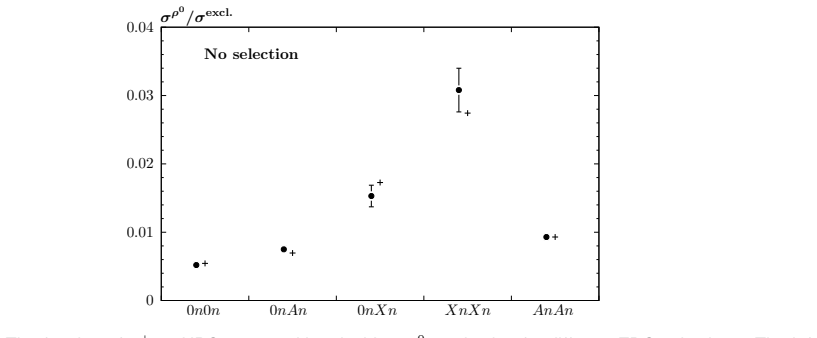
Coincident particle production in a UPC can be treated just like mutual ion dissociation: the probability that an additional exclusive state $V$ is photoproduced at impact parameter $b_\perp$ is $P_V(b_\perp) = 2 \int (d\omega/\omega) |\tilde N(x,b_\perp)|^2 \sigma_{\gamma A \to V A}(\omega)$, and this factor multiplies the survival and dissociation probabilities in the amplitude. Applying this to rho0 photoproduction alongside $\gamma\gamma \to \mu^+\mu^-$, the paper finds a coincidence fraction at the percent level that grows as the interaction becomes less peripheral: it is smallest for the 0n0n ZDC selection, which favours large impact parameters, and largest for XnXn, and it rises with dimuon invariant mass and falls with dimuon rapidity for the most peripheral classes. The calculations, normalized to the measured rho0 UPC cross section, reproduce the ATLAS coincidence fractions within uncertainties.
Load-bearing premise
The central comparison assumes that the roughly 24% loss of rho0 events from the ATLAS pion acceptance is almost exactly offset by the roughly 20% non-resonant dipion contribution, so that a purely resonant rho0 prediction can be compared directly with data; the paper itself calls the non-resonant estimate only an estimate.
Editorial extensions
If this is right
- The coincidence fraction is not a constant percent; it varies with ZDC class and dimuon kinematics, so UPC predictions that ignore it will fail at the percent level in a non-uniform way.
- The measured coincident rho0-plus-dimuon production can be used as a new probe of the impact-parameter, or peripherality, dependence of UPC production.
- Coincident electron-pair production near threshold is predicted to be effectively ubiquitous, so exclusivity vetos and unitarisation must account for it.
- Coincident muon-pair production is very suppressed, consistent with earlier estimates in the literature.
- The predicted average dimuon acoplanarity shifts when a coincident rho0 is required, giving a new observable signature of the peripherality mechanism.
Reading between the lines
- If the cancellation of pion-acceptance loss and non-resonant dipion contribution breaks down in future data, the absolute coincidence fractions would need rescaling, but the differential trends with ZDC class and dimuon kinematics should survive; a dedicated measurement with varied pion transverse-momentum thresholds could test this.
- The same impact-parameter formalism applies directly to coincident photoproduction of other vector mesons such as J/psi, omega, and phi, whose rates are estimated to be one to two orders of magnitude lower but potentially observable, providing further checks of the mechanism.
- The predicted coupling of coincidence rate to peripherality suggests that coincident production could serve as a self-calibrating handle on the ion-ion impact parameter in UPCs, with possible consequences for nuclear-structure and beyond-standard-model studies that the paper only gestures toward.
Editorial analysis
A structured set of objections, weighed in public.
Referee Report
Summary. The paper presents a theoretical framework for coincident particle production in ultraperipheral heavy ion collisions, implemented in the SuperChic Monte Carlo generator. The central application is the coincident photoproduction of a rho0 meson in association with muon pair production, motivated by a recent ATLAS measurement. The paper compares predictions with ATLAS data for the coincidence fraction as a function of ZDC neutron selection and dimuon kinematic cuts, and reports good agreement. It also discusses coincident two-photon-initiated lepton pair production and the implications of coincident production for exclusivity vetos in standard UPC measurements.
Significance. If correct, the paper provides the first detailed differential predictions for a newly measured coincident UPC process and makes the calculation publicly available in SuperChic. The predicted variation of the coincidence fraction across ZDC classes and with dimuon rapidity, invariant mass, and leading-photon energy is non-trivial and appears to capture the trends seen in the ATLAS data. The discussion of exclusivity-veto corrections is a useful practical contribution. However, the absolute normalization of the coincidence rate is not fully predicted: it is adjusted to match the ATLAS AnAn no-selection point, and the treatment of the pion acceptance and non-resonant dipion contributions relies on an unquantified cancellation. The paper's claim to provide 'the first precise theoretical calculation of the expected rate' therefore overstates what is demonstrated, even though the relative predictions are a substantial and likely robust achievement.
major comments (3)
- [Section 3.2 (normalization of σ_{γA→ρA})] The absolute coincidence fraction is not a parameter-free prediction. In Section 3.2, the value of σ_{γA→V A} is 'chosen so as to match the ATLAS AnAn (no selection) results'; consequently the agreement of Fig. 2 at that point is by construction. The abstract and conclusions nevertheless describe the calculation as 'the first precise theoretical calculation of the expected rate.' The authors should either reframe the central claim to emphasize that only the relative dependence on ZDC selection and kinematics is predicted, or present an absolute prediction based solely on the ALICE input and quantify the resulting difference from the ATLAS normalization.
- [Section 3.2 (pion acceptance and non-resonant cancellation)] The comparison to ATLAS relies on the assumption that a ~76% pion-acceptance suppression and a ~20% non-resonant dipion contribution cancel. The paper gives no uncertainty on either factor, and the residual of this cancellation enters multiplicatively in the predicted coincidence fraction. A few-percent error in the cancellation therefore changes the absolute rate by tens of percent. This should be quantified and propagated into Figs. 2 and 3, or the absolute-rate claim should be downgraded to a statement about relative trends.
- [Section 3.2 (non-resonant fraction)] The quoted non-resonant contribution is itself uncertain at the level of 15-35% depending on fit, and the paper states that 'this can only be considered as an estimate.' Since this estimate is a central input to the cancellation used to set the absolute scale, the uncertainty on the 20% value should be propagated into the quoted coincidence fractions. Without this, the agreement in absolute rate is not quantitatively established.
minor comments (5)
- [Fig. 1 caption] The caption contains a duplicated phrase: 'multiplied by a factor of multiplied by a factor of 50.'
- [Section 3.2, opening paragraph] The sentence 'we presented detailed numerical results' should read 'we present detailed numerical results' to match the present-tense style of the section.
- [Section 2.3] The notation 'AnAn' is introduced indirectly via 'An is inclusive with respect to neutron production'; a brief explicit definition at first use would improve clarity.
- [Conclusions] The sentence 'Results for this are found' is unclear; consider 'Results for this process are found' for readability.
- [Abstract vs. Conclusions] The abstract says 'first detailed and differential predictions' while the conclusion says 'first precise theoretical calculation of the expected rate'; the latter is too strong given the normalization choice, and the wording should be aligned.
Circularity Check
Absolute-rate agreement is partly by construction: the γA→ρ0A normalization is chosen to match the ATLAS AnAn rate, and all coincident rates scale linearly with it; differential ZDC/kinematic trends remain independent predictions.
-
fitted input called prediction
[Section 3.2, paragraph after Eq. (15) and the Fig. 2 comparison]
"We note that the precise value is chosen so as to match the ATLAS AnAn (no selection) results, subject to the considerations below, but as noted above, it is entirely consistent with the ALICE data. ... as the coincident cross section is simply linearly dependent on the overall normalization of σγA→V A(ω), it is straightforward to vary this when comparing to data, if required."
The absolute coincident rate is controlled by σγA→V A through Eq. (15). The paper states that this normalization is 'chosen so as to match the ATLAS AnAn (no selection) results' and that all coincident cross sections scale linearly with it. Therefore the agreement of the overall AnAn coincidence fraction in Fig. 2 is enforced by choosing the parameter after seeing the data, not predicted from independent inputs. The ALICE value provides external anchoring and keeps the tuning mild, and the ZDC ordering and kinematic dependences are unaffected by this common rescaling, so the differential predictions remain substantive. But the headline 'precise expected rate' is not fully independent: its normalization is fitted to the very observable it claims to predict.
full rationale
The paper's core differential content is not circular. Equations (1)-(19) combine external ingredients—ion form factors, the measured γA→A* dissociation cross section, and the ALICE-anchored γA→ρ0A cross section—and the ZDC-class ordering and dimuon kinematic trends in Figs. 2-5 are computed, not fitted. The one clear circular element is the absolute normalization: σγA→V A is explicitly 'chosen so as to match the ATLAS AnAn (no selection) results,' and the paper itself notes that all coincident cross sections are linearly proportional to this parameter. Hence the statement that the overall coincident-fraction normalization 'is matched well' is partly a restatement of that choice, rather than a fully independent prediction. The 76% pion-acceptance suppression and ~20% non-resonant contribution are assumed to cancel without a propagated uncertainty; this affects the absolute rate but is an unquantified modelling assumption, not a circular reduction. Because the differential ZDC and kinematic predictions are insensitive to a common normalization, the central physical result retains independent content, so the score is moderate rather than maximal.
Assumptions & free parameters
free parameters (2)
- sigma_{gamma A -> rho A} photoproduction normalization =
2.3 mb, assumed constant over photon energy
- Effective pion acceptance and non-resonant cancellation factor =
1 (0.76 acceptance times 1.20 non-resonant factor)
assumptions (5)
- domain assumption The initial-state photons can be treated as quasi-real and their off-shellness is neglected in the gamma gamma to X subprocess.
- domain assumption Ion dissociation and coincident production probabilities factorize and depend on the primary process only through the ion-ion impact parameter.
- domain assumption The gamma A to rho0 A cross section is constant over the relevant photon energy range.
- ad hoc to paper The pion-acceptance suppression and the non-resonant dipion contribution cancel, so a purely resonant rho0 prediction applies directly to the ATLAS selection.
- domain assumption The ion form factors, photon-ion excitation cross sections, and ion-ion opacity from [12,19] are accurate inputs.
Cite this review
Pith. "Pith review of Modelling Coincident Particle Production in Ultraperipheral Heavy Ion Collisions." pith.science (2026). https://pith.science/paper/3QL6KLPW
@misc{pith2026250603264,
  author       = {Pith},
  title        = {Pith review of: Modelling Coincident Particle Production in Ultraperipheral Heavy Ion Collisions},
  year         = {2026},
  howpublished = {\url{https://pith.science/paper/3QL6KLPW}},
  note         = {Machine review of arXiv:2506.03264}
}
abstract
In this paper, we present an analysis of coincident particle production in ultraperipheral heavy ion collisions. In particular, we present the first detailed and differential predictions for coincident $\rho^0$ meson production in association with muon pair production, motivated by the recent ATLAS measurement of this process. These are found to describe the data very well, including the dependence of the coincidence fraction on the ZDC selection and/or other kinematic constraints on the muons. Differential predictions at the level of various kinematic variables are presented, and the calculation is made publicly available in the SuperChic MC generator. We also present general results for coincident two-photon initiated production focussing on muon and electron pair production; while the former is rather suppressed, the latter will be ubiquitous at threshold. The impact of coincident production on exclusivity vetos in ultraperipheral measurements is in addition discussed.
Figures


Figures from the paper (3 more)


Reference graph
Works this paper leans on
- [1]
-
[2]
Aad et al., JHEP 03, 243 (2021), 2008.05355, [Erratum: JHEP 11, 050 (2021)]
ATLAS, G. Aad et al., JHEP 03, 243 (2021), 2008.05355, [Erratum: JHEP 11, 050 (2021)]
arXiv 2021
-
[3]
Aad et al., JHEP 2306, 182 (2023), 2207.12781
ATLAS, G. Aad et al., JHEP 2306, 182 (2023), 2207.12781
arXiv 2023
- [4]
-
[5]
CMS, A. Tumasyan et al., Phys. Rev. Lett. 131, 151803 (2023), 2206.05192
arXiv 2023
-
[6]
CMS, A. M. Sirunyan et al., Phys. Rev. Lett. 127, 122001 (2021), 2011.05239
arXiv 2021
- [7]
- [8]
Show all 34 references
-
[9]
Adam et al., Phys
STAR, J. Adam et al., Phys. Rev. Lett. 127, 052302 (2021), 1910.12400
2021
-
[10]
M. Broz, J. G. Contreras, and J. D. Tapia Takaki, Comput. Phys. Commun. 253, 107181 (2020), 1908.08263
2020 arXiv
-
[11]
Klein and P
S. Klein and P. Steinberg, Ann. Rev. Nucl. Part. Sci. 70, 323 (2020), 2005.01872
2020 arXiv
-
[12]
L. A. Harland-Lang, Phys. Rev. D 107, 093004 (2023), 2303.04826
2023 arXiv
-
[13]
Hencken, E
K. Hencken, E. A. Kuraev, and V. Serbo, Phys. Rev. C 75, 034903 (2007), hep-ph/0606069
2007 arXiv
-
[14]
P. A. Krachkov, R. N. Lee, and A. I. Milstein, Phys. Rev. A 90, 062112 (2014), 1410.6566
2014 arXiv
-
[15]
K lusek-Gawenda and A
M. K lusek-Gawenda and A. Szczurek, Phys. Lett. B 763, 416 (2016), 1607.05095
2016 arXiv
-
[16]
van Hameren, M
A. van Hameren, M. K lusek-Gawenda, and A. Szczurek, Phys. Lett. B 776, 84 (2018), 1708.07742
2018 arXiv
- [17]
- [18]
-
[19]
L. A. Harland-Lang, V. A. Khoze, and M. G. Ryskin, Eur. Phys. J. C 79, 39 (2019), 1810.06567
2019 arXiv
-
[20]
Harland-Lang, J
L. Harland-Lang, J. Jaeckel, and M. Spannowsky, Phys. Lett. B 793, 281 (2019), 1902.04878
2019 arXiv
-
[21]
V. M. Budnev, I. F. Ginzburg, G. V. Meledin, and V. G. Serbo, Phys. Rept. 15, 181 (1975). 14
1975
-
[22]
G. Baur, K. Hencken, D. Trautmann, S. Sadovsky, and Y. Kharlov, Phys. Rept. 364, 359 (2002), hep-ph/0112211
2002 arXiv
-
[23]
C. N. Azevedo, V. P. Goncalves, and B. D. Moreira, Eur. Phys. J. A 59, 193 (2023), 2306.05519
2023 arXiv
-
[24]
L. A. Harland-Lang, C. H. Kom, K. Sakurai, and W. J. Stirling, Eur. Phys. J. C 72, 1969 (2012), 1110.4320
2012 arXiv
-
[25]
L. A. Harland-Lang, V. A. Khoze, and M. G. Ryskin, SciPost Phys. 11, 064 (2021), 2104.13392
2021 arXiv
-
[26]
S. R. Klein, J. Nystrand, J. Seger, Y. Gorbunov, and J. Butterworth, Comput. Phys. Commun. 212, 258 (2017), 1607.03838
2017 arXiv
-
[27]
Acharya et al., JHEP 06, 035 (2020), 2002.10897
ALICE, S. Acharya et al., JHEP 06, 035 (2020), 2002.10897
2020 arXiv
-
[28]
Frankfurt, V
L. Frankfurt, V. Guzey, M. Strikman, and M. Zhalov, Phys. Lett. B 752, 51 (2016), 1506.07150
2016 arXiv
-
[29]
Breitweg et al., Eur
ZEUS, J. Breitweg et al., Eur. Phys. J. C 2, 247 (1998), hep-ex/9712020
1998 arXiv
-
[30]
Adam et al., JHEP 09, 095 (2015), 1503.09177
ALICE, J. Adam et al., JHEP 09, 095 (2015), 1503.09177
2015 arXiv
-
[31]
Adamczyk et al., Phys
STAR, L. Adamczyk et al., Phys. Rev. C 96, 054904 (2017), 1702.07705
2017
-
[32]
Aaij et al., (2025), 2506.06250
LHCb, R. Aaij et al., (2025), 2506.06250
2025
- [33]
-
[34]
Aaboud et al., Phys
ATLAS, M. Aaboud et al., Phys. Lett. B 777, 303 (2018), 1708.04053. 15
2018 arXiv
Reviewed August 7, 2026 · model on record in the stance chip above.
Discussion (0). Sign in to comment.