REVIEW 3 major objections 5 minor 1 cited by
Adding thermal masses to the plasma calculation removes the artificial infrared enhancement of W-boson friction, making gauge-boson drag subleading in cosmological bubble-wall dynamics.
Reviewed by Pith at T0; open to challenge. T0 means a machine referee read the full paper against a public rubric. the ladder, T0–T4 →
T0 review · deepseek-v4-flash
2026-08-02 00:49 UTC pith:3RGHHQDV
load-bearing objection Genuine step on IR gauge-boson friction, but the claimed sub-percent insensitivity to the ad hoc a=1/2 dispersion is unsubstantiated and controls the headline result. the 3 major comments →
Thermal Masses and Bubble-Wall Friction in Cosmological Phase Transitions
The pith
A machine-rendered reading of the paper's core claim, the machinery that carries it, and where it could break.
Core claim
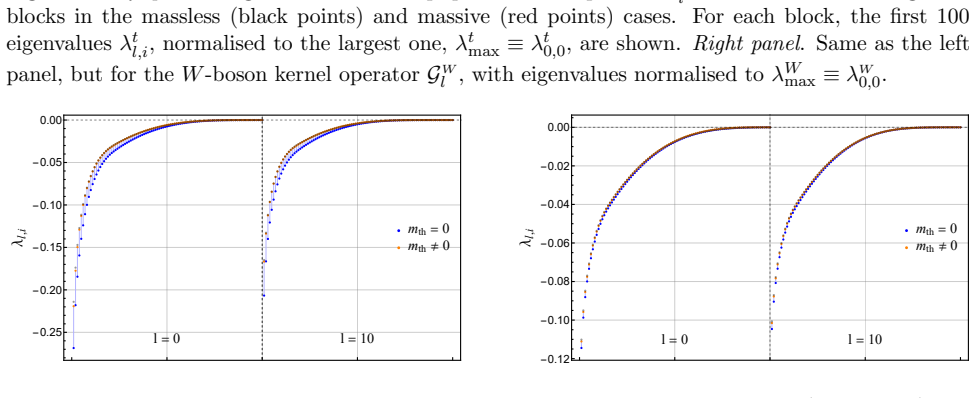
The central claim is that thermal masses, implemented as constant effective masses in the equilibrium distributions and entering both the Liouville operator and the collision integrals, regulate the infrared sector of the plasma and remove the artificial enhancement of soft gauge bosons in bubble-wall friction. The paper demonstrates this in the singlet-extended Standard Model: once thermal masses are included, the W-boson friction integrand loses its low-momentum peak, the dominant momenta move to the scale of the temperature, and the W contribution becomes subleading compared with the top quark. The authors further find that for top quarks the reduction of the source term and the reduction
What carries the argument
The central object is the linearised Boltzmann equation for out-of-equilibrium plasma perturbations in the bubble-wall frame, with collision integrals treated by a spectral decomposition of the collision kernel into Hermitian operators (Legendre blocks, eigenvalues, and eigenfunctions). The new ingredient is the inclusion of thermal masses m_th ~ gT in the equilibrium distribution functions that enter both the Liouville source term and the collision integrals, using constant effective masses and massless kinematics, with the ad hoc energy interpolation p0 = |p| + a m (a = 1/2) used to preserve Hermiticity. This machinery lets the authors compute how thermal masses rescale the collision kerne
Load-bearing premise
The calculation treats thermal masses as constant and retains massless kinematics in the collision integrals, restoring Hermiticity with the ad hoc interpolation p0 = |p| + a m (a = 1/2); the physical accuracy of this prescription is not derived, and a materially different infrared dispersion could change the magnitude of the W suppression.
What would settle it
Repeat the Boltzmann computation using the full finite-temperature spectral functions for transverse and longitudinal W modes instead of constant thermal masses; if the W contribution then remains comparable to the top-quark contribution, the central claim of subleading gauge-boson friction would be refuted.
If this is right
- Gauge-boson friction becomes subleading once thermal masses are included, so wall velocities are close to those obtained from top-quark friction alone.
- The dominant source of uncertainty from infrared gauge modes is removed, making friction predictions less sensitive to the poorly controlled infrared sector of the plasma.
- The compensation between source and collision effects in the top sector means the massless top-only approximation remains a good proxy across the studied parameter space.
- The parameter region admitting stationary deflagration solutions is enlarged by out-of-equilibrium friction, and thermal masses do not radically alter this topology.
Where Pith is reading between the lines
- If thermal masses shift dominant W momenta to scales of order T, the quasiparticle description used in kinetic treatments is on firmer ground, and the need for separate effective descriptions of soft modes (e.g., Langevin-type approaches) is reduced for the friction budget.
- The near-cancellation in the top sector suggests a general pattern: for fermions with thermal mass small relative to T, the massless approximation remains reliable, while for any bosonic species with O(T) thermal masses, massless treatments may overestimate friction.
- The ad hoc p0 = |p| + a m prescription is a testable handle: repeating the calculation with the full momentum-dependent thermal dispersion relations (for both transverse and longitudinal gauge modes) would show whether the magnitude of the W suppression is robust or depends on this interpolation.
- The neglect of top-W cross terms in the Boltzmann system, justified a posteriori by the smallness of the W contribution, could be reexamined in regions of parameter space where the W contribution is not negligible.
Editorial analysis
A structured set of objections, weighed in public.
Referee Report
Summary. The paper revisits the computation of bubble-wall friction in cosmological phase transitions, arguing that previous Boltzmann treatments artificially enhance the infrared gauge-boson contribution by using massless equilibrium distributions. It proposes to include thermal masses consistently in the local-equilibrium distributions entering both the Liouville source term and the collision integrals, while retaining massless kinematics and leading-log amplitudes for the scattering matrix elements. The technical framework is the spectral-decomposition method of Refs. [25,27], extended to massive-equilibrium kernels. Applied to the singlet-extended SM, the paper finds that thermal masses change top-quark friction by only a few percent because source and collision effects largely compensate, but they strongly suppress W-boson friction, shifting the dominant momenta from β|p|≈0.25 to ≈1 and rendering W subleading. As a result, the full (top+W) wall velocity is close to the top-only value across the parameter space (Figs. 7–13, Table 2).
Significance. If correct, the paper's central claim is significant: it would remove a longstanding infrared uncertainty in bubble-wall friction calculations—the artificial Bose-enhanced soft gauge-boson contribution—and justify the simpler top-only, massless approximation for the SSM to a few percent. The numerical work is substantial: the spectral decomposition of the collision kernels, the systematic separation of Liouville/collision effects, the two benchmarks, and the parameter scan give a fairly complete picture. The paper is honest about its approximations, but several of those approximations are not quantitatively controlled; the most important is the a=1/2 energy interpolation that regulates the W infrared occupancy. Because the headline suppression depends on that cutoff, the robustness of the result is not yet fully established. No fitted parameters are used to force the outcome, and the qualitative shift of the W peak away from β|p|∼0.25 is clearly demonstrated.
major comments (3)
- [§2.3, Eq. (2.30)] Eq. (2.30) introduces p0=|p|+a m with a=1/2 as a 'technical device' to preserve Hermiticity. The paper states that friction depends on a only at the sub-percent level, but no scan, derivation, or error estimate is given. This is load-bearing: the W suppression in Figs. 9–10 is driven by the infrared behaviour of f0. For m_W≈0.6T, a=1/2 makes the soft-mode weight exp(−β a m_W)≈e^{−0.3} rather than the physical exp(−β m_W)≈e^{−0.6}, and a also enters the momentum derivative of f0 in the Liouville source. A change from a=0.5 to a=1.0 can therefore alter the W source at the tens-of-percent level, not the claimed sub-percent level, and would change the size of the W correction to v_w in Table 2. Please demonstrate robustness by scanning a (e.g. 0≤a≤1) or by using the actual HTL dispersion for the infrared modes.
- [§2.2, p.7 (after Eq. 2.27)] The neglect of top–W cross terms in the bracket is justified 'a posteriori, since the out-of-equilibrium contribution of the W bosons is found to be significantly smaller than that of the top quarks once thermal masses are included.' This is circular for the paper's central conclusion: the smallness of the W contribution is precisely what the calculation is meant to establish. Cross terms coupling δf_t and δf_W could feed back into the W equation and change the size of the W perturbation. Please estimate their magnitude, for example by adding one representative t–W process to the bracket, or provide a kinematic argument that they are small independently of the final W OOE size.
- [§2.3/Sec. 3 (source term)] The equilibrium distributions used in the source term treat the top and W as having only thermal masses, with p0=|p|+a m_th; the z-dependent VEV mass m_i(z) enters only through the force (m_i^2)' in L, as in Eq. (2.29). The paper does not quantify the error from neglecting m_i(z) in f0. For the W, m_i(z) grows from 0 to about 80 GeV across the wall at T∼100 GeV, comparable to m_W^th, so using only m_th changes the Bose weight and the p_z-derivative of f0 in the wall region. This affects the source at O(1) and therefore the W friction. Please estimate this effect, e.g. by comparing with a source built from p0=sqrt(p^2+m_i(z)^2+m_th^2) in f0.
minor comments (5)
- [General/typos] Page 21: 'as sown in Fig. 11' should be 'as shown in Fig. 11'. The introduction also contains an unresolved placeholder '[?]' in the reference list [?, 1–37].
- [Notation, Eqs. (2.16)/(2.28)] The symbol m^2_q is used for the quark thermal mass in the propagators (Eq. 2.16) and again in Eq. (2.28) for the asymptotic quark mass; the two are defined with different coefficients (g_s^2/6 vs g_s^2/6? check: Eq. 2.28 gives m_q^2=g_s^2/6 T_n^2, same as Eq. 2.16 for quarks, but m_g differs). Please define the notation once and state which mass enters each amplitude in Table 1.
- [Sec. 2.3] The statement 'as we have explicitly checked' regarding moderate variations of the W thermal mass not altering the results would be much more useful as a figure or a quantitative bound. A short robustness paragraph with a number would remove a reader's doubt.
- [Fig. 1 and general figure captions] In several captions the labels 'massive'/'massless' and the abbreviations m_th,C, m_th,L, m_th,C+L are used without being defined in the caption; please define them in the captions or in a common table.
- [Sec. 2.3] The treatment treats transverse and longitudinal W polarizations identically with the same thermal mass (m_W^2=11/12 g_W^2 T_n^2). Since the longitudinal plasmon dispersion differs substantially at soft momenta, a one-sentence statement of why this does not affect the conclusion would be useful.
Circularity Check
Mild internal circularity in the a-posteriori justification for dropping top–W cross terms; the central thermal-mass suppression is otherwise an independent calculation.
specific steps
-
other
[Sec. 2.2, paragraph following Eq. (2.27)]
"To avoid this additional complexity, we neglect the cross terms and instead describe the top quarks and W bosons through two independent Boltzmann equations. This approximation is justified a posteriori, since the out-of-equilibrium contribution of the W bosons is found to be significantly smaller than that of the top quarks once thermal masses are included."
The approximation (decoupling the top and W Boltzmann equations by dropping their cross terms) is justified by the paper's own conclusion that W-boson friction is subleading after thermal masses are included. But that conclusion is obtained from precisely the equations in which the cross terms are absent. If the top–W cross terms were non-negligible, the W perturbation, and thus its friction, could differ; invoking the result to validate the approximation is a closed loop. This is a localized, secondary circularity: the main thermal-mass suppression in the Liouville source and collision kernels is computed independently of this assumption.
full rationale
The paper's central claim—that including thermal masses in both the Liouville operator and the collision integrals suppresses the infrared W-boson contribution and makes it subleading—is not produced by fitting a parameter to the final wall velocity. The thermal masses are computed from the standard couplings (Eq. 2.28), and the suppression follows from inserting them into the local-equilibrium distributions and the kernel construction. The Boltzmann machinery and spectral decomposition are taken from the same authors' prior work, but those citations are method references, not load-bearing uniqueness claims or forbidden alternatives. The only genuinely circular element is the a-posteriori justification for neglecting top–W cross terms (Sec. 2.2), which is a mild internal loop but does not reduce the derivation to its inputs. The ad hoc energy interpolation p0 = |p| + a m (Eq. 2.30), fixed at a = 1/2 with a claimed sub-percent sensitivity that is not demonstrated, is an acknowledged technical device and a legitimate approximation uncertainty; it controls the low-momentum cutoff of the W equilibrium distributions and could affect the quantitative size of the W suppression, but it is not circular because it is not fitted to the predicted friction. Overall, the central derivation is self-contained against the model inputs, so the circularity score is low.
Axiom & Free-Parameter Ledger
free parameters (1)
- Interpolation parameter a =
1/2
axioms (7)
- domain assumption Boltzmann equation and quasiparticle picture valid for relevant plasma modes; 2→2 processes dominate thermalisation
- domain assumption Perturbative leading-order thermal masses for quarks, gluons and electroweak bosons (Eq. 2.28) approximate the true dispersion relations; for W bosons this is formally unreliable since m_W ~ T
- ad hoc to paper Equilibrium energies can be approximated with the linear dispersion p0 = |p| + a m with a = 1/2
- domain assumption Collision integrals evaluated with massless kinematics and external particles massless; thermal masses only in propagators of exchanged states
- domain assumption Top-quark and W-boson Boltzmann equations treated independently, neglecting cross terms in the collision operator
- domain assumption Constant thermal masses, with longitudinal and transverse W polarizations treated identically; U(1)_Y neglected, W/Z degenerate triplet
- domain assumption tanh profile ansatz and the hydrodynamic equations (Eqs. 4.5-4.10) describe the wall and plasma
read the original abstract
Bubble-wall friction controls the dynamics of first-order cosmological phase transitions. In Boltzmann-equation approaches, a major uncertainty arises from infrared gauge bosons, whose contribution is artificially enhanced in the massless approximation. We study the impact of thermal masses by including them consistently in both the Liouville operator and the collision integrals. Thermal masses suppress the source term for out-of-equilibrium perturbations while also reducing interaction rates. These effects largely cancel for top quarks, giving only percent-level changes, but they strongly suppress the infrared gauge-boson contribution, shifting the dominant momenta to scales of order the temperature. As a result, gauge bosons become subleading and wall velocities are close to those obtained from top-quark friction alone. We illustrate this in the singlet-extended Standard Model. Our results show that thermal masses reduce the sensitivity of friction calculations to the poorly controlled infrared sector of the plasma.
Figures




Forward citations
Cited by 1 Pith paper
-
Theoretical uncertainties in reconstructing model parameters with gravitational waves from supercooled phase transitions
In the conformal U(1)_X model, the daisy-resummed nucleation scheme shifts LISA-reconstructed gauge couplings by O(10%) relative to the NLO effective-field-theory result, an order of magnitude above the Fisher-matrix ...
Reference graph
Works this paper leans on
-
[1]
G. D. Moore and T. Prokopec,Bubble wall velocity in a first order electroweak phase transition, Phys. Rev. Lett.75(1995), 777-780, arXiv:hep-ph/9503296 [hep-ph]
Pith/arXiv arXiv 1995
-
[2]
G. D. Moore and T. Prokopec,How fast can the wall move? A Study of the electroweak phase transition dynamics, Phys. Rev. D52(1995), 7182-7204, arXiv:hep-ph/9506475 [hep-ph]
Pith/arXiv arXiv 1995
-
[3]
G. D. Moore,Electroweak bubble wall friction: Analytic results, JHEP03(2000), 006, arXiv:hep-ph/0001274 [hep-ph]
Pith/arXiv arXiv 2000
-
[4]
P. John and M. G. Schmidt,Do stops slow down electroweak bubble walls?, Nucl. Phys. B 598(2001), 291-305 [erratum: Nucl. Phys. B648(2003), 449-452], arXiv:hep-ph/0002050 [hep-ph]
Pith/arXiv arXiv 2001
-
[5]
J. M. Cline, M. Joyce and K. Kainulainen,Supersymmetric electroweak baryogenesis, JHEP07(2000), 018, arXiv:hep-ph/0006119 [hep-ph]
Pith/arXiv arXiv 2000
-
[6]
L. Fromme and S. J. Huber,Top transport in electroweak baryogenesis, JHEP03(2007), 049, arXiv:hep-ph/0604159 [hep-ph]
Pith/arXiv arXiv 2007
-
[7]
A. Megevand and A. D. Sanchez,Velocity of electroweak bubble walls, Nucl. Phys. B825 (2010), 151-176, arXiv:0908.3663 [hep-ph]
Pith/arXiv arXiv 2010
-
[8]
S. J. Huber and M. Sopena,An efficient approach to electroweak bubble velocities, arXiv:1302.1044 [hep-ph]. 25
-
[9]
T. Konstandin, G. Nardini and I. Rues,From Boltzmann equations to steady wall veloci- ties, JCAP09(2014), 028, arXiv:1407.3132 [hep-ph]
Pith/arXiv arXiv 2014
-
[10]
J. Kozaczuk,Bubble Expansion and the Viability of Singlet-Driven Electroweak Baryoge- nesis, JHEP10(2015), 135, arXiv:1506.04741 [hep-ph]
Pith/arXiv arXiv 2015
-
[11]
G. C. Dorsch, S. J. Huber and T. Konstandin,Bubble wall velocities in the Standard Model and beyond, JCAP12(2018), 034, arXiv:1809.04907 [hep-ph]
Pith/arXiv arXiv 2018
-
[12]
J. M. Cline and K. Kainulainen,Electroweak baryogenesis at high bubble wall velocities,” Phys. Rev. D101(2020) no.6, 063525, arXiv:2001.00568 [hep-ph]
Pith/arXiv arXiv 2020
-
[13]
B. Laurent and J. M. Cline,Fluid equations for fast-moving electroweak bubble walls, Phys. Rev. D102(2020) no.6, 063516, arXiv:2007.10935 [hep-ph]
Pith/arXiv arXiv 2020
-
[14]
A. Friedlander, I. Banta, J. M. Cline and D. Tucker-Smith,Wall speed and shape in singlet-assisted strong electroweak phase transitions, Phys. Rev. D103(2021) no.5, 055020, arXiv:2009.14295 [hep-ph]
Pith/arXiv arXiv 2021
-
[15]
X. Wang, F. P. Huang and X. Zhang,Bubble wall velocity beyond leading-log approxima- tion in electroweak phase transition, arXiv:2011.12903 [hep-ph]
Pith/arXiv arXiv 2011
-
[16]
G. C. Dorsch, S. J. Huber and T. Konstandin,On the wall velocity dependence of elec- troweak baryogenesis, JCAP08(2021), 020, arXiv:2106.06547 [hep-ph]
Pith/arXiv arXiv 2021
-
[17]
J. M. Cline and B. Laurent,Electroweak baryogenesis from light fermion sources: A critical study, Phys. Rev. D104(2021) no.8, 083507, arXiv:2108.04249 [hep-ph]
Pith/arXiv arXiv 2021
-
[18]
M. Lewicki, M. Merchand and M. Zych,Electroweak bubble wall expansion: gravitational waves and baryogenesis in Standard Model-like thermal plasma, JHEP02(2022), 017, arXiv:2111.02393 [astro-ph.CO]
Pith/arXiv arXiv 2022
-
[19]
G. C. Dorsch, S. J. Huber and T. Konstandin,A sonic boom in bubble wall friction, JCAP 04(2022) no.04, 010 arXiv:2112.12548 [hep-ph]
Pith/arXiv arXiv 2022
-
[20]
S. De Curtis, L. Delle Rose, A. Guiggiani, ´A. G. Muyor and G. Panico,Bubble wall dynamics at the electroweak phase transition, JHEP03(2022), 163, arXiv:2201.08220 [hep-ph]
Pith/arXiv arXiv 2022
-
[21]
B. Laurent and J. M. Cline,First principles determination of bubble wall velocity, Phys. Rev. D106(2022) no.2, 023501, arXiv:2204.13120 [hep-ph]
Pith/arXiv arXiv 2022
-
[22]
S. De Curtis, L. Delle Rose, A. Guiggiani, ´A. Gil Muyor and G. Panico,Dynamics of bubble walls at the electroweak phase transition, EPJ Web Conf.270(2022), 00035, arXiv:2209.06509 [hep-ph]
Pith/arXiv arXiv 2022
-
[23]
De Curtis, L
S. De Curtis, L. Delle Rose, A. Guiggiani, ´A. Gil Muyor and G. Panico,Bubble wall dynamics at the electroweak scale, PoSICHEP2022, 080
-
[24]
S. Jiang, F. P. Huang and X. Wang,Bubble wall velocity during electroweak phase transi- tion in the inert doublet model, Phys. Rev. D107(2023) no.9, 095005, arXiv:2211.13142 [hep-ph]. 26
Pith/arXiv arXiv 2023
-
[25]
S. De Curtis, L. Delle Rose, A. Guiggiani, ´A. Gil Muyor and G. Panico,Collision integrals for cosmological phase transitions, JHEP05(2023), 194, arXiv:2303.05846 [hep-ph]
Pith/arXiv arXiv 2023
-
[26]
G. C. Dorsch and D. A. Pinto,Bubble wall velocities with an extended fluid Ansatz, JCAP 04(2024), 027, arXiv:2312.02354 [hep-ph]
Pith/arXiv arXiv 2024
-
[27]
S. De Curtis, L. Delle Rose, A. Guiggiani, ´A. Gil Muyor and G. Panico,Non-linearities in cosmological bubble wall dynamics, JHEP05(2024), 009, arXiv:2401.13522 [hep-ph]
Pith/arXiv arXiv 2024
-
[28]
K. Kainulainen and N. Venkatesan,Systematic moment expansion for electroweak baryo- genesis, JCAP08(2024), 058, arXiv:2407.13639 [hep-ph]
Pith/arXiv arXiv 2024
-
[29]
C. Branchina, A. Conaci, S. De Curtis, L. Delle Rose, A. Guiggiani, A. Gil Muyor and G. Panico,New calculation of collision integrals for cosmological phase transitions, EPJ Web Conf.314(2024), 00031, arXiv:2410.00766 [hep-ph]
Pith/arXiv arXiv 2024
-
[30]
A. Ekstedt, O. Gould, J. Hirvonen, B. Laurent, L. Niemi, P. Schicho and J. van de Vis, How fast does the WallGo? A package for computing wall velocities in first-order phase transitions, JHEP04(2025), 101, arXiv:2411.04970 [hep-ph]
Pith/arXiv arXiv 2025
-
[31]
W. Y. Ai, B. Laurent and J. van de Vis,Bounds on the bubble wall velocity, JHEP02 (2025), 119, arXiv:2411.13641 [hep-ph]
Pith/arXiv arXiv 2025
-
[32]
G. C. Dorsch, T. Konstandin, E. Perboni and D. A. Pinto,Non-singular solutions to the Boltzmann equation with a fluid Ansatz, JCAP04(2025), 033, arXiv:2412.09266 [hep-ph]
Pith/arXiv arXiv 2025
-
[33]
C. Branchina, A. Conaci, L. Delle Rose and S. De Curtis,Bubble wall velocity with out-of-equilibrium corrections, Phys. Rev. D113(2026) no.3, 035024, arXiv:2510.21942 [hep-ph]
arXiv 2026
-
[34]
G. Barni,Electroweak Baryogenesis with BARYONET: a self-contained review of the WKB approach, arXiv:2510.21915 [hep-ph]
-
[35]
J. van de Vis, P. Schicho, L. Niemi, B. Laurent, J. Hirvonen and O. Gould,WallGo investigates: Theoretical uncertainties in the bubble wall velocity, JHEP04(2026), 041, arXiv:2510.27691 [hep-ph]
arXiv 2026
-
[36]
A. Ekstedt, T. Konstandin and J. van de Vis,Scalar damping in cosmological phase transitions, arXiv:2512.16663 [hep-ph]
-
[37]
T. Krajewski, M. Lewicki, M. Merchand, I. Nalecz and M. Zych,From friction scaling to an efficient method for estimating bubble wall velocity, arXiv:2603.24583 [astro-ph.CO]
-
[38]
P. B. Arnold, D. Son and L. G. Yaffe,The Hot baryon violation rate is O (alpha-w**5 T**4), Phys. Rev. D55(1997), 6264-6273, arXiv:hep-ph/9609481 [hep-ph]
Pith/arXiv arXiv 1997
-
[39]
P. Huet and D. T. Son,Long range physics in a hot nonAbelian plasma, Phys. Lett. B 393(1997), 94-102, arXiv:hep-ph/9610259 [hep-ph]
Pith/arXiv arXiv 1997
-
[40]
D. T. Son,Effective nonperturbative real time dynamics of soft modes in hot gauge theo- ries, arXiv:hep-ph/9707351 [hep-ph]. 27
-
[41]
Bodeker,On the effective dynamics of soft nonAbelian gauge fields at finite tempera- ture, Phys
D. Bodeker,On the effective dynamics of soft nonAbelian gauge fields at finite tempera- ture, Phys. Lett. B426(1998), 351-360, arXiv:hep-ph/9801430 [hep-ph]
Pith/arXiv arXiv 1998
-
[42]
Bodeker,Diagrammatic approach to soft nonAbelian dynamics at high temperature, Nucl
D. Bodeker,Diagrammatic approach to soft nonAbelian dynamics at high temperature, Nucl. Phys. B566(2000), 402-422, arXiv:hep-ph/9903478 [hep-ph]
Pith/arXiv arXiv 2000
-
[43]
Bodeker,From hard thermal loops to Langevin dynamics, Nucl
D. Bodeker,From hard thermal loops to Langevin dynamics, Nucl. Phys. B559(1999), 502-538, arXiv:hep-ph/9905239 [hep-ph]
Pith/arXiv arXiv 1999
-
[44]
P. B. Arnold, D. T. Son and L. G. Yaffe,Longitudinal subtleties in diffusive Langevin equations for nonAbelian plasmas, Phys. Rev. D60(1999), 025007, arXiv:hep-ph/9901304 [hep-ph]
Pith/arXiv arXiv 1999
-
[45]
P. B. Arnold and L. G. Yaffe,Nonperturbative dynamics of hot nonAbelian gauge fields: Beyond leading log approximation, Phys. Rev. D62(2000), 125013, arXiv:hep- ph/9912305 [hep-ph]
arXiv 2000
-
[46]
M. L. Bellac,Thermal Field Theory, Cambridge University Press, 2011
2011
-
[47]
U. Kraemmer, A. K. Rebhan and H. Schulz,Resummations in hot scalar electrodynamics, Annals Phys.238(1995), 286-331, arXiv:hep-ph/9403301 [hep-ph]
Pith/arXiv arXiv 1995
-
[48]
H. A. Weldon,Effective Fermion Masses of Order gT in High Temperature Gauge Theories with Exact Chiral Invariance, Phys. Rev. D26(1982), 2789
1982
-
[49]
C. Branchina, A. Conaci, L. Delle Rose and S. De Curtis,Electroweak phase transition and bubble wall velocity in local thermal equilibrium, Phys. Rev. D112(2025) no.9, 095008, arXiv:2504.21213 [hep-ph]
Pith/arXiv arXiv 2025
-
[50]
W. Y. Ai, M. Carosi, B. Garbrecht, C. Tamarit and M. Vanvlasselaer,Bubble wall dy- namics from nonequilibrium quantum field theory, JHEP08(2025), 077, arXiv:2504.13725 [hep-ph]
Pith/arXiv arXiv 2025
-
[51]
M. J. Ramsey-Musolf and J. Zhu,Bubble wall velocity from Kadanoff-Baym equations: fluid dynamics and microscopic interactions, arXiv:2504.13724 [hep-ph]. 28
discussion (0)
Sign in with ORCID, Apple, or X to comment. Anyone can read and Pith papers without signing in.