REVIEW 4 major objections 5 minor 40 references
Assessing Intersectional Bias in Representations of Pre-Trained Image Recognition Models
T0 review · 4 major / 5 minor · reviewed 2026-08-07 · deepseek-v4-flash
Pith's one-line read Pre-trained ImageNet classifiers, regardless of architecture, strongly encode age information in their representations of facial images, while race and gender signals are weaker.
desk verdict A transparent but overclaimed extension of the authors' own prior work: the age-differentiation result is plausible and consistent across architectures, but the headline 'strongly encode age' rests on in-sample probe accuracy the paper itself admits does not generalize. read the letter →
The pith
A machine-rendered reading of the paper's core claim, the machinery that carries it, and where it could break.
The reading
What carries the argument
The argument is carried by two instruments: linear classifier probes, which train a linear readout on a layer's activations to predict the 126 intersectional groups and treat higher accuracy as evidence that the concept is encoded; and Neuron Activation Profiles (NAPs), which average activations per group, subtract the overall expected activation, and lay the resulting patterns out as topographic activation maps via a UMAP projection with a particle-repulsion layout. The probes give the quantitative separability curve across layers, while the maps give a visual counterpart in which similar group patterns predict which groups the model will confuse. A third, smaller mechanism is the error table analysis, which names the most frequent misclassifications and thereby locates the bias in particular intersections.
What would settle it
A decisive check would be to rerun the same probes on FairFace images whose demographic labels are kept but whose appearance correlates are removed or controlled, for example by normalizing skin texture to remove wrinkles or cropping out hair and clothing; if the age probe's accuracy collapses to chance while accuracy on the appearance controls stays high, the central claim is reduced to appearance encoding, and if the age accuracy survives such normalization, the claim is confirmed.
Extended reading notes
Core claim
The paper's central claim is that pre-trained ImageNet classifiers, regardless of architecture, strongly encode age information in their representations, with less pronounced encoding of race and gender. Across three architectures, central layers' activations allow a linear probe to separate the 126 intersectional groups in training data, but validation accuracy stays low, meaning the signal is real yet not general enough for a linear readout. Error analysis and topographic activation maps show age errors dominate and usually move to adjacent age groups; race errors concentrate on confusion with 'Latino_Hispanic', 'White', 'Indian', and 'Middle Eastern'; gender errors are rare and gender differences appear mainly for middle ages. The paper interprets this as evidence that the bias lives in the feature extractor itself and would be available to a non-linear classifier during transfer learning.
Load-bearing premise
The argument depends on treating FairFace's demographic labels as the thing the representations are encoding: if the models are actually encoding wrinkles, hairstyles, facial hair, or other appearance cues that merely line up with the labels, then the claimed 'age bias' is an observation about visual appearance rather than about a demographic concept.
Editorial extensions
If this is right
- A downstream model built on any of these backbones can, in principle, read off age from the feature extractor, so age bias transfers even to tasks unrelated to age.
- Because the age signal appears in all three architectures, switching backbone is not a remedy; mitigation would have to act on the representation itself.
- Race bias shows up as systematic confusions among particular ethnicities, so auditing single-race accuracy is not enough.
- Gender differences are concentrated in middle-aged groups, so gender-bias measurements that average across ages can hide the effect.
- The gap between high training and low validation accuracy on the probes implies that a non-linear classifier would likely exploit the encoded bias more fully than a linear probe can.
Reading between the lines
- The authors leave open whether the effect is specific to ImageNet; a natural extension is to run the same probe and NAP pipeline on models trained on non-face and face-specific datasets, which would separate data-source effects from architecture effects.
- A quantitative pairwise similarity index derived from the NAP maps could turn the visual confusions into a per-intersection audit metric, letting practitioners flag the most confusable demographic cells before deployment.
- If the age signal is largely carried by skin-texture and face-shape cues, then the same measurement could be re-framed as a test of whether representations encode 'facial age appearance' rather than social age; the paper's method cannot distinguish these, and that distinction matters for deciding whether intervention is needed.
- The failure of linear probes to generalize suggests that representation-bias audits should treat linear separability as a lower bound and include non-linear probes or few-shot readouts to estimate the bias a real downstream model would experience.
Editorial analysis
A structured set of objections, weighed in public.
Referee Report
Summary. The paper investigates intersectional bias in the internal representations of three pre-trained ImageNet CNNs (VGG16, ResNet50, InceptionV3) using the FairFace dataset. For each of 126 intersectional groups defined by race, age, and gender, the authors train linear classifier probes on layer activations and visualize average activations as topographic maps. The central claim is that these models, regardless of architecture, 'strongly encode age information' in their representations, with weaker encoding of ethnicity and of gender in middle-aged groups.
Significance. If the central claim were established, the paper would be a useful contribution to the transfer-learning fairness literature, because it would identify a generalizable demographic signal in widely used backbone representations. The paper also has concrete strengths: the code is publicly released, the evaluation uses an independent and relatively balanced face dataset, and the intersectional grouping across 126 categories is more granular than much prior work. However, the main evidence offered for the central claim is in-sample linear-probe accuracy, which the authors themselves report as failing to generalize, and the qualitative topographic-map analysis is not validated against a quantitative baseline. As a result, the significance of the paper is currently limited by the gap between its conclusions and the strength of the evidence.
major comments (4)
- [§6.4, §7, Figs. 5, 7, 9] The central claim that pre-trained ImageNet classifiers 'strongly encode age information' rests on training accuracy of linear probes, but the paper's own results show that validation accuracy is far lower and the authors state in Section 7 that the probes 'could distinguish training data, but did not generalize to unseen data.' In-sample separability by a high-capacity probe is not evidence of generalizable encoding; it is consistent with memorization or overfitting. No shuffled-label control or evaluation on FairFace's official held-out split is reported, so the abstract's conclusion is not supported by the probe experiments as presented.
- [§5.2, §6.4] The argument that FairFace is an 'independent evaluation data set' because its labels are not ImageNet categories and its examples were not used in training does not rule out encoding of visual correlates of the labels. Age labels are strongly correlated with wrinkles, skin texture, hairstyle, facial shape, and other appearance cues; the paper itself says in Section 6.4 that age differences are 'driven by change of skin texture with age.' This undercuts the interpretation that the models encode 'age information' as a demographic concept rather than low-level visual attributes. The conclusion needs to either control for such correlates or be carefully reframed as a claim about visual appearance correlates.
- [§5.3, Figs. 5, 7, 9] The probe setup is not calibrated against a null model. After downsampling activations to at most 8x8 spatial resolution, InceptionV3's mixed7 layer has 768 channels, yielding about 49,152 input features to a fully connected layer with 126 outputs, trained on roughly 14.5k examples (90% of 126 batches of up to 128). With this parameter count and class count, high training accuracy can be achieved even for random labels. The paper reports no shuffled-label baseline, no repeated runs with different random splits, and no confidence intervals. Therefore the near-1.0 training accuracies in Figures 5, 7, and 9 do not by themselves demonstrate that the representations 'strongly encode' the intersectional groups.
- [§5.4, §6.4] The topographic-map interpretation relies on subjective visual comparison of average activation patterns, and the paper does not quantify the similarity or dissimilarity that drives the conclusions, such as 'activation differences between genders mostly emerge for middle ages' or 'age differences are most pronounced.' Without a quantitative similarity measure or a statistical test, these qualitative claims cannot be independently verified. They are used to reinforce the central claim and should either be backed by a quantitative analysis or be presented as hypotheses rather than findings.
minor comments (5)
- [§1, §7] The phrase 'regardless of the architecture' is too strong given that only three CNN architectures, all trained on ImageNet with similar supervision, are examined; the paper itself lists Vision Transformers as future work.
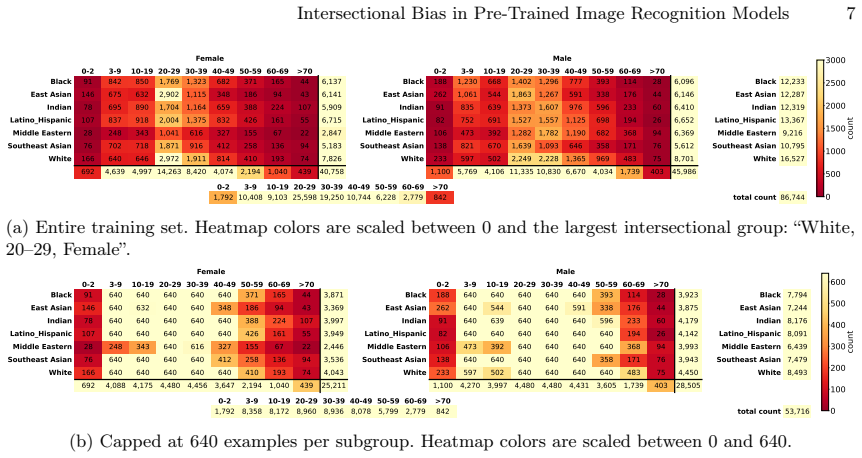
- [§5.3] The relationship between the 128-example batch per group used for probes and the 640-example cap in Figure 1b should be clarified; it is not clear whether the probe batches are drawn from the capped set or from the full set.
- [§6.2] The text says 'High training accuracy with low performance on the validation accuracy indicates overfitting,' but the paper then uses training accuracy to rank layers and identify biases; this inconsistency should be addressed by stating explicitly which quantity is intended to measure encoding.
- [§6.4] The statement that multi-layer non-linear classifiers 'would be more likely to learn generalized patterns from the activations' is speculative and not tested; it should be removed or supported by experiments.
- [§6.3] There are typographical errors, including 'missclassfications' and 'classfication' in the classification-errors paragraph.
Circularity Check
No circular derivation: the central claim rests on independent linear probes and activation visualizations; the sole corroborating self-citation is not load-bearing.
full rationale
The paper contains no derivation chain in which an output quantity is defined from, fitted to, or forced by the quantity it claims to predict. The linear probes are an external method (Alain and Bengio [2]) applied to activations of externally pre-trained models on the externally provided FairFace data set; NAPs and topographic activation maps are re-specified in Section 4.2 rather than imported as unstated assumptions. The paper explicitly flags the main limitation on its own evidence: 'Linear classifier probes could distinguish training data, but did not generalize to unseen data' (Section 7). This is a generalizability threat and a possible gap between in-sample separability and the conclusion 'strongly encode age information,' but it is not a circular reduction: training and validation accuracies are reported as measured, no fitted parameter is renamed as a prediction, and no equation is shown to equal its own input. The only self-citation touching the central claim is the sentence 'This is in agreement with a recent related study that follows a clustering-based analysis [23],' where [23] is the authors' own IJCNN paper. That corroboration is not load-bearing because the conclusion is already drawn from the paper's own experiments, and earlier self-citations [20-22] are methodological lineage for NAPs and topographic maps, explicitly described in the methods section. Therefore no circular step is exhibited; the score of 2 reflects one minor non-load-bearing self-citation rather than any actual circularity.
Assumptions & free parameters
free parameters (3)
- max_group_size_640 =
640
- linear_probe_hyperparameters =
dropout 0.25, L1 1e-5, L2 1e-4, 50 epochs
- layer_selection =
VGG16 layer 4, ResNet50 layer 15, InceptionV3 layer 9
assumptions (3)
- domain assumption Linear classifier probes measure what information a layer encodes.
- domain assumption FairFace demographic labels are correct and the dataset is independent of ImageNet.
- domain assumption Similar activation patterns across groups indicate likely confusion and hence bias.
Cite this review
Pith. "Pith review of Assessing Intersectional Bias in Representations of Pre-Trained Image Recognition Models." pith.science (2026). https://pith.science/paper/3SUGTPVB
@misc{pith2026250603664,
  author       = {Pith},
  title        = {Pith review of: Assessing Intersectional Bias in Representations of Pre-Trained Image Recognition Models},
  year         = {2026},
  howpublished = {\url{https://pith.science/paper/3SUGTPVB}},
  note         = {Machine review of arXiv:2506.03664}
}
read the original abstract
Deep Learning models have achieved remarkable success. Training them is often accelerated by building on top of pre-trained models which poses the risk of perpetuating encoded biases. Here, we investigate biases in the representations of commonly used ImageNet classifiers for facial images while considering intersections of sensitive variables age, race and gender. To assess the biases, we use linear classifier probes and visualize activations as topographic maps. We find that representations in ImageNet classifiers particularly allow differentiation between ages. Less strongly pronounced, the models appear to associate certain ethnicities and distinguish genders in middle-aged groups.
Figures


Figures from the paper (6 more)


Reference graph
Works this paper leans on
-
[1]
J. Ahn and A. Oh. Mitigating language-dependent ethnic bias in BERT. InProceedings of the 2021 Conference on Empirical Methods in Natural Language Processing (EMNLP), pages 533– 549, Online and Punta Cana, Dominican Republic, Nov. 2021. Association for Computational Linguistics
work page 2021
-
[2]
G. Alain and Y. Bengio. Understanding intermediate layers using linear classifier probes. In International Conference on Learning Representations (ICLR), Workshop Track Proceedings, 2017
work page 2017
- [3]
-
[4]
T. Bolukbasi, K.-W. Chang, J. Y. Zou, V. Saligrama, and A. T. Kalai. Man is to computer programmer as woman is to homemaker? Debiasing Word Embeddings. InAdvances in Neural Information Processing Systems, volume 29, pages 4349–4357, 2016
work page 2016
-
[5]
J. Buolamwini and T. Gebru. Gender Shades: Intersectional Accuracy Disparities in Commer- cial Gender Classification. InProceedings of the 1st Conference on Fairness, Accountability and Transparency, volume 81, pages 77–91. PMLR, 23–24 Feb 2018
work page 2018
-
[6]
Carter, Z
S. Carter, Z. Armstrong, L. Schubert, I. Johnson, and C. Olah. Activation atlas.Distill, 4(3):e15, 2019
2019
-
[7]
J. Deng, W. Dong, R. Socher, L.-J. Li, K. Li, and L. Fei-Fei. Imagenet: A large-scale hierarchi- cal image database. In2009 IEEE Conference on Computer Vision and Pattern Recognition (CVPR), pages 248–255. Ieee, 2009
work page 2009
-
[8]
J. Devlin, M.-W. Chang, K. Lee, and K. Toutanova. BERT: Pre-training of Deep Bidirectional Transformers for Language Understanding.arXiv preprint arXiv:1810.04805, 2019
arXiv 2019
Show all 40 references
-
[9]
Dosovitskiy, L
A. Dosovitskiy, L. Beyer, A. Kolesnikov, D. Weissenborn, X. Zhai, T. Unterthiner, M. De- hghani, M. Minderer, G. Heigold, S. Gelly, et al. An image is worth 16x16 words: Transformers for image recognition at scale.arXiv preprint arXiv:2010.11929, 2020
2010 arXiv
-
[10]
Erhan, Y
D. Erhan, Y. Bengio, A. Courville, and P. Vincent. Visualizing higher-layer features of a deep network.University of Montreal, 1341(3):1, 2009
2009
-
[11]
Fiacco, S
J. Fiacco, S. Choudhary, and C. Rose. Deep neural model inspection and comparison via func- tional neuron pathways. InAnnual Meeting of the Association for Computational Linguistics (ACL), pages 5754–5764, 2019
2019
-
[12]
Goodfellow, Y
I. Goodfellow, Y. Bengio, A. Courville, and Y. Bengio.Deep learning, volume 1. MIT press Cambridge, 2016
2016
-
[13]
K. He, X. Zhang, S. Ren, and J. Sun. Deep residual learning for image recognition. In Proceedings of the IEEE conference on computer vision and pattern recognition, pages 770– 778, 2016
2016
-
[14]
Hohman, H
F. Hohman, H. Park, C. Robinson, and D. H. P. Chau. Summit: Scaling deep learning inter- pretability by visualizing activation and attribution summarizations.IEEE Transactions on Visualization and Computer Graphics, 26(1):1096–1106, 2019
2019
-
[15]
M. Hort, Z. Chen, J. M. Zhang, M. Harman, and F. Sarro. Bias mitigation for machine learning classifiers: A comprehensive survey.ACM Journal on Responsible Computing, 2023. Intersectional Bias in Pre-Trained Image Recognition Models 19
2023
-
[16]
Karkkainen and J
K. Karkkainen and J. Joo. FairFace: Face Attribute Dataset for Balanced Race, Gender, and Age for Bias Measurement and Mitigation. InProceedings of the IEEE/CVF Winter Conference on Applications of Computer Vision, pages 1548–1558, 2021
2021
-
[17]
B. Kim, M. Wattenberg, J. Gilmer, C. Cai, J. Wexler, F. Viegas, et al. Interpretability Beyond Feature Attribution: Quantitative Testing with Concept Activation Vectors (TCAV). InProceedings of the International Conference on Machine Learning (ICML), pages 2668– 2677, 2018
2018
-
[18]
S. Kim, A. Gholami, A. Shaw, N. Lee, K. Mangalam, J. Malik, M. W. Mahoney, and K. Keutzer. Squeezeformer: An efficient transformer for automatic speech recognition. In Advances in Neural Information Processing Systems, volume 35, pages 9361–9373, 2022
2022
-
[19]
Kindermans, K
P.-J. Kindermans, K. T. Schütt, M. Alber, K.-R. Müller, D. Erhan, B. Kim, and S. Dähne. Learninghowtoexplainneuralnetworks:PatternNetandPatternAttribution. InInternational Conference on Learning Representations (ICLR), 2018
2018
-
[20]
V. Krug. Neuroscience-Inspired Analysis and Visualization of Deep Neural Networks, 2024
2024
-
[21]
V. Krug, C. Olson, and S. Stober. Visualizing Bias in Activations of Deep Neural Networks as Topographic Maps. InProceedings of the 1st Workshop on Fairness and Bias in AI (AE- QUITAS 2023) co-located with 26th European Conference on Artificial Intelligence (ECAI
2023
-
[22]
V. Krug, R. K. Ratul, C. Olson, and S. Stober. Visualizing Deep Neural Networks with Topographic Activation Maps. InHHAI 2023: Augmenting Human Intellect, pages 138–152. IOS Press, 2023
2023
-
[23]
V. Krug, F. Röhrbein, and S. Stober. Intersectional Bias Quantification in Facial Image Processing with Pre-Trained ImageNet Classifiers. In2025 International Joint Conference on Neural Networks (IJCNN), pages 1–8, 2025
2025
-
[24]
B. Li, H. Peng, R. Sainju, J. Yang, L. Yang, Y. Liang, W. Jiang, B. Wang, H. Liu, and C. Ding. Detecting Gender Bias in Transformer-based Models: A Case Study on BERT.arXiv preprint arXiv:2110.15733, 2021
2021 arXiv
-
[25]
McInnes, J
L. McInnes, J. Healy, and J. Melville. UMAP: Uniform Manifold Approximation and Projec- tion for Dimension Reduction.arXiv preprint arXiv:1802.03426, 2020
2020 arXiv
-
[26]
McInnes, J
L. McInnes, J. Healy, N. Saul, and L. Grossberger. UMAP: Uniform Manifold Approximation and Projection.The Journal of Open Source Software, 3(29):861, 2018
2018
-
[27]
A. S. Morcos, M. Raghu, and S. Bengio. Insights on representational similarity in neural networks with canonical correlation.arXiv preprint arXiv:1806.05759, 2018
2018 arXiv
-
[28]
Mordvintsev, C
A. Mordvintsev, C. Olah, and M. Tyka. Inceptionism: Going deeper into neural networks. Google Research Blog. Retrieved June, 20(14):5, 2015
2015
-
[29]
Nagamine, M
T. Nagamine, M. L. Seltzer, and N. Mesgarani. Exploring how deep neural networks form phonemic categories. InConference of the International Speech Communication Association (Interspeech), 2015
2015
-
[30]
Osindero and G
S. Osindero and G. E. Hinton. Modeling image patches with a directed hierarchy of Markov random fields. InAdvances in Neural Information Processing Systems, pages 1121–1128, 2008
2008
-
[31]
H. Park, N. Das, R. Duggal, A. P. Wright, O. Shaikh, F. Hohman, and D. H. P. Chau. Neu- rocartography: Scalable automatic visual summarization of concepts in deep neural networks. IEEE Transactions on Visualization and Computer Graphics, 28(1):813–823, 2021
2021
-
[32]
Salman, S
H. Salman, S. Jain, A. Ilyas, L. Engstrom, E. Wong, and A. Madry. When does bias transfer in transfer learning?arXiv preprint arXiv:2207.02842, 2022. 20 V. Krug and S. Stober
2022 arXiv
-
[33]
R. R. Selvaraju, M. Cogswell, A. Das, R. Vedantam, D. Parikh, and D. Batra. Grad-CAM: Visual Explanations From Deep Networks via Gradient-Based Localization. InIEEE Inter- national Conference on Computer Vision (ICCV), pages 618–626, 2017
2017
-
[34]
Simonyan and A
K. Simonyan and A. Zisserman. Very deep convolutional networks for large-scale image recog- nition.arXiv preprint arXiv:1409.1556, 2014
2014 arXiv
-
[35]
Stricker, F
P. Stricker, F. Röhrbein, and A. Knoblauch. Weight Perturbation and Competitive Heb- bian Plasticity for Training Sparse Excitatory Neural Networks. In2024 International Joint Conference on Neural Networks (IJCNN), pages 1–8, 2024
2024
-
[36]
L. Sweeney. Discrimination in Online Ad Delivery.arXiv preprint arXiv:1301.6822, 2013
2013 arXiv
-
[37]
Szegedy, V
C. Szegedy, V. Vanhoucke, S. Ioffe, J. Shlens, and Z. Wojna. Rethinking the inception archi- tecture for computer vision. InProceedings of the IEEE conference on computer vision and pattern recognition, pages 2818–2826, 2016
2016
-
[38]
Torrey and J
L. Torrey and J. Shavlik. Transfer learning. InHandbook of research on machine learning applications and trends: algorithms, methods, and techniques, pages 242–264. IGI global, 2010
2010
-
[39]
Yosinski, J
J. Yosinski, J. Clune, A. Nguyen, T. Fuchs, and H. Lipson. Understanding Neural Networks Through Deep Visualization.arXiv preprint arXiv:1506.06579, 2015
2015 arXiv
-
[2023]
CEUR-WS, 2023
Kraków, Poland. CEUR-WS, 2023
2023
Reviewed August 7, 2026 · model on record in the stance chip above.
Discussion (0). Sign in to comment.