REVIEW 1 major objections 2 minor 1 cited by
Agentic AI coding improves when conversational intent is turned into contracts and verified artifacts through structured processes.
Reviewed by Pith at T0; open to challenge. T0 means a machine referee read the full paper against a public rubric. the ladder, T0–T4 →
T0 review · grok-4.3
2026-05-21 06:48 UTC pith:3T2SMBNS
load-bearing objection This is a position paper that names a process framework for agentic coding but offers no worked examples showing how its SCOPE-V loop actually resolves the failures it cites. the 1 major comments →
Agentic Agile-V: From Vibe Coding to Verified Engineering in Software and Hardware Development
The pith
A machine-rendered reading of the paper's core claim, the machinery that carries it, and where it could break.
Core claim
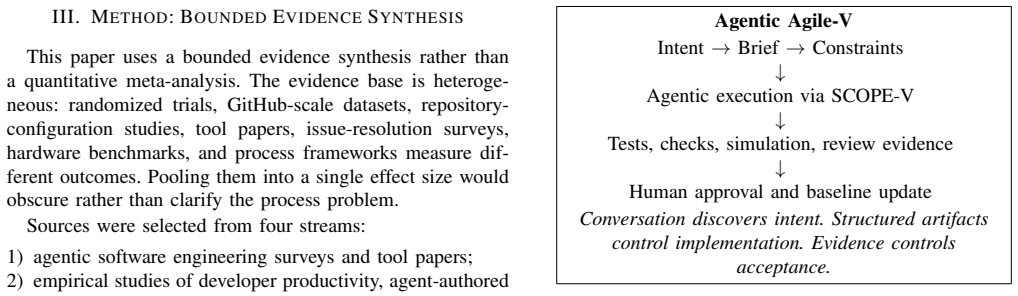
Agentic AI does not eliminate engineering discipline; it increases the value of requirements, constraints, traceability, independent verification, and human approval. The paper proposes Agentic Agile-V as a framework that applies Agile-V as the lifecycle and introduces a task-level SCOPE-V loop to transform conversational intent into structured engineering artifacts and acceptance evidence. It contributes a taxonomy of minimum input artifacts, a conversation-to-contract gate, risk-adaptive workflows, and an evidence-bundle acceptance model.
What carries the argument
The SCOPE-V loop (Specify, Constrain, Orchestrate, Prove, Evolve, Verify) inside the Agentic Agile-V framework, which converts exploratory dialogue into traceable contracts and verified outputs while preserving human approval.
Load-bearing premise
The assumption that a conversation-to-contract gate and SCOPE-V loop will reliably convert current agent failures in repository setup, dependency handling, and hardware verification into successful outcomes.
What would settle it
A controlled experiment that measures success rates on repository setup, dependency resolution, and hardware verification tasks when agents use the conversation-to-contract gate and SCOPE-V loop versus current unstructured methods, showing no meaningful improvement.
If this is right
- Minimum input artifact taxonomies will standardize how agents receive requirements for software, firmware, and hardware tasks.
- The conversation-to-contract gate will separate exploratory chat from implementation to prevent unverified changes.
- Risk-adaptive workflows will adjust the level of specification and verification for features, bug fixes, testing, and hardware work.
- Evidence-bundle acceptance will supply concrete criteria for approving agent-generated artifacts.
Where Pith is reading between the lines
- Similar gates and loops could extend to agentic tasks in data pipelines or scientific computing to reduce setup errors.
- Large open-source projects might adopt the framework to improve traceability when multiple agents contribute to the same repository.
- Hardware teams could test the evidence-bundle model first on RTL verification benchmarks to quantify gains in approval speed.
Editorial analysis
A structured set of objections, weighed in public.
Referee Report
Summary. The manuscript synthesizes evidence from agentic AI coding studies, GitHub adoption data, productivity trials, and hardware verification research to argue that current agentic systems exhibit persistent failures in repository setup, dependency handling, permission gating, and RTL/hardware verification. It proposes the Agentic Agile-V framework, which uses an Agile-V lifecycle backbone together with a task-level SCOPE-V loop (Specify, Constrain, Orchestrate, Prove, Evolve, Verify), a conversation-to-contract gate, a taxonomy of minimum input artifacts, risk-adaptive workflows, and an evidence-bundle acceptance model. The central claim is that agentic AI does not reduce the need for engineering discipline but instead increases the value of requirements, constraints, traceability, independent verification, and human approval.
Significance. If the proposed mechanisms can be shown to address the cited failure modes, the work would supply a structured process model for reliable integration of agentic tools into software and hardware engineering. The synthesis of heterogeneous evidence (controlled trials, meta-analyses, and domain benchmarks) and the explicit taxonomy of artifacts plus evidence-bundle model are constructive contributions that could guide both practitioners and future empirical studies, even without new validation data in the present manuscript.
major comments (1)
- [SCOPE-V loop description and failure-mode synthesis] The assertion that the SCOPE-V loop systematically converts documented agent failures (repository setup, dependency handling, hardware/RTL verification) into reliable outcomes lacks any concrete mapping or worked example. No trace is supplied showing how a specific step such as 'Constrain' or 'Prove' would detect or prevent, for example, a missing dependency manifest or an RTL timing violation that current agents miss. This mapping is load-bearing for the claim that the framework reliably mitigates the limitations identified in the productivity and verification literature.
minor comments (2)
- [Figures and workflow diagrams] The high-level workflow diagrams would be clearer if each SCOPE-V step were explicitly annotated with the failure modes it is intended to address.
- [Introduction] The distinction between the literature synthesis and the novel framework elements could be stated more explicitly in the introduction to help readers separate established findings from the proposal.
Simulated Author's Rebuttal
We thank the referee for the constructive and detailed review. We are encouraged by the recognition of the evidence synthesis, the taxonomy of artifacts, and the evidence-bundle model as potential contributions. We respond point-by-point to the major comment below and outline the revisions we will make.
read point-by-point responses
-
Referee: The assertion that the SCOPE-V loop systematically converts documented agent failures (repository setup, dependency handling, hardware/RTL verification) into reliable outcomes lacks any concrete mapping or worked example. No trace is supplied showing how a specific step such as 'Constrain' or 'Prove' would detect or prevent, for example, a missing dependency manifest or an RTL timing violation that current agents miss. This mapping is load-bearing for the claim that the framework reliably mitigates the limitations identified in the productivity and verification literature.
Authors: We agree that the manuscript presents the SCOPE-V loop primarily at the level of process definition and does not supply an explicit step-by-step trace or worked example that maps individual steps (e.g., Constrain or Prove) onto the concrete failure modes cited in the literature review. The framework is intended to address these issues by requiring explicit constraints on input artifacts (including dependency manifests and timing specifications) and by inserting independent proof and verification gates before acceptance; however, the current text leaves the operationalization implicit. In the revised manuscript we will add a new illustrative subsection containing two concise worked examples: one tracing a repository-setup and dependency-handling failure through the full SCOPE-V sequence, and one tracing an RTL timing violation. Each example will show the specific artifacts generated or checked at the Constrain, Prove, and Verify steps and how these steps differ from unaided agent behavior. This addition will be placed in Section 4 or as a new Figure 3 to make the mitigation claim more traceable without requiring new empirical data. revision: yes
Circularity Check
Proposal framework synthesizes external evidence without self-referential reduction or definitional loops
full rationale
The manuscript is a conceptual process proposal that synthesizes cited studies on agentic productivity, repository-level failures, and hardware verification to motivate Agentic Agile-V and the SCOPE-V loop. No equations, fitted parameters, or self-definitional constructs appear that would reduce the proposed conversation-to-contract gate, taxonomy of artifacts, or evidence-bundle model back to the input failure modes by construction. The central claim draws on external benchmarks rather than load-bearing self-citations or ansatz smuggling; the derivation chain is therefore self-contained against the referenced evidence.
Axiom & Free-Parameter Ledger
axioms (1)
- domain assumption Current agentic AI systems exhibit persistent failures in repository setup, dependency handling, permission gating, and hardware verification.
invented entities (2)
-
Agentic Agile-V
no independent evidence
-
SCOPE-V loop
no independent evidence
read the original abstract
Agentic AI coding systems can inspect repositories, plan implementation steps, edit files, call tools, run tests, and submit pull requests. These capabilities make software and hardware development faster in some settings, but current evidence does not support the simple claim that autonomous code generation automatically improves engineering outcomes. Controlled studies report productivity gains in some enterprise tasks, slowdowns in mature open-source work, moderate but heterogeneous meta-analytic effects, and persistent failures in repository setup, dependency handling, permission gating, and hardware verification. This paper argues that the central problem is no longer prompt engineering; it is engineering process control. It synthesizes evidence from agentic software engineering, GitHub-scale adoption studies, repository-level agent configuration, productivity trials, issue-resolution benchmarks, and hardware/RTL verification research. It proposes Agentic Agile-V, a process framework that uses Agile-V as the lifecycle backbone and a task-level SCOPE-V loop - Specify, Constrain, Orchestrate, Prove, Evolve, and Verify - to convert conversational intent into structured engineering artifacts and acceptance evidence. The paper contributes: (i) a taxonomy of minimum input artifacts for agentic software, firmware, and hardware work; (ii) a conversation-to-contract gate that separates exploratory dialogue from implementation; (iii) risk-adaptive feature, bug-fix, testing, and hardware workflows; and (iv) an evidence-bundle acceptance model for agent-generated artifacts. The paper concludes that agentic AI does not eliminate engineering discipline; it increases the value of requirements, constraints, traceability, independent verification, and human approval.
Figures
Lean theorems connected to this paper
-
IndisputableMonolith/Cost/FunctionalEquation.leanwashburn_uniqueness_aczel unclear?
unclearRelation between the paper passage and the cited Recognition theorem.
SCOPE-V micro-cycle: Specify (task brief with acceptance criteria), Constrain (boundaries, no new dependencies), Orchestrate (inspect then plan), Prove (unit tests, simulation, formal checks), Evolve, Verify.
-
IndisputableMonolith/Foundation/AbsoluteFloorClosure.leanabsolute_floor_iff_bare_distinguishability unclear?
unclearRelation between the paper passage and the cited Recognition theorem.
Evidence-bundle acceptance model and risk-adaptive gates (R0–R3) requiring traceable requirements, simulation logs, HIL evidence.
What do these tags mean?
- matches
- The paper's claim is directly supported by a theorem in the formal canon.
- supports
- The theorem supports part of the paper's argument, but the paper may add assumptions or extra steps.
- extends
- The paper goes beyond the formal theorem; the theorem is a base layer rather than the whole result.
- uses
- The paper appears to rely on the theorem as machinery.
- contradicts
- The paper's claim conflicts with a theorem or certificate in the canon.
- unclear
- Pith found a possible connection, but the passage is too broad, indirect, or ambiguous to say the theorem truly supports the claim.
Forward citations
Cited by 1 Pith paper
-
Proof-or-Stop: Don't Trust the Agent, Trust the Evidence -- Loop Engineering for Verifiable Evidence-Gated Lifecycle Control
Proof-or-Stop gates autonomous coding lifecycle transitions on fresh, source-state-bound, mechanically verifiable evidence, cutting visible-pass/hidden-fail amplification from 31/1800 to 2/1800 injected cells in a 9,2...
Reference graph
Works this paper leans on
-
[1]
C. Koch and J. A. Wellbrock, “Agile V: A Compliance-Ready Frame- work for AI-Augmented Engineering – From Concept to Audit-Ready Delivery,” arXiv:2602.20684, 2026. [Online]. Available: https://arxiv. org/abs/2602.20684
-
[2]
Large Language Model-Based Agents for Software Engineering: A Survey
J. Liu et al., “Large Language Model-Based Agents for Software Engineering: A Survey,” arXiv:2409.02977, 2024. [Online]. Available: https://arxiv.org/abs/2409.02977
work page internal anchor Pith review Pith/arXiv arXiv 2024
-
[3]
A Survey on Code Generation with LLM-based Agents
Y . Dong et al., “A Survey on Code Generation with LLM-based Agents,” arXiv:2508.00083, 2025. [Online]. Available: https://arxiv.org/abs/2508. 00083
work page internal anchor Pith review Pith/arXiv arXiv 2025
-
[4]
How much does AI impact development speed? An enterprise-based randomized controlled trial,
E. Paradis et al., “How much does AI impact development speed? An enterprise-based randomized controlled trial,” arXiv:2410.12944, 2024. [Online]. Available: https://arxiv.org/abs/2410.12944
-
[5]
Measuring the Impact of Early-2025 AI on Experienced Open-Source Developer Productivity
J. Becker, N. Rush, E. Barnes, and D. Rein, “Measuring the Impact of Early-2025 AI on Experienced Open-Source Developer Productivity,” arXiv:2507.09089, 2025. [Online]. Available: https://arxiv.org/abs/2507. 09089
work page Pith review arXiv 2025
-
[6]
A meta-analysis of the effect of generative AI on productivity and learning in programming
S. Maier, M. Gunzenhaeuser, J. Schweisthal, M. Schneider, and S. Feuerriegel, “A meta-analysis of the effect of generative AI on produc- tivity and learning in programming,” arXiv:2605.04779, 2026. [Online]. Available: https://arxiv.org/abs/2605.04779
work page internal anchor Pith review Pith/arXiv arXiv 2026
-
[7]
The impact of llm-assistants on software developer productivity: A systematic literature review,
A. Mohamed, M. Assi, and M. Guizani, “The Impact of LLM-Assistants on Software Developer Productivity: A Systematic Literature Review,” arXiv:2507.03156, 2025. [Online]. Available: https://arxiv.org/abs/2507. 03156
work page internal anchor Pith review arXiv 2025
-
[8]
AIDev: Studying AI coding agents on GitHub,
H. Li, H. Zhang, and A. E. Hassan, “AIDev: Studying AI Coding Agents on GitHub,” arXiv:2602.09185, 2026. [Online]. Available: https://arxiv. org/abs/2602.09185
-
[9]
Comparing AI Coding Agents: A Task-Stratified Analysis of Pull Request Acceptance
G. Pinna, J. Gong, D. Williams, and F. Sarro, “Comparing AI Cod- ing Agents: A Task-Stratified Analysis of Pull Request Acceptance,” arXiv:2602.08915, 2026. [Online]. Available: https://arxiv.org/abs/2602. 08915
work page internal anchor Pith review Pith/arXiv arXiv 2026
-
[10]
On the use of agentic coding: An empirical study of pull requests on GitHub,
M. Watanabe, H. Li, Y . Kashiwa, B. Reid, H. Iida, and A. E. Hassan, “On the Use of Agentic Coding: An Empirical Study of Pull Requests on GitHub,” arXiv:2509.14745, 2025. [Online]. Available: https://arxiv. org/abs/2509.14745
-
[11]
Harness Engineering for Agentic AI Coding Tools: An Exploratory Study
M. Galster, S. Mohsenimofidi, J. L. Lulla, M. A. Abubakar, C. Treude, and S. Baltes, “Configuring Agentic AI Coding Tools: An Exploratory Study,” arXiv:2602.14690, 2026. [Online]. Available: https://arxiv.org/ abs/2602.14690
work page internal anchor Pith review Pith/arXiv arXiv 2026
-
[12]
J. L. Lulla, S. Mohsenimofidi, M. Galster, J. M. Zhang, S. Baltes, and C. Treude, “On the Impact of AGENTS.md Files on the Efficiency of AI Coding Agents,” arXiv:2601.20404, 2026. [Online]. Available: https: //arxiv.org/abs/2601.20404
-
[13]
Evaluating AGENTS.md: Are Repository-Level Context Files Helpful for Coding Agents?
T. Gloaguen, N. Muendler, M. Mueller, V . Raychev, and M. Vechev, “Evaluating AGENTS.md: Are Repository-Level Context Files Helpful for Coding Agents?” arXiv:2602.11988, 2026. [Online]. Available: https: //arxiv.org/abs/2602.11988
work page internal anchor Pith review arXiv 2026
-
[14]
D. McMillan, “Instruction Adherence in Coding Agent Configu- ration Files: A Factorial Study of Four File-Structure Variables,” arXiv:2605.10039, 2026. [Online]. Available: https://arxiv.org/abs/2605. 10039
work page internal anchor Pith review Pith/arXiv arXiv 2026
-
[15]
https://arxiv.org/abs/2508.18993
Z. Ni et al., “GitTaskBench: A Benchmark for Code Agents Solving Real-World Tasks Through Code Repository Leveraging,” arXiv:2508.18993, 2025. [Online]. Available: https://arxiv.org/abs/2508. 18993
-
[16]
H. Wang et al., “RepoMaster: Autonomous Exploration and Un- derstanding of GitHub Repositories for Complex Task Solving,” arXiv:2505.21577, 2025. [Online]. Available: https://arxiv.org/abs/2505. 21577
-
[17]
arXiv preprint arXiv:2603.15401 , year=
T. Han et al., “SWE-Skills-Bench: Do Agent Skills Actually Help in Real-World Software Engineering?” arXiv:2603.15401, 2026. [Online]. Available: https://arxiv.org/abs/2603.15401
-
[18]
SWE-rebench V2: Language-Agnostic SWE Task Collection at Scale
I. Badertdinov, M. Nekrashevich, A. Shevtsov, and A. Golubev, “SWE- rebench V2: Language-Agnostic SWE Task Collection at Scale,” arXiv:2602.23866, 2026. [Online]. Available: https://arxiv.org/abs/2602. 23866
work page internal anchor Pith review arXiv 2026
-
[19]
Agentic software issue resolution with large language models: A survey,
Z. Jiang, D. Lo, and Z. Liu, “Agentic Software Issue Resolution with Large Language Models: A Survey,” arXiv:2512.22256, 2025. [Online]. Available: https://arxiv.org/abs/2512.22256
-
[21]
Available: https://arxiv.org/abs/2601.11655
[Online]. Available: https://arxiv.org/abs/2601.11655
-
[23]
The OpenHands Software Agent SDK: A Composable and Extensible Foundation for Production Agents
[Online]. Available: https://arxiv.org/abs/2511.03690
work page internal anchor Pith review Pith/arXiv arXiv
-
[24]
GitHub’s new AI coding agent can fix bugs for you,
T. Warren, “GitHub’s new AI coding agent can fix bugs for you,” The Verge, 2025. [Online]. Available: https://www.theverge.com/news/ 669339/github-ai-coding-agent-fix-bugs
work page 2025
-
[25]
GitHub is launching a hub for multiple AI coding agents,
T. Warren, “GitHub is launching a hub for multiple AI coding agents,” The Verge, 2025. [Online]. Available: https://www.theverge.com/news/ 808032/github-ai-agent-hq-coding-openai-anthropic
work page 2025
-
[26]
Google Antigravity is an agent-first coding tool built for Gemini 3,
D. Preston, “Google Antigravity is an agent-first coding tool built for Gemini 3,” The Verge, 2025. [Online]. Available: https://www.theverge. com/news/822833/google-antigravity-ide-coding-agent-gemini-3-pro
work page 2025
-
[27]
OpenAI, Anthropic, and Block Are Team- ing Up to Make AI Agents Play Nice,
S. Levy, “OpenAI, Anthropic, and Block Are Team- ing Up to Make AI Agents Play Nice,” Wired,
-
[28]
[Online]. Available: https://www.wired.com/story/ openai-anthropic-and-block-are-teaming-up-on-ai-agent-standards
-
[29]
Measuring the Permission Gate: A Stress-Test Evaluation of Claude Code's Auto Mode
Z. Ji, Z. Li, W. Jiang, Y . Gao, and S. Wang, “Measuring the Permis- sion Gate: A Stress-Test Evaluation of Claude Code’s Auto Mode,” arXiv:2604.04978, 2026. [Online]. Available: https://arxiv.org/abs/2604. 04978
work page internal anchor Pith review Pith/arXiv arXiv 2026
-
[30]
RealBench: Benchmarking Verilog Generation Models with Real-World IP Designs,
P. Jin et al., “RealBench: Benchmarking Verilog Generation Models with Real-World IP Designs,” arXiv:2507.16200, 2025. [Online]. Available: https://arxiv.org/abs/2507.16200
-
[31]
FIXME: Towards End-to-End Benchmarking of LLM-Aided Design Verification,
G.-W. Wan et al., “FIXME: Towards End-to-End Benchmarking of LLM-Aided Design Verification,” arXiv:2507.04276, 2025. [Online]. Available: https://arxiv.org/abs/2507.04276
-
[32]
A Survey of Research in Large Language Models for Electronic Design Automation,
J. Pan, G. Zhou, C.-C. Chang, I. Jacobson, J. Hu, and Y . Chen, “A Survey of Research in Large Language Models for Electronic Design Automation,” arXiv:2501.09655, 2025. [Online]. Available: https://arxiv. org/abs/2501.09655
-
[33]
A Survey: Collaborative Hardware and Software De- sign in the Era of Large Language Models,
C. Guo et al., “A Survey: Collaborative Hardware and Software De- sign in the Era of Large Language Models,” arXiv:2410.07265, 2024. [Online]. Available: https://arxiv.org/abs/2410.07265
-
[34]
Revolution or Hype? Seeking the Limits of Large Models in Hardware Design,
Q. Xu, L. Stok, R. Drechsler, X. Wang, G. L. Zhang, and I. L. Markov, “Revolution or Hype? Seeking the Limits of Large Models in Hardware Design,” arXiv:2509.04905, 2025. [Online]. Available: https://arxiv.org/ abs/2509.04905
-
[35]
F. Xu, P. K. Medappa, M. M. Tunc, M. Vroegindeweij, and J. C. Fransoo, “AI-assisted Programming May Decrease the Productiv- ity of Experienced Developers by Increasing Maintenance Burden,” arXiv:2510.10165, 2025. [Online]. Available: https://arxiv.org/abs/2510. 10165
-
[36]
Rethinking Software Engineering for Agentic AI Systems
M. Alenezi, “Rethinking Software Engineering for Agentic AI Systems,” arXiv:2604.10599, 2026. [Online]. Available: https://arxiv.org/abs/2604. 10599
work page internal anchor Pith review Pith/arXiv arXiv 2026
discussion (0)
Sign in with ORCID, Apple, or X to comment. Anyone can read and Pith papers without signing in.