REVIEW 3 major objections 3 minor 50 references
Thermal transports of one-dimensional ultrathin carbon structures
T0 review · 3 major / 3 minor · reviewed 2026-08-14 · deepseek-v4-flash
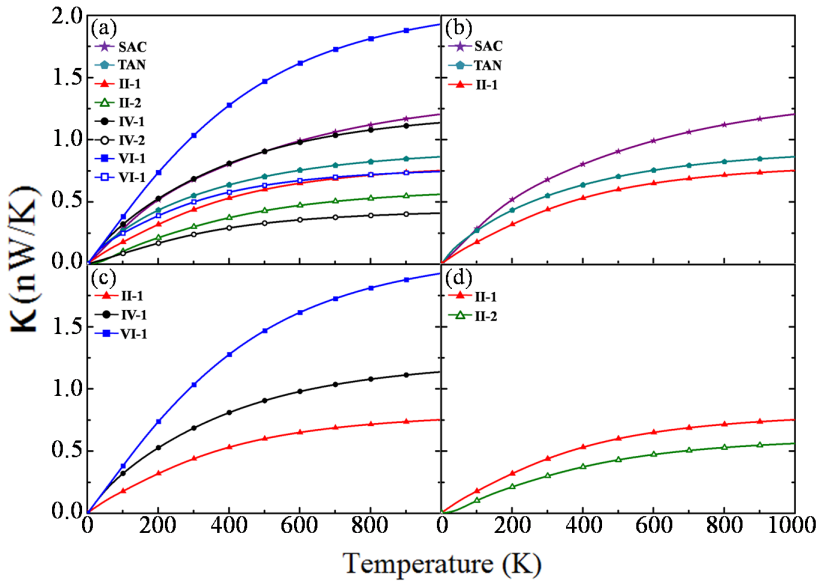
Pith's one-line read The paper shows that the thermal conductance of one-dimensional ultrathin carbon structures, from a single atomic chain to benzene-ring polymers and nanothreads, spans 0.24 to 1.00 nW/K at 300 K, with the exact value set by how the…
desk verdict Useful systematic conductance data for 1D carbon chains, but the quantitative numbers and ranking rest on an unvalidated REBO force field and a post hoc channel multiplier. read the letter →
The pith
A machine-rendered reading of the paper's core claim, the machinery that carries it, and where it could break.
The reading
What carries the argument
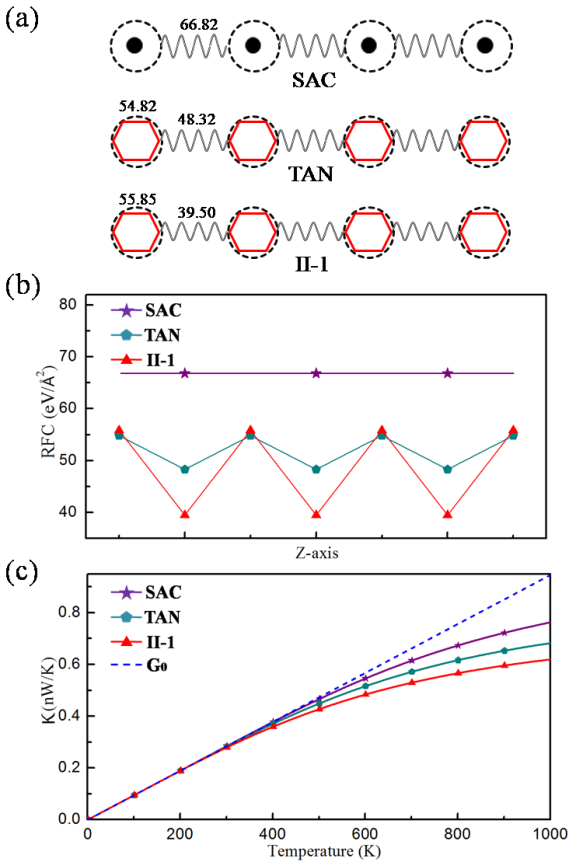
The engine is a two-stage reduction. First, the nonequilibrium Green's function formalism computes the transmission coefficient $T[\omega]$ and conductance $\kappa(T)$ from the mass-weighted harmonic force-constant matrix of each structure, with the second-generation reactive empirical bond order potential providing optimized geometries, stability-checked phonon dispersions, and the force constants. Second, a simplified one-dimensional model collapses each benzene ring to a single lattice site connected by springs; the spring constants are reduced force constants (RFCs) obtained by averaging the full force-constant matrix along xx, yy, and zz. The model explains transport by counting parallel channels between rings and by resolving RFCs into directional components, so that differences among the structures reduce to a few scalar couplings rather than hundreds of atomic degrees of freedom.
What would settle it
Compute the same ballistic conductance with density-functional-theory force constants for the nanothread VI-1 and the polymer IV-2: if their ordering reverses, or either value falls clearly outside the 0.24–1.00 nW/K range, the central claim is refuted. A measured room-temperature conductance outside that window on a recovered nanothread sample would also settle it.
Extended reading notes
Core claim
On the paper's own terms, the discovery is a quantitative map: among the eight structures, the carbon nanothread VI-1 conducts best at 1.00 nW/K and the linear benzene polymer IV-2 worst at 0.24 nW/K at 300 K, with the single atomic chain landing at 0.68 nW/K. The authors show that the conductance is determined by connectivity style rather than by the material's carbon-only composition. Degree of saturation sets the number of parallel phonon channels (one, two, or three saturated-bond bridges between rings), so conductance roughly scales with that number; topological pattern, by contrast, changes the orientation of the inter-ring couplings while leaving their scalar strength nearly unchanged, which shifts the xx/yy/zz components of transmission and hence the total conductance. Both effects are captured by reducing each benzene ring to a lattice site and each bond to a reduced force constant.
Load-bearing premise
The argument stands on the reactive bond-order potential's force constants being quantitatively right for these benzene-ring geometries; if those stiffnesses are wrong, the computed conductance values and the ordering of the structures could change.
Editorial extensions
If this is right
- If the ranking is right, the nanothread VI-1 is the best phonon conductor of the set, about four to five times better than the linear polymer IV-2 at room temperature.
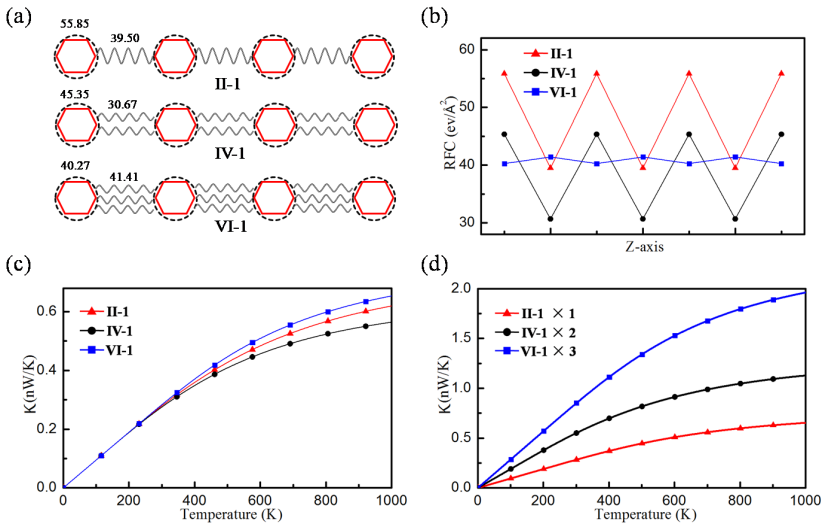
- Degree of saturation acts as a channel dial: conductance roughly triples from II-1 (two saturated carbons) to IV-1 (four) to VI-1 (six), matching one, two, and three saturated-bond channels.
- Topological pattern tunes conductance at fixed saturation: II-1 outperforms II-2 because its inter-ring couplings project more strongly onto the xx and yy directions.
- The reduced-force-constant model gives a reusable template: any ultrathin chain of molecular units can be screened for thermal conductance by counting channels and projecting couplings, without a full atomistic Green's function calculation.
- The 0.24–1.00 nW/K window gives quantitative targets for thermal management in molecular-scale carbon interconnects.
Reading between the lines
- Beyond the paper, the channel-count rule suggests that replacing benzene with other ring monomers—heterocyclic or functionalized—should scale thermal conductance by the number of saturated bridging bonds; this is a testable prediction the paper leaves implicit.
- Because the calculation is ballistic and infinite-length, the quoted numbers are upper bounds; adding anharmonic phonon scattering or finite length would lower conductance and should produce length-dependent crossover, both of which could be checked by simulation.
- If the empirical-potential-derived ranking is confirmed by density-functional force constants, the same simplified model could be used to screen other ultrathin one-dimensional structures for thermal conductance without full nonequilibrium Green's function calculations.
Signed reviews
Editorial analysis
A structured set of objections, weighed in public.
Referee Report
Summary. This paper reports ballistic phonon thermal conductance calculations for eight one-dimensional carbon structures: a single atomic chain, one thinnest armchair-edged nanoribbon, two linear benzene polymers of saturation degree II, two of degree IV, and two carbon nanothreads of degree VI. The authors use the nonequilibrium Green's function method with second-generation REBO force constants obtained from GULP, check structural stability via phonon dispersions and AIMD simulations, and obtain thermal conductance values from 0.24 to 1.00 nW/K at 300 K, with VI-1 the highest and IV-2 the lowest. They also propose a simplified one-dimensional force-constant model in which benzene rings are reduced to lattices with averaged reduced force constants, and they apply a channel-number multiplier of 1, 2, or 3 to match the full NEGF results.
Significance. If the quantitative results are trustworthy, the paper provides a useful systematic dataset for thermal conductance of these emerging one-dimensional carbon structures and a compact coarse-grained picture of how connectivity styles affect ballistic phonon transport. The strengths are the standard NEGF implementation, the structural stability checks through phonon dispersions and AIMD, and the comparison of SAC/SPC results against a published molecular dynamics value, which validates the numerical procedure. However, the quantitative claims rest on REBO force constants that are not independently validated for these specific strained geometries, and the simplified model's agreement with the full calculation is partly built in by construction. These issues are central to the headline conductance range and the VI-1/IV-2 ranking.
major comments (3)
- [Section 2, Eqs. (1)-(3)] The entire quantitative output inherits the REBO force constants, but no DFT or experimental Hessian is provided for the polybenzene and nanothread geometries studied. The phonon dispersion stability check and the 20 ps AIMD run at 1000 K confirm that the optimized geometry is mechanically and thermally stable, yet they do not test the quantitative accuracy of the force constants entering Eq. (1). Because Eq. (3) weights the transmission by the Bose-Einstein factor, errors in low-frequency inter-ring and torsional force constants can change the 300 K conductance by tens of percent and could reorder VI-1 relative to IV-2. I request a DFT-based Hessian or phonon calculation at least for VI-1 and IV-2, the best and worst conductors, to determine whether the reported 0.24-1.00 nW/K range and the connectivity ranking survive.
- [Section 3 and Figs. 3-5] The simplified force-constant model is a coarse-graining of the same REBO force constants used in the full NEGF calculation, so it is not an independent prediction of the transport properties. Moreover, the channel-number multiplier of 1, 2, and 3 in Fig. 4(d) is introduced after comparing the one-channel model with the full NEGF results; with this free parameter adjusted to match, the agreement in Fig. 4(d) does not constitute a validation of the model. The abstract's claim that the model 'explains' the complicated transport processes is therefore overstated; the authors should either test the model on structures not used to fix the multiplier or explicitly present it as a descriptive interpolation rather than an independent explanatory mechanism.
- [Section 3 and Eq. (3)] The NEGF calculation is harmonic and ballistic, so the reported 300 K conductances are upper bounds if anharmonic phonon-phonon scattering is significant. The comparison with polyethylene in Fig. S3(d) validates the ballistic numerical procedure but does not address the magnitude of anharmonicity in the new structures, which contain strained four-coordinate carbon with tilted-ring geometries. A quantitative estimate or benchmark, for example a molecular dynamics or anharmonic NEGF calculation for one nanothread and one polymer, is needed to indicate how much the 0.24-1.00 nW/K values could be reduced at room temperature.
minor comments (3)
- [Figure 3 caption] The caption cites reference [45] for the quantized thermal conductance G0, but reference [45] is the Nosé thermostat paper; the correct citation is reference [46] (Rego and Kirczenow), which is otherwise not cited in the text.
- [Section 3, SPC validation] The text states that 0.32 nW/K from this work and 0.50 nW/K from MD in reference [31] are 'comparable', but this is about a 36% discrepancy; the sentence should state the expected differences (e.g., system length, force field, or finite-size effects) that make the two values consistent rather than implying close agreement.
- [Section 2] The sentence 'only one phonon mode is need to be considered' should read 'only one phonon mode is needed to be considered', and in the same paragraph 'the length of the central region is set long enough' would be more convincing if the convergence of thermal conductance with central-region length were shown in the supplementary material.
Circularity Check
The central NEGF/REBO conductance values are self-contained, but the paper's 'force-constant model' reuses the same force constants and is rescaled by channel counts to match the full result, so its explanatory agreement is partly by construction.
-
self definitional
[Section 3, paragraph introducing the simplified models (Fig. 3)]
"The RFCs on/between the lattices are calculated approximately according to average values of the force constant matrix in xx, yy and zz directions[47], i.e., only one phonon mode is need to be considered here"
The NEGF conductance in Eqs. (1)-(3) is built from the harmonic force-constant matrix obtained from the REBO potential in Section 2. The simplified model's reduced force constants are defined as averages over that same force-constant matrix. The model is therefore a one-mode projection of the same input, so its agreement with the full conductance (the paper says the model results in Fig. 3(c) agree well with Fig. 2(b)) is a consequence of construction rather than an independent confirmation of the transport mechanism.
-
fitted input called prediction
[Section 3, paragraph on degree of saturation, Fig. 4(a)-(d)]
"The discrepancy is attributed to different number of phonon transport channels in the structures. In the structure II-1, the two saturated bonds between benzene rings form one transport channel along z direction. In the structures IV-1 and VI-1, the saturated bonds form two and three channels, respectively. Therefore, the total thermal conductance for the three structures should be 1, 2 and 3 times of those for the corresponding simplified models. After considering the channel numbers, the thermal conductance of models fits the results of real structures well."
The one-channel simplified model initially deviates substantially from the full NEGF result. The paper then multiplies the model conductance by integer channel numbers (1, 2, 3) chosen so that the model 'fits the results of real structures well.' The channel counts are geometrically motivated, but the quantitative agreement is enforced by this multiplicative rescaling of the same force-constant input, so the model's explanatory success is partly by construction rather than an independent check.
full rationale
The paper's headline numerical result (0.24-1.00 nW/K at 300 K, with VI-1 highest and IV-2 lowest) is computed directly from REBO force constants via the NEGF equations (1)-(3); it is not obtained from the simplified model, and it is benchmarked against external MD for polyethylene (0.32 vs 0.50 nW/K), so the central derivation is self-contained. The circularity is confined to the explanatory 'force-constant model': its reduced force constants are averages of the same Hessian that feeds the NEGF calculation, and the channel multiplier is rescaled to match the full results. That is a post-hoc coarse-graining, not an independent prediction. There is a minor self-citation [47] for the RFC averaging method, but it is not load-bearing for the numerical claim. The use of REBO without a DFT Hessian cross-check for these specific geometries is a correctness and accuracy risk, not a circularity, and is outside this pass's score.
Assumptions & free parameters
free parameters (1)
- channel number multiplier =
1 for II-1, 2 for IV-1, 3 for VI-1
assumptions (3)
- domain assumption The second-generation REBO potential accurately describes interatomic forces and force constants in these hydrogenated carbon structures.
- domain assumption Thermal transport in these infinite 1D structures is ballistic and harmonic, so NEGF with harmonic force constants gives the conductance.
- ad hoc to paper A single effective phonon mode with averaged reduced force constants captures the connectivity-dependent differences in thermal conductance.
Cite this review
Pith. "Pith review of Thermal transports of one-dimensional ultrathin carbon structures." pith.science (2026). https://pith.science/paper/3TFR5KH6
@misc{pith2026190809461,
  author       = {Pith},
  title        = {Pith review of: Thermal transports of one-dimensional ultrathin carbon structures},
  year         = {2026},
  howpublished = {\url{https://pith.science/paper/3TFR5KH6}},
  note         = {Machine review of arXiv:1908.09461}
}
read the original abstract
Carbon atomic chain, linear benzene polymers, and carbon nanothreads are all one-dimensional (1D) ultrathin carbon structures. They possess excellent electronic and mechanical properties; however, their thermal transport properties have been rarely explored. Here, we systematically study their thermal conductance by combining the nonequilibrium Green's function and force field methods. The thermal conductance varies from 0.24 to 1.00 nW/K at 300 K, and phonon transport in the linear benzene polymers and carbon nanothreads is strongly dependent on the connectivity styles between the benzene rings. We propose a simple 1D model, namely force-constant model, that explains the complicated transport processes in these structures. Our study not only reveals intrinsic mechanisms of phonon transport in these carbon structures, but also provides an effective method to analyze thermal properties of other 1D ultrathin structures made of only several atomic chains.
Figures

Figures from the paper (2 more)

Reference graph
Works this paper leans on
-
[1]
Allen M J, Tung V C and Kaner R B 2010 Honeycomb Carbon: A Review of Graphene Chem. Rev. 110 132-45
work page 2010
-
[2]
Balandin A A 2011 Thermal properties of graphene and nanostructured carbon materials Nat. Mater. 10 569
work page 2011
-
[3]
Choi W, Lahiri I, Seelaboyina R and Kang Y S 2010 Synthesis of Graphene and Its Applications: A Review Crit. Rev. Solid State 35 52-71
work page 2010
-
[4]
Zhang Z L, Chen Y P, Xie Y E, Zhang M and Zhong J X 2011 Spin-polarized transport properties of Fe atomic chain adsorbed on zigzag graphene nanoribbons J. Phys. D. Appl. Phys. 44 215403
work page 2011
-
[5]
Han M Y , Özyilmaz B, Zhang Y and Kim P 2007 Energy Band -Gap Engineering of Graphene Nanoribbons Phys. Rev. Lett. 98 206805
work page 2007
-
[6]
Yogeswaran U and Chen S -M 2008 A Review on the Electrochemical Sensors and Biosensors Composed of Nanowires as Sensing Material Sensors 8
work page 2008
-
[7]
De V older M F L, Tawfick S H, Baughman R H and Hart A J 2013 Carbon Nanotubes: Present and Future Commercial Applications Science 339 535
work page 2013
-
[8]
Synthesis and Testing of Components Accounts
Tour J M 2000 Molecular Electronics. Synthesis and Testing of Components Accounts. Chem. Res. 33 791-804
work page 2000
Show all 50 references
-
[9]
Jariwala D, Sangwan V K, Lauhon L J, Marks T J and Hersam M C 2013 Carbon nanomaterials for electronics, optoelectronics, photovoltaics, and sensing Chem. Soc. Rev. 42 2824-60
2013
-
[10]
Li X, Wang X, Zhang L, Lee S and Dai H 2008 Chemically Derived, Ultrasmooth Grap hene Nanoribbon Semiconductors Science 319 1229
2008
-
[11]
Yang X, Dou X, Rouhanipour A, Zhi L, Räder H J and Müllen K 2008 Two-Dimensional Graphene Nanoribbons J. Am. Chem. Soc. 130 4216-7
2008
-
[12]
Liang G, Neophytou N, Nikonov D E and Lundstrom M S 2007 Performanc e Projections for Ballistic Graphene Nanoribbon Field-Effect Transistors Ieee. T. Electron Dev. 54 677-82
2007
-
[13]
Wang X, Ouyang Y , Li X, Wang H, Guo J and Dai H 2008 Room-Temperature All-Semiconducting Sub-10-nm Graphene Nanoribbon Field-Effect Transistors Phys. Rev. Lett. 100 206803
2008
-
[14]
Terrones M, Botello-Méndez A R, Campos-Delgado J, López-Urías F, Vega-Cantú Y I, Rodríguez- Macías F J, Elías A L, Muñoz-Sandoval E, Cano-Márquez A G, Charlier J-C and Terrones H 2010 Graphene and graphite nanoribbons: Morpho logy, properties, synthesis, defects and applicatio...
2010
-
[15]
13 3487-93
Cretu O, Botello -Mendez A R, Janowska I, Pham -Huu C, Charlier J -C and Banhart F 2013 Electrical Transport Measured in Atomic Carbon Chains Nano Lett. 13 3487-93
2013
-
[16]
Shen L, Zeng M, Yang S-W, Zhang C, Wang X and Feng Y 2010 Electron Transport Properties of Atomic Carbon Nanowires between Graphene Electrodes J. Am. Chem. Soc. 132 11481-6
2010
-
[17]
18 4934-42
Wang T, Duan P, Xu E-S, Vermilyea B, Chen B, Li X, Badding J V , Schmidt-Rohr K and Crespi V H 2018 Constraining Carbon Nanothread Structures by Experimental and Calculated Nuclear Magnetic Resonance Spectra Nano Lett. 18 4934-42
2018
-
[18]
Li X, Baldini M, Wang T, Chen B, Xu E-s, Vermilyea B, Crespi V H, Hoffmann R, Molaison J J, Tulk C A, Guthrie M, Sinogeikin S and Badding J V 2017 Mechanochemical Synthesis of Carbon Nanothread Single Crystals J. Am. Chem. Soc. 139 16343-9
2017
-
[19]
McMillan P F 2007 Benzene bridges under pressure Nat. Mater. 6 7
2007
-
[20]
Silveira J F R V and Muniz A R 2017 Functionalized d iamond nanothreads from benzene 12 derivatives Phys. Chem. Chem. Phys. 19 7132-7
2017
-
[21]
Chen B, Hoffmann R, Ashcroft N W, Badding J, Xu E and Crespi V 2015 Linearly Polymerized Benzene Arrays As Intermediates, Tracing Pathways to Carbon Nanothreads J. Am. Chem. Soc. 137 14373-86
2015
-
[22]
15 5124-30
Xu E-s, Lammert P E and Crespi V H 2015 Systematic Enumeration of sp3 Nanothreads Nano Lett. 15 5124-30
2015
-
[23]
Barua S R, Quanz H, Olbrich M, Schreiner P R, Trauner D and Allen W D 2014 Polytwistane Chem-Eur. J. 20 1638-45
2014
-
[24]
Pruzan P, Chervin J C, Thiéry M M, Itié J P, Besson J M, Forgerit J P and Revault M 1990 Transformation of benzene to a polymer after static pressurization to 30 GPa J. Chem. Phys. 92 6910-5
1990
-
[25]
Cansell F, Fabre D and Petitet J P 1993 Phase transitions and chemical transformations of benzene up to 550 °C and 30 GPa J. Chem. Phys. 99 7300-4
1993
-
[26]
Ciabini L, Santoro M, Bini R and Schettino V 2002 High pressure reactivity of solid benzene probed by infrared spectroscopy J. Chem. Phys. 116 2928-35
2002
-
[27]
Ciabini L, Gorelli F A, Santoro M, Bini R, Schettino V and Mezouar M 2005 High -pressure and high-temperature equation of state and phase diagram of solid benzene Phys. Rev. B 72 094108
2005
-
[28]
Ciabini L, Santoro M, Gorelli F A, Bini R, Schettino V and Raugei S 2006 Triggering dynamics of the high-pressure benzene amorphization Nat. Mater. 6 39
2006
-
[29]
Fitzgibbons T C, Guthrie M, Xu E-s, Crespi V H, Davidowski S K, Cody G D, Alem N and Badding J V 2014 Benzene-derived carbon nanothreads Nat. Mater. 14 43
2014
-
[30]
Sperling L H 2006 Introduction to Physical Polymer Science (New Jersey:Wiley-interscience)
2006
-
[31]
Henry A and Chen G 2008 High Thermal Conductivity of Single Polyethylene Chains Using Molecular Dynamics Simulations Phys. Rev. Lett. 101 235502
2008
-
[32]
Nanotechnol
Shen S, Henry A, Tong J, Zheng R and Chen G 2010 Polyethylene nanofibres with very high thermal conductivities Nat. Nanotechnol. 5 251
2010
-
[33]
Cui L, Jeong W, Hur S, Matt M, Klöckner J C, Pauly F, Nielaba P, Cuevas J C, M eyhofer E and Reddy P 2017 Quantized thermal transport in single-atom junctions Science 355 1192
2017
-
[34]
Wang Z, Carter J A, Lagutchev A, Koh Y K, Seong N-H, Cahill D G and Dlott D D 2007 Ultrafast Flash Thermal Conductance of Molecular Chains Science 317 787
2007
-
[35]
Hopkins P E and Serrano J R 2009 Phonon localization and thermal rectification in asymmetric harmonic chains using a nonequilibrium Green's function formalism Phys. Rev. B 80 201408
2009
-
[36]
Stojkovic D, Zhang P and Crespi V H 2001 Smallest Nanotube: Bre aking the Symmetry of sp3 Bonds in Tubular Geometries Phys. Rev. Lett. 87 125502
2001
-
[37]
Liao Q, Zeng L, Liu Z and Liu W 2016 Tailoring Thermal Conductivity of Single-stranded Carbon- chain Polymers through Atomic Mass Modification Sci. Rep. 6 34999
2016
-
[38]
Heat Trans-T
Luo D , Huang C and Huang Z 2017 Decreased Thermal Conductivity of Polyethylene Chain Influenced by Short Chain Branching J. Heat Trans-T. Asme 140 031302--6
2017
-
[39]
Yamamoto T and Watanabe K 2006 Nonequilibrium Green's Function Approach to Phonon Transport in Defective Carbon Nanotubes Phys. Rev. Lett. 96 255503
2006
-
[40]
Microst 28 253-78
Datta S 2000 Nanoscale device modeling: the Green ’s function method Superlattice. Microst 28 253-78
2000
-
[41]
Gale J D and Rohl A L 2003 The General Utility Lattice Program (GULP) Mol. Simulat. 29 291- 341 13
2003
-
[42]
Brenner D W 2002 A Second -Generation Reactive Empirical Bond Order (REBO) Potential Energy Expression for Hydrocarbons J. Phys. : Condens. Matter 14 783
2002
-
[43]
Ouyang T, Chen Y , Liu L-M, Xie Y , Wei X and Zhong J 2012 Thermal transport in graphyne nanoribbons Phys. Rev. B 85 235436
2012
-
[44]
Xu Y , Chen X, Gu B-L and Duan W 2009 Intrinsic anisotropy of thermal conductance in graphene nanoribbons Appl. Phys. Lett. 95 233116
2009
-
[45]
Nosé S 1984 A unified formulation of the constant temperature molecular dynamics methods J. Chem. Phys. 81 511-9
1984
-
[46]
Rego L G C and Kirczenow G 1998 Quantized Thermal Conductance of Dielectric Quantum Wires Phys. Rev. Lett. 81 232-5
1998
-
[47]
Zhang Z, Xie Y , Ouyang Y and Chen Y 2017 A systematic investigation of thermal conductivities of transition metal dichalcogenides Int. J. Heat Mass. Tran 108 417-22
2017
-
[48]
Liu J and Yang R 2012 Length-dependent thermal conductivity of single extended polymer chains Phys. Rev. B 86 104307
2012
-
[49]
Wang X, Kaviany M and Huang B 2017 Phonon coupling and transport in individual polyethylene chains: a comparison study with the bulk crystal Nanoscale 9 18022-31
2017
-
[50]
Zhang Q, Liu C, Liu X, Liu J, Cui Z, Zhang Y , Yang L, Zhao Y , Xu T T, Chen Y , Wei J, Mao Z and Li D 2018 Thermal Transport in Quasi-1D van der Waals Crystal Ta2Pd3Se8 Nanowires: Size and Length Dependence ACS Nano 12 2634-42 14 Figure Captions Figure 1. Atomic structures of...
2018
Reviewed August 14, 2026 · model on record in the stance chip above.
Discussion (0). Continue with ORCID to comment.