REVIEW 5 major objections 6 minor 45 references
Visual IRL for Human-Like Robotic Manipulation
T0 review · 5 major / 6 minor · reviewed 2026-08-11 · deepseek-v4-flash
Pith's one-line read Cobots pick up human-like manipulation style directly from RGB-D video.
desk verdict A genuinely new pipeline with real cobot trials, but human-likeness is asserted rather than measured and the restricted joint workspace is never validated. read the letter →
The pith
A machine-rendered reading of the paper's core claim, the machinery that carries it, and where it could break.
The reading
What carries the argument
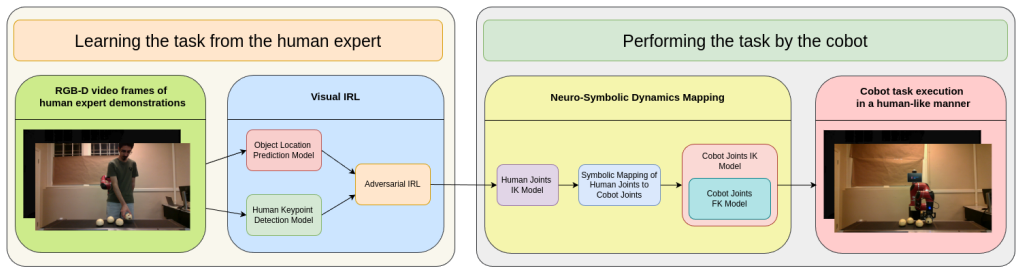
The load-bearing mechanism is the Neuro-Symbolic Dynamics Mapping, a four-stage transfer that takes the wrist's 3D position, predicts human hip, shoulder, and elbow coordinates, maps those one-to-one to cobot joints, and refines the initial joint angles through a restricted forward-kinematics model and an inverse-kinematics optimizer. The optimizer's loss combines end-effector position error with a penalty for deviating from the human-derived angles, which is what keeps the motion human-like. Visual IRL itself is the second mechanism: it uses AIRL with continuous keypoint-based states, avoiding the separate state-action recognition networks used in earlier learn-from-observation pipelines.
What would settle it
Run a reachability audit on either cobot: sample target end-effector positions from the actual task distribution, run the restricted four-joint forward and inverse kinematics, and check convergence to the 0.01 m threshold; any target that fails while the full-degree-of-freedom solver succeeds would falsify the claim that the restricted model preserves task execution.
Extended reading notes
Core claim
The central claim is that human pose keypoints from an RGB-D stream can serve directly as state features for inverse reinforcement learning, and that the resulting reward and policy can be transferred to physically different cobots while preserving human-like motion. Visual IRL models the task as an MDP whose state is the 3D end-effector location, object location, and predicted object label, and whose action is end-effector displacement; AIRL learns a reward function from these continuous observations. The neuro-symbolic dynamics mapping translates human wrist coordinates into human joint angles, maps those one-to-one onto the cobot's hip, shoulder, elbow, and wrist, and then uses a restricted forward model plus inverse kinematics to minimize both position error and joint deviation, with loss $L = \|\hat{p}_{ee} - p_{ee}\| + \alpha \|\theta - \theta_0\|$. Evaluated on onion sorting with a 7-DoF Sawyer and liquid pouring with a 6-DoF KUKA LBR iisy, the authors report higher learned-behavior accuracy than a MAP-BIRL baseline (90.4% versus 83.3%) and lower time, jerkiness, and end-effector displacement than the RRT or RRT-connect planners.
Load-bearing premise
The load-bearing premise is that fixing all cobot joints except hip, shoulder, elbow, and wrist at zero still leaves enough reachable workspace to execute the task, so if any needed target lies outside that restricted reach the IK refinement cannot recover.
Editorial extensions
If this is right
- Human keypoints can replace hand-designed state-action recognition in learn-from-observation, since AIRL learns directly from the stream of 3D keypoint features.
- A reward learned in keypoint space transfers from a human to cobots with different numbers of joints, as long as a joint-level mapping exists.
- Joint-level mapping plus IK refinement yields smoother motion than end-effector-only sampling planners, with lower jerkiness and shorter end-effector travel on both tested tasks.
- Because the learned reward encodes human preferences, the resulting policy can sort objects or pour liquids without task-specific programming.
Reading between the lines
- The paper does not test relaxing the restricted-joint assumption, but allowing the remaining cobot joints to move only when the restricted configuration cannot reach the target could preserve human-likeness while removing the admitted workspace limitation.
- The reward is defined over keypoint and object-location features rather than robot-specific angles, so the same Visual IRL reward could plausibly be reused with a retrained dynamics mapping on other robots, reducing per-robot retraining.
- The camera is fixed and the human-cobot base alignment is assumed stable; perturbing either would directly stress-test the 2D-to-3D conversion.
- The pouring task treats pouring as a triggered tilt and does not model liquid flow, so tasks requiring exact poured volume would need an additional sensing loop.
Signed reviews
Editorial analysis
A structured set of objections, weighed in public.
Referee Report
Summary. The paper proposes an end-to-end pipeline for learning manipulation policies from human RGB-D demonstrations and transferring them to collaborative robots with different degrees of freedom. Visual IRL feeds pose keypoints and object localization information into AIRL to learn a reward; a neuro-symbolic dynamics module maps human hip/shoulder/elbow/wrist joints to cobot joints, fixes other cobot joints to zero, and refines the four mapped angles with learned FK/IK models. Experiments on onion sorting with a Sawyer arm and liquid pouring with a KUKA LBR iisy compare efficiency metrics (time, so-called jerkiness, end-effector displacement) against RRT/RRT-connect baselines, together with component-level detection/regression evaluations and a small LBA comparison against MAP-BIRL.
Significance. If the pipeline were fully validated, it would be a practical contribution to learning-from-observation for industrial cobots: it directly consumes RGB-D keypoints, avoids custom state-action recognition networks, and demonstrates real-world deployments on two different cobots. The reported efficiency gains over RRT/RRT-connect baselines and the improved LBA over MAP-BIRL are encouraging. However, the evidence does not yet establish the central 'human-like' claim, and several load-bearing components (restricted workspace, learned FK/IK accuracy, quantitative human comparison) are not evaluated. The approach is not obviously incorrect, and the missing evaluations are obtainable within the manuscript's scope.
major comments (5)
- [§4.2 and Section 6] The restricted four-joint workspace is never validated. Eq. (6) can only adjust the hip, shoulder, elbow, and wrist angles after all other cobot joints are fixed at 0 degrees, and Section 6 admits that this 'inherently limited the cobot's range of movement capabilities.' The paper reports no reachability analysis, no IK convergence statistics, and no task success rates for either task; Tables 5 and 6 report only time, jerkiness, and displacement. If a required target lies outside the restricted workspace, the position-error term in Eq. (6) cannot converge below 0.01 m and the task cannot be completed, so the reported results may be over a biased subset of reachable motions. Please add reachability analysis over the task-relevant target sets, IK convergence rates, and per-task success rates.
- [§5.3, Tables 5-6, Figure 4] The central human-likeness claim is not quantitatively compared with human motion. The baselines are RRT and RRT-connect, which are not designed to be human-like, and Figure 4 offers only a qualitative visual comparison. Since the neuro-symbolic dynamics model is fitted to human demonstrations, closeness to those same trajectories is expected and cannot be used as independent evidence. Please report quantitative metrics of robot-vs-human trajectory similarity (e.g., DTW, joint-angle correlation, displacement/jerk relative to human data) and clarify that the 'human-like' conclusion relies on those comparisons rather than on beating a generic planner.
- [§4.2 'Cobot's Restricted Forward Kinematics Model' and 'Cobot's Inverse Kinematics Model'] The learned FK and IK models are not validated on held-out data or against analytic kinematics. The FK model is trained on Gazebo/Rviz simulation data, and the IK of Eq. (6) uses that learned FK as its forward predictor; no FK test error, IK end-effector accuracy on known targets, or comparison to a URDF-based solver is reported. Because a biased learned FK could let Eq. (6) converge at a predicted position that differs from the physical end-effector position, the accuracy of the transfer pipeline is not established. Please report held-out FK RMSE (e.g., in meters over a withheld joint-angle set) and IK success/accuracy on physical or simulated test targets.
- [§4.1 and §5.1, 'State and Action Parameters'] The exact state and action spaces used by AIRL are inconsistent. The abstract and Section 4.1 say Visual IRL uses RGB-D keypoints directly as state features, but the formal problem formulation defines the state as end-effector location, object location, and object label, and Section 5.1 repeats only these three variables. It is unclear whether the hip, shoulder, and elbow keypoints enter the reward/policy learning at all, or whether the wrist keypoint is the only human keypoint used (as the end-effector). Please specify the exact state and action vectors and reconcile the wording with the claimed contribution.
- [§5.4, 'Evaluating Visual IRL toward LfO'] The LBA comparison of 90.4% versus 83.3% is reported without variance, per-trial counts, or statistical significance, and the 'true policy' used for LBA is not defined. This is the only quantitative evidence that Visual IRL improves over MAP-BIRL, so please report per-trial results (or mean ± std), define LBA precisely, and provide a significance test.
minor comments (6)
- [Table 3] The header repeats the joint names from Table 1 (Right Hip, Right Shoulder, Right Elbow, Right Wrist), but the text says the table compares Faster-RCNN and YOLOv8 object detection models; the columns should be Precision, Recall, mAP50, and mAP50-95.
- [Table 2] Table 2 appears to contain duplicated values: Shoulder X equals Elbow X, Wrist Y equals Elbow Y, and Wrist Z equals Shoulder Z; please verify and correct the entries.
- [§5.3, 'Average Movement Jerkiness'] The metric called 'Average Movement Jerkiness' is defined as the summed angular movement of joints, which is not jerkiness (the third derivative of position); rename the metric to 'joint movement' or similar.
- [§5.4, trial description] The trial description is ambiguous: '10 trials with our proposed model and 10 other trials with the baseline model replaced with our neuro-symbolic model' seems to state that both conditions use the neuro-symbolic model; clarify the actual number of trials per condition.
- [§5.3, LBA definition] The definition of Learned Behavior Accuracy ('expressed as a percentage of the former') is unclear; rewrite to specify exactly what is matched and how the percentage is computed.
- [§5.4, 'power efficiency'] Section 5.4 states that the results indicate 'power efficiency,' but no power measurements are reported; please remove this claim or add the corresponding measurements.
Circularity Check
The IK loop treats its own learned FK model as ground truth, so the 0.01 m positioning claim is satisfied by construction; LBA is also scored on the demonstrated pairs used for training, leaving only the RRT/MAP-BIRL comparisons as independent evidence.
-
fitted input called prediction
[Section 4.2, 'Cobot's Inverse Kinematics Model' (Eq. 6)]
"The model starts with an initial guess for the joint angles and iteratively uses the trained forward kinematics model to estimate the end-effector's position based on the updated angles. ... The loss function L can be formulated as follows: L = || ˆpee − pee || + α || θ − θ0 || ... The process converges when the position error is below a specified threshold (0.01 m)."
The p̂_ee in the IK loss is produced by the trained Restricted FK model, which is itself a learned surrogate fit to Gazebo/Rviz simulation data. Minimizing ||p̂_ee − p_ee|| and declaring convergence at 0.01 m therefore certifies agreement with the learned FK model, not with the cobot's true forward kinematics or with an independently validated plant model. The paper reports no test accuracy for the FK model and no physical end-effector error, so the conclusion that the cobot's end-effector reaches the desired target location is satisfied by construction inside the same fitted model used to generate the candidate positions.
-
fitted input called prediction
[Section 5.3, 'Evaluating Visual IRL toward LfO']
"LBA is computed as the number of demonstrated state-action pairs that match between using the true and learned policies expressed as a percentage of the former ... Predictions from Visual IRL achieved an LBA of 90.4%, compared to 83.3% that uses discrete state-action pairs as input trajectory."
LBA is defined over demonstrated state-action pairs, and Visual IRL's reward and policy are fit to expert trajectories collected from keypoints and object locations via AIRL/TRPO in Section 4.1. The evaluation subsection reports no held-out split for this metric, so the 90.4% number is a training-set match rate rather than an independent prediction of generalization. The comparison to MAP-BIRL on the same protocol provides relative evidence, but the absolute claim that Visual IRL yields an accurate reward function rests partly on reproducing the very demonstrations used to fit the model.
full rationale
The strongest circularity is in the neuro-symbolic IK stage: Eq. (6) uses the trained Restricted FK model's output as both the optimizer's predicted position and the arbiter of the 0.01 m convergence threshold, so the reported accurate end-effector positioning is defined relative to a fitted surrogate rather than the physical robot. A secondary issue is LBA, which is scored on demonstrated state-action pairs without a described train/test split, making the 90.4% figure a fit diagnostic. These are partial circularities, not total ones: the method is also compared against RRT/RRT-connect on physical cobots (Tables 5–6), against MAP-BIRL for LBA, and the human-likeness improvement over RRT is an external benchmark. The Section 6 admission that fixing joints inherently limited the cobot's range of movement capabilities is a reachability and correctness risk rather than a circular step. Self-citations in the references are not load-bearing for the central derivation, so they do not raise the score further. Overall score 6: the central positioning-accuracy claim reduces, by construction, to the learned FK model, while other claims retain independent content.
Assumptions & free parameters
free parameters (5)
- alpha (IK adjustment penalty weight) =
0.0005
- IK convergence threshold =
0.01 m
- learning rates =
0.001 and 0.01
- max IK iterations =
10000
- object detection confidence threshold =
0.5
assumptions (6)
- domain assumption Expert demonstrations are optimal with respect to some unknown reward function.
- domain assumption The state (end-effector location, object location, object label) is Markovian for the manipulation tasks.
- ad hoc to paper The wrist 3D location is sufficient to infer the human hip, shoulder, and elbow positions.
- ad hoc to paper Fixing non-human-like cobot joints at 0 degrees still permits task completion.
- ad hoc to paper The learned forward kinematics model accurately predicts the cobot's end-effector position.
- domain assumption YOLOv8's object label (e.g., blemished or unblemished) matches the human expert's judgment used in the demonstrations.
Cite this review
Pith. "Pith review of Visual IRL for Human-Like Robotic Manipulation." pith.science (2026). https://pith.science/paper/3XYZCZGS
@misc{pith2026241211360,
  author       = {Pith},
  title        = {Pith review of: Visual IRL for Human-Like Robotic Manipulation},
  year         = {2026},
  howpublished = {\url{https://pith.science/paper/3XYZCZGS}},
  note         = {Machine review of arXiv:2412.11360}
}
read the original abstract
We present a novel method for collaborative robots (cobots) to learn manipulation tasks and perform them in a human-like manner. Our method falls under the learn-from-observation (LfO) paradigm, where robots learn to perform tasks by observing human actions, which facilitates quicker integration into industrial settings compared to programming from scratch. We introduce Visual IRL that uses the RGB-D keypoints in each frame of the observed human task performance directly as state features, which are input to inverse reinforcement learning (IRL). The inversely learned reward function, which maps keypoints to reward values, is transferred from the human to the cobot using a novel neuro-symbolic dynamics model, which maps human kinematics to the cobot arm. This model allows similar end-effector positioning while minimizing joint adjustments, aiming to preserve the natural dynamics of human motion in robotic manipulation. In contrast with previous techniques that focus on end-effector placement only, our method maps multiple joint angles of the human arm to the corresponding cobot joints. Moreover, it uses an inverse kinematics model to then minimally adjust the joint angles, for accurate end-effector positioning. We evaluate the performance of this approach on two different realistic manipulation tasks. The first task is produce processing, which involves picking, inspecting, and placing onions based on whether they are blemished. The second task is liquid pouring, where the robot picks up bottles, pours the contents into designated containers, and disposes of the empty bottles. Our results demonstrate advances in human-like robotic manipulation, leading to more human-robot compatibility in manufacturing applications.
Figures


Figures from the paper (2 more)


Reference graph
Works this paper leans on
-
[1]
Arash Ajoudani, Andrea Maria Zanchettin, Serena Ivaldi, Alin Albu-Schäffer, Kazuhiro Kosuge, and Oussama Khatib. 2018. Progress and prospects of the human–robot collaboration. Autonomous Robots 42 (2018), 957–975
work page 2018
-
[2]
Saurabh Arora and Prashant Doshi. 2019. A Survey of Inverse Reinforcement Learning: Challenges, Methods and Progress. CoRR abs/1806.06877 (2019). http://arxiv.org/abs/1806.06877
arXiv 2019
-
[3]
Saurabh Arora, Prashant Doshi, and Bikramjit Banerjee. 2023. Online Inverse Reinforcement Learning with Learned Observation Model. In Conference on Robot Learning. PMLR, 1468–1477
work page 2023
-
[4]
Ehsan Asali, Prashant Doshi, and Jin Sun. 2023. MVSA-Net: Multi-View State- Action Recognition for Robust and Deployable Trajectory Generation. arXiv preprint arXiv:2311.08393 (2023)
work page Pith review arXiv 2023
-
[5]
Tommaso Bendinelli, Luca Biggio, and Pierre-Alexandre Kamienny. 2023. Con- trollable neural symbolic regression. In International Conference on Machine Learning. PMLR, 2063–2077
work page 2023
-
[6]
Luca Biggio, Tommaso Bendinelli, Alexander Neitz, Aurelien Lucchi, and Gi- ambattista Parascandolo. 2021. Neural symbolic regression that scales. In Inter- national Conference on Machine Learning. Pmlr, 936–945
work page 2021
-
[7]
N Boddupalli, T Matchen, and J Moehlis. 2023. Symbolic regression via neural networks. Chaos: An Interdisciplinary Journal of Nonlinear Science33, 8 (2023)
work page 2023
-
[8]
Davide Chicco, Matthijs J Warrens, and Giuseppe Jurman. 2021. The coefficient of determination R-squared is more informative than SMAPE, MAE, MAPE, MSE and RMSE in regression analysis evaluation. Peerj computer science 7 (2021), e623
2021
Show all 45 references
-
[9]
Jaedeug Choi and Kee-Eung Kim. 2011. Map inference for bayesian inverse reinforcement learning. Advances in Neural Information Processing Systems 24 (2011)
2011
-
[10]
Miles Cranmer, Alvaro Sanchez Gonzalez, Peter Battaglia, Rui Xu, Kyle Cranmer, David Spergel, and Shirley Ho. 2020. Discovering symbolic models from deep learning with inductive biases. Advances in neural information processing systems 33 (2020), 17429–17442
2020
-
[11]
Kourosh Darvish, Yeshasvi Tirupachuri, Giulio Romualdi, Lorenzo Rapetti, Diego Ferigo, Francisco Javier Andrade Chavez, and Daniele Pucci. 2019. Whole-body geometric retargeting for humanoid robots. In 2019 IEEE-RAS 19th International Conference on Humanoid Robots (Humanoids)....
2019
-
[12]
Neha Das, Sarah Bechtle, Todor Davchev, Dinesh Jayaraman, Akshara Rai, and Franziska Meier. 2021. Model-based inverse reinforcement learning from visual demonstrations. In Conference on Robot Learning. PMLR, 1930–1942
2021
-
[13]
Chioniso Dube and Jonathan Tapson. 2009. Kinematics design and human motion transfer for a humanoid service robot arm. Robotics and Mechatronics Sympo- sium
2009
-
[14]
Chrisantus Eze and Christopher Crick. 2024. Learning by Watching: A Review of Video-based Learning Approaches for Robot Manipulation. arXiv preprint arXiv:2402.07127 (2024)
2024
-
[15]
Chelsea Finn, Tianhe Yu, Tianhao Zhang, Pieter Abbeel, and Sergey Levine. 2017. One-shot visual imitation learning via meta-learning. In Conference on robot learning. PMLR, 357–368
2017
-
[16]
Justin Fu, Katie Luo, and Sergey Levine. 2018. Learning Robust Rewards with Adversarial Inverse Reinforcement Learning. In International Conference on Learning Representations
2018
-
[17]
Ian Goodfellow, Jean Pouget-Abadie, Mehdi Mirza, Bing Xu, David Warde-Farley, Sherjil Ozair, Aaron Courville, and Yoshua Bengio. 2014. Generative Adversarial Nets. In Advances in Neural Information Processing Systems. 2672–2680
2014
-
[18]
James J Kuffner and Steven M LaValle. 2000. RRT-connect: An efficient approach to single-query path planning. In Proceedings 2000 ICRA. Millennium Confer- ence. IEEE International Conference on Robotics and Automation. Symposia Proceedings (Cat. No. 00CH37065), V ol. 2. IEEE, 995–1001
2000
-
[19]
Mikel Landajuela, Chak Shing Lee, Jiachen Yang, Ruben Glatt, Claudio P San- tiago, Ignacio Aravena, Terrell Mundhenk, Garrett Mulcahy, and Brenden K Petersen. 2022. A unified framework for deep symbolic regression. Advances in Neural Information Processing Systems 35 (2022), 3...
2022
-
[20]
Steven M LaValle and James J Kuffner Jr. 2001. Randomized kinodynamic planning. The international journal of robotics research20, 5 (2001), 378–400
2001
-
[21]
Chiuhsiang Joe Lin and Rio Prasetyo Lukodono. 2021. Sustainable human–robot collaboration based on human intention classification.Sustainability 13, 11 (2021), 5990
2021
-
[22]
Priyanka Mandikal and Kristen Grauman. 2022. Dexvip: Learning dexterous grasping with human hand pose priors from video. In Conference on Robot Learning. PMLR, 651–661
2022
-
[23]
Raphael Memmesheimer, Ivanna Kramer, Viktor Seib, and Dietrich Paulus. 2019. Simitate: A hybrid imitation learning benchmark. In2019 IEEE/RSJ International Conference on Intelligent Robots and Systems (IROS). IEEE, 5243–5249
2019
-
[24]
Martin L Puterman. 2014. Markov decision processes: discrete stochastic dynamic programming. John Wiley & Sons
2014
-
[25]
Yuzhe Qin, Wei Yang, Binghao Huang, Karl Van Wyk, Hao Su, Xiaolong Wang, Yu-Wei Chao, and Dieter Fox. 2023. Anyteleop: A general vision-based dexterous robot arm-hand teleoperation system. arXiv preprint arXiv:2307.04577 (2023)
2023 arXiv
-
[26]
Harish Ravichandar, Athanasios S Polydoros, Sonia Chernova, and Aude Billard
-
[27]
John Schulman, Sergey Levine, Pieter Abbeel, Michael Jordan, and Philipp Moritz
-
[28]
Aran Sena and Matthew Howard. 2020. Quantifying teaching behavior in robot learning from demonstration. The International Journal of Robotics Research 39, 1 (2020), 54–72
2020
-
[29]
Prasanth Sengadu Suresh, Yikang Gui, and Prashant Doshi. 2023. Dec-AIRL: Decentralized Adversarial IRL for Human-Robot Teaming. In Proceedings of the 2023 International Conference on Autonomous Agents and Multiagent Systems. 1116–1124
2023
-
[30]
Lin Shao, Toki Migimatsu, Qiang Zhang, Karen Yang, and Jeannette Bohg. 2021. Concept2robot: Learning manipulation concepts from instructions and human demonstrations. The International Journal of Robotics Research40, 12-14 (2021), 1419–1434
2021
-
[31]
Laura Smith, Nikita Dhawan, Marvin Zhang, Pieter Abbeel, and Sergey Levine
-
[32]
Nihal Soans, Ehsan Asali, Yi Hong, and Prashant Doshi. 2020. Sa-net: Robust state-action recognition for learning from observations. In 2020 IEEE Interna- tional Conference on Robotics and Automation (ICRA). IEEE, 2153–2159
2020
-
[33]
Prasanth Sengadu Suresh and Prashant Doshi. 2022. Marginal MAP estimation for inverse RL under occlusion with observer noise. In Proceedings of the Thirty- Eighth Conference on Uncertainty in Artificial Intelligence. 1907–1916
2022
-
[34]
Silviu-Marian Udrescu and Max Tegmark. 2020. AI Feynman: A physics-inspired method for symbolic regression. Science Advances 6, 16 (2020), eaay2631
2020
-
[35]
Aleksandar Vakanski and Farrokh Janabi-Sharifi. 2017. Robot learning by visual observation. John Wiley & Sons
2017
-
[36]
Chien-Yao Wang, Alexey Bochkovskiy, and Hong-Yuan Mark Liao. 2023. YOLOv7: Trainable bag-of-freebies sets new state-of-the-art for real-time object detectors. In Proceedings of the IEEE/CVF Conference on Computer Vision and Pattern Recognition (CVPR)
2023
-
[37]
Sen Wang, Xinxin Zuo, Runxiao Wang, Fuhua Cheng, and Ruigang Yang. 2017. A generative human-robot motion retargeting approach using a single depth sensor. In 2017 IEEE International Conference on Robotics and Automation (ICRA) . IEEE, 5369–5376
2017
-
[38]
Jun Yamada, Jack Collins, and Ingmar Posner. 2023. Efficient skill acquisition for complex manipulation tasks in obstructed environments. arXiv preprint arXiv:2303.03365 (2023)
2023 arXiv
-
[39]
Sarah Young, Dhiraj Gandhi, Shubham Tulsiani, Abhinav Gupta, Pieter Abbeel, and Lerrel Pinto. 2021. Visual imitation made easy. In Conference on Robot Learning. PMLR, 1992–2005
2021
-
[40]
Tianhe Yu, Chelsea Finn, Annie Xie, Sudeep Dasari, Tianhao Zhang, Pieter Abbeel, and Sergey Levine. 2018. One-shot imitation from observing humans via domain-adaptive meta-learning. arXiv preprint arXiv:1802.01557 (2018)
2018 arXiv
-
[41]
Kevin Zakka, Andy Zeng, Pete Florence, Jonathan Tompson, Jeannette Bohg, and Debidatta Dwibedi. 2022. Xirl: Cross-embodiment inverse reinforcement learning. In Conference on Robot Learning. PMLR, 537–546
2022
-
[42]
Brian D Ziebart. 2010. Modeling Purposeful Adaptive Behavior with the Principle of Maximum Causal Entropy. Ph. D. Dissertation. Carnegie Mellon University
2010
-
[2015]
In Proceedings of the 32nd International Conference on Machine Learning
Trust Region Policy Optimization. In Proceedings of the 32nd International Conference on Machine Learning. 1889–1897
-
[2019]
arXiv preprint arXiv:1912.04443 (2019)
Avid: Learning multi-stage tasks via pixel-level translation of human videos. arXiv preprint arXiv:1912.04443 (2019)
2019 arXiv
-
[2020]
Annual review of control, robotics, and autonomous systems 3 (2020), 297–330
Recent advances in robot learning from demonstration. Annual review of control, robotics, and autonomous systems 3 (2020), 297–330
2020
Reviewed August 11, 2026 · model on record in the stance chip above.
Discussion (0). Continue with ORCID to comment.