Λ(1520) as a probe of resonance-driven deuteron formation at the LHC
Pith reviewed 2026-06-27 11:06 UTC · model grok-4.3
The pith
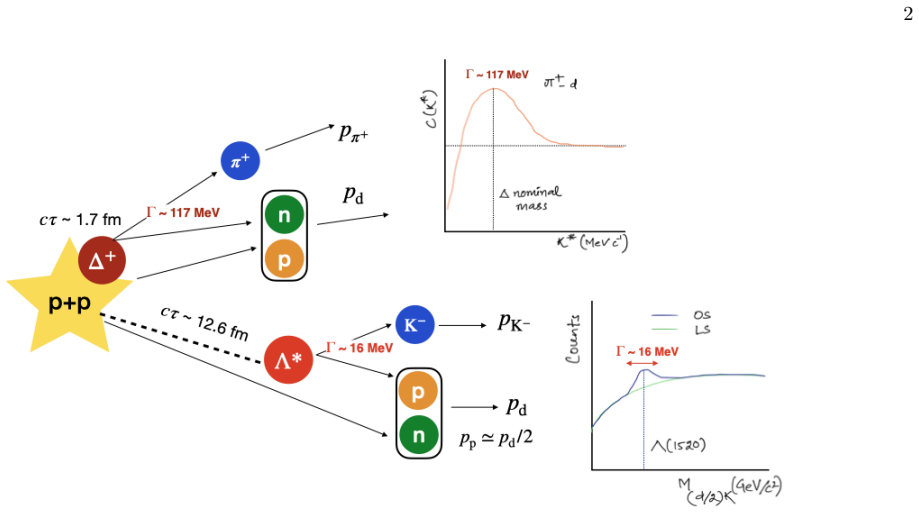
Λ(1520) decays produce a detectable peak in M(d/2)K only if deuterons form by coalescence.
A machine-rendered reading of the paper's core claim, the machinery that carries it, and where it could break.
Core claim
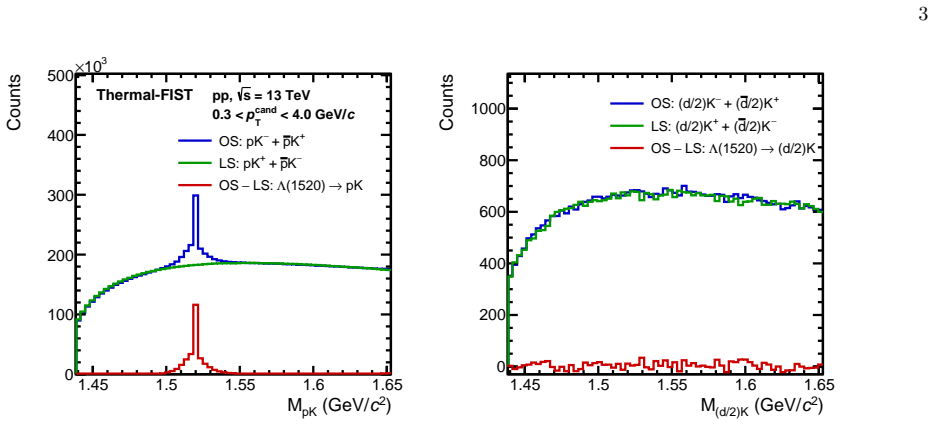
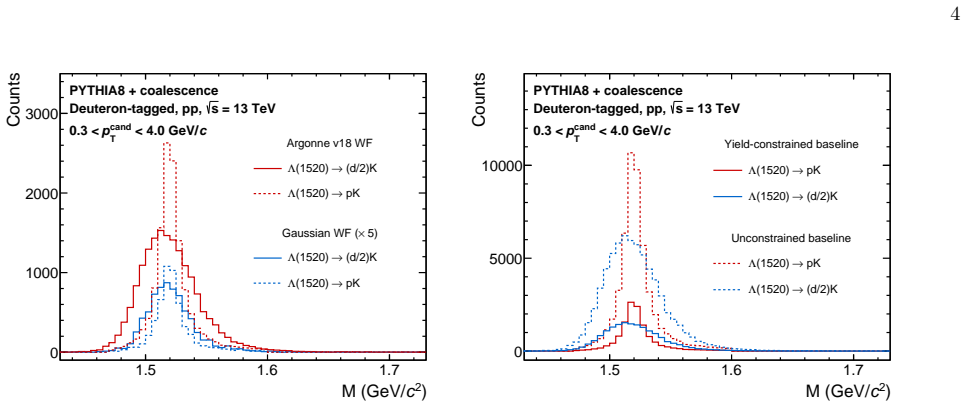
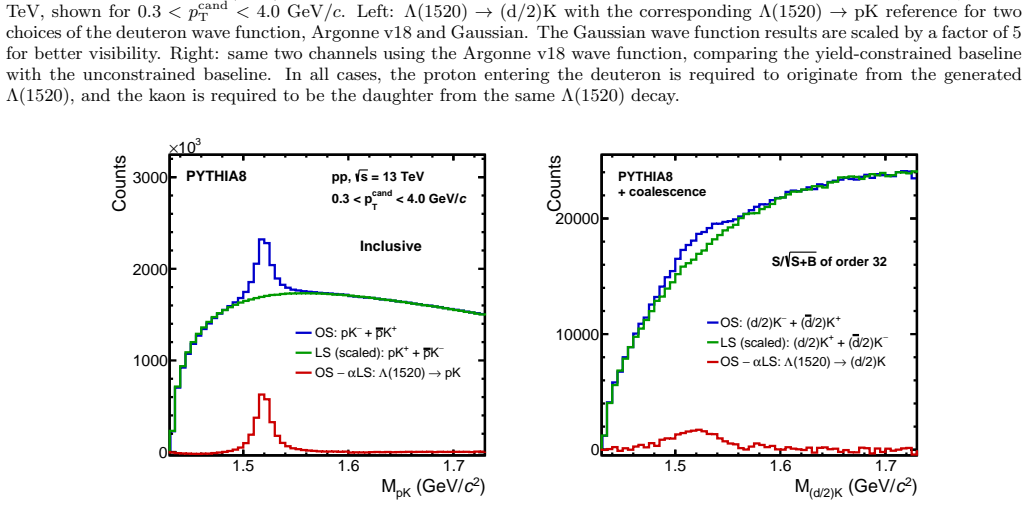
Using the Λ(1520) → pK decay, the invariant mass constructed from the kaon and half the deuteron four-momentum, denoted M(d/2)K, exhibits a resonance peak exclusively when deuterons are produced via coalescence from the decay protons in PYTHIA simulations with an afterburner, whereas the thermal model Thermal-FIST produces no such peak. This establishes the observable as a direct discriminator between coalescence and statistical hadronization for light nuclei production at the LHC.
What carries the argument
The proxy mass M(d/2)K, formed by combining the kaon four-momentum with half the deuteron four-momentum, which acts to preserve the kinematic correlation from the resonance decay in the coalescence scenario.
If this is right
- Experimental observation of the M(d/2)K peak would support resonance-driven coalescence as the deuteron production mechanism.
- Absence of the peak would favor pure thermal production without late-stage coalescence.
- The method can be applied to study coalescence dynamics in proton-proton and heavy-ion collisions at the LHC.
- It provides a test for how well models preserve momentum correlations in resonance decays.
Where Pith is reading between the lines
- Similar proxy masses could be used for other light nuclei like tritons or helium to probe their formation.
- This approach might connect to studies of femtoscopy or correlation functions in particle physics.
- If validated, it could influence how statistical models are modified to include coalescence effects.
Load-bearing premise
The assumption that the coalescence afterburner applied to PYTHIA correctly preserves the momentum correlation between the kaon from Λ(1520) decay and the deuteron formed from its proton daughter.
What would settle it
Measuring the M(d/2)K distribution in LHC data and finding no resonance peak at the Λ(1520) mass would indicate that the coalescence scenario does not hold as modeled.
Figures
read the original abstract
Light nuclei such as deuterons are produced abundantly in high-energy proton-proton and nuclear collisions despite their tiny binding energies. Their production mechanism remains unresolved, as both nucleon coalescence and statistical thermal models reproduce inclusive LHC yields. We propose a direct invariant-mass observable that discriminates between these scenarios using the long-lived $\Lambda(1520) \to {\rm pK}$ resonance. If decay protons coalesce into deuterons, the produced nuclei remain correlated with the kaon, allowing the resonance peak to be reconstructed experimentally through proxy masses, $M_{\rm (d/2)K}$, formed from kaons and half the deuteron four-momentum. Using Thermal-FIST and PYTHIA with a deuteron coalescence afterburner, we show that a $M_{\rm (d/2)K}$ peak emerges only in the coalescence scenario. This observable provides a direct experimental probe of resonance-fed deuteron production and of late-stage coalescence dynamics in high-energy collisions.
Editorial analysis
A structured set of objections, weighed in public.
Referee Report
Summary. The manuscript claims that the proxy invariant mass M_{(d/2)K} constructed from kaons and half the deuteron four-momentum reconstructs the Λ(1520) resonance peak only in the coalescence scenario for deuteron production. This is demonstrated by comparing the Thermal-FIST thermal model (no peak) against PYTHIA with a deuteron coalescence afterburner (peak present), positioning the observable as an experimental probe of resonance-driven deuteron formation at the LHC.
Significance. If the result holds, the proposed M_{(d/2)K} observable would supply a direct, falsifiable discriminator between coalescence and statistical thermal mechanisms for light-nuclei production, a longstanding open question in heavy-ion physics. The approach cleverly exploits the long-lived Λ(1520) → pK decay to tag late-stage coalescence without new detector requirements. Credit is given for the conceptual novelty of using an existing resonance as a correlation tag.
major comments (1)
- [Abstract (final paragraph) and PYTHIA simulation description] Abstract (final paragraph) and PYTHIA simulation description: The central claim—that a M_{(d/2)K} peak emerges only under coalescence—rests on the assumption that the coalescence afterburner correctly propagates the four-momentum correlation from Λ(1520) → pK decays into the formed deuteron. Because the neutron partner is drawn from the ambient event, p_d = p_p + p_n introduces an extra random component whose effect on the proxy p_d/2 is set by the coalescence window and neutron spectrum. The manuscript provides no quantification of how the afterburner (momentum-space cut, Wigner-function overlap, or rescattering) preserves or dilutes this correlation, nor any sensitivity study varying the coalescence parameters. This is load-bearing, as the Thermal-FIST comparison isolates the mechanism only if the generators are equivalent in resonance kinematics and the afterburner faithfully transmit
minor comments (1)
- [Abstract] The notation M_{(d/2)K} is introduced without an explicit statement that 'd/2' denotes half the deuteron four-momentum vector; a one-sentence clarification in the abstract or introduction would prevent misreading.
Simulated Author's Rebuttal
We thank the referee for the positive evaluation of the conceptual novelty and for identifying a key robustness issue in our simulation comparison. We address the major comment below.
read point-by-point responses
-
Referee: The central claim—that a M_{(d/2)K} peak emerges only under coalescence—rests on the assumption that the coalescence afterburner correctly propagates the four-momentum correlation from Λ(1520) → pK decays into the formed deuteron. Because the neutron partner is drawn from the ambient event, p_d = p_p + p_n introduces an extra random component whose effect on the proxy p_d/2 is set by the coalescence window and neutron spectrum. The manuscript provides no quantification of how the afterburner (momentum-space cut, Wigner-function overlap, or rescattering) preserves or dilutes this correlation, nor any sensitivity study varying the coalescence parameters. This is load-bearing, as the Thermal-FIST comparison isolates the mechanism only if the generators are equivalent in resonance kinematics and the afterburner faithfully transmit
Authors: We agree that the absence of a quantitative study on correlation preservation and parameter sensitivity is a genuine limitation of the current manuscript. The central claim relies on the afterburner faithfully transmitting the proton-kaon correlation from Λ(1520) decays, and the random neutron contribution could in principle dilute the proxy mass peak. In the revised manuscript we will add an explicit sensitivity analysis: we will vary the coalescence momentum window (e.g., ±50 to ±150 MeV/c) and the Wigner-function width in the PYTHIA afterburner, recompute the M_{(d/2)K} distributions, and report the resulting peak significance and dilution factor relative to the ideal case. We will also directly compare the Λ(1520) resonance kinematics (mass, width, and p_T spectrum) between Thermal-FIST and PYTHIA to confirm they are equivalent before the afterburner is applied. These additions will make the isolation of the coalescence mechanism more robust. revision: yes
Circularity Check
No significant circularity; model comparison is self-contained
full rationale
The paper compares two distinct generators (Thermal-FIST thermal model vs. PYTHIA + coalescence afterburner) and reports that the M_(d/2)K peak appears only in the latter. This difference follows directly from the differing production mechanisms encoded in each code; it is not obtained by fitting a parameter to the target observable and then relabeling the output as a prediction, nor by any self-citation chain that imports a uniqueness theorem or ansatz. No equations reduce the claimed signature to a tautology or to inputs that already contain the result by construction. The derivation therefore remains independent of the specific afterburner details once the two generators are accepted as separate implementations.
Axiom & Free-Parameter Ledger
axioms (1)
- domain assumption PYTHIA plus coalescence afterburner and Thermal-FIST thermal model are adequate representations of the two competing production mechanisms
Reference graph
Works this paper leans on
-
[1]
Sato and K
H. Sato and K. Yazaki, Phys. Lett.B98, 153 (1981)
1981
-
[2]
J. L. Nagle, B. S. Kumar, D. Kusnezov, H. Sorge, and R. Mattiello, Phys. Rev.C53, 367 (1996)
1996
-
[3]
R. Scheibl and U. W. Heinz, Phys. Rev.C59, 1585 (1999), arXiv:nucl-th/9809092 [nucl-th]
Pith/arXiv arXiv 1999
-
[4]
K. Blum, K. C. Y. Ng, R. Sato, and M. Takimoto, Phys. Rev. D96, 103021 (2017), arXiv:1704.05431 [astro- ph.HE]
Pith/arXiv arXiv 2017
-
[5]
K. Blum and M. Takimoto, Phys. Rev.C99, 044913 (2019), arXiv:1901.07088 [nucl-th]
arXiv 2019
-
[6]
S. Mr´ owczy´ nski and P. S lo´ n, Acta Phys. Polon. B51, 1739 (2020), arXiv:1904.08320 [nucl-th]
arXiv 2020
-
[7]
F. Bellini, K. Blum, A. P. Kalweit, and M. Puccio, Phys. Rev. C103, 014907 (2021), arXiv:2007.01750 [nucl-th]
arXiv 2021
-
[8]
M. Mahlein, L. Barioglio, F. Bellini, L. Fabbietti, C. Pinto, B. Singh, and S. Tripathy, Eur. Phys. J. C 83, 804 (2023), arXiv:2302.12696 [hep-ex]
arXiv 2023
-
[9]
M. Korsmeier, F. Donato, and N. Fornengo, Phys.Rev.D 97, 103011 (2018), arXiv:1711.08465 [astro-ph.HE]
Pith/arXiv arXiv 2018
-
[10]
M. Kachelrieß, S. Ostapchenko, and J. Tjemsland, JCAP 08, 048, arXiv:2002.10481 [hep-ph]
arXiv 2002
-
[11]
von Doetinchemet al., JCAP08, 035, arXiv:2002.04163 [astro-ph.HE]
P. von Doetinchemet al., JCAP08, 035, arXiv:2002.04163 [astro-ph.HE]
arXiv 2002
-
[12]
ˇSerkˇ snyt˙ e, S
L. ˇSerkˇ snyt˙ e, S. K¨ onigstorfer, P. von Doetinchem, L. Fabbietti, D. M. Gomez-Coral, J. Herms, A. Ibarra, T. P¨ oschl, A. Shukla, A. Strong, and I. Vorobyev, Phys. Rev. D105, 083021 (2022)
2022
-
[13]
J. Cleymans, S. Kabana, I. Kraus, H. Oeschler, K. Redlich, and N. Sharma, Phys. Rev.C84, 054916 (2011), arXiv:1105.3719 [hep-ph]
Pith/arXiv arXiv 2011
-
[14]
A. Andronic, P. Braun-Munzinger, J. Stachel, and H. St¨ ocker, Phys. Lett.B697, 203 (2011), arXiv:1010.2995 [nucl-th]
Pith/arXiv arXiv 2011
-
[15]
F. Becattini, E. Grossi, M. Bleicher, J. Steinheimer, and R. Stock, Phys. Rev.C90, 054907 (2014), arXiv:1405.0710 [nucl-th]
Pith/arXiv arXiv 2014
-
[16]
V. Vovchenko and H. St¨ ocker, Phys. Rev.C95, 044904 (2017), arXiv:1606.06218 [hep-ph]
Pith/arXiv arXiv 2017
-
[17]
A. Andronic, P. Braun-Munzinger, K. Redlich, and J. Stachel, Nature561, 321 (2018), arXiv:1710.09425 [nucl-th]
Pith/arXiv arXiv 2018
-
[18]
N. Sharma, J. Cleymans, B. Hippolyte, and M. Paradza, Phys. Rev.C99, 044914 (2019), arXiv:1811.00399 [hep- ph]
Pith/arXiv arXiv 2019
-
[19]
S. Tripathy and P. Christiansen, Eur. Phys. J. C86, 443 (2026), arXiv:2509.03195 [hep-ph]
Pith/arXiv arXiv 2026
-
[20]
Acharyaet al.(ALICE), Nature648, 306 (2025), arXiv:2504.02393 [nucl-ex]
S. Acharyaet al.(ALICE), Nature648, 306 (2025), arXiv:2504.02393 [nucl-ex]
arXiv 2025
-
[21]
S. Acharyaet al.(ALICE), Phys. Lett. B802, 135225 (2020), arXiv:1910.14419 [nucl-ex]
arXiv 2020
-
[22]
V. Vovchenko and H. Stoecker, Comput. Phys. Commun. 244, 295 (2019), arXiv:1901.05249 [nucl-th]
arXiv 2019
-
[23]
S. Acharyaet al.(ALICE), Eur. Phys. J. C80, 693 (2020), arXiv:2003.02394 [nucl-ex]
arXiv 2020
-
[24]
S. Acharyaet al.(ALICE), Eur. Phys. J. C80, 889 (2020), arXiv:2003.03184 [nucl-ex]
arXiv 2020
-
[25]
S. Acharyaet al.(ALICE), Phys. Rev. C107, 064904 (2023), arXiv:2211.14015 [nucl-ex]
arXiv 2023
-
[26]
V. Vovchenko, B. D¨ onigus, and H. Stoecker, Phys. Lett. B785, 171 (2018), arXiv:1808.05245 [hep-ph]
arXiv 2018
-
[27]
S. Acharyaet al.(ALICE), Phys. Rev. Lett.133, 092301 (2024), arXiv:2311.13332 [nucl-ex]
arXiv 2024
-
[28]
C. Bierlichet al., SciPost Phys. Codeb.2022, 8 (2022), arXiv:2203.11601 [hep-ph]
Pith/arXiv arXiv 2022
-
[29]
Andersson, G
B. Andersson, G. Gustafson, G. Ingelman, and T. Sjos- trand, Phys. Rept.97, 31 (1983)
1983
-
[30]
S. Padhan, Understanding the hadronic phase with reso- nance studies with ALICE at LHC Energies, Presentation at ATHIC2025: 10th Asian Triangle Heavy-Ion Confer- ence (2025), parallel session, 15 January 2025, Gopalpur, India
2025
-
[31]
S. Acharyaet al.(ALICE), Eur. Phys. J. C81, 256 (2021), arXiv:2005.11120 [nucl-ex]
arXiv 2021
-
[32]
C. Pinto, ALICE Highlight I – Recent Results from Light Flavor, Presentation at SQM2026: International Confer- ence on Strangeness in Quark Matter (2026), plenary ses- sion, 23 March 2026, Los Angeles, contribution 265
2026
-
[33]
S. Acharyaet al.(ALICE), Phys. Rev. C99, 024905 (2019), arXiv:1805.04361 [nucl-ex]
arXiv 2019
-
[34]
One should be aware that there has been evidence of suppression of Λ(1520) in central heavy-ion collisions due to rescattering in the hadronic phase [33], however, the study here is only focused on minimum bias pp collisions where rescattering effects are not expected
discussion (0)
Sign in with ORCID, Apple, or X to comment. Anyone can read and Pith papers without signing in.