Spectral Density of the Causal Propagator
Pith reviewed 2026-06-28 21:02 UTC · model grok-4.3
The pith
The causal propagator in free scalar QFT has a conjectured asymptotic spectral density scaling supported by examples.
A machine-rendered reading of the paper's core claim, the machinery that carries it, and where it could break.
Core claim
We present a conjecture for its asymptotic spectral density in a free theory, and give examples that lend evidence to the conjectured scaling. Our work has implications for Lorentzian spectral geometry in much the same way as Weyl's asymptotic law has for Riemannian spectral geometry.
What carries the argument
The causal propagator (Pauli-Jordan function) and the conjecture for the asymptotic density of its spectrum.
If this is right
- The conjecture supplies a tool for defining quantum field theory in a more explicitly covariant manner.
- It offers concrete input relevant to constructions in causal set theory.
- It opens a route to Lorentzian spectral geometry that mirrors the established Riemannian case.
Where Pith is reading between the lines
- The scaling could be checked by explicit diagonalization of the propagator on simple manifolds such as Minkowski or de Sitter space.
- If the free-theory result survives, similar spectral analysis might be attempted for interacting fields or discrete causal-set discretizations.
- The conjecture may link to other volume-dependent spectral counts already studied in quantum gravity models.
Load-bearing premise
Examples computed in free theories are taken to indicate that the same spectral-density scaling holds for the causal propagator in general.
What would settle it
A direct calculation of the spectrum of the causal propagator on a curved background such as Schwarzschild spacetime that fails to match the conjectured asymptotic scaling.
Figures
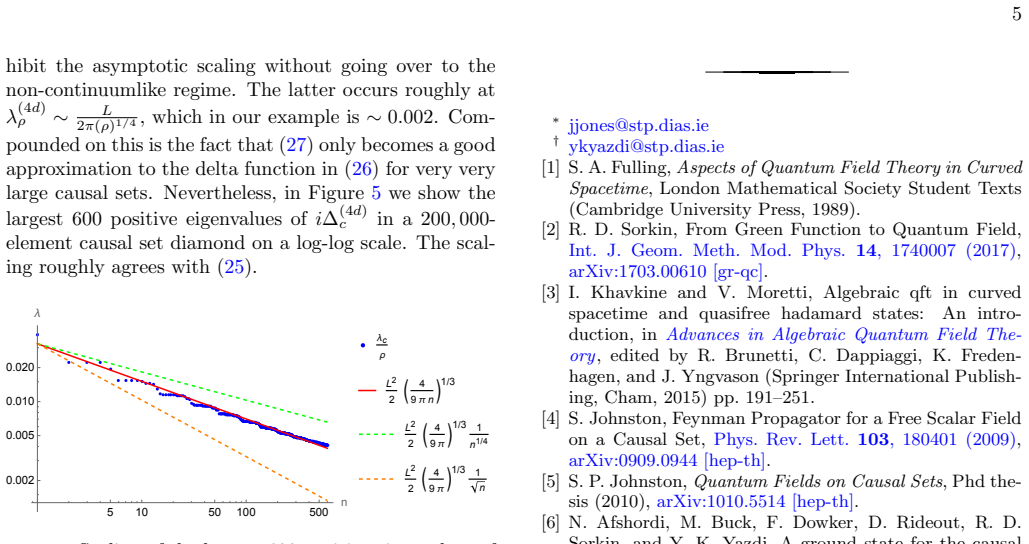
read the original abstract
The causal propagator (or Pauli-Jordan function), which multiplied by $i$ is the spacetime commutator of the field $[\phi(x),\phi(x')]$, plays an essential role in scalar quantum field theory. We discuss the role of the causal propagator and its spectrum in recent developments in defining quantum field theory in a more explicitly covariant manner, as well as in causal set theory. We then present a conjecture for its asymptotic spectral density in a free theory, and give examples that lend evidence to the conjectured scaling. Our work has implications for Lorentzian spectral geometry in much the same way as Weyl's asymptotic law has for Riemannian spectral geometry.
Editorial analysis
A structured set of objections, weighed in public.
Referee Report
Summary. The manuscript discusses the role of the causal propagator (Pauli-Jordan function) in scalar QFT, particularly in covariant formulations and causal set theory. It presents a conjecture for the asymptotic spectral density of this propagator in free theories, supported by examples that lend evidence to a conjectured scaling, and draws an analogy to Weyl's law for implications in Lorentzian spectral geometry.
Significance. If the conjecture holds with greater generality, it would establish a foundational result in Lorentzian spectral geometry analogous to Weyl's asymptotic law, potentially aiding covariant definitions of QFT and discrete quantum gravity models such as causal sets. The examples provide initial supporting evidence, strengthening the exploratory value of the work.
major comments (1)
- Abstract and main text: The central claim is explicitly framed as a conjecture supported by examples in free theory, but no derivation, general argument, or error analysis is provided to establish the scaling beyond the specific cases considered; this makes the evidence for generality limited, as noted in the abstract's description of the claim.
minor comments (2)
- Clarify the precise class of spacetimes or field theories to which the conjecture is intended to apply, as the abstract does not specify this.
- Consider adding quantitative measures (e.g., fit errors or scaling exponents with uncertainties) to the examples to strengthen the evidence presentation.
Simulated Author's Rebuttal
We thank the referee for the careful reading and positive assessment of the manuscript. We address the single major comment below.
read point-by-point responses
-
Referee: [—] Abstract and main text: The central claim is explicitly framed as a conjecture supported by examples in free theory, but no derivation, general argument, or error analysis is provided to establish the scaling beyond the specific cases considered; this makes the evidence for generality limited, as noted in the abstract's description of the claim.
Authors: We agree that the central claim is presented as a conjecture supported by examples in free scalar QFT, without a general derivation, argument, or error analysis. This is by design: the manuscript proposes the conjecture and supplies concrete supporting cases as initial evidence, rather than claiming a general result. The abstract and main text already describe the claim in precisely these terms, so the limitation on generality is explicitly acknowledged. No revision is required on this point. revision: no
Circularity Check
Conjecture with supporting examples; no circular derivation chain
full rationale
The paper explicitly frames its central result as a conjecture for the asymptotic spectral density of the causal propagator in free theory, backed by examples that provide evidence rather than a closed derivation. No load-bearing step reduces by construction to a self-definition, fitted input renamed as prediction, or self-citation chain. The work positions itself as exploratory (analogous to Weyl's law) without claiming a forced uniqueness theorem or smuggling an ansatz. The derivation chain is self-contained against external benchmarks and does not exhibit any of the enumerated circularity patterns.
Axiom & Free-Parameter Ledger
Reference graph
Works this paper leans on
-
[1]
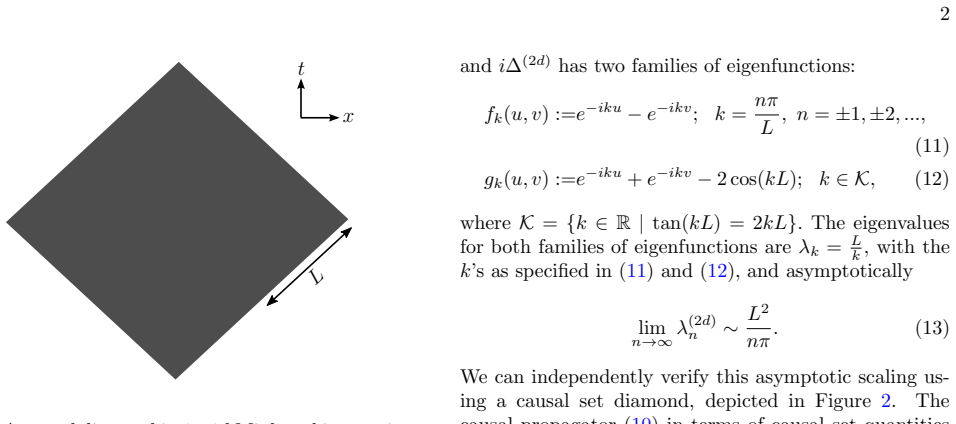
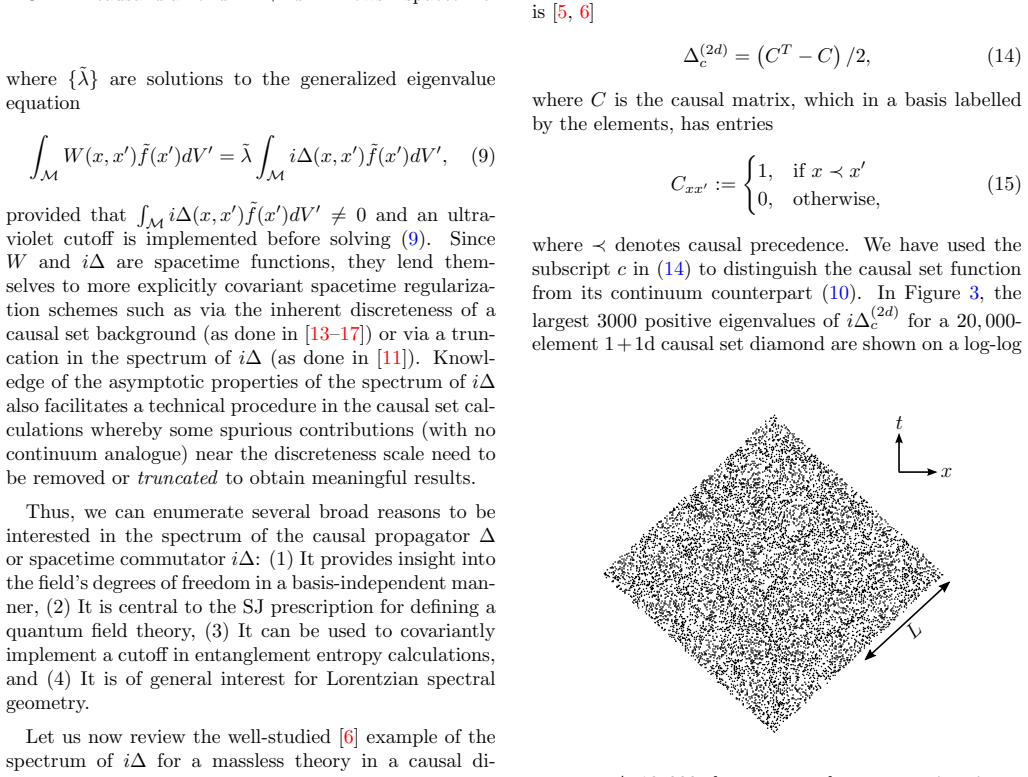
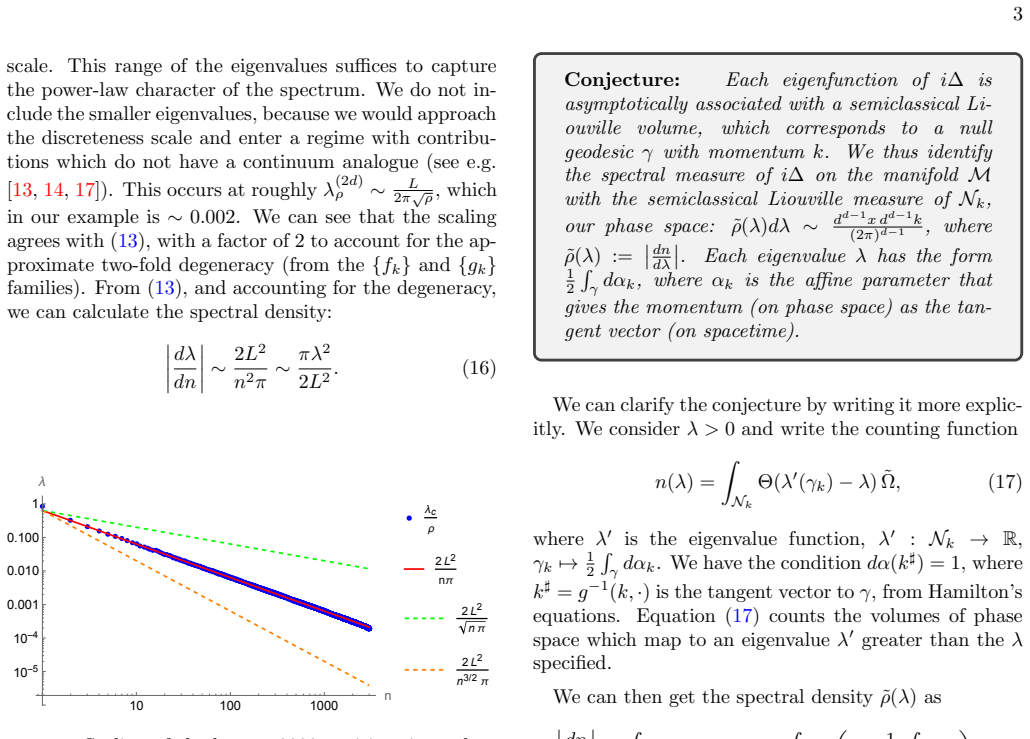
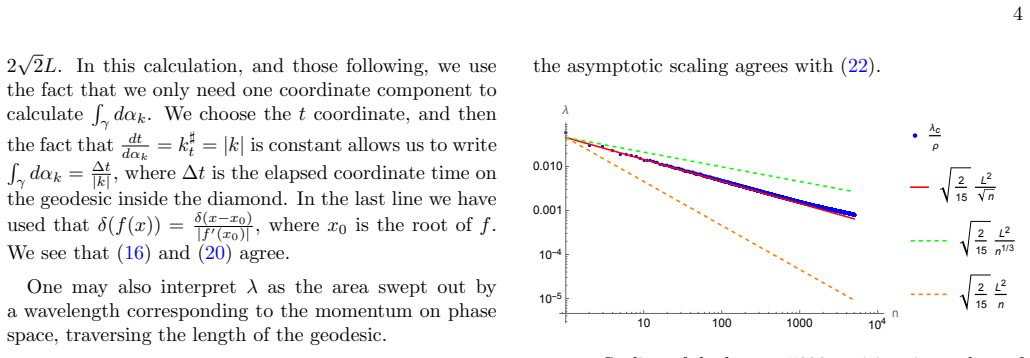
We choose −L≤u, v≤L; see Figure 1 for the setup. The causal propagator is [5, 18] ∆(2d)(u, v;u ′, v′) = (1−Θ(u−u ′)−Θ(v−v ′))/2, (10) andi∆ (2d) has two families of eigenfunctions: fk(u, v) :=e−iku −e −ikv;k= nπ L , n=±1,±2, ..., (11) gk(u, v) :=e−iku +e −ikv −2 cos(kL);k∈ K,(12) whereK={k∈R|tan(kL) = 2kL}.The eigenvalues for both families of eigenfunctio...
-
[2]
S. A. Fulling,Aspects of Quantum Field Theory in Curved Spacetime, London Mathematical Society Student Texts (Cambridge University Press, 1989)
1989
- [3]
-
[4]
Khavkine and V
I. Khavkine and V. Moretti, Algebraic qft in curved spacetime and quasifree hadamard states: An intro- duction, inAdvances in Algebraic Quantum Field The- ory, edited by R. Brunetti, C. Dappiaggi, K. Freden- hagen, and J. Yngvason (Springer International Publish- ing, Cham, 2015) pp. 191–251
2015
-
[5]
Feynman Propagator for a Free Scalar Field on a Causal Set
S. Johnston, Feynman Propagator for a Free Scalar Field on a Causal Set, Phys. Rev. Lett.103, 180401 (2009), arXiv:0909.0944 [hep-th]
work page internal anchor Pith review Pith/arXiv arXiv 2009
-
[6]
S. P. Johnston,Quantum Fields on Causal Sets, Phd the- sis (2010), arXiv:1010.5514 [hep-th]
work page internal anchor Pith review Pith/arXiv arXiv 2010
-
[7]
Afshordi, M
N. Afshordi, M. Buck, F. Dowker, D. Rideout, R. D. Sorkin, and Y. K. Yazdi, A ground state for the causal diamond in 2 dimensions, Journal of High Energy Physics 2012, 88 (2012)
2012
-
[8]
Afshordi, S
N. Afshordi, S. Aslanbeigi, and R. D. Sorkin, A distin- guished vacuum state for a quantum field in a curved spacetime: formalism, features, and cosmology, Journal of High Energy Physics2012, 137 (2012)
2012
-
[9]
J. Y. L. Jones, Principles for a Distinguished Global Vacuum: Entropy and the Vacuum State in Causal Set Theory, in17th Marcel Grossmann Meeting: On Recent Developments in Theoretical and Experimental General Relativity, Gravitation, and Relativistic Field Theories (2024) arXiv:2412.07832 [gr-qc]
-
[10]
R. D. Sorkin, Expressing entropy globally in terms of (4D) field-correlations, J. Phys. Conf. Ser.484, 012004 (2014), arXiv:1205.2953 [hep-th]
work page internal anchor Pith review Pith/arXiv arXiv 2014
-
[11]
Y. Chen, L. Hackl, R. Kunjwal, H. Moradi, Y. K. Yazdi, and M. Zilh˜ ao, Towards spacetime entanglement entropy for interacting theories, Journal of High Energy Physics 2020, 114 (2020)
2020
-
[12]
M. Saravani, R. D. Sorkin, and Y. K. Yazdi, Spacetime entanglement entropy in 1 + 1 dimensions, Class. Quant. Grav.31, 214006 (2014), arXiv:1311.7146 [hep-th]
- [13]
- [14]
-
[15]
R. D. Sorkin and Y. K. Yazdi, Entanglement Entropy in Causal Set Theory, Class. Quant. Grav.35, 074004 (2018), arXiv:1611.10281 [hep-th]
work page internal anchor Pith review Pith/arXiv arXiv 2018
- [16]
- [17]
-
[18]
T. Keseman, H. J. Muneesamy, and Y. K. Yazdi, Insights 6 on entanglement entropy in 1 + 1 dimensional causal sets, Class. Quant. Grav.39, 245004 (2022), arXiv:2111.05879 [hep-th]
-
[19]
Y. V. Egorov and M. A. Shubin, Generalized functions and fundamental solutions of differential equations, in Partial Differential Equations II: Elements of the Mod- ern Theory. Equations with Constant Coefficients, edited by Y. V. Egorov and M. A. Shubin (Springer Berlin Hei- delberg, Berlin, Heidelberg, 1994) pp. 128–149
1994
-
[20]
Brightwell and R
G. Brightwell and R. Gregory, Structure of random dis- crete spacetime, Phys. Rev. Lett.66, 260 (1991)
1991
-
[21]
Weyl, Ueber die asymptotische verteilung der eigen- werte, Nachrichten von der Gesellschaft der Wis- senschaften zu G¨ ottingen, Mathematisch-Physikalische Klasse1911, 110 (1911)
H. Weyl, Ueber die asymptotische verteilung der eigen- werte, Nachrichten von der Gesellschaft der Wis- senschaften zu G¨ ottingen, Mathematisch-Physikalische Klasse1911, 110 (1911)
1911
-
[22]
W. A. Strauss,Partial differential equations, 2nd ed. (John Wiley & Sons, Ltd.,, USA:, [c2008])
-
[23]
Ivrii, 100 years of weyl’s law, Bulletin of Mathematical Sciences6, 379–452 (2016)
V. Ivrii, 100 years of weyl’s law, Bulletin of Mathematical Sciences6, 379–452 (2016)
2016
-
[24]
Weyl's Law and Connes' Trace Theorem for Noncommutative Two Tori
F. Fathizadeh and M. Khalkhali, Weyl’s Law and Connes’ trace theorem for noncommutative two tori, Lett. Math. Phys.103, 1 (2013), arXiv:1111.1358 [math.QA]
work page internal anchor Pith review Pith/arXiv arXiv 2013
-
[25]
Ponge, Connes’ integration and weyl’s laws (2021), arXiv:2107.01242 [math.OA]
R. Ponge, Connes’ integration and weyl’s laws (2021), arXiv:2107.01242 [math.OA]
-
[26]
S. W. Hawking, Quantum gravity and path integrals, Phys. Rev. D18, 1747 (1978)
1978
- [27]
-
[28]
Towards Spectral Geometric Methods for Euclidean Quantum Gravity
M. Panine and A. Kempf, Towards Spectral Geometric Methods for Euclidean Quantum Gravity, Phys. Rev. D 93, 084033 (2016), arXiv:1601.07510 [math-ph]
work page internal anchor Pith review Pith/arXiv arXiv 2016
discussion (0)
Sign in with ORCID, Apple, or X to comment. Anyone can read and Pith papers without signing in.