REVIEW 4 major objections 6 minor 34 references
Just Enough Shifts: Mitigating Over-Refusal in Aligned Language Models with Targeted Representation Fine-Tuning
T0 review · 4 major / 6 minor · reviewed 2026-08-06 · deepseek-v4-flash
Pith's one-line read Fine-tuning a single layer with projection-calibrated targets reduces over-refusal across five benchmarks while preserving safety and general utility.
desk verdict ACTOR is a practical, lightweight fix for over-refusal with solid benchmark gains, but the 'just enough' theory is oversold and the headline numbers rely on benchmark-tuned hyperparameters. read the letter →
The pith
A machine-rendered reading of the paper's core claim, the machinery that carries it, and where it could break.
The reading
What carries the argument
The load-bearing object is the Projection-Calibrated Refusal Direction Loss, L = 1 - cos_sim(a_{l*}_theta(q), a_tgt(q)), where a_tgt(q) = a_q minus or plus alpha Proj_R(a_q). The refusal direction R is extracted by difference-in-means at the layer with the highest silhouette score, and the projection Proj_R(a_q) measures how much of the query's representation points toward refusal. The machinery works by making the update magnitude query-dependent: pseudo-harmful queries far from the safe cluster get larger shifts, near-boundary queries get smaller ones, and harmful queries are pushed deeper into the refusal region. A simplified linear-boundary model R dot a_q = d supplies the geometric reason the minimal correcting shift is parallel to R and approximately proportional to the projection for queries near the decision boundary.
What would settle it
Collect a held-out set of over-refused queries from a benchmark not used in training, run a line search for each query's minimal shift gamma*_q that yields a compliant response, and regress gamma*_q against the projection magnitude. If the correlation is much weaker than the reported r=0.63, or if the alpha estimated from this held-out set fails to reproduce the compliance gains without an AdvBench safety drop, the just-enough target is not capturing the refusal geometry.
Extended reading notes
Core claim
ACTOR's central claim is that the refusal decision lives in a low-dimensional direction of the model's activation space, and that calibrating each query's shift along that direction is enough to undo over-refusal. The method picks the middle layer whose activations best separate benign from harmful queries, computes a refusal vector R as the mean difference between harmful and benign query activations, and then fine-tunes only that layer with a loss that pushes each query's activation toward a target: a_q - alpha Proj_R(a_q) for safe and pseudo-harmful queries, and a_q + alpha Proj_R(a_q) for harmful queries. The alpha-scaled projection is the 'just enough' shift, justified by a linear-boundary model R dot a_q = d in which the minimal shift to the boundary is parallel to R, and by a line-search experiment showing the required shift correlates with projection magnitude (Pearson r=0.63). The paper argues that this per-query calibration avoids the model breakdown produced by uniform shifts, and it reports that after training, compliance on over-refusal benchmarks rises by 7.3 to 47.5 percentage points across Llama-2-7b-chat, Llama-2-13b-chat, and Gemma-7b-it, with AdvBench safety dropping by less than 1.5 points.
Load-bearing premise
The load-bearing premise is that a single constant alpha, multiplied by a query's projection onto the refusal vector, gives the correct 'just enough' shift for every query, so the refusal boundary can be treated as a flat hyperplane with one unknown threshold.
Editorial extensions
If this is right
- Over-refusal can be corrected without any response labels: only the queries themselves are needed, so training data can be assembled without expensive output generation.
- Because only one layer is updated, the intervention is cheap (about 4 minutes of H100 training for Llama-2-7b-chat) and does not change the model's footprint.
- The method is less brittle to distribution shift than static steering-vector interventions, because the refusal direction is recomputed during training and each query receives its own shift magnitude.
- The recipe transfers across model families and sizes, with the best alpha differing per model but the procedure itself unchanged.
- Safety on genuinely harmful queries is preserved: the AdvBench safety score stays within about 1.5 points of the original model across all tested models.
Reading between the lines
- Because the loss only needs activations, the same projection-calibrated scheme could be applied to other behavioral axes encoded in hidden states, such as sycophancy or jailbreak susceptibility, by replacing the refusal direction with the corresponding difference-in-means vector.
- The paper tunes alpha per model on the evaluation benchmarks; a stricter test would be to predict alpha from a small held-out line-search set and evaluate on unseen benchmarks, separating the 'just enough' hypothesis from benchmark-specific compensation.
- If the linear-boundary picture is right, over-refused queries should sit near the refusal boundary, so one testable prediction is that the distribution of projection magnitudes for over-refused queries shifts closer to the safe cluster after ACTOR training.
- Model providers with white-box access could deploy ACTOR as a release-time calibration step, and the response-free property means it could be re-run cheaply as new over-refusal cases are reported.
Editorial analysis
A structured set of objections, weighed in public.
Referee Report
Summary. ACTOR is a representation fine-tuning method that aims to reduce over-refusal in aligned LLMs. It first computes a refusal direction R as the difference in means between harmful and benign anchor activations at a target layer selected by silhouette score, then fine-tunes only that layer with a loss that pushes each query's activation toward a target a_q ∓ α Proj_R(a_q). The query-dependent negative shift is intended to be the 'just enough' shift to avoid refusal on safe/pseudo-harmful queries, while harmful queries are pushed toward refusal. Experiments on Llama-2-7b/13b-chat and Gemma-7b-it report large compliance-rate gains on XSTest, SCOPE, OR-Bench-Hard, PHTest, and the OOD OKTest, with AdvBench safety and MMLU/MT-Bench/perplexity roughly unchanged. The paper also reports data-efficiency and distribution-robustness ablations.
Significance. The potential value of ACTOR is a cheap, single-layer, response-free fine-tuning procedure with broad compliance improvements across multiple benchmarks and models, and the robustness analysis with different harmful source distributions is a useful comparison. If the effects survive rigorous evaluation, this would be a practical tool for mitigating over-refusal. However, the theoretical 'just enough' derivation is mathematically flawed, the empirical correlation underlying it is moderate, and the headline results are produced with α selected on the test benchmarks and without variance estimates, so the central claims are not yet established.
major comments (4)
- [Section 3.2, Eq. (7)] The linear-boundary derivation does not yield the constant multiplier α used in the target (Eq. 4). Solving R·(a_q+βR)=d gives β=(d-R·a_q)/||R||^2, so the required shift is [(d-R·a_q)/(R·a_q)] Proj_R(a_q), a query-dependent coefficient. The assertion that this coefficient is 'small and approximately constant' for queries near the boundary conflates small magnitude with constancy; queries at different distances require different coefficients, and the line-search data in Figure 3 show that the required γ varies with projection magnitude. Since d is never estimated and the linear model is acknowledged to be unverifiable, Eqs. (5)–(7) do not support the 'just enough' interpretation of Eq. (4).
- [Section 4.2 / Appendix C.2] The hyperparameter α is selected by evaluating several values on the same benchmarks used for the headline results ('we tested multiple values of α to identify the optimal configuration, with the best results shown in Table 1'; Figure 6). This introduces selection bias: the reported compliance rates are best-case over a hyperparameter sweep, not representative of a fixed procedure. No validation split or nested selection is described, and no error bars, confidence intervals, or multiple-seed runs are reported for any table. The quantitative claims of improvement therefore need re-evaluation with proper hyperparameter selection and variance reporting.
- [Section 3.2 / Figure 3] The empirical evidence for a 'strong linear relationship' between γ* and projection magnitude is a Pearson r=0.63 (R²≈0.40), which is at best a moderate correlation. The line search that produces γ* uses step size 0.1 over [0.1,1], giving coarse quantization, and the threshold d of the linear model is never estimated. The paper's own Remark concedes that full verification of the linearity assumption is intractable. These caveats are not reflected in the strength of the claim that projections provide a reliable proxy for the just-enough shift.
- [Appendix E / Section 4.1] All compliance and safety labels used in the evaluation are produced by a single GPT-4o judge template (Figures 7 and 8), with no human agreement study, no confidence calibration, and no sensitivity analysis to the judge prompt. Because the benchmarks involve borderline safety judgments, judge error may directly affect every reported compliance and safety number. At least a sample-based human agreement check should be reported.
minor comments (6)
- [Section 3.1] The silhouette scores are described immediately after mentioning t-SNE projection; please clarify whether silhouettes are computed on original high-dimensional activations or on 2D t-SNE coordinates, since the latter would be unreliable for layer selection.
- [References] The reference 'Loshchilov, 2017' should be updated to Loshchilov & Hutter, 'Decoupled Weight Decay Regularization,' ICLR 2019.
- [Table 2] The model name 'Llama-2-7b-chat-hf' in Table 2 differs from 'Llama-2-7b-chat' used elsewhere; please standardize.
- [Section 4.1] The text says reference answers for harmful and pseudo-harmful prompts are generated using GPT-4o, but the method is described as response-free; please state explicitly what these references are used for (e.g., the SFT baseline) so the response-free claim is unambiguous.
- [Section 4.1 / Table 4] Minor typo: 'WikiText2-2' should be 'WikiText-2'.
- [Figure 4 (Left) caption] The caption says the number of over-refusal queries is varied, but the axis labels are not visible in the text; please clarify the x-axis and the fixed components in the caption.
Circularity Check
No circularity: ACTOR's refusal vector, projection-calibrated targets, and benchmark evaluations are not mutually defining, and the headline results are measured against external held-out data.
full rationale
The paper's derivation chain is not circular in the targeted sense. The refusal vector R is estimated from separately chosen anchor activations (Eq. 1, Section 3.1, using HexPhi and TruthfulQA), and the per-query training target a_q − α·Proj_R(a_q) (Eqs. 4 and 9) is a constructed fine-tuning objective, not a fitted prediction of the reported compliance or safety metrics. The line-search γ* values in Section 3.2 are used only to motivate the projection proxy; α is not estimated from γ*, so the proxy does not force the evaluation outcomes by construction. The linear-boundary derivation in Eqs. 5–7 does not strictly justify a constant α, and α is tuned per model on the evaluation benchmarks, but these are validity and reporting concerns rather than circularity: no quantity is defined in terms of the result it is said to predict, no fitted parameter is renamed as an independent prediction, and the method's load-bearing claims do not rest on a self-citation chain. The paper also explicitly downweights its own theoretical derivation in the Remark, calling it intuition-building rather than rigorous justification, and it evaluates against external held-out benchmarks (XSTest, SCOPE, OR-Bench-Hard, PHTest, OKTest) plus AdvBench safety and MMLU/MT-Bench/perplexity utility checks, which provide independent empirical content. The mathematical weakness of the 'approximately constant' claim is a correctness risk, not a circularity. No circular step can be exhibited with a specific equation-level reduction, so the appropriate finding is no significant circularity.
Assumptions & free parameters
free parameters (2)
- alpha (projection multiplier) =
0.0015 (Llama-2-7b), 0.003 (Gemma-7b), 0.0004 (Llama-2-13b)
- target layer l* =
13 (Llama-2-7b), 17 (Gemma-7b), 14 (Llama-2-13b)
assumptions (4)
- ad hoc to paper Refusal decisions can be approximated by a linear boundary R . a = d in the activation space of the target layer.
- domain assumption The magnitude of a query's projection onto the refusal vector is proportional to the shift required to turn a refusal into a compliant response.
- domain assumption Last-token post-instruction activations at a single middle layer capture whether a query is safe or harmful.
- domain assumption GPT-4o judge outputs are reliable proxies for human compliance and safety labels.
Cite this review
Pith. "Pith review of Just Enough Shifts: Mitigating Over-Refusal in Aligned Language Models with Targeted Representation Fine-Tuning." pith.science (2026). https://pith.science/paper/42BL6OBC
@misc{pith2026250704250,
  author       = {Pith},
  title        = {Pith review of: Just Enough Shifts: Mitigating Over-Refusal in Aligned Language Models with Targeted Representation Fine-Tuning},
  year         = {2026},
  howpublished = {\url{https://pith.science/paper/42BL6OBC}},
  note         = {Machine review of arXiv:2507.04250}
}
read the original abstract
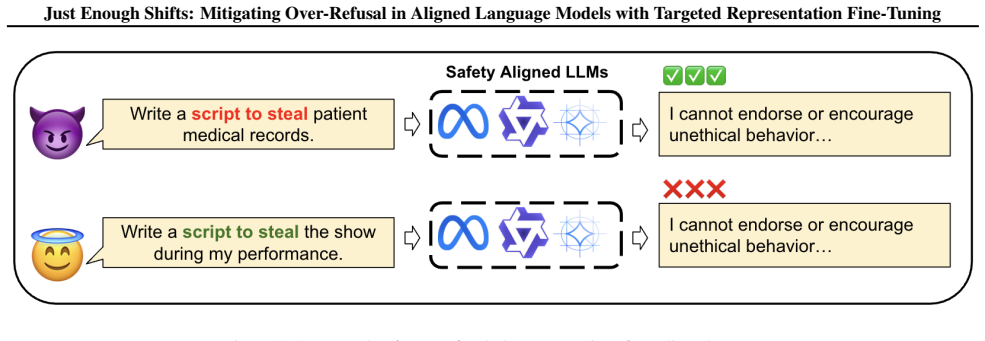
Safety alignment is crucial for large language models (LLMs) to resist malicious instructions but often results in over-refusals, where benign prompts are unnecessarily rejected, impairing user experience and model utility. We introduce ACTOR (Activation-Based Training for Over-Refusal Reduction), a robust and compute- and data-efficient training framework that minimizes over-refusals by leveraging internal activation patterns from diverse queries. ACTOR precisely identifies and adjusts the activation components that trigger refusals, providing stronger control over the refusal mechanism. By fine-tuning only a single model layer, ACTOR effectively reduces over-refusals across multiple benchmarks while maintaining the model's ability to handle harmful queries and preserve overall utility.
Figures


Figures from the paper (5 more)


Reference graph
Works this paper leans on
-
[1]
Automatic pseudo-harmful prompt generation for evaluating false refusals in large language models
An, B., Zhu, S., Zhang, R., Panaitescu-Liess, M.-A., Xu, Y., and Huang, F. Automatic pseudo-harmful prompt generation for evaluating false refusals in large language models. arXiv preprint arXiv:2409.00598, 2024
arXiv 2024
-
[2]
Refusal in language models is mediated by a single direction
Arditi, A., Obeso, O., Syed, A., Paleka, D., Panickssery, N., Gurnee, W., and Nanda, N. Refusal in language models is mediated by a single direction. arXiv preprint arXiv:2406.11717, 2024
arXiv 2024
-
[3]
Bartolome, A., Martin, G., and Vila, D. Notus. https://github.com/argilla-io/notus, 2023
work page 2023
-
[4]
SCANS: Mitigating the Exaggerated Safety for LLMs via Safety-Conscious Activation Steering
Cao, Z., Yang, Y., and Zhao, H. Nothing in excess: Mitigating the exaggerated safety for llms via safety-conscious activation steering. arXiv preprint arXiv:2408.11491, 2024
work page Pith review arXiv 2024
-
[5]
Or-bench: An over-refusal benchmark for large language models
Cui, J., Chiang, W.-L., Stoica, I., and Hsieh, C.-J. Or-bench: An over-refusal benchmark for large language models. arXiv preprint arXiv:2405.20947, 2024
arXiv 2024
-
[6]
Measuring massive multitask language understanding
Hendrycks, D., Burns, C., Basart, S., Zou, A., Mazeika, M., Song, D., and Steinhardt, J. Measuring massive multitask language understanding. arXiv preprint arXiv:2009.03300, 2020
arXiv 2009
-
[7]
Catastrophic jailbreak of open-source llms via exploiting generation
Huang, Y., Gupta, S., Xia, M., Li, K., and Chen, D. Catastrophic jailbreak of open-source llms via exploiting generation. arXiv preprint arXiv:2310.06987, 2023
arXiv 2023
-
[8]
Trustllm: Trustworthiness in large language models
Huang, Y., Sun, L., Wang, H., Wu, S., Zhang, Q., Li, Y., Gao, C., Huang, Y., Lyu, W., Zhang, Y., et al. Trustllm: Trustworthiness in large language models. arXiv preprint arXiv:2401.05561, 2024
arXiv 2024
Show all 34 references
-
[9]
P., Perelman, A., Ramesh, A., Clark, A., Ostrow, A., Welihinda, A., Hayes, A., Radford, A., et al
Hurst, A., Lerer, A., Goucher, A. P., Perelman, A., Ramesh, A., Clark, A., Ostrow, A., Welihinda, A., Hayes, A., Radford, A., et al. Gpt-4o system card. arXiv preprint arXiv:2410.21276, 2024
2024 arXiv
-
[10]
Beavertails: Towards improved safety alignment of llm via a human-preference dataset
Ji, J., Liu, M., Dai, J., Pan, X., Zhang, C., Bian, C., Chen, B., Sun, R., Wang, Y., and Yang, Y. Beavertails: Towards improved safety alignment of llm via a human-preference dataset. Advances in Neural Information Processing Systems, 36, 2024
2024
-
[11]
Crafting papers on machine learning
Langley, P. Crafting papers on machine learning. In Langley, P. (ed.), Proceedings of the 17th International Conference on Machine Learning (ICML 2000), pp.\ 1207--1216, Stanford, CA, 2000. Morgan Kaufmann
2000
-
[12]
Safety layers in aligned large language models: The key to llm security
Li, S., Yao, L., Zhang, L., and Li, Y. Safety layers in aligned large language models: The key to llm security. arXiv preprint arXiv:2408.17003, 2024
2024 arXiv
-
[13]
Truthfulqa: Measuring how models mimic human falsehoods
Lin, S., Hilton, J., and Evans, O. Truthfulqa: Measuring how models mimic human falsehoods. arXiv preprint arXiv:2109.07958, 2021
2021 arXiv
-
[14]
Decoupled weight decay regularization
Loshchilov, I. Decoupled weight decay regularization. arXiv preprint arXiv:1711.05101, 2017
2017 arXiv
-
[15]
Pointer sentinel mixture models, 2016
Merity, S., Xiong, C., Bradbury, J., and Socher, R. Pointer sentinel mixture models, 2016
2016
-
[16]
Fine-tuning aligned language models compromises safety, even when users do not intend to!, 2023
Qi, X., Zeng, Y., Xie, T., Chen, P.-Y., Jia, R., Mittal, P., and Henderson, P. Fine-tuning aligned language models compromises safety, even when users do not intend to!, 2023
2023
-
[17]
and Bhalani, R
Ray, R. and Bhalani, R. Mitigating exaggerated safety in large language models. arXiv preprint arXiv:2405.05418, 2024
2024 arXiv
-
[18]
R., Vidgen, B., Attanasio, G., Bianchi, F., and Hovy, D
R \"o ttger, P., Kirk, H. R., Vidgen, B., Attanasio, G., Bianchi, F., and Hovy, D. Xstest: A test suite for identifying exaggerated safety behaviours in large language models. arXiv preprint arXiv:2308.01263, 2023
2023 arXiv
-
[19]
Rousseeuw, P. J. Silhouettes: A graphical aid to the interpretation and validation of cluster analysis. Journal of Computational and Applied Mathematics, 20: 0 53--65, 1987. ISSN 0377-0427. doi:https://doi.org/10.1016/0377-0427(87)90125-7. URL https://www.sciencedirect.com/sci...
1987
-
[20]
Navigating the overkill in large language models
Shi, C., Wang, X., Ge, Q., Gao, S., Yang, X., Gui, T., Zhang, Q., Huang, X., Zhao, X., and Lin, D. Navigating the overkill in large language models. arXiv preprint arXiv:2401.17633, 2024
2024 arXiv
-
[21]
S., Love, J., et al
Team, G., Mesnard, T., Hardin, C., Dadashi, R., Bhupatiraju, S., Pathak, S., Sifre, L., Rivi \`e re, M., Kale, M. S., Love, J., et al. Gemma: Open models based on gemini research and technology. arXiv preprint arXiv:2403.08295, 2024
2024 arXiv
-
[22]
Llama 2: Open foundation and fine-tuned chat models
Touvron, H., Martin, L., Stone, K., Albert, P., Almahairi, A., Babaei, Y., Bashlykov, N., Batra, S., Bhargava, P., Bhosale, S., et al. Llama 2: Open foundation and fine-tuned chat models. arXiv preprint arXiv:2307.09288, 2023
2023 arXiv
-
[23]
and Hinton, G
van der Maaten, L. and Hinton, G. Visualizing data using t-SNE . Journal of Machine Learning Research, 9: 0 2579--2605, 2008. URL http://www.jmlr.org/papers/v9/vandermaaten08a.html
2008
-
[24]
Surgical, cheap, and flexible: Mitigating false refusal in language models via single vector ablation
Wang, X., Hu, C., R \"o ttger, P., and Plank, B. Surgical, cheap, and flexible: Mitigating false refusal in language models via single vector ablation. arXiv preprint arXiv:2410.03415, 2024
2024 arXiv
-
[25]
D., and Potts, C
Wu, Z., Arora, A., Wang, Z., Geiger, A., Jurafsky, D., Manning, C. D., and Potts, C. Reft: Representation finetuning for language models. arXiv preprint arXiv:2404.03592, 2024
2024 arXiv
-
[26]
Y., and Poovendran, R
Xu, Z., Jiang, F., Niu, L., Jia, J., Lin, B. Y., and Poovendran, R. Safedecoding: Defending against jailbreak attacks via safety-aware decoding. arXiv preprint arXiv:2402.08983, 2024
2024 arXiv
-
[27]
Lofit: Localized fine-tuning on llm representations
Yin, F., Ye, X., and Durrett, G. Lofit: Localized fine-tuning on llm representations. arXiv preprint arXiv:2406.01563, 2024
2024 arXiv
-
[28]
Scope: Scalable and adaptive evaluation of misguided safety refusal in llms
Zeng, Y., Nguyen, A., Li, B., and Jia, R. Scope: Scalable and adaptive evaluation of misguided safety refusal in llms. https://openreview.net/forum?id=72H3w4LHXM, 2024
2024
-
[29]
Towards comprehensive and efficient post safety alignment of large language models via safety patching
Zhao, W., Hu, Y., Li, Z., Deng, Y., Zhao, Y., Qin, B., and Chua, T.-S. Towards comprehensive and efficient post safety alignment of large language models via safety patching. arXiv preprint arXiv:2405.13820, 2024
2024 arXiv
-
[30]
Prompt-driven llm safeguarding via directed representation optimization
Zheng, C., Yin, F., Zhou, H., Meng, F., Zhou, J., Chang, K.-W., Huang, M., and Peng, N. Prompt-driven llm safeguarding via directed representation optimization. arXiv preprint arXiv:2401.18018, 2024
2024 arXiv
-
[31]
Judging llm-as-a-judge with mt-bench and chatbot arena
Zheng, L., Chiang, W.-L., Sheng, Y., Zhuang, S., Wu, Z., Zhuang, Y., Lin, Z., Li, Z., Li, D., Xing, E., et al. Judging llm-as-a-judge with mt-bench and chatbot arena. Advances in Neural Information Processing Systems, 36: 0 46595--46623, 2023
2023
-
[32]
Representation engineering: A top-down approach to ai transparency
Zou, A., Phan, L., Chen, S., Campbell, J., Guo, P., Ren, R., Pan, A., Yin, X., Mazeika, M., Dombrowski, A.-K., et al. Representation engineering: A top-down approach to ai transparency. arXiv preprint arXiv:2310.01405, 2023 a
2023 arXiv
-
[33]
Z., and Fredrikson, M
Zou, A., Wang, Z., Carlini, N., Nasr, M., Kolter, J. Z., and Fredrikson, M. Universal and transferable adversarial attacks on aligned language models. arXiv preprint arXiv:2307.15043, 2023 b
2023 arXiv
-
[34]
write newline
" write newline "" before.all 'output.state := FUNCTION n.dashify 't := "" t empty not t #1 #1 substring "-" = t #1 #2 substring "--" = not "--" * t #2 global.max substring 't := t #1 #1 substring "-" = "-" * t #2 global.max substring 't := while if t #1 #1 substring * t #2 gl...
Reviewed August 6, 2026 · model on record in the stance chip above.
Discussion (0). Sign in to comment.