AdaMem: Learning What to Remember for Personalized Long-Horizon LLM Agents
Pith reviewed 2026-06-26 14:05 UTC · model grok-4.3
The pith
AdaMem learns what to remember from user feedback to prevent memory bloat in long-horizon LLM agents
A machine-rendered reading of the paper's core claim, the machinery that carries it, and where it could break.
Core claim
AdaMem maintains a structured, role-specific Memory Policy and refines it from weekly QA feedback through a lightweight, patch-style self-reflection step with failure rollback, leading to improved QA accuracy and reduced memory volume compared to uniform extraction.
What carries the argument
The role-specific Memory Policy, which is adapted via patch-style self-reflection from QA feedback to decide what information to retain.
If this is right
- Long-horizon agents can sustain higher QA accuracy over weeks of interaction.
- Memory systems can adapt to individual user preferences without storing all facts.
- Production LLM agents incur lower inference costs due to smaller memory stores.
- Feedback-driven refinement reduces the impact of irrelevant trivia on agent performance.
Where Pith is reading between the lines
- Similar feedback mechanisms could improve memory management in multi-user or multi-agent settings.
- The method might extend to other types of feedback beyond QA, such as direct user corrections.
- Testing on real-world diverse interactions could reveal if the benchmark overestimates gains due to its structured nature.
Load-bearing premise
The assumption that weekly QA feedback is a reliable, unbiased, and representative signal for refining the memory policy without introducing selection effects or overfitting to the benchmark questions.
What would settle it
A controlled experiment where feedback is provided on non-benchmark questions or with noise, showing whether accuracy gains disappear or memory volume fails to shrink.
Figures
read the original abstract
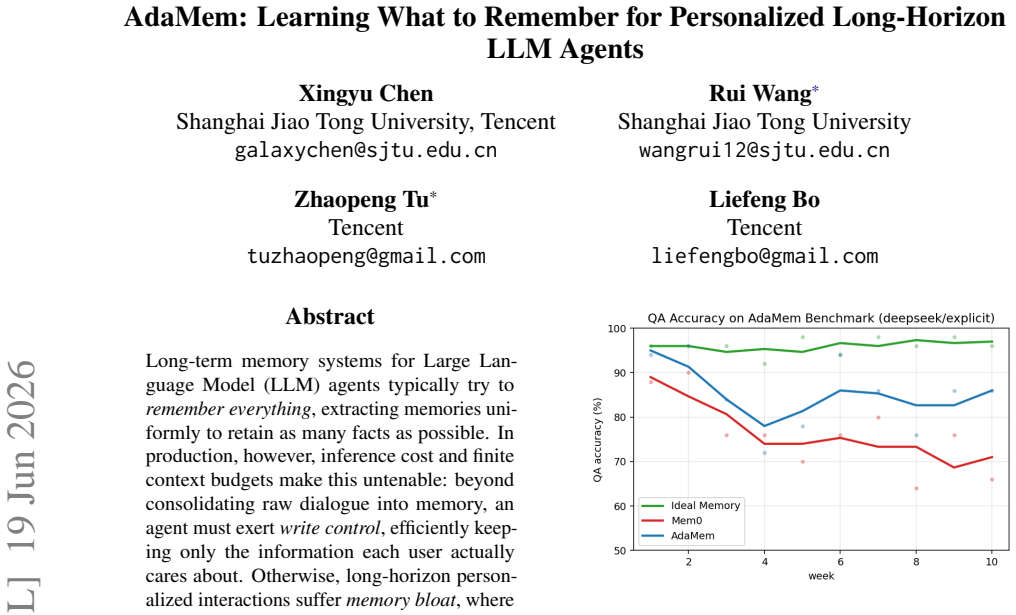
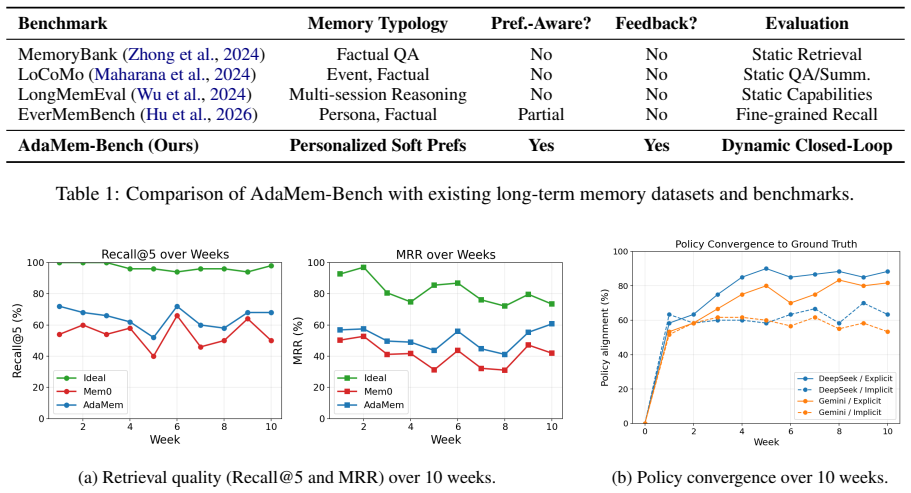
Long-term memory systems for Large Language Model (LLM) agents typically try to \emph{remember everything}, extracting memories uniformly to retain as many facts as possible. In production, however, inference cost and finite context budgets make this untenable: beyond consolidating raw dialogue into memory, an agent must exert \emph{write control}, efficiently keeping only the information each user actually cares about. Otherwise, long-horizon personalized interactions suffer \emph{memory bloat}, where irrelevant trivia crowds out useful information and steadily erodes question-answering (QA) accuracy. We argue that what is worth remembering is role-dependent, and propose \textbf{AdaMem} (Adaptive Memory), a method that \emph{learns what to remember} for each user from feedback. AdaMem maintains a structured, role-specific Memory Policy and refines it from weekly QA feedback through a lightweight, patch-style self-reflection step with failure rollback. To study this setting, we build \textbf{AdaMem-Bench}, a benchmark that simulates weeks of interaction with week-by-week QA. Across two extraction models and two feedback modes, AdaMem improves QA accuracy by up to \textbf{+9.0\%} over the uniform Mem0 baseline while shrinking memory volume by \textbf{9\%}.
Editorial analysis
A structured set of objections, weighed in public.
Referee Report
Summary. The paper claims that long-term memory for LLM agents suffers from bloat under uniform extraction and proposes AdaMem to learn a role-specific Memory Policy from weekly QA feedback via lightweight self-reflection with failure rollback. On the introduced AdaMem-Bench simulating week-by-week interactions, AdaMem yields up to +9.0% QA accuracy gains and 9% memory volume reduction versus the Mem0 uniform baseline across two extraction models and two feedback modes.
Significance. If the reported gains prove robust and the learned policy generalizes, the work would be significant for practical deployment of personalized long-horizon agents by replacing uniform memory consolidation with learned write control. The benchmark construction and patch-style update mechanism are concrete contributions that could be adopted or extended.
major comments (2)
- [Abstract] Abstract: the central quantitative claims (+9.0% QA accuracy, 9% volume reduction) are presented without any mention of statistical significance, variance across runs, number of seeds, or exact benchmark construction details; this information is load-bearing for assessing whether the gains support the claim of a generalizable Memory Policy.
- [§4] AdaMem-Bench and experimental setup (presumably §4): no description is given of how weekly feedback questions are sampled or partitioned relative to the held-out evaluation questions, nor of any controls for topic selection effects or overlap; without this, the self-reflection step could be fitting to benchmark-specific failures rather than learning role-dependent importance, directly undermining the generalizability claim.
minor comments (2)
- The abstract introduces 'Memory Policy' and 'failure rollback' without a brief formal definition or pseudocode sketch, which would aid immediate understanding of the method.
- [Abstract] The two feedback modes and two extraction models are referenced but not named in the abstract; listing them would improve clarity.
Simulated Author's Rebuttal
We thank the referee for the constructive feedback. We address each major comment below and commit to revisions that strengthen the reporting of statistical details and benchmark construction without misrepresenting our results.
read point-by-point responses
-
Referee: [Abstract] Abstract: the central quantitative claims (+9.0% QA accuracy, 9% volume reduction) are presented without any mention of statistical significance, variance across runs, number of seeds, or exact benchmark construction details; this information is load-bearing for assessing whether the gains support the claim of a generalizable Memory Policy.
Authors: We agree that the abstract would benefit from additional context on robustness. In the revision we will note that results are averaged over multiple seeds with standard deviations reported in the main text, and we will expand benchmark construction details in Section 4. This directly addresses the load-bearing information for the generalizability claim. revision: yes
-
Referee: [§4] AdaMem-Bench and experimental setup (presumably §4): no description is given of how weekly feedback questions are sampled or partitioned relative to the held-out evaluation questions, nor of any controls for topic selection effects or overlap; without this, the self-reflection step could be fitting to benchmark-specific failures rather than learning role-dependent importance, directly undermining the generalizability claim.
Authors: We acknowledge the description of sampling and partitioning is currently insufficient. Weekly feedback questions are drawn from that week's interactions while evaluation questions are strictly held out from subsequent weeks; we will add an explicit subsection in the revised §4 detailing the sampling procedure, train/eval partition, and topic-overlap controls to show the policy learns role-dependent importance rather than benchmark artifacts. revision: yes
Circularity Check
No circularity: empirical method with external feedback, no derivations or self-referential predictions.
full rationale
The paper presents AdaMem as an empirical system that refines a memory policy from weekly QA feedback on AdaMem-Bench. No equations, first-principles derivations, fitted parameters renamed as predictions, or self-citation chains appear in the described method or results. The +9.0% accuracy and 9% volume claims are direct empirical measurements against a uniform baseline, not reductions to inputs by construction. The method is self-contained against external benchmarks and feedback signals.
Axiom & Free-Parameter Ledger
axioms (1)
- domain assumption Weekly QA feedback supplies an unbiased and sufficient training signal for memory policy updates
invented entities (1)
-
Memory Policy
no independent evidence
Reference graph
Works this paper leans on
-
[1]
2023 , journal =
MemGPT: Towards LLMs as Operating Systems , author =. 2023 , journal =
2023
-
[2]
Proceedings of the 36th Annual ACM Symposium on User Interface Software and Technology , pages=
Generative agents: Interactive simulacra of human behavior , author=. Proceedings of the 36th Annual ACM Symposium on User Interface Software and Technology , pages=
-
[3]
2023 , journal =
Reflexion: language agents with verbal reinforcement learning , author =. 2023 , journal =
2023
-
[4]
Retrieval-augmented generation for knowledge-intensive
Lewis, Patrick and Perez, Ethan and Piktus, Aleksandra and Petroni, Fabio and Karpukhin, Vladimir and Goyal, Naman and Kuttler, Heinrich and Lewis, Mike and Yih, Wen-tau and Riedel, Sebastian , journal=. Retrieval-augmented generation for knowledge-intensive
-
[5]
2023 , journal =
Judging llm-as-a-judge with mt-bench and chatbot arena , author =. 2023 , journal =
2023
-
[6]
Mem0: The Memory Layer for Personalized
Mem0 , year=. Mem0: The Memory Layer for Personalized
-
[7]
2024 , journal =
MemoryBank: Enhancing Large Language Models with Long-Term Memory , author =. 2024 , journal =
2024
-
[8]
2024 , journal =
A survey on large language model based autonomous agents , author =. 2024 , journal =
2024
-
[9]
2023 , journal =
Self-Refine: Iterative Refinement with Self-Feedback , author =. 2023 , journal =
2023
-
[10]
2025 , journal =
Rap: Retrieval-augmented personalization for multimodal large language models , author =. 2025 , journal =
2025
-
[11]
Evaluating Very Long-Term Conversational Memory of
Maharana, Adyasha and Lee, Dong-Ho and Tulyakov, Sergey and Bansal, Mohit and Barbieri, Francesco and Fang, Yuwei , journal=. Evaluating Very Long-Term Conversational Memory of
-
[12]
2024 , journal =
LongMemEval: Benchmarking Chat Assistants on Long-Term Interactive Memory , author =. 2024 , journal =
2024
-
[13]
2026 , journal =
EverMemBench: Benchmarking Long-Term Interactive Memory in Large Language Models , author =. 2026 , journal =
2026
-
[14]
2025 , journal =
Memory OS of AI Agent , author =. 2025 , journal =
2025
-
[15]
2026 , journal =
All-Mem: Agentic Lifelong Memory via Dynamic Topology Evolution , author =. 2026 , journal =
2026
-
[16]
2026 , journal =
Beyond Dialogue Time: Temporal Semantic Memory for Personalized LLM Agents , author =. 2026 , journal =
2026
-
[17]
2025 , journal =
MemInsight: Autonomous Memory Augmentation for LLM Agents , author =. 2025 , journal =
2025
-
[18]
2026 , journal =
SimpleMem: Efficient Lifelong Memory for LLM Agents , author =. 2026 , journal =
2026
-
[19]
2025 , journal =
Nemori: Self-Organizing Agent Memory Inspired by Cognitive Science , author =. 2025 , journal =
2025
-
[20]
2025 , journal =
PersonaAgent: Bridging Memory and Action for Personalized LLM Agents , author =. 2025 , journal =
2025
-
[21]
2025 , journal =
Dynamic Affective Memory Management for Personalized LLM Agents , author =. 2025 , journal =
2025
-
[22]
2026 , journal =
Agentic Memory: Learning Unified Long-Term and Short-Term Memory Management for Large Language Model Agents , author =. 2026 , journal =
2026
-
[23]
2025 , journal =
In Prospect and Retrospect: Reflective Memory Management for Long-term Personalized Dialogue Agents , author =. 2025 , journal =
2025
-
[24]
2026 , journal =
EvolveMem:Self-Evolving Memory Architecture via AutoResearch for LLM Agents , author =. 2026 , journal =
2026
-
[25]
2026 , journal =
Evoking User Memory: Personalizing LLM via Recollection-Familiarity Adaptive Retrieval , author =. 2026 , journal =
2026
-
[26]
2026 , journal =
A Survey on the Security of Long-Term Memory in LLM Agents: Toward Mnemonic Sovereignty , author =. 2026 , journal =
2026
discussion (0)
Sign in with ORCID, Apple, or X to comment. Anyone can read and Pith papers without signing in.