REVIEW 4 major objections 5 minor 1 cited by
Nanoscale Mechanical Structures Fabricated from Silicon-on-Insulator Substrates
T0 review · 4 major / 5 minor · reviewed 2026-08-15 · deepseek-v4-flash
Pith's one-line read A four-step SIMOX process yields suspended silicon resonators measured at 110 MHz.
desk verdict A 1996 fabrication paper that holds up as a process recipe; the readout validation is thin, but the SIMOX method and the measured resonances are credible. read the letter →
The pith
A machine-rendered reading of the paper's core claim, the machinery that carries it, and where it could break.
The reading
What carries the argument
The process flow is the central mechanism. A SIMOX substrate supplies a 200 nm single-crystal silicon layer on a 400 nm buried silicon-dioxide layer; optical lithography defines alignment marks, electron-beam lithography writes Cr/Au wiring and contact pads, and a sputtered nickel layer serves as an etch mask. Anisotropic reactive ion etching in NF3 and CCl2F2 transfers the pattern through the silicon and just into the buried oxide; wet nickel etch removes the mask, and 48% hydrofluoric acid removes the buried oxide to suspend the structures, with CO2 critical-point drying preventing collapse. The load-bearing identity is that the device thickness equals the top Si layer thickness, so no etching step controls the thickness. For readout, a Lorentz-force scheme drives the resonator with an alternating current in the metal lead under a transverse magnetic field and detects the induced electromotive force with a network analyzer.
What would settle it
A sweep with the magnetic field reduced to zero should make the reported peaks disappear if they are mechanical, and an optical interferometer pointed at the same beam should find a peak at the same frequency when the field is restored.
Extended reading notes
Core claim
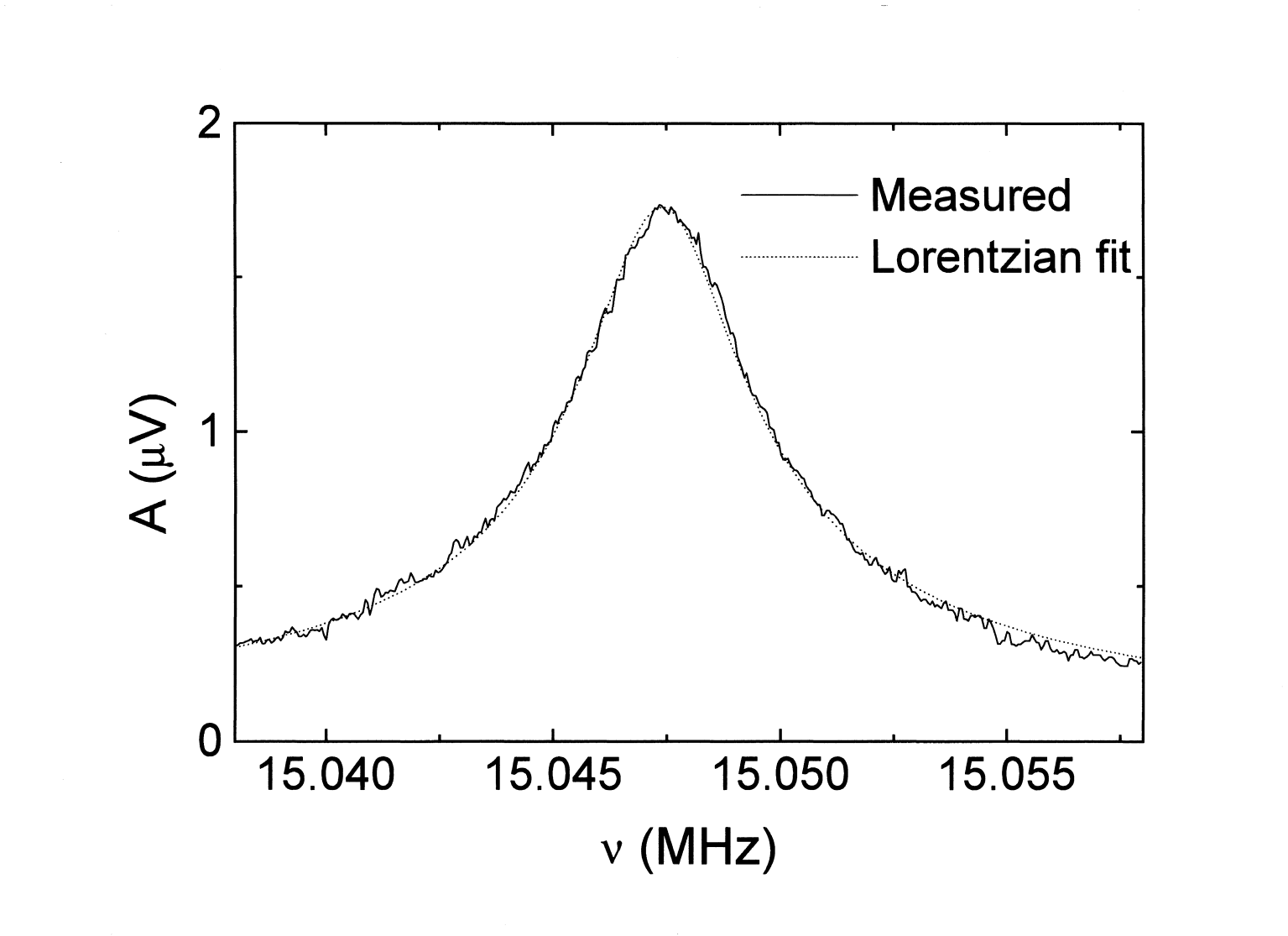
The discovery claimed is that suspended single-crystal silicon structures with minimum features of 0.1-0.2 µm can be fabricated from SIMOX wafers by a four-level process, and that these structures are good mechanical resonators. Thickness control is the key improvement over earlier recipes: it is provided by the substrate's top silicon layer (200 nm here) rather than by the etch. The authors demonstrate the claim with SEM images of released structures and with resonance curves measured at 4.2 K, including a cradle resonator at 15.048 MHz with $Q=4800$, a tuning fork with two separately measured tines, and a simple beam at 110 MHz; calculated resonance frequencies agree with measured values to about 10 percent. They also report fabrication of structures whose calculated frequencies reach about 800 MHz and potentially 1 GHz.
Load-bearing premise
The Lorentzian peaks seen in the network-analyzer traces are assumed to be the mechanical resonances of the silicon structures, an assumption based only on the magnetomotive detection scheme, with no independent non-electrical confirmation.
Editorial extensions
If this is right
- Reproducible sub-micron single-crystal silicon resonators can be made without trying to control thickness by etch depth, since the SIMOX layer defines it.
- Fundamental frequencies in the hundred-megahertz range become routinely accessible in simple beams, with gigahertz-scale frequencies reachable by scaling dimensions.
- Multiple resonator geometries (beam, tuning fork, cradle, torsion) can be integrated on one wafer with metal wiring from the same lithographic levels.
- Measured quality factors around $10^4$ at 4.2 K point to clamping and metallization as loss sources, so altering anchors or metal coverage should raise Q.
Reading between the lines
- A natural extension of the thickness-control idea is to use the same flow for clamped membranes, double-beam structures, or resonator arrays whose dimensions are set by lithography alone, which are the building blocks of phononic and optomechanical devices.
- The absence of an independent displacement probe leaves the 10 percent frequency agreement without a cross-check; adding optical or capacitive readout should settle whether the magnetomotive peaks are purely mechanical.
- Because Q is attributed to support and metallization losses, systematic variation of metal coverage or anchor geometry on identical SIMOX beams should map those losses and point to higher-Q designs.
Signed reviews
Editorial analysis
A structured set of objections, weighed in public.
Referee Report
Summary. The paper presents a fabrication process for sub-micron single-crystal silicon mechanical resonators using SIMOX (separation by implantation of oxygen) substrates. The process combines optical and electron-beam lithography, Cr/Au metallization, a nickel mask, anisotropic reactive ion etching, and wet removal of the buried oxide layer. The authors fabricated several suspended structures (a cradle resonator, a torsional oscillator, a tuning fork, and simple beams) with minimum dimensions of 0.1–0.2 μm and measured their resonances at 4.2 K using a magnetomotive readout. Reported measurements include a cradle resonance at 15.048 MHz with Q = 4800, two tuning-fork peaks near 60–62 MHz, and a simple-beam fundamental at 110 MHz. The paper claims that calculated resonance frequencies agree with measurements to within about 10%, and that quality factors range from 0.5–2 × 10^4.
Significance. If the fabrication recipe is as reliable as the scanning electron micrographs suggest, the method would be an important step toward high-frequency single-crystal silicon mechanical resonators with thickness precisely controlled by the SOI top layer. The demonstrated integration of multilayer electron-beam lithography with suspended Si structures is a useful contribution to micro- and nanomechanics. The measured Lorentzian resonance curves, the self-consistent fabrication description, and the reported quality factors are concrete strengths. However, the mechanical validation is incomplete: the magnetomotive readout lacks a B=0 control or other cross-check, the 10% agreement with calculation is unsupported by details, and the 110 MHz result appears only as a one-sentence claim. These gaps do not undermine the fabrication method itself but limit the confidence in the resonant-frequency and quality-factor values.
major comments (4)
- [p.5, Fig. 3] The magnetomotive readout is the sole evidence that the observed Lorentzian peaks in Figs. 4 and 5 correspond to mechanical motion. No B=0 control, no magnetic-field dependence, and no independent transduction (optical, capacitive, or piezoelectric) are reported. Because the network analyzer measures an electrical response, the peaks could in principle stem from electrical feedthrough, cabling, or substrate resonances. Please add a B=0 control trace and, if possible, a plot of signal amplitude versus B^2, or at minimum state explicitly that the resonances disappear when the magnetic field is removed.
- [p.5, 'calculated resonance frequencies'] The statement that calculated resonance frequencies agree with measured values to within about 10% is unsupported. The manuscript gives no formula for the eigenmode calculation, no boundary conditions, no dimensions of the structures compared, and no statistics (number of devices, mean, or standard deviation). Please provide the calculational model (e.g., Euler–Bernoulli beam theory with appropriate end conditions), a table of measured and calculated frequencies for each device with its dimensions, and the deviation for each case.
- [p.5, '110 MHz'] The 110 MHz fundamental resonance of a simple beam is reported in a single sentence without a measured trace, beam dimensions, or comparison with calculation. This value is also inconsistent with the abstract, which states 'fundamental resonances up to 100 MHz.' The authors should include the resonance curve, the beam geometry, the measurement conditions, and reconcile the abstract and text statements.
- [p.5, 'quality factors'] The quality factors are quoted as a range (0.5–2 × 10^4) without associating values with individual structures. For the two resonance curves shown in Figs. 4 and 5, the Lorentzian fit parameters (resonance frequency and Q) should be reported for each peak, so that the reader can connect the stated range to specific devices.
minor comments (5)
- [p.1, abstract] The abstract states 'fundamental resonance frequencies above 10^7 Hz,' while the text (p.5) reports measurements up to 110 MHz; please use consistent numbers throughout.
- [p.6, after references] There is an undeciphered handwritten annotation after the references (appearing as 'fvti c-lw.el ...') that appears to be a leftover note. It should be removed or transcribed in a footnote if it conveys substantive information.
- [References] Reference 3 is listed as 'in preparation.' If this is a companion paper, please provide an update or remove it; if it is a self-citation to the present work, it should not be cited.
- [Fig. 5 caption] The caption for Fig. 5 says 'Resonance shape measured for the two tines of the tuning fork structure,' but the two peaks are at approximately 60.28 and 61.98 MHz. It would be clearer to state which tine corresponds to which peak and to give the fitted Q values.
- [p.3, Ni mask removal] For the Ni mask removal step, the composition of the etch is given but not the etch time or temperature; stating these conditions would improve reproducibility.
Circularity Check
Minor self-citation in prior-art motivation; the fabrication recipe and resonance measurements are empirically self-contained, so no substantial circularity is present.
-
self citation load bearing
[Introduction, second paragraph (page 2, references 1-3)]
"Other authors have reported recipes for fabricating sub-micron suspended Si structures 1-3. These recipes were however somewhat complicated and all suffered from an inability to precisely control the thickness of the suspended structures."
Reference 3 is the authors' own unpublished manuscript ('A.N. Cleland and M.L. Roukes, in preparation'), yet it is grouped with 'other authors' to support the claim that all prior recipes lacked precise thickness control. The support for this motivation is therefore partly a self-citation rather than an independent external source. This is a minor self-referential step, but it is not load-bearing for the paper's main claims: the fabrication recipe is supported by SEM micrographs and process details, and the resonance measurements are raw data with Lorentzian fits, with no parameter fitted to force agreement with the stated calculation.
full rationale
The paper's central claim is an empirical fabrication recipe plus measured resonance responses. No equation in the paper defines a target result in terms of an input parameter, and no fitted quantity is renamed as a prediction. The resonance peaks in Figs. 4 and 5 are presented as direct measurements with Lorentzian fits; the stated 'calculated resonance frequencies ... agree with the measured frequencies to within about 10%' is not accompanied by the calculation, but the absence of the calculation is an evidence-completeness issue, not circularity, because there is no indication that the calculated values were adjusted to match the data. The only identifiable circular element is the self-citation in the introduction, where the authors cite their own in-preparation work as part of the prior-art landscape that their method improves upon. That citation is used to support a motivational claim about the inadequacy of earlier recipes, but it is not needed to derive the fabrication flow or the measured mechanical properties, and the paper's core results stand independently of it. Accordingly, the circularity score is low, reflecting one minor self-citation that is not load-bearing for the main claims.
Assumptions & free parameters
assumptions (4)
- standard math Euler-Bernoulli beam theory with bulk silicon constants predicts measured resonance frequencies to within about 10%.
- domain assumption SIMOX top Si layer thickness is uniform and well controlled enough to set the resonator thickness.
- domain assumption The magnetomotive readout detects actual mechanical motion with no significant spurious electrical background.
- domain assumption Metalization and support losses do not dominate the resonator stiffness or frequency.
Cite this review
Pith. "Pith review of Nanoscale Mechanical Structures Fabricated from Silicon-on-Insulator Substrates." pith.science (2026). https://pith.science/paper/42GZ5HAR
@misc{pith2026250504574,
  author       = {Pith},
  title        = {Pith review of: Nanoscale Mechanical Structures Fabricated from Silicon-on-Insulator Substrates},
  year         = {2026},
  howpublished = {\url{https://pith.science/paper/42GZ5HAR}},
  note         = {Machine review of arXiv:2505.04574}
}
read the original abstract
We describe a method with which to fabricate sub-micron mechanical structures from silicon-on-insulator substrates. We believe this is the first reported method for such fabrication, and our technique allows for complex, multilayer electron beam lithography to define metallized layers and structural Si layers on these substrates. The insulating underlayer may be removed by a straightforward wet processing step, leaving suspended single crystal Si mechanical structures. We have fabricated and mechanically tested structures such as beam resonators, tuning-fork resonators, and torsional oscillators, all with smallest dimensions of 0.1-0.2 microns and fundamental resonance frequencies above 10 MHz.
Figures


Figures from the paper (3 more)


Forward citations
Cited by 1 Pith paper
-
Origins of microwave losses in superconducting circuits made with silicon-on-insulator substrates
At millikelvin temperatures, trap-rich SOI substrates give the highest superconducting-resonator quality factors; high-resistivity SOI suffers from parasitic sheet conduction at the buried-oxide interface.
Reference graph
Works this paper leans on
- [1]
-
[2]
J. Yao, S. Arney, N.C. MacDonald, J. Microelectromech. Sys. 1, 14 (1992)
work page 1992
- [3]
-
[4]
M. Tortonese, R.C. Barrett and C.F. Quate, Appl. Phys. Lett. 62, 834 (1993)
work page 1993
-
[5]
A wafer was kindly donated by Janet Kelley, IBIS Corporation, Danvers MA
- [6]
-
[7]
Critical point dryer fabricated VG Microtech, East Sussex, England, UK
-
[8]
D.S. Greywall et al., Phys. Rev. Lett. 12, 2992 (1994); B. Yurke, D.S. Greywall, AN. Pargellis and P.A. Busch, Phys. Rev. A 51, 4211 (1995); D.S. Greywall, B. Yurke, P.A. Busch, S. Arney, Europhys. Lett. 34, 37 (1996). fvti c-lw.el - ,. ~ i s.e ol 'rR. { e Ve,l/1 c.{yj . Te-xi- 11\DW v-4-~cM Toy rol/lt4t, I,;. :::,o I r,voV t 0 F,'c-,vl'l4 v'~vi~ f2:> ~~r...
work page 1994
Reviewed August 15, 2026 · model on record in the stance chip above.
Discussion (0). Continue with ORCID to comment.