VBT-MPC: Vision-Based Tactile MPC for Contour Following
Pith reviewed 2026-05-21 07:09 UTC · model grok-4.3
The pith
A model predictive controller tracks object contours by operating directly on tactile sensor features instead of estimated poses.
A machine-rendered reading of the paper's core claim, the machinery that carries it, and where it could break.
Core claim
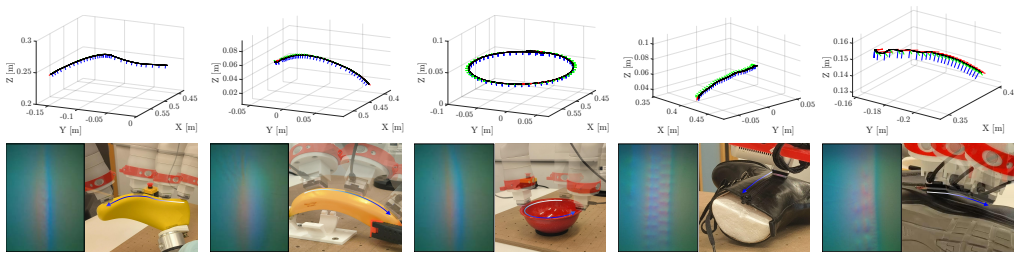
The proposed VBT-MPC controller operates directly in contour features space, thereby avoiding the need for separate pose-estimation modules or complex force-control architectures. The framework is compared to visual-servoing strategies adapted to tactile features and evaluated on objects with diverse geometries and materials in both simulation and real-world experiments.
What carries the argument
The MPC optimizer that works directly in the space of contour features extracted from vision-based tactile sensor images.
If this is right
- The controller maintains contact and tracks contours across objects with varied geometries and materials.
- Performance is evaluated against visual-servoing baselines adapted to the same tactile features.
- The method functions in both simulated environments and real robot trials with an eye-in-hand sensor mount.
- The overall system architecture is simplified by removing dedicated pose estimation and force control modules.
Where Pith is reading between the lines
- The same feature-space formulation might transfer to related contact tasks such as edge polishing or weld seam tracking.
- Lower dependence on explicit pose estimation could reduce the need for multi-sensor fusion in other manipulation pipelines.
- Further experiments on highly reflective or deformable surfaces would test the practical limits of the current feature stability.
Load-bearing premise
Contour features extracted from the vision-based tactile sensor images remain stable and informative enough for the MPC optimizer to maintain contact and track the contour across changes in object geometry, material, and lighting without requiring additional real-time calibration or filtering steps.
What would settle it
A physical experiment in which the robot loses sustained contact or deviates from the contour when the object material or ambient lighting changes abruptly would show the central claim does not hold.
Figures


read the original abstract
Tactile sensing plays a key role in robotic manipulation, particularly in tasks like surface inspection. Successful execution requires maintaining contact while accurately tracking object contours. In this work, we propose a Vision-Based Tactile Model Predictive Control (VBT-MPC) framework for robotic contour following using a Vision-Based Tactile Sensor (VBTS) mounted in an eye-in-hand configuration. The proposed controller operates directly in contour features space, thereby avoiding the need for separate pose-estimation modules or complex force-control architectures. We further compare our VBT-MPC with visual-servoing strategies adapted to tactile features, and evaluate contour tracking on objects with diverse geometries and materials in both simulation and real-world experiments.
Editorial analysis
A structured set of objections, weighed in public.
Referee Report
Summary. The manuscript proposes a Vision-Based Tactile Model Predictive Control (VBT-MPC) framework for robotic contour following. A vision-based tactile sensor (VBTS) is mounted in an eye-in-hand configuration, and the controller is designed to operate directly in contour feature space. This is claimed to eliminate separate pose-estimation modules and complex force-control architectures. The approach is compared to visual-servoing strategies adapted to tactile features and evaluated on objects with diverse geometries and materials via both simulation and real-world experiments.
Significance. If the central claim holds with supporting quantitative evidence, the work could simplify tactile contour tracking by removing intermediate pose estimation, offering a more direct and potentially robust alternative for manipulation and inspection tasks. The dual simulation-plus-real-world evaluation on varied objects is a constructive element that would strengthen applicability if accompanied by detailed metrics.
major comments (2)
- [Abstract] Abstract: The architectural claim that the controller operates directly in contour feature space (thereby avoiding pose estimation) is presented without any equations, feature definitions, cost functions, or quantitative tracking error results. This absence prevents verification of whether the reported experiments actually support the avoidance of separate modules.
- [§4 (Experiments) and §3 (Method)] §4 (Experiments) and §3 (Method): The evaluation on objects with diverse geometries and materials does not report measures of contour feature stability (e.g., under specular highlights on metal or deformation on soft materials). This stability is a load-bearing precondition for the MPC optimizer to maintain contact and track contours without additional real-time calibration or filtering, yet no such analysis or failure-case results are provided.
minor comments (2)
- [§3 (Method)] Clarify the exact definition of the contour features extracted from VBTS images and how they are fed into the MPC cost function.
- Add error bars or statistical summaries to any tracking performance plots to improve interpretability of the simulation versus real-world comparison.
Simulated Author's Rebuttal
We thank the referee for the constructive comments, which highlight opportunities to strengthen the presentation of our core claims and supporting analyses. We address each major comment below and have revised the manuscript to improve clarity and completeness.
read point-by-point responses
-
Referee: [Abstract] Abstract: The architectural claim that the controller operates directly in contour feature space (thereby avoiding pose estimation) is presented without any equations, feature definitions, cost functions, or quantitative tracking error results. This absence prevents verification of whether the reported experiments actually support the avoidance of separate modules.
Authors: The abstract is intentionally concise, as is standard. The full mathematical details—including the definition of contour features extracted from the VBTS, the MPC formulation that optimizes directly over these features, the cost function terms for contour tracking and contact maintenance, and the absence of any explicit pose-estimation step—are provided in Section 3. Section 4 reports quantitative tracking errors (position and orientation deviations) across all tested objects, which were achieved without pose estimation or separate force controllers. To address the concern, we have expanded the abstract to reference the direct feature-space optimization and key quantitative results. revision: yes
-
Referee: [§4 (Experiments) and §3 (Method)] §4 (Experiments) and §3 (Method): The evaluation on objects with diverse geometries and materials does not report measures of contour feature stability (e.g., under specular highlights on metal or deformation on soft materials). This stability is a load-bearing precondition for the MPC optimizer to maintain contact and track contours without additional real-time calibration or filtering, yet no such analysis or failure-case results are provided.
Authors: We agree that explicit stability analysis would strengthen the claims. Our experiments already include metal objects with specular surfaces and soft deformable materials; successful contour tracking without real-time calibration or filtering is demonstrated by the low tracking errors and sustained contact reported in Section 4. To provide the requested evidence, we have added a new analysis subsection that quantifies contour feature stability (e.g., variance and detection consistency under specular highlights and material deformation) using data from the existing trials, along with discussion of observed failure modes and recovery behavior. revision: yes
Circularity Check
VBT-MPC is a direct feature-space controller proposal with no reduction to fitted inputs or self-citations
full rationale
The paper introduces VBT-MPC as an MPC architecture that operates directly on contour features extracted from VBTS images in an eye-in-hand setup. The central claim (avoiding separate pose estimation and force control) is realized by the controller design itself rather than by fitting parameters to the target performance or by importing uniqueness results from prior self-work. No equations or derivations in the provided text reduce the claimed prediction or result to its own inputs by construction. External comparisons to visual-servoing and evaluations on varied objects serve as independent validation rather than circular reinforcement.
Axiom & Free-Parameter Ledger
Reference graph
Works this paper leans on
-
[1]
Tactile sensing in dexterous robot hands-review,
Z. Kappassov, J. Corrales, and P. Veronique, “Tactile sensing in dexterous robot hands-review,”Robotics and Autonomous Systems, vol. 74, pp. 195–220, 2015. doi: 10.1016/j.robot.2015.07.015
-
[2]
Tactile robotics: Past and future,
N. F. Lepora, “Tactile robotics: Past and future,”The Int. J. of Robotics Research, 2026. doi: 10.1177/02783649261421615
-
[3]
Hardware technology of vision-based tactile sensor: A review,
S. Zhang, Z. Chen, Y . Gao, W. Wan, J. Shan, H. Xue, F. Sun, Y . Yang, and B. Fang, “Hardware technology of vision-based tactile sensor: A review,”IEEE Sensors Journal, vol. 22, no. 22, pp. 21 410–21 427,
-
[4]
doi: 10.1109/JSEN.2022.3210210
-
[5]
A survey of vision-based tactile sensors: Hardware, al- gorithm, application, and future direction,
K. He, “A survey of vision-based tactile sensors: Hardware, al- gorithm, application, and future direction,”IEEE Trans. on In- strumentation and Measurement, vol. 74, pp. 1–21, 2025. doi: 10.1109/TIM.2025.3604922
-
[6]
Classification of vision-based tactile sensors: A review,
H. Li, Y . Lin, C. Lu, M. Yang, E. Psomopoulou, and N. F. Lep- ora, “Classification of vision-based tactile sensors: A review,”IEEE Sensors Journal, vol. 25, no. 29, pp. 35 672–35 686, 2025. doi: 10.1109/JSEN.2025.3599236
-
[7]
S. Luo, N. F. Lepora, W. Yuan, K. Althoefer, G. Cheng, and R. Dahiya, “Tactile robotics: An outlook,”IEEE Trans. on Robotics, vol. 41, pp. 5564–5583, 2025. doi: 10.1109/TRO.2025.3608686
-
[8]
Pose-based tactile servoing: Controlled soft touch using deep learning,
N. F. Lepora and J. Lloyd, “Pose-based tactile servoing: Controlled soft touch using deep learning,”IEEE Robotics & Automation Magazine, vol. 28, no. 4, pp. 43–55, 2021. doi: 10.1109/MRA.2021.3096141
-
[9]
Pose-and-shear-based tactile servoing,
J. Lloyd and N. F. Lepora, “Pose-and-shear-based tactile servoing,” The Int. J. of Robotics Research, vol. 43, no. 7, pp. 1024–1055, 2024. doi: 10.1177/02783649231225811
-
[10]
Tactile servo: Control of touch- driven robot motion,
P. Sikka, H. Zhang, and S. Sutphen, “Tactile servo: Control of touch- driven robot motion,” inExperimental Robotics III: Lecture Notes in Control and Information Sciences, vol. 200. Springer, 1994, pp. 219–
work page 1994
-
[11]
doi: 10.1007/BFb0027597
-
[12]
Touch driven con- troller and tactile features for physical interactions,
Z. Kappassov, J. Corrales, and V . Perdereau, “Touch driven con- troller and tactile features for physical interactions,”Robotics and Autonomous Systems, vol. 123, p. 103332, 2020. doi: https://doi.org/10.1016/j.robot.2019.103332
-
[13]
A control framework for tactile servoing,
Q. Li, C. Sch ¨urmann, R. Haschke, and H. J. Ritter, “A control framework for tactile servoing,” inRobotics: Science and Systems (RSS), 2013. doi: 10.15607/RSS.2013.IX.045
-
[14]
A visuo-tactile control framework for manipulation and exploration of unknown objects,
Q. Li, R. Haschke, and H. Ritter, “A visuo-tactile control framework for manipulation and exploration of unknown objects,” inIEEE-RAS 15th Int. Conf. on Humanoid Robots (Humanoids), 2015, pp. 610–615. doi: 10.1109/HUMANOIDS.2015.7363434
-
[15]
Z. Kappassov, J. A. Corrales, and V . Perdereau, “Tactile-based task definition through edge contact formation setpoints for object ex- ploration and manipulation,”IEEE Robotics and Automation Letters, vol. 7, no. 2, pp. 5007–5014, 2022. doi: 10.1109/LRA.2022.3154478
-
[16]
N. F. Lepora, A. Church, C. de Kerckhove, R. Hadsell, and J. Lloyd, “From pixels to percepts: Highly robust edge perception and contour following using deep learning and an optical biomimetic tactile sensor,”IEEE Robotics and Automation Letters, vol. 4, no. 2, pp. 2101–2107, 2019. doi: 10.1109/LRA.2019.2899192
-
[17]
Tactile control for object tracking and dynamic contour following,
K. Aquilina, D. A. Barton, and N. F. Lepora, “Tactile control for object tracking and dynamic contour following,”Robotics and Autonomous Systems, vol. 178, p. 104710, 2024. doi: 10.1016/j.robot.2024.104710
-
[18]
Gelsight: High-resolution robot tactile sensors for estimating geometry and force,
W. Yuan, S. Dong, and E. H. Adelson, “Gelsight: High-resolution robot tactile sensors for estimating geometry and force,”Sensors, vol. 17, no. 12, 2017. doi: 10.3390/s17122762
-
[19]
Lee, Matthew Tan, Yuke Zhu, and Jeannette Bohg
S. Wang, Y . She, B. Romero, and E. Adelson, “Gelsight wedge: Measuring high-resolution 3d contact geometry with a compact robot finger,” inIEEE Int. Conf. on Robotics and Automation (ICRA), 2021, pp. 6468–6475. doi: 10.1109/ICRA48506.2021.9560783
-
[20]
Unet++: A nested u-net architecture for medical image segmenta- tion,
Z. Zhou, M. M. Rahman Siddiquee, N. Tajbakhsh, and J. Liang, “Unet++: A nested u-net architecture for medical image segmenta- tion,” inDeep Learning in Medical Image Analysis and Multimodal Learning for Clinical Decision Support. Cham: Springer International Publishing, 2018, pp. 3–11. doi: 10.1007/978-3-030-00889-5-1
-
[21]
URL http://dx.doi.org/10.1109/CVPR.2016.90
K. He, X. Zhang, S. Ren, and J. Sun, “Deep residual learning for image recognition,” inIEEE Conf. on Computer Vision and Pattern Recognition (CVPR), 2016, pp. 770–778. doi: 10.1109/CVPR.2016.90
-
[22]
Eye-in-hand/eye-to-hand multi-camera visual servoing,
V . Lippiello, B. Siciliano, and L. Villani, “Eye-in-hand/eye-to-hand multi-camera visual servoing,” in44th IEEE Conf. on Decision and Control, 2005, pp. 5354–5359. doi: 10.1109/CDC.2005.1583013
-
[23]
F. Chaumette, S. Hutchinson, and P. Corke,Visual Servoing. Cham: Springer International Publishing, 2016, pp. 841–866
work page 2016
-
[24]
Direct least square fitting of ellipses,
A. Fitzgibbon, M. Pilu, and R. Fisher, “Direct least square fitting of ellipses,”IEEE Trans. on Pattern Analysis and Machine Intelligence, vol. 21, no. 5, pp. 476–480, 1999. doi: 10.1109/34.765658
-
[25]
J. Shi and C. Tomasi, “Good features to track,” inIEEE Conf. on Computer Vision and Pattern Recognition (CVPR), 1994, pp. 593–
work page 1994
-
[26]
doi: 10.1109/CVPR.1994.323794
-
[27]
aca- dos—a modular open-source framework for fast embedded optimal control,
R. Verschueren, G. Frison, D. Kouzoupis, J. Frey, N. v. Duijkeren, A. Zanelli, B. Novoselnik, T. Albin, R. Quirynen, and M. Diehl, “aca- dos—a modular open-source framework for fast embedded optimal control,”Math. Program. Comp., vol. 14, no. 1, pp. 147–183, 2022. doi: 10.1007/s12532-021-00208-8
-
[28]
CasADi – A software framework for nonlinear optimization and optimal con- trol
J. A. Andersson, J. Gillis, G. Horn, J. B. Rawlings, and M. Diehl, “Casadi: a software framework for nonlinear optimization and optimal control,”Math. Program. Comp., vol. 11, no. 1, pp. 1–36, 2019. doi: 10.1007/s12532-018-0139-4
-
[29]
A new partitioned approach to image-based visual servo control,
P. I. Corke and S. A. Hutchinson, “A new partitioned approach to image-based visual servo control,”IEEE Trans. on Robotics and Automation, vol. 17, no. 4, pp. 507–515, 2002. doi: 10.1109/70.954764
discussion (0)
Sign in with ORCID, Apple, or X to comment. Anyone can read and Pith papers without signing in.