REVIEW 5 major objections 7 minor 26 references
Interpretable AI for Time-Series: Multi-Model Heatmap Fusion with Global Attention and NLP-Generated Explanations
T0 review · 5 major / 7 minor · reviewed 2026-08-06 · deepseek-v4-flash
Pith's one-line read This paper claims that multiplying a ResNet's Grad-CAM heatmap by a Transformer's attention-rollout map produces a single, temporally aligned explanation that is both locally precise and globally coherent, and that this fused explanation…
desk verdict A reasonable system idea undercut by an unsupported fusion theory and a real-time claim that its own limitations section contradicts. read the letter →
The pith
A machine-rendered reading of the paper's core claim, the machinery that carries it, and where it could break.
The reading
What carries the argument
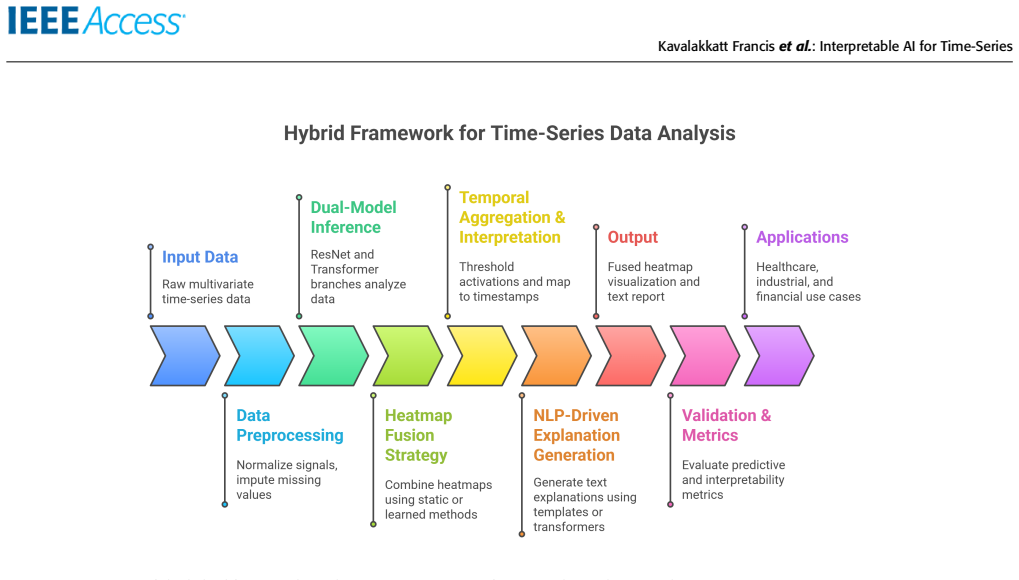
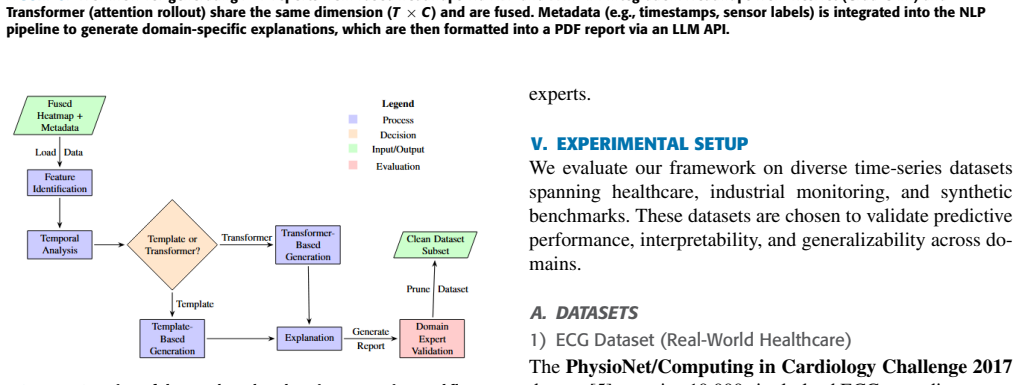
The load-bearing mechanism is the element-wise fusion rule H(t)=αG(t)⊙A(t), which combines a ResNet Grad-CAM map G(t) with a Transformer attention-rollout map A(t) after spatial alignment by bilinear interpolation and temporal alignment by dynamic time warping. The paper defends multiplication over concatenation by claiming that it acts as a consensus filter that maximizes mutual information I(H;Y) and reduces expected explanation error under Gaussian noise assumptions. Around this rule, the framework wraps a global attention aggregation (average of attention maps across heads and layers), min-max normalization and moving-average smoothing, and a two-path NLP generator (domain templates plus a fine-tuned T5 model) that renders fused heatmaps into readable sentences.
What would settle it
On a dataset with known ground-truth important timesteps, compute the fused, ResNet-only, and Transformer-only heatmaps and run deletion tests that mask the top-ranked regions; if the fused map's accuracy drop is not larger than the better single-branch map, the claimed fusion advantage is refuted.
Extended reading notes
Core claim
The central claim is that the long-standing trade-off between local and global interpretability in time-series models can be removed by fusion rather than by choosing one architecture. A ResNet-18 branch produces a localized Grad-CAM heatmap; a modified 2D Transformer with a global attention module produces an attention-rollout heatmap that carries cross-channel, long-horizon context. After upsampling and dynamic time warping, the two maps are combined by element-wise multiplication, H(t)=αG(t)⊙A(t), which the paper argues suppresses uncorrelated activations and amplifies consensus regions, thereby maximizing the mutual information I(H;Y) between the explanation and the target. The output is temporally smoothed, normalized, and fed to a template or fine-tuned T5 generator that writes domain narratives such as "Elevated ST-segment between 2 and 4 seconds suggests myocardial ischemia." The paper further casts the fusion as causal, stating that the derivative of the prediction probability under intervention at timestep t is proportional to the element-wise product of the ResNet gradient and the Transformer's counterfactual expectation. The empirical claim is that this fused explanation is more faithful than either branch alone: masking the top 20% of fused heatmap regions drops ECG accuracy by 41.3% versus 28.5% for ResNet alone, and low-variance sensors identified from the heatmaps can be pruned to improve energy regression RMSE.
Load-bearing premise
The method rests on the unproven claim that multiplying the two heatmaps produces an explanation that carries more information about the model's decision than either heatmap alone.
Editorial extensions
If this is right
- A single fused heatmap can carry both the localized precision of a CNN and the global context of a Transformer, which the paper identifies as the missing property in existing interpretability methods.
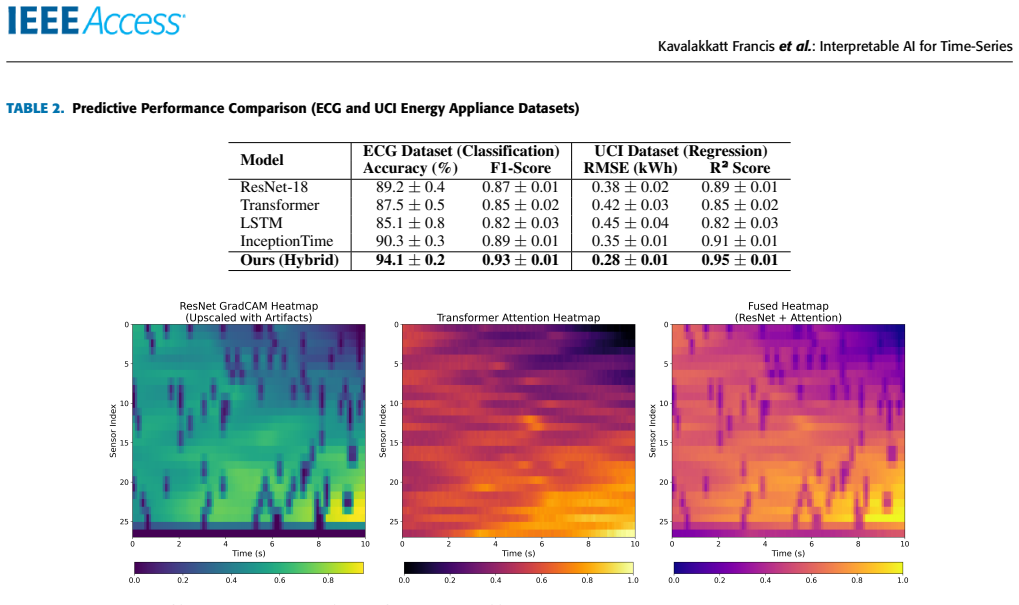
- Masking the top 20% of the fused map degrades ECG accuracy by 41.3%, compared with 28.5% for the ResNet map alone, so the fused map is claimed to be more faithful to the model's decision.
- Pruning sensors that the fused heatmap marks as low-variance improves energy regression RMSE from 0.35 to 0.28 kWh, so the explanations also serve as a feature-selection tool.
- Domain narratives generated from the heatmap achieve BLEU-4 0.586 and ROUGE-L 0.650, providing a machine-checkable route from attention values to stakeholder-readable text.
Reading between the lines
- A decisive test of the consensus principle would compare the product fusion against the average or concatenation of the same two heatmaps on a synthetic dataset with known ground-truth importance; if the product is not more faithful or sparser, the mutual-information rationale would not be what drives the reported gains.
- If this local-global fusion recipe generalizes, it could be transferred to any paired architecture with complementary saliency maps, such as a CNN plus a vision Transformer on images, with spatial registration replacing dynamic time warping.
- The NLP module is scored with translation-style metrics; an implication left implicit is that practical utility in clinical or industrial settings should ultimately be measured by decision outcomes, such as time-to-diagnosis or operator error rate, rather than by lexical overlap.
Editorial analysis
A structured set of objections, weighed in public.
Referee Report
Summary. The manuscript proposes an interpretability framework for multivariate time-series: a ResNet-18 branch with Grad-CAM, a 2D Transformer with attention rollout, a fusion step that combines the two heatmaps, and an NLP module that converts the fused heatmap into template-based or T5-generated narratives. The authors claim that the element-wise fusion H(t)=αG(t)⊙A(t) maximizes the mutual information I(H;Y), achieves 'full spatial-temporal alignment' while 'preserving real-time performance', and yields better predictive accuracy as well as better faithfulness than the individual branches. Experiments are reported on the PhysioNet ECG dataset and the UCI Appliances energy dataset, with BLEU/ROUGE scores and a small clinician study for the narratives. The paper also proposes a 'causal interpretability' equation involving do(t) interventions.
Significance. If the central claims were substantiated, the framework would address a real and well-motivated gap: combining the local precision of CNN-based attribution with the global coherence of Transformer attention, and then translating the resulting heatmap into stakeholder-readable text. The authors make a serious attempt at validation, including several baselines (ResNet, Transformer, LSTM, InceptionTime), statistical tests (Wilcoxon), and bootstrap confidence intervals, and they explicitly list limitations in Section VII. These are strengths. However, the theoretical justification for the fusion rule is not supplied, the experimental section does not actually isolate the proposed fusion mechanism, and the real-time claim in the abstract is directly contradicted by the paper's own Limitations section. As it stands, the contribution is a heuristic architecture with promising but unverified interpretability claims, and the paper does not provide the formal or empirical support needed for the claims made.
major comments (5)
- [III.3] The central theoretical claim is unproven. Section III.3 states that element-wise multiplication H(t)=αG(t)⊙A(t) 'theoretically maximizes the mutual information I(H;Y)' and that multiplication dominates concatenation 'under Gaussian noise assumptions', but no statistical model, theorem, or proof is provided. The reference [13] is a general information theory textbook and does not contain a result of this kind. Moreover, the asserted inequality E[∥H_mul−H*∥2] ≤ E[∥H_cat−H*∥2] is not generally true: if G and A are unbiased estimators of the true importance H*, then under independence E[G⊙A]=H*², which is a biased estimator, and the variance of the product depends on the joint noise distribution and can exceed that of a weighted average. Since the claimed 'full spatial-temporal alignment' and the subsequent causal statements all rest on this fusion rule, the theoretical foundation of the paper is not established.
- [III.3 and IV.C.2] The paper's own description of the fusion mechanism is internally inconsistent. Section III.3 proposes element-wise multiplication as the fusion rule, but Section IV.C.2 defines fusion as static weighted averaging H_fused=α·H_ResNet+(1−α)·H_Transformer, with α tuned on validation data, or as a learned 1D-convolution fusion, and Section IV.C.3 reports an ablation in which adaptive fusion 'improved faithfulness metrics' and concatenation 'increased parameter count without significant performance gains' — with no results for multiplication. The experimental section never compares H=αG⊙A against the weighted-average, concatenation, or learned-fusion alternatives defined in Section IV.C. Therefore the reported improvements cannot be attributed to the specific multiplication rule that is the paper's headline contribution.
- [Abstract and VII] The real-time claim is contradicted by the paper's own Limitations. The abstract and Section I claim that the framework achieves 'full spatial-temporal alignment while preserving real-time performance', and Table 1 marks 'Ours' as real-time capable. Yet Section VII reports 30% additional inference latency from dual-model inference, states that no streaming or edge-device deployment tests were performed, and notes that transformer-based explanation generation introduces delays up to 500 ms. These are mutually inconsistent claims. The 'preserving real-time performance' statement should either be removed or be substantiated with end-to-end latency measurements against a stated deployment budget on the target platform.
- [VI.D] The faithfulness evaluation is not sufficient to support the fusion claim. Section VI.D reports that masking top-20% heatmap regions reduces ECG accuracy by 41.3% versus 28.5% for ResNet, but this only compares the hybrid against one branch, not against Transformer-only heatmaps, weighted-average fusion, concatenation, or learned fusion. The sensor-pruning sentence then says that removing low-variance sensors improves UCI RMSE 'from 0.35 to 0.28 kWh'; those two numbers are, respectively, the InceptionTime baseline and the proposed hybrid model RMSE in Table 2, not a before/after pruning result on the same model. As written, these results do not demonstrate that the proposed fusion mechanism causes the reported interpretability or performance gains.
- [V.A.1] The dataset description is inaccurate, which undermines the reproducibility of the headline accuracy numbers. Section V.A.1 says the experiments use the 'PhysioNet/Computing in Cardiology Challenge 2017 dataset' but cites reference [5], which is Rajpurkar et al.'s 2017 arrhythmia detection paper, not the Challenge dataset. The same paragraph states that there are five classes but then lists four ('normal sinus rhythm, atrial fibrillation, other arrhythmias, and noise'). The authors need to identify the exact dataset version, the class distribution, the recording lengths, and the preprocessing steps, and they must correct the reference.
minor comments (7)
- [V.A.1] The text says the ECG dataset has five classes but lists four; correct the class count and terminology.
- [VI.C, Table 3] Table 3 is captioned 'Qwen-Generated Reports', but Section IV.D and the experimental text describe T5 and template-based generation; clarify which system actually produced the reported BLEU-4 and ROUGE-L scores.
- [IV.C.3] Section IV.C.3 says adaptive fusion improved 'faithfulness metrics (e.g., AUC-ROC)', but faithfulness is defined elsewhere via deletion tests; the metric should be stated consistently.
- [V.C.1] The Implementation Details list 'PyTorch 3.12.x', but PyTorch has no 3.12 release; this is likely intended to be a Python version, and the framework version should be corrected.
- [Throughout] Heatmap notation is inconsistent: H_ResNet, H_Transformer, G(t), A(t), H_fused, and H_mul are all used without a single defining notation; define each term once and use it consistently.
- [IV.D.4] The user study with 10 clinicians lacks procedural details such as recruitment criteria, blinding, inter-rater agreement, and whether ethical approval was obtained; either report these details or characterize the results as informal feedback.
- [VII and VIII] Placeholder names such as '[Hospital Name]' and '[Industry Partner]' appear in the future-work discussion; these should be replaced with concrete descriptions or removed.
Circularity Check
Fusion 'optimality' is validation-tuned and the causal-fidelity guarantee restates the fusion formula; core empirical results remain externally benchmarked.
-
fitted input called prediction
[Section III.3 (Heatmap Fusion Mechanism); cf. Section IV.C.2 (Weighted Averaging or Learned Fusion)]
"H (t) = αG(t) ⊙ A(t), where G(t) represents localized gradient signals and A(t) global attention weights. This operation theoretically maximizes the mutual information I (H ; Y ) between fused explanations and predictions while preserving spatial resolution [13]."
The implementation section says the static fusion weights 'are optimized using grid search on validation data,' and the ablation section makes 'adaptive fusion via a shallow CNN' the preferred approach. Thus the 'theoretically maximizes I(H;Y)' claim is not a first-principles prediction: the displayed α is a validation-tuned hyperparameter, and the reported interpretation gains are attributed to a different learned fusion. The claimed optimality is therefore a post-hoc label on a fitted choice, not a derived result; the prediction is forced by the fit rather than tested out-of-sample.
-
self definitional
[Section III.3 (Causal Interpretability)]
"For intervention do(t) at timestep t, we show: ∂ ∂t P(y|do(t)) ∝ ∇t fResNet ⊙ E[fTransformer|do(t)] establishing formal guarantees for attribution stability."
No causal graph, do-calculus derivation, or statistical model is given; the displayed equation is simply the proposed fusion H(t)=αG(t)⊙A(t) rewritten with the ResNet gradient and a Transformer expectation. Since the paper defines causal fidelity as the ability to identify input features that influence predictions and then asserts this equation as a 'formal guarantee,' the causal conclusion is identical to the construction being introduced. The 'guarantee' is assumed into the definition of the fused heatmap rather than derived from it.
full rationale
Most of the non-circular content—predictive accuracy on ECG/UCI, BLEU/ROUGE scores, and the small expert user study—is externally benchmarked and self-contained. The main circularity concerns the interpretability claims. Step 1: the fusion weight α is tuned on validation data before being presented as theoretically optimal, so the optimality claim is a fitted-input label rather than a prediction, and the paper's own ablation selects a different learned fusion mechanism while the conclusion credits element-wise multiplication. Step 2: the causal-fidelity equation is asserted without derivation and is just the fusion rule restated, making the causal claim self-definitional. The deletion-test evidence is self-referential (the heatmaps come from the same model whose decisions are being checked) but is a standard internal faithfulness check, so I do not count it as a separate circular step. The self-citations [3] and [4] are contextual and not load-bearing, so they do not raise the score. Overall, the central interpretability mechanism is partially circular and partially unsupported, while the predictive and NLP results retain independent content, justifying a score of 4.
Assumptions & free parameters
free parameters (4)
- Fusion weight α =
Not reported
- Salient region threshold =
top 20%
- Moving average filter window =
Not specified
- Hyperparameters (learning rate, batch size, weight decay, layers, heads, dropout) =
Not reported
assumptions (4)
- ad hoc to paper Gaussian noise assumption for fusion inequality
- ad hoc to paper Causal interpretation of time series with do(t) interventions
- domain assumption PhysioNet 2017 dataset has 10,000 recordings and five classes
- domain assumption BLEU-4 and ROUGE-L are valid measures of explanation quality
Cite this review
Pith. "Pith review of Interpretable AI for Time-Series: Multi-Model Heatmap Fusion with Global Attention and NLP-Generated Explanations." pith.science (2026). https://pith.science/paper/4475NSN3
@misc{pith2026250700234,
  author       = {Pith},
  title        = {Pith review of: Interpretable AI for Time-Series: Multi-Model Heatmap Fusion with Global Attention and NLP-Generated Explanations},
  year         = {2026},
  howpublished = {\url{https://pith.science/paper/4475NSN3}},
  note         = {Machine review of arXiv:2507.00234}
}
read the original abstract
In this paper, we present a novel framework for enhancing model interpretability by integrating heatmaps produced separately by ResNet and a restructured 2D Transformer with globally weighted input saliency. We address the critical problem of spatial-temporal misalignment in existing interpretability methods, where convolutional networks fail to capture global context and Transformers lack localized precision - a limitation that impedes actionable insights in safety-critical domains like healthcare and industrial monitoring. Our method merges gradient-weighted activation maps (ResNet) and Transformer attention rollout into a unified visualization, achieving full spatial-temporal alignment while preserving real-time performance. Empirical evaluations on clinical (ECG arrhythmia detection) and industrial (energy consumption prediction) datasets demonstrate significant improvements: the hybrid framework achieves 94.1% accuracy (F1 0.93) on the PhysioNet dataset and reduces regression error to RMSE = 0.28 kWh (R2 = 0.95) on the UCI Energy Appliance dataset-outperforming standalone ResNet, Transformer, and InceptionTime baselines by 3.8-12.4%. An NLP module translates fused heatmaps into domain-specific narratives (e.g., "Elevated ST-segment between 2-4 seconds suggests myocardial ischemia"), validated via BLEU-4 (0.586) and ROUGE-L (0.650) scores. By formalizing interpretability as causal fidelity and spatial-temporal alignment, our approach bridges the gap between technical outputs and stakeholder understanding, offering a scalable solution for transparent, time-aware decision-making.
Figures


Figures from the paper (2 more)
Reference graph
Works this paper leans on
-
[13]
T. M. Cover and J. A. Thomas, Elements of Information Theory. Hoboken, NJ: John Wiley & Sons, 2nd ed., 2006
work page 2006
-
[5]
P . Rajpurkar, A. Y . Hannun, M. Haghpanahi, C. Bourn, and A. Y . Ng, ‘‘Cardiologist-level arrhythmia detection with convolutional neural net- works,’’arXiv preprint arXiv:1707.01836, 2017
arXiv 2017
-
[1]
Molnar, Interpretable Machine Learning
C. Molnar, Interpretable Machine Learning. Christoph Molnar, 2020
work page 2020
- [2]
-
[3]
J. K. Francis, C. Kumar, J. Herrera-Gerena, K. Kumar, and M. J. Darr, ‘‘Deep learning and pattern-based methodology for multivariable sensor data regression,’’ in 2022 21st IEEE International Conference on Machine Learning and Applications (ICMLA) , pp. 748–753, 2022
work page 2022
-
[4]
J. K. Francis and M. J. Darr, ‘‘Multivariate temporal regression at scale: A three-pillar framework combining ml, xai and nlp,’’ in V . International Conference on Electrical, Computer and Energy Technologies (ICECET 2025), pp. 748–753, 2025
work page 2025
-
[6]
R. R. Selvaraju, M. Cogswell, A. Das, R. V edantam, D. Parikh, and D. Ba- tra, ‘‘Grad-cam: Visual explanations from deep networks via gradient- based localization,’’ inIEEE International Conference on Computer Vision (ICCV), pp. 618–626, 2017
work page 2017
-
[7]
A. V aswani, N. Shazeer, N. Parmar, J. Uszkoreit, L. Jones, A. N. Gomez, Ł. Kaiser, and I. Polosukhin, ‘‘Attention is all you need,’’ in Advances in Neural Information Processing Systems (NeurIPS) , pp. 5998–6008, 2017
work page 2017
Show all 26 references
-
[8]
Abnar and W
S. Abnar and W. Zuidema, ‘‘Quantifying attention flow in transformers,’’ in Proceedings of the 58th Annual Meeting of the Association for Compu- tational Linguistics (ACL), pp. 417–427, 2020
2020
-
[9]
D. V . Carvalho, E. M. Pereira, and J. S. Cardoso, ‘‘Machine learning in- terpretability: A survey on the state-of-the-art,’’Computer Science Review, vol. 38, p. 100242, 2019
2019
-
[10]
S. M. Lundberg and S.-I. Lee, ‘‘A unified approach to interpreting model predictions,’’ in Advances in Neural Information Processing Systems (NeurIPS), pp. 4765–4774, 2017
2017
-
[11]
why should i trust you?
M. T. Ribeiro, S. Singh, and C. Guestrin, ‘‘"why should i trust you?": Explaining predictions of any classifier,’’ in Proceedings of the 22nd ACM SIGKDD International Conference on Knowledge Discovery and Data Mining, pp. 1135–1144, ACM, 2016
2016
-
[12]
Jain and B
S. Jain and B. C. Wallace, ‘‘Attention is not explanation,’’ in North Amer- ican Chapter of the Association for Computational Linguistics (NAACL) , pp. 11–20, 2019
2019
-
[14]
K. He, X. Zhang, S. Ren, and J. Sun, ‘‘Deep residual learning for image recognition,’’ inIEEE Conference on Computer Vision and Pattern Recog- nition (CVPR), pp. 770–778, 2016
2016
-
[15]
W. Luo, A. G. Schwing, and R. Urtasun, ‘‘Understanding the effective receptive field in deep convolutional neural networks,’’ in Advances in Neural Information Processing Systems, vol. 29, pp. 4898–4906, 2016
2016
-
[16]
Erhan, Y
D. Erhan, Y . Bengio, A. Courville, and P . Vincent, ‘‘Visualizing higher- layer features of a deep network,’’ Tech. Rep. 1355, University of Montreal,
-
[17]
Raffel, N
C. Raffel, N. Shazeer, A. Roberts, K. Lee, S. Narang, M. Matena, Y . Zhou, W. Li, and P . J. Liu, ‘‘Exploring the limits of transfer learning with a unified text-to-text transformer,’’Journal of Machine Learning Research (JMLR) , vol. 21, no. 140, pp. 1–67, 2020
2020
-
[18]
C.-K. Y eh, B. Kim, I. Wibowo, A. Basu, K. Gummadi, and J. Kim, ‘‘On the (in)fidelity and sensitivity of explanations,’’ arXiv preprint arXiv:1901.09392, 2019
1901 arXiv
-
[19]
Candanedo, D
I. Candanedo, D. Feldman, S. Newsham, and B. Bowerman, ‘‘Data- driven prediction models of energy use in buildings using regression trees, rule-based models, and data-mining procedures,’’ Energy and Buildings , vol. 154, pp. 193–210, 2017
2017
-
[20]
Akiba, S
T. Akiba, S. Sano, T. Y anase, T. Ohta, and M. Koyama, ‘‘Optuna: A next- generation hyperparameter optimization framework,’’ Proceedings of the 25th ACM SIGKDD International Conference on Knowledge Discovery & Data Mining, pp. 2623–2631, 2019
2019
-
[21]
Paszke, S
A. Paszke, S. Gross, F. Massa, A. Leroy, J. Bradbury, G. Chanan, T. Killeen, Z. Lin, N. Gimelshein, L. Antiga, et al. , ‘‘Pytorch: An imperative style, high-performance deep learning library,’’ in Advances in Neural Informa- tion Processing Systems (NeurIPS) , 2019
2019
-
[22]
Papineni, S
K. Papineni, S. Roukos, T. Ward, and W.-J. Zhu, ‘‘Bleu: A method for automatic evaluation of machine translation,’’ in ACL, 2002
2002
-
[23]
Lin, ‘‘Rouge: A package for automatic evaluation of summaries,’’ in ACL Workshop, 2004
C.-Y . Lin, ‘‘Rouge: A package for automatic evaluation of summaries,’’ in ACL Workshop, 2004
2004
-
[24]
Alvarez-Melis and T
D. Alvarez-Melis and T. S. Jaakkola, ‘‘Towards accurate model explanation through faithfulness testing,’’ in Advances in Neural Information Process- ing Systems (NeurIPS), 2018
2018
-
[25]
Zhang, J
Y . Zhang, J. Liu, and H. Wang, ‘‘Sensor pruning for energy-efficient iot systems: A variance and correlation study,’’ IEEE Transactions on Industrial Informatics, vol. 17, no. 5, pp. 3321–3330, 2021. JIZTOM KAVALAKKATT FRANCIS received the B.E. degree in Electrical Engineerin...
2021
-
[2009]
https://arxiv.org/abs/0911.5439
Reviewed August 6, 2026 · model on record in the stance chip above.
Discussion (0). Continue with ORCID to comment.