REVIEW 3 major objections 7 minor 73 references
FlowRAM: Grounding Flow Matching Policy with Region-Aware Mamba Framework for Robotic Manipulation
T0 review · 3 major / 7 minor · reviewed 2026-08-06 · deepseek-v4-flash
Pith's one-line read FlowRAM claims that making 3D perception shrink with the flow-matching trajectory yields state-of-the-art robot manipulation: 82.3% average success on RLBench and a 12.0-point gain on high-precision tasks.
desk verdict A genuinely new coupling of sampling radius to flow time, with solid RLBench numbers—but the headline 12-point gain is not directly ablated and the radius schedule is under-specified. read the letter →
The pith
A machine-rendered reading of the paper's core claim, the machinery that carries it, and where it could break.
The reading
What carries the argument
The load-bearing mechanism is the Dynamic Radius Schedule (DRS) coupled with conditional flow matching. DRS produces a sequence of region-aware masks M_i = {(p_i, r_i) | i = 0 ... N}, where p_i is the noise-perturbed end-effector position at flow time i and r_i = (1 - i)(r_0 - r_min) + r_min shrinks monotonically with i. Because p_i converges toward the target pose while r_i shrinks, the point-cloud encoder samples progressively finer geometry around the task-relevant contact region, so the generation trajectory doubles as a coarse-to-fine attention schedule. Conditional flow matching supplies the velocity field v_theta(x_t, t, C) that transports a Gaussian sample to a 6-DoF keyframe pose through Euler integration, and Mamba, a selective state space model with linear-time sequence processing, fuses geometric, semantic, instruction, and proprioceptive tokens.
What would settle it
Run the same FlowRAM configuration on the 7 high-precision tasks with DRS replaced by global farthest-point sampling while keeping CFM at 2 inference steps; the paper's mechanism predicts average success should fall (its multi-task ablation shows a 3.7-point drop at i=2). A complementary check is to record the distance between the region center p_i and the final target pose at each flow step; if early-step centers are frequently far off-target, the shrinking-radius schedule is concentrating resolution on the wrong geometry.
Extended reading notes
Core claim
FlowRAM's central claim is that the flow-matching trajectory itself can serve as an attention schedule for 3D perception. At each discretized flow step i, the model defines a region mask centered at the noise-perturbed end-effector position p_i, whose radius r_i decreases monotonically as i grows. This Dynamic Radius Schedule turns the generation process into a coarse-to-fine perception process: the policy first sees the whole workspace, then concentrates sampled points on the geometry around the predicted contact point just as the pose estimate approaches the target. The velocity field v_theta is trained by regressing x_1 - x_0 along linear interpolation paths, so at inference the action pose is produced by integrating the ODE in as few as 2 steps. On that basis the paper reports 82.3% average success on 10 RLBench tasks, 52.0% average success on 7 high-precision tasks (12.0 percentage points above the prior best), and successful real-world execution on 49 of 60 episodes across 6 tasks.
Load-bearing premise
The load-bearing premise is that the noise-perturbed end-effector position stays a reliable center for the task-relevant region at every flow step while the radius shrinks; if early flow steps land off-target, the model spends its resolution on the wrong geometry, and the paper does not report the exact starting and ending radii needed to check this.
Editorial extensions
If this is right
- If the reported results hold, diffusion-based manipulation policies can be replaced by flow-matching policies that generate keyframe poses in 2-4 integration steps, which puts learned high-precision control inside a real-time feedback loop.
- The Dynamic Radius Schedule should transfer to other tasks where contact, insertion, or alignment determines success, because it does not depend on task-specific object models and can use other radius functions such as cosine annealing.
- Using a state space model for multimodal fusion means the added geometric tokens from region-aware sampling do not incur quadratic attention cost, so scaling to more cameras or denser point clouds is cheaper than with Transformer-based policies.
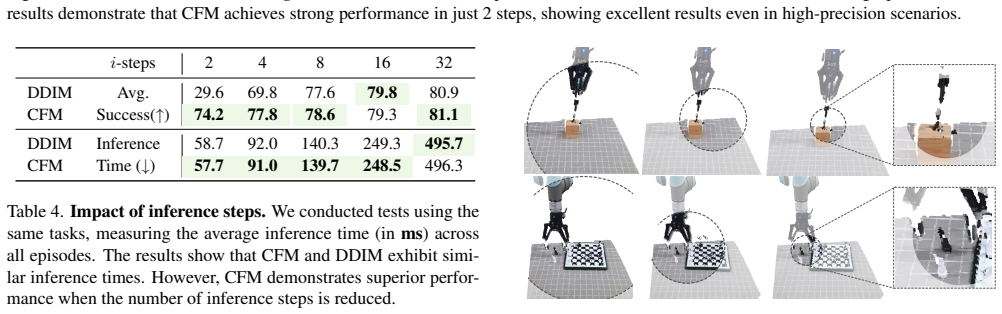
- Since CFM outperformed DDIM at the same inference step counts, the choice of training objective, not just the region-aware sampling, is part of the reported speed-accuracy advantage.
- The high-precision setting results (52.0% average, 12.0 points above the previous best) imply that the largest gains from region-aware perception appear exactly where global-voxel and multi-stage methods lose geometric detail.
Reading between the lines
- Inference: an untested consequence of DRS is that the schedule's center p_i could be wrong early in generation; a robust variant might replace the noisy position with a predicted region-of-interest heatmap, which would keep resolution on target even if the initial noise sample is far from the true pose.
- Inference: because the radius function f(i) is a free design choice, the reported linear schedule may not be optimal; learning or per-task tuning of r_0 and r_min could push the high-precision numbers higher, but the paper does not report those values.
- Inference: if CFM's few-step advantage generalizes, the same architecture could be trained with a rectified-flow objective toward one-step generation, making the policy effectively a deterministic map from observation to action while retaining multimodal diversity through the sampled noise.
- Inference: the paper's own failure-case analysis attributes some umbrella-insertion failures to a simulator bug and multi-task trade-offs to uniform sampling; reweighting task sampling could improve the reported averages beyond the stated numbers.
Editorial analysis
A structured set of objections, weighed in public.
Referee Report
Summary. The paper proposes FlowRAM, a keyframe-based robotic manipulation policy that couples conditional flow matching (CFM) for 6-DoF pose generation with a Mamba-based multimodal fusion module and a Dynamic Radius Schedule (DRS) that progressively narrows 3D point-cloud sampling around the noise-perturbed end-effector position during flow integration. On the RLBench benchmark, the authors report a state-of-the-art average success rate of 82.3% over 10 multi-task settings and 52.0% over 7 high-precision tasks, the latter exceeding the previous best by 12.0 percentage points. They further report strong few-step inference performance (74.2% with 2 integration steps) and real-world deployment results on 6 tasks.
Significance. If the empirical claims hold, the paper offers a practical and conceptually simple way to make generative flow steps region-aware, with a measurable speed advantage from few-step inference. The experimental comparison is broad, includes the standard RLBench benchmark and a real-robot evaluation, and the reported per-task numbers are internally consistent with the stated averages. The inclusion of training/inference pseudocode is also a strength. That said, the load-bearing causal claim—that DRS is responsible for the high-precision margin—is not directly tested on the high-precision benchmark, and the mathematical specification of the core DRS schedule is ambiguous as written. These issues must be resolved before the paper can be accepted.
major comments (3)
- [3.3, Eq. (7)] The dynamic radius schedule as written is not reproducible: r_i = (1 - i)*(r0 - rmin) + rmin with i in {0,...,N} gives r_1 = rmin and negative radii for all i > 1, which contradicts the stated monotonicity rmin <= r_i < r_{i-1} < ... < r_0. If i is intended to be normalized by the total number of steps, that normalization is omitted. Please restate the schedule (e.g., r_i = (1 - i/N)*(r0 - rmin) + rmin) and report the exact values of r0 and rmin, including the values used for the 2-step and 50-step evaluations.
- [4.2-4.3, Tables 2, 3, C] The headline 12.0 percentage-point improvement on the 7 high-precision tasks is attributed to the Dynamic Radius Schedule, but the DRS ablation is only conducted on the 10-task multi-task benchmark. Table C shows DRS helps in that setting, yet there is no w/o DRS row for Table 2. Because DRS is the paper's main novelty and the high-precision benchmark is its main claim, the causal role of DRS in high-precision performance remains unsupported. Please add DRS ablations on the same 7-task high-precision benchmark.
- [3.3 and Table 4] The DRS mechanism centers sampling on the noise-perturbed position p_i. Since p_i = t*x1 + (1 - t)*x0, the target x1 lies within radius r_i only when r_i >= (1 - t)*||x0 - x1||, but the fixed schedule is independent of ||x0 - x1|| and no sensitivity to r0/rmin is reported. At the 2-step Euler integration used in Table 4, the only intermediate state is t = 0.5; if the radius has already shrunk below the typical displacement, the sampled geometric tokens may exclude the target, and the reported 2-step success could rely on the global RGB branch rather than the proposed region-aware mechanism. Please report the radius schedule values and include a sensitivity study or a discussion of this failure mode.
minor comments (7)
- [3.3 and Table B] The notation N1/N2 for sampled tokens is swapped between the text and Table B. In Section 3.3, F_geo is in R^{N1 x C} and F_rgb is in R^{N2 x C}, so N1 is the geometric token count and N2 the semantic token count; Table B instead lists 'sampled semantic tokens N1=4096' and 'sampled geometric tokens N2=1024'. Please align the notation.
- [3.2, Eq. (6)] The action representation declares arot in SO(3) but the next sentence states that a 6D rotation representation is used; please write arot in R^6 to avoid the contradiction.
- [3.3 and Fig. 2] The number of Mamba blocks N is a key architectural hyperparameter but it is not reported in Table B or anywhere else; please list its value.
- [Table 3] The checkmark/box symbols used to indicate DRS, P.E., and T.O. are not legible in the compiled text; please use explicit 'Yes/No' columns.
- [Table 1] The column header 'Slide Bolck' should read 'Slide Block'.
- [Abstract and Table 5] The claim of generating physically plausible actions 'in less than 4 time steps' for real-world tasks is not supported by a reported inference-step count in the real-robot experiments; please report the number of integration steps used in Table 5 or qualify the claim.
- [Section 2.2] The sentence beginning 'Where flow matching...' should begin with 'While' to read correctly.
Circularity Check
No significant circularity: the central claims are empirical benchmark comparisons, not derivations that reduce to their inputs.
full rationale
I walked the claimed derivation chain: the Dynamic Radius Schedule is defined as a design choice (Eq. 7) that centers a perception region on the noised pose and shrinks with a hand-specified schedule; the conditional flow matching objective (Eq. 11) is the standard flow matching loss regressing a velocity field; and the inference rule (Eq. 13) is ordinary Euler integration. None of these equations takes the reported success rates as an input, and neither the 82.3% multi-task average nor the 52.0% high-precision average is produced by fitting a parameter to the target result. The results are empirical comparisons against external RLBench baselines. The only self-citation, reference [64], appears in the related-work discussion of deterministic policies and is not load-bearing. The under-specification of r0 and rmin and the apparent missing normalization in Eq. 7 are reproducibility weaknesses, not circularity. Therefore I find no circular step.
Assumptions & free parameters
free parameters (4)
- DRS radii r0 and rmin =
not reported
- Loss weights lambda_CFM and lambda_open =
100 and 10
- Number of Mamba blocks N =
not reported
- Sampled token counts N1 and N2 =
4096 and 1024, with labels swapped in Table B
assumptions (5)
- standard math Conditional flow matching with linear interpolation xt = t*x1 + (1 - t)*x0 gives a tractable velocity-field objective (Eq. 2 and Eq. 10).
- standard math State-space models discretized with zero-order hold preserve long-range dependencies and linear complexity (Eq. 4).
- domain assumption Keyframe-based manipulation reduces the problem to predicting the next bottleneck action pose, with keyframes defined by near-zero joint velocities and unchanged gripper state.
- domain assumption The learned velocity field trained with Logit-Normal time sampling transfers to fewer inference steps without significant distribution shift.
- ad hoc to paper The noise-perturbed position p_i is a reliable center for the task-relevant region as the flow progresses.
Cite this review
Pith. "Pith review of FlowRAM: Grounding Flow Matching Policy with Region-Aware Mamba Framework for Robotic Manipulation." pith.science (2026). https://pith.science/paper/4AI5JKAP
@misc{pith2026250616201,
  author       = {Pith},
  title        = {Pith review of: FlowRAM: Grounding Flow Matching Policy with Region-Aware Mamba Framework for Robotic Manipulation},
  year         = {2026},
  howpublished = {\url{https://pith.science/paper/4AI5JKAP}},
  note         = {Machine review of arXiv:2506.16201}
}
read the original abstract
Robotic manipulation in high-precision tasks is essential for numerous industrial and real-world applications where accuracy and speed are required. Yet current diffusion-based policy learning methods generally suffer from low computational efficiency due to the iterative denoising process during inference. Moreover, these methods do not fully explore the potential of generative models for enhancing information exploration in 3D environments. In response, we propose FlowRAM, a novel framework that leverages generative models to achieve region-aware perception, enabling efficient multimodal information processing. Specifically, we devise a Dynamic Radius Schedule, which allows adaptive perception, facilitating transitions from global scene comprehension to fine-grained geometric details. Furthermore, we integrate state space models to integrate multimodal information, while preserving linear computational complexity. In addition, we employ conditional flow matching to learn action poses by regressing deterministic vector fields, simplifying the learning process while maintaining performance. We verify the effectiveness of the FlowRAM in the RLBench, an established manipulation benchmark, and achieve state-of-the-art performance. The results demonstrate that FlowRAM achieves a remarkable improvement, particularly in high-precision tasks, where it outperforms previous methods by 12.0% in average success rate. Additionally, FlowRAM is able to generate physically plausible actions for a variety of real-world tasks in less than 4 time steps, significantly increasing inference speed.
Figures


Figures from the paper (2 more)

Reference graph
Works this paper leans on
-
[1]
Riemannian flow matching policy for robot motion learning
Max Braun, No ´emie Jaquier, Leonel Rozo, and Tamim As- four. Riemannian flow matching policy for robot motion learning. arXiv preprint arXiv:2403.10672, 2024. 3
arXiv 2024
-
[2]
Rt-1: Robotics transformer for real-world control at scale
Anthony Brohan, Noah Brown, Justice Carbajal, Yevgen Chebotar, Joseph Dabis, Chelsea Finn, Keerthana Gopalakr- ishnan, Karol Hausman, Alex Herzog, Jasmine Hsu, et al. Rt-1: Robotics transformer for real-world control at scale. arXiv preprint arXiv:2212.06817, 2022. 2
arXiv 2022
-
[3]
GenCHiP: Generating Robot Policy Code for High-Precision and Contact-Rich Manipulation Tasks
Kaylee Burns, Ajinkya Jain, Keegan Go, Fei Xia, Michael Stark, Stefan Schaal, and Karol Hausman. Genchip: Gen- erating robot policy code for high-precision and contact-rich manipulation tasks. arXiv preprint arXiv:2404.06645, 2024. 1
work page Pith review arXiv 2024
-
[4]
Mamba policy: Towards efficient 3d diffusion policy with hybrid selective state models
Jiahang Cao, Qiang Zhang, Jingkai Sun, Jiaxu Wang, Hao Cheng, Yulin Li, Jun Ma, Yecheng Shao, Wen Zhao, Gang Han, et al. Mamba policy: Towards efficient 3d diffusion policy with hybrid selective state models. arXiv preprint arXiv:2409.07163, 2024. 3
arXiv 2024
-
[5]
Scanrefer: 3d object localization in rgb-d scans using natural language
Dave Zhenyu Chen, Angel X Chang, and Matthias Nießner. Scanrefer: 3d object localization in rgb-d scans using natural language. In ECCV, pages 202–221. Springer, 2020. 1
work page 2020
-
[6]
Flow matching on gen- eral geometries
Ricky TQ Chen and Yaron Lipman. Flow matching on gen- eral geometries. In ICLR, 2024. 2
work page 2024
-
[7]
Polarnet: 3d point clouds for language-guided robotic manipulation
Shizhe Chen, Ricardo Garcia, Cordelia Schmid, and Ivan Laptev. Polarnet: 3d point clouds for language-guided robotic manipulation. CoRL, 2023. 2
work page 2023
-
[8]
Confidence-based policy learning from demonstration using gaussian mixture models
Sonia Chernova and Manuela Veloso. Confidence-based policy learning from demonstration using gaussian mixture models. In Proceedings of the 6th international joint confer- ence on Autonomous agents and multiagent systems , pages 1–8, 2007. 2
work page 2007
Show all 73 references
-
[9]
Diffusion policy: Visuomotor policy learning via action dif- fusion
Cheng Chi, Zhenjia Xu, Siyuan Feng, Eric Cousineau, Yilun Du, Benjamin Burchfiel, Russ Tedrake, and Shuran Song. Diffusion policy: Visuomotor policy learning via action dif- fusion. The International Journal of Robotics Research, page 02783649241273668, 2023. 2, 3
2023
-
[10]
Learn- ing robotic manipulation policies from point clouds with conditional flow matching
Eugenio Chisari, Nick Heppert, Max Argus, Tim Welschehold, Thomas Brox, and Abhinav Valada. Learn- ing robotic manipulation policies from point clouds with conditional flow matching. In CoRL, 2024. 3
2024
-
[11]
Reducing the barrier to entry of complex robotic software: a moveit! case study
David Coleman, Ioan Sucan, Sachin Chitta, and Niko- laus Correll. Reducing the barrier to entry of complex robotic software: a moveit! case study. arXiv preprint arXiv:1404.3785, 2014. 8
2014 arXiv
-
[12]
Flow matching in latent space
Quan Dao, Hao Phung, Binh Nguyen, and Anh Tran. Flow matching in latent space. arXiv preprint arXiv:2307.08698,
-
[13]
Efficient video prediction via sparsely conditioned flow matching
Aram Davtyan, Sepehr Sameni, and Paolo Favaro. Efficient video prediction via sparsely conditioned flow matching. In ICCV, pages 23263–23274, 2023. 3
2023
-
[14]
Hamba: Single-view 3d hand reconstruction with graph-guided bi-scanning mamba,
Haoye Dong, Aviral Chharia, Wenbo Gou, Francisco Vicente Carrasco, and Fernando De la Torre. Hamba: Single-view 3d hand reconstruction with graph-guided bi-scanning mamba,
-
[15]
Palm-e: An embodied multimodal language model
Danny Driess, Fei Xia, Mehdi SM Sajjadi, Corey Lynch, Aakanksha Chowdhery, Brian Ichter, Ayzaan Wahid, Jonathan Tompson, Quan Vuong, Tianhe Yu, et al. Palm-e: An embodied multimodal language model. In ICML, pages 8469–8488. PMLR, 2023. 2
2023
-
[16]
Deep se (3)-equivariant geometric reasoning for precise placement tasks
Ben Eisner, Yi Yang, Todor Davchev, Mel Vecerik, Jonathan Scholz, and David Held. Deep se (3)-equivariant geometric reasoning for precise placement tasks. In ICLR, 2024. 1
2024
-
[17]
Scaling recti- fied flow transformers for high-resolution image synthesis
Patrick Esser, Sumith Kulal, Andreas Blattmann, Rahim Entezari, Jonas M ¨uller, Harry Saini, Yam Levi, Dominik Lorenz, Axel Sauer, Frederic Boesel, et al. Scaling recti- fied flow transformers for high-resolution image synthesis. In ICML, 2024. 2, 3, 5
2024
-
[18]
Actionflow: Equivari- ant, accurate, and efficient policies with spatially symmetric flow matching
Niklas Funk, Julen Urain, Joao Carvalho, Vignesh Prasad, Georgia Chalvatzaki, and Jan Peters. Actionflow: Equivari- ant, accurate, and efficient policies with spatially symmetric flow matching. arXiv preprint arXiv:2409.04576, 2024. 3
2024 arXiv
-
[19]
Act3d: 3d feature field transformers for multi-task robotic manipulation
Theophile Gervet, Zhou Xian, Nikolaos Gkanatsios, and Ka- terina Fragkiadaki. Act3d: 3d feature field transformers for multi-task robotic manipulation. In CoRL, 2023. 1, 2, 6, 7
2023
-
[20]
Rvt: Robotic view transformer for 3d object manipulation
Ankit Goyal, Jie Xu, Yijie Guo, Valts Blukis, Yu-Wei Chao, and Dieter Fox. Rvt: Robotic view transformer for 3d object manipulation. In CoRL, pages 694–710. PMLR, 2023. 2, 3
2023
-
[21]
Rvt2: Learning precise manipulation from few demonstrations
Ankit Goyal, Valts Blukis, Jie Xu, Yijie Guo, Yu-Wei Chao, and Dieter Fox. Rvt2: Learning precise manipulation from few demonstrations. RSS, 2024. 1, 2, 3, 6, 7
2024
-
[22]
Mamba: Linear-time sequence modeling with selective state spaces
Albert Gu and Tri Dao. Mamba: Linear-time sequence modeling with selective state spaces. arXiv preprint arXiv:2312.00752, 2023. 2, 3, 5
2023 arXiv
-
[23]
Efficiently mod- eling long sequences with structured state spaces
Albert Gu, Karan Goel, and Christopher R´e. Efficiently mod- eling long sequences with structured state spaces. In ICLR,
-
[24]
Instruction-driven history-aware policies for robotic manip- ulations
Pierre-Louis Guhur, Shizhe Chen, Ricardo Garcia Pinel, Makarand Tapaswi, Ivan Laptev, and Cordelia Schmid. Instruction-driven history-aware policies for robotic manip- ulations. In CoRL, pages 175–187. PMLR, 2023. 2, 7, 1
2023
-
[25]
Mambair: A simple baseline for image restoration with state-space model
Hang Guo, Jinmin Li, Tao Dai, Zhihao Ouyang, Xudong Ren, and Shu-Tao Xia. Mambair: A simple baseline for image restoration with state-space model. In ECCV, 2024. 3
2024
-
[26]
Denoising dif- fusion probabilistic models
Jonathan Ho, Ajay Jain, and Pieter Abbeel. Denoising dif- fusion probabilistic models. NeurIPS, 33:6840–6851, 2020. 7
2020
-
[27]
3d-llm: Inject- ing the 3d world into large language models
Yining Hong, Haoyu Zhen, Peihao Chen, Shuhong Zheng, Yilun Du, Zhenfang Chen, and Chuang Gan. 3d-llm: Inject- ing the 3d world into large language models. NeurIPS, 36: 20482–20494, 2023. 1
2023
-
[28]
Q-attention: En- abling efficient learning for vision-based robotic manipula- tion
Stephen James and Andrew J Davison. Q-attention: En- abling efficient learning for vision-based robotic manipula- tion. IEEE Robotics and Automation Letters , 7(2):1612– 1619, 2022. 4
2022
-
[29]
Stephen James, Zicong Ma, David Rovick Arrojo, and An- drew J. Davison. Rlbench: The robot learning benchmark & learning environment. IEEE Robotics and Automation Let- ters, 2020. 2, 6, 1
2020
-
[30]
Coarse-to-fine q-attention: Efficient learn- ing for visual robotic manipulation via discretisation
Stephen James, Kentaro Wada, Tristan Laidlow, and An- drew J Davison. Coarse-to-fine q-attention: Efficient learn- ing for visual robotic manipulation via discretisation. In CVPR, pages 13739–13748, 2022. 2, 4
2022
-
[31]
Bc-z: Zero-shot task generalization with robotic imitation learning
Eric Jang, Alex Irpan, Mohi Khansari, Daniel Kappler, Fred- erik Ebert, Corey Lynch, Sergey Levine, and Chelsea Finn. Bc-z: Zero-shot task generalization with robotic imitation learning. In CoRL, pages 991–1002. PMLR, 2022. 2
2022
-
[32]
Coarse-to-fine imitation learning: Robot ma- nipulation from a single demonstration
Edward Johns. Coarse-to-fine imitation learning: Robot ma- nipulation from a single demonstration. In ICRA, pages 4613–4619. IEEE, 2021. 4
2021
-
[33]
3d diffuser actor: Policy diffusion with 3d scene rep- resentations
Tsung-Wei Ke, Nikolaos Gkanatsios, and Katerina Fragki- adaki. 3d diffuser actor: Policy diffusion with 3d scene rep- resentations. CoRL, 2024. 3, 4, 6, 7
2024
-
[34]
Diff-bgm: A diffusion model for video background mu- sic generation
Sizhe Li, Yiming Qin, Minghang Zheng, Xin Jin, and Yang Liu. Diff-bgm: A diffusion model for video background mu- sic generation. In CVPR, pages 27348–27357, 2024. 3
2024
-
[35]
Pointmamba: A simple state space model for point cloud analysis
Dingkang Liang, Xin Zhou, Wei Xu, Xingkui Zhu, Zhikang Zou, Xiaoqing Ye, Xiao Tan, and Xiang Bai. Pointmamba: A simple state space model for point cloud analysis. In NeurIPS, 2024. 2, 3, 5, 7
2024
-
[36]
MTMamba: Enhancing multi-task dense scene understanding by mamba-based de- coders
Baijiong Lin, Weisen Jiang, Pengguang Chen, Yu Zhang, Shu Liu, and Ying-Cong Chen. MTMamba: Enhancing multi-task dense scene understanding by mamba-based de- coders. In ECCV, 2024. 3
2024
-
[37]
Feature pyramid networks for object detection
Tsung-Yi Lin, Piotr Doll ´ar, Ross Girshick, Kaiming He, Bharath Hariharan, and Serge Belongie. Feature pyramid networks for object detection. In CVPR, pages 2117–2125,
-
[38]
Flow matching for generative modeling
Yaron Lipman, Ricky TQ Chen, Heli Ben-Hamu, Maximil- ian Nickel, and Matthew Le. Flow matching for generative modeling. In ICLR, 2023. 2, 3
2023
-
[39]
Robomamba: Mul- timodal state space model for efficient robot reasoning and manipulation
Jiaming Liu, Mengzhen Liu, Zhenyu Wang, Lily Lee, Kaichen Zhou, Pengju An, Senqiao Yang, Renrui Zhang, Yandong Guo, and Shanghang Zhang. Robomamba: Mul- timodal state space model for efficient robot reasoning and manipulation. NeurIPS, 2024. 3
2024
-
[40]
Rectified flow: A marginal preserving approach to optimal transport
Qiang Liu. Rectified flow: A marginal preserving approach to optimal transport. arXiv preprint arXiv:2209.14577, 2022. 2, 3
2022 arXiv
-
[41]
Flow straight and fast: Learning to generate and transfer data with rectified flow
Xingchao Liu, Chengyue Gong, et al. Flow straight and fast: Learning to generate and transfer data with rectified flow. In ICLR, 2023. 2, 3
2023
-
[42]
Vmamba: Visual state space model
Yue Liu, Yunjie Tian, Yuzhong Zhao, Hongtian Yu, Lingxi Xie, Yaowei Wang, Qixiang Ye, and Yunfan Liu. Vmamba: Visual state space model. arXiv preprint arXiv:2401.10166,
-
[43]
Pose-and-shear-based tactile servoing
John Lloyd and Nathan F Lepora. Pose-and-shear-based tactile servoing. The International Journal of Robotics Re- search, 43(7):1024–1055, 2024. 1
2024
-
[44]
Decoupled weight decay regularization
I Loshchilov. Decoupled weight decay regularization. arXiv preprint arXiv:1711.05101, 2017. 6
2017 arXiv
-
[45]
Manigaussian: Dynamic gaus- sian splatting for multi-task robotic manipulation
Guanxing Lu, Shiyi Zhang, Ziwei Wang, Changliu Liu, Ji- wen Lu, and Yansong Tang. Manigaussian: Dynamic gaus- sian splatting for multi-task robotic manipulation. arXiv preprint arXiv:2403.08321, 2024. 2, 6, 7
2024 arXiv
-
[46]
Madiff: Motion-aware mamba diffusion models for hand trajectory prediction on egocentric videos, 2024
Junyi Ma, Xieyuanli Chen, Wentao Bao, Jingyi Xu, and Hes- heng Wang. Madiff: Motion-aware mamba diffusion models for hand trajectory prediction on egocentric videos, 2024. 3
2024
-
[47]
Hierarchical diffusion policy for kinematics-aware multi- task robotic manipulation
Xiao Ma, Sumit Patidar, Iain Haughton, and Stephen James. Hierarchical diffusion policy for kinematics-aware multi- task robotic manipulation. In CVPR, pages 18081–18090,
-
[48]
Iris: Implicit reinforcement without interaction at scale for learn- ing control from offline robot manipulation data
Ajay Mandlekar, Fabio Ramos, Byron Boots, Silvio Savarese, Li Fei-Fei, Animesh Garg, and Dieter Fox. Iris: Implicit reinforcement without interaction at scale for learn- ing control from offline robot manipulation data. In ICRA, pages 4414–4420. IEEE, 2020. 2
2020
-
[49]
S4nd: Modeling images and videos as multidimensional signals with state spaces
Eric Nguyen, Karan Goel, Albert Gu, Gordon Downs, Preey Shah, Tri Dao, Stephen Baccus, and Christopher R ´e. S4nd: Modeling images and videos as multidimensional signals with state spaces. NeurIPS, 35:2846–2861, 2022. 3
2022
-
[50]
Read: Retrieval-enhanced asymmetric diffusion for motion plan- ning
Takeru Oba, Matthew Walter, and Norimichi Ukita. Read: Retrieval-enhanced asymmetric diffusion for motion plan- ning. In CVPR, pages 17974–17984, 2024. 3
2024
-
[51]
Scalable diffusion models with transformers
William Peebles and Saining Xie. Scalable diffusion models with transformers. In ICCV, pages 4195–4205, 2023. 5
2023
-
[52]
Alvinn: An autonomous land vehicle in a neural network
Dean A Pomerleau. Alvinn: An autonomous land vehicle in a neural network. NeurIPS, 1, 1988. 4
1988
-
[53]
Pointnet: Deep learning on point sets for 3d classification and segmentation
Charles R Qi, Hao Su, Kaichun Mo, and Leonidas J Guibas. Pointnet: Deep learning on point sets for 3d classification and segmentation. In CVPR, pages 652–660, 2017. 5
2017
-
[54]
Learn- ing transferable visual models from natural language super- vision
Alec Radford, Jong Wook Kim, Chris Hallacy, Aditya Ramesh, Gabriel Goh, Sandhini Agarwal, Girish Sastry, Amanda Askell, Pamela Mishkin, Jack Clark, et al. Learn- ing transferable visual models from natural language super- vision. In ICML, pages 8748–8763. PMLR, 2021. 5
2021
-
[55]
A generalist agent
Scott Reed, Konrad Zolna, Emilio Parisotto, Sergio Gomez Colmenarejo, Alexander Novikov, Gabriel Barth-Maron, Mai Gimenez, Yury Sulsky, Jackie Kay, Jost Tobias Sprin- genberg, et al. A generalist agent. arXiv preprint arXiv:2205.06175, 2022. 2
2022 arXiv
-
[56]
V-rep: A versatile and scalable robot simulation framework
Eric Rohmer, Surya PN Singh, and Marc Freese. V-rep: A versatile and scalable robot simulation framework. In IROS, pages 1321–1326. IEEE, 2013. 6
2013
-
[57]
Learning from demonstration
Stefan Schaal. Learning from demonstration. NeurIPS, 9,
-
[58]
Cliport: What and where pathways for robotic manipulation
Mohit Shridhar, Lucas Manuelli, and Dieter Fox. Cliport: What and where pathways for robotic manipulation. In CoRL, pages 894–906. PMLR, 2022. 2
2022
-
[59]
Perceiver- actor: A multi-task transformer for robotic manipulation
Mohit Shridhar, Lucas Manuelli, and Dieter Fox. Perceiver- actor: A multi-task transformer for robotic manipulation. In CoRL, pages 785–799. PMLR, 2023. 2, 4, 6, 7, 1, 3
2023
-
[60]
Denoising diffusion implicit models
Jiaming Song, Chenlin Meng, and Stefano Ermon. Denoising diffusion implicit models. arXiv preprint arXiv:2010.02502, 2020. 3, 7
2010 arXiv
-
[61]
Octo: An open-source generalist robot policy
Octo Model Team, Dibya Ghosh, Homer Walke, Karl Pertsch, Kevin Black, Oier Mees, Sudeep Dasari, Joey Hejna, Tobias Kreiman, Charles Xu, et al. Octo: An open-source generalist robot policy. arXiv preprint arXiv:2405.12213, 2024. 4
2024 arXiv
-
[62]
Deep generative models in robotics: A survey on learning from multimodal demonstrations
Julen Urain, Ajay Mandlekar, Yilun Du, Mahi Shafiullah, Danfei Xu, Katerina Fragkiadaki, Georgia Chalvatzaki, and Jan Peters. Deep generative models in robotics: A survey on learning from multimodal demonstrations. arXiv preprint arXiv:2408.04380, 2024. 2
2024 arXiv
-
[63]
Unleashing large-scale video generative pre-training for visual robot manipulation
Hongtao Wu, Ya Jing, Chilam Cheang, Guangzeng Chen, Jiafeng Xu, Xinghang Li, Minghuan Liu, Hang Li, and Tao Kong. Unleashing large-scale video generative pre-training for visual robot manipulation. In ICLR, 2024. 4
2024
-
[64]
Learning to refactor action and co-occurrence fea- tures for temporal action localization
Kun Xia, Le Wang, Sanping Zhou, Nanning Zheng, and Wei Tang. Learning to refactor action and co-occurrence fea- tures for temporal action localization. In Proceedings of the IEEE/CVF conference on computer vision and pattern recognition, pages 13884–13893, 2022. 2
2022
-
[65]
Chaineddiffuser: Uni- fying trajectory diffusion and keypose prediction for robotic manipulation
Zhou Xian, Nikolaos Gkanatsios, Theophile Gervet, Tsung- Wei Ke, and Katerina Fragkiadaki. Chaineddiffuser: Uni- fying trajectory diffusion and keypose prediction for robotic manipulation. In CoRL, 2023. 2
2023
-
[66]
M2t2: Multi-task masked transformer for object-centric pick and place
Wentao Yuan, Adithyavairavan Murali, Arsalan Mousavian, and Dieter Fox. M2t2: Multi-task masked transformer for object-centric pick and place. In CoRL, pages 3619–3630. PMLR, 2023. 2
2023
-
[67]
Gnfactor: Multi-task real robot learning with generalizable neural feature fields
Yanjie Ze, Ge Yan, Yueh-Hua Wu, Annabella Macaluso, Yuying Ge, Jianglong Ye, Nicklas Hansen, Li Erran Li, and Xiaolong Wang. Gnfactor: Multi-task real robot learning with generalizable neural feature fields. InCoRL, pages 284–
-
[68]
3d diffusion policy: Gen- eralizable visuomotor policy learning via simple 3d repre- sentations
Yanjie Ze, Gu Zhang, Kangning Zhang, Chenyuan Hu, Muhan Wang, and Huazhe Xu. 3d diffusion policy: Gen- eralizable visuomotor policy learning via simple 3d repre- sentations. In RSS, 2024. 1, 2, 3
2024
-
[69]
Affordance-based robot manipulation with flow matching
Fan Zhang and Michael Gienger. Affordance-based robot manipulation with flow matching. arXiv preprint arXiv:2409.01083, 2024. 3
2024
-
[70]
Point could mamba: Point cloud learning via state space model
Tao Zhang, Xiangtai Li, Haobo Yuan, Shunping Ji, and Shuicheng Yan. Point could mamba: Point cloud learning via state space model. arXiv preprint arXiv:2403.00762, 2024. 3
2024 arXiv
-
[71]
Learning fine-grained bimanual manipulation with low-cost hardware
Tony Z Zhao, Vikash Kumar, Sergey Levine, and Chelsea Finn. Learning fine-grained bimanual manipulation with low-cost hardware. In RSS, 2023. 1
2023
-
[72]
On the continuity of rotation representations in neural networks
Yi Zhou, Connelly Barnes, Jingwan Lu, Jimei Yang, and Hao Li. On the continuity of rotation representations in neural networks. In CVPR, pages 5745–5753, 2019. 4
2019
-
[73]
Vision mamba: Efficient visual representation learning with bidirectional state space model
Lianghui Zhu, Bencheng Liao, Qian Zhang, Xinlong Wang, Wenyu Liu, and Xinggang Wang. Vision mamba: Efficient visual representation learning with bidirectional state space model. In ICML, 2024. 3 FlowRAM: Grounding Flow Matching Policy with Region-Aware Mamba Framework for Robo...
2024
Reviewed August 6, 2026 · model on record in the stance chip above.
Discussion (0). Sign in to comment.