REVIEW 5 major objections 4 minor 3 cited by
The paper claims that one control signal — object distortion noise applied to the edited region — lets a single diffusion model handle removal, outpainting, motion, lighting, color, style, swap, and addition edits, trained with two LoRAs in
Reviewed by Pith at T0; open to challenge. T0 means a machine referee read the full paper against a public rubric. the ladder, T0–T4 →
A video editor trained on randomly distorted objects, then steered by adaptive noise at inference, is claimed to surpass dedicated and unified editors across eight tasks with far less training.
T0 review reviewed 2026-08-05 challenge →
load-bearing objection A plausible unified-control idea with a real efficiency win, oversold by a fragile private-benchmark evaluation. the 5 major comments →
O-DisCo-Edit: Object Distortion Control for Unified Realistic Video Editing
The pith
A machine-rendered reading of the paper's core claim, the machinery that carries it, and where it could break.
The reading
Core claim
The paper's central claim: every existing video-editing control (boxes, masks, optical flow, tracking points) is a particular distortion of the reference video, and noise is the most general distortion. O-DisCo degrades only the masked region — random color arithmetic, scaling, and mosaic down/upsampling during training, so the model must follow the edited first frame rather than copy original pixels; adaptive contrast scaling plus Gaussian blur at inference, with blur strength fitted as a quadratic polynomial of two edge-map similarities. For removal and outpainting the distortion is zero. A copy-form module feeds unedited-region latents into the denoising branch instead of zero-padding, an
What carries the argument
O-DisCo (object distortion control): a masked, noise-distorted copy of the reference video that serves as the single editing-control input. Random in training (R-O-DisCo), it prevents the model from copying the original object appearance and forces it to generate from the user-edited first frame; adaptive at inference (A-O-DisCo), it sets the granularity of each edit through contrast α, Gaussian-noise intensity σ, and kernel size k, fitted by a quadratic polynomial of two SSIM-based similarities (edge-map agreement between the reference image and the first frame; intra-video temporal edge stability). Two supporting modules carry the rest: copy-form preservation (CFP) replaces zero-padding in
Load-bearing premise
The central claim rests on the evaluation premise: a self-built, unreleased benchmark of 134 clips and a user study with 9 respondents, with raw score differences of roughly 0.1–0.3 on a 1–5 scale and no confidence intervals or significance tests, is taken as sufficient to show one model consistently surpasses both multi-task and specialized state-of-the-art baselines — even though several automatic metrics in the paper's own Table 3 favor VACE or Senorita.
What would settle it
Re-run the eight-task comparison on a public benchmark with per-video paired metrics and confidence intervals, and replace the random distorter at training with plain matched-variance Gaussian noise. The consistently-surpasses-SOTA claim fails if the 0.1–0.3 MOS edges and normalized average scores fall within noise on any task, or if plain noise matches the color-arithmetic/mosaic distortion — which would show the noise principle rather than the specific O-DisCo construction does the work.
If this is right
- One trained model covers eight editing tasks; adding or switching tasks at inference requires only choosing a distortion strength, not retraining or task-specific modules.
- Training cost drops to 7,550 steps with two LoRAs on 8 A800 GPUs, roughly an order of magnitude below the multi-task baselines it is compared with (VACE: 200K steps on 128 A100s; VideoPainter: 82K steps on 64 V100s).
- Editing granularity becomes continuous: zero distortion for removal and outpainting, lighter noise for identity-sensitive swaps, heavier noise for style and color changes — all from the same weights.
- Specialized models may become unnecessary for removal: the same weights that do style transfer also beat a dedicated removal model on the OmnimatteRF benchmark.
- Preservation of unedited regions is handled by copying their latents into the denoising branch, so preservation quality no longer competes with editing flexibility — the two are separated in the architecture.
Where Pith is reading between the lines
- Editorial extension: if every control signal is really a distortion, then control modalities the paper never tests — depth-rendered distortion, pose-skinned edits, prompt-conditioned noise — may plug into the same training loop, giving new tasks without new architectures or datasets.
- Editorial extension: the paper uses mask-annotated training pairs, but its own logic suggests the mask is only a scope selector; training with randomly generated masks or mask-free distortion could remove the remaining annotation cost.
- Editorial extension: a decisive test of the unification claim would feed each baseline's native signal (optical flow for VACE, canny edges for Senorita) through O-DisCo's distortion pipeline and check whether the reported gaps persist — separating the contribution of the signal itself from that of the first-frame-guidance training paradigm.
Editorial analysis
A structured set of objections, weighed in public.
Referee Report
Summary. The paper proposes O-DisCo-Edit, a unified video-editing framework built on the CogVideoX-I2V / Diffusion-as-Shader backbone. Its central contribution is a single control signal, O-DisCo, obtained by distorting the reference video: a random distorter during training (R-O-DisCo) and an adaptive distorter during inference (A-O-DisCo) whose contrast, noise, and blur parameters are set by quadratic functions of two edge-map SSIM similarities. A "copy-form" preservation module injects the latent of unedited regions into the denoising main branch, and an identity preservation module adds ID tokens and ID-based key/value resampling. Training uses roughly 180k video-mask pairs from Senorita-2M in about 7.55K steps on 8 A800 GPUs. The paper claims consistent state-of-the-art performance against VACE, Senorita, VideoPainter, and specialized removal baselines across eight video-editing tasks, with a private 134-clip benchmark and a 9-respondent user study as the primary evidence.
Significance. If the claims were substantiated, the work would be significant: a single noise-based control signal that covers removal, outpainting, motion/lighting/color/style transfer, swap, and addition, at a fraction of the training cost of current multi-task models, is an appealing and potentially field-changing idea. The method itself is coherent, the training-cost comparison in Table 1 is concrete, and the authors include useful ablation studies for three tasks and a candid bad-case analysis in Appendix B.4. However, the evidence presented does not currently establish the headline "consistently surpasses SOTA" claim. The main weaknesses are statistical: the user study has only 9 valid responses with no significance testing, the automatic metrics in Table 3 frequently favor baselines, and the adaptive-controller coefficients in Appendix A.2 are empirically fitted without a held-out validation split. The core method is plausible, but the evaluation needs substantial strengthening before the SOTA claim can be accepted.
major comments (5)
- [Table 3] The automatic metrics do not consistently favor O-DisCo-Edit, contrary to the claim in §4.1 of "superior performance across all these tasks." Concretely: in Swap (f), VACE 1.3B has better FVD (688.2 vs 711.8) and higher Avg Score (0.7068 vs 0.6950); in Addition (g), Senorita has better FVD (316.8 vs 448.3) and higher Avg Score (0.7375 vs 0.6470); in Color Change (e), Senorita has better ArtFID (8.002 vs 8.008) and higher CLIP-IE (97.67 vs 97.49); in Internal Motion Transfer (c), VACE 1.3B has higher TC, PSNRP, and SSIMP. The "Normalized Average Score" that drives the overall claim is a min-max normalized aggregate with equal weights and no confidence intervals or significance tests. Given these close margins, the automatic evaluation does not support the claim that the method surpasses the baselines on the majority of tasks.
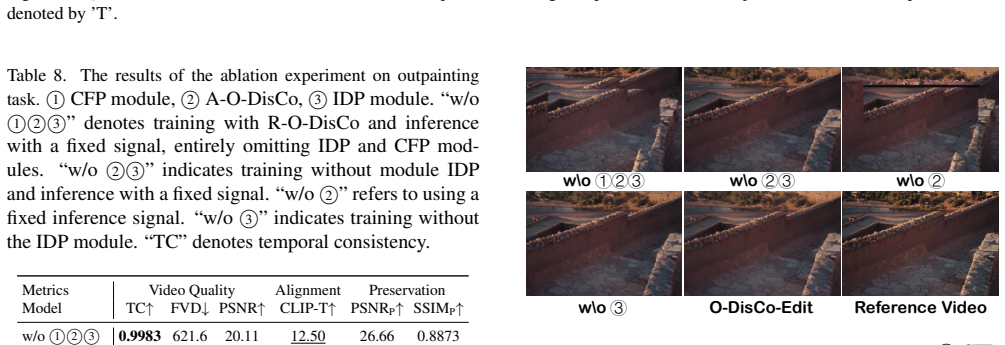
- [Appendix B.3, Tables 6-7] The user study is too small to support "comprehensive human evaluations" or the SOTA claim. Only 9 valid responses were collected, and no significance tests or confidence intervals are reported. Many MOS differences are around 0.1-0.3 on a 1-5 scale; for example, in Outpainting the EC scores are 4.289 (Ours) vs 4.244 (VACE 1.3B), a difference of 0.045 that is almost certainly within the noise floor for N=9. In Color Change, the user study actually favors Senorita (EC 4.033 vs 3.944). Without statistical support, the user-study results cannot be used to overrule the mixed automatic metrics.
- [Appendix A.2] The adaptive controller parameters α, σ, and k are set by quadratic functions f1, f2, f3 whose coefficients are described only as "empirically fitted" and chosen because they "yield superior results." The paper gives no fitting procedure, no held-out split, and no sensitivity analysis. Because these hand-fitted coefficients determine the A-O-DisCo used to produce every benchmark number in Table 3, the evaluation risks circularity: the coefficients may be tuned to the same private 134-clip benchmark on which the SOTA claim is made. Please provide a validation protocol (e.g., fitting on one split and reporting on a held-out split) or at least a sensitivity analysis over the coefficient ranges.
- [§4, Benchmarks; Appendix C] The benchmark is self-constructed, unreleased, and heavily processed: edited first frames were obtained with HiDream-E1 and commercial models, prompts were generated with Qwen2.5-VL-7B, and for Senorita a dedicated prompt was used. This makes the comparison difficult to reproduce externally. Appendix C itself acknowledges that comparisons with specialized models are performed only for object removal, ablations were run for only three tasks, and performance depends heavily on first-frame edit quality. These are exactly the points that need to be addressed to support the central SOTA claim.
- [Algorithm 2, Eq. (3)] There is an inconsistency between Eq. (3) and Algorithm 2. Eq. (3) applies Gaussian blur to Vc, the contrast-scaled frame, but Algorithm 2 line 30 appears to apply GaussianBlur to fref (the original frame) rather than fc. If the implementation follows Algorithm 2, the reported A-O-DisCo differs from the formulation in Eq. (3). Please clarify which is correct.
minor comments (4)
- [Tables 1, 3] Typos: "Mutil-Task" in Table 1, "User Stuty" in Table 3, "Diffueraser" vs "DiffuEraser" inconsistent, "propainter" should be "ProPainter", "Addtion" in Table 7, and "DA VIS" vs "DIV AS" inconsistent across the paper.
- [Figure 3] The label "(c)" is used for at least two different components (masks and condition DiT), which makes the figure hard to parse. Also, the legend for train/infer paths is not always visually distinct.
- [§4.1, Swap paragraph] The text says "Quantitative evaluation in Tab. 3 (f) shows O-DisCo-Edit’s performance is second to VACE," but then claims superior visual results based on the user study. Given the small N, this interpretation should be heavily qualified.
- [Appendix A.1] The random arithmetic operations in Eq. (1) are stated as addition, subtraction, multiplication, or division, but Algorithm 1 only implements multiplication/division by a scaling factor and addition/subtraction of an offset on other channels. Please align the description with the algorithm.
Circularity Check
No significant circularity; the SOTA claim is empirical and under-supported, but no derivation reduces to its inputs by construction.
full rationale
The paper's central claims are empirical: that O-DisCo-Edit outperforms baselines, that the O-DisCo signal unifies multiple editing cues, and that the training paradigm is resource-efficient. None of these is a derivation from first principles that could be equivalent to its inputs by construction. The adaptive controller parameters (α, σ, k) in Appendix A.2 are described as 'Empirically, fitting these three parameters using a quadratic polynomial of two similarity yields superior results.' This is hand-designed hyperparameter tuning, not a fit to the evaluation benchmark followed by a prediction of the same benchmark; the paper does not claim a held-out validation split, but that is a statistical limitation, not a circular reduction. The 'unification' claim is conceptual—Figure 2 argues other control signals can be viewed as distortions—but it is not a self-definitional equivalence between an input and an output. The evaluation weaknesses are real and are even acknowledged by the authors: Appendix C states 'we only compare it with a multi-task model in other tasks', 'we conducted ablation studies for only three tasks', and 'the performance of our model heavily depends on the quality of the first frame edit'; Appendix B.3 reports only '9 valid responses' for the user study. These undermine the strength of the SOTA claim but do not make the claim circular. There is one self-citation ([23], Follow-your-Canvas, which shares co-author Qi Tian), but it is used descriptively in Related Work for 2D bounding-box outpainting and is not load-bearing for any of the paper's contributions. No machine-checked or externally falsifiable derivation is invoked as a substitute for evidence, and no cited 'uniqueness theorem' is used to force the method choice. Therefore the correct finding is no significant circularity.
Axiom & Free-Parameter Ledger
free parameters (3)
- Adaptive distorter coefficients f1, f2, f3 =
f1=3000*Simi^2+6000*Simi+300; f2=4622.64*Simv^2+92453.28*Simv+4623.64; f3=-36*Simv^2+72*Simv-35
- Random distorter sampling ranges =
theta in [1.5,3.0]; delta in {-100,-50,50,100}; block size in {8,10,12,15,16,20,24}; mask dilation kernel in {1,3,...,21
- Normalized Average Score weighting =
Min-max normalized across methods; all metrics except CLIP-T weighted equally
axioms (4)
- ad hoc to paper All control signals (box, mask, flow, tracking) are specific types of reference-video distortion
- ad hoc to paper Random distortion of the edited region during training prevents copying and forces reliance on the first-frame appearance
- ad hoc to paper Edge-map SSIM between reference image and first frame (Simi) and intra-frame edge-map SSIM (Simv) are sufficient to set contrast, noise, and blur parameters
- domain assumption The frozen base model (Diffusion as Shader / CogVideoX-I2V) provides an adequate prior for all eight tasks
invented entities (1)
-
O-DisCo (object distortion control)
no independent evidence
Cite this review
Pith. "Pith review of O-DisCo-Edit: Object Distortion Control for Unified Realistic Video Editing." pith.science (2026). https://pith.science/paper/4BJOWFMF
@misc{pith2026250901596,
  author       = {Pith},
  title        = {Pith review of: O-DisCo-Edit: Object Distortion Control for Unified Realistic Video Editing},
  year         = {2026},
  howpublished = {\url{https://pith.science/paper/4BJOWFMF}},
  note         = {Machine review of arXiv:2509.01596}
}
read the original abstract
Diffusion models have recently advanced video editing, yet controllable editing remains challenging due to the need for precise manipulation of diverse object properties. Current methods require different control signal for diverse editing tasks, which complicates model design and demands significant training resources. To address this, we propose O-DisCo-Edit, a unified framework that incorporates a novel object distortion control (O-DisCo). This signal, based on random and adaptive noise, flexibly encapsulates a wide range of editing cues within a single representation. Paired with a "copy-form" preservation module for preserving non-edited regions, O-DisCo-Edit enables efficient, high-fidelity editing through an effective training paradigm. Extensive experiments and comprehensive human evaluations consistently demonstrate that O-DisCo-Edit surpasses both specialized and multitask state-of-the-art methods across various video editing tasks. https://cyqii.github.io/O-DisCo-Edit.github.io/
Figures




Forward citations
Cited by 3 Pith papers
-
AVI-Edit: Audio-sync Video Instance Editing with Granularity-Aware Mask Refiner
AVI-Edit enables precise audio-synchronized instance-level video editing via a granularity-aware mask refiner, a self-feedback audio agent, and a new large-scale annotated dataset.
-
Occlusion-Aware Physics-Semantic Keyframe Selection for Robust Video Editing
Occlusion-aware keyframe selection via structural, cycle-consistent tracking, and vision-language criteria improves diffusion video editing robustness without manual annotations.
-
Occlusion-Aware Physics-Semantic Keyframe Selection for Robust Video Editing
A new keyframe selection framework combines structural, tracking, and semantic criteria to select reliable anchor frames for diffusion-based video editing under occlusion.
Reference graph
Works this paper leans on
-
[1]
Cogvideox: Text-to-video diffusion models with an expert transformer
Zhuoyi Yang, Jiayan Teng, Wendi Zheng, Ming Ding, Shiyu Huang, Jiazheng Xu, Yuanming Yang, Wenyi Hong, Xiao- han Zhang, Guanyu Feng, et al. Cogvideox: Text-to-video diffusion models with an expert transformer. arXiv preprint arXiv:2408.06072, 2024. 1, 3
Pith/arXiv arXiv 2024
-
[2]
Wan: Open and advanced large-scale video generative models
Team Wan, Ang Wang, Baole Ai, Bin Wen, Chaojie Mao, Chen-Wei Xie, Di Chen, Feiwu Yu, Haiming Zhao, Jianx- iao Yang, et al. Wan: Open and advanced large-scale video generative models. arXiv preprint arXiv:2503.20314, 2025
Pith/arXiv arXiv 2025
-
[3]
Cogvideo: Large-scale pretraining for text-to-video generation via transformers
Wenyi Hong, Ming Ding, Wendi Zheng, Xinghan Liu, and Jie Tang. Cogvideo: Large-scale pretraining for text-to-video generation via transformers. arXiv preprint arXiv:2205.15868, 2022
Pith/arXiv arXiv 2022
-
[4]
Ltx-video: Realtime video latent diffusion
Yoav HaCohen, Nisan Chiprut, Benny Brazowski, Daniel Shalem, Dudu Moshe, Eitan Richardson, Eran Levin, Guy Shiran, Nir Zabari, Ori Gordon, et al. Ltx-video: Realtime video latent diffusion. arXiv preprint arXiv:2501.00103 ,
-
[5]
Videoanydoor: High-fidelity video ob- ject insertion with precise motion control
Yuanpeng Tu, Hao Luo, Xi Chen, Sihui Ji, Xiang Bai, and Hengshuang Zhao. Videoanydoor: High-fidelity video ob- ject insertion with precise motion control. arXiv preprint arXiv:2501.01427, 2025. 2, 3
Pith/arXiv arXiv 2025
-
[6]
Direct-a-video: Customized video generation with user- directed camera movement and object motion
Shiyuan Yang, Liang Hou, Haibin Huang, Chongyang Ma, Pengfei Wan, Di Zhang, Xiaodong Chen, and Jing Liao. Direct-a-video: Customized video generation with user- directed camera movement and object motion. In Proceed- ings of ACM SIGGRAPH 2024 Conference Papers, pages 1– 12, 2024
work page 2024
-
[7]
Magicmotion: Controllable video genera- tion with dense-to-sparse trajectory guidance
Quanhao Li, Zhen Xing, Rui Wang, Hui Zhang, Qi Dai, and Zuxuan Wu. Magicmotion: Controllable video genera- tion with dense-to-sparse trajectory guidance. arXiv preprint arXiv:2503.16421, 2025. 2
arXiv 2025
-
[8]
Dreaminsert: Zero-shot image-to-video object insertion from a single image
Qi Zhao, Zhan Ma, and Pan Zhou. Dreaminsert: Zero-shot image-to-video object insertion from a single image. arXiv preprint arXiv:2503.10342, 2025. 2
Pith/arXiv arXiv 2025
-
[9]
Through-the-mask: Mask-based motion trajec- tories for image-to-video generation
Guy Yariv, Yuval Kirstain, Amit Zohar, Shelly Sheynin, Yaniv Taigman, Yossi Adi, Sagie Benaim, and Adam Polyak. Through-the-mask: Mask-based motion trajec- tories for image-to-video generation. In Proceedings of the IEEE/CVF international conference on computer vision, pages 18198–18208, 2025. 2
work page 2025
-
[10]
Dragnuwa: Fine-grained control in video generation by integrating text
Shengming Yin, Chenfei Wu, Jian Liang, Jie Shi, Houqiang Li, Gong Ming, and Nan Duan. Dragnuwa: Fine-grained control in video generation by integrating text. Image, and Trajectory, 2023. 2
work page 2023
-
[11]
Consistent Video Editing as Flow-Driven Image-to-Video Generation
Ge Wang, Songlin Fan, Hangxu Liu, Quanjian Song, Hewei Wang, and Jinfeng Xu. Consistent video editing as flow-driven image-to-video generation. arXiv preprint arXiv:2506.07713, 2025
work page internal anchor Pith review Pith/arXiv arXiv 2025
-
[12]
Stablev2v: Stablizing shape consistency in video-to- video editing
Chang Liu, Rui Li, Kaidong Zhang, Yunwei Lan, and Dong Liu. Stablev2v: Stablizing shape consistency in video-to- video editing. arXiv preprint arXiv:2411.11045, 2024. 2
arXiv 2024
-
[13]
Diffusion as shader: 3d-aware video diffu- sion for versatile video generation control
Zekai Gu, Rui Yan, Jiahao Lu, Peng Li, Zhiyang Dou, Chenyang Si, Zhen Dong, Qifeng Liu, Cheng Lin, Ziwei Liu, et al. Diffusion as shader: 3d-aware video diffu- sion for versatile video generation control. arXiv preprint arXiv:2501.03847, 2025. 2, 3, 5
Pith/arXiv arXiv 2025
-
[14]
Xianguo Wu, Zongbao Feng, Sai Yang, Yawei Qin, Hongyu Chen, and Yang Liu. Safety risk perception and control of water inrush during tunnel excavation in karst areas: An im- proved uncertain information fusion method. Automation in Construction, page 105421, 2024
work page 2024
-
[15]
Levitor: 3d trajectory oriented image-to-video syn- thesis
Hanlin Wang, Hao Ouyang, Qiuyu Wang, Wen Wang, Ka Leong Cheng, Qifeng Chen, Yujun Shen, and Limin Wang. Levitor: 3d trajectory oriented image-to-video syn- thesis. In Proceedings of the IEEE/CVF international con- ference on computer vision, pages 12490–12500, 2025. 2
work page 2025
-
[16]
Omniv2v: Versatile video generation and edit- ing via dynamic content manipulation
Sen Liang, Zhentao Yu, Zhengguang Zhou, Teng Hu, Hong- mei Wang, Yi Chen, Qin Lin, Yuan Zhou, Xin Li, Qinglin Lu, et al. Omniv2v: Versatile video generation and edit- ing via dynamic content manipulation. arXiv preprint arXiv:2506.01801, 2025. 2, 3, 4, 12
Pith/arXiv arXiv 2025
-
[17]
Tokenmotion: Decoupled motion control via token disentanglement for human-centric video generation
Ruineng Li, Daitao Xing, Huiming Sun, Yuanzhou Ha, Jinglin Shen, and Chiuman Ho. Tokenmotion: Decoupled motion control via token disentanglement for human-centric video generation. In Proceedings of the IEEE/CVF inter- national conference on computer vision , pages 1951–1961, 2025
work page 1951
-
[18]
Enabling Versatile Controls for Video Diffusion Models
Xu Zhang, Hao Zhou, Haoming Qin, Xiaobin Lu, Jiaxing Yan, Guanzhong Wang, Zeyu Chen, and Yi Liu. Enabling versatile controls for video diffusion models. arXiv preprint arXiv:2503.16983, 2025
work page internal anchor Pith review Pith/arXiv arXiv 2025
-
[19]
Unic: Unified in-context video editing
Zixuan Ye, Xuanhua He, Quande Liu, Qiulin Wang, Xintao Wang, Pengfei Wan, Di Zhang, Kun Gai, Qifeng Chen, and Wenhan Luo. Unic: Unified in-context video editing. arXiv preprint arXiv:2506.04216, 2025. 3, 12
Pith/arXiv arXiv 2025
-
[20]
Vace: All-in-one video creation and editing
Zeyinzi Jiang, Zhen Han, Chaojie Mao, Jingfeng Zhang, Yulin Pan, and Yu Liu. Vace: All-in-one video creation and editing. arXiv preprint arXiv:2503.07598, 2025. 2, 3, 4, 5, 12, 13
Pith/arXiv arXiv 2025
-
[21]
Omnimat- terf: Robust omnimatte with 3d background modeling
Geng Lin, Chen Gao, Jia-Bin Huang, Changil Kim, Yipeng Wang, Matthias Zwicker, and Ayush Saraf. Omnimat- terf: Robust omnimatte with 3d background modeling. In Proceedings of the IEEE/CVF International Conference on Computer Vision, pages 23471–23480, 2023. 2, 5, 12
work page 2023
-
[22]
Minimax-remover: Taming bad noise helps video object removal.arXiv preprint arXiv:2505.24873, 2025
Bojia Zi, Weixuan Peng, Xianbiao Qi, Jianan Wang, Shihao Zhao, Rong Xiao, and Kam-Fai Wong. Minimax-remover: Taming bad noise helps video object removal.arXiv preprint arXiv:2505.24873, 2025. 2, 5
Pith/arXiv arXiv 2025
-
[23]
Qihua Chen, Yue Ma, Hongfa Wang, Junkun Yuan, Wenzhe Zhao, Qi Tian, Hongmei Wang, Shaobo Min, Qifeng Chen, and Wei Liu. Follow-your-canvas: Higher-resolution video outpainting with extensive content generation.arXiv preprint arXiv:2409.01055, 2024. 3
Pith/arXiv arXiv 2024
-
[24]
Recammaster: Camera-controlled generative rendering from a single video
Jianhong Bai, Menghan Xia, Xiao Fu, Xintao Wang, Lian- rui Mu, Jinwen Cao, Zuozhu Liu, Haoji Hu, Xiang Bai, Pengfei Wan, et al. Recammaster: Camera-controlled generative rendering from a single video. arXiv preprint arXiv:2503.11647, 2025. 3
Pith/arXiv arXiv 2025
-
[25]
Bojia Zi, Penghui Ruan, Marco Chen, Xianbiao Qi, Shaozhe Hao, Shihao Zhao, Youze Huang, Bin Liang, Rong Xiao, and Kam-Fai Wong. Se\˜ norita-2m: A high-quality instruction- based dataset for general video editing by video specialists. arXiv preprint arXiv:2502.06734, 2025. 3, 5, 13
Pith/arXiv arXiv 2025
-
[26]
Lmp: Leveraging motion prior in zero-shot video generation with diffusion transformer
Changgu Chen, Xiaoyan Yang, Junwei Shu, Changbo Wang, and Yang Li. Lmp: Leveraging motion prior in zero-shot video generation with diffusion transformer. arXiv preprint arXiv:2505.14167, 2025. 3
Pith/arXiv arXiv 2025
-
[27]
Xinyu Zhang, Zicheng Duan, Dong Gong, and Lingqiao Liu. Training-free motion-guided video generation with en- hanced temporal consistency using motion consistency loss. arXiv preprint arXiv:2501.07563, 2025. 3
Pith/arXiv arXiv 2025
-
[28]
Videopainter: Any- length video inpainting and editing with plug-and-play con- text control
Yuxuan Bian, Zhaoyang Zhang, Xuan Ju, Mingdeng Cao, Liangbin Xie, Ying Shan, and Qiang Xu. Videopainter: Any- length video inpainting and editing with plug-and-play con- text control. arXiv preprint arXiv:2503.05639, 2025. 4, 5, 12, 13
Pith/arXiv arXiv 2025
-
[29]
Jinze Bai, Shuai Bai, Yunfei Chu, Zeyu Cui, Kai Dang, Xiaodong Deng, Yang Fan, Wenbin Ge, Yu Han, Fei Huang, et al. Qwen technical report. arXiv preprint arXiv:2309.16609, 2023. 5, 12
Pith/arXiv arXiv 2023
-
[30]
Dif- fueraser: A diffusion model for video inpainting
Xiaowen Li, Haolan Xue, Peiran Ren, and Liefeng Bo. Dif- fueraser: A diffusion model for video inpainting. arXiv preprint arXiv:2501.10018, 2025. 5
Pith/arXiv arXiv 2025
-
[31]
Propainter: Improving propagation and transformer for video inpainting
Shangchen Zhou, Chongyi Li, Kelvin CK Chan, and Chen Change Loy. Propainter: Improving propagation and transformer for video inpainting. In Proceedings of the IEEE/CVF international conference on computer vision, pages 10477–10486, 2023. 5
work page 2023
-
[32]
The 2017 davis challenge on video object segmentation.arXiv preprint arXiv:1704.00675, 2017
Jordi Pont-Tuset, Federico Perazzi, Sergi Caelles, Pablo Ar- bel´aez, Alex Sorkine-Hornung, and Luc Van Gool. The 2017 davis challenge on video object segmentation.arXiv preprint arXiv:1704.00675, 2017. 5, 12, 15
Pith/arXiv arXiv 2017
-
[33]
Hidream-i1: A high-efficient image gen- erative foundation model with sparse diffusion transformer
Qi Cai, Jingwen Chen, Yang Chen, Yehao Li, Fuchen Long, Yingwei Pan, Zhaofan Qiu, Yiheng Zhang, Fengbin Gao, Peihan Xu, et al. Hidream-i1: A high-efficient image gen- erative foundation model with sparse diffusion transformer. arXiv preprint arXiv:2505.22705, 2025. 5, 12
Pith/arXiv arXiv 2025
-
[34]
Godiva: Gen- erating open-domain videos from natural descriptions
Chenfei Wu, Lun Huang, Qianxi Zhang, Binyang Li, Lei Ji, Fan Yang, Guillermo Sapiro, and Nan Duan. Godiva: Gen- erating open-domain videos from natural descriptions. arXiv preprint arXiv:2104.14806, 2021. 5
Pith/arXiv arXiv 2021
-
[35]
Flexiact: Towards flexible ac- tion control in heterogeneous scenarios
Shiyi Zhang, Junhao Zhuang, Zhaoyang Zhang, Ying Shan, and Yansong Tang. Flexiact: Towards flexible ac- tion control in heterogeneous scenarios. arXiv preprint arXiv:2505.03730, 2025. 5
Pith/arXiv arXiv 2025
-
[36]
To- wards accurate generative models of video: A new metric & challenges
Thomas Unterthiner, Sjoerd Van Steenkiste, Karol Kurach, Raphael Marinier, Marcin Michalski, and Sylvain Gelly. To- wards accurate generative models of video: A new metric & challenges. arXiv preprint arXiv:1812.01717, 2018. 5
Pith/arXiv arXiv 2018
-
[37]
Artfid: Quantitative evaluation of neural style transfer
Matthias Wright and Bj ¨orn Ommer. Artfid: Quantitative evaluation of neural style transfer. In Proceedings of DAGM German Conference on Pattern Recognition, pages 560–576. Springer, 2022. 5, 12
work page 2022
-
[38]
Control-a-video: Controllable text-to-video generation with diffusion models
Weifeng Chen, Jie Wu, Pan Xie, Hefeng Wu, Jiashi Li, Xin Xia, Xuefeng Xiao, and Liang Lin. Control-a-video: Controllable text-to-video generation with diffusion models. CoRR, 2023. 5
work page 2023
-
[39]
Vbench: Comprehensive bench- mark suite for video generative models
Ziqi Huang, Yinan He, Jiashuo Yu, Fan Zhang, Chenyang Si, Yuming Jiang, Yuanhan Zhang, Tianxing Wu, Qingyang Jin, Nattapol Chanpaisit, et al. Vbench: Comprehensive bench- mark suite for video generative models. In Proceedings of the IEEE/CVF Conference on Computer Vision and Pattern Recognition, pages 21807–21818, 2024. 5
work page 2024
-
[40]
Jiwoo Chung, Sangeek Hyun, and Jae-Pil Heo. Style injec- tion in diffusion: A training-free approach for adapting large- scale diffusion models for style transfer. In Proceedings of the IEEE/CVF conference on computer vision and pattern recognition, pages 8795–8805, 2024. 5, 13
work page 2024
-
[41]
Shaoteng Liu, Tianyu Wang, Jui-Hsien Wang, Qing Liu, Zhifei Zhang, Joon-Young Lee, Yijun Li, Bei Yu, Zhe Lin, Soo Ye Kim, et al. Generative video propagation. In Pro- ceedings of the Computer Vision and Pattern Recognition Conference, pages 17712–17722, 2025. 12
work page 2025
-
[42]
The unreasonable effectiveness of deep features as a perceptual metric
Richard Zhang, Phillip Isola, Alexei A Efros, Eli Shecht- man, and Oliver Wang. The unreasonable effectiveness of deep features as a perceptual metric. In Proceedings of the IEEE conference on computer vision and pattern recogni- tion, pages 586–595, 2018. 13
work page 2018
-
[43]
Gans trained by a two time-scale update rule converge to a local nash equilib- rium
Martin Heusel, Hubert Ramsauer, Thomas Unterthiner, Bernhard Nessler, and Sepp Hochreiter. Gans trained by a two time-scale update rule converge to a local nash equilib- rium. Advances in neural information processing systems , 30, 2017. 13
work page 2017
-
[44]
Imgedit: A uni- fied image editing dataset and benchmark
Yang Ye, Xianyi He, Zongjian Li, Bin Lin, Shenghai Yuan, Zhiyuan Yan, Bohan Hou, and Li Yuan. Imgedit: A uni- fied image editing dataset and benchmark. arXiv preprint arXiv:2505.20275, 2025. 13
Pith/arXiv arXiv 2025
-
[45]
Xiang Wang, Hangjie Yuan, Shiwei Zhang, Dayou Chen, Ji- uniu Wang, Yingya Zhang, Yujun Shen, Deli Zhao, and Jin- gren Zhou. Videocomposer: Compositional video synthesis with motion controllability. Advances in Neural Information Processing Systems, pages 7594–7611, 2023. 15 Appendix A. More Details about Methodology A.1. Random Object Distortion Control D...
work page 2023
This paper was first reviewed by deepseek-v4-flash on August 5, 2026.
discussion (0)
Sign in with ORCID, Apple, or X to comment. Anyone can read and Pith papers without signing in.