REVIEW 2 major objections 5 minor 45 references
Privacy-Aware Detection of Fake Identity Documents: Methodology, Benchmark, and Improved Algorithms (FakeIDet2)
T0 review · 2 major / 5 minor · reviewed 2026-08-05 · deepseek-v4-flash
Pith's one-line read Fake IDs can be detected from anonymous ID patches, not whole documents
desk verdict A real public database and benchmark for fake-ID detection, but the cross-database numbers partly measure 'non-Spanish rejection'; the data contribution is solid enough to warrant peer review. read the letter →
The pith
A machine-rendered reading of the paper's core claim, the machinery that carries it, and where it could break.
The reading
What carries the argument
The method FakeIDet2 comprises three modules: a Privacy-Aware Patch Extractor that divides an ID into non-overlapping 64x64 or 128x128 patches with optional anonymization; a Patch Embedding Extractor built on a frozen DINOv2 backbone plus an AdaFace margin loss with dynamic class weights that decay from inverse-frequency weights to uniform weights over training; and a Patch Embedding Fusion module using two stacked Multi-Head Self-Attention layers with residual connections followed by attention pooling to fuse patch embeddings into a single document-level score. The dynamic class weights address the severe imbalance of composite-attack patches, and the fusion module is the key mechanism for
What would settle it
Take the public FakeIDet2 checkpoint and evaluate it with a bona fide set of official IDs from a different country and a different capture device set than the iPhone, Xiaomi, and Redmi used here; if EER degrades substantially relative to the 8.90% and 13.84% cross-database numbers while attack data are held fixed, the claimed generalization tied to the privacy-aware patch training is not portable across real-ID distributions. A simpler check: compute the per-subject EER spread over the 47 Spanish IDs; if a few IDs drive the low EER, the small bona fide subset is not representative.
Extended reading notes
Core claim
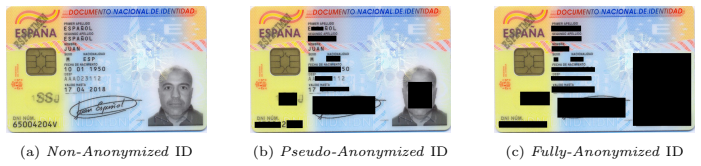
The central claim is that fake ID detection can be performed from small, anonymized image patches instead of complete ID scans, preserving privacy while remaining competitive with, and often better than, whole-ID training. The paper demonstrates that 64x64 patches drawn from pseudo-anonymized IDs retain enough discriminative information to detect unseen physical attacks, and that a learnable patch-embedding fusion based on multi-head self-attention handles composite attacks (where only part of the document is fake) much better than simple score averaging, reducing composite-attack EER from 54.08% to 2.09% on the paper's own evaluation set. On the cross-database benchmark, the privacy-aware c
Load-bearing premise
The out-of-distribution results depend on the assumption that the 50 official Spanish IDs in the FakeIDet2-db evaluation split represent the distribution of real IDs a deployed system will encounter, in terms of templates, devices, users, and capture conditions.
Editorial extensions
If this is right
- If valid, ID holders such as governments, banks, and police can contribute official real-ID data to train detectors without disclosing full documents, since only shuffled, partially anonymized patches are shared.
- Remote identity-verification systems could deploy detectors trained on pseudo-anonymized patches, with only a modest performance drop (3.99% to 8.64% EER in the authors' intra-database comparison).
- The released benchmark allows direct comparison of future fake-ID detectors against a standard protocol spanning physical and synthetic attacks across European, Asian, and South American ID templates.
- Prior 'real' datasets that were actually laboratory-printed cards may have inflated apparent performance; the paper's cross-database protocol quantifies generalization to official IDs and unseen attacks.
Reading between the lines
- The reported cross-database numbers may underestimate or overestimate deployment performance depending on how representative the 50 official Spanish IDs used as bona fide are of the target population of real IDs; the paper does not measure that generalization gap directly.
- Because synthetic attacks (Benalcazar et al.) yield 39.41% EER, a plausible extension is to train or adapt the patch-level extractor on synthetic-to-physical style transfers, or to add a separate synthetic-attack detector, rather than treating physical and synthetic fakes as one class.
- The attention-pooling fusion could plausibly be used for tamper localization: the per-patch attention weights already single out anomalous regions, so a lightly modified version of FakeIDet2 might output a localization map as a by-product, which the paper leaves as future work.
Editorial analysis
A structured set of objections, weighed in public.
Referee Report
Summary. The paper proposes a patch-based, privacy-aware methodology for fake ID detection, presents a new public database (FakeIDet2-db) of official Spanish ID images and patches with physical attacks (print, screen, composite), introduces a detection method (FakeIDet2) based on DINOv2 embeddings and a learned attention-fusion module, and reports results on internal and cross-database benchmarks. The headline claims are: 2.01% EER on the internal non-anonymized evaluation set (Table 5), 8.64% EER for the pseudo-anonymized configuration (Table 6), and 8.90%/13.84% EER on DLC-2021/KID34K in the cross-database evaluation (Table 9). The paper also releases a reproducible benchmark and the database, which are positioned as community resources for advancing ID presentation-attack detection.
Significance. If the results hold, this is a valuable contribution to the ID-PAD field. The release of a public database with official real IDs and physical composite attacks is a genuine novelty, and the reproducible benchmark addresses a recognized gap in the literature. The internal experiments (Tables 4–6) convincingly demonstrate the benefit of patch-level training over whole-ID fine-tuning and show that the proposed dynamic-class-weight scheme improves handling of the heavily imbalanced composite-attack class. The authors are also transparent about the poor synthetic-detection result (39.41% EER on Benalcazar). However, the cross-database generalization claim is weakened by a protocol confound, and the privacy-aware claim is asserted rather than measured; both points need attention before the central conclusions can be accepted.
major comments (2)
- [Sec. 6.6, Table 9] The cross-database EERs are computed with the FakeIDet2-db evaluation split as the only bona fide class (a small set of official Spanish IDs, acquired with the same three devices and lighting/height protocol used in training) and every sample from DLC-2021, KID34K, and Benalcazar treated as an attack. Because the model is trained exclusively on Spanish ID patches, a low EER on KID34K (Korean) and Benalcazar (Chilean) can be achieved by rejecting non-Spanish document statistics without detecting fakeness. The abstract's claim that the method 'detects very realistic fake IDs under unseen type of attacks' is therefore not established by these numbers. Please add a control with genuine non-Spanish bona fide IDs (e.g., the 'real' samples from KID34K, despite being lab-created) and/or explicitly reframe the result as a domain-shift evaluation relative to a Spanish-ID reference, stating this co
- [Sec. 3.3, Sec. 4, Sec. 7] The paper's central motivation is privacy: individual patches are claimed to contain 'much less sensitive information than the whole ID' and the framework is described as 'privacy compliant (GDPR, EU Data Act)'. However, no privacy property is defined or measured. There is no reconstruction-resistance test, membership-inference evaluation, or information-theoretic quantification, and the residual leakage of the pseudo-anonymization (black rectangles) is not analyzed. Because 'privacy-aware' is in the title and is a claimed contribution, this gap is load-bearing. Please either add a small empirical privacy evaluation (e.g., attempt to reconstruct the ID from patches, measure OCR leakage, or run a membership test) or explicitly scope the contribution as 'designed to reduce exposure', acknowledging that quantitative privacy guarantees are not provided.
minor comments (5)
- [Eq. (12)] The APCER equation appears to have a typo: the denominator and summation index use NBF, the number of bona fide samples, which is inconsistent with the definition of APCER over attack presentations. Please correct to use the number of attack presentations.
- [Table 3] The composite-attack patch counts are ~15x lower than the other classes (e.g., 3,810 vs 56,017 in the 128x128 Non-Anon row). Please explain the cause (e.g., the 80% black-patch filtering) and discuss how this extreme imbalance interacts with the dynamic class-weight design.
- [Tables 4–9] All EERs are point estimates with no confidence intervals or repeated trials. This is especially important for the cross-database results, where the bona fide set is very small. Please add intervals, bootstrap estimates, or at least a discussion of variance.
- [Sec. 2.1 vs Sec. 6.6] Sec. 2.1 describes DLC-2021 as built from the MIDV-family documents, but Sec. 6.6 states that 'DLC-2021 contains Spanish IDs'. Please clarify the template countries/versions in DLC-2021 and how this affects the interpretation of the cross-database protocol.
- [Sec. 5.1] The AdaFace margin m=0.4 and scaling factor s=64 are described as 'the optimal experimental values' without an ablation or citation justifying them for this protocol. Please provide supporting experiments or a reference for these choices.
Circularity Check
No significant circularity: the method and benchmark are self-contained, and the cross-database results are genuine out-of-distribution evaluations.
full rationale
The claimed derivation chain is not circular. FakeIDet2's components—patch extraction, DINOv2 encoder, AdaFace loss with the fully specified dynamic-weight update rules in Eqs. 5–7, and MHSA/attention-pooling fusion—are trained on a disjoint development split of FakeIDet2-db, and the reported 2.01% EER (Table 5) is an evaluation on a held-out 20% identity split, not a fitted quantity recycled as a prediction. The headline cross-database results (Table 9) come from a model trained only on FakeIDet2-db and applied without tuning to DLC-2021, KID34K, and Benalcazar et al.; those databases are external and are not used for model selection, so the EERs are genuine out-of-distribution measurements. Self-citations do appear—e.g., [14] for dynamic-weight trends and [25] as the prior FakeIDet baseline—but none is load-bearing in a way that reduces a result to its own input. The dynamic-weight mechanism is derived and explained in the paper itself, and the comparison to FakeIDet is a baseline, not the source of the central claims. The cross-database protocol indeed uses only FakeIDet2-db evaluation IDs as bona fide and treats all DLC/KID/Benalcazar samples as attacks; that is a real validity limitation concerning whether the task reduces to rejecting non-Spanish templates, but it is a protocol/dataset-design concern, not circularity, because external attack labels are never used during training and no external result is defined into the model.
Assumptions & free parameters
free parameters (4)
- AdaFace margin m =
0.4
- Scaling factor s =
64
- Weight decay schedule lambda0/lambda_e =
1 / 0
- Patch sampling probability p =
0.9
assumptions (5)
- domain assumption Individual ID patches contain much less sensitive information than the whole ID
- domain assumption Placing printed cutouts from a print attack onto the real ID faithfully simulates real physical composite attacks
- domain assumption All samples in DLC-2021, KID34K, and Benalcazar databases can be treated as attacks
- domain assumption Frozen DINOv2 features generalize across ID templates and countries
- standard math Softmax-based margin losses with class weighting produce separable patch embeddings
Cite this review
Pith. "Pith review of Privacy-Aware Detection of Fake Identity Documents: Methodology, Benchmark, and Improved Algorithms (FakeIDet2)." pith.science (2026). https://pith.science/paper/4BX4VY24
@misc{pith2026250811716,
  author       = {Pith},
  title        = {Pith review of: Privacy-Aware Detection of Fake Identity Documents: Methodology, Benchmark, and Improved Algorithms (FakeIDet2)},
  year         = {2026},
  howpublished = {\url{https://pith.science/paper/4BX4VY24}},
  note         = {Machine review of arXiv:2508.11716}
}
read the original abstract
Remote user verification in Internet-based applications is becoming increasingly important nowadays. A popular scenario for it consists of submitting a picture of the user's Identity Document (ID) to a service platform, authenticating its veracity, and then granting access to the requested digital service. An ID is well-suited to verify the identity of an individual, since it is government issued, unique, and nontransferable. However, with recent advances in Artificial Intelligence (AI), attackers can surpass security measures in IDs and create very realistic physical and synthetic fake IDs. Researchers are now trying to develop methods to detect an ever-growing number of these AI-based fakes that are almost indistinguishable from authentic (bona fide) IDs. In this counterattack effort, researchers are faced with an important challenge: the difficulty in using real data to train fake ID detectors. This real data scarcity for research and development is originated by the sensitive nature of these documents, which are usually kept private by the ID owners (the users) and the ID Holders (e.g., government, police, bank, etc.). The main contributions of our study are: 1) We propose and discuss a patch-based methodology to preserve privacy in fake ID detection research. 2) We provide a new public database, FakeIDet2-db, comprising over 900K real/fake ID patches extracted from 2,000 ID images, acquired using different smartphone sensors, illumination and height conditions, etc. In addition, three physical attacks are considered: print, screen, and composite. 3) We present a new privacy-aware fake ID detection method, FakeIDet2. 4) We release a standard reproducible benchmark that considers physical and synthetic attacks from popular databases in the literature.
Figures


Figures from the paper (4 more)


Reference graph
Works this paper leans on
-
[1]
Arlazarov, V.V., Bulatov, K., Chernov, T., Arlazarov, V.L., 2019. MIDV- 500: A Dataset for Identity Document Analysis and Recognition on Mobile Devices in Video Stream. Computer Optics 43
work page 2019
-
[2]
Aslett, K., Sanderson, Z., Godel, W., Persily, N., Nagler, J., Tucker, J.A.,
-
[3]
Ba, J.L., Kiros, J.R., Hinton, G.E., 2016. Layer Normalization. arXiv preprint arXiv:1607.06450 URL: https://arxiv.org/abs/1607.06450, arXiv:1607.06450
arXiv 2016
-
[4]
Neural Machine Translation by Jointly Learning to Align and Translate
Bahdanau, D., Cho, K., Bengio, Y., 2016. Neural Machine Translation by Jointly Learning to Align and Translate. URL: https://arxiv.org/abs/ 1409.0473, arXiv:1409.0473
arXiv 2016
-
[5]
Synthetic ID Card Image Generation for Improving Presentation Attack Detection
Benalcazar, D., Tapia, J.E., Gonzalez, S., Busch, C., 2023. Synthetic ID Card Image Generation for Improving Presentation Attack Detection. IEEE Transactions on Information Forensics and Security 18, 1814–1824
work page 2023
-
[6]
MIDV-2020: A Com- prehensive Benchmark Dataset for Identity Document Analysis
Bulatov, K., Emelianova, E., Tropin, D., et al., 2022. MIDV-2020: A Com- prehensive Benchmark Dataset for Identity Document Analysis. Computer Optics 46. 10https://deepid-iccv.github.io/ 29
work page 2022
-
[7]
Bulatov, K., Matalov, D., Arlazarov, V.V., 2020. MIDV-2019: Challenges of the Modern Mobile-Based Document OCR, in: Proceedings of the In- ternational Conference on Machine Vision, pp. 818–824
work page 2020
-
[8]
IRL-Net: Inpainted region localization network via spatial attention
Daryani, A.E., Mirmahdi, M., Hassanpour, A., Shahreza, H.O., Yang, B., Fierrez, J., 2023. IRL-Net: Inpainted region localization network via spatial attention. IEEE Access 11, 115677–115687
work page 2023
Show all 45 references
-
[9]
Active membership inference test (aMINT): Enhancing model auditability with multi-task learning, in: IEEE/CVF International Conference on Computer Vision
DeAlcala, D., Morales, A., Fierrez, J., Mancera, G., Tolosana, R., Ortega- Garcia, J., 2025a. Active membership inference test (aMINT): Enhancing model auditability with multi-task learning, in: IEEE/CVF International Conference on Computer Vision
-
[10]
AttZoom: Attention zoom for better visual features, in: Proceedings IEEE/CVF Intl
DeAlcala, D., Morales, A., Fierrez, J., Tolosana, R., 2025b. AttZoom: Attention zoom for better visual features, in: Proceedings IEEE/CVF Intl. Conf. on Computer Vision Workshops. URL: https://arxiv.org/abs/ 2508.03625
-
[11]
ArcFace: Additive Angular Margin Loss for Deep Face Recognition, in: Proceedings of the IEEE/CVF Conference on Computer Vision and Pattern Recognition, pp
Deng, J., Guo, J., Xue, N., Zafeiriou, S., 2019. ArcFace: Additive Angular Margin Loss for Deep Face Recognition, in: Proceedings of the IEEE/CVF Conference on Computer Vision and Pattern Recognition, pp. 4690–4699
2019
-
[12]
Fang, M., Huber, M., Fierrez, J., et al., 2023. SynFacePAD 2023: Com- petition on Face Presentation Attack Detection Based on Privacy-aware Synthetic Training Data, in: Proceedings IEEE/IAPR International Joint Conference on Biometrics, pp. 1–11
2023
-
[13]
Privacy Backdoors: Stealing Data with Cor- rupted Pretrained Models, in: Proceedings of the 41st International Con- ference on Machine Learning, pp
Feng, S., Tram` er, F., 2024. Privacy Backdoors: Stealing Data with Cor- rupted Pretrained Models, in: Proceedings of the 41st International Con- ference on Machine Learning, pp. 13326–13364
2024
-
[14]
Multiple classifiers in biometrics
Fierrez, J., Morales, A., Vera-Rodriguez, R., Camacho, D., 2018. Multiple classifiers in biometrics. Part 2: Trends and challenges. Information Fusion 44, 103–112
2018
-
[15]
Forged Presentation Attack Detection for ID Cards on Remote Verification Systems
Gonzalez, S., Tapia, J.E., 2025. Forged Presentation Attack Detection for ID Cards on Remote Verification Systems. Pattern Recognition 162, 111352
2025
-
[16]
Intro- duction to Presentation Attack Detection in Face Biometrics and Recent Advances, in: S
Hernandez-Ortega, J., Fierrez, J., Morales, A., Galbally, J., 2023. Intro- duction to Presentation Attack Detection in Face Biometrics and Recent Advances, in: S. Marcel, J. Fierrez, N.E. (Ed.), Handbook of Biometric Anti-Spoofing, Springer. pp. 203–230. 3rd Ed
2023
-
[17]
AdaFace: Quality adaptive margin for face recognition, in: Proceedings of the IEEE/CVF Conference on Com- puter Vision and Pattern Recognition, pp
Kim, M., Jain, A.K., Liu, X., 2022. AdaFace: Quality adaptive margin for face recognition, in: Proceedings of the IEEE/CVF Conference on Com- puter Vision and Pattern Recognition, pp. 18750–18759
2022
-
[18]
Robust Domain Mis- information Detection via Multi-Modal Feature Alignment
Liu, H., Wang, W., Sun, H., Rocha, A., Li, H., 2024. Robust Domain Mis- information Detection via Multi-Modal Feature Alignment. IEEE Trans- actions on Information Forensics and Security 19, 793–806. 30
2024
-
[19]
Benchmarking graph neural networks for document layout analysis in public affairs, in: Proc
Lopez-Duran, M., Fierrez, J., Morales, A., et al., 2025. Benchmarking graph neural networks for document layout analysis in public affairs, in: Proc. Intl. Conf. on Document and Analysis Workshops (ICDARw). URL: https://arxiv.org/abs/2505.14699
2025 arXiv
-
[20]
Open-Set: ID Card Presentation Attack Detection Using Neural Style Transfer
Markham, R.P., L´ opez, J.M.E., Nieto-Hidalgo, M., Tapia, J.E., 2024. Open-Set: ID Card Presentation Attack Detection Using Neural Style Transfer. IEEE Access 12, 68573–68585
2024
-
[21]
Melzi, P., Rathgeb, C., Tolosana, R., Vera-Rodriguez, R., Lawatsch, D., Domin, F., Schaubert, M., 2023. GANDiffFace: Controllable Generation of Synthetic Datasets for Face Recognition with Realistic Variations, in: Proceedings of the IEEE/CVF International Conference on Comput...
2023
-
[22]
FRCSyn-onGoing: Benchmarking and Comprehensive Evaluation of Real and Synthetic Data to Improve Face Recognition Systems
Melzi, P., Tolosana, R., Vera-Rodriguez, R., Kim, M., Rathgeb, C., Liu, X., DeAndres-Tame, I., Morales, A., Fierrez, J., Ortega-Garcia, J., et al., 2024. FRCSyn-onGoing: Benchmarking and Comprehensive Evaluation of Real and Synthetic Data to Improve Face Recognition Systems. I...
2024
-
[23]
SetMargin Loss applied to deep keystroke biometrics with circle packing interpretation
Morales, A., Fierrez, J., Acien, A., Tolosana, R., Serna, I., 2022. SetMargin Loss applied to deep keystroke biometrics with circle packing interpretation. Pattern Recognition 122, 108283
2022
-
[24]
Mudgalgundurao, R., Schuch, P., Raja, K., Ramachandra, R., Damer, N.,
-
[25]
FakeIDet: Exploring Patches for Privacy-Preserving Fake ID Detection, in: Proceedings IEEE/IAPR International Joint Conference on Biometrics
Mu˜ noz-Haro, J., Tolosana, R., Vera-Rodriguez, R., Morales, A., Fierrez, J., 2025. FakeIDet: Exploring Patches for Privacy-Preserving Fake ID Detection, in: Proceedings IEEE/IAPR International Joint Conference on Biometrics. URL: https://arxiv.org/abs/2504.07761
2025 arXiv
-
[26]
GANprintR: Improved fakes and evaluation of the state of the art in face manipulation detection
Neves, J.C., Tolosana, R., Vera-Rodriguez, R., Lopes, V., Proenca, H., Fierrez, J., 2020. GANprintR: Improved fakes and evaluation of the state of the art in face manipulation detection. IEEE Journal of Selected Topics in Signal Processing 14, 1038–1048
2020
-
[27]
DINOv2: Learning Robust Visual Features Without Supervision
Oquab, M., Darcet, T., Moutakanni, T., Vo, H.V., Szafraniec, M., Khali- dov, V., Fernandez, P., HAZIZA, D., Massa, F., El-Nouby, A., Assran, M., Ballas, N., Galuba, W., Howes, R., Huang, P.Y., Li, S.W., Misra, I., Rabbat, M., Sharma, V., Synnaeve, G., Xu, H., Jegou, H., Mairal...
2024
-
[28]
KID34K: A Dataset for Online Identity Card Fraud Detection, in: Proc
Park, E.J., Back, S.Y., Kim, J., Woo, S.S., 2023. KID34K: A Dataset for Online Identity Card Fraud Detection, in: Proc. of the 32nd ACM Intl. Conf. on Information and Knowledge Management, pp. 5381–5385
2023
-
[29]
Pe˜ na, A., Fierrez, J., Morales, A., Mancera, G., Lopez, M., Tolosana, R.,
-
[30]
Document Live- ness Challenge Dataset (DLC-2021)
Polevoy, D.V., Sigareva, I.V., Ershova, D.M., et al., 2022. Document Live- ness Challenge Dataset (DLC-2021). Journal of Imaging 8
2022
-
[31]
Schlett, T., Rathgeb, C., Henniger, O., Galbally, J., Fierrez, J., Busch, C.,
-
[32]
Shahreza, H.O., Ecabert, C., George, A., Unnervik, A., Marcel, S., et al.,
-
[33]
BID Dataset: a Challenge Dataset for Document Processing Tasks, in: Anais Estendidos da Conference on Graphics, Patterns and Images, pp
Soares, A., Batista, R., Leite, B., 2020. BID Dataset: a Challenge Dataset for Document Processing Tasks, in: Anais Estendidos da Conference on Graphics, Patterns and Images, pp. 143–146
2020
-
[34]
First Competition on Presentation Attack Detection on ID Card, in: Proceedings of the IEEE International Joint Conference on Biometrics, pp
Tapia, J.E., Damer, N., Busch, C., et al., 2024. First Competition on Presentation Attack Detection on ID Card, in: Proceedings of the IEEE International Joint Conference on Biometrics, pp. 1–10
2024
-
[35]
ACM Computing Surveys 10, 1–49
Face image quality assessment: A literature survey. ACM Computing Surveys 10, 1–49
-
[36]
Handbook of Digital Face Manipulation and Detection
Tolosana, R., Vera-Rodriguez, R., Fierrez, J., Morales, A., Ortega-Garcia, J., 2022b. Handbook of Digital Face Manipulation and Detection. Springer. chapter An Introduction to Digital Face Manipulation. pp. 3–26
-
[37]
SDFR: Synthetic Data for Face Recognition Competition, in: Pro- ceedings 18th International Conference on Automatic Face and Gesture Recognition, pp. 1–9
-
[38]
CosFace: Large margin cosine loss for deep face recognition, in: Proceedings of the IEEE/CVF Conference on Computer Vision and Pattern Recognition, pp
Wang, H., Wang, Y., Zhou, Z., Ji, X., Gong, D., Zhou, J., Li, Z., Liu, W., 2018. CosFace: Large margin cosine loss for deep face recognition, in: Proceedings of the IEEE/CVF Conference on Computer Vision and Pattern Recognition, pp. 5265–5274
2018
-
[39]
IDNet: A Novel Identity Document Dataset via Few-Shot and Quality-Driven Synthetic Data Generation, in: Proceedings of the IEEE International Conference on Big Data, pp
Xie, L., Wang, Y., Guan, H., Nag, S., Goel, R., Swamy, N., Yang, Y., Xiao, C., Prisby, J., Maciejewski, R., Zou, J., 2024. IDNet: A Novel Identity Document Dataset via Few-Shot and Quality-Driven Synthetic Data Generation, in: Proceedings of the IEEE International Conference o...
2024
-
[40]
Deepfakes detection across generations: Analysis of facial regions, fusion, and performance evaluation
Tolosana, R., Romero-Tapiador, S., Vera-Rodriguez, R., Gonzalez-Sosa, E., Fierrez, J., 2022a. Deepfakes detection across generations: Analysis of facial regions, fusion, and performance evaluation. Engineering Applications of Artificial Intelligence 110, 104673
-
[42]
Media Forensics and DeepFakes: An Overview
Verdoliva, L., 2020. Media Forensics and DeepFakes: An Overview. IEEE Journal of Selected Topics in Signal Processing 14, 910–932
2020
-
[45]
The Secret Revealer: Generative Model-Inversion Attacks Against Deep Neural Net- works, in: Proceedings of the IEEE/CVF Conference on Computer Vision and Pattern Recognition, pp
Zhang, Y., Jia, R., Pei, H., Wang, W., Li, B., Song, D., 2020. The Secret Revealer: Generative Model-Inversion Attacks Against Deep Neural Net- works, in: Proceedings of the IEEE/CVF Conference on Computer Vision and Pattern Recognition, pp. 250–258. 32
2020
-
[2022]
IET Biometrics 11, 383–395
Pixel-Wise Supervision for Presentation Attack Detection on Identity Document Cards. IET Biometrics 11, 383–395
-
[2024]
Nature 625, 548–556
Online Searches to Evaluate Misinformation Can Increase Its Per- ceived Veracity. Nature 625, 548–556
-
[2025]
URL: https://arxiv.org/abs/2506.11880
Addressing Bias in LLMs: Strategies and Application to Fair AI- based Recruitment, in: Proceedings AAAI/ACM Conference on AI, Ethics, and Society. URL: https://arxiv.org/abs/2506.11880. 31
Reviewed August 5, 2026 · model on record in the stance chip above.
Discussion (0). Sign in to comment.