REVIEW 3 major objections 5 minor 3 cited by
Emergence of higher-order interactions in systems of coupled Kuramoto oscillators with time delay
T0 review · 3 major / 5 minor · reviewed 2026-08-03 · deepseek-v4-flash
Pith's one-line read Delayed pairwise coupling in Kuramoto oscillators is equivalent to three-body coupling to second order, and the three-body term explains delay-induced bistability.
desk verdict A clean O(ε²) reduction from delayed pairwise to three-body Kuramoto coupling, but the claimed τ<1/ε regime is too broad; the numerics run where ετ is not small. read the letter →
The pith
A machine-rendered reading of the paper's core claim, the machinery that carries it, and where it could break.
The reading
What carries the argument
The central device is the second-order Taylor expansion of the delayed sine coupling in powers of the coupling strength, equivalently in powers of the product epsilon*tau. Iterated substitution of the equations of motion converts delayed derivatives into combinations of phase differences, and reorganizing terms by powers of epsilon yields the delay-free higher-order model. The Ott-Antonsen ansatz, which assumes the phase distribution's Fourier coefficients decay geometrically, then collapses the infinite-dimensional system to a closed equation for the synchronization degree R, from which the stability conditions for incoherent and fully synchronized states are read off.
What would settle it
Simulate the original delayed model and the reduced higher-order model for a parameter point where epsilon*tau is not small, e.g., epsilon = 0.5 and tau = 4 (product 2, violating tau < 1/epsilon), and compare synchronization transition curves: if the reduced model fails to reproduce bistable regions or transition thresholds, the claimed equivalence is limited to the small-parameter regime.
Extended reading notes
Core claim
For identical oscillators with small coupling epsilon and delay tau, the time-delayed Kuramoto model reduces to an ordinary differential equation: each pair experiences sine coupling with phase lag omega0 tau, plus a three-body (2,-1,-1) harmonic with amplitude proportional to epsilon^2 tau. The derivation expands the delayed argument in a Taylor series and repeatedly substitutes the equations of motion to eliminate delay derivatives, keeping terms through O(epsilon^2). Numerical simulations and the standard Ott-Antonsen order-parameter reduction show that this reduced model reproduces the synchronization transitions and, crucially, the bistable region of the original delayed system, provide
Load-bearing premise
The approximation is valid only when the product of coupling strength and delay, epsilon*tau, is small enough that truncating the Taylor expansion at second order is safe; the paper assumes tau < 1/epsilon, and if this fails the residual delay and four-body terms can change the dynamics.
Editorial extensions
If this is right
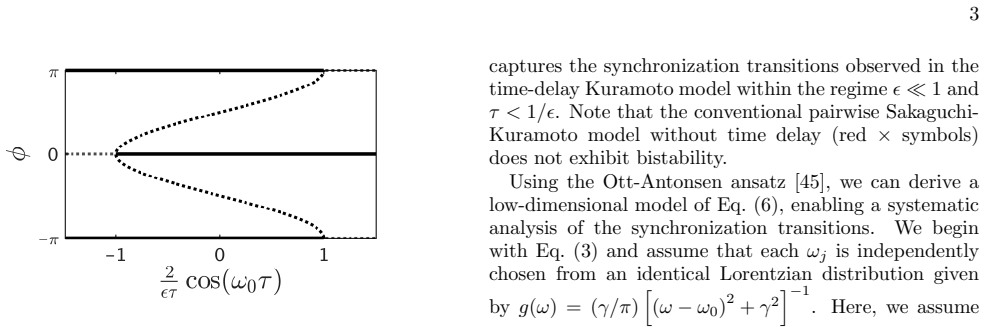
- Bistability between incoherence and full synchrony in the delayed Kuramoto model is caused by the three-body term; the pairwise phase-lagged part alone cannot produce hysteresis.
- The effective higher-order model is a system of ordinary differential equations, so all standard analysis and control methods for higher-order Kuramoto networks become applicable to time-delayed systems.
- Stability boundaries of the incoherent and synchronized states reduce to simple trigonometric inequalities in epsilon and tau, which match the independently known diagram for the delayed model in the small-parameter regime.
- The reduction offers a systematic route to derive many-body effective couplings for other delay-coupled oscillator systems beyond Kuramoto dynamics.
Reading between the lines
- Because the three-body strength scales as epsilon^2 tau, delay-induced effects grow linearly with delay but quadratically with coupling; experiments or numerics that vary epsilon and tau separately could test this scaling directly.
- The same Taylor-expansion route should generate four-body interactions at O(epsilon^3); these may become visible for delays near tau ~ 1/epsilon and could produce cluster states or other phenomena absent from the truncated model.
- For non-identical frequencies the effective couplings acquire frequency-dependent phase lags, suggesting a frequency-filtered interaction that could matter for broad frequency distributions.
- The equivalence between delay and higher-order interactions may extend to non-global network topologies, where the three-body term would couple triangles of oscillators and make delayed network dynamics amenable to hypergraph analyses.
Signed reviews
Editorial analysis
A structured set of objections, weighed in public.
Referee Report
Summary. The paper studies globally coupled Kuramoto oscillators with a uniform time delay τ in the pairwise coupling, Eq. (1). Under a weak-coupling assumption, it Taylor-expands the delayed phase and substitutes the equations of motion repeatedly to obtain a delay-free model, Eq. (6), consisting of a Kuramoto–Sakaguchi pairwise term and a (2,−1,−1) three-body harmonic whose strength is ε²τ. The paper demonstrates bistability for N=2, compares finite-N simulations of the delayed and reduced models, applies the Ott–Antonsen ansatz to derive the order-parameter dynamics, Eqs. (10)–(12), and derives stability conditions, Eqs. (14)–(15), which it benchmarks against the Yeung–Strogatz result. The central assertion is that, within the regime ε≪1 and τ<1/ε, the higher-order Kuramoto model quantitatively reproduces the synchronization transitions and bistability of the time-delayed model.
Significance. The conceptual message — that delayed pairwise interactions can be recast, through a controlled weak-coupling expansion, as higher-order interactions — is interesting and potentially useful, connecting two active fields. The derivation is explicit and self-contained, with no fitted parameters; the reduction to a low-dimensional Ott–Antonsen equation makes the reduced model analytically tractable; and the stability boundaries are checked against the independent Yeung–Strogatz diagram. These are genuine strengths. The main weakness is that the stated domain of validity is broader than the expansion actually supports: the accuracy is controlled by ετ, not by ε alone, and the numerical comparisons include parameter values with ετ close to or above 1.
major comments (3)
- [Appendix A1 and Eq. (6)] The derivation is an expansion in ετ, not in ε alone. In Appendix A1, θ_k(t−τ) is replaced by θ_k(t)−ω_kτ plus a remainder of order ετ. When this remainder is substituted into the O(ε) coupling, the first omitted correction to the retained O(ε²τ) three-body term is smaller by a factor O(ετ). The paper itself states that the accuracy is characterized by the smallness of ετ, but then asserts the regime τ<1/ε, which allows ετ arbitrarily close to 1. At ετ≈1 the neglected corrections are comparable to the retained three-body term, so the statement that Eq. (6) approximates Eq. (1) to O(ε²) is not valid on the claimed domain. The validity condition should be ετ≪1, and the phrase τ<1/ε in the main text and in Fig. 3 should be replaced or supplemented.
- [Fig. 2 and Fig. 3] The numerical evidence for the central 'quantitatively reproduces' claim lies largely outside the small-ετ regime. In Fig. 2(a), τ=2.8 and the reported bifurcations occur at ε=0.12 and ε=0.27, giving ετ≈0.34 and 0.76; if the plotted ε-range extends beyond 0.3, ετ exceeds 1. In Fig. 2(b), ε=0.3, so ετ>1 for any τ>3.3, which covers most of the displayed periodic sequence. Fig. 3 compares stability boundaries over the entire region below the line τ=1/ε, including ετ close to 1. These comparisons therefore do not cleanly test the asymptotic regime in which the reduction is derived. The authors should either restrict the numerical and analytical comparisons to ετ≪1, or provide an explicit error estimate showing that the agreement persists when ετ is not small.
- [Appendix A3 and Eqs. (10)–(15)] The reduction to the identical-oscillator limit takes γ→0 after applying the Ott–Antonsen ansatz. This is a singular limit, and the replacement of f1 and f2 by τ and 0 uses (ω_l−ω_k)τ=O(ετ), which again requires ετ≪1. The paper does not justify that the N→∞ and γ→0 limits commute, nor does it discuss the fact that the Lorentzian becomes a δ-distribution. Since the stability diagram is a central quantitative output, the authors should either derive the identical-oscillator case directly or verify the γ→0 limit against finite-N simulations of Eq. (6) in the ετ≪1 regime.
minor comments (5)
- [Abstract and §5] The abstract says the reduced model exhibits 'qualitatively consistent' transitions, while the main text and conclusion say it 'quantitatively reproduces' the phenomena. These statements should be aligned to the same strength, especially after the validity regime is corrected.
- [Eq. (6)] The sums over k and l allow l=j, so the 'three-body' term includes O(1/N) pairwise and constant contributions. In the thermodynamic limit they vanish, but the paper should either exclude l=j explicitly or state that these contributions are negligible for large N.
- [Eqs. (10) and (11)] The phrase 'low-dimensional mode' should read 'low-dimensional model'. Also, the redefinition of z1 in the γ→0 limit is stated but the notation could be cleaner.
- [Fig. 2 caption] Please specify the full parameter ranges, the number of oscillators, initial conditions, and how the stable and unstable branches were obtained (e.g., forward/backward sweeps). It would also be helpful to mark the ετ≪1 validity boundary or indicate the ετ values at the reported transition points.
- [Appendix A1] The sentence 'The case with ω_l=ω_k is trivial' should be expanded: the limiting values f1=τ and f2=0 are used in the central Eq. (6), so they deserve an explicit derivation.
Circularity Check
No significant circularity: the delayed-to-higher-order reduction is a self-contained Taylor expansion checked against the independent Yeung–Strogatz result.
full rationale
The central chain is Eq.(1) -> Taylor expansion Eq.(2) -> Eq.(3) -> Eq.(6) -> Ott–Antonsen reduction Eq.(10)-(12) -> stability conditions Eq.(14)-(15). No parameter is fitted to the quantities later called predictions: the three-body coupling strength ε²τ/2 is fixed by the expansion itself, not calibrated to simulation data. The OA closure uses the standard external Ott–Antonsen ansatz [45], and the stability diagram is compared with the independent Yeung–Strogatz [40] time-delay result, which is an external benchmark. Self-citations [48,52,53] are contextual or future-work references and do not carry any load-bearing step in the derivation. The only substantive caveat is a validity-regime concern, not circularity: the paper says the approximation is controlled by the smallness of ετ, yet also states the broader condition τ<1/ε, and some numerical points (e.g., Fig. 2, where ετ can reach about 0.76 or exceed 1) may lie outside the genuinely small-ετ regime. That is a correctness/scope issue, not a reduction of the claimed result to its inputs.
Assumptions & free parameters
assumptions (4)
- domain assumption The original dynamics are the all-to-all delayed Kuramoto model, Eq. (1), with uniform delay tau and frequency distribution g(omega).
- domain assumption The delay is Taylor-expanded and the equation is truncated at O(epsilon^2), with epsilon*tau < 1 assumed.
- domain assumption The Ott-Antonsen ansatz P_m(omega,t) = alpha(omega,t)^m is valid for the Lorentzian frequency distribution.
- ad hoc to paper gamma = O(epsilon) and (omega_l - omega_k)*tau small, so that f1 and f2 can be replaced by -i tau and 0; then gamma -> 0 for identical oscillators.
Cite this review
Pith. "Pith review of Emergence of higher-order interactions in systems of coupled Kuramoto oscillators with time delay." pith.science (2026). https://pith.science/paper/4CQUKDR2
@misc{pith2026251216193,
  author       = {Pith},
  title        = {Pith review of: Emergence of higher-order interactions in systems of coupled Kuramoto oscillators with time delay},
  year         = {2026},
  howpublished = {\url{https://pith.science/paper/4CQUKDR2}},
  note         = {Machine review of arXiv:2512.16193}
}
read the original abstract
We show that higher-order interactions naturally emerge from time-delayed pairwise coupling in Kuramoto oscillators. By expanding the delayed pairwise coupling to the second order, we derive a delay-free Kuramoto model possessing both pairwise and three-body interactions. Numerical simulations and stability analysis demonstrate that the three-body Kuramoto model and the time-delayed pairwise Kuramoto model exhibit qualitatively consistent synchronization transitions under appropriate conditions. In particular, the bistability arising in the time-delayed Kuramoto model is accounted for by the three-body interactions. Our findings reveal that time delays can be recast effectively as higher-order interactions, providing an insight into how coupling delays shape collective dynamics.
Figures


Forward citations
Cited by 3 Pith papers
-
Higher-order interactions for controlling time-delayed Kuramoto model
Higher-order delay-free approximations of delayed Kuramoto interactions enable accurate reduced-order control of synchronization, including bistability and intermediate states, outperforming conventional pairwise appr...
-
Impact of Channel Dynamics on Higher-order Interactions of Oscillators
Standard 3-body Kuramoto couplings are mathematically equivalent to pairwise connections through latent transmission channels, and relaxing the adiabatic limit reveals symmetry-dependent bistability and finite-size cl...
-
On the efficiency of pairwise Hamiltonian control to desynchronize the higher-order Kuramoto model
Applying a minimally invasive pairwise Hamiltonian control to a higher-order Kuramoto model, the authors find that triadic coupling raises the control strength needed near synchrony and produces a non-monotonic effect...
Reference graph
Works this paper leans on
-
[1]
Battiston, G
F. Battiston, G. Cencetti, I. Iacopini, V. Latora, M. Lu- cas, A. Patania, J.-G. Young, and G. Petri. Networks beyond pairwise interactions: structure and dynamics. Phys. Rep., 874:1–92, 2020
2020
-
[2]
Bianconi.Higher-Order Networks: An introduction to simplicial complexes
G. Bianconi.Higher-Order Networks: An introduction to simplicial complexes. Cambridge University Press, 2021
2021
-
[3]
Battiston, E
F. Battiston, E. Amico, A. Barrat, G. Bianconi, G.F. de Arruda, B. Franceschiello, I. Iacopini, S. K´ efi, V. La- tora, Y. Moreno, M.M. Murray, T.P. Peixoto, F. Vac- carino, and G. Petri. The physics of higher-order inter- actions in complex systems.Nat. Phys., 17:1093–1098, 2021
2021
-
[4]
Majhi, M
S. Majhi, M. Perc, and D. Ghosh. Dynamics on higher- order networks: a review.Journal of The Royal Society Interface, 19(188):20220043, 2022
2022
-
[5]
Bick, Elizabeth Gross, Heather A Harrington, and Michael T Schaub
C. Bick, Elizabeth Gross, Heather A Harrington, and Michael T Schaub. What are higher-order networks? SIAM Rev., 65(3):686–731, 2023
2023
-
[6]
Boccaletti, P
S. Boccaletti, P. De Lellis, C.I. Del Genio, K. Alfaro- Bittner, R. Criado, S. Jalan, and M. Romance. The structure and dynamics of networks with higher order interactions.Phys. Rep., 1018:1–64, 2023
2023
-
[7]
Muolo, L
R. Muolo, L. Giambagli, H. Nakao, D. Fanelli, and T. Carletti. Turing patterns on discrete topologies: from networks to higher-order structures.Proceedings of the Royal Society A, 480(2302):20240235, 2024
2024
-
[8]
Mill´ an, H
A.P. Mill´ an, H. Sun, L. Giambagli, R. Muolo, T. Carletti, J.J. Torres, F. Radicchi, J. Kurths, and G. Bianconi. Topology shapes dynamics of higher-order networks.Na- ture Physics, 21:353–361, 2025. 6
2025
Show all 56 references
-
[9]
Battiston, C
F. Battiston, C. Bick, M. Lucas, A.P. Mill´ an, P.S. Skardal, and Y. Zhang. Collective dynamics on higher- order networks.arXiv preprint arXiv:2510.05253, 2025
2025
-
[10]
Mill´ an, J.J
A.P. Mill´ an, J.J. Torres, and G. Bianconi. Explo- sive higher-order Kuramoto dynamics on simplicial com- plexes.Phys. Rev. Lett., 124(21):218301, 2020
2020
-
[11]
Di Patti, L
L.V Gambuzza, F. Di Patti, L. Gallo, S. Lepri, M. Ro- mance, R. Criado, M. Frasca, V. Latora, and S. Boc- caletti. Stability of synchronization in simplicial com- plexes.Nat. Comm., 12(1):1–13, 2021
2021
-
[12]
Gallo, R
L. Gallo, R. Muolo, L.V. Gambuzza, V. Latora, M. Frasca, and T. Carletti. Synchronization induced by directed higher-order interactions.Comm. Phys., 5:236, 2022
2022
-
[13]
Von Der Gracht, E
S. Von Der Gracht, E. Nijholt, and B. Rink. Hyper- networks: cluster synchronization is a higher-order ef- fect.SIAM Journal on Applied Mathematics, 83(6):2329– 2353, 2023
2023
-
[14]
von der Gracht, E
S. von der Gracht, E. Nijholt, and B. Rink. Higher- order interactions lead to ‘reluctant’ synchrony breaking. Proceedings A of the Royal Society, 480(2301):20230945, 2024
2024
-
[15]
Zhang, P.S
Y. Zhang, P.S. Skardal, F. Battiston, G. Petri, and M. Lucas. Deeper but smaller: Higher-order interactions increase linear stability but shrink basins.Science Ad- vances, 10(40):eado8049, 2024
2024
-
[16]
Z. Wang, J. Zhu, and X. Liu. Network stochastic res- onance under higher-order interactions.arXiv preprint arXiv:2509.14796, 2025
2025
-
[17]
Muolo, L
R. Muolo, L. Gallo, V. Latora, M. Frasca, and T. Car- letti. Turing patterns in systems with high-order inter- actions.Chaos, Solitons & Fractals, 166:112912, 2023
2023
-
[18]
Carletti, D
T. Carletti, D. Fanelli, and S. Nicoletti. Dynamical sys- tems on hypergraphs.J. Phys. Complex., 1(3):035006, 2020
2020
-
[19]
Iacopini, G
I. Iacopini, G. Petri, A. Barrat, and V. Latora. Simpli- cial models of social contagion.Nat. Comm., 10(1):2485, 2019
2019
-
[20]
Neuh¨ auser, A
L. Neuh¨ auser, A. Mellor, and R. Lambiotte. Multibody interactions and nonlinear consensus dynamics on net- worked systems.Phys. Rev. E, 101:032310, Mar 2020
2020
-
[21]
De Lellis, F
P. De Lellis, F. Della Rossa, F. Lo Iudice, and D. Li- uzza. Pinning control of hypergraphs.IEEE Control Syst. Lett., 7:691–696, 2022
2022
-
[22]
Della Rossa, D
F. Della Rossa, D. Liuzza, F. Lo Iudice, and P. De Lellis. Emergence and control of synchronization in networks with directed many-body interactions.Phys. Rev. Lett., 131(20):207401, 2023
2023
-
[23]
Xia and L
R. Xia and L. Xiang. Pinning control of simplicial com- plexes.European Journal of Control, 77:100994, 2024
2024
-
[24]
Kuramoto
Y. Kuramoto. Self-entrainment of a population of cou- pled non-linear oscillators. In H. Araki, editor,Inter- national Symposium on Mathematical Problems in Theo- retical Physics, pages 420–422, Berlin, Heidelberg, 1975. Springer Berlin Heidelberg
1975
-
[25]
Kuramoto.Chemical Oscillations, Waves, and Tur- bulence
Y. Kuramoto.Chemical Oscillations, Waves, and Tur- bulence. Springer, Berlin, 1984
1984
-
[26]
Acebr´ on, L.L
J.A. Acebr´ on, L.L. Bonilla, C.J. P´ erez Vicente, F. Ri- tort, and R. Spigler. The Kuramoto model: A simple paradigm for synchronization phenomena.Reviews of modern physics, 77(1):137–185, 2005
2005
-
[27]
Tanaka and T
T. Tanaka and T. Aoyagi. Multistable attractors in a network of phase oscillators with three-body interactions. Phys. Rev. Lett., 106(22):224101, 2011
2011
-
[28]
Skardal and A
P.S. Skardal and A. Arenas. Higher order interactions in complex networks of phase oscillators promote abrupt synchronization switching.Communications Physics, 3(1):218, Nov 2020
2020
-
[29]
Lucas, G
M. Lucas, G. Cencetti, and F. Battiston. Multiorder Laplacian for synchronization in higher-order networks. Physical Review Research, 2(3):033410, 2020
2020
-
[30]
Le´ on, R
I. Le´ on, R. Muolo, S. Hata, and H. Nakao. Higher-order interactions induce anomalous transitions to synchrony. Chaos: An Interdisciplinary Journal of Nonlinear Sci- ence, 34(1):013105, 01 2024
2024
-
[31]
Muolo, S
I Le´ on, R. Muolo, S. Hata, and H. Nakao. Theory of phase reduction from hypergraphs to simplicial com- plexes: A general route to higher-order Kuramoto mod- els.Physica D: Nonlinear Phenomena, 482:134858, 2025
2025
-
[32]
H. Nakao. Phase reduction approach to synchronisa- tion of nonlinear oscillators.Contemporary Physics, 57(2):188–214, Oct. 2016
2016
-
[33]
Monga, D
B. Monga, D. Wilson, T. Matchen, and J. Moehlis. Phase reduction and phase-based optimal control for biological systems: a tutorial.Biological cybernetics, 113(1):11–46, 2019
2019
-
[34]
Pietras and A
B. Pietras and A. Daffertshofer. Network dynamics of coupled oscillators and phase reduction techniques. Physics Reports, 819:1–105, 2019
2019
-
[35]
Le´ on and D
I. Le´ on and D. Paz´ o. Phase reduction beyond the first or- der: The case of the mean-field complex ginzburg-landau equation.Phys. Rev. E, 100:012211, Jul 2019
2019
-
[36]
C. Bick, T. B¨ ohle, and C. Kuehn. Higher-order network interactions through phase reduction for oscillators with phase-dependent amplitude.Journal of Nonlinear Sci- ence, 34(4):77, 2024
2024
-
[37]
Schwartz, Luis Mier-y Teran Romero, Christoffer R
Klementyna Szwaykowska, Ira B. Schwartz, Luis Mier-y Teran Romero, Christoffer R. Heckman, Dan Mox, and M. Ani Hsieh. Collective motion patterns of swarms with delay coupling: Theory and experiment.Phys. Rev. E, 93:032307, Mar 2016
2016
-
[38]
Lag synchronization of coupled time- delayed fitzhugh–nagumo neural networks via feedback control.Scientific Reports, 11(1):3884, 2021
Malik Muhammad Ibrahim, Muhammad Ahmad Kam- ran, Malik Muhammad Naeem Mannan, Il Hyo Jung, and Sangil Kim. Lag synchronization of coupled time- delayed fitzhugh–nagumo neural networks via feedback control.Scientific Reports, 11(1):3884, 2021
2021
-
[39]
Pulse-coupled oscillator synchroniza- tion: Bridging theory and experiments with electronic firefly networks.Chaos, Solitons & Fractals, 196:116377, 2025
Mois´ es Santill´ an. Pulse-coupled oscillator synchroniza- tion: Bridging theory and experiments with electronic firefly networks.Chaos, Solitons & Fractals, 196:116377, 2025
2025
-
[40]
M. K. Stephen Yeung and Steven H. Strogatz. Time delay in the Kuramoto model of coupled oscillators.Phys. Rev. Lett., 82:648–651, Jan 1999
1999
-
[41]
Kozyreff, A
G. Kozyreff, A. G. Vladimirov, and Paul Mandel. Global coupling with time delay in an array of semiconductor lasers.Phys. Rev. Lett., 85:3809–3812, Oct 2000
2000
-
[42]
Time delay effect in a living coupled oscillator system with the plasmodium of physarum polycephalum.Phys
Atsuko Takamatsu, Teruo Fujii, and Isao Endo. Time delay effect in a living coupled oscillator system with the plasmodium of physarum polycephalum.Phys. Rev. Lett., 85:2026–2029, Aug 2000
2026
-
[43]
En- hancing power grid synchronization and stability through time-delayed feedback control.Phys
Halgurd Taher, Simona Olmi, and Eckehard Sch¨ oll. En- hancing power grid synchronization and stability through time-delayed feedback control.Phys. Rev. E, 100:062306, Dec 2019
2019
-
[44]
B¨ ottcher, Andreas Otto, Stefan Kettemann, and Carsten Agert
Philipp C. B¨ ottcher, Andreas Otto, Stefan Kettemann, and Carsten Agert. Time delay effects in the control of synchronous electricity grids.Chaos: An Interdisci- plinary Journal of Nonlinear Science, 30(1):013122, 01 7 2020
2020
-
[45]
Ott and T.M
E. Ott and T.M. Antonsen. Low dimensional behavior of large systems of globally coupled oscillators.Chaos: An Interdisciplinary Journal of Nonlinear Science, 18(3), September 2008
2008
-
[46]
Antonsen
Wai Shing Lee, Edward Ott, and Thomas M. Antonsen. Large coupled oscillator systems with heterogeneous in- teraction delays.Phys. Rev. Lett., 103:044101, Jul 2009
2009
-
[47]
A solu- ble active rotater model showing phase transitions via mutual entertainment.Progress of Theoretical Physics, 76(3):576–581, 09 1986
Hidetsugu Sakaguchi and Yoshiki Kuramoto. A solu- ble active rotater model showing phase transitions via mutual entertainment.Progress of Theoretical Physics, 76(3):576–581, 09 1986
1986
-
[48]
Namura, R
N. Namura, R. Muolo, and H. Nakao. Optimal inter- action functions realizing higher-order kuramoto dynam- ics with arbitrary limit-cycle oscillators.arXiv preprint arXiv:2510.14501, 2025
2025
-
[49]
Slow switching in a population of delayed pulse-coupled oscillators.Phys
Hiroshi Kori. Slow switching in a population of delayed pulse-coupled oscillators.Phys. Rev. E, 68:021919, Aug 2003
2003
-
[50]
D’Souza, M
R.M. D’Souza, M. di Bernardo, and Y.-Y. Liu. Con- trolling complex networks with complex nodes.Nature Reviews Physics, 5(4):250–262, 2023
2023
-
[51]
von der Gracht, E
S. von der Gracht, E. Nijholt, and B. Rink. A parametri- sation method for high-order phase reduction in coupled oscillator networks.arXiv preprint arXiv:2306.03320, 2023
2023 arXiv
-
[52]
C. Bick, B. Rink, and B.A.J. de Wolff. When time de- lays and phase lags are not the same: higher-order phase reduction unravels delay-induced synchronization in os- cillator networks.arXiv preprint arXiv:2404.11340, 2024
2024 arXiv
-
[53]
C. Bick, B. Rink, and B.A.J. de Wolff. Higher- order phase reduction for delay-coupled oscillators be- yond the phase-shift approximation.arXiv preprint arXiv:2510.27524, 2025. Appendix A: Supplementary
2025
-
[54]
(3), from the time-delay Kuramoto model, Eq
Derivation of the higher-order interaction from time-delayed pairwise coupling We show the details of the calculation to derive the higher-order Kuramoto model, Eq. (3), from the time-delay Kuramoto model, Eq. (1), under the assumption of smallϵ. Eq. (1) and its Taylor expansi...
-
[55]
(8) from Eq
Derivation of Eq.(8) We derive Eq. (8) from Eq. (3) under the assumptionγ=O(ϵ) andN≫1. From Eq. (3), ˙θj(t) =ω j + ϵ N NX k=1 k̸=j ei(θk(t)−θj (t)−ωkτ) −e −i(θk(t)−θj (t)−ωkτ) 2i + ϵ2 N 2 NX k=1 k̸=j NX l=1 l̸=k ei(θk(t)−θj (t)−ωkτ) +e −i(θk(t)−θj (t)−ωkτ) 2 ei(θl(t)−θk(t)−ωlτ...
-
[56]
(9) is redefined as zm(t) = Z 2π 0 Z ∞ −∞ eim(θ′−ω′τ) P(θ ′, ω′, t)g(ω′)dω′dθ′,(A10) and the time evolution ofP(θ, ω, t) is given from Eq
Ott-Antonsen ansatz In theN→ ∞limit, the general complex order parameter in Eq. (9) is redefined as zm(t) = Z 2π 0 Z ∞ −∞ eim(θ′−ω′τ) P(θ ′, ω′, t)g(ω′)dω′dθ′,(A10) and the time evolution ofP(θ, ω, t) is given from Eq. (8) as ∂P ∂t =− ∂ ∂θ ˙θP =− ∂ ∂θ ω+ 1 2i e−iθH−e iθH ∗ P ,...
Reviewed August 3, 2026 · model on record in the stance chip above.
Discussion (0). Continue with ORCID to comment.