REVIEW 3 major objections 5 minor 3 cited by
Rig3R: Rig-Aware Conditioning for Learned 3D Reconstruction
T0 review · 3 major / 5 minor · reviewed 2026-08-07 · deepseek-v4-flash
Pith's one-line read Rig3R introduces a single-pass transformer that conditions on optional multi-camera rig metadata and learns to infer rig structure from unordered images, achieving leading results in reconstruction, pose estimation, and rig discovery.
desk verdict A solid rig-aware extension of DUSt3R whose most novel claim—rig discovery on unseen rigs—is not yet backed by a clean held-out experiment. read the letter →
The pith
A machine-rendered reading of the paper's core claim, the machinery that carries it, and where it could break.
The reading
What carries the argument
The load-bearing mechanism is the raymap, a dense field of unit ray directions anchored at a shared camera center, produced by two heads: a pose raymap in the global frame and a rig raymap in a rig-centric frame. Rig raymaps decouple fixed camera geometry from ego-motion, so clustering them across frames reveals camera identity and rig calibration. On the input side, optional metadata embeddings, namely camera ID, timestamp, and rig raymap patches, are added to image patch tokens and dropped independently with 50 percent probability during training, forcing the model to use rig cues when present and to infer them when absent. The map from raymaps to camera parameters is closed form: focal lengths come from pixel-ray angular constraints and rotations from SVD alignment of camera-frame and global-frame rays, which is why pose estimates stay stable in regions where pointmap depth is unreliable.
What would settle it
Run Rig3RUnstr on a sequence from a rig geometry absent from the training distribution, such as a six-camera asymmetric rig with unusual relative rotations; if rig-ID clustering accuracy and rig-relative pose mAA stay near chance levels while the calibrated variant remains accurate, the rig-discovery and generalization claims are refuted.
Extended reading notes
Core claim
Rig3R is a single-pass transformer that predicts, for every input image, a dense pointmap, a global pose raymap in the first frame's coordinate system, and a rig raymap in a rig-centric frame that is constant across time. The rig raymap is the paper's key device: because it encodes each camera's fixed position and orientation within the rig, the model can condition on that structure when calibration metadata is provided and can recover it from image content when it is not. Camera ID, timestamp, and rig pose are injected as optional embeddings with 50 percent dropout during training, so the same weights handle unordered images, partially calibrated rigs, and fully calibrated rigs. The paper's claim is that this rig-aware latent space is what allows one forward pass, with no bundle adjustment or iterative refinement, to outperform both classical rig-aware COLMAP and learned feedforward baselines on real driving data, and to discover rig calibration from unordered image sets.
Load-bearing premise
The claim that Rig3R generalizes to unseen rig geometries and discovers rig structure rests on the training data containing enough variety in rig configurations, which the paper itself identifies as its main limitation.
Editorial extensions
If this is right
- Autonomous driving pipelines could obtain dense scene geometry and camera poses in a single transformer pass, removing the need for explicit feature matching and bundle adjustment on rig data.
- Rig calibration could be discovered from unordered, timestamp-free image sets, a task the paper says no classical or learned method previously addressed.
- Pose estimation from raymaps should remain accurate in sky, reflective, and dynamic regions where pointmap-based pose estimation degrades sharply.
- Partial or noisy metadata is usable: models trained with dropped or corrupted rig embeddings outperform unstructured baselines and can be finetuned to hold up under calibration noise.
Reading between the lines
- Going beyond the paper, the rig-raymap representation could generalize to non-driving camera networks such as drones or distributed fixed cameras, where calibration is unknown but relative rig geometry is approximately constant.
- A natural test of the stated data-diversity limitation is to train with procedurally augmented continuous rig configurations; if generalization is data-limited, rig-discovery accuracy on novel geometries should rise accordingly.
- Rig3R's clean separation of ego-motion and rig geometry suggests combining it with dynamic-scene models, which currently build pose priors from pointmaps and struggle in moving regions.
- Because rig discovery works from unordered images, it could serve as an unsupervised self-calibration signal for camera networks before any metric reconstruction is attempted.
Editorial analysis
A structured set of objections, weighed in public.
Referee Report
Summary. Rig3R is a single-pass transformer model for multi-view 3D reconstruction and camera pose estimation from multi-camera rigs. In addition to predicting dense pointmaps, it predicts two types of raymaps: a global pose raymap and a rig-relative raymap. The model optionally conditions on camera ID, timestamp, and rig-relative calibration, with dropout during training to tolerate missing metadata; when metadata is absent, the rig raymap head is used to discover rig structure directly from images. The paper reports state-of-the-art pose and pointmap accuracy on Waymo and WayveScenes101, ablations of metadata and auxiliary heads, robustness to noisy calibration, and rig-discovery results on Argoverse2 across 1-, 3-, 5-, and 7-camera configurations. The central claims are that rig-aware conditioning improves reconstruction and pose estimation, and that the model can discover rig calibration from unordered images on previously unseen rig configurations.
Significance. If the findings hold, Rig3R would be a meaningful step beyond unstructured multi-view models: it explicitly exploits rig geometry when available, and it introduces a rig-relative raymap representation with closed-form pose and intrinsic recovery. The experimental package is substantial: real-world driving datasets, multiple baselines including DUSt3R-GA and Fast3R, clear ablations of each metadata component, and a useful Appendix C showing that raymap-based pose estimation dramatically outperforms pointmap-based PnP (Table 5). The closed-form solver in Appendix B and the use of external LiDAR/COLMAP ground truth reduce circularity concerns. However, the most distinctive claim—generalization of rig discovery to unseen rig configurations—is not yet supported by a clean held-out evaluation, and this is the main reason the contribution cannot be accepted as stated.
major comments (3)
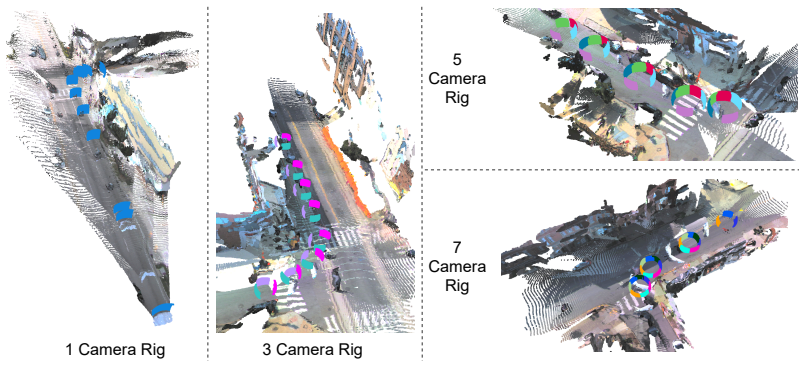
- [Section 4.3 and Figure 5] The rig-discovery results are evaluated only on the Argoverse2 validation set, even though Argoverse2 is explicitly listed in the training data mix in Section 3.4. The 1-, 3-, 5-, and 7-camera settings in Figure 5 are subsampled versions of the same seven-camera rig geometry seen during training, so high Rig ID accuracy and rig mAA may reflect memorization of a familiar rig layout rather than generalization to a novel rig. The only held-out dataset, WayveScenes101, appears in Tables 1 and 2 but has no rig-discovery metrics. Since the abstract and Section 1 claim the first method to support rig calibration discovery from unordered images, the paper needs either rig-discovery metrics on WayveScenes101 (or another dataset with a genuinely different rig layout) or a clear demonstration of generalization to a rig configuration not present in training. The paper's own Section 5 limitation statement, which names rig-configuration diversity as the main performance limitation, reinforces that this evidence is missing.
- [Section 3.4 and Tables 1-2] The training mix includes 'an internal dataset' that is not described, and the evaluation on WayveScenes101 is presented as an unseen-dataset test. Given that the authors are from Wayve and WayveScenes101 is also a Wayve dataset, the manuscript must state whether the internal training data overlaps with WayveScenes101 or any of its scenes. Without an explicit non-overlap statement, the 'unseen' status of WayveScenes101 is not verifiable, and the generalization claims built on Tables 1 and 2 are weakened.
- [Table 1 and Section 4.1] On WayveScenes101, the unstructured variant Rig3RUnstr achieves only 25.7 mAA, substantially below DUSt3R-GA's 48.6 mAA. The text focuses on outperforming feedforward baselines and 'performing comparably to Rig COLMAP' (29.2 mAA), but this selective comparison does not address the paper's novelty claim: that rig structure can be inferred from unordered images on an unseen rig. A direct discussion of why Rig3RUnstr falls behind a global-alignment classical baseline on the held-out rig, and ideally rig-discovery metrics on that same data, is required to support the claimed capability.
minor comments (5)
- [Figure 5] The y-axis labels in Figure 5 range from 10 to 100 without units; add '%' or a stated metric unit for clarity.
- [Table 3] The checkmarks in the ablation table are ambiguous: specify that each row corresponds to adding that metadata component to the unstructured baseline, and define the baseline row explicitly.
- [Appendix B, Eq. (2)] The notation \(\tilde{u}\), \(\tilde{u}'\) is introduced only in text; define these as homogeneous image coordinates in the equation or its preceding sentence.
- [Abstract and Section 4] The claim of outperforming baselines by 17-45% mAA is stated without a pointer to a specific table or to which Rig3R variant is meant; clarify whether this range refers to Rig3RCalib, Rig3RUnstr, or a combination.
- [Section 4] All tables report single runs without error bars, confidence intervals, or repeated-seed statistics. Given the large reported gaps this is not disqualifying, but for a rigorous comparison please state that these are single runs and, where feasible, provide repeated-seed statistics or at least acknowledge the absence.
Circularity Check
No circularity: the paper's predictions are evaluated against external ground truth and recovered via fixed closed-form solvers, with no fitted parameter or self-citation chain defining the reported metrics.
full rationale
I examined the derivation chain for circular reductions. The central outputs are dense pointmaps, global pose raymaps, and rig-relative raymaps. Camera poses are recovered from predicted raymaps using a fixed closed-form solver (Appendix B: intrinsic recovery from angular constraints and extrinsic recovery via SVD alignment), not by fitting parameters to the evaluation targets. Pose and reconstruction metrics are computed against external ground truth: Waymo LiDAR poses and WayveScenes101 COLMAP reconstructions, with classical and learned baselines evaluated under the same protocol. Rig discovery is measured by clustering the predicted rig raymaps and matching clusters to known rig labels via the Hungarian algorithm; the rig raymap head is supervised by external rig calibration ground truth, and the rig ID accuracy and rig mAA metrics are not parameters that were fit to produce those numbers. The use of Argoverse2 validation for rig-configuration generalization is a potential evaluation-scope concern, since Argoverse2 appears in the training data mix, but the paper refers to a validation split and this is not a circular derivation. Self-citations, such as initializing from DUSt3R and following VGGT for training stability, are not load-bearing for the reported results, and no uniqueness theorem is imported to force the design. The stated limitation about data diversity and rig-configuration variety is an honest external constraint, not a circular step. Overall, the claimed predictions are not equivalent to their inputs by construction.
Assumptions & free parameters
free parameters (5)
- lambda_p (pose raymap loss weight) =
not reported
- lambda_r (rig raymap loss weight) =
not reported
- alpha (confidence regularization weight in Lpmap) =
not reported
- beta (camera center loss weight) =
not reported
- metadata dropout probability =
0.5
assumptions (5)
- domain assumption Pinhole camera model with principal point fixed at the image center for raymap recovery
- domain assumption Rig is synchronized and rigid across time
- domain assumption Ground-truth geometry from LiDAR and COLMAP is accurate
- domain assumption Training data diversity covers the rig configurations seen at test time
- domain assumption Initializing the image encoder from DUSt3R provides a beneficial starting point
invented entities (1)
-
Rig raymap
independent evidence
Cite this review
Pith. "Pith review of Rig3R: Rig-Aware Conditioning for Learned 3D Reconstruction." pith.science (2026). https://pith.science/paper/4FEDSBBY
@misc{pith2026250602265,
  author       = {Pith},
  title        = {Pith review of: Rig3R: Rig-Aware Conditioning for Learned 3D Reconstruction},
  year         = {2026},
  howpublished = {\url{https://pith.science/paper/4FEDSBBY}},
  note         = {Machine review of arXiv:2506.02265}
}
read the original abstract
Estimating agent pose and 3D scene structure from multi-camera rigs is a central task in embodied AI applications such as autonomous driving. Recent learned approaches such as DUSt3R have shown impressive performance in multiview settings. However, these models treat images as unstructured collections, limiting effectiveness in scenarios where frames are captured from synchronized rigs with known or inferable structure. To this end, we introduce Rig3R, a generalization of prior multiview reconstruction models that incorporates rig structure when available, and learns to infer it when not. Rig3R conditions on optional rig metadata including camera ID, time, and rig poses to develop a rig-aware latent space that remains robust to missing information. It jointly predicts pointmaps and two types of raymaps: a pose raymap relative to a global frame, and a rig raymap relative to a rig-centric frame consistent across time. Rig raymaps allow the model to infer rig structure directly from input images when metadata is missing. Rig3R achieves state-of-the-art performance in 3D reconstruction, camera pose estimation, and rig discovery, outperforming both traditional and learned methods by 17-45% mAA across diverse real-world rig datasets, all in a single forward pass without post-processing or iterative refinement.
Figures


Figures from the paper (5 more)


Forward citations
Cited by 3 Pith papers
-
TRIG: Trajectory-Rig Decoupled Metric Geometry Learning
TRIG factorizes multi-camera poses into ego-trajectory and static rig geometry, with decoupled supervision and sparse temporal-spatial attention, claiming SOTA metric depth, pose, and 3D reconstruction on five driving...
-
OmniNWM: Omniscient Driving Navigation World Models
OmniNWM jointly generates long panoramic multi-modal driving videos, controls them precisely via normalized Plücker ray-maps, and derives dense driving rewards from generated 3D occupancy.
-
E3D-Bench: A Benchmark for End-to-End 3D Geometric Foundation Models
E3D-Bench compares 16 3D geometric foundation models on depth, reconstruction, pose, and view-synthesis tasks with a unified evaluation toolkit.
Reference graph
Works this paper leans on
-
[1]
Multiple View Geometry in Computer Vision
Richard Hartley and Andrew Zisserman. Multiple View Geometry in Computer Vision. Cam- bridge University Press, 2003
work page 2003
-
[2]
Raúl Mur-Artal and Juan D. Tardós. ORB-SLAM2: an open-source SLAM system for monocu- lar, stereo and RGB-D cameras. IEEE Transactions on Robotics, 33(5):1255–1262, 2017. doi: 10.1109/TRO.2017.2705103
arXiv 2017
-
[3]
Loam: Lidar odometry and mapping in real-time
Ji Zhang and Sanjiv Singh. Loam: Lidar odometry and mapping in real-time. 07 2014. doi: 10.15607/RSS.2014.X.007
-
[4]
Srinivasan, Matthew Tancik, Jonathan T
Ben Mildenhall, Pratul P. Srinivasan, Matthew Tancik, Jonathan T. Barron, Ravi Ramamoorthi, and Ren Ng. Nerf: Representing scenes as neural radiance fields for view synthesis, 2020. URL https://arxiv.org/abs/2003.08934
arXiv 2020
-
[5]
3d gaussian splatting for real-time radiance field rendering, 2023
Bernhard Kerbl, Georgios Kopanas, Thomas Leimkühler, and George Drettakis. 3d gaussian splatting for real-time radiance field rendering, 2023. URL https://arxiv.org/abs/2308. 04079
2023
-
[6]
Instant neural graphics primitives with a multiresolution hash encoding
Thomas Müller, Alex Evans, Christoph Schied, and Alexander Keller. Instant neural graphics primitives with a multiresolution hash encoding. ACM Transactions on Graphics, 41(4), 2022. ISSN 1557-7368. doi: 10.1145/3528223.3530127. URL http://dx.doi.org/10.1145/ 3528223.3530127
arXiv 2022
-
[7]
Neus: Learning neural implicit surfaces by volume rendering for multi-view reconstruction
Peng Wang, Lingjie Liu, Yuan Liu, Christian Theobalt, Taku Komura, and Wenping Wang. Neus: Learning neural implicit surfaces by volume rendering for multi-view reconstruction. arXiv preprint arXiv:2106.10689, 2021
arXiv 2021
-
[8]
Schonberger and Jan-Michael Frahm
Johannes L. Schonberger and Jan-Michael Frahm. Structure-from-motion revisited. In Pro- ceedings of the IEEE Conference on Computer Vision and Pattern Recognition (CVPR), June 2016
work page 2016
Show all 79 references
-
[9]
Raúl Mur-Artal, J. M. M. Montiel, and Juan D. Tardós. Orb-slam: A versatile and accurate monocular slam system. IEEE Transactions on Robotics, 31(5):1147–1163, 2015
2015
-
[10]
Accurate, dense, and robust multiview stereopsis
Yasutaka Furukawa and Jean Ponce. Accurate, dense, and robust multiview stereopsis. IEEE Transactions on Pattern Analysis and Machine Intelligence, 32(8):1362–1376, 2010
2010
-
[11]
Dust3r: Geometric 3d vision made easy
Shuzhe Wang, Vincent Leroy, Yohann Cabon, Boris Chidlovskii, and Jerome Revaud. Dust3r: Geometric 3d vision made easy. In Proceedings of the IEEE/CVF Conference on Computer Vision and Pattern Recognition (CVPR), 2024
2024
-
[12]
Liang, Mikael Henaff, Hao Tang, Ang Cao, Joyce Chai, Franziska Meier, and Matt Feiszli
Jianing Yang, Alexander Sax, Kevin J. Liang, Mikael Henaff, Hao Tang, Ang Cao, Joyce Chai, Franziska Meier, and Matt Feiszli. Fast3r: Towards 3d reconstruction of 1000+ images in one forward pass. In Proceedings of the IEEE/CVF Conference on Computer Vision and Pattern Recogni...
2025
-
[13]
Mv-dust3r+: Single-stage scene reconstruction from sparse views in 2 seconds
Zhenggang Tang, Yuchen Fan, Dilin Wang, Hongyu Xu, Rakesh Ranjan, Alexander Schwing, and Zhicheng Yan. Mv-dust3r+: Single-stage scene reconstruction from sparse views in 2 seconds. arXiv preprint arXiv:2412.06974, 2024
2024 arXiv
-
[14]
Probabilistic structure matching for visual slam with a multi-camera rig
Michael Kaess and Frank Dellaert. Probabilistic structure matching for visual slam with a multi-camera rig. Computer Vision and Image Understanding, 114(2):286–296, 2010
2010
-
[15]
Leveraging image-based localization for infrastructure-based calibration of a multi-camera rig
Lionel Heng, Paul Furgale, and Marc Pollefeys. Leveraging image-based localization for infrastructure-based calibration of a multi-camera rig. Journal of Field Robotics, 32(5):775–802, 2015
2015
-
[16]
Gerardo Carrera, Adrien Angeli, and Andrew J. Davison. Slam-based automatic extrinsic calibration of a multi-camera rig. In Proceedings of the IEEE International Conference on Robotics and Automation (ICRA), pages 2652–2659. IEEE, 2011
2011
-
[17]
Schönberger
Linfei Pan, Dániel Baráth, Marc Pollefeys, and Johannes L. Schönberger. Global structure- from-motion revisited, 2024. URL https://arxiv.org/abs/2407.20219. 13
2024 arXiv
-
[18]
Walter, Vitor Campagnolo Guizilini, and Greg Shakhnarovich
Jiahao Li, Haochen Wang, Muhammad Zubair Irshad, Igor Vasiljevic, Matthew R. Walter, Vitor Campagnolo Guizilini, and Greg Shakhnarovich. Fastmap: Revisiting dense and scalable structure from motion, 2025. URL https://arxiv.org/abs/2505.04612
2025 arXiv
-
[19]
Superpoint: Self-supervised interest point detection and description, 2018
Daniel DeTone, Tomasz Malisiewicz, and Andrew Rabinovich. Superpoint: Self-supervised interest point detection and description, 2018. URL https://arxiv.org/abs/1712.07629
2018 arXiv
-
[20]
Superglue: Learning feature matching with graph neural networks, 2020
Paul-Edouard Sarlin, Daniel DeTone, Tomasz Malisiewicz, and Andrew Rabinovich. Superglue: Learning feature matching with graph neural networks, 2020. URL https://arxiv.org/ abs/1911.11763
2020 arXiv
-
[21]
Back to the feature: Learning robust camera localization from pixels to pose, 2021
Paul-Edouard Sarlin, Ajaykumar Unagar, Måns Larsson, Hugo Germain, Carl Toft, Viktor Larsson, Marc Pollefeys, Vincent Lepetit, Lars Hammarstrand, Fredrik Kahl, and Torsten Sattler. Back to the feature: Learning robust camera localization from pixels to pose, 2021. URL https://...
2021 arXiv
-
[22]
LoFTR: Detector-free local feature matching with transformers
Jiaming Sun, Zehong Shen, Yuang Wang, Hujun Bao, and Xiaowei Zhou. LoFTR: Detector-free local feature matching with transformers. CVPR, 2021
2021
-
[23]
RoMa: Robust Dense Feature Matching
Johan Edstedt, Qiyu Sun, Georg Bökman, Mårten Wadenbäck, and Michael Felsberg. RoMa: Robust Dense Feature Matching. arXiv preprint arXiv:2305.15404, 2023
2023 arXiv
-
[24]
Ricardo Martin-Brualla, Noha Radwan, Mehdi S. M. Sajjadi, Jonathan T. Barron, Alexey Dosovitskiy, and Daniel Duckworth. Nerf in the wild: Neural radiance fields for unconstrained photo collections, 2021. URL https://arxiv.org/abs/2008.02268
2021 arXiv
-
[25]
Das3r: Dynamics-aware gaussian splatting for static scene reconstruction, 2024
Kai Xu, Tze Ho Elden Tse, Jizong Peng, and Angela Yao. Das3r: Dynamics-aware gaussian splatting for static scene reconstruction, 2024. URL https://arxiv.org/abs/2412.19584
2024 arXiv
-
[26]
MVSplat: Efficient 3D Gaussian Splatting from Sparse Multi-view Images , page 370–386
Yuedong Chen, Haofei Xu, Chuanxia Zheng, Bohan Zhuang, Marc Pollefeys, Andreas Geiger, Tat-Jen Cham, and Jianfei Cai. MVSplat: Efficient 3D Gaussian Splatting from Sparse Multi-view Images , page 370–386. Springer Nature Switzerland, October 2024. ISBN 9783031726644. doi: 10.1...
2024 doi
-
[27]
Moge: Unlocking accurate monocular geometry estimation for open-domain images with optimal training supervision
Ruicheng Wang, Sicheng Xu, Cassie Dai, Jianfeng Xiang, Yu Deng, Xin Tong, and Jiaolong Yang. Moge: Unlocking accurate monocular geometry estimation for open-domain images with optimal training supervision. arXiv preprint arXiv:2410.19115, 2024
-
[28]
Maxime Oquab, Timothée Darcet, Théo Moutakanni, Huy V . V o, Marc Szafraniec, Vasil Khalidov, Pierre Fernandez, Daniel Haziza, Francisco Massa, Alaaeldin ElNouby, Mido Assran, Nicolas Ballas, Wojciech Galuba, Russell Howes, Po-Yao Huang, Shang-Wen Li, Ishan Misra, Michael Rabb...
2024
-
[29]
Depth anything: Unleashing the power of large-scale unlabeled data
Lihe Yang, Bingyi Kang, Zilong Huang, Xiaogang Xu, Jiashi Feng, and Hengshuang Zhao. Depth anything: Unleashing the power of large-scale unlabeled data. In Proceedings of the IEEE/CVF Conference on Computer Vision and Pattern Recognition (CVPR), 2024
2024
-
[30]
Vggsfm: Visual geometry grounded deep structure from motion
Jianyuan Wang, Nikita Karaev, Christian Rupprecht, and David Novotny. Vggsfm: Visual geometry grounded deep structure from motion. In Proceedings of the IEEE/CVF Conference on Computer Vision and Pattern Recognition (CVPR), 2024
2024
-
[31]
Efros, and Angjoo Kanazawa
Qianqian Wang, Yifei Zhang, Aleksander Holynski, Alexei A. Efros, and Angjoo Kanazawa. Continuous 3d perception model with persistent state, 2025. URL https://arxiv.org/abs/ 2501.12387
2025 arXiv
-
[32]
3d reconstruction with spatial memory, 2024
Hengyi Wang and Lourdes Agapito. 3d reconstruction with spatial memory, 2024. URL https://arxiv.org/abs/2408.16061
2024 arXiv
-
[33]
Monst3r: A simple approach for estimating geometry in the presence of motion, 2025
Junyi Zhang, Charles Herrmann, Junhwa Hur, Varun Jampani, Trevor Darrell, Forrester Cole, Deqing Sun, and Ming-Hsuan Yang. Monst3r: A simple approach for estimating geometry in the presence of motion, 2025. URL https://arxiv.org/abs/2410.03825. 14
2025 arXiv
-
[34]
Stereo4d: Learning how things move in 3d from internet stereo videos, 2025
Linyi Jin, Richard Tucker, Zhengqi Li, David Fouhey, Noah Snavely, and Aleksander Holynski. Stereo4d: Learning how things move in 3d from internet stereo videos, 2025. URL https: //arxiv.org/abs/2412.09621
2025 arXiv
-
[35]
Easi3r: Estimating disentangled motion from dust3r without training, 2025
Xingyu Chen, Yue Chen, Yuliang Xiu, Andreas Geiger, and Anpei Chen. Easi3r: Estimating disentangled motion from dust3r without training, 2025. URL https://arxiv.org/abs/ 2503.24391
2025
-
[36]
Slam3r: Real-time dense scene reconstruction from monocular rgb videos,
Yuzheng Liu, Siyan Dong, Shuzhe Wang, Yingda Yin, Yanchao Yang, Qingnan Fan, and Baoquan Chen. Slam3r: Real-time dense scene reconstruction from monocular rgb videos,
-
[38]
Riku Murai, Eric Dexheimer, and Andrew J. Davison. Mast3r-slam: Real-time dense slam with 3d reconstruction priors, 2024. URL https://arxiv.org/abs/2412.12392
2024 arXiv
-
[39]
Vggt: Visual geometry grounded transformer
Jianyuan Wang, Minghao Chen, Nikita Karaev, Andrea Vedaldi, Christian Rupprecht, and David Novotny. Vggt: Visual geometry grounded transformer. In Proceedings of the IEEE/CVF Conference on Computer Vision and Pattern Recognition, 2025
2025
-
[40]
Pow3r: Empowering unconstrained 3d reconstruction with camera and scene priors, 2025
Wonbong Jang, Philippe Weinzaepfel, Vincent Leroy, Lourdes Agapito, and Jerome Revaud. Pow3r: Empowering unconstrained 3d reconstruction with camera and scene priors, 2025. URL https://arxiv.org/abs/2503.17316
2025 arXiv
-
[41]
Epnp: An accurate o(n) solution to the pnp problem
Vincent Lepetit, Francesc Moreno-Noguer, and Pascal Fua. Epnp: An accurate o(n) solution to the pnp problem. International Journal of Computer Vision, 81(2):155–166, 2009
2009
-
[42]
Fischler and Robert C
Martin A. Fischler and Robert C. Bolles. Random sample consensus: A paradigm for model fitting with applications to image analysis and automated cartography. Communications of the ACM, 24(6):381–395, 1981
1981
-
[43]
Posenet: A convolutional network for real-time 6-dof camera relocalization, 2016
Alex Kendall, Matthew Grimes, and Roberto Cipolla. Posenet: A convolutional network for real-time 6-dof camera relocalization, 2016. URL https://arxiv.org/abs/1505.07427
2016 arXiv
-
[44]
Zhang, Amy Lin, Moneish Kumar, Tzu-Hsuan Yang, Deva Ramanan, and Shubham Tulsiani
Jason Y . Zhang, Amy Lin, Moneish Kumar, Tzu-Hsuan Yang, Deva Ramanan, and Shubham Tulsiani. Cameras as rays: Pose estimation via ray diffusion, 2024. URL https://arxiv. org/abs/2402.14817
2024 arXiv
-
[45]
Reloc3r: Large-scale training of relative camera pose regression for generalizable, fast, and accurate visual localization, 2025
Siyan Dong, Shuzhe Wang, Shaohui Liu, Lulu Cai, Qingnan Fan, Juho Kannala, and Yanchao Yang. Reloc3r: Large-scale training of relative camera pose regression for generalizable, fast, and accurate visual localization, 2025. URL https://arxiv.org/abs/2412.08376
2025 arXiv
-
[46]
Matching 2d images in 3d: Metric relative pose from metric correspondences, 2024
Axel Barroso-Laguna, Sowmya Munukutla, Victor Adrian Prisacariu, and Eric Brachmann. Matching 2d images in 3d: Metric relative pose from metric correspondences, 2024. URL https://arxiv.org/abs/2404.06337
2024 arXiv
-
[47]
Tinghui Zhou, Matthew Brown, Noah Snavely, and David G. Lowe. Unsupervised learning of depth and ego-motion from video, 2017. URL https://arxiv.org/abs/1704.07813
2017 arXiv
-
[48]
Droid-slam: Deep visual slam for monocular, stereo, and rgb-d cameras, 2022
Zachary Teed and Jia Deng. Droid-slam: Deep visual slam for monocular, stereo, and rgb-d cameras, 2022. URL https://arxiv.org/abs/2108.10869
2022 arXiv
-
[49]
Erik Sandström, Yue Li, Luc Van Gool, and Martin R. Oswald. Point-slam: Dense neural point cloud-based slam. In Proceedings of the IEEE/CVF International Conference on Computer Vision (ICCV), 2023
2023
-
[50]
Oswald, and Marc Pollefeys
Zihan Zhu, Songyou Peng, Viktor Larsson, Weiwei Xu, Hujun Bao, Zhaopeng Cui, Martin R. Oswald, and Marc Pollefeys. Nice-slam: Neural implicit scalable encoding for slam. In Proceedings of the IEEE/CVF Conference on Computer Vision and Pattern Recognition (CVPR), June 2022. 15
2022
-
[51]
Splatam: Splat, track & map 3d gaussians for dense rgb-d slam
Nikhil Keetha, Jay Karhade, Krishna Murthy Jatavallabhula, Gengshan Yang, Sebastian Scherer, Deva Ramanan, and Jonathon Luiten. Splatam: Splat, track & map 3d gaussians for dense rgb-d slam. In Proceedings of the IEEE/CVF Conference on Computer Vision and Pattern Recognition, 2024
2024
-
[52]
Grounding image matching in 3d with mast3r
Vincent Leroy, Yohann Cabon, and Jérôme Révaud. Grounding image matching in 3d with mast3r. arXiv preprint arXiv:2406.09756, 2024
2024 arXiv
-
[53]
Scene coordinate reconstruction: Posing of image collections via incremental learning of a relocalizer
Eric Brachmann, Jamie Wynn, Shuai Chen, Tommaso Cavallari, Áron Monszpart, Daniyar Turmukhambetov, and Victor Adrian Prisacariu. Scene coordinate reconstruction: Posing of image collections via incremental learning of a relocalizer. In ECCV, 2024
2024
-
[54]
Somani Arun, Thomas S
K. Somani Arun, Thomas S. Huang, and Steven D. Blostein. Least-squares fitting of two 3-d point sets. IEEE Transactions on Pattern Analysis and Machine Intelligence , (5):698–700, 1987
1987
-
[55]
An image is worth 16x16 words: Transformers for image recognition at scale, 2021
Alexey Dosovitskiy, Lucas Beyer, Alexander Kolesnikov, Dirk Weissenborn, Xiaohua Zhai, Thomas Unterthiner, Mostafa Dehghani, Matthias Minderer, Georg Heigold, Sylvain Gelly, Jakob Uszkoreit, and Neil Houlsby. An image is worth 16x16 words: Transformers for image recognition at...
2021 arXiv
-
[56]
Gomez, Lukasz Kaiser, and Illia Polosukhin
Ashish Vaswani, Noam Shazeer, Niki Parmar, Jakob Uszkoreit, Llion Jones, Aidan N. Gomez, Lukasz Kaiser, and Illia Polosukhin. Attention is all you need, 2023. URL https://arxiv. org/abs/1706.03762
2023 arXiv
-
[57]
Vision transformers for dense prediction,
René Ranftl, Alexey Bochkovskiy, and Vladlen Koltun. Vision transformers for dense prediction,
-
[58]
Modelling uncertainty in deep learning for camera relo- calization
Alex Kendall and Roberto Cipolla. Modelling uncertainty in deep learning for camera relo- calization. In Proceedings of the IEEE International Conference on Robotics and Automation (ICRA), pages 4762–4769. IEEE, 2016
2016
-
[59]
Capturing the geometry of object categories from video supervision
David Novotny, Diane Larlus, and Andrea Vedaldi. Capturing the geometry of object categories from video supervision. IEEE Transactions on Pattern Analysis and Machine Intelligence , 2018
2018
-
[60]
Common objects in 3d: Large-scale learning and evaluation of real-life 3d category reconstruction
Jeremy Reizenstein, Roman Shapovalov, Philipp Henzler, Luca Sbordone, Patrick Labatut, and David Novotny. Common objects in 3d: Large-scale learning and evaluation of real-life 3d category reconstruction. In International Conference on Computer Vision, 2021
2021
-
[61]
Blendedmvs: A large-scale dataset for generalized multi-view stereo networks.Computer Vision and Pattern Recognition (CVPR), 2020
Yao Yao, Zixin Luo, Shiwei Li, Jingyang Zhang, Yufan Ren, Lei Zhou, Tian Fang, and Long Quan. Blendedmvs: A large-scale dataset for generalized multi-view stereo networks.Computer Vision and Pattern Recognition (CVPR), 2020
2020
-
[62]
Map-free visual relocalization: Metric pose relative to a single image
Eduardo Arnold, Jamie Wynn, Sara Vicente, Guillermo Garcia-Hernando, Áron Monszpart, Victor Adrian Prisacariu, Daniyar Turmukhambetov, and Eric Brachmann. Map-free visual relocalization: Metric pose relative to a single image. In ECCV, 2022
2022
-
[63]
Chang, Manolis Savva, Maciej Halber, Thomas Funkhouser, and Matthias Nießner
Angela Dai, Angel X. Chang, Manolis Savva, Maciej Halber, Thomas Funkhouser, and Matthias Nießner. Scannet: Richly-annotated 3d reconstructions of indoor scenes. In Proc. Computer Vision and Pattern Recognition (CVPR), IEEE, 2017
2017
-
[64]
Mvimgnet: A large-scale dataset of multi-view images
Xianggang Yu, Mutian Xu, Yidan Zhang, Haolin Liu, Chongjie Ye, Yushuang Wu, Zizheng Yan, Tianyou Liang, Guanying Chen, Shuguang Cui, and Xiaoguang Han. Mvimgnet: A large-scale dataset of multi-view images. In Proceedings of the IEEE/CVF Conference on Computer Vision and Patter...
2023
-
[65]
Harley, Bokui Shen, Gordon Wetzstein, and Leonidas J
Yang Zheng, Adam W. Harley, Bokui Shen, Gordon Wetzstein, and Leonidas J. Guibas. Pointodyssey: A large-scale synthetic dataset for long-term point tracking, 2023. URL https://arxiv.org/abs/2307.15055
2023 arXiv
-
[66]
Virtual kitti 2, 2020
Yohann Cabon, Naila Murray, and Martin Humenberger. Virtual kitti 2, 2020. URL https: //arxiv.org/abs/2001.10773. 16
2020 arXiv
-
[67]
Tartanair: A dataset to push the limits of visual slam
Wenshan Wang, Delong Zhu, Xiangwei Wang, Yaoyu Hu, Yuheng Qiu, Chen Wang, Yafei Hu, Ashish Kapoor, and Sebastian Scherer. Tartanair: A dataset to push the limits of visual slam. 2020
2020
-
[68]
Pandaset: Advanced sensor suite dataset for autonomous driving
Pengchuan Xiao, Zhenlei Shao, Steven Hao, Zishuo Zhang, Xiaolin Chai, Judy Jiao, Zesong Li, Jian Wu, Kai Sun, Kun Jiang, et al. Pandaset: Advanced sensor suite dataset for autonomous driving. In 2021 IEEE International Intelligent Transportation Systems Conference (ITSC) , pag...
2021
-
[69]
Are we ready for autonomous driving? the kitti vision benchmark suite
Andreas Geiger, Philip Lenz, and Raquel Urtasun. Are we ready for autonomous driving? the kitti vision benchmark suite. In 2012 IEEE Conference on Computer Vision and Pattern Recognition (CVPR), pages 3354–3361. IEEE, 2012
2012
-
[70]
Argoverse 2: Next generation datasets for self-driving perception and forecasting.arXiv preprint arXiv:2301.00493, 2023
Benjamin Wilson, William Qi, Tanmay Agarwal, John Lambert, Jagjeet Singh, Siddhesh Khandelwal, Bowen Pan, Ratnesh Kumar, Andrew Hartnett, Jhony Kaesemodel Pontes, et al. Argoverse 2: Next generation datasets for self-driving perception and forecasting.arXiv preprint arXiv:2301...
2023 arXiv
-
[71]
Lang, Sourabh V ora, Venice Erin Liong, Qiang Xu, Anush Krishnan, Yu Pan, Giancarlo Baldan, and Oscar Beijbom
Holger Caesar, Varun Bankiti, Alex H. Lang, Sourabh V ora, Venice Erin Liong, Qiang Xu, Anush Krishnan, Yu Pan, Giancarlo Baldan, and Oscar Beijbom. nuscenes: A multimodal dataset for autonomous driving. arXiv preprint arXiv:1903.11027, 2019
1903 arXiv
-
[72]
Scalability in perception for autonomous driving: Waymo open dataset
Pei Sun, Henrik Kretzschmar, Xerxes Dotiwalla, Aurelien Chouard, Vijaysai Patnaik, Paul Tsui, James Guo, Yin Zhou, Yuning Chai, Benjamin Caine, et al. Scalability in perception for autonomous driving: Waymo open dataset. In Proceedings of the IEEE/CVF Conference on Computer Vi...
2020
-
[73]
Omnire: Omni urban scene reconstruction
Ziyu Chen, Jiawei Yang, Jiahui Huang, Riccardo de Lutio, Janick Martinez Esturo, Boris Ivanovic, Or Litany, Zan Gojcic, Sanja Fidler, Marco Pavone, Li Song, and Yue Wang. Omnire: Omni urban scene reconstruction. arXiv preprint arXiv:2408.16760, 2024
2024 arXiv
-
[74]
Wayvescenes101: A dataset and benchmark for novel view synthesis in autonomous driving, 2024
Jannik Zürn, Paul Gladkov, Sofía Dudas, Fergal Cotter, Sofi Toteva, Jamie Shotton, Vasiliki Simaiaki, and Nikhil Mohan. Wayvescenes101: A dataset and benchmark for novel view synthesis in autonomous driving, 2024. URL https://arxiv.org/abs/2407.08280
2024 arXiv
-
[75]
Posediffusion: Solving pose esti- mation via diffusion-aided bundle adjustment, 2024
Jianyuan Wang, Christian Rupprecht, and David Novotny. Posediffusion: Solving pose esti- mation via diffusion-aided bundle adjustment, 2024. URL https://arxiv.org/abs/2306. 15667
2024
-
[76]
Relpose: Predicting probabilistic relative rotation for single objects in the wild
Jason Y Zhang, Deva Ramanan, and Shubham Tulsiani. Relpose: Predicting probabilistic relative rotation for single objects in the wild. In European Conference on Computer Vision (ECCV), pages 592–611. Springer, 2022
2022
-
[77]
Image matching across wide baselines: From paper to practice
Yuhe Jin, Dmytro Mishkin, Anastasiia Mishchuk, Jiri Matas, Pascal Fua, Kwang Moo Yi, and Eduard Trulls. Image matching across wide baselines: From paper to practice. International Journal of Computer Vision, 129(2):517–547, 2021
2021
-
[78]
A Consistently Fast and Globally Optimal Solution to the Perspective-n-Point Problem, pages 478–494
George Terzakis and Manolis Lourakis. A Consistently Fast and Globally Optimal Solution to the Perspective-n-Point Problem, pages 478–494. 11 2020. ISBN 978-3-030-58451-1. doi: 10.1007/978-3-030-58452-8_28. 17
2020 doi
-
[2021]
URL https://arxiv.org/abs/2103.13413
-
[2025]
URL https://arxiv.org/abs/2412.09401
Reviewed August 7, 2026 · model on record in the stance chip above.
Discussion (0). Sign in to comment.