REVIEW 1 major objections 7 minor 3 cited by
The paper claims that a conditional diffusion model can reconstruct a full radio map from sparse, power-normalized RSS readings taken at building corners, and that the brightest point of that map is an accurate estimate of a non-cooperative
Reviewed by Pith at T0; open to challenge. T0 means a machine referee read the full paper against a public rubric. the ladder, T0–T4 →
A diffusion model reconstructs radio maps from sparse vertex-level RSS samples, yielding non-line-of-sight emitter localization without known transmit power.
T0 review reviewed 2026-08-05 challenge →
load-bearing objection Plausible pipeline, but the power-invariance headline is untested and the baseline comparison is confounded. the 1 major comments →
RadioDiff-Loc: Diffusion Model Enhanced Scattering Congnition for NLoS Localization with Sparse Radio Map Estimation
The pith
A machine-rendered reading of the paper's core claim, the machinery that carries it, and where it could break.
The reading
Core claim
RadioDiff-Loc's central claim is that a conditional denoising diffusion model, trained on pairs of building layouts and radio maps, can generate a full radio map from a sparse set of vertex-targeted, max-normalized RSS measurements, and that the maximum-intensity point of that generated map is an accurate estimate of the unknown emitter position. The paper argues that this is a legitimate MAP-style inference because each radio map is treated as an implicit sample of the likelihood p(R | d, H): the diffusion model learns the prior over maps conditioned on geometry, and sparse measurements condition the reverse diffusion. The physical ingredient is knife-edge diffraction: the field near buildi
What carries the argument
The key machinery is the radio-map-as-prior: a conditional diffusion model that takes as input a binary building layout and two sparse RSS channels (measurements at selected locations, zeros elsewhere) and outputs a full-resolution relative signal-strength map. Sampling locations are chosen by a vertex-based mask derived from knife-edge diffraction, supported by the Fisher-information scaling J_jj proportional to 1/s_j^2 and the submodularity of mutual information, which the paper uses to argue that edge and vertex probes are information-dense anchors. Power invariance comes from normalizing each reading by the maximum observed value, and localization is the argmax of the generated map, with
Load-bearing premise
The sampling strategy assumes that the places carrying the most information about the radio field near building corners are the same places carrying the most information about where the emitter is, but the paper does not prove that link for the source position itself.
What would settle it
Using a ray-tracing simulator that provides ground-truth emitter positions and fields, compute the Fisher information about the emitter coordinates from RSS measurements at building vertices versus at interior or random points, holding measurement noise and count fixed. If interior points are equally or more informative about the emitter position, or if random sampling at the same budget matches the localization accuracy in a controlled experiment, the central claim that vertex-targeted sampling is the source of the gain is falsified. A simpler observational check: ablate the sampling mask alo
If this is right
- Sampling cost scales with the number of building vertices or edges rather than the number of grid cells, so simple scenes need fewer than 1% of positions measured.
- No transmitter power calibration, pilot signals, or line-of-sight paths are required; only relative RSS values are needed.
- The reconstructed radio map is a dense surrogate field, so classical methods such as trilateration, fingerprinting, and threshold-centroid estimators can be applied on top, forming a dual data-driven and model-driven pipeline.
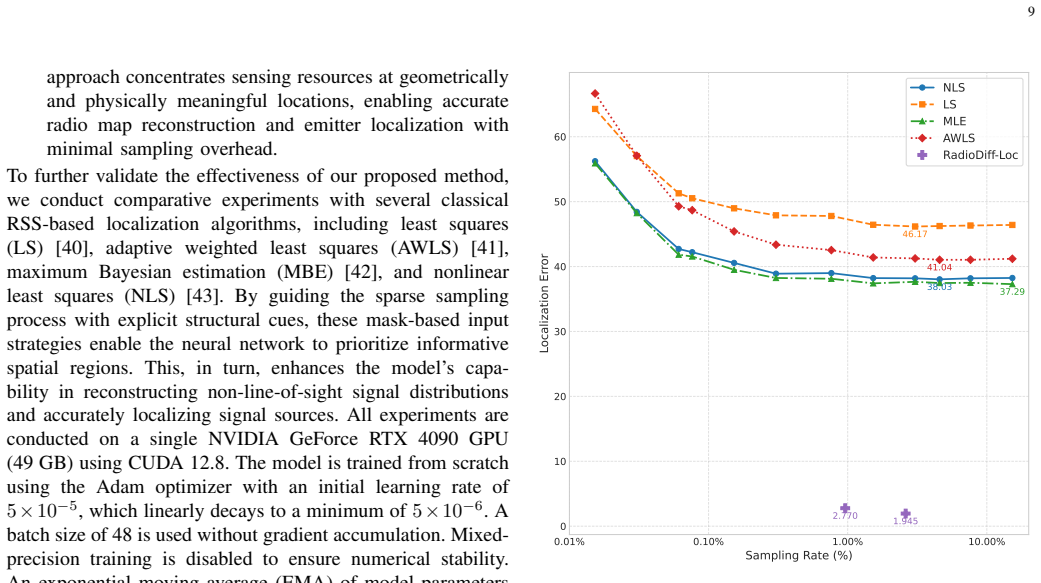
- The reported margin over classical baselines—about 3 meters versus 18 to 41 meters at a 0.96% sampling rate on an urban dataset—suggests that RSS-only NLoS localization is feasible under severe sensing constraints.
- Under shrinking sampling budgets, the vertex-based strategy degrades more gracefully than random sampling, indicating that the sampling rule itself, not just the generative model, is what preserves accuracy.
Where Pith is reading between the lines
- A direct testable extension would compare, in a ray-tracing simulator, the Fisher information about the emitter coordinates at vertex sites versus interior sites; if interior sites are more informative about the source position, the theoretical support for vertex sampling would need revision even if the empirical gains hold.
- Because the pipeline outputs a power-invariant dense relative field, the same trained model could also serve coverage mapping, jammer localization, or channel prediction tasks without recalibration.
- The brightest-point rule assumes a single dominant source; adapting the estimator to multiple emitters or extended sources would require peak detection and assignment on the generated map, a natural next step.
- The sampling-efficiency claim depends on the number of vertices, so environments with many small structures may see the advantage shrink; clustering nearby vertices into a bounded set of probes would be a practical extension.
Editorial analysis
A structured set of objections, weighed in public.
Referee Report
Summary. The paper proposes RadioDiff-Loc, a framework for non-line-of-sight emitter localization that reconstructs a dense radio map from sparse RSS measurements using a conditional diffusion model. The sampling locations are chosen near building edges/vertices, motivated by knife-edge diffraction theory; RSS inputs are normalized by the maximum sampled value to remove dependence on unknown transmit power; and the emitter is localized as the maximum-intensity point of the reconstructed map. The method is evaluated on the RadioMapSeer dataset and compared against classical RSS localization algorithms and alternative sampling strategies. The paper claims high localization accuracy with under 1% sampling and power-invariant inference.
Significance. If the claims were fully validated, the work would be a useful contribution: it combines physically motivated sparse sampling with generative radio-map reconstruction, addresses the unknown-power problem, and demonstrates a dual-driven use of reconstructed maps with classical post-processing. The use of a public benchmark dataset (RadioMapSeer) is a strength, as is the explicit attempt to connect sampling design to diffraction physics. However, the current validation does not support the headline claims: the power-invariance mechanism is not demonstrated, the main comparison against classical methods is confounded by training advantage and differing sampling budgets, and the theoretical justification for vertex sampling is not actually about the source position. These issues are load-bearing for the central claims, so the manuscript needs a substantive revision.
major comments (1)
- [Sec. V-E, Table I] The claim that 'when the sampling budget is constrained, random sampling experiences an increase in localization error exceeding 50%, whereas vertex-based sampling shows a more graceful degradation with only a 40% increase' appears without a corresponding experiment. Table I contains only one sampling rate per strategy and no sweep of sampling budgets. This unsupported quantitative comparison is used to bolster the central sampling-efficiency claim and should be removed or substantiated with the relevant experiments.
minor comments (7)
- [Title, Abstract] Typo: 'Scattering Congnition' should be 'Scattering Cognition'.
- [Sec. II-B] Typo: 'The forward diffusion process is described by the SDE ad follows' should be 'as follows'.
- [Sec. IV-B] Equation numbering is inconsistent: Eq. (18) appears twice, Eq. (19) appears twice, and the localization estimator is labeled Eq. (21) despite no Eq. (20) in that section.
- [Table I] The PSNR column is labeled 'PNSR'; should be PSNR.
- [Sec. V-D, Fig. 4] The text uses MBE (maximum Bayesian estimation) while Fig. 4 uses MLE; please make the terminology consistent.
- [Tables III and IV] Both tables have the caption 'Performance Comparison of Edge Sampling and Random Sampling,' but Table IV compares Hybrid (Vertex + Random) versus Random. The captions should be distinct and correct.
- [Sec. V-B] The input tensor uses two identical sparse-sampled signal strength maps; the reason for the duplication is not explained.
Circularity Check
No circularity: localization and RM reconstruction are evaluated on held-out RadioMapSeer maps; the power-invariance and sampling-theory gaps are validation gaps, not definitional reductions.
full rationale
The claimed derivation chain is: (i) choose sparse sensor locations from building geometry (Sec. IV-A, V-B); (ii) measure RSS and normalize by the sampled maximum (Eq. 31); (iii) condition a diffusion model on the sparse RSS and layout to generate a full RM (Sec. IV-B); (iv) estimate the source as the RM peak (Eq. 21). No step is equivalent to its input by construction. The training targets are RadioMapSeer ground-truth pathloss maps at a fixed 23 dBm (Sec. V-A, V-B), the test maps are geographically disjoint (Sec. V-A), and the sampling masks depend only on building geometry, not on the RSS values or the source position. The vertex/edge vs random comparisons in Table I use matched sampling budgets, so the reported improvements are empirical ablations rather than fitted predictions. The main caveats are not circularity: the power-invariant claim (Eq. 31 + Sec. IV-B) is never tested by varying transmit power, and the Fisher/mutual-information analysis in Eqs. (26)-(29) is computed for the boundary field u, not for the source position d, so it does not rigorously prove that vertex sampling is information-optimal for localization. These are unvalidated assertions or heuristic motivation, but they do not reduce the method's output to its input. Self-citations to the RadioDiff family are contextual and not used as a load-bearing uniqueness argument; the decoupled-diffusion background is cited to external work [38]. The paper is therefore not circular; it is over-claimed in validation coverage.
Axiom & Free-Parameter Ledger
free parameters (2)
- Diffusion model weights and hyperparameters =
Trained with Adam, lr 5e-5 decaying to 5e-6, batch size 48, EMA every 10 steps
- Post-processing thresholds for dual-driven fusion =
top-k (5 to 50), Thr percentile (95% to 99.9%), LBC alpha (0.85 to 0.99)
axioms (4)
- ad hoc to paper The maximum-intensity point of the reconstructed normalized radio map corresponds to the emitter position.
- ad hoc to paper Normalizing RSS measurements by the maximum observed value removes the dependence on unknown transmit power.
- domain assumption The RadioMapSeer simulated pathloss data is representative of real NLoS propagation for the claims made.
- domain assumption Knife-edge diffraction at building edges and vertices is the dominant mechanism enabling informative sparse sampling.
Cite this review
Pith. "Pith review of RadioDiff-Loc: Diffusion Model Enhanced Scattering Congnition for NLoS Localization with Sparse Radio Map Estimation." pith.science (2026). https://pith.science/paper/4IK5TDAY
@misc{pith2026250901875,
  author       = {Pith},
  title        = {Pith review of: RadioDiff-Loc: Diffusion Model Enhanced Scattering Congnition for NLoS Localization with Sparse Radio Map Estimation},
  year         = {2026},
  howpublished = {\url{https://pith.science/paper/4IK5TDAY}},
  note         = {Machine review of arXiv:2509.01875}
}
read the original abstract
Accurate localization of non-cooperative signal sources in non-line-of-sight (NLoS) environments remains a critical challenge with a wide range of applications, including autonomous navigation, industrial automation, and emergency response. In such settings, traditional positioning techniques relying on line-of-sight (LoS) or cooperative signaling fail due to severe multipath propagation and unknown transmit power. This paper proposes a novel generative inference framework for NLoS localization based on conditional diffusion models. By leveraging the physical insight that diffracted electromagnetic energy concentrates near building edges, we develop a sampling strategy that collects sparse received signal strength (RSS) measurements at the geometric vertices of obstacles--locations that maximize Fisher information and mutual information with respect to the unknown source. To overcome the lack of known transmission power, we normalize all sampled RSS values relative to the maximum observed intensity, enabling the construction of a power-invariant radio map (RM). A conditional diffusion model is trained to reconstruct the full RM based on environmental layout and sparse RSS observations. Localization is then achieved by identifying the brightest point on the generated RM. Moreover, the proposed framework is compatible with existing RSS-based localization algorithms, enabling a dual-driven paradigm that fuses physical knowledge and data-driven inference for improved accuracy. Extensive theoretical analysis and empirical validation demonstrate that our approach achieves high localization accuracy with significantly reduced sampling cost, offering a scalable and physically grounded solution for non-cooperative NLoS emitter localization.
Figures


Forward citations
Cited by 3 Pith papers
-
RadioDiff-Inv2: Differentiable Diffusion Inversion under Location Drift from Sparse Noisy Measurements for Radio Map Estimation
RadioDiff-Inv2 estimates radio maps from sparse noisy measurements under location drift by making diffusion inversion differentiable via Gaussian resampling and probability-flow ODE optimization.
-
A Tutorial on Learning-Based Radio Map Construction: Data, Paradigms, and Physics-Awareness
Learning-based radio map construction is taxonomized as source-aware forward prediction versus source-agnostic inverse reconstruction, spanning five neural families, optics-inspired continuous fields, and a three-leve...
-
A Tutorial on Learning-Based Radio Map Construction: Data, Paradigms, and Physics-Awareness
A tutorial organizes learning-based radio map construction around data sources, neural architectures, and physics-awareness integration for wireless environments.
Reference graph
Works this paper leans on
-
[1]
6G omni-scenario on-demand services provisioning: vision, technology and prospect(in chinese),
N. Cheng, F. Chen, W. Chen, Z. Cheng, Q. Yang, C. Li, and X. Shen, “6G omni-scenario on-demand services provisioning: vision, technology and prospect(in chinese),” Sci Sin Inform, vol. 54, pp. 1025–1054,, 2024
work page 2024
-
[2]
Enhanced fingerprinting and trajectory prediction for iot localization in smart buildings,
K. Lin, M. Chen, J. Deng, M. M. Hassan, and G. Fortino, “Enhanced fingerprinting and trajectory prediction for iot localization in smart buildings,” IEEE Transactions on Automation Science and Engineering , vol. 13, no. 3, pp. 1294–1307, 2016
work page 2016
-
[3]
Y . Li, Y . Zhuang, X. Hu, Z. Gao, J. Hu, L. Chen, Z. He, L. Pei, K. Chen, M. Wang et al. , “Toward location-enabled iot (le-iot): Iot positioning techniques, error sources, and error mitigation,” IEEE Internet of Things Journal, vol. 8, no. 6, pp. 4035–4062, 2020
work page 2020
-
[4]
A hybrid indoor navigation system,
A. Butz, J. Baus, A. Kr ¨uger, and M. Lohse, “A hybrid indoor navigation system,” in Proceedings of the 6th international conference on Intelligent user interfaces , 2001, pp. 25–32
work page 2001
-
[5]
C. Li, L. Zhang, and L. Zhang, “A route and speed optimization model to find conflict-free routes for automated guided vehicles in large warehouses based on quick response code technology,” Advanced engineering informatics , vol. 52, p. 101604, 2022
work page 2022
-
[6]
A tutorial on terahertz-band localization for 6g communication systems,
H. Chen, H. Sarieddeen, T. Ballal, H. Wymeersch, M.-S. Alouini, and T. Y . Al-Naffouri, “A tutorial on terahertz-band localization for 6g communication systems,” IEEE Communications Surveys & Tutorials , vol. 24, no. 3, pp. 1780–1815, 2022
work page 2022
-
[7]
Los/nlos near- field localization with a large reconfigurable intelligent surface,
D. Dardari, N. Decarli, A. Guerra, and F. Guidi, “Los/nlos near- field localization with a large reconfigurable intelligent surface,” IEEE Transactions on Wireless Communications , vol. 21, no. 6, pp. 4282– 4294, 2021
work page 2021
-
[8]
Localizing spoofing attacks on vehicular gps using vehicle-to-vehicle communications,
C. Sanders and Y . Wang, “Localizing spoofing attacks on vehicular gps using vehicle-to-vehicle communications,” IEEE Transactions on V ehicular Technology, vol. 69, no. 12, pp. 15 656–15 667, 2020. 12
work page 2020
-
[9]
Z. Huang, S. Chen, Y . Pian, Z. Sheng, S. Ahn, and D. A. Noyce, “Toward c-v2x enabled connected transportation system: Rsu-based cooperative localization framework for autonomous vehicles,” IEEE Transactions on Intelligent Transportation Systems , vol. 25, no. 10, pp. 13 417–13 431, 2024
work page 2024
-
[10]
D. S. Jones, The theory of electromagnetism . Elsevier, 2013
work page 2013
-
[11]
Ray techniques in electromagnetics,
G. A. Deschamps, “Ray techniques in electromagnetics,” Proc. IEEE , vol. 60, no. 9, pp. 1022–1035, 1972
work page 1972
-
[12]
V . N. Vapnik, V . Vapniket al. , Statistical learning theory . wiley New York, 1998
work page 1998
-
[13]
Rss distribution-based passive localization and its application in sensor networks,
C. Liu, D. Fang, Z. Yang, H. Jiang, X. Chen, W. Wang, T. Xing, and L. Cai, “Rss distribution-based passive localization and its application in sensor networks,” IEEE Transactions on Wireless Communications , vol. 15, no. 4, pp. 2883–2895, 2015
work page 2015
-
[14]
A tutorial on environment-aware communications via channel knowledge map for 6G,
Y . Zeng, J. Chen, J. Xu, D. Wu, X. Xu, S. Jin, X. Gao, D. Gesbert, S. Cui, and R. Zhang, “A tutorial on environment-aware communications via channel knowledge map for 6G,” IEEE Commun. Surveys Tuts. , vol. 26, no. 3, pp. 1478–1519, 2024
2024
-
[15]
X. Wang, Q. Zhang, N. Cheng, R. Sun, Z. Li, S. Cui, and X. Shen, “Radiodiff- k2: Helmholtz equation informed generative diffu- sion model for multi-path aware radio map construction,” arXiv preprint arXiv:2504.15623, 2025
-
[16]
X. Wang, Q. Zhang, N. Cheng, J. Chen, Z. Zhang, Z. Li, S. Cui, and X. Shen, “Radiodiff-3d: A 3d ×3d radio map dataset and generative diffusion based benchmark for 6g environment-aware communication,” IEEE Transactions on Network Science and Engineering , 2025
work page 2025
-
[17]
X. Wang, K. Tao, N. Cheng, Z. Yin, Z. Li, Y . Zhang, and X. Shen, “RadioDiff: An effective generative diffusion model for sampling- free dynamic radio map construction,” IEEE Trans. Cognit. Commun. Networking, Early access , pp. 1–13, 2024
work page 2024
-
[18]
Radiodiff-inverse: Diffusion enhanced bayesian inverse estimation for isac radio map construction,
X. Wang, Z. Fang, N. Cheng, R. Sun, Z. Li et al. , “Radiodiff-inverse: Diffusion enhanced bayesian inverse estimation for isac radio map construction,” arXiv preprint arXiv:2504.14298 , 2025
Pith/arXiv arXiv 2025
-
[19]
Toward environment-aware 6G communications via channel knowledge map,
Y . Zeng and X. Xu, “Toward environment-aware 6G communications via channel knowledge map,” IEEE Wireless Commun. , vol. 28, no. 3, pp. 84–91, 2021
2021
-
[20]
RadioUNet: Fast radio map estimation with convolutional neural networks,
R. Levie, C ¸ . Yapar, G. Kutyniok, and G. Caire, “RadioUNet: Fast radio map estimation with convolutional neural networks,” IEEE Trans. Wireless Commun., vol. 20, no. 6, pp. 4001–4015, 2021
work page 2021
-
[21]
High- resolution image synthesis with latent diffusion models,
R. Rombach, A. Blattmann, D. Lorenz, P. Esser, and B. Ommer, “High- resolution image synthesis with latent diffusion models,” 2021
2021
-
[22]
A novel nlos mitigation algorithm for uwb localization in harsh indoor environments,
K. Yu, K. Wen, Y . Li, S. Zhang, and K. Zhang, “A novel nlos mitigation algorithm for uwb localization in harsh indoor environments,” IEEE Transactions on V ehicular Technology, vol. 68, no. 1, pp. 686–699, 2018
work page 2018
-
[23]
Robust nlos localization in 5g mmwave networks: Data-based methods and performance,
R. Klus, J. Talvitie, J. Equi, G. Fodor, J. Torsner, and M. Valkama, “Robust nlos localization in 5g mmwave networks: Data-based methods and performance,” IEEE Transactions on V ehicular Technology, 2024
work page 2024
-
[24]
K. Bregar and M. Mohor ˇciˇc, “Improving indoor localization using convolutional neural networks on computationally restricted devices,” IEEE Access , vol. 6, pp. 17 429–17 441, 2018
work page 2018
-
[25]
Uwb positioning system based on lstm classification with mitigated nlos effects,
D.-H. Kim, A. Farhad, and J.-Y . Pyun, “Uwb positioning system based on lstm classification with mitigated nlos effects,” IEEE Internet of Things Journal , vol. 10, no. 2, pp. 1822–1835, 2022
work page 2022
-
[26]
Y . Zhao and M. Wang, “The los/nlos classification method based on deep learning for the uwb localization system in coal mines,” Applied Sciences, vol. 12, no. 13, p. 6484, 2022
work page 2022
-
[27]
L. Cheng, Y . Li, M. Xue, and Y . Wang, “An indoor localization algorithm based on modified joint probabilistic data association for wireless sensor network,” IEEE Transactions on Industrial Informatics , vol. 17, no. 1, pp. 63–72, 2020
work page 2020
-
[28]
L. Cheng, F. Zhao, P. Zhao, and J. Guan, “Uwb/ins fusion positioning algorithm based on generalized probability data association for indoor vehicle,” IEEE Transactions on Intelligent V ehicles , vol. 9, no. 1, pp. 446–458, 2023
work page 2023
-
[29]
J.-M. Kang, “Nmap-net: Deep learning-aided near-field multi- beamforming design and antenna position optimization for xl-mimo communications,” IEEE Internet of Things Journal , 2025
work page 2025
-
[30]
O. Yong Kang and C. Long, “A robust indoor mobile localization algorithm for wireless sensor network in mixed los/nlos environments,” Journal of Sensors , vol. 2020, no. 1, p. 8854389, 2020
work page 2020
-
[31]
Nlos identification and mitigation for localization based on uwb experimental data,
S. Marano, W. M. Gifford, H. Wymeersch, and M. Z. Win, “Nlos identification and mitigation for localization based on uwb experimental data,” IEEE Journal on selected areas in communications , vol. 28, no. 7, pp. 1026–1035, 2010
work page 2010
-
[32]
Nlos identification for localization based on the application of uwb,
M. Liu, X. Lou, X. Jin, R. Jiang, K. Ye, and S. Wang, “Nlos identification for localization based on the application of uwb,” Wireless Personal Communications, vol. 119, no. 4, pp. 3651–3670, 2021
work page 2021
-
[33]
Nlos effect mitigation via spatial geometry exploitation in cooperative localization,
Y . Wang, K. Gu, Y . Wu, W. Dai, and Y . Shen, “Nlos effect mitigation via spatial geometry exploitation in cooperative localization,” IEEE Transactions on Wireless Communications , vol. 19, no. 9, pp. 6037– 6049, 2020
work page 2020
-
[34]
Rayloc: Wireless in- door localization via fully differentiable ray-tracing,
X. Han, T. Zheng, T. X. Han, and J. Luo, “Rayloc: Wireless in- door localization via fully differentiable ray-tracing,” arXiv preprint arXiv:2501.17881, 2025
Pith/arXiv arXiv 2025
-
[35]
Nlos detection algorithms for ultra-wideband localization,
J. Schroeder, S. Galler, K. Kyamakya, and K. Jobmann, “Nlos detection algorithms for ultra-wideband localization,” in 2007 4th Workshop on Positioning, Navigation and Communication . IEEE, 2007, pp. 159– 166
work page 2007
-
[36]
Denoising diffusion probabilistic models,
J. Ho, A. Jain, and P. Abbeel, “Denoising diffusion probabilistic models,” Advances in neural information processing systems , vol. 33, pp. 6840– 6851, 2020
2020
-
[37]
Score-based generative modeling through stochastic differ- ential equations,
Y . Song, J. Sohl-Dickstein, D. P. Kingma, A. Kumar, S. Ermon, and B. Poole, “Score-based generative modeling through stochastic differ- ential equations,” arXiv preprint arXiv:2011.13456 , 2020
Pith/arXiv arXiv 2011
-
[38]
Decoupled diffusion models: Simultaneous image to zero and zero to noise,
Y . Huang, Z. Qin, X. Liu, and K. Xu, “Decoupled diffusion models: Simultaneous image to zero and zero to noise,” 2024
work page 2024
-
[39]
The first pathloss radio map prediction challenge,
C ¸ . Yapar, F. Jaensch, R. Levie, G. Kutyniok, and G. Caire, “The first pathloss radio map prediction challenge,” in Proceedings of the 2023 IEEE International Conference on Acoustics, Speech and Signal Processing (ICASSP), 2023, pp. 1–2
work page 2023
-
[40]
Linear least squares localization in sensor networks,
Y . Wang, “Linear least squares localization in sensor networks,” Eurasip journal on wireless communications and networking , vol. 2015, no. 1, p. 51, 2015
work page 2015
-
[41]
Robust visual tracking using structurally random projection and weighted least squares,
S. Zhang, H. Zhou, F. Jiang, and X. Li, “Robust visual tracking using structurally random projection and weighted least squares,” IEEE Transactions on Circuits and Systems for Video Technology , vol. 25, no. 11, pp. 1749–1760, 2015
work page 2015
-
[42]
H. Huan, K. Wang, Y . Xie, and L. Zhou, “Indoor location fingerprinting algorithm based on path loss parameter estimation and bayesian infer- ence,” IEEE Sensors Journal , vol. 23, no. 3, pp. 2507–2521, 2022
work page 2022
-
[43]
A kernel method to nonlinear location estimation with rss-based fingerprint,
P. C. Ng, P. Spachos, J. She, and K. N. Plataniotis, “A kernel method to nonlinear location estimation with rss-based fingerprint,” IEEE Trans- actions on Mobile Computing , vol. 22, no. 8, pp. 4388–4404, 2022
work page 2022
This paper was first reviewed by deepseek-v4-flash on August 5, 2026.
discussion (0)
Sign in with ORCID, Apple, or X to comment. Anyone can read and Pith papers without signing in.