REVIEW 5 major objections 5 minor 27 references
Boundary effects in classical liquid density fluctuations at finite temperature
T0 review · 5 major / 5 minor · reviewed 2026-08-16 · deepseek-v4-flash
Pith's one-line read In a liquid between two reflecting planes, exact finite-temperature formulas show that the mean square density fluctuation does not become classical unless one also takes ℏ to zero.
desk verdict Competent finite-temperature extension of earlier phonon-Casimir work with plausible closed forms; the two headline claims (hbar->0 classical limit, third-law validation) are partly imposed by prescription, so it deserves peer review but with conditions. read the letter →
The pith
A machine-rendered reading of the paper's core claim, the machinery that carries it, and where it could break.
The reading
What carries the argument
The machine that carries the whole calculation is the thermal Hadamard two-point function $G_T(w,w')$ in Eq. (20). It expresses the phonon field's symmetric two-point correlation at inverse temperature $\beta$ as an image-sum over $\ell$ (reflections off the two planes) and a Matsubara-like sum over $j$ (thermal winding), with coefficients $\nu^{(i)}_\ell,\epsilon^{(i)}_\ell\in\{-1,+1\}$ encoding Dirichlet, Neumann, and the two mixed conditions. From this single object the authors obtain every observable by coincidence-limit derivatives: two time derivatives yield $\langle\rho^2\rangle_T$, the Hamiltonian operator acting on it yields the energy density, one temperature integral yields the free energy, and one temperature derivative yields the entropy. The argument thus reduces boundary-condition dependence to a sign pattern in a universal closed-form sum.
What would settle it
Measure the mean square density fluctuation of a liquid confined between two parallel solid walls as a function of temperature at fixed separation $a$, in the high-temperature regime $\gamma_a\gg 1$: the paper predicts a temperature-independent plateau proportional to $\hbar\rho_0/(u a^4)$ (times a boundary-condition sum) that vanishes as $a^{-4}$, and if instead a linear-in-$T$ classical term is observed the core claim is wrong. Conversely, a null result with no plateau would indicate the phonon-quantization analogy or the imported two-point function is not applicable.
Extended reading notes
Core claim
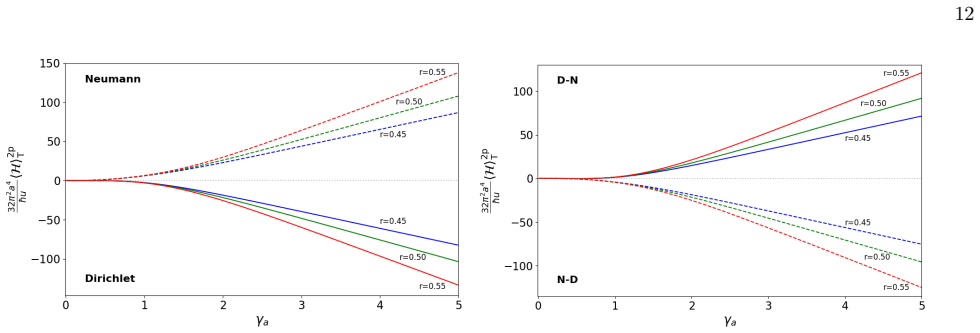
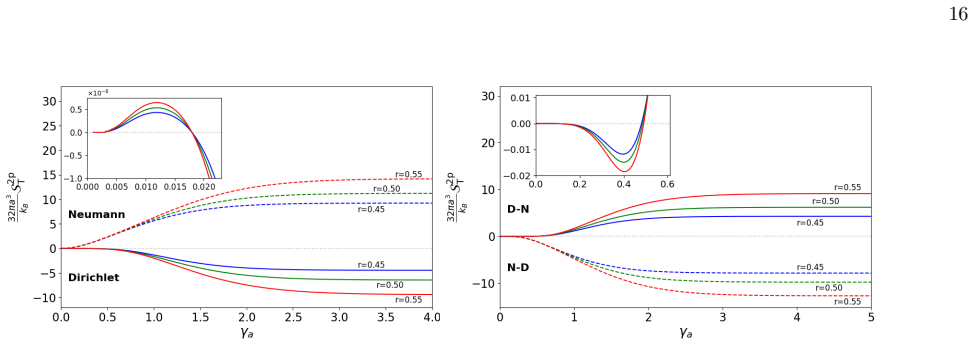
The paper claims that for a classical liquid in a slab between two perfectly reflecting parallel planes, the finite-temperature part of every principal observable—mean square mass density $\langle \rho^2\rangle_T$, total energy density $\langle H\rangle_T$, Helmholtz free energy density $F_T$, and entropy density $S_T$—can be written in closed form as sums over a thermal index $j$, an image index $\ell$, and boundary-condition coefficients $\nu^{(i)}_\ell$ and $\epsilon^{(i)}_\ell$ that only take values $\pm 1$. The low-temperature regime ($\gamma_a \ll 1$, with $\gamma_a = 2 a k_B T/\hbar u$) is quantum-dominated and follows power laws in $T$ whose exponents depend on the boundary condition: for example, the two-plane density fluctuation scales as $T^6$ for Dirichlet, $T^3$ for Neumann, and $T^4$ for the two mixed cases. In the high-temperature regime ($\gamma_a\gg 1$), the energy, free energy, and entropy acquire classical, $\hbar$-independent leading terms, but the mean square density fluctuation instead approaches a temperature-independent plateau proportional to $\hbar$; the classical limit is recovered only by taking $\hbar \to 0$ explicitly. Entropy vanishes as $T\to 0$ for every boundary condition, in agreement with the Nernst heat theorem.
Load-bearing premise
The load-bearing premise is that quantizing the velocity potential with $[\hat{\bar\rho},\hat\phi]=i\hbar\,\delta^3(\mathbf r-\mathbf r')$ and $\hat{\bar\rho}=-\rho_0 u^{-2}\partial_t\hat\phi$ truly describes a classical liquid's density fluctuations, and that the thermal two-point function taken from Ref. [17] is correct; if either fails, every derived formula for $\langle\rho^2\rangle_T$, energy, free energy, and entropy loses its foundation.
Editorial extensions
If this is right
- In a slab geometry, measuring any one of the four observables at fixed $\gamma_a$ determines the sign pattern of the boundary conditions, so the formulas give a spectroscopic probe of wall type.
- At high temperature the two-plane energy density grows linearly with $T$, whereas the mean square density fluctuation reaches a $\hbar$-dependent plateau; this dichotomy is a clean experimental signature to look for in light-scattering or neutron-scattering measurements.
- The crossover scale $k_B T \sim \hbar u/a$ predicts that reducing the plate separation $a$ shifts the quantum-to-classical transition to higher temperatures, giving a tunable knob.
- The vanishing entropy at $T=0$ for all boundary conditions means the confined liquid satisfies the third law within this phonon-quantization model.
Reading between the lines
- The same $\hbar\to 0$ subtlety should reappear in higher-order density correlators, since they are built from the same Hadamard function; a natural extension is to compute the third and fourth moments and check whether the classical limit fails there too.
- The constant high-temperature plateau in $\langle\rho^2\rangle_T$ could be tested with an analogue experiment in a thin superfluid film or a colloidal suspension, where the sound velocity and plate separation can be varied independently.
- The formalism suggests that the 'classical limit' of thermal Casimir-type forces in fluids is not a single prescription: each observable has its own route to $\hbar$ independence, so comparisons between measured quantities and Lifshitz-theory predictions should be done observable by observable.
Signed reviews
Editorial analysis
A structured set of objections, weighed in public.
Referee Report
Summary. The manuscript studies thermal fluctuations of a confined classical liquid modeled as a quantized massless scalar (phonon) field between two parallel mirrors with Dirichlet, Neumann, and mixed boundary conditions. Using a thermal Hadamard two-point function, it derives closed-form expressions for the finite-temperature mean square mass density fluctuation, total energy density, Helmholtz free energy density, and entropy density. The paper reports low-temperature power laws and high-temperature behavior, and emphasizes that the density fluctuation, unlike the other observables, does not become classical at high temperature unless one additionally sends hbar to zero. Numerical plots illustrate the asymptotic regimes.
Significance. If correct, the results would provide a useful exact finite-temperature extension of the phonon analog-model calculations of Ford and Svaiter and of de Farias et al., with explicit boundary-condition dependence and closed-form asymptotics. The analytic mode sums and the distinction between quantum and classical regimes are potentially valuable. However, the paper's central input is imported from a self-citation, and the key classical-limit claim for density fluctuations is tied to a subtraction prescription that is not independently checked. The thermodynamic section also contains coefficient errors and a questionable identification of the energy used in the Gibbs relation. The paper is therefore of interest but needs substantial revision before its conclusions can be relied upon.
major comments (5)
- [II.B, Eq. (20)] The thermal Hadamard function in Eq. (20) is the single input from which every observable in Section III is computed, but its evaluation is not given in this manuscript. The text refers to Ref. [17] for the Abel-Plana steps, and Eq. (20) is simply imported. Since Ref. [17] concerns a different physical setup, the reader cannot verify the normalization or the image coefficients without consulting an external paper. Please provide the derivation, or at least an appendix reproducing the Abel-Plana sums for the three boundary conditions.
- [III.A, Eqs. (27)-(32)] The conclusion that the mean square density fluctuation has no natural classical limit and must be followed by hbar to zero limit is not established independently of the subtraction prescription. The bulk blackbody term (27) diverges as hbar goes to zero, and the surviving single- and two-plane terms (29) and (32) are O(hbar); their vanishing in the hbar to zero limit is therefore a property of the subtracted expression, not a demonstrated classical-limit result. A direct classical (Rayleigh-Jeans) mode-sum calculation for the same boundary conditions, with a definite regularization, is needed to decide whether the physical boundary correction to the density fluctuation is zero, cutoff-dependent, or finite in the classical limit.
- [III.C, Eq. (51) and Section IV] The vanishing of the entropy at T=0 is imposed by setting the integration constant C to zero in Eq. (51); the later statement in Section IV that this provides strong validation of the third law is therefore circular. The results can be reported as consistent with the Nernst theorem once the constant is fixed, but they do not independently validate it.
- [III.C, Eqs. (49)-(52)] The free energy and entropy are derived from U_T = u^2/rho0 <rho^2>_T, which Eq. (49) identifies with the time-derivative (kinetic) term of the Hamiltonian density in Eq. (35). This is not the total energy density <H>_T computed in Section III.B; the two differ at boundaries, for example, the high-temperature single-plane limits of Eqs. (28) and (41) are respectively O(hbar) and O(k_B T). Since the Gibbs relation (50) requires the total internal energy, the use of U_T needs to be justified, or the calculation must be redone with the full Hamiltonian density. Without clarification, the thermodynamic potentials derived below are not evidently those of the confined liquid.
- [III.B, Eq. (43), and III.C, Eqs. (55), (65)] There are concrete coefficient errors in the asymptotic formulas. Expanding Eq. (41) for small gamma_z gives H_T^{1p} approximately epsilon0 pi^2 (k_B T)^4/[45 (hbar u)^3] + O(T^6), independent of z; the printed Eq. (43), epsilon0 (k_B T)^2/(12 hbar u z^4), is dimensionally inconsistent and has the wrong temperature power. Similarly, reducing Eq. (56) for gamma_a >> 1 gives a two-plane free energy proportional to -k_B T/(32 pi a^3) times the displayed bracket, not -k_B T/(64 pi a^3) as in Eq. (55); with Eq. (55) as printed, S = -dF/dT would disagree with Eq. (65) by a factor of two. These formulas must be corrected and checked against the closed forms.
minor comments (5)
- [III.B, text before Eq. (47)] The sentence 'we can perform the sum over j in Eq. (47)' should refer to Eq. (44), since Eq. (47) is the result of that summation.
- [Eqs. (30), (44), (53), (63)] The double sums in these equations are not absolutely convergent; please state the summation prescription (partial sums, Abel-Plana regularization, or analytic continuation) used for the numerical evaluation, since the order of summation matters for conditionally convergent series.
- [Eqs. (23)-(24)] The notation <rho^2>_T is used both for the thermal two-point function in Eq. (23) and for its coincidence limit in Eq. (24); please distinguish the two explicitly.
- [III.A, below Eq. (27)] The phrase 'a reasonable hypothesis' in the discussion of the hbar to zero limit is vague; please state the renormalization prescription precisely and give the physical rationale for subtracting the Minkowski blackbody contribution.
- [Eq. (22)] The vectors nu and epsilon are introduced with four entries, but the single-plane discussion refers only to epsilon0; please define the index i explicitly and state that the DN and ND configurations are swapped under z -> a-z.
Circularity Check
Entropy vanishing is imposed by setting C=0, then billed as a Nernst-theorem validation; the core thermal two-point function is imported from a same-author citation.
-
fitted input called prediction
[Section III.C, Eq. (51) and the paragraph after Eq. (62); echoed in the Conclusions.]
"FT =−Tu2/ρ2 0 Z dT T 2⟨ρ2⟩T +CT, where the integration constant C must vanish to ensure the entropy S→ 0 as T→ 0, in accordance with the third law of thermodynamics (Nernst heat theorem) [27], as shown later. ... Note that if we had not set the constant C in Eq. (51) to zero, the entropy density in this limit would instead be S1p T = C. Therefore, to ensure that the entropy density satisfies the third law of thermodynamics, we must set C = 0."
The free energy is integrated with an undetermined constant C. The paper fixes C=0 by requiring S(0)=0, i.e. by imposing the Nernst theorem. The entropy then vanishes at T=0 by construction, and the later statement that this vanishing provides a 'strong validation of the third law' merely reports the same condition that was inserted into Eq. (51). The low-temperature power laws are not forced, but the advertised Nernst agreement is a fitted input rather than an independent prediction.
-
self citation load bearing
[Section II.B, Eq. (20), in the paragraph introducing Eq. (20).]
"The same mathematical operations involving the k-integral and n-summation appearing in Eq. (18) have been thoroughly analyzed in Ref. [17] using the Abel-Plana formula [16] for Dirichlet, Neumann and mixed boundary conditions. Therefore, we can express the final result in compact form as Eq. (20)."
Eq. (20) is the thermal Hadamard two-point function from which every observable in Section III (mean square density, energy, free energy, entropy) is computed. The paper does not re-derive this central input; it imports the result from Ref. [17], whose author H. F. Santana Mota is a coauthor of the present work. The derivation chain is therefore load-bearing on a self-citation for its starting point, with no independent derivation or external check supplied here.
full rationale
After Eq. (20) is granted, the algebraic derivations of the boundary-condition-dependent expressions are internally consistent and contain substantial independent content: the low- and high-temperature asymptotics, the crossover scale k_BT ~ ℏu/a, and the distinct Dirichlet/Neumann/mixed behaviors are not themselves circular. However, two steps prevent a clean 0-2 verdict. First, the Nernst-theorem agreement is not a prediction: Eq. (51) sets the integration constant C=0 specifically to make S→0 at T=0, and the conclusions then cite this enforced vanishing as a strong validation of the third law. Second, the core thermal Hadamard function in Eq. (20) is taken without re-derivation from Ref. [17], which is coauthored by one of the present authors; this makes the central input load-bearing on a self-citation. The high-temperature density-fluctuation result ('requires explicit ℏ→0') is obtained by a stipulated bulk-subtraction plus ℏ→0 prescription; that is a physical-interpretation risk rather than a demonstrated classical-mode-sum result, but it is not the same as a by-construction reduction. Overall, partial circularity in the Nernst validation, plus a load-bearing same-author citation, warrant a score of 6.
Assumptions & free parameters
assumptions (7)
- domain assumption The liquid's density fluctuations satisfy the linear dispersion relation omega = u|k| (Eq. (2)).
- ad hoc to paper Density fluctuation and velocity potential operators obey the canonical commutation relation [rho-hat, phi-hat] = i h-bar delta^3 (Eq. (5)).
- domain assumption The operator relation rho-hat = -rho0/u^2 partial_t phi-hat (Eq. (6)).
- domain assumption The thermal Hadamard two-point function in Eq. (20) is correct.
- domain assumption Perfectly reflecting parallel plates impose Dirichlet, Neumann, or mixed boundary conditions on the field (Table II A).
- ad hoc to paper The bulk (Minkowski) blackbody contribution can be subtracted to isolate boundary effects.
- ad hoc to paper The integration constant C in Eq. (51) is set to zero.
Cite this review
Pith. "Pith review of Boundary effects in classical liquid density fluctuations at finite temperature." pith.science (2026). https://pith.science/paper/4JPG3F44
@misc{pith2026250421766,
  author       = {Pith},
  title        = {Pith review of: Boundary effects in classical liquid density fluctuations at finite temperature},
  year         = {2026},
  howpublished = {\url{https://pith.science/paper/4JPG3F44}},
  note         = {Machine review of arXiv:2504.21766}
}
abstract
We investigate thermal effects on density fluctuations in confined classical liquids using phonon quantization. The system is modeled via a massless scalar field between perfectly reflecting parallel planes with Dirichlet, Neumann, and mixed boundary conditions. Exact closed-form expressions are derived for the mean square mass density, total energy density, and thermodynamic quantities including Helmholtz free energy and entropy densities. Our analysis identifies distinct regimes, namely, a low-temperature quantum regime exhibiting characteristic power-law behavior for each boundary condition, and a high-temperature classical regime where $\hbar$-independent behavior emerges as expected. A particularly interesting finding shows that while most quantities transition naturally to classical behavior, the mean square density fluctuation requires explicit consideration of the $\hbar\to 0$ limit. The entropy density vanishes at zero temperature, in agreement with the Nernst heat theorem. Numerical analysis confirms our analytical results, particularly the asymptotic temperature behaviors and the intermediate crossover region, in which quantum and classical effects compete. This regime is governed by the energy scale $k_B T \sim \hbar u / a$, where $a$ is the distance between the planes and $u$ is the sound velocity.
Figures


Figures from the paper (5 more)



Reference graph
Works this paper leans on
-
[17]
E. J. B. Ferreira and H. F. Santana Mota, Quantum Brownian motion induced by a scalar field in Einstein’s universe , Eur. Phys. J. C 84 (2024) 412, [ 2311.15749]
work page Pith review arXiv 2024
-
[1]
C. Kittel and P. McEuen, Introduction to solid state physics . John Wiley & Sons, 2018
work page 2018
-
[2]
E. M. Lifshitz and L. P. Pitaevskii, Statistical physics: theory of the condensed state , vol. 9. Elsevier, 2013
2013
-
[3]
I. E. Dzyaloshinskii, E. M. Lifshitz and L. P. Pitaevskii, The general theory of van der Waals forces , Adv. Phys. 10 (1961) 165–209
work page 1961
- [4]
-
[5]
L. H. Ford and N. F. Svaiter, The Phononic Casimir Effect: An Analog Model , J. Phys. Conf. Ser. 161 (2009) 012034, [0811.2409]
work page Pith review arXiv 2009
-
[6]
L. H. Ford and N. F. Svaiter, A Fluid Analog Model for Boundary Effects in Field Theory , Phys. Rev. D 80 (2009) 065034, [0903.2694]
work page Pith review arXiv 2009
-
[7]
K. E. L. de Farias, A. Mohammadi and H. F. Santana Mota, Boundary effects on classical liquid density fluctuations , Phys. Rev. D 104 (2021) 045015, [ 2105.10040]
work page Pith review arXiv 2021
Show all 27 references
-
[8]
K. E. L. de Farias, A. Mohammadi and H. F. Mota Santana, Thermal Casimir effect in a classical liquid in a quasiperiod- ically identified conical spacetime, Phys. Rev. D 105 (2022) 085024, [ 2201.07898]
2022 arXiv
-
[9]
L. H. Ford and N. F. Svaiter, Quantum Density Fluctuations in Classical Liquids , Phys. Rev. Lett. 102 (2009) 030602, [0809.1851]
2009 arXiv
-
[10]
H. B. Casimir, On the attraction between two perfectly conducting plates , in Proc. Kon. Ned. Akad. Wet. , vol. 51, p. 793, 1948
1948
-
[11]
Bschorr, The force between two parallel rigid plates due to the radiation pressure of phonons , The Journal of the Acoustical Society of America 106 (1999) 3730–3731
O. Bschorr, The force between two parallel rigid plates due to the radiation pressure of phonons , The Journal of the Acoustical Society of America 106 (1999) 3730–3731
1999
-
[12]
Larraza and B
A. Larraza and B. Denardo, An acoustic casimir effect , Physics Letters A 248 (1998) 151–155
1998
-
[13]
Larraza, C
A. Larraza, C. D. Holmes, R. T. Susbilla and B. Denardo, The force between two parallel rigid plates due to the radiation pressure of broadband noise: An acoustic casimir effect , The Journal of the Acoustical Society of America 103 (1998) 2267–2272
1998
-
[14]
J. C. Jaskula, G. B. Partridge, M. Bonneau, R. Lopes, J. Ruaudel, D. Boiron et al., An acoustic analog to the dynamical Casimir effect in a Bose-Einstein condensate , Phys. Rev. Lett. 109 (2012) 220401, [ 1207.1338]
2012 arXiv
-
[15]
N. D. Birrell and P. C. W. Davies, Quantum fields in curved space . Cambridge university press, 1984
1984
-
[16]
A. A. Saharian, The generalized abel-plana formula with applications to bessel functions and casimir effect , arXiv preprint arXiv:0708.1187 (2007)
2007 arXiv
-
[18]
Geyer, G
B. Geyer, G. L. Klimchitskaya and V. M. Mostepanenko, Thermal Casimir effect in ideal metal rectangular boxes , Eur. Phys. J. C 57 (2008) 823–834, [ 0808.3754]
2008 arXiv
-
[19]
E. M. Lifshitz, The theory of molecular attractive forces between solids , Sov. Phys. JETP 2 (1956) 73–83
1956
-
[20]
V. B. Bezerra, G. L. Klimchitskaya, V. M. Mostepanenko and C. Romero, Thermal Casimir effect in closed Friedmann universe revisited, Phys. Rev. D 83 (2011) 104042
2011
-
[21]
V. B. Bezerra, V. M. Mostepanenko, H. F. Mota and C. Romero, Thermal Casimir effect for neutrino and electromagnetic fields in closed Friedmann cosmological model , Phys. Rev. D 84 (2011) 104025, [ 1110.4504]
2011 arXiv
-
[22]
V. A. De Lorenci, L. G. Gomes and E. S. Moreira, Jr., Local thermal behaviour of a massive scalar field near a reflecting wall, JHEP 03 (2015) 096, [ 1410.7826]
2015 arXiv
-
[23]
Elizalde, Ten physical applications of spectral zeta functions , vol
E. Elizalde, Ten physical applications of spectral zeta functions , vol. 35. 1995, 10.1007/978-3-540-44757-3
1995 doi
-
[24]
Elizalde, Explicit analytical continuation of the inhomogeneous epstein zeta function , Hiroshima Univ
E. Elizalde, Explicit analytical continuation of the inhomogeneous epstein zeta function , Hiroshima Univ. preprint (Septem- ber 1994)
1994
-
[25]
Abramowitz and I
M. Abramowitz and I. Stegun, Handbook of Mathematical Functions with Formulas, Graphs, and Mathematical Tables . No. v. 55,N º 1972 in Applied mathematics series. U.S. Government Printing Office, 1970
1972
-
[26]
Gradshteyn and I
I. Gradshteyn and I. Ryzhik, Table of Integrals, Series, and Products . Elsevier, 2007
2007
-
[27]
L. D. Landau and E. M. Lifshitz, Statistical Physics, Part 1 , vol. 5 of Course of Theoretical Physics . Butterworth- Heinemann, Oxford, 1980
1980
Reviewed August 16, 2026 · model on record in the stance chip above.
Discussion (0). Continue with ORCID to comment.