REVIEW 2 major objections 2 minor 1 cited by
Incorporating thermodynamic consistency into learnable terms allows data-driven recovery of Hamiltonians in open quantum systems.
Reviewed by Pith at T0; open to challenge. T0 means a machine referee read the full paper against a public rubric. the ladder, T0–T4 →
T0 review · grok-4.3
2026-05-19 11:19 UTC pith:4O7MBMTQ
load-bearing objection The paper adds learnable nonlinear terms to open quantum master equations while enforcing thermodynamic consistency and shows validation on both synthetic and experimental data. the 2 major comments →
Learning thermodynamic master equations for open quantum systems
The pith
A machine-rendered reading of the paper's core claim, the machinery that carries it, and where it could break.
Core claim
The central claim is that a data-driven model for open quantum systems can be constructed by including learnable, thermodynamically consistent terms in the dynamical equations. This results in a trained model that is interpretable because it directly estimates the system Hamiltonian and the linear components of the coupling to the environment. The approach is validated through tests on synthetic data for two-level and three-level systems as well as on experimental two-level data from a quantum device.
What carries the argument
A master equation augmented with learnable nonlinear terms constrained by thermodynamic consistency conditions, enabling direct extraction of the Hamiltonian and linear couplings during training.
Load-bearing premise
Imposing thermodynamic consistency on the nonlinear learnable terms does not introduce systematic bias that would stop the model from correctly identifying the Hamiltonian and couplings when only limited noisy data is available.
What would settle it
Training the model on synthetic data generated from a known Hamiltonian and checking whether the extracted parameters match the ground truth within the level of added noise.
If this is right
- The model recovers the system Hamiltonian accurately from finite noisy datasets.
- Linear coupling coefficients to the environment are estimated directly as part of training.
- The method applies to both two-level and three-level quantum systems.
- It supports characterization tasks needed for quantum computing and related applications.
Where Pith is reading between the lines
- The learned parameters could be used to predict system behavior under control fields not present in the training data.
- Similar consistency constraints might apply to master equations describing other environmental interactions.
- The interpretability feature could aid in identifying discrepancies between expected and observed device performance.
Editorial analysis
A structured set of objections, weighed in public.
Referee Report
Summary. The paper presents a data-driven model for learning master equations describing open quantum systems. It incorporates learnable nonlinear terms that are constrained to satisfy thermodynamic consistency, while remaining interpretable through direct estimation of the system Hamiltonian and the linear components of environmental coupling. The approach is validated on synthetic trajectories for two- and three-level systems as well as on experimental data from a two-level device.
Significance. If the results hold, the work offers a concrete route to embedding physical constraints into nonlinear scientific machine-learning models for open quantum systems. The combination of data-driven flexibility with thermodynamic consistency and direct interpretability of Hamiltonian and coupling parameters addresses a recognized gap between purely black-box neural models and traditional Lindblad or Redfield equations. Validation on both synthetic and real experimental trajectories from a quantum device is a positive feature that supports practical applicability in quantum computing and control.
major comments (2)
- [§4] §4 (Validation on synthetic and experimental data): the interpretability claim—that the model accurately recovers the true Hamiltonian and linear couplings—rests on the assumption that the thermodynamic consistency constraint on the nonlinear terms does not introduce systematic bias under finite noisy data. No ablation study or quantitative bias analysis (e.g., comparison of recovered parameters with and without the consistency penalty across noise levels or trajectory lengths) is reported. This omission directly affects the central claim that the learned model remains faithful to the underlying physics while enforcing consistency.
- [§3.2] §3.2 (Thermodynamic consistency enforcement): the precise functional form used to impose thermodynamic consistency on the learnable nonlinear coefficients is not shown to be free of implicit bias on the linear coupling terms. If the consistency condition couples back into the linear sector through the optimization, the recovered Hamiltonian and coupling parameters could be shifted even when the nonlinear terms are small; an explicit derivation or numerical check of this decoupling is needed.
minor comments (2)
- [Abstract and §3] The abstract states that the model 'directly estimates' the Hamiltonian and couplings, but the precise mapping from learned parameters to these quantities should be stated explicitly in the main text (e.g., via an equation in §3).
- [Figures in §4] Figure captions for the validation plots should include the number of trajectories, noise level, and optimization hyperparameters used in each experiment to allow reproducibility.
Simulated Author's Rebuttal
We thank the referee for the constructive feedback on our manuscript. We address the two major comments point by point below, agreeing where revisions are warranted to strengthen the evidence for interpretability and the decoupling of consistency constraints.
read point-by-point responses
-
Referee: [§4] §4 (Validation on synthetic and experimental data): the interpretability claim—that the model accurately recovers the true Hamiltonian and linear couplings—rests on the assumption that the thermodynamic consistency constraint on the nonlinear terms does not introduce systematic bias under finite noisy data. No ablation study or quantitative bias analysis (e.g., comparison of recovered parameters with and without the consistency penalty across noise levels or trajectory lengths) is reported. This omission directly affects the central claim that the learned model remains faithful to the underlying physics while enforcing consistency.
Authors: We agree that an explicit ablation study would provide stronger quantitative support for the claim that the consistency constraint does not introduce systematic bias in the recovered Hamiltonian and linear couplings. Our existing synthetic validations show accurate parameter recovery under noise, but we did not include direct comparisons to an unconstrained baseline. We will add this analysis to the revised Section 4, reporting recovery errors for Hamiltonian and coupling parameters with and without the consistency penalty, across multiple noise levels and trajectory lengths. revision: yes
-
Referee: [§3.2] §3.2 (Thermodynamic consistency enforcement): the precise functional form used to impose thermodynamic consistency on the learnable nonlinear coefficients is not shown to be free of implicit bias on the linear coupling terms. If the consistency condition couples back into the linear sector through the optimization, the recovered Hamiltonian and coupling parameters could be shifted even when the nonlinear terms are small; an explicit derivation or numerical check of this decoupling is needed.
Authors: The consistency constraint is implemented as a penalty on the nonlinear coefficients that enforces non-negative entropy production and is constructed to act exclusively on the nonlinear sector (see Eq. (12) and surrounding derivation in §3.2). The linear coupling terms enter the loss separately and are not directly modified by the penalty gradient. To address possible indirect effects through joint optimization, we will add a numerical decoupling check in the revision: we compare recovered linear parameters in the limit of vanishing nonlinear terms with the consistency penalty active versus inactive, confirming no measurable shift within optimization tolerance. revision: partial
Circularity Check
No significant circularity; data-driven fitting with external constraints remains independent
full rationale
The paper constructs a learnable model for open quantum dynamics by fitting parameters directly to observed trajectories (synthetic 2/3-level and experimental 2-level data). Thermodynamic consistency is imposed as a structural constraint on the nonlinear terms rather than being derived from or equivalent to the target Hamiltonian/coupling estimates. No self-definitional reduction, fitted-input-as-prediction, or self-citation load-bearing step is present; the central interpretability claim rests on recovery from data under the constraint, which is externally falsifiable via the reported validation experiments. This is the most common honest non-finding for a data-driven physics-informed model.
Axiom & Free-Parameter Ledger
free parameters (1)
- learnable nonlinear coefficients
axioms (1)
- domain assumption Thermodynamic consistency (non-decreasing entropy, energy balance) can be imposed as hard constraints on the learnable model without destroying identifiability of the Hamiltonian.
read the original abstract
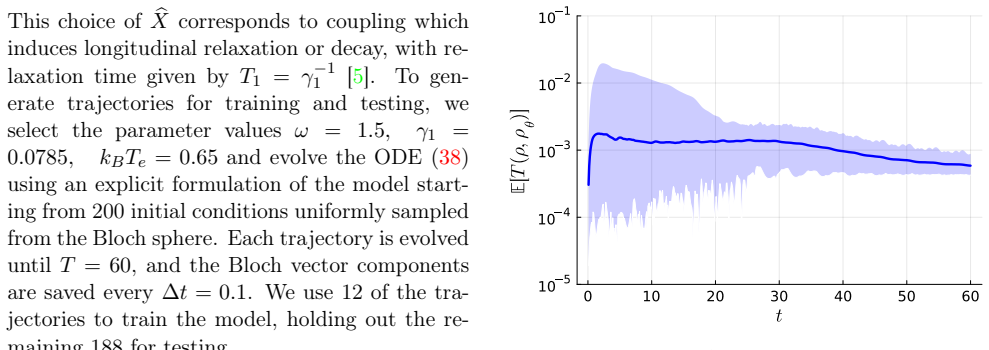
The characterization of Hamiltonians and other components of open quantum dynamical systems plays a crucial role in quantum computing and other applications. Scientific machine learning techniques have been applied to this problem in a variety of ways, including by modeling with deep neural networks. However, the majority of mathematical models describing open quantum systems are linear, and the natural nonlinearities in learnable models have not been incorporated using physical principles. We present a data-driven model for open quantum systems that includes learnable, thermodynamically consistent terms. The trained model is interpretable, as it directly estimates the system Hamiltonian and linear components of coupling to the environment. We validate the model on synthetic two and three-level data, as well as experimental two-level data collected from a quantum device at Lawrence Livermore National Laboratory.
Figures


Lean theorems connected to this paper
-
IndisputableMonolith/Cost/FunctionalEquation.leanwashburn_uniqueness_aczel unclear?
unclearRelation between the paper passage and the cited Recognition theorem.
We present a data-driven model for open quantum systems that includes learnable, thermodynamically consistent terms... via the GENERIC formalism
What do these tags mean?
- matches
- The paper's claim is directly supported by a theorem in the formal canon.
- supports
- The theorem supports part of the paper's argument, but the paper may add assumptions or extra steps.
- extends
- The paper goes beyond the formal theorem; the theorem is a base layer rather than the whole result.
- uses
- The paper appears to rely on the theorem as machinery.
- contradicts
- The paper's claim conflicts with a theorem or certificate in the canon.
- unclear
- Pith found a possible connection, but the passage is too broad, indirect, or ambiguous to say the theorem truly supports the claim.
Forward citations
Cited by 1 Pith paper
-
Learning Volterra Memory Kernels for Non-Markovian Qubit Dynamics
Padé-rational fits to Volterra memory kernels can predict non-Markovian qubit trajectories across initial states even when the underlying kernels are not uniquely recoverable.
discussion (0)
Sign in with ORCID, Apple, or X to comment. Anyone can read and Pith papers without signing in.