REVIEW 3 major objections 6 minor 37 references
Sharing how classes relate inside each client beats sharing model weights or prototype coordinates when federated models have different architectures.
Reviewed by Pith at T0; open to challenge. T0 means a machine referee read the full paper against a public rubric. the ladder, T0–T4 →
T0 review · grok-4.5
2026-07-30 20:39 UTC pith:4QIN3ITV
load-bearing objection Solid hetero-FL methods paper: relation topology is a real step past prototype averaging, with one clean control still missing. the 3 major comments →
FedTopo: Relation-Level Topology Sharing for Model-Heterogeneous Federated Learning
The pith
A machine-rendered reading of the paper's core claim, the machinery that carries it, and where it could break.
Core claim
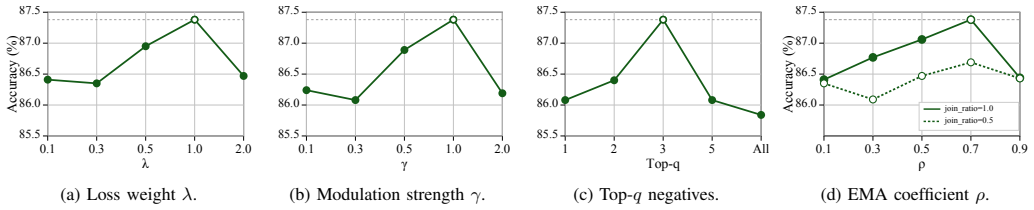
Under model heterogeneity and non-IID data, global knowledge is more reliably transferred as a reliability-weighted class-relation topology than as parameters, distilled predictions, or absolute prototype coordinates; guiding local training by emphasizing topology-similar negatives yields consistently higher personalized accuracy with low communication and zero inference overhead.
What carries the argument
Reliability-aware class-relation topology: each client builds a cosine-similarity matrix among its local class prototypes, the server aggregates those matrices with harmonic-mean weights that down-weight sparsely supported pairs and an observation mask for missing classes, then clients use the resulting global topology only during training to boost the logits of the top-q most similar negatives.
Load-bearing premise
That the way classes sit relative to one another inside each client's own feature space stays similar enough across different network architectures to serve as a useful shared signal, even when those architectures warp features in ways that simple scaling and rotation cannot cancel.
What would settle it
Train the same eight heterogeneous backbones on CIFAR-100 or Tiny-ImageNet under the pathological split and check whether FedTopo's average local-test accuracy still exceeds the strongest prototype- and distillation-sharing baselines by a clear margin; a reversal or statistical tie would falsify the claim that relation topology is the more transferable carrier.
If this is right
- Model-heterogeneous FL systems can drop shared heads, public distillation data, and prototype averaging when only class-relation matrices and counts are exchanged.
- Communication per round scales with the square of the number of classes rather than model size or feature dimension, remaining cheaper than prototype methods for moderate label spaces.
- Topology guidance can be switched off at inference, so deployed client models keep their original size and latency.
- Reliability weighting automatically discounts clients or class pairs that contribute little statistical support, reducing negative transfer under severe label skew.
Where Pith is reading between the lines
- The same relative-topology idea could be tried for open-set or continually arriving classes, where absolute prototypes become even harder to align.
- If the residual non-conformal feature distortion grows with modality gap (e.g., vision vs. language backbones), relation consistency may degrade and would need a cross-modal reliability term.
- Sparse or low-rank approximations of the C-by-C relation matrix could keep communication sub-quadratic for problems with thousands of classes.
Editorial analysis
A structured set of objections, weighed in public.
Referee Report
Summary. FedTopo addresses model-heterogeneous federated learning by sharing class relation topology rather than parameters, logits, or prototype coordinates. Each client builds a cosine-similarity relation matrix from local prototypes, uploads it with class counts, and the server forms a reliability-weighted global topology (Rg, Sg) that is EMA-smoothed and broadcast. Clients then raise logits of top-q topology-similar negatives and add an auxiliary CE term during training only. The paper argues that relations are more transferable under backbone mismatch than absolute coordinates (Prop. 1 on conformal invariance; mechanism Figs. 4–5), and reports consistent gains over parameter-, distillation-, and prototype-sharing baselines on CIFAR-10/100 and Tiny-ImageNet under Dirichlet and pathological non-IID with eight heterogeneous backbones (Table I), plus ablations, sensitivity, and low communication/no inference overhead.
Significance. If the gains are truly driven by transferable relation topology under non-aligned feature spaces, the work offers a clean, data-free alternative to prototype and partial-parameter sharing for heterogeneous FL, with attractive O(C²) communication that is still small for moderate C and zero inference cost. Strengths include a clear three-stage design, multi-dataset/multi-backbone evaluation with mean±std over three runs, an ablation separating local vs shared topology (Table II), heterogeneity sweeps (Fig. 8), communication/FLOP accounting (Table III), mechanism visualizations (Figs. 4–5), and public code. The conformal-invariance argument (Prop. 1) is a useful, if limited, analytical anchor. The contribution is incremental but practically relevant for heterogeneous edge/silo settings.
major comments (3)
- [§IV-D Eqs. (9)–(13); Table II; §V-B] The central causal claim—that Table I gains come from cross-client relation topology surviving backbone mismatch—is only partly isolated. Table II shows Local 85.43 → local topology 86.01 → full FedTopo 87.38, so sharing helps beyond the auxiliary loss alone. However, the training signal (Eqs. 9–13) is hard-negative logit boosting plus auxiliary CE; that machinery can improve discrimination even if Rg is only a weak or non-semantic prior. There is no control that keeps identical boosting (λ, γ, top-q, mask) while replacing Rg with a non-semantic matrix (identity, fixed random, or name-embedding similarities). Without that, “relation-level topology sharing beats other paradigms because relations survive non-aligned spaces” remains confounded with “auxiliary hard-negative boosting helps personalized heads.” A scrambled/random-Rg control (and ideally a public-similarity prior) on at least C
- [§V-B Eq. (18), Prop. 1; Figs. 4–5; Table I] Proposition 1 shows cosine relations cancel isotropic scaling and orthogonal transforms (Ek=0 in Eq. 18), but real heterogeneous backbones induce non-conformal residuals, sampling noise, and optimization error, which the text acknowledges. Figs. 4–5 support greater relation consistency than prototype coordinates on vision backbones sharing the same label space, yet they do not quantify how large Ek is under the actual eight-backbone FL setup, nor whether residual mismatch correlates with per-client gains. A short quantitative residual analysis (e.g., Procrustes residual after conformal fit of same-class prototypes, or correlation of Dr_k with accuracy lift) would tighten the link between the theory and Table I, especially for the many-class pathological setting where the largest gains appear.
- [§VI-A.2; comparison to prototype methods in Table I] All backbones are forced to a unified d=512 via adaptive average pooling (§VI-A.2). That is reasonable for fair prototype baselines, but it partially homogenizes the representation interface and may understate the coordinate mismatch FedTopo claims to avoid. A brief sensitivity check with backbone-native feature dimensions (or different d) would show whether relation sharing still dominates when coordinate spaces differ in both semantics and dimension—the regime the introduction emphasizes.
minor comments (6)
- [Fig. 1] Fig. 1 caption and body use “ropology” / mixed math fonts; clean typography for Rg, Sg, and the aggregation formula.
- [Algorithm 1; §VI-A.4] Algorithm 1 initializes Rg_0 = I_C; briefly justify why a self-relation prior is preferred to zeros or a uniform matrix, and whether it interacts with the 3-round warmup.
- [Table III; §VII] Table III communication is O(C²); the conclusion notes this, but a one-line comparison for C=100 and C=200 against C×d prototype upload would make the “low communication” claim easier to assess at a glance.
- [§VI-A.1] Pathological setting assigns 2/10/20 classes per client on the three datasets; state how classes are chosen (random disjoint vs overlapping) for reproducibility.
- [§II; References] Related work cites several 2025–2026 venues; ensure camera-ready citations match final proceedings and that FedRE/FedSCE settings match the authors’ official protocols where possible.
- [§VI-A.4; Fig. 9] Default hyperparameters (λ=γ=1, q=3, ρ=0.7) are supported by Fig. 9 on CIFAR-10; note whether the same defaults were used unchanged on CIFAR-100 and Tiny-ImageNet.
Circularity Check
No significant circularity: standard empirical FL method with an algebraic identity and held-out accuracy comparisons.
full rationale
FedTopo’s chain is: (i) define local cosine class-relation matrices from client prototypes (Eqs. 2–3), (ii) reliability-weighted server aggregation (Eqs. 4–8), (iii) topology-guided logit boosting of top-q negatives at train time (Eqs. 9–13), (iv) report mean local-test accuracy vs baselines (Table I). Proposition 1 is a short, parameter-free algebraic identity (cosine is invariant to isotropic scale and orthogonal transforms); it does not fit data or redefine the target metric. Hyperparameters λ, γ, q, ρ are chosen via sensitivity plots (Fig. 9), not smuggled into a claimed closed-form prediction. Evaluation uses held-out local test splits never used to set the method’s equations. Citations are to external FL baselines and standard architectures, not author-owned uniqueness theorems that force the design. Skeptical concerns about whether gains isolate topology transfer versus hard-negative boosting are experimental-design/correctness issues, not circular reduction of a claimed derivation to its inputs. No step reduces by construction to a fitted target or self-definitional loop.
Axiom & Free-Parameter Ledger
free parameters (6)
- topology loss weight λ =
1.0
- logit modulation strength γ =
1.0
- top-q negatives q =
3
- EMA coefficient ρ =
0.7
- warmup rounds before topology guidance =
3
- unified feature dimension d after adaptive pooling =
512
axioms (5)
- domain assumption Cosine similarity of class-mean embeddings is a valid proxy for semantic class relatedness within a client.
- domain assumption Clients share a common closed label set C so a C×C relation matrix is meaningful to every client.
- ad hoc to paper Pair reliability proportional to the harmonic mean of the two class counts is an appropriate support measure.
- domain assumption Cross-entropy on logits with selected negatives raised by γ sharpens decision boundaries usefully without harming the primary task when λ is moderate.
- domain assumption Non-IID partitions via Dirichlet(α) and pathological class subsets are adequate stress tests of heterogeneous FL methods.
invented entities (2)
-
Global class relation topology (Rg) as the primary shared knowledge carrier
no independent evidence
-
Relation reliability matrix Sg
no independent evidence
read the original abstract
Federated learning (FL) enables collaborative learning over decentralized data silos without centralizing raw data. However, heterogeneous local architectures often induce non-aligned representation spaces, making it difficult to transfer global knowledge across silos. Existing paradigms share this knowledge as model parameters, distilled predictions, or class prototypes, yet all encode it in an absolute space that must be aligned across clients. Heterogeneous backbones break this alignment, so the shared knowledge becomes unreliable and misleads local training. We propose FedTopo, a relation-level framework that encodes global knowledge as class relation topology, capturing how classes relate within each client rather than where they lie in feature space. Each client builds its relation topology from local prototypes and uploads it with class statistics. The server then aggregates these relations in a reliability-aware manner that down-weights weakly supported ones, and broadcasts the global topology to clients. The global topology guides local training by emphasizing topology-similar negative classes. Experiments on three datasets under eight heterogeneous backbones show that FedTopo consistently outperforms parameter-, distillation-, and prototype-sharing baselines, with low communication and no inference overhead. Our code is available at https://github.com/Zhaoyang-Ma/FedTopo.
Figures


Reference graph
Works this paper leans on
-
[1]
Communication-efficient learning of deep networks from decentralized data,
B. McMahan, E. Moore, D. Ramage, S. Hampson, and B. A. y Arcas, “Communication-efficient learning of deep networks from decentralized data,” inProceedings of International Conference on Artificial Intelli- gence and Statistics (AISTATS), Fort Lauderdale, FL, USA, April 20-22, 2017, pp. 1273–1282
2017
-
[2]
Federated machine learning: Concept and applications,
Q. Yang, Y . Liu, T. Chen, and Y . Tong, “Federated machine learning: Concept and applications,”ACM Transactions on Intelligent Systems and Technology, vol. 10, no. 2, pp. 1–19, 2019
2019
-
[3]
Advances and open problems in federated learning,
P. Kairouz and H. B. McMahan, “Advances and open problems in federated learning,”Foundations and Trends in Machine Learning, vol. 14, no. 1-2, pp. 1–210, 2021
2021
-
[4]
Projected federated averaging with heterogeneous differential privacy,
J. Liu, J. Lou, L. Xiong, J. Liu, and X. Meng, “Projected federated averaging with heterogeneous differential privacy,” inProceedings of the VLDB Endowment (VLDB), Copenhagen, Denmark, August 16–20, vol. 15, no. 4, 2021, pp. 787–799
2021
-
[5]
Federated learning: Challenges, methods, and future directions,
T. Li, A. K. Sahu, A. Talwalkar, and V . Smith, “Federated learning: Challenges, methods, and future directions,”IEEE Signal Processing Magazine, vol. 37, no. 3, pp. 50–60, 2020
2020
-
[6]
FedKNOW: Federated continual learning with signature task knowledge integration at edge,
Y . Luopan, R. Han, Q. Zhang, C. H. Liu, G. Wang, and L. Y . Chen, “FedKNOW: Federated continual learning with signature task knowledge integration at edge,” inIEEE International Conference on Data Engineering (ICDE), Anaheim, California, USA, April 3–7, 2023, pp. 341–354
2023
-
[7]
HeteroFL: Computation and com- munication efficient federated learning for heterogeneous clients,
E. Diao, J. Ding, and V . Tarokh, “HeteroFL: Computation and com- munication efficient federated learning for heterogeneous clients,” in International Conference on Learning Representations (ICLR), Virtual Event, Vienna, Austria, May 4-8, 2021
2021
-
[8]
FedMD: Heterogenous federated learning via model distillation,
D. Li and J. Wang, “FedMD: Heterogenous federated learning via model distillation,”arXiv preprint arXiv:1910.03581, 2019
Pith/arXiv arXiv 1910
-
[9]
Fedproto: Federated prototype learning across heterogeneous clients,
Y . Tan, G. Long, L. Liu, T. Zhou, Q. Lu, J. Jiang, and C. Zhang, “Fedproto: Federated prototype learning across heterogeneous clients,” inProceedings of the AAAI Conference on Artificial Intelligence (AAAI), Virtual Event, Vancouver, Canada, February 22-March 1, vol. 36, no. 8, 2022, pp. 8432–8440
2022
-
[10]
Htfllib: A comprehensive heterogeneous federated learning library and benchmark,
J. Zhang, X. Wu, Y . Zhou, X. Sun, Q. Cai, Y . Liu, Y . Hua, Z. Zheng, J. Cao, and Q. Yang, “Htfllib: A comprehensive heterogeneous federated learning library and benchmark,” inProceedings of the ACM SIGKDD Conference on Knowledge Discovery and Data Mining (SIGKDD), Toronto, ON, Canada, August 3-7, 2025, pp. 5900–5911
2025
-
[11]
Think locally, act globally: Federated learning with local and global representations,
P. P. Liang, T. Liu, L. Ziyin, N. B. Allen, R. P. Auerbach, D. Brent, R. Salakhutdinov, and L.-P. Morency, “Think locally, act globally: Federated learning with local and global representations,”arXiv preprint arXiv:2001.01523, 2020
Pith/arXiv arXiv 2001
-
[12]
Data-free knowledge distillation for het- erogeneous federated learning,
Z. Zhu, J. Hong, and J. Zhou, “Data-free knowledge distillation for het- erogeneous federated learning,” inInternational Conference on Machine Learning (ICML), Virtual Event, Vienna, Austria, July 18-24, 2021, pp. 12 878–12 889
2021
-
[13]
On bridging generic and personalized federated learning for image classification,
H.-Y . Chen and W.-L. Chao, “On bridging generic and personalized federated learning for image classification,” inInternational Conference on Learning Representations (ICLR), Virtual Event, April 25-29, 2022
2022
-
[14]
Fedgh: Heterogeneous federated learning with generalized global header,
L. Yi, G. Wang, X. Liu, Z. Shi, and H. Yu, “Fedgh: Heterogeneous federated learning with generalized global header,” inProceedings of ACM International Conference on Multimedia (ACMMM), Ottawa, Ontario, Canada, October 29-November 3, 2023, pp. 8686–8696
2023
-
[15]
FedEcover: Fast and sta- ble converging model-heterogeneous federated learning with efficient- coverage submodel extraction,
J. Liang, L. Zhang, X. Qu, and J. Wang, “FedEcover: Fast and sta- ble converging model-heterogeneous federated learning with efficient- coverage submodel extraction,” inIEEE International Conference on Data Engineering (ICDE), Hong Kong, China, May 19-23, 2025, pp. 2575–2587
2025
-
[16]
Ensemble distillation for robust model fusion in federated learning,
T. Lin, L. Kong, S. U. Stich, and M. Jaggi, “Ensemble distillation for robust model fusion in federated learning,” inAdvances in Neural Information Processing Systems (NeurIPS), Virtual Event, Vancouver, Canada, December 6-12, vol. 33, 2020, pp. 2351–2363
2020
-
[17]
Communication-efficient federated learning via knowledge distillation,
C. Wu, F. Wu, L. Lyu, Y . Huang, and X. Xie, “Communication-efficient federated learning via knowledge distillation,”Nature Communications, vol. 13, no. 1, p. 2032, 2022
2032
-
[18]
Fedskd: Aggregation-free model- heterogeneous federated learning via multidimensional similarity knowl- edge distillation for medical image classification,
Z. Weng, W. Cai, and B. Zhou, “Fedskd: Aggregation-free model- heterogeneous federated learning via multidimensional similarity knowl- edge distillation for medical image classification,”IEEE Transactions on Neural Networks and Learning Systems, 2026
2026
-
[19]
FedCD: Towards consolidated distillation for heterogeneous federated learning,
Y . Li, H. Su, H. Li, H. Yang, X. Zhuang, H. Xue, H. Wang, and I. Razzak, “FedCD: Towards consolidated distillation for heterogeneous federated learning,” inProceedings of the AAAI Conference on Artificial Intelligence (AAAI), Singapore, January 20-27, vol. 40, no. 28, 2026, pp. 23 256–23 264
2026
-
[20]
Fedtgp: Trainable global proto- types with adaptive-margin-enhanced contrastive learning for data and model heterogeneity in federated learning,
J. Zhang, Y . Liu, Y . Hua, and J. Cao, “Fedtgp: Trainable global proto- types with adaptive-margin-enhanced contrastive learning for data and model heterogeneity in federated learning,” inProceedings of the AAAI Conference on Artificial Intelligence (AAAI), Vancouver, BC, Canada, February 20-27, vol. 38, no. 15, 2024, pp. 16 768–16 776
2024
-
[21]
E. Jeong, S. Oh, H. Kim, J. Park, M. Bennis, and S.-L. Kim, “Communication-efficient on-device machine learning: Federated dis- tillation and augmentation under non-iid private data,”arXiv preprint arXiv:1811.11479, 2018
Pith/arXiv arXiv 2018
-
[22]
An upload-efficient scheme for transferring knowledge from a server-side pre-trained generator to clients in heterogeneous federated learning,
J. Zhang, Y . Liu, Y . Hua, and J. Cao, “An upload-efficient scheme for transferring knowledge from a server-side pre-trained generator to clients in heterogeneous federated learning,” inProceedings of the IEEE/CVF Conference on Computer Vision and Pattern Recognition (CVPR), Seattle, WA, USA, June 17-22, 2024, pp. 12 109–12 119
2024
-
[23]
Model-heterogeneous federated graph learning with prototype propagation,
Z. Liu, H. Zhou, X. He, H. Yuan, J. Du, M. Wang, G. Shen, X. Kong, and F. Xia, “Model-heterogeneous federated graph learning with prototype propagation,”IEEE Transactions on Artificial Intelligence, vol. 6, no. 3, pp. 676–689, 2024
2024
-
[24]
Hetefedrec: Federated recommender systems with model heterogeneity,
W. Yuan, L. Qu, L. Cui, Y . Tong, X. Zhou, and H. Yin, “Hetefedrec: Federated recommender systems with model heterogeneity,” inIEEE International Conference on Data Engineering (ICDE), Utrecht, Nether- lands, May 13–17, 2024, pp. 1324–1337
2024
-
[25]
Exploiting shared representations for personalized federated learning,
L. Collins, H. Hassani, A. Mokhtari, and S. Shakkottai, “Exploiting shared representations for personalized federated learning,” inInterna- tional Conference on Machine Learning (ICML), Virtual Event, Hon- olulu, Hawaii, USA, July 18-24, 2021, pp. 2089–2099
2021
-
[26]
T. Shen, J. Zhang, X. Jia, F. Zhang, G. Huang, P. Zhou, K. Kuang, F. Wu, and C. Wu, “Federated mutual learning,”arXiv preprint arXiv:2006.16765, 2020
Pith/arXiv arXiv 2006
-
[27]
Subspace constraint and contribution estimation for heterogeneous federated learning,
X. Zhang, S. Li, A. Li, Y . Liu, F. Zhang, C. Zhu, and L. Zhang, “Subspace constraint and contribution estimation for heterogeneous federated learning,” inProceedings of the IEEE/CVF Conference on Computer Vision and Pattern Recognition (CVPR), Nashville, Tennessee, USA, June 11-15, 2025, pp. 20 632–20 642
2025
-
[28]
Federated model heterogeneous matryoshka representation learning,
L. Yi, H. Yu, C. Ren, G. Wang, X. Liu, and X. Li, “Federated model heterogeneous matryoshka representation learning,” inAdvances in Neural Information Processing Systems (NeurIPS), Vancouver, BC, Canada, December 10-15, vol. 37, 2024, pp. 66 431–66 454
2024
-
[29]
FedRE: A representation entanglement framework for model-heterogeneous federated learning,
Y . Yao, L. Wang, J. Wu, J. Song, S. Chen, Z. Wang, Z. Tian, W. Chen, H. Li, and X. Li, “FedRE: A representation entanglement framework for model-heterogeneous federated learning,” inProceedings of the IEEE/CVF Conference on Computer Vision and Pattern Recognition (CVPR), Denver, Colorado, USA, June 3-7, 2026, pp. 39 466–39 475
2026
-
[30]
Learning multiple layers of features from tiny images,
A. Krizhevsky and G. Hinton, “Learning multiple layers of features from tiny images,” University of Toronto, Department of Computer Science, Toronto, ON, Canada, Tech. Rep., 2009
2009
-
[31]
ImageNet large scale visual recognition challenge,
O. Russakovsky, J. Deng, H. Su, J. Krause, S. Satheesh, S. Ma, Z. Huang, A. Karpathy, A. Khosla, M. Bernsteinet al., “ImageNet large scale visual recognition challenge,”International Journal of Computer Vision, vol. 115, no. 3, pp. 211–252, 2015
2015
-
[32]
Tiny imagenet visual recognition challenge,
Y . Le, X. Yanget al., “Tiny imagenet visual recognition challenge,”CS 231N, vol. 7, no. 7, p. 3, 2015
2015
-
[33]
Measuring the effects of non- identical data distribution for federated visual classification,
T.-M. H. Hsu, H. Qi, and M. Brown, “Measuring the effects of non- identical data distribution for federated visual classification,”arXiv preprint arXiv:1909.06335, 2019
Pith/arXiv arXiv 1909
-
[34]
Bayesian nonparametric federated learning of neural networks,
M. Yurochkin, M. Agarwal, S. Ghosh, K. Greenewald, N. Hoang, and Y . Khazaeni, “Bayesian nonparametric federated learning of neural networks,” inInternational conference on machine learning (ICML), Long Beach, CA, USA, June 10-15, 2019, pp. 7252–7261
2019
-
[35]
Going deeper with convolutions,
C. Szegedy, W. Liu, Y . Jia, P. Sermanet, S. Reed, D. Anguelov, D. Erhan, V . Vanhoucke, and A. Rabinovich, “Going deeper with convolutions,” inProceedings of the IEEE Conference on Computer Vision and Pattern Recognition (CVPR), Boston, MA, USA, June 7-12, 2015, pp. 1–9
2015
-
[36]
Mo- bileNetV2: Inverted residuals and linear bottlenecks,
M. Sandler, A. Howard, M. Zhu, A. Zhmoginov, and L.-C. Chen, “Mo- bileNetV2: Inverted residuals and linear bottlenecks,” inProceedings of the IEEE Conference on Computer Vision and Pattern Recognition (CVPR), Salt Lake City, UT, USA, June 18-22, 2018, pp. 4510–4520
2018
-
[37]
Deep residual learning for image recognition,
K. He, X. Zhang, S. Ren, and J. Sun, “Deep residual learning for image recognition,” inProceedings of the IEEE Conference on Computer Vision and Pattern Recognition (CVPR), Las Vegas, NV , USA, June 27-30, 2016, 2016, pp. 770–778
2016
discussion (0)
Sign in with ORCID, Apple, or X to comment. Anyone can read and Pith papers without signing in.