REVIEW 3 major objections 3 minor 1 cited by
A variational autoencoder trained on vetted SDSS quasar spectra generates new spectra that match the original sample in median properties, variance, and derived quantities like black hole mass.
Reviewed by Pith at T0; open to challenge. T0 means a machine referee read the full paper against a public rubric. the ladder, T0–T4 →
T0 review · grok-4.3
2026-05-21 20:40 UTC pith:4QXUK4FJ
load-bearing objection QUEST is a standard VAE on SDSS DR16Q spectra that reproduces median/variance and photometry without ad-hoc tuning, but its value for z>7 work depends on untested generalization from a low-z dominated sample. the 3 major comments →
QUEST (Quasar Unsupervised Encoder and Synthesis Tool): A machine learning framework to generate quasar spectra
The pith
A machine-rendered reading of the paper's core claim, the machinery that carries it, and where it could break.
Core claim
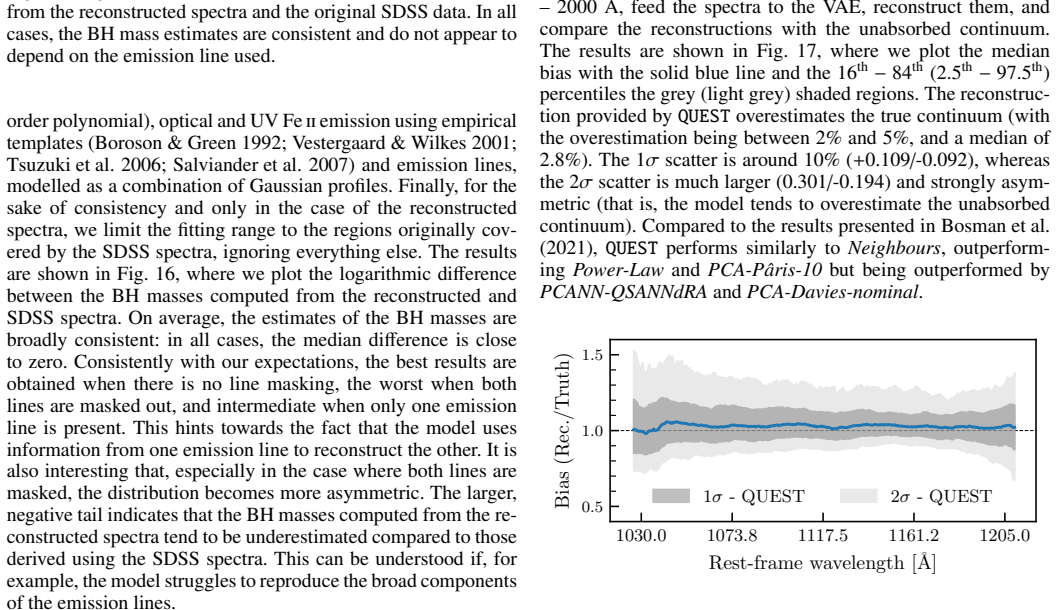
QUEST is a variational autoencoder trained on pre-processed and vetted spectra from the SDSS DR16Q catalog that faithfully reproduces the median and variance of the input spectra, generates photometry in excellent agreement with control samples, reconstructs emission lines so that black hole mass estimates remain consistent with the originals, and interpolates over broad absorption features without requiring ad-hoc adjustments.
What carries the argument
Variational autoencoder that compresses quasar spectra into a latent space capturing correlations with continuum luminosity, black hole mass, redshift, and emission line properties, then decodes samples from that space back into full spectra.
Load-bearing premise
The cleaned and vetted SDSS DR16Q spectra capture enough of the true diversity of quasars, including rarer high-redshift objects, that the trained model generalizes without introducing systematic biases in generated photometry or mass estimates.
What would settle it
A large held-out set of quasar spectra where black hole mass estimates derived from the model's reconstructions differ by more than the typical measurement uncertainty from estimates on the original spectra.
If this is right
- Generated spectra can be post-processed to produce synthetic photometry that agrees with real quasar observations.
- Reconstructed spectra preserve enough emission line information that black hole mass estimates match those from the input data.
- The model interpolates over broad absorption line systems when reconstructing affected spectra.
- No manual tuning is needed to reproduce the full range of spectral shapes present in the training catalog.
Where Pith is reading between the lines
- The latent space correlations with physical parameters could allow targeted sampling to create rare high-redshift quasar examples for training other classifiers.
- Extending the same architecture to spectra from other instruments might enable consistent imputation across different observing setups.
- If the latent dimensions align with known physical quantities, the model could serve as a low-dimensional emulator for quasar population studies.
Editorial analysis
A structured set of objections, weighed in public.
Referee Report
Summary. The manuscript introduces QUEST, a variational autoencoder (VAE) trained on a pre-processed and vetted subset of the SDSS DR16Q quasar catalog. The central claims are that the model faithfully reproduces the median and variance of the input spectra, generates photometry in excellent agreement with control samples, reconstructs emission lines such that black-hole mass estimates remain consistent with the originals, successfully interpolates over broad absorption features, and learns a latent space correlated with physical quantities including continuum slope, bolometric luminosity, redshift, and emission-line properties. The framework is presented as a parameter-free tool for synthetic photometry generation and spectral imputation, with particular utility for high-redshift (z > 7) quasar selection.
Significance. If the reproduction and interpolation results hold under rigorous quantitative scrutiny, QUEST would supply a flexible, unsupervised generator of quasar spectra that captures observed diversity without ad-hoc tuning. This could directly support machine-learning pipelines for rare-object searches at the redshift frontier where labeled training data are scarce. The reported agreement with prior generative models and the explicit mapping of latent dimensions to physical parameters are concrete strengths that would enhance reproducibility and interpretability in the field.
major comments (3)
- [§2] §2 (Data preparation): The vetting and pre-processing pipeline applied to SDSS DR16Q is described only at a high level; no quantitative thresholds (e.g., S/N cuts, redshift range statistics, or rejection fractions) are provided. This information is load-bearing for the claim that the training set is representative enough for downstream high-z applications.
- [§4.2 and §5] §4.2 and §5 (Photometry and BH-mass validation): The text states “excellent agreement” and “good agreement” for generated photometry and reconstructed BH masses, yet no error bars, RMS residuals, or statistical tests (e.g., median absolute deviation or Kolmogorov-Smirnov p-values) are reported on the comparisons. Without these metrics the quantitative support for the central reproduction claim remains incomplete.
- [Introduction and §6] Introduction and §6 (Generalization): The motivating use case is z > 7 quasar selection and imputation, but the training set is drawn from SDSS DR16Q, which is overwhelmingly low-redshift. No hold-out tests on published z > 7 spectra, no extrapolation experiments in the latent space, and no assessment of continuum-slope or line-ratio coverage at high z are presented. This directly affects whether the reported interpolation and photometry results extend to the frontier population.
minor comments (3)
- [Figure 2] Figure 2 caption: the meaning of the color bar and any overlaid contours in the latent-space projection should be stated explicitly.
- [§3.1] §3.1: the precise form of the VAE loss (including any weighting between reconstruction and KL terms) and the hyperparameter search procedure are not listed; a short table or paragraph would improve reproducibility.
- [References] References: several recent VAE applications to quasar or galaxy spectra are cited only in passing; a dedicated comparison paragraph would help situate the novelty claim.
Simulated Author's Rebuttal
We thank the referee for their constructive and detailed comments, which have identified key areas where the manuscript can be strengthened with additional quantitative information and discussion. We respond to each major comment below, indicating the revisions planned for the next version of the manuscript.
read point-by-point responses
-
Referee: §2 (Data preparation): The vetting and pre-processing pipeline applied to SDSS DR16Q is described only at a high level; no quantitative thresholds (e.g., S/N cuts, redshift range statistics, or rejection fractions) are provided. This information is load-bearing for the claim that the training set is representative enough for downstream high-z applications.
Authors: We agree that §2 would benefit from more quantitative detail to support claims of representativeness. In the revised manuscript we will expand this section to report the specific S/N threshold applied (median S/N > 4 per pixel in the rest-frame 1200–3000 Å range), the final redshift distribution (0.05 < z < 5.2, with 80% of objects at z < 2.5), and the overall rejection fraction (approximately 18% of the initial DR16Q sample removed due to low S/N, pipeline artifacts, or non-quasar classification). These additions will clarify the spectral diversity captured in the training set and its relevance to high-redshift applications. revision: yes
-
Referee: §4.2 and §5 (Photometry and BH-mass validation): The text states “excellent agreement” and “good agreement” for generated photometry and reconstructed BH masses, yet no error bars, RMS residuals, or statistical tests (e.g., median absolute deviation or Kolmogorov-Smirnov p-values) are reported on the comparisons. Without these metrics the quantitative support for the central reproduction claim remains incomplete.
Authors: We acknowledge that the validation would be more robust with explicit statistical metrics. We will revise §§4.2 and 5 to include error bars on all comparison plots, RMS residuals and median absolute deviations between generated and observed photometry, and Kolmogorov-Smirnov p-values comparing the distributions of reconstructed versus original black-hole masses. These quantitative measures will be added to the text and figures to provide stronger support for the reported agreements. revision: yes
-
Referee: Introduction and §6 (Generalization): The motivating use case is z > 7 quasar selection and imputation, but the training set is drawn from SDSS DR16Q, which is overwhelmingly low-redshift. No hold-out tests on published z > 7 spectra, no extrapolation experiments in the latent space, and no assessment of continuum-slope or line-ratio coverage at high z are presented. This directly affects whether the reported interpolation and photometry results extend to the frontier population.
Authors: We recognize that direct validation at z > 7 is limited by the small number of confirmed spectra available. While we cannot perform extensive hold-out tests on z > 7 objects, we will add to the Introduction and §6 a discussion of latent-space extrapolation: we will show that dimensions correlated with continuum slope and emission-line ratios can be varied to produce spectra with properties expected at high redshift. We will also include an explicit caveat that full generalization to z > 7 remains to be tested with future observations. This provides a partial but substantive response to the concern. revision: partial
Circularity Check
No significant circularity in QUEST VAE training and evaluation
full rationale
The paper trains a standard VAE on the external public SDSS DR16Q catalog after pre-processing and vetting, then evaluates reconstruction fidelity, photometry generation, emission-line recovery, and BH-mass estimates against held-out control samples and original spectra. No equations, performance metrics, or central claims reduce by construction to quantities defined solely by the fitted parameters or training inputs. Latent-space correlations and comparisons to prior work are presented as independent checks against external benchmarks rather than self-referential derivations. This is self-contained validation against public data and is the expected non-circular outcome for such ML frameworks.
Axiom & Free-Parameter Ledger
axioms (1)
- domain assumption A variational autoencoder can learn a continuous latent representation that captures the statistical and physical variations present in quasar spectra.
Cite this review
Pith. "Pith review of QUEST (Quasar Unsupervised Encoder and Synthesis Tool): A machine learning framework to generate quasar spectra." pith.science (2026). https://pith.science/paper/4QXUK4FJ
@misc{pith2026251023206,
  author       = {Pith},
  title        = {Pith review of: QUEST (Quasar Unsupervised Encoder and Synthesis Tool): A machine learning framework to generate quasar spectra},
  year         = {2026},
  howpublished = {\url{https://pith.science/paper/4QXUK4FJ}},
  note         = {Machine review of arXiv:2510.23206}
}
read the original abstract
Quasars at the redshift frontier (z > 7.0) are fundamental probes of black hole (BH) growth and evolution but notoriously difficult to identify. At these redshifts, machine learning-based selection methods have proven to be efficient, but require appropriate training sets to express their full potential. Here, we present QUEST, a Variational Auto-Encoder capable of generating realistic quasar spectra that can be post-processed for generating synthetic photometry and for spectral imputation. We start from the SDSS DR16Q catalogue, pre-process the spectra, and vet the sample to obtain a clean data set. After training the model, we investigate the properties of its latent space to understand whether it has learnt relevant physics. We provide a pipeline to generate photometry from the sampled spectra, compare it with actual quasar photometry, and showcase the capabilities of the model in reconstructing and extending quasar spectra. The trained network faithfully reproduces the input spectrum, both in terms of sample median and variance. By examining the latent space, we find correlations with continuum and bolometric luminosity, BH mass, redshift, continuum slope, and emission line properties. When used to generate photometry, we find results in excellent agreement with the control sample. The model provides satisfactory results in reconstructing emission lines: estimates of the BH mass from the reconstructed spectra are in good agreement with those from the original spectra. Furthermore, when spectra with broad absorption line features are reconstructed, the model successfully interpolates over the absorption systems. Compared with previous work, we find excellent agreement between the spectra sampled from our model and the output of their results. However, QUEST does not require any ad-hoc tuning, and is capable of reproducing the full variety of spectra available in the training set.
Figures



Forward citations
Cited by 1 Pith paper
-
Euclid: Discovery of 31 new quasars at $6.6 < z < 7.8$
Euclid imaging plus multi-telescope spectroscopy discovers 31 new quasars at 6.6 < z < 7.8, including a record-holder at z ≈ 7.77 and 12 objects at z ≥ 7.
Reference graph
Works this paper leans on
- [1]
-
[2]
Ansel, J., Yang, E., He, H., et al. 2024, in ASPLOS ’24, V ol. 2, Proceedings of the 29th ACM International Conference on Architectural Support for Program- ming Languages and Operating Systems, V olume 2 (New York, NY , USA: Association for Computing Machinery), 929–947
work page 2024
-
[3]
Baldwin, J. A. 1977, The Astrophysical Journal, 214, 679, aDS Bibcode: 1977ApJ...214..679B
work page 1977
-
[4]
Barnett, R., Warren, S. J., Cross, N. J. G., et al. 2021, Monthly Notices of the Royal Astronomical Society, 501, 1663, publisher: OUP ADS Bibcode: 2021MNRAS.501.1663B Bañados, E., Schindler, J.-T., Venemans, B. P., et al. 2023, The Astrophys- ical Journal Supplement Series, 265, 29, publisher: IOP ADS Bibcode: 2023ApJS..265...29B Bañados, E., Venemans, B...
work page 2021
-
[5]
2025, Astronomy & Astrophysics, 699, A335, arXiv:2505.15923 [astro-ph]
Belladitta, S., Bañados, E., Xie, Z.-L., et al. 2025, Astronomy & Astrophysics, 699, A335, arXiv:2505.15923 [astro-ph]
-
[6]
Boroson, T. A. & Green, R. F. 1992, The Astrophysical Journal Supplement Se- ries, 80, 109, publisher: IOP ADS Bibcode: 1992ApJS...80..109B
work page 1992
-
[7]
Bosman, S. E. I., Davies, F. B., Becker, G. D., et al. 2022, Monthly Notices of the Royal Astronomical Society, 514, 55, aDS Bibcode: 2022MNRAS.514...55B
work page 2022
- [8]
-
[9]
Busca, N. & Balland, C. 2018, QuasarNET: Human-level spectral clas- sification and redshifting with Deep Neural Networks, aDS Bibcode: 2018arXiv180809955B
work page 2018
-
[10]
Byrne, X., Meyer, R. A., Farina, E. P., et al. 2024, Monthly Notices of the Royal Astronomical Society, 530, 870, publisher: OUP ADS Bibcode: 2024MN- RAS.530..870B
work page 2024
-
[11]
Carswell, R. F., Whelan, J. A. J., Smith, M. G., Boksenberg, A., & Tytler, D. 1982, MNRAS, 198, 91
work page 1982
-
[12]
Chambers, K. C., Magnier, E. A., Metcalfe, N., et al. 2016, The Pan-STARRS1 Surveys, aDS Bibcode: 2016arXiv161205560C
work page 2016
-
[13]
Champagne, J. B., Casey, C. M., Finkelstein, S. L., et al. 2023, The Astrophysical Journal, 952, 99, aDS Bibcode: 2023ApJ...952...99C
work page 2023
- [14]
-
[15]
Collaboration, T. A., Price-Whelan, A. M., Lim, P. L., et al. 2022, The Astro- physical Journal, 935, 167, arXiv:2206.14220 [astro-ph]
work page internal anchor Pith review Pith/arXiv arXiv 2022
-
[16]
The Astropy Project: Building an inclusive, open-science project and status of the v2.0 core package
Collaboration, T. A., Price-Whelan, A. M., Sip ˝ocz, B. M., et al. 2018, The As- tronomical Journal, 156, 123, arXiv:1801.02634 [astro-ph] Dall’Aglio, A., Wisotzki, L., & Worseck, G. 2008, A&A, 491, 465 DESI Collaboration, Abdul-Karim, M., Adame, A. G., et al. 2025, Data Release 1 of the Dark Energy Spectroscopic Instrument, aDS Bibcode: 2025arXiv250314745D
work page internal anchor Pith review Pith/arXiv arXiv 2018
-
[17]
2013, The Messenger, 154, 32, aDS Bibcode: 2013Msngr.154...32E
Edge, A., Sutherland, W., Kuijken, K., et al. 2013, The Messenger, 154, 32, aDS Bibcode: 2013Msngr.154...32E
work page 2013
-
[18]
Eilers, A.-C., Hogg, D. W., Schölkopf, B., et al. 2022, The Astrophysical Journal, 938, 17, publisher: IOP ADS Bibcode: 2022ApJ...938...17E
work page 2022
-
[19]
Etezad-Razavi, S., Bosman, S. E. I., & Davies, F. B. 2025, A New Approach for Constraining Large-Scale Temperature Fluctuations in the Intergalactic Medium, aDS Bibcode: 2025arXiv250105575E Euclid Collaboration, Gabarra, L., Mancini, C., et al. 2023, Astronomy and As- trophysics, 676, A34, publisher: EDP ADS Bibcode: 2023A&A...676A..34E Euclid Collaborati...
work page 2025
-
[20]
Fan, X., Bañados, E., & Simcoe, R. A. 2023, Annual Review of Astronomy and Astrophysics, 61, 373, aDS Bibcode: 2023ARA&A..61..373F
work page 2023
-
[21]
Fan, X., Strauss, M. A., Becker, R. H., et al. 2006, The Astronomical Journal, 132, 117, publisher: IOP ADS Bibcode: 2006AJ....132..117F
work page 2006
-
[22]
P., Schindler, J.-T., Walter, F., et al
Farina, E. P., Schindler, J.-T., Walter, F., et al. 2022, The Astrophysical Journal, 941, 106, publisher: IOP ADS Bibcode: 2022ApJ...941..106F
work page 2022
-
[23]
Fitzpatrick, E. L. & Massa, D. 1999, ApJ, 525, 1011
work page 1999
- [24]
- [25]
-
[26]
Gretton, A., Borgwardt, K. M., Rasch, M. J., Schölkopf, B., & Smola, A. 2012, J. Mach. Learn. Res., 13, 723
work page 2012
-
[27]
Guo, H., Shen, Y ., & Wang, S. 2018, Astrophysics Source Code Library, ascl:1809.008, aDS Bibcode: 2018ascl.soft09008G Article number, page 15 A&A proofs:manuscript no. 00_main
work page 2018
-
[28]
Hahn, C., Gontcho, S. G. A., Melchior, P., et al. 2025, Reconstructing Quasar Spectra and Measuring the LyαForest with ${\rm S{\scriptsize pender}Q}$, aDS Bibcode: 2025arXiv250618986H
work page 2025
-
[29]
Harris, C. R., Millman, K. J., van der Walt, S. J., et al. 2020, Nature, 585, 357, publisher: Nature Publishing Group
work page 2020
-
[30]
He, Y ., Guo, Q., & Shao, S. 2022, Research in Astronomy and Astrophysics, 22, 085014, publisher: IOP ADS Bibcode: 2022RAA....22h5014H
work page 2022
-
[31]
Hennawi, J. F., Kist, T., Davies, F. B., & Tamanas, J. 2024, arXiv e-prints, _eprint: Arxiv:2406.12070v1
-
[32]
2017, in International Conference on Learning Representations
Higgins, I., Matthey, L., Pal, A., et al. 2017, in International Conference on Learning Representations
work page 2017
-
[33]
Hunter, J. D. 2007, Computing in Science & Engineering, 9, 90
work page 2007
-
[34]
2020, Annual Review of Astronomy and Astrophysics, 58, 27, aDS Bibcode: 2020ARA&A..58...27I
Inayoshi, K., Visbal, E., & Haiman, Z. 2020, Annual Review of Astronomy and Astrophysics, 58, 27, aDS Bibcode: 2020ARA&A..58...27I
work page 2020
-
[35]
F., Schindler, J.-T., Tamanas, J., & Nanni, R
Kang, Y ., Hennawi, J. F., Schindler, J.-T., Tamanas, J., & Nanni, R. 2024, Extreme Deconvolution Reimagined: Conditional Densities via Neural Networks and an Application in Quasar Classification, aDS Bibcode: 2024arXiv241203029K
work page 2024
-
[36]
Kingma, D. P. & Ba, J. 2017, Adam: A Method for Stochastic Optimization, arXiv:1412.6980 [cs]
work page internal anchor Pith review Pith/arXiv arXiv 2017
-
[37]
Kingma, D. P. & Welling, M. 2013, Auto-Encoding Variational Bayes, aDS Bib- code: 2013arXiv1312.6114K
work page internal anchor Pith review Pith/arXiv arXiv 2013
- [38]
-
[39]
Kist, T., Hennawi, J. F., & Davies, F. B. 2025, Monthly Notices of the Royal Astronomical Society, 538, 2704, publisher: OUP ADS Bibcode: 2025MN- RAS.538.2704K
work page 2025
-
[40]
Kormendy, J. & Ho, L. C. 2013, Annual Review of Astronomy and Astrophysics, 51, 511, aDS Bibcode: 2013ARA&A..51..511K
work page 2013
-
[41]
Kullback, S. & Leibler, R. A. 1951, The Annals of Mathematical Statistics, 22, 79, publisher: Institute of Mathematical Statistics
work page 1951
-
[42]
Lawrence, A., Warren, S. J., Almaini, O., et al. 2007, Monthly Notices of the Royal Astronomical Society, 379, 1599, publisher: OUP ADS Bibcode: 2007MNRAS.379.1599L
work page 2007
-
[43]
Li, J., Silverman, J. D., Izumi, T., et al. 2022, The Astrophysical Journal Letters, 931, L11, publisher: The American Astronomical Society
work page 2022
-
[44]
Lucie-Smith, L., Despali, G., & Springel, V . 2024a, A deep learning model for the density profiles of subhaloes in IllustrisTNG, arXiv:2403.12125 [astro- ph]
-
[45]
Lucie-Smith, L., Peiris, H. V ., & Pontzen, A. 2024b, Physical Review Letters, 132, 031001, arXiv:2305.03077 [astro-ph]
- [46]
-
[47]
Lyke, B. W., Higley, A. N., McLane, J. N., et al. 2020, The Astrophys- ical Journal Supplement Series, 250, 8, publisher: IOP ADS Bibcode: 2020ApJS..250....8L
work page 2020
-
[48]
Maas, A. L. 2013, in ICML’13: Proceedings of the 30th International Conference on International Conference on Machine Learning - V olume 28
work page 2013
-
[49]
2025, Subaru High-z Explo- ration of Low-Luminosity Quasars (SHELLQs)
Matsuoka, Y ., Iwasawa, K., Onoue, M., et al. 2025, Subaru High-z Explo- ration of Low-Luminosity Quasars (SHELLQs). XXIV. 54 New Quasars and Candidate Obscured Quasars at $5.71\le z\le 7.02$, aDS Bibcode: 2025arXiv250821229M
work page 2025
-
[50]
M., Dix, C., Shemmer, O., et al
Matthews, B. M., Dix, C., Shemmer, O., et al. 2023, The Astrophysical Journal, 950, 95, publisher: IOP ADS Bibcode: 2023ApJ...950...95M
work page 2023
-
[51]
M., Shemmer, O., Dix, C., et al
Matthews, B. M., Shemmer, O., Dix, C., et al. 2021, The Astrophysical Journal Supplement Series, 252, 15, publisher: The American Astronomical Society
work page 2021
-
[52]
2021, Astrophysics Source Code Li- brary, ascl:2106.008, aDS Bibcode: 2021ascl.soft06008M
McGreer, I., Moustakas, J., & Schindler, J. 2021, Astrophysics Source Code Li- brary, ascl:2106.008, aDS Bibcode: 2021ascl.soft06008M
work page 2021
-
[53]
2017, Journal of Open Source Software, 2, 205
McInnes, L., Healy, J., & Astels, S. 2017, Journal of Open Source Software, 2, 205
work page 2017
-
[54]
UMAP: Uniform Manifold Approximation and Projection for Dimension Reduction
McInnes, L., Healy, J., & Melville, J. 2018, arXiv e-prints, arXiv:1802.03426
work page internal anchor Pith review Pith/arXiv arXiv 2018
-
[55]
G., Banerji, M., Gonzalez, E., et al
McMahon, R. G., Banerji, M., Gonzalez, E., et al. 2013, The Messenger, 154, 35, aDS Bibcode: 2013Msngr.154...35M
work page 2013
-
[56]
2023, The Astronomical Jour- nal, 166, 74, publisher: IOP ADS Bibcode: 2023AJ....166...74M
Melchior, P., Liang, Y ., Hahn, C., & Goulding, A. 2023, The Astronomical Jour- nal, 166, 74, publisher: IOP ADS Bibcode: 2023AJ....166...74M
work page 2023
-
[57]
A., Decarli, R., Walter, F., et al
Meyer, R. A., Decarli, R., Walter, F., et al. 2022, The Astrophysical Journal, 927, 141, aDS Bibcode: 2022ApJ...927..141M
work page 2022
-
[58]
Moradi, R., Rastegarnia, F., Wang, Y ., & Mirtorabi, M. T. 2024, Monthly Notices of the Royal Astronomical Society, 533, 1976, publisher: OUP ADS Bibcode: 2024MNRAS.533.1976M
work page 2024
-
[59]
Mortlock, D. J., Warren, S. J., Venemans, B. P., et al. 2011, Nature, 474, 616, aDS Bibcode: 2011Natur.474..616M
work page 2011
-
[60]
Nanni, R., Hennawi, J. F., Wang, F., et al. 2022, Monthly Notices of the Royal Astronomical Society, 515, 3224, publisher: OUP ADS Bibcode: 2022MN- RAS.515.3224N
work page 2022
- [61]
-
[62]
Oke, J. B. & Gunn, J. E. 1983, The Astrophysical Journal, 266, 713, publisher: IOP ADS Bibcode: 1983ApJ...266..713O
work page 1983
-
[63]
Homogeneous measurements of proximity zone sizes for 59 quasars in the Epoch of Reionization
Onorato, S., Hennawi, J. F., Pizzati, E., Venemans, B. P., & Eilers, A.-C. 2025, arXiv e-prints, tex.eprint: Arxiv:2505.09676v1 pandas development team, T. 2025, pandas-dev/pandas: Pandas
work page internal anchor Pith review Pith/arXiv arXiv 2025
-
[64]
Piras, D., Peiris, H. V ., Pontzen, A., et al. 2023, Machine Learning: Science and Technology, 4, 025006
work page 2023
-
[65]
2025, A&A, 698, A292 Planck Collaboration, Aghanim, N., Akrami, Y ., et al
Pistis, F., Fumagalli, M., Fossati, M., et al. 2025, A&A, 698, A292 Planck Collaboration, Aghanim, N., Akrami, Y ., et al. 2020, Astronomy and As- trophysics, 641, A6, publisher: EDP ADS Bibcode: 2020A&A...641A...6P Pâris, I., Petitjean, P., Ross, N. P., et al. 2017, Astronomy and Astrophysics, 597, A79, publisher: EDP ADS Bibcode: 2017A&A...597A..79P
work page 2025
-
[66]
Qin, Y ., Mesinger, A., Prelogovi´c, D., et al. 2025, Publications of the Astronom- ical Society of Australia, 42, e049, aDS Bibcode: 2025PASA...42...49Q
work page 2025
-
[67]
Robitaille, T. P., Tollerud, E. J., Greenfield, P., et al. 2013, Astronomy & Astro- physics, 558, A33, publisher: EDP Sciences
work page 2013
- [68]
-
[69]
Rumelhart, D. E. & McClelland, J. L. 1987, in Parallel Distributed Processing: Explorations in the Microstructure of Cognition: Foundations (MIT Press), 318–362
work page 1987
-
[70]
2025, Astronomy and Astro- physics, 695, A23, publisher: EDP ADS Bibcode: 2025A&A...695A..23S
Salvestrini, F., Feruglio, C., Tripodi, R., et al. 2025, Astronomy and Astro- physics, 695, A23, publisher: EDP ADS Bibcode: 2025A&A...695A..23S
work page 2025
-
[71]
A., Gebhardt, K., & Bonning, E
Salviander, S., Shields, G. A., Gebhardt, K., & Bonning, E. W. 2007, The Astro- physical Journal, 662, 131, publisher: IOP Publishing
work page 2007
-
[72]
2023, The Astrophysical Journal, 943, 67, publisher: IOP ADS Bibcode: 2023ApJ...943...67S
Schindler, J.-T., Bañados, E., Connor, T., et al. 2023, The Astrophysical Journal, 943, 67, publisher: IOP ADS Bibcode: 2023ApJ...943...67S
work page 2023
-
[73]
Shannon, C. E. 1948, The Bell System Technical Journal, 27, 379
work page 1948
-
[74]
Shen, Y ., Hall, P. B., Horne, K., et al. 2019, The Astrophysical Journal Supple- ment Series, 241, 34, publisher: IOP ADS Bibcode: 2019ApJS..241...34S
work page 2019
-
[75]
Silverman, J., Li, J., Ding, X., et al. 2025, SHELLQs-JWST perspective on the intrinsic mass relation between supermassive black holes and their host galax- ies at z>6, arXiv:2507.23066 [astro-ph]
-
[76]
Spilker, J. S., Champagne, J. B., Fan, X., et al. 2025, The Astrophysical Journal, 982, 72, publisher: IOP ADS Bibcode: 2025ApJ...982...72S
work page 2025
-
[77]
Temple, M. J., Hewett, P. C., & Banerji, M. 2021, Monthly Notices of the Royal Astronomical Society, 508, 737, publisher: OUP ADS Bibcode: 2021MN- RAS.508..737T
work page 2021
-
[78]
Tiwari, A. & Vivek, M. 2025, Spectroscopic Quasar Anomaly Detection (SQuAD) I: Rest-Frame UV Spectra from SDSS DR16, conference Name: 43rd meeting of the Astronomical Society of India (ASI ADS Bibcode: 2025asi..confP.102T
work page 2025
-
[79]
2006, The Astrophysical Journal, 650, 57, publisher: IOP Publishing
Tsuzuki, Y ., Kawara, K., Yoshii, Y ., et al. 2006, The Astrophysical Journal, 650, 57, publisher: IOP Publishing
work page 2006
-
[80]
Umeda, H., Ouchi, M., Kageura, Y ., et al. 2025, Probing the Cosmic Reionization History with JWST: Gunn-Peterson and Ly$a$ Damping Wing Absorption at $4.5<z<13$, aDS Bibcode: 2025arXiv250404683U Vanden Berk, D. E., Richards, G. T., Bauer, A., et al. 2001, The Astronomical Journal, 122, 549
work page 2025
discussion (0)
Sign in with ORCID, Apple, or X to comment. Anyone can read and Pith papers without signing in.