Gaussian vs. Real Wavefunction of Nuclear Clusters and Hypernuclei
Pith reviewed 2026-06-27 11:17 UTC · model grok-4.3
The pith
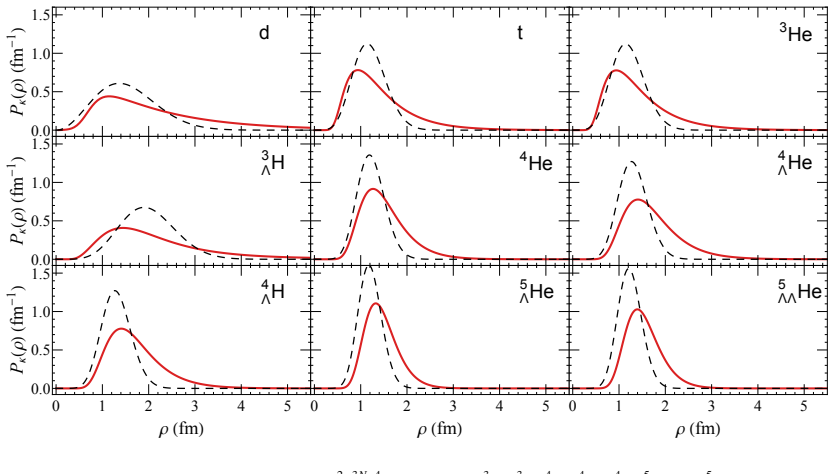
Realistic wave functions of nuclear clusters and hypernuclei are significantly broader and non-Gaussian than Gaussian forms matched only on rms radius.
A machine-rendered reading of the paper's core claim, the machinery that carries it, and where it could break.
Core claim
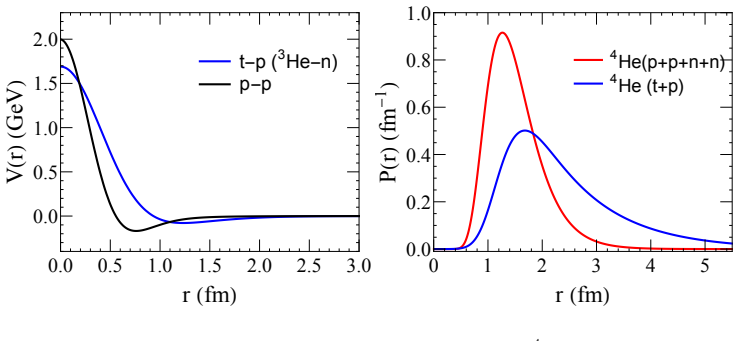
Realistic N-body wave functions obtained from solutions of the Schrödinger equation exhibit significantly broader spatial distributions and pronounced non-Gaussian structures compared to Gaussian ansatze constrained to the same rms radius. Investigation of production channels for A=4 clusters with a phenomenological two-body interaction supplies a mechanism that may reduce the underestimation of cluster yields in theoretical models relative to experiment.
What carries the argument
Direct comparison of microscopic N-body wave functions from the Schrödinger equation against Gaussian ansatze fixed solely by rms radius.
If this is right
- Models relying on Gaussian wave functions will continue to underpredict A=4 cluster production yields unless the non-Gaussian tails are incorporated.
- The same broadening applies to hypernuclear wave functions, altering predicted binding and decay properties.
- Phenomenological two-body interactions can be tuned to reproduce observed cluster yields once the realistic wave-function shapes are used.
- Transport simulations that embed these microscopic wave functions should show improved agreement with measured cluster multiplicities in heavy-ion collisions.
Where Pith is reading between the lines
- Replacing Gaussian ansatze with tabulated microscopic wave functions in coalescence or transport codes would provide a direct test of whether the yield discrepancy shrinks.
- The non-Gaussian tails may also affect electromagnetic observables such as form factors or transition rates in light nuclei.
Load-bearing premise
Matching the Gaussian form only to the rms radius creates a fair benchmark, and the chosen two-body interaction adequately represents the production process for A=4 clusters.
What would settle it
Direct experimental measurement of the spatial extent or two-particle correlation functions for A=4 clusters that deviates from the broader non-Gaussian distributions predicted by the microscopic wave functions.
Figures
read the original abstract
We compare realistic $N$-body wave functions obtained from solutions of the Schr\"odinger equation with Gaussian ans\"atze constrained to the same rms radius. The microscopic wave functions exhibit significantly broader spatial distributions, revealing pronounced non-Gaussian structures. In addition, we investigate possible production channels for $A=4$ clusters using a phenomenological two-body interaction. This study provides a potential mechanism that may help alleviate the underestimation of $A=4$ cluster yields in theoretical models compared to experimental data.
Editorial analysis
A structured set of objections, weighed in public.
Referee Report
Summary. The manuscript compares realistic N-body wave functions obtained from solutions of the Schrödinger equation with Gaussian ansatze constrained to the same rms radius for nuclear clusters and hypernuclei. It reports that the microscopic wave functions exhibit significantly broader spatial distributions and pronounced non-Gaussian structures. The study also investigates possible production channels for A=4 clusters using a phenomenological two-body interaction, providing a potential mechanism to alleviate the underestimation of A=4 cluster yields in theoretical models compared to experimental data.
Significance. If the central comparison and production mechanism hold after addressing the benchmark issues, the work could help explain and correct underpredictions of light cluster yields in nuclear collision models by highlighting limitations of Gaussian wave function approximations. The explicit contrast between microscopic solutions and simple ansatze addresses a practical modeling choice in the field.
major comments (2)
- [Abstract] Abstract: the central claim that microscopic wave functions exhibit significantly broader, non-Gaussian distributions (and thus a mechanism for A=4 yields) rests on comparing to a Gaussian constrained solely by rms radius. Production calculations typically employ Gaussians optimized to binding energies, separation energies, or electromagnetic observables rather than rms radius alone; without demonstrating that the reported difference persists against such optimized forms, the implication for yields is not established.
- [Production investigation] Production investigation (abstract): the phenomenological two-body interaction is introduced to investigate production without showing that it reproduces known A=4 observables or that two-body dynamics dominate over multi-body or medium effects. With free parameters of the interaction listed among the adjustable quantities, the claimed mechanism risks reducing to a fit rather than an independent prediction.
minor comments (1)
- The abstract supplies no equations, error estimates, or numerical data, which limits assessment of the quantitative support for the non-Gaussian claim.
Simulated Author's Rebuttal
We thank the referee for the careful reading and the specific comments on the abstract and production investigation. We respond to each point below.
read point-by-point responses
-
Referee: [Abstract] Abstract: the central claim that microscopic wave functions exhibit significantly broader, non-Gaussian distributions (and thus a mechanism for A=4 yields) rests on comparing to a Gaussian constrained solely by rms radius. Production calculations typically employ Gaussians optimized to binding energies, separation energies, or electromagnetic observables rather than rms radius alone; without demonstrating that the reported difference persists against such optimized forms, the implication for yields is not established.
Authors: The comparison in the manuscript is performed with a Gaussian ansatz fixed solely by the rms radius, as stated. We agree that this does not match the optimization procedures (binding energies, separation energies, or electromagnetic observables) commonly used in production calculations. The manuscript contains no such additional comparisons, so the implication that the observed difference provides a mechanism for A=4 yields is not demonstrated. We will revise the abstract to remove the reference to alleviating underestimation of yields and add a clarifying sentence in the discussion noting the limited scope of the rms-only constraint. revision: yes
-
Referee: [Production investigation] Production investigation (abstract): the phenomenological two-body interaction is introduced to investigate production without showing that it reproduces known A=4 observables or that two-body dynamics dominate over multi-body or medium effects. With free parameters of the interaction listed among the adjustable quantities, the claimed mechanism risks reducing to a fit rather than an independent prediction.
Authors: The production study is presented as an exploratory illustration using a simple phenomenological two-body interaction. The manuscript does not demonstrate reproduction of A=4 observables, dominance of two-body dynamics, or independence from parameter adjustment. We will revise the abstract and the relevant section to state explicitly that the calculation is illustrative and phenomenological, without claiming predictive power or dominance over multi-body or medium effects. revision: yes
Circularity Check
No significant circularity detected
full rationale
The paper compares N-body Schrödinger solutions to Gaussian ansätze matched solely on rms radius and reports broader distributions; this is a direct, non-reductive comparison with no self-definition or fitted-input-as-prediction structure. The phenomenological two-body interaction is introduced for investigating A=4 production channels without any quoted indication that its parameters are adjusted to the target yields or that the result reduces to the input by construction. No self-citation load-bearing steps, uniqueness theorems, or ansatz smuggling appear in the provided text. The derivation chain remains independent of its own outputs.
Axiom & Free-Parameter Ledger
free parameters (1)
- parameters of the phenomenological two-body interaction
axioms (1)
- domain assumption Solutions of the Schrödinger equation yield realistic N-body wave functions for the clusters under study
Reference graph
Works this paper leans on
-
[1]
Modern Ab Initio Approaches and Applications in Few-Nucleon Physics with A \ge 4
W. Leidemann, G. Orlandini, Modern Ab Initio Approaches and Applications in Few-Nucleon Physics with A >=4, Prog. Part. Nucl. Phys. 68 (2013) 158–214. arXiv:1204.4617, doi:10.1016/j.ppnp.2012.09.001
work page internal anchor Pith review Pith/arXiv arXiv doi:10.1016/j.ppnp.2012.09.001 2013
-
[2]
A. Ekström, C. Forssén, G. Hagen, G. R. Jansen, W. Jiang, T. Papenbrock, What is ab initio in nuclear theory?, Front. Phys. 11 (2023) 1129094. arXiv:2212.11064, doi:10.3389/fphy.2023.1129094
-
[3]
J. Zhao, J. Aichelin, E. Bratkovskaya, Wigner phase-space densities of nuclear clusters and hypernuclei, Phys. Rev. C 112 (6) (2025) 064902. arXiv:2508.05814, doi:10.1103/nfmh-8zzq
-
[4]
State Dependent Effective Interaction for the Hyperspherical Formalism
N. Barnea, W. Leidemann, G. Orlandini, State dependent effective interaction for the hyperspherical formalism, Phys. Rev. C 61 (2000) 054001. arXiv:nucl-th/9910062, doi:10.1103/PhysRevC.61.054001
work page internal anchor Pith review Pith/arXiv arXiv doi:10.1103/physrevc.61.054001 2000
-
[5]
L. E. Marcucci, J. Dohet-Eraly, L. Girlanda, A. Gnech, A. Kievsky, M. Viviani, The Hyperspherical Har- monics method: a tool for testing and improving nuclear interaction models, Front. in Phys. 8 (2020) 69. arXiv:1912.09751, doi:10.3389/fphy.2020.00069
-
[6]
J. Zhao, S. Shi, P. Zhuang, Fully-heavy tetraquarks in a strongly interacting medium, Phys. Rev. D 102 (11) (2020) 114001. arXiv:2009.10319, doi:10.1103/PhysRevD.102.114001
-
[7]
Y . H. Leung, Y . Zhou, N. Herrmann, Data-guided coalescence model for production of light nuclei and hypernuclei in relativistic heavy-ion collisions at sNN=3–200GeV, Phys. Rev. C 113 (3) (2026) 034912. arXiv:2510.06758, doi:10.1103/9m2b-99x4
-
[8]
M. Mahlein, L. Barioglio, F. Bellini, L. Fabbietti, C. Pinto, B. Singh, S. Tripathy, A realistic coalescence model for deuteron production, Eur. Phys. J. C 83 (9) (2023) 804. arXiv:2302.12696, doi:10.1140/epjc/s10052-023- 11972-3
-
[9]
Pi-mesonic decay of the hypertriton
H. Kamada, J. Golak, K. Miyagawa, H. Witala, W. Gloeckle, Pi mesonic decay of the hypertriton, Phys. Rev. C 57 (1998) 1595–1603. arXiv:nucl-th/9709035, doi:10.1103/PhysRevC.57.1595
work page internal anchor Pith review Pith/arXiv arXiv doi:10.1103/physrevc.57.1595 1998
-
[10]
A. Gal, E. V . Hungerford, D. J. Millener, Strangeness in nuclear physics, Rev. Mod. Phys. 88 (3) (2016) 035004. arXiv:1605.00557, doi:10.1103/RevModPhys.88.035004
work page internal anchor Pith review Pith/arXiv arXiv doi:10.1103/revmodphys.88.035004 2016
-
[11]
Lambda-Lambda interaction from relativistic heavy-ion collisions
K. Morita, T. Furumoto, A. Ohnishi,ΛΛinteraction from relativistic heavy-ion collisions, Phys. Rev. C 91 (2) (2015) 024916. arXiv:1408.6682, doi:10.1103/PhysRevC.91.024916
work page internal anchor Pith review Pith/arXiv arXiv doi:10.1103/physrevc.91.024916 2015
-
[12]
S. Acharya, et al., Measurement of (anti)alpha production in central Pb–Pb collisions at sNN=5.02 TeV, Phys. Lett. B 858 (2024) 138943. arXiv:2311.11758, doi:10.1016/j.physletb.2024.138943
-
[13]
M. Abdulhamid, et al., Production of protons and light nuclei in Au+Au collisions at sNN=3 GeV with the STAR detector, Phys. Rev. C 110 (5) (2024) 054911. arXiv:2311.11020, doi:10.1103/PhysRevC.110.054911. 4
discussion (0)
Sign in with ORCID, Apple, or X to comment. Anyone can read and Pith papers without signing in.