REVIEW 4 major objections 4 minor 1 cited by
Engineering harmonic emission through spatial modulation in a Kitaev chain
T0 review · 4 major / 4 minor · reviewed 2026-08-07 · deepseek-v4-flash
Pith's one-line read This paper claims that the harmonic emission spectrum of a dimerized Kitaev chain is controlled by the spatial-modulation parameter λ, with three plateau segments and mid-gap/Majorana states as the decisive transition channels.
desk verdict Solid numerical mapping of HHG in a dimerized Kitaev chain; the mechanism claim is incomplete but the λ≤0 comparison is a genuine control. read the letter →
The pith
A machine-rendered reading of the paper's core claim, the machinery that carries it, and where it could break.
The reading
What carries the argument
The workhorse is the dimerized Kitaev Hamiltonian with site-dependent hopping amplitudes w(1−λ) and w(1+λ), a real p-wave pairing Δ, and chemical potential μ, coupled to the laser through a Peierls phase $e^{{−iaA(t)}}$ in the velocity gauge. The Bogoliubov-de Gennes spectrum has four bands—one valence band and three conduction bands—plus three intermediate states: a negative mid-gap state below CB1, a Majorana bound state at zero energy between CB1 and CB2, and a positive mid-gap state above CB2. The harmonic intensity is the squared Fourier transform of the total current, computed by propagating the occupied eigenstates with the Crank-Nicolson method. The three-segment classification of λ is the organizing grid that connects band topology to the plateau structure of the harmonic spectrum.
What would settle it
Repeat the calculation with a time-dependent pairing term, for example Δ(t)=Δ₀(1+αA(t)), or with a self-consistently updated order parameter, and compare the three-segment plateau structure; if the segment boundaries shift or the plateaus disappear, the static-pairing assumption is the load-bearing premise. Experimentally, a dimerized Kitaev-chain nanowire illuminated by a mid-infrared pulse should show the predicted λ-dependent plateau count if the claim is right.
Extended reading notes
Core claim
On its own terms, the paper establishes that the high-harmonic spectrum of a dimerized Kitaev chain depends sensitively and systematically on the dimerization parameter λ, which modulates the hopping amplitudes w(1−λ) and w(1+λ) and tunes the band topology. The spectrum is classified into three segments: Segment I (0<|λ|≤0.25) shows two plateaus with the dominant one coming from transitions to a chiral partner state; Segment II (0.26<|λ|≤0.59) shows multiple plateaus mediated by intermediate states that give competing transition pathways to higher conduction bands; Segment III (0.6<|λ|≤1) shows broader plateaus from active interband transitions as CB1 and CB2 close toward zero energy. For λ≤0, the mid-gap states hybridize with the bulk, suppressing the harmonic enhancements that occur when the mid-gap states are isolated. The paper concludes that the harmonic emission profile can be selectively controlled by λ, making spatial modulation a design knob for high-harmonic generation in topological superconductors.
Load-bearing premise
The superconducting pairing term is assumed to stay frozen while the laser drives the chain, which is only valid if the superconductor is completely shielded from the light; if light reaches the pairing, the band structure and the harmonic plateaus would become time-dependent.
Editorial extensions
If this is right
- The same λ that sets the band topology also sets the harmonic plateau structure, so a measured plateau pattern can serve as a spectroscopic readout of the dimerization and topological-parameter regime.
- Harmonic emission can be selectively enhanced or suppressed by tuning λ: transitions through isolated mid-gap states and Majorana bound states appear only where those states stay separated from the bulk.
- The three-segment classification gives a concrete target for engineered Kitaev-chain nanowire platforms, where each segment should be distinguishable by the number and bandwidth of its harmonic plateaus.
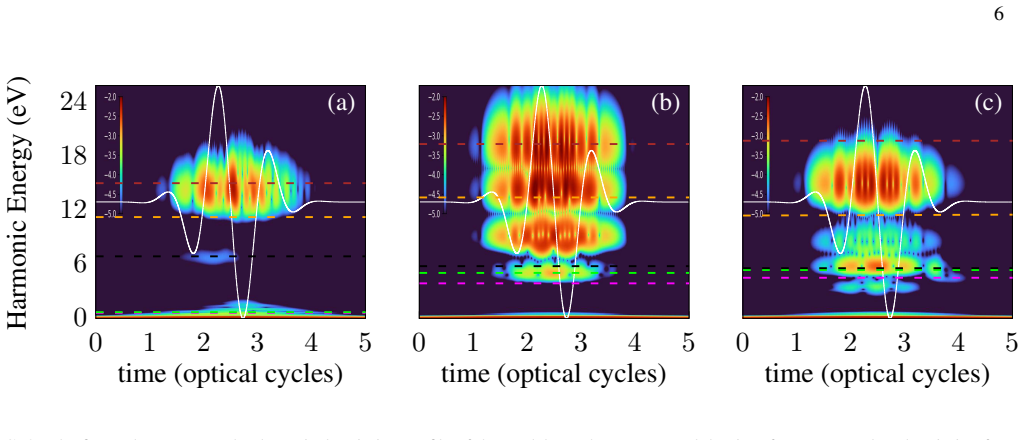
- Time-frequency analysis indicates a single dominant channel in Segment I, multiple interfering channels in Segment II, and band-closing broad transitions in Segment III, which explains why some harmonic emissions follow the laser envelope and others do not.
- In the λ≤0 regime, mid-gap-state hybridization acts as a suppressor of specific harmonic lines, meaning hybridization itself could be used as an on-off switch for certain emission channels.
Reading between the lines
- Extension: varying the laser amplitude or frequency at fixed λ would test whether the three-segment boundaries are intrinsic to the band structure or pulse-dependent, since the paper only explores one pulse shape and one field strength.
- Extension: replacing the static pairing term with a time-dependent Δ(t), for example Δ(t)=Δ₀(1+αA(t)), would reveal how strongly the shielding assumption shapes the plateaus, because an oscillating gap would alter the band structure during the pulse.
- Extension: deliberate defect engineering that hybridizes mid-gap states with the bulk should reproduce the λ≤0 suppression of mid-gap-mediated harmonics, giving a defect-based control knob for high-harmonic emission.
- Extension: the dimensionless λ maps to real dimerization strength in engineered nanowire arrays, so the predicted crossover from two plateaus to multiple plateaus to broad plateaus could be searched in existing topological-superconductor platforms.
Editorial analysis
A structured set of objections, weighed in public.
Referee Report
Summary. The manuscript studies high-harmonic generation (HHG) in a dimerized Kitaev chain, with the dimerization controlled by a site-dependent parameter λ that also tunes the hopping amplitudes and the topology. The authors compute the field-free band structure, propagate the occupied states under a laser field via Peierls substitution, compute the total current Jtot(t), and present the resulting HHG spectra as functions of λ. They classify the spectra into three segments of λ and attribute the observed plateaus to specific interband transitions involving the valence band, conduction bands, and intermediate states (nMGS, MBS, pMGS). They also compare λ>0 (isolated MGS) with λ<0 (hybridized MGS) to argue that intermediate states control the harmonic enhancements. The central claim is that λ selectively controls the harmonic emission profile and that the plateaus arise from transitions involving mid-gap and Majorana states.
Significance. If the central claim holds, the paper would establish a simple tuning parameter for HHG spectra in a topological superconductor and identify intermediate states as the controlling factor for emission pathways. The numerical approach is direct time propagation with no fitting to the output, which is a strength, and the Gabor time-frequency analysis provides supporting timing information. However, the mechanistic conclusion that specific plateaus arise from specific MGS/MBS transitions is not yet established by the evidence presented; the current analysis relies on overlaying static eigenenergy differences on the total-current spectrum, which is an interpretive step rather than a causal test. The paper is within the scope of the journal and addresses a timely topic, but the central mechanism claim needs additional support.
major comments (4)
- [Sec. III.B, Fig. 2, and Table I] The assignment of each plateau to a specific interband transition (e.g., VB→CB3, MGS↔MBS, VB→CB2) is based solely on comparing static eigenenergy differences from Table I with features in the total-current spectrum Stot(ω) defined in Eq. (8). Since Jtot(t) in Eq. (6) is a coherent sum over all occupied states and all current matrix elements, a spectral feature at a given frequency can arise from many multi-photon pathways, and a single transition can radiate at several harmonics of ω0. Without a transition-resolved current decomposition, time-dependent band populations, or a control calculation with candidate states removed, the central claim that the plateaus arise from specific MGS/MBS transitions is not established. This is load-bearing because the abstract and Sec. IV state this mechanism as the main result.
- [Sec. III.A and Fig. 1(b)] The division of the parameter space into Segment I (0<|λ|≤0.25), Segment II (0.26≤|λ|≤0.59), and Segment III (0.6≤|λ|≤1) appears to be chosen by inspecting the same HHG spectra in Fig. 1(b). This makes the three-segment classification circular with respect to the claim that the spectra exhibit three distinct regimes. An independent criterion, such as band-gap closing points, topological invariants, or an automated spectral classifier with stated tolerances, is needed to justify the segment boundaries.
- [Sec. II.B, Eq. (5)] The pairing term Δ is treated as static during the laser interaction, with the justification that the superconductor is shielded from the incoming light. This assumption is stated but not tested. If the field penetrates the superconductor, Δ(t) would evolve in time, altering the instantaneous band structure and likely the harmonic spectra. The authors should either provide a concrete plausibility argument or numerical comparison for a time-dependent Δ, or explicitly restrict the conclusions to the shielded scenario and soften the general claim of 'tailoring HHG'.
- [Sec. II.B and all figures] The manuscript does not state the number of unit cells N used in the simulations, nor the time step, the number of occupied states, or any convergence checks with respect to these quantities. Finite-size effects are particularly relevant for a chain with edge states, and the claim that the spectra reflect the bulk band structure requires evidence that N is large enough and that the results are converged. Without this information, the reported spectra cannot be reproduced or assessed quantitatively.
minor comments (4)
- [Sec. III.B and Fig. 1] The parameter λ is dimensionless (|λ|<1), yet the text repeatedly states values such as 'λ=0.01,0.05,and 0.1 a.u.' and Fig. 1(a) labels the axis 'λ (a.u.)'. These units should be corrected.
- [Table I] The entries 'Last of VB' and 'First of CB1' are ambiguous; the authors should specify whether these refer to specific band-edge states at a particular k-point or to all states in the band, since the transition assignment depends on this identification.
- [Sec. II.B] The pulse definition in Eq. (4) uses T=1.25τ with total time 4T, but τ is defined only as 'one optical cycle'. The total duration in optical cycles is 5τ; this should be stated explicitly to avoid confusion.
- [Fig. 3] The color lines indicating enhancement pathways in the time-frequency plots are not explicitly listed in the caption; referring the reader to Table I in the caption would improve readability.
Circularity Check
No significant circularity: HHG spectra are direct time-propagation outputs; transition-line matching is post hoc interpretation, not an input.
full rationale
The paper's derivation chain is self-contained: it fixes the Hamiltonian (Eq. 1), couples the field via Peierls substitution (Eq. 5), propagates the initial eigenstates with the Crank-Nicolson method, computes the total current Jtot(t) (Eqs. 6-7), and Fourier-transforms it to obtain Stot(omega) (Eq. 8). No parameter is fitted to the HHG output; lambda, w, mu, Delta, A0, and omega0 are all prescribed inputs. The colored lines in Table I are static eigenenergy differences drawn onto the computed spectrum, and the segment boundaries (0.25/0.26, 0.59/0.6) are descriptive categories chosen from the band structure, not quantities that feed back into the time propagation. The claim that specific plateaus arise from MGS/MBS transitions is an a posteriori interpretation of a total-current spectrum; even if this attribution were under-supported, that is a scientific-evidence concern, not circularity, because the spectrum itself is not constructed from those transitions. The static-pairing assumption in Sec. II.B is explicitly flagged as a limitation ('This assumption is only justified if the superconductor is shielded from the incoming light'), not dressed as a prediction. Self-citations (e.g., [12], [13], [33], [55]) are used for the numerical method, contextual prior work, and definitions of quasi-Majorana modes; no load-bearing claim is justified solely by a self-citation. Therefore no step reduces to its own input. Score 1 reflects only the presence of minor, non-load-bearing self-citations, while the central derivation remains independent.
Assumptions & free parameters
free parameters (7)
- mu (chemical potential) =
0.225 a.u.
- w (hopping amplitude) =
0.25 a.u.
- Delta (pairing potential) =
0.2375 a.u.
- A0 (vector potential amplitude) =
0.1 a.u.
- omega0 (laser frequency) =
0.00632 a.u.
- T (pulse duration) =
1.25 optical cycles
- N (number of unit cells) =
not specified
assumptions (4)
- domain assumption Peierls substitution with velocity gauge
- domain assumption Static pairing potential
- standard math Crank-Nicolson time propagation
- domain assumption Initial state is a field-free eigenstate
Cite this review
Pith. "Pith review of Engineering harmonic emission through spatial modulation in a Kitaev chain." pith.science (2026). https://pith.science/paper/4VAQJUG4
@misc{pith2026250605003,
  author       = {Pith},
  title        = {Pith review of: Engineering harmonic emission through spatial modulation in a Kitaev chain},
  year         = {2026},
  howpublished = {\url{https://pith.science/paper/4VAQJUG4}},
  note         = {Machine review of arXiv:2506.05003}
}
abstract
We investigate High-harmonic generation (HHG) in a dimerized Kitaev chain. The dimerization in the model is introduced through a site-dependent modulating potential, determined by a parameter $\lambda \in [-1:1]$. This parameter also determines the strength of the hopping amplitudes and tunes the system's topology. Depending upon the parameter $\lambda$, the HHG emission spectrum can be classified into three segments. The first segment exhibits two plateau structures, with the dominant one resulting from transitions to the chiral partner state, consistent with quasiparticle behavior in the topological superconducting phase. The second segment displays multiple plateaus, where intermediate states enable various transition pathways to higher conduction bands. Finally, the third segment presents broader plateaus, indicative of active interband transitions. In the $\lambda\leq0$ regime, we observe the mid-gap states (MGSs) hybridize with the bulk, suppressing the earlier observed harmonic enhancements. This highlights the key role of the intermediate states, particularly when MGSs are isolated. These results demonstrate that harmonic emission profiles can be selectively controlled through the modulating parameter $\lambda$, offering new prospects for tailoring HHG in topological systems.
Figures


Figures from the paper (1 more)

Forward citations
Cited by 1 Pith paper
-
Harmonic emission as a probe to coherent transitions in the topological superconductors
Laser-driven dimerized Kitaev chain exhibits Rabi-like population oscillations attributed to Majorana bound states, with harmonic emission as a probe.
Reference graph
Works this paper leans on
-
[1]
Color code used to represent different electronic transi- tions contributing to the harmonic spectra
Segment I: the harmonic spectrum exhibits a substan- TABLE I. Color code used to represent different electronic transi- tions contributing to the harmonic spectra. This standardized scheme is used throughout this work. Line color Initial state Final state Magenta Last of VB nMGS Green Last of VB First of CB1 Black nMGS MBS Orange Last of VB First of CB2 B...
-
[2]
Segment II: multiple enhancements with equiprobable intensities are observed. This indicates the presence of several intermediate states between the bands, suf- ficiently separated from the bulk, enabling the quasi- particle to access all unoccupied CBs with almost equal probability
-
[3]
Segment III, the bulk CBs (CB1 and CB2) approach closer to the MBS. This proximity results in a plateau- like broader enhancement across the spectrum, particu- larly from the magenta to the orange line region, signi- fying a broader range of active transitions. B. Harmonic enhancements in different segments We elaborate on the results presented in Fig. 1 ...
work page 2017
- [4]
-
[5]
Krausz and M
F. Krausz and M. Ivanov, Attosecond physics, Rev. Mod. Phys. 81, 163 (2009)
2009
-
[6]
S. Ghimire, A. D. DiChiara, E. Sistrunk, P. Agostini, L. F. Di- Mauro, and D. A. Reis, Observation of high-order harmonic generation in a bulk crystal, Nature Physics7, 138 (2011)
work page 2011
-
[8]
R. Geneaux, H. J. Marroux, A. Guggenmos, D. M. Neumark, and S. R. Leone, Transient absorption spectroscopy using high harmonic generation: A review of ultrafast x-ray dynamics in molecules and solids, Philosophical Transactions of the Royal Society A: Mathematical, Physical and Engineering Sciences 377, 20170463 (2019)
work page 2019
-
[9]
H. Lakhotia, H. Y . Kim, M. Zhan, S. Hu, S. Meng, and E. Goulielmakis, Laser picoscopy of valence electrons in solids, Nature583, 55 (2020)
work page 2020
Show all 66 references
-
[10]
Hohenleutner, F
M. Hohenleutner, F. Langer, O. Schubert, M. Knorr, U. Huttner, S. W. Koch, M. Kira, and R. Huber, Real-time observation of in- terfering crystal electrons in high-harmonic generation, Nature 523, 572 (2015)
2015
-
[11]
Y . S. You, D. Reis, and S. Ghimire, Anisotropic high-harmonic generation in bulk crystals, Nature Physics13, 345 (2017)
2017
-
[12]
Klemke, N
N. Klemke, N. Tancogne-Dejean, G. M. Rossi, Y . Yang, F. Scheiba, R. E. Mainz, G. Di Sciacca, A. Rubio, F. X. Kärtner, and O. D. Mücke, Polarization-state-resolved high- harmonic spectroscopy of solids, Nature Communications10, 1319 (2019)
2019
-
[13]
M. R. Bionta, E. Haddad, A. Leblanc, V . Gruson, P. Lassonde, H. Ibrahim, J. Chaillou, N. Émond, M. R. Otto, A. Jiménez- Galán, R. E. F. Silva, M. Ivanov, B. J. Siwick, M. Chaker, and F. m. c. Légaré, Tracking ultrafast solid-state dynamics using high harmonic spectroscopy, Ph...
2021
-
[14]
Heide, Y
C. Heide, Y . Kobayashi, S. R. U. Haque, and S. Ghimire, Ultra- fast high-harmonic spectroscopy of solids, Nature Physics20, 1546 (2024)
2024
-
[15]
N. R, A. R. Holkundkar, and J. N. Bandyopadhyay, Tempo- ral control of high-order harmonic cutoffs in periodic crystals, Phys. Rev. A108, 063503 (2023)
2023
-
[16]
A. R. Holkundkar, N. R, and J. N. Bandyopadhyay, Role of interband and intraband current in laser interaction with bichro- matic quasiperiodic crystals, Phys. Rev. B109, 155155 (2024)
2024
-
[17]
Schubert, M
O. Schubert, M. Hohenleutner, F. Langer, B. Urbanek, C. Lange, U. Huttner, D. Golde, T. Meier, M. Kira, S. W. Koch, and R. Huber, Sub-cycle control of terahertz high-harmonic generation by dynamical bloch oscillations, Nature Photonics 8, 119 (2014)
2014
-
[18]
Vampa, T
G. Vampa, T. J. Hammond, N. Thiré, B. E. Schmidt, F. Légaré, C. R. McDonald, T. Brabec, D. D. Klug, and P. B. Corkum, All- optical reconstruction of crystal band structure, Phys. Rev. Lett. 115, 193603 (2015)
2015
-
[19]
M. Garg, M. Zhan, T. T. Luu, H. Lakhotia, T. Klostermann, A. Guggenmos, and E. Goulielmakis, Multi-petahertz elec- tronic metrology, Nature538, 359 (2016)
2016
-
[20]
T. T. Luu and H. J. Wörner, Measurement of the berry curvature of solids using high-harmonic spectroscopy, Nature Communi- cations9, 916 (2018)
2018
-
[21]
Yoshikawa, T
N. Yoshikawa, T. Tamaya, and K. Tanaka, High- harmonic generation in graphene enhanced by ellipti- cally polarized light excitation, Science356, 736 (2017), https://www.science.org/doi/pdf/10.1126/science.aam8861
2017 doi
-
[22]
M. S. Mrudul and G. Dixit, High-harmonic generation from monolayer and bilayer graphene, Phys. Rev. B103, 094308 (2021)
2021
-
[23]
L. Yue, R. Hollinger, C. B. Uzundal, B. Nebgen, Z. Gan, E. Na- jafidehaghani, A. George, C. Spielmann, D. Kartashov, A. Tur- chanin, D. Y . Qiu, M. B. Gaarde, and M. Zuerch, Signatures of multiband effects in high-harmonic generation in monolayer mos2, Phys. Rev. Lett.129, 147...
2022
-
[24]
Uchida, V
K. Uchida, V . Pareek, K. Nagai, K. M. Dani, and K. Tanaka, Visualization of two-dimensional transition dipole moment tex- ture in momentum space using high-harmonic generation spec- troscopy, Phys. Rev. B103, L161406 (2021)
2021
-
[25]
Drüeke and D
H. Drüeke and D. Bauer, Robustness of topologically sensitive harmonic generation in laser-driven linear chains, Phys. Rev. A 99, 053402 (2019)
2019
-
[26]
Jürß and D
C. Jürß and D. Bauer, High-harmonic generation in su- schrieffer-heeger chains, Phys. Rev. B99, 195428 (2019)
2019
-
[27]
Y . Bai, F. Fei, S. Wang, N. Li, X. Li, F. Song, R. Li, Z. Xu, and P. Liu, High-harmonic generation from topological surface states, Nature Physics17, 311 (2021)
2021
-
[28]
Baykusheva, A
D. Baykusheva, A. Chacón, D. Kim, D. E. Kim, D. A. Reis, and S. Ghimire, Strong-field physics in three-dimensional topolog- ical insulators, Phys. Rev. A103, 023101 (2021)
2021
-
[29]
R. E. F. Silva, Á. Jiménez-Galán, B. Amorim, O. Smirnova, and M. Ivanov, Topological strong-field physics on sub-laser-cycle timescale, Nature Photonics13, 849 (2019)
2019
-
[30]
Chacón, D
A. Chacón, D. Kim, W. Zhu, S. P. Kelly, A. Dauphin, E. Pisanty, A. S. Maxwell, A. Picón, M. F. Ciappina, D. E. Kim, C. Ticknor, A. Saxena, and M. Lewenstein, Circular dichro- ism in higher-order harmonic generation: Heralding topologi- cal phases and transitions in chern insul...
2020
-
[31]
Baykusheva, A
D. Baykusheva, A. Chacón, J. Lu, T. P. Bailey, J. A. Sob- ota, H. Soifer, P. S. Kirchmann, C. Rotundu, C. Uher, T. F. Heinz, D. A. Reis, and S. Ghimire, All-optical probe of three- dimensional topological insulators based on high-harmonic generation by circularly polarized las...
2021
-
[32]
C. P. Schmid, L. Weigl, P. Grössing, V . Junk, C. Gorini, S. Schlauderer, S. Ito, M. Meierhofer, N. Hofmann, D. Afanasiev, J. Crewse, K. A. Kokh, O. E. Tereshchenko, J. Güdde, F. Evers, J. Wilhelm, K. Richter, U. Höfer, and R. Hu- ber, Tunable non-integer high-harmonic generat...
2021
-
[33]
Heide, Y
C. Heide, Y . Kobayashi, D. R. Baykusheva, D. Jain, J. A. Sobota, M. Hashimoto, P. S. Kirchmann, S. Oh, T. F. Heinz, D. A. Reis, and S. Ghimire, Probing topological phase transi- tions using high-harmonic generation, Nature Photonics16, 620 (2022)
2022
-
[34]
M. L. Bera, J. O. de Almeida, M. Dziurawiec, M. Płodzie ´n, M. M. Ma ´ska, M. Lewenstein, T. Grass, and U. Bhat- tacharya, Topological phase detection through high-harmonic spectroscopy in extended su-schrieffer-heeger chains, Phys. Rev. B108, 214104 (2023)
2023
-
[35]
Neufeld, N
O. Neufeld, N. Tancogne-Dejean, H. Hübener, U. De Giovan- nini, and A. Rubio, Are there universal signatures of topological phases in high-harmonic generation? probably not., Phys. Rev. X13, 031011 (2023)
2023
-
[36]
N. R, J. N. Bandyopadhyay, and A. R. Holkundkar, Prob- ing topological phase transitions in the aubry-andre-harper model via high-harmonic generation, Phys. Rev. B110, 115103 (2024)
2024
-
[37]
García-Cabrera, R
A. García-Cabrera, R. Boyero-García, Ó. Zurrón-Cifuentes, J. Serrano, J. S. Román, L. Plaja, and C. Hernández- García, Topological high-harmonic spectroscopy, Communica- tions Physics7, 28 (2024)
2024
-
[38]
Gurevich, Challenges and opportunities for applications of unconventional superconductors, Annual Review of Condensed Matter Physics5, 35 (2014)
A. Gurevich, Challenges and opportunities for applications of unconventional superconductors, Annual Review of Condensed Matter Physics5, 35 (2014)
2014
-
[39]
Sigrist and K
M. Sigrist and K. Ueda, Phenomenological theory of unconven- tional superconductivity, Rev. Mod. Phys.63, 239 (1991)
1991
-
[40]
S. D. Sarma, M. Freedman, and C. Nayak, Majorana zero modes and topological quantum computation, Npj Quantum Inf.1(2015)
2015
-
[41]
Flensberg, F
K. Flensberg, F. von Oppen, and A. Stern, Engineered platforms for topological superconductivity and Majorana zero modes, Nat. Rev. Mater.6, 944 (2021)
2021
-
[42]
A. Y . Kitaev, Unpaired Majorana fermions in quantum wires, Physics-Uspekhi44, 131 (2001)
2001
-
[43]
J. Yao, X. Hao, B. Song, Y . Jia, C. Hua, and M. Zhou, Majorana-like end states in one-dimensional dimerized kitaev topolectrical circuit, New Journal of Physics24, 043032 (2022)
2022
-
[44]
Ren, S.-S
J.-T. Ren, S.-S. Ke, Y . Guo, H.-W. Zhang, and H.-F. Lü, Phase diagram and quantum transport in a semiconductor- superconductor hybrid nanowire with long-range pairing inter- actions, Phys. Rev. B103, 045428 (2021)
2021
-
[45]
T. D. Stanescu and S. Tewari, Majorana fermions in semicon- ductor nanowires: fundamentals, modeling, and experiment, Journal of Physics: Condensed Matter25, 233201 (2013)
2013
-
[46]
Pan and S
H. Pan and S. Das Sarma, Majorana nanowires, kitaev chains, and spin models, Phys. Rev. B107, 035440 (2023)
2023
-
[47]
Moore, C
C. Moore, C. Zeng, T. D. Stanescu, and S. Tewari, Quantized zero-bias conductance plateau in semiconductor- superconductor heterostructures without topological Majorana zero modes, Phys. Rev. B98, 155314 (2018)
2018
-
[48]
Pattanayak, S
A. Pattanayak, S. Pujari, and G. Dixit, Role of majorana fermions in high-harmonic generation from kitaev chain, Sci- entific Reports12, 6722 (2022)
2022
-
[49]
Baldelli, U
N. Baldelli, U. Bhattacharya, D. González-Cuadra, M. Lewen- stein, and T. Graß, Detecting majorana zero modes via strong field dynamics, ACS Omega7, 47424 (2022)
2022
-
[50]
Dudovich, O
N. Dudovich, O. Smirnova, J. Levesque, Y . Mairesse, M. Y . Ivanov, D. M. Villeneuve, and P. B. Corkum, Measuring and controlling the birth of attosecond xuv pulses, Nature Physics 2, 781 (2006)
2006
-
[51]
J. Yao, Y . Cheng, J. Chen, H. Zhang, H. Xu, H. Xiong, B. Zeng, W. Chu, J. Ni, X. Liu, and Z. Xu, Generation of narrow- bandwidth, tunable, coherent xuv radiation using high-order harmonic generation, Phys. Rev. A83, 033835 (2011)
2011
-
[52]
Bengtsson and J
S. Bengtsson and J. Mauritsson, Ultrafast control and opto- optical modulation of extreme ultraviolet light, Journal of Physics B: Atomic, Molecular and Optical Physics52, 063002 (2019)
2019
-
[53]
Y . S. You, M. Wu, Y . Yin, A. Chew, X. Ren, S. Gholam-Mirzaei, D. A. Browne, M. Chini, Z. Chang, K. J. Schafer, M. B. Gaarde, and S. Ghimire, Laser waveform control of extreme ultraviolet high harmonics from solids, Opt. Lett.42, 1816 (2017)
2017
-
[54]
S. Roy, S. N. Nabi, and S. Basu, Critical and topological phases of dimerized kitaev chain in presence of quasiperiodic potential, Phys. Rev. B107, 014202 (2023)
2023
-
[55]
Wang, J.-J
Y . Wang, J.-J. Miao, H.-K. Jin, and S. Chen, Characterization of topological phases of dimerized kitaev chain via edge corre- lation functions, Phys. Rev. B96, 205428 (2017)
2017
-
[56]
K. Roy, S. Roy, and S. Basu, Quasiperiodic disorder induced critical phases in a periodically driven dimerized p-wave kitaev chain, Scientific Reports14, 20603 (2024)
2024
-
[57]
B. A. Bernevig, C. Felser, and H. Beidenkopf, Progress and prospects in magnetic topological materials, Nature603, 41 (2022)
2022
-
[58]
Srinidhi, A
S. Srinidhi, A. Agrawal, and J. N. Bandyopadhyay, Quasi- majorana modes in the p-wave kitaev chains on a square lattice, Journal of Physics: Condensed Matter37, 205403 (2025)
2025
-
[59]
A. Y . Kitaev, Unpaired Majorana fermions in quantum wires, Physics-Uspekhi44, 131 (2001). 9
2001
-
[60]
Agrawal and J
A. Agrawal and J. N. Bandyopadhyay, Cataloging topological phases ofnstacked Su-Schrieffer-Heeger chains by a system- atic breaking of symmetries, Phys. Rev. B108, 104101 (2023)
2023
-
[61]
B. J. Wieder, B. Bradlyn, J. Cano, Z. Wang, M. G. Vergniory, L. Elcoro, A. A. Soluyanov, C. Felser, T. Neupert, N. Regnault, and B. A. Bernevig, Topological materials discovery from crys- tal symmetry, Nat. Rev. Mater.7, 196 (2021)
2021
-
[62]
S. Ryu, A. P. Schnyder, A. Furusaki, and A. W. W. Ludwig, Topological insulators and superconductors: tenfold way and dimensional hierarchy,12, 065010 (2010)
2010
-
[63]
Yu, High-order harmonic generation from su-schrieffer- heeger chains with edge states: Three-step processes and their interference, Phys
C. Yu, High-order harmonic generation from su-schrieffer- heeger chains with edge states: Three-step processes and their interference, Phys. Rev. A110, 033113 (2024)
2024
-
[64]
C. Yu, K. K. Hansen, and L. B. Madsen, High-order harmonic generation in imperfect crystals, Phys. Rev. A99, 063408 (2019)
2019
-
[65]
Pattanayak, M
A. Pattanayak, M. M. S., and G. Dixit, Influence of vacancy defects in solid high-order harmonic generation, Phys. Rev. A 101, 013404 (2020)
2020
-
[66]
Shao, Laser-field-strength dependence of solid high-order harmonic generation from doped systems, Phys
T.-J. Shao, Laser-field-strength dependence of solid high-order harmonic generation from doped systems, Phys. Rev. A108, 023105 (2023)
2023
-
[67]
Zhang, W
Y . Zhang, W. He, L. Li, H. Cui, S. Qiao, P. Lan, and P. Lu, Role of localized electronic states in high-order harmonic generation from doped semiconductors, Phys. Rev. B109, 165204 (2024)
2024
Reviewed August 7, 2026 · model on record in the stance chip above.
Discussion (0). Sign in to comment.