REVIEW 4 major objections 6 minor 43 references
Intent Factored Generation: Unleashing the Diversity in Your Language Model
T0 review · 4 major / 6 minor · reviewed 2026-08-07 · deepseek-v4-flash
Pith's one-line read Intent Factored Generation claims that separating LLM sampling into a high-temperature intent stage and a low-temperature response stage yields more semantically diverse outputs without sacrificing quality, improving pass@k on maths and…
desk verdict The reasoning results are solid; the diversity headline depends on a metric the paper never validates. read the letter →
The pith
A machine-rendered reading of the paper's core claim, the machinery that carries it, and where it could break.
The reading
What carries the argument
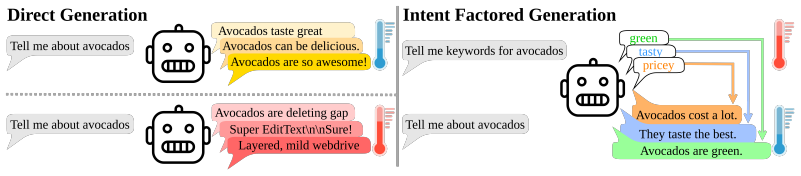
The load-bearing object is the intent: a short, semantically dense representation such as keywords or a summary, sampled before the response. IFG changes sampling from $r \sim M(p)$ to $i \sim M(p)$ followed by $r \sim M(p,i)$, with separate temperatures $t_i$ and $t_r$, and for reasoning it inserts an intent before each chain-of-thought step. The companion metric RSE computes semantic diversity by asking a prompted LLM whether pairs of generations are similar, building an adjacency matrix, and taking connected components as equivalence classes.
What would settle it
Take a sample of the generated comment sets from the diverse comment generation experiment, have human annotators label which pairs are semantically the same, build clusters from their labels, and recompute entropy for IFG versus direct sampling; if IFG no longer dominates the quality-diversity frontier, the reported diversity gains are an artifact of the LLM judge.
Extended reading notes
Core claim
IFG's central claim is that factorising the sampling distribution as $i \sim M(p)$ then $r \sim M(p,i)$ makes semantic diversity controllable: the intent $i$ anchors the concepts of the response, so sampling intents hot and responses cold decouples diversity from coherence. The paper reports that this improves pass@k on MATH and LiveCodeBench, improves STaR-based RL from verifier feedback on MATH at 3B, 7B and 14B scales, achieves higher reward at equal diversity after DPO instruction tuning, and shifts the quality-diversity Pareto frontier for generated reader comments. The paper introduces Relaxed Semantic Entropy (RSE), which replaces bidirectional entailment with LLM-judged pairwise similarity and clusters by connected components, as the metric for these diversity comparisons.
Load-bearing premise
The paper's headline diversity results assume that its LLM-judged similarity metric, RSE, measures semantic diversity the way humans would, and that assumption is not validated against human judgments in the paper.
Editorial extensions
If this is right
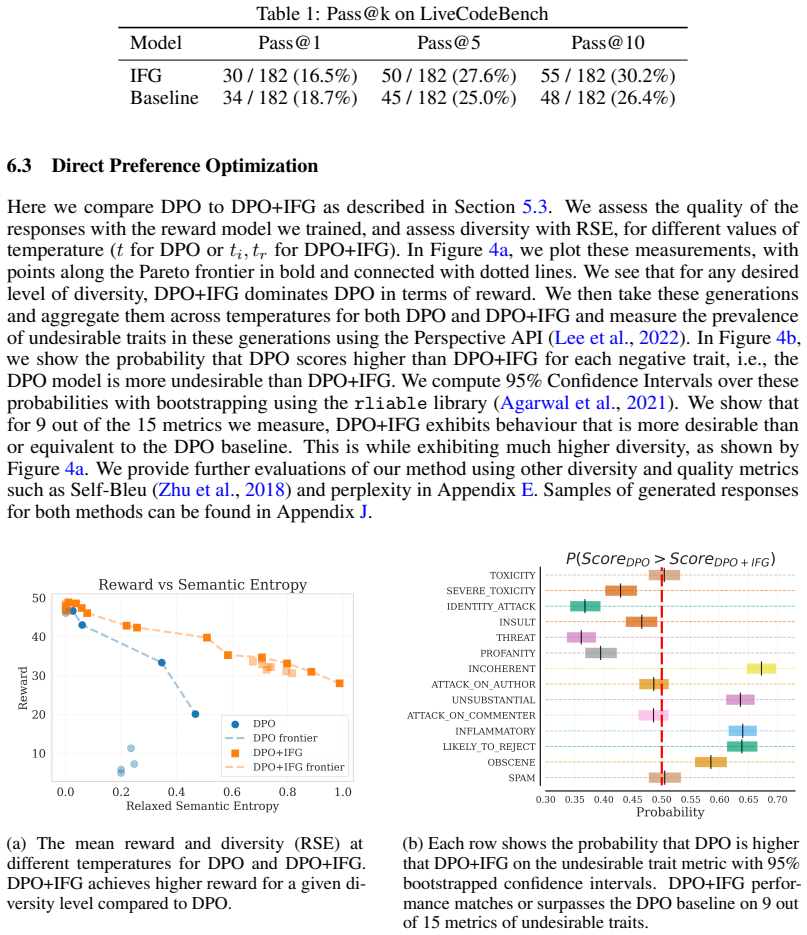
- IFG raises pass@k at every tested $k$ on MATH, and on LiveCodeBench it solves more problems in 5 attempts than the baseline solves in 10.
- IFG+STaR outperforms STaR alone across 3B, 7B and 14B models, with larger gains at larger scale and in early training iterations.
- DPO+IFG produces a reward-diversity Pareto frontier that dominates vanilla DPO on conversational responses.
- Finetuned IFG generates reader comments with higher RSE diversity at comparable coherence, and the two-temperature split is necessary: constraining $t_i=t_r$ lowers performance on code, comments, and DPO.
- IFG is implementable by changing the prompt and alternating temperatures, requiring no extra model or training in the few-shot version.
Reading between the lines
- If the diversity measure is trusted, IFG provides a drop-in diversity knob for any algorithm that benefits from diverse samples, including tree search, evolutionary methods, and verifier-based RL, since it only wraps the sampling call.
- The method's ceiling depends on the intent sampler: if the model cannot produce varied intents, high $t_i$ will only shuffle wording, so measuring and steering intent diversity directly is a natural next test.
- The RSE-based quality-diversity results should be re-checked with human similarity judgments, because an LLM judge that mistakes topic adjacency or wording changes for semantic difference could inflate IFG's apparent advantage.
Editorial analysis
A structured set of objections, weighed in public.
Referee Report
Summary. The paper introduces Intent Factored Generation (IFG), a two-stage sampling scheme: first sample an intent (keywords, a summary, or a step outline) at a high temperature, then sample the final response conditioned on both the original prompt and that intent at a lower temperature. The authors define Relaxed Semantic Entropy (RSE), an LLM-judged, connected-components variant of semantic entropy, and use it to measure diversity. They report pass@k improvements on MATH and LiveCodeBench, STaR gains on MATH, improved reward-diversity frontiers for DPO instruction tuning, and improved coherence-diversity frontiers on a new Reddit news-comment dataset. IFG is implemented either by few-shot prompting or by finetuning on intent-annotated data, and the code and dataset are open-sourced.
Significance. If the central empirical claims hold, IFG is an attractive and low-cost method for semantic diversity: it changes only prompting and sampling temperatures, can wrap around API models, and integrates naturally with test-time compute and reinforcement learning from verifier feedback. The MATH pass@k and STaR results are measured against an external benchmark with bootstrapped confidence intervals, and the paper is transparent about hyperparameters, prompts, and failure modes, including the MMLU/STaR limitation and the reliance on reliable verifiers. The main risk is that the diversity headline rests on RSE, a new metric introduced and evaluated by the same authors without human validation, so the paper's broadest claim is not yet established. Nonetheless, the method is simple enough that the reasoning-exploration claims can be checked and reused independently of RSE.
major comments (4)
- [4.2, Algorithm 2, Figures 4-5] Section 4.2 (Eq. 5, Algorithm 2): RSE is the diversity measure behind the headline claims in Sections 6.3 and 6.4, but it is neither validated against human similarity judgments nor compared with an existing semantic-diversity metric on these tasks. Because the similarity prompt in Appendix I.3 encodes the authors' own notion of 'similar' versus 'different', and because connected components over pairwise LLM judgments can merge long chains of superficially related texts, the improved Pareto frontiers in Figures 4a and 5 may reflect the judge's biases rather than true semantic diversity. The authors should provide a validation study, for example human agreement, sensitivity to prompt wording, and controls with known surface variation, or explicitly restrict the diversity claims to 'RSE diversity'.
- [6.2, Table 1] Section 6.2, Table 1: The code-generation claim rests on 50 vs. 45 correct problems at pass@5 and 55 vs. 48 at pass@10 out of 182, with no confidence intervals or significance tests, and pass@1 is lower for IFG (30 vs. 34). These differences are small enough that they could be within sampling noise given the single temperature-tuning procedure described in Section 5.2, so the statement that IFG 'improves pass@k' on LiveCodeBench is not yet supported at the reported precision. Please add uncertainty quantification, such as bootstrap over problems or repeated sampling, or temper the claim.
- [5.3, Appendix E.2, Table 6] Section 5.3 and Appendix E.2 (Table 6): The DPO comparison is not fully controlled, because the baseline DPO model was trained on 8 L40S GPUs while the DPO+IFG model was trained on 8 H200s. Even with identical hyperparameters, different hardware introduces nondeterminism, and the appendix does not report seeds or repeated runs. Since Figure 4a is one of the two main pieces of evidence for the diversity-quality frontier, the authors should either retrain under matched conditions or provide a control demonstrating that the hardware difference does not affect the comparison.
- [6.4, Figure 5, Appendix C] Section 6.4, Figure 5 and Appendix C: Quality in the comment-generation experiment is measured by 1 - INCOHERENCE from the Perspective API, which is a moderation classifier and not a semantic quality metric. A comment can be irrelevant to the article or subtly nonsensical while still receiving a low INCOHERENCE score, so the Pareto frontier in Figure 5 may overstate the quality of high-RSE IFG comments. The authors' own attempt at LLM-judged quality in Appendix E.4 was unreliable at high temperatures, which underscores the need for human evaluation of relevance and semantic coherence before drawing the diversity-without-quality-loss conclusion.
minor comments (6)
- [Appendix D.2] Appendix D.2 contains an unfinished parenthetical 'Note check this' regarding the data collection date range; this should be resolved before publication.
- [Appendix E.2 and Figure 6] Appendix E.2 contains typos such as 'tained', 'wheread', and 'hyperparamters', and the caption of Figure 6 reads 'Pareot Plots' instead of 'Pareto Plots'.
- [Appendix B, Eq. (10)] Appendix B, Eq. (10) minimizes L_i + L_j, but the loss is defined earlier as L_i and L_r; L_j appears to be a typo for L_r.
- [Figure 3 caption] The caption of Figure 3(b) says 'for all values of k' when discussing STaR iterations; this should refer to iterations, not k, and the legend 'IFG Baseline' is ambiguous.
- [Section 4.1, Figure 5b reference] Section 4.1 states that IFG intent and response examples are shown in 'Figure 5b', but Figure 5 shows comment-generation results, not the referenced examples; the cross-reference appears to be wrong.
- [Appendix I.3] Appendix I.3 contains typos such as 'Differnet' and 'commnet', and the semantic-clustering prompts would benefit from a statement that the judge was not the same model used for generation.
Circularity Check
No significant circularity: the reasoning gains are measured on external benchmarks, and the RSE-based diversity claims use a new metric that is not fitted to IFG's outputs.
full rationale
The paper's central claims split into two chains. First, IFG improves pass@k and STaR on MATH and LiveCodeBench; these results are measured against external benchmarks and verifier feedback, not against quantities defined in this paper. Temperatures are tuned on separate validation or training subsets before the reported test numbers, so no reported value is a fitted parameter relabeled as a prediction. Second, IFG improves the quality-diversity frontier on instruction-tuning and comment generation. That claim uses Relaxed Semantic Entropy (RSE), introduced in Section 4.2, together with the Perspective API incoherence score and a Bradley-Terry reward model. RSE is an operationalization of semantic diversity rather than a parameter fitted to IFG outputs; the similarity prompts in Appendix I.3 define a judgment criterion and are not optimized against the reported diversity numbers. A concern that RSE may not match human judgments of semantic equivalence, or that Perspective API's INCOHERENCE is a weak quality signal, is a validity and correctness risk, not a circularity defect: the paper does not derive the diversity result from the definition of RSE. The only self-citation is the related-work comparison to Rainbow Teaming, which is not load-bearing. The appended '(Note check this)' in Section D.2 flags an unresolved data-collection detail, but it does not feed into the derivation. Overall, no equation reduces to its own inputs and no fitted value is renamed as a prediction; the reported gains are, at worst, dependent on the validity of the chosen metrics rather than on circular reasoning.
Assumptions & free parameters
free parameters (4)
- intent temperature t_i =
0.73 on LiveCodeBench; varied per task and validation split
- response temperature t_r =
0.60 on LiveCodeBench; varied per task and validation split
- intent granularity =
one intent per chain-of-thought step, one per 1 to 3 lines of code, one per comment
- keyword length for DPO annotation =
no more than 3 words
assumptions (4)
- domain assumption The factorisation p(r|p) = sum_i p(i|p) p(r|p,i) means intent diversity propagates to response diversity.
- domain assumption A prompted LLM's bidirectional similarity judgments are a valid semantic equivalence for clustering outputs in RSE.
- domain assumption Perspective API incoherence and related scores are valid proxies for generated comment quality.
- domain assumption The post-release LiveCodeBench slice is contamination-free.
Cite this review
Pith. "Pith review of Intent Factored Generation: Unleashing the Diversity in Your Language Model." pith.science (2026). https://pith.science/paper/4W5AGCPQ
@misc{pith2026250609659,
  author       = {Pith},
  title        = {Pith review of: Intent Factored Generation: Unleashing the Diversity in Your Language Model},
  year         = {2026},
  howpublished = {\url{https://pith.science/paper/4W5AGCPQ}},
  note         = {Machine review of arXiv:2506.09659}
}
read the original abstract
Obtaining multiple meaningfully diverse, high quality samples from Large Language Models for a fixed prompt remains an open challenge. Current methods for increasing diversity often only operate at the token-level, paraphrasing the same response. This is problematic because it leads to poor exploration on reasoning problems and to unengaging, repetitive conversational agents. To address this we propose Intent Factored Generation (IFG), factorising the sampling process into two stages. First, we sample a semantically dense intent, e.g., a summary or keywords. Second, we sample the final response conditioning on both the original prompt and the intent from the first stage. This allows us to use a higher temperature during the intent step to promote conceptual diversity, and a lower temperature during the final generation to ensure the outputs are coherent and self-consistent. Additionally, we find that prompting the model to explicitly state its intent for each step of the chain-of-thought before generating the step is beneficial for reasoning tasks. We demonstrate our method's effectiveness across a diverse set of tasks. We show this method improves both pass@k and Reinforcement Learning from Verifier Feedback on maths and code tasks. For instruction-tuning, we combine IFG with Direct Preference Optimisation to increase conversational diversity without sacrificing reward. Finally, we achieve higher diversity while maintaining the quality of generations on a general language modelling task, using a new dataset of reader comments and news articles that we collect and open-source. In summary, we present a simple method of increasing the sample diversity of LLMs while maintaining performance. This method can be implemented by changing the prompt and varying the temperature during generation, making it easy to integrate into many algorithms for gains across various applications.
Figures


Figures from the paper (14 more)


Reference graph
Works this paper leans on
-
[1]
Toolformer: Language models can teach themselves to use tools
Timo Schick, Jane Dwivedi-Yu, Roberto Dess \` , Roberta Raileanu, Maria Lomeli, Eric Hambro, Luke Zettlemoyer, Nicola Cancedda, and Thomas Scialom. Toolformer: Language models can teach themselves to use tools. Advances in Neural Information Processing Systems, 36: 0 68539--68551, 2023
2023
-
[2]
Witscript 2: A System for Generating Improvised Jokes Without Wordplay
Joe Toplyn. Witscript 2: A system for generating improvised jokes without wordplay. arXiv preprint arXiv:2302.03036, 2023
work page Pith review arXiv 2023
-
[3]
Mina Lee, Percy Liang, and Qian Yang. Coauthor: Designing a human-ai collaborative writing dataset for exploring language model capabilities. In Proceedings of the 2022 CHI conference on human factors in computing systems, pages 1--19, 2022
work page 2022
-
[4]
Max Peeperkorn, Tom Kouwenhoven, Dan Brown, and Anna Jordanous. Is temperature the creativity parameter of large language models? arXiv preprint arXiv:2405.00492, 2024
arXiv 2024
-
[5]
Lorenz Kuhn, Yarin Gal, and Sebastian Farquhar. Semantic uncertainty: Linguistic invariances for uncertainty estimation in natural language generation. arXiv preprint arXiv:2302.09664, 2023
arXiv 2023
-
[6]
Codemonkeys: Scaling test-time compute for software engineering, 2025
Ryan Ehrlich, Bradley Brown, Jordan Juravsky, Ronald Clark, Christopher Ré, and Azalia Mirhoseini. Codemonkeys: Scaling test-time compute for software engineering, 2025. URL https://arxiv.org/abs/2501.14723
arXiv 2025
-
[7]
Gold-medalist performance in solving olympiad geometry with alphageometry2
Yuri Chervonyi, Trieu H Trinh, Miroslav Ol s \'a k, Xiaomeng Yang, Hoang Nguyen, Marcelo Menegali, Junehyuk Jung, Vikas Verma, Quoc V Le, and Thang Luong. Gold-medalist performance in solving olympiad geometry with alphageometry2. arXiv preprint arXiv:2502.03544, 2025
arXiv 2025
-
[8]
Teaching large language models to reason with reinforcement learning, 2024
Alex Havrilla, Yuqing Du, Sharath Chandra Raparthy, Christoforos Nalmpantis, Jane Dwivedi-Yu, Maksym Zhuravinskyi, Eric Hambro, Sainbayar Sukhbaatar, and Roberta Raileanu. Teaching large language models to reason with reinforcement learning, 2024. URL https://arxiv.org/abs/2403.04642
arXiv 2024
Show all 43 references
-
[9]
Diverse beam search: Decoding diverse solutions from neural sequence models
Ashwin K Vijayakumar, Michael Cogswell, Ramprasath R Selvaraju, Qing Sun, Stefan Lee, David Crandall, and Dhruv Batra. Diverse beam search: Decoding diverse solutions from neural sequence models. arXiv preprint arXiv:1610.02424, 2016
-
[10]
Instruction tuning for large language models: A survey
Shengyu Zhang, Linfeng Dong, Xiaoya Li, Sen Zhang, Xiaofei Sun, Shuhe Wang, Jiwei Li, Runyi Hu, Tianwei Zhang, Fei Wu, et al. Instruction tuning for large language models: A survey. arXiv preprint arXiv:2308.10792, 2023
2023
-
[11]
Chain-of-thought prompting elicits reasoning in large language models, 2023
Jason Wei, Xuezhi Wang, Dale Schuurmans, Maarten Bosma, Brian Ichter, Fei Xia, Ed Chi, Quoc Le, and Denny Zhou. Chain-of-thought prompting elicits reasoning in large language models, 2023. URL https://arxiv.org/abs/2201.11903
2023 arXiv
-
[12]
Measuring mathematical problem solving with the math dataset
Dan Hendrycks, Collin Burns, Saurav Kadavath, Akul Arora, Steven Basart, Eric Tang, Dawn Song, and Jacob Steinhardt. Measuring mathematical problem solving with the math dataset. arXiv preprint arXiv:2103.03874, 2021 a
2021 arXiv
-
[13]
Livecodebench: Holistic and contamination free evaluation of large language models for code
Naman Jain, King Han, Alex Gu, Wen-Ding Li, Fanjia Yan, Tianjun Zhang, Sida Wang, Armando Solar-Lezama, Koushik Sen, and Ion Stoica. Livecodebench: Holistic and contamination free evaluation of large language models for code. arXiv preprint arXiv:2403.07974, 2024
2024 arXiv
-
[14]
Reddit. Reddit. https://www.reddit.com
-
[15]
A neural probabilistic language model
Yoshua Bengio, R \'e jean Ducharme, and Pascal Vincent. A neural probabilistic language model. Advances in neural information processing systems, 13, 2000
2000
-
[16]
Language models are unsupervised multitask learners
Alec Radford, Jeffrey Wu, Rewon Child, David Luan, Dario Amodei, Ilya Sutskever, et al. Language models are unsupervised multitask learners. OpenAI blog, 1 0 (8): 0 9, 2019
2019
-
[17]
Reinforcement learning: An introduction
Richard S Sutton. Reinforcement learning: An introduction. A Bradford Book, 2018
2018
-
[18]
Deepseek-r1: Incentivizing reasoning capability in llms via reinforcement learning, 2025
DeepSeek-AI, Daya Guo, Dejian Yang et al. Deepseek-r1: Incentivizing reasoning capability in llms via reinforcement learning, 2025. URL https://arxiv.org/abs/2501.12948
2025 arXiv
-
[19]
Vineppo: Unlocking rl potential for llm reasoning through refined credit assignment, 2024
Amirhossein Kazemnejad, Milad Aghajohari, Eva Portelance, Alessandro Sordoni, Siva Reddy, Aaron Courville, and Nicolas Le Roux. Vineppo: Unlocking rl potential for llm reasoning through refined credit assignment, 2024. URL https://arxiv.org/abs/2410.01679
2024 arXiv
-
[20]
Eric Zelikman, Yuhuai Wu, Jesse Mu, and Noah D. Goodman. Star: Bootstrapping reasoning with reasoning, 2022. URL https://arxiv.org/abs/2203.14465
2022 arXiv
-
[21]
The primacy bias in deep reinforcement learning, 2022
Evgenii Nikishin, Max Schwarzer, Pierluca D'Oro, Pierre-Luc Bacon, and Aaron Courville. The primacy bias in deep reinforcement learning, 2022. URL https://arxiv.org/abs/2205.07802
2022 arXiv
-
[22]
Zhao, Kelvin Guu, Adams Wei Yu, Brian Lester, Nan Du, Andrew M
Jason Wei, Maarten Bosma, Vincent Y. Zhao, Kelvin Guu, Adams Wei Yu, Brian Lester, Nan Du, Andrew M. Dai, and Quoc V. Le. Finetuned language models are zero-shot learners, 2022. URL https://arxiv.org/abs/2109.01652
2022 arXiv
-
[23]
Direct preference optimization: Your language model is secretly a reward model
Rafael Rafailov, Archit Sharma, Eric Mitchell, Christopher D Manning, Stefano Ermon, and Chelsea Finn. Direct preference optimization: Your language model is secretly a reward model. Advances in Neural Information Processing Systems, 36: 0 53728--53741, 2023
2023
-
[24]
Gonzalez, and Matei Zaharia
Alan Zhu, Parth Asawa, Jared Quincy Davis, Lingjiao Chen, Boris Hanin, Ion Stoica, Joseph E. Gonzalez, and Matei Zaharia. Bare: Combining base and instruction-tuned language models for better synthetic data generation, 2025. URL https://arxiv.org/abs/2502.01697
2025 arXiv
-
[25]
Rainbow teaming: Open-ended generation of diverse adversarial prompts
Mikayel Samvelyan, Sharath Chandra Raparthy, Andrei Lupu, Eric Hambro, Aram H Markosyan, Manish Bhatt, Yuning Mao, Minqi Jiang, Jack Parker-Holder, Jakob Foerster, et al. Rainbow teaming: Open-ended generation of diverse adversarial prompts. arXiv preprint arXiv:2402.16822, 2024
2024 arXiv
-
[26]
Illuminating search spaces by mapping elites
Jean-Baptiste Mouret and Jeff Clune. Illuminating search spaces by mapping elites. arXiv preprint arXiv:1504.04909, 2015
2015 arXiv
-
[27]
CTRL - A Conditional Transformer Language Model for Controllable Generation
Nitish Shirish Keskar, Bryan McCann, Lav Varshney, Caiming Xiong, and Richard Socher. CTRL - A Conditional Transformer Language Model for Controllable Generation . arXiv preprint arXiv:1909.05858, 2019
1909 arXiv
-
[28]
Guiding language model reasoning with planning tokens
Xinyi Wang, Lucas Caccia, Oleksiy Ostapenko, Xingdi Yuan, William Yang Wang, and Alessandro Sordoni. Guiding language model reasoning with planning tokens. In First Conference on Language Modeling, 2024. URL https://openreview.net/forum?id=wi9IffRhVM
2024
-
[29]
Xing, and Zhiting Hu
Bowen Tan, Zichao Yang, Maruan Al - Shedivat, Eric P. Xing, and Zhiting Hu. Progressive generation of long text. CoRR, abs/2006.15720, 2020. URL https://arxiv.org/abs/2006.15720
2006 arXiv
-
[30]
Plan-and-write: Towards better automatic storytelling, 2019
Lili Yao, Nanyun Peng, Ralph Weischedel, Kevin Knight, Dongyan Zhao, and Rui Yan. Plan-and-write: Towards better automatic storytelling, 2019. URL https://arxiv.org/abs/1811.05701
2019 arXiv
-
[31]
An Yang, Baosong Yang, Beichen Zhang, Binyuan Hui, Bo Zheng, Bowen Yu, Chengyuan Li, Dayiheng Liu, Fei Huang, Haoran Wei, et al. Qwen2. 5 technical report. arXiv preprint arXiv:2412.15115, 2024
2024 arXiv
-
[32]
Qwen2.5-coder technical report, 2024
Binyuan Hui, Jian Yang, Zeyu Cui et al. Qwen2.5-coder technical report, 2024. URL https://arxiv.org/abs/2409.12186
2024 arXiv
-
[33]
Ulma: Unified language model alignment with human demonstration and point-wise preference, 2024
Tianchi Cai, Xierui Song, Jiyan Jiang, Fei Teng, Jinjie Gu, and Guannan Zhang. Ulma: Unified language model alignment with human demonstration and point-wise preference, 2024. URL https://arxiv.org/abs/2312.02554
2024 arXiv
-
[34]
Deep reinforcement learning at the edge of the statistical precipice
Rishabh Agarwal, Max Schwarzer, Pablo Samuel Castro, Aaron C Courville, and Marc Bellemare. Deep reinforcement learning at the edge of the statistical precipice. Advances in neural information processing systems, 34: 0 29304--29320, 2021
2021
-
[35]
Texygen: A benchmarking platform for text generation models
Yaoming Zhu, Sidi Lu, Lei Zheng, Jiaxian Guo, Weinan Zhang, Jun Wang, and Yong Yu. Texygen: A benchmarking platform for text generation models. In The 41st International ACM SIGIR Conference on Research & Development in Information Retrieval, SIGIR '18, page 1097–1100, New Yor...
2018
-
[36]
Perspective API : Content moderation attributes and languages, 2024
Perspective API . Perspective API : Content moderation attributes and languages, 2024. URL https://developers.perspectiveapi.com/s/about-the-api-attributes-and-languages. Accessed: January 29, 2024
2024
-
[37]
A new generation of perspective api: Efficient multilingual character-level transformers
Alyssa Lees, Vinh Q Tran, Yi Tay, Jeffrey Sorensen, Jai Gupta, Donald Metzler, and Lucy Vasserman. A new generation of perspective api: Efficient multilingual character-level transformers. In Proceedings of the 28th ACM SIGKDD conference on knowledge discovery and data mining,...
2022
-
[38]
Measuring massive multitask language understanding, 2021 b
Dan Hendrycks, Collin Burns, Steven Basart, Andy Zou, Mantas Mazeika, Dawn Song, and Jacob Steinhardt. Measuring massive multitask language understanding, 2021 b . URL https://arxiv.org/abs/2009.03300
2021 arXiv
-
[39]
The pushshift reddit dataset
Jason Baumgartner, Savvas Zannettou, Brian Keegan, Megan Squire, and Jeremy Blackburn. The pushshift reddit dataset. In Proceedings of the international AAAI conference on web and social media, volume 14, pages 830--839, 2020
2020
-
[40]
Beautiful soup documentation
Leonard Richardson. Beautiful soup documentation. April, 2007
2007
-
[41]
Dirt cheap web-scale parallel text from the common crawl
Jason R Smith, Herve Saint-Amand, Magdalena Plamada, Philipp Koehn, Chris Callison-Burch, and Adam Lopez. Dirt cheap web-scale parallel text from the common crawl. Association for Computational Linguistics, 2013
2013
-
[42]
Huggingface's transformers: State-of-the-art natural language processing
T Wolf. Huggingface's transformers: State-of-the-art natural language processing. arXiv preprint arXiv:1910.03771, 2019
1910 arXiv
-
[43]
write newline
" write newline "" before.all 'output.state := FUNCTION n.dashify 't := "" t empty not t #1 #1 substring "-" = t #1 #2 substring "--" = not "--" * t #2 global.max substring 't := t #1 #1 substring "-" = "-" * t #2 global.max substring 't := while if t #1 #1 substring * t #2 gl...
Reviewed August 7, 2026 · model on record in the stance chip above.
Discussion (0). Sign in to comment.