REVIEW 4 major objections 4 minor 38 references
SyncMind: Measuring Agent Out-of-Sync Recovery in Collaborative Software Engineering
T0 review · 4 major / 4 minor · reviewed 2026-08-08 · deepseek-v4-flash
Pith's one-line read State-of-the-art LLM coding agents are poor at recovering from 'out-of-sync' states in shared codebases: the best tested agent, Claude-3.5-Sonnet, reaches only 28.18% independent recovery and 33.70% with collaborator help, while…
desk verdict SyncBench is a real, reusable benchmark for agent out-of-sync recovery, but the headline SR numbers are internally inconsistent and lack error bars, so treat the quantitative claims as provisional. read the letter →
The pith
A machine-rendered reading of the paper's core claim, the machinery that carries it, and where it could break.
The reading
What carries the argument
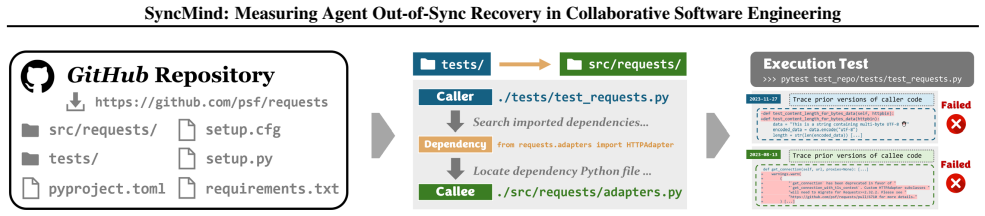
The object that carries the argument is the SyncBench out-of-sync instance, generated by a commit-history rollback proxy: for each extracted Python function, the pipeline takes the current state as ground truth $S_2$ and walks the repository's history backwards to find an older state $B_2$ where the function (Caller) or one of its imported dependencies (Callee) is stale and the unit tests fail. Multi-level filtering keeps only instances where the updated state passes, the rolled-back state fails, and parsing results are stable across runs. Agents then recover under a 30-turn protocol (extended to 50 turns in a resource-awareness condition) with three action types: exploring the repository by executing commands in an agentic coding environment, proposing a solution, and, in collaborative mode, asking a know-everything LLM-simulated collaborator. Success is judged by whether the agent's parsed test outputs exactly match the ground-truth outputs, and five metrics summarize the result: success rate, localization accuracy at file and function level, conditional success rate given localization, assistance-seeking rate, and recovery efficiency in time and expense.
What would settle it
Run the same seven agents on instances where the rolled-back state still passes all unit tests but produces different parsed outputs (the pass-to-pass divergence that the paper's own construction pipeline supports but SyncBench's released version filters out). If agents recover at rates far above 28% there, the benchmark's difficulty is an artifact of visible test failures and the claim that agents fail to resynchronize would be weakened; if they recover at similar low rates, the difficulty reflects genuine desynchronization.
Extended reading notes
Core claim
The paper's central claim is that current LLM agents are not reliable collaborators in evolving codebases because they cannot consistently detect, diagnose, and recover from out-of-sync states. An agent is out-of-sync when its belief state $B_k$ differs from the true repository state $S_k$ at time $T_k$ after a collaborator's update $U$ that the agent missed; recovery requires localizing the root cause, learning about the missing update, and updating the belief so that $B_n = S_n$. SyncBench operationalizes this by rolling a function (Caller tasks) or an imported dependency (Callee tasks) back through commit history until the tests fail, then asking the agent to make the parsed test outputs match the ground truth exactly. Across 300 evaluated instances and seven models, Claude-3.5-Sonnet reaches 28.18% independent success and 33.70% with collaborator assistance, all agents seek assistance at most 4.86% of the time, and an oracle-information upper bound of 86.33% shows large untapped headroom. The paper concludes that technical proficiency alone is insufficient: successful recovery requires proactive collaboration and adaptive resource use, both of which current agents largely lack.
Load-bearing premise
The load-bearing premise is that rolling one function or one imported dependency back through commit history, then scoring the agent on whether parsed test outputs exactly match the current state, faithfully stands in for a real collaborator whose understanding of a shared codebase has gone out of sync.
Editorial extensions
If this is right
- Frontier coding agents are far from reliable on shared codebases: if the 28.18% independent recovery rate holds, roughly seven out of ten out-of-sync situations end in failure, so production systems cannot delegate maintenance of evolving repositories to these agents without human oversight.
- Collaboration headroom is large: with oracle information the success rate jumps to 86.33%, so agent behavior rather than raw coding skill is a major bottleneck, and training or prompting for proactive, well-timed help-seeking could be a comparatively cheap lever.
- Static software-engineering benchmarks fix the workspace, whereas SyncBench's dynamic rollback instances measure a distinct capability, so agent rankings on static tasks may not predict performance in live collaborative development.
- Resource awareness cannot be assumed: tripling budgets and halving or doubling assistance costs produced negligible changes in behavior and success, meaning efficiency must be engineered explicitly rather than left to the model.
- Agents that explore early and ask high-quality, targeted questions recover more often, giving concrete behavioral targets for the next generation of collaborative agents.
Reading between the lines
- Implicit in the paper but not stated: the benchmark slices the phenomenon narrowly, since each instance rolls back one function or one dependency and is filtered to be test-visible, so the 28% figure should be read as the difficulty of single-edit, failure-visible desynchronization rather than of all collaboration failures; multi-file or silent-drift desynchronization may behave differently.
- A testable extension suggested by the results: the oracle-information upper bound of 86.33% implies that most of the gap is initiative and situation awareness rather than code-generation skill, so prompting or fine-tuning agents to verify repository changes before editing could be evaluated directly on SyncBench's 300 instances.
- Another consequence the paper leaves implicit: because tripling budgets and halving or doubling assistance costs barely moved behavior, simple resource mentions in prompts are evidently too weak a signal, and explicit cost accounting with real penalties for overspending is a natural next experiment on the same benchmark.
Editorial analysis
A structured set of objections, weighed in public.
Referee Report
Summary. The paper introduces SyncMind, a framework that formalizes the notion of an LLM coding agent being out-of-sync with a shared codebase, together with SyncBench, a benchmark constructed by rolling Python functions or imported dependencies back to older failing commits in 21 GitHub repositories. The benchmark contains 24,332 raw instances, of which 300 are evaluated across seven LLMs under independent and collaborative recovery settings, with executable test-based verification, localization and conditional success metrics, assistance-seeking rate, and resource-aware recovery under time and budget constraints. The headline empirical findings are that recovery success is generally low (Claude-3.5-Sonnet reaches 28.18% independent and 33.70% collaborative SR), assistance-seeking is rare (ASR at most 4.86%), collaboration improves performance when it occurs, and varying budgets or time limits has little effect on the two models tested in the resource experiments.
Significance. If the quantitative results are taken at face value, this is a useful and timely contribution to agent evaluation in collaborative software engineering. The construction pipeline is open-source, the instances are derived from real repositories, verification uses executable ground-truth tests rather than subjective judgments, and the evaluation spans seven LLMs in two interaction modes with several complementary metrics. These are concrete strengths that go beyond a purely static code-repair benchmark. The credible parts of the paper would provide evidence that current agents are weak at recovering from a controlled single-edit desynchronization and rarely ask for help. The main value lies in the benchmark artifact and in the qualitative observation that agent behavior changes little under resource constraints, though the latter is currently established only for two models.
major comments (4)
- [Table 1 vs Table C1, §3.4 and §4.2] There is an arithmetic inconsistency in the headline metric. For Llama-3.1-8B, Table 1 reports independent SR of 1.33% on Caller (150 instances) and 0.67% on Callee (150 instances), which pools to 1.00% (3 successes out of 300), yet Table C1 reports overall independent SR of 0.33%. Since Table C1 is the source for the performance-gap statements in §4.2 and for the abstract's lower-bound figures, this is not a rounding artifact. Please correct the affected row and re-derive the claims that depend on it, or explicitly explain why the two tables are not directly comparable.
- [§4.2, §4.6, Tables C1 and B2] No confidence intervals, significance tests, or effect-size estimates are reported. With 300 total instances and per-repository samples as small as n=3 (whisper) and n=6 (scikit-learn), the mid-tier ordering (e.g., GPT-4o 4.00%, DeepSeek 7.33%, Llama-3.3-70B 16.33%) may plausibly be within sampling noise, and the repository-level analysis in §4.6 relies on very small counts. Please add binomial confidence intervals or an explicit uncertainty/ordering analysis, and restrict the qualitative model-ordering claims to what those intervals support.
- [§4.7 and Tables C5–C7] The resource-awareness experiments are run on only two models, Llama-3.1-8B and Llama-3.1-70B, but the abstract and §4.7 conclude that existing LLM agents show a significant lack of resource awareness and adaptability. This generalization is not supported by the reported evidence. Please either extend the resource-constraint evaluation to all seven agents or explicitly scope the conclusion to the two evaluated models and remove the broader claim from the abstract.
- [§3.1, §3.4, Appendix A] The benchmark operationalizes out-of-sync scenarios as a git rollback of one function (Caller) or one imported dependency (Callee) to an older failing commit, with success defined by exact parsed-test-output match. As the authors acknowledge in Appendix A, this may not capture multi-file, multi-agent, or non-test-visible desynchronization. This is not a circularity problem, but it is a validity threat to the abstract's wording about fundamental limitations of LLMs in CSE generally. Please add an analysis of how representative the rollback instances are of real out-of-sync events (e.g., distribution of change sizes, comparison with genuine concurrent-edit scenarios), or re-scope the abstract and conclusion to the simulated single-edit recovery setting.
minor comments (4)
- [§B.2, example (2)] The example header says 'nwaskon/seaborn'; the repository name should be 'mwaskom/seaborn' as in Table B2.
- [§C.1] The sentence 'comparable technical recovery capacities among Claude-3.5-Sonnet, GPT-4o mini, and GPT-4o mini' appears to contain a typo; the second mention should likely be 'GPT-4o'.
- [§C.1] The phrase 'our evaluation results (Tab. C1-1)' should refer to a specific table number, either 'Table C1' or 'Table 1'.
- [Equation (5) and Table C8] The text says recovery efficiency is inversely proportional to the reported Eff values; this wording is confusing because higher efficiency should mean lower resource use. Consider renaming the quantities to 'resource usage ratios' or clarifying the direction explicitly.
Circularity Check
No significant circularity: the central claims are empirical measurements against executable ground-truth tests, not derivations from the benchmark's own definitions.
full rationale
SyncMind's out-of-sync definition (§2.1) and SyncBench's construction (§3.1) define what counts as an out-of-sync instance—a git-rolled-back function or dependency whose tests fail—but the paper's headline results are measured agent behaviors on those instances: SR is computed by executing the agent's proposed repository and comparing parsed test outputs with the ground-truth commit (§3.4), ASR is measured from turn-level actions, and resource-awareness findings are measured under varied turn, budget, and cost settings (§4.7). None of these quantities is fitted from, or definitionally equal to, the benchmark's filtering criteria; the metric is not defined as the filter itself, so the construction and the finding remain separable. The oracle "upper-bound" experiment (§4.4) does inject ground-truth information by design, but the reported 86.33% is an empirical outcome of how well agents follow full instructions, not a forced consequence of the setup. The only same-group citation is OpenHands (Wang et al., 2024a), used as the agent environment; it is an external, code-released platform rather than a load-bearing self-citation, and the paper does not invoke any author-supplied uniqueness theorem or ansatz. Appendix A's stated limitations—Python-only repositories, simplified resource modeling, and simulation not capturing all live collaboration patterns—are honest scope restrictions and do not indicate a circular derivation. A separate arithmetic discrepancy between Table 1 and Table C1 for Llama-3.1-8B SR is a consistency and correctness concern, not a circularity one.
Assumptions & free parameters
free parameters (5)
- Max recovery turns =
30 turns (50 in extension)
- Initial budget =
$1000
- Action costs =
$100 proposal, $100 assistance
- Per-repo downsampling cap =
15 instances per repo (300 total)
- Filtering criteria =
at least 1 failure in B2, more than 1 pass in S1, identical parsing S1/Sn
assumptions (5)
- domain assumption A single collaborator's belief state Bk deviating from world state Sk is a complete characterization of the out-of-sync problem.
- domain assumption Rolling a function or dependency back through git history until unit tests fail produces realistic out-of-sync instances.
- domain assumption An LLM given complete ground-truth context and response restrictions behaves like a know-everything human collaborator.
- domain assumption Exact match of parsed pytest outputs between agent solution and ground-truth state is a correct success criterion.
- domain assumption The tested models are representative of 'existing LLM agents' for generalizing resource-awareness conclusions.
invented entities (2)
-
Agent out-of-sync state (Bk != Sk)
-
Know-everything collaborator
Cite this review
Pith. "Pith review of SyncMind: Measuring Agent Out-of-Sync Recovery in Collaborative Software Engineering." pith.science (2026). https://pith.science/paper/4YJRCGSL
@misc{pith2026250206994,
  author       = {Pith},
  title        = {Pith review of: SyncMind: Measuring Agent Out-of-Sync Recovery in Collaborative Software Engineering},
  year         = {2026},
  howpublished = {\url{https://pith.science/paper/4YJRCGSL}},
  note         = {Machine review of arXiv:2502.06994}
}
read the original abstract
Software engineering (SE) is increasingly collaborative, with developers working together on shared complex codebases. Effective collaboration in shared environments requires participants -- whether humans or AI agents -- to stay on the same page as their environment evolves. When a collaborator's understanding diverges from the current state -- what we term the out-of-sync challenge -- the collaborator's actions may fail, leading to integration issues. In this work, we introduce SyncMind, a framework that systematically defines the out-of-sync problem faced by large language model (LLM) agents in collaborative software engineering (CSE). Based on SyncMind, we create SyncBench, a benchmark featuring 24,332 instances of agent out-of-sync scenarios in real-world CSE derived from 21 popular GitHub repositories with executable verification tests. Experiments on SyncBench uncover critical insights into existing LLM agents' capabilities and limitations. Besides substantial performance gaps among agents (from Llama-3.1 agent <= 3.33% to Claude-3.5-Sonnet >= 28.18%), their consistently low collaboration willingness (<= 4.86%) suggests fundamental limitations of existing LLM in CSE. However, when collaboration occurs, it positively correlates with out-of-sync recovery success. Minimal performance differences in agents' resource-aware out-of-sync recoveries further reveal their significant lack of resource awareness and adaptability, shedding light on future resource-efficient collaborative systems. Code and data are openly available on our project website: https://xhguo7.github.io/SyncMind/.
Figures


Figures from the paper (5 more)



Reference graph
Works this paper leans on
-
[1]
write newline
" write newline "" before.all 'output.state := FUNCTION n.dashify 't := "" t empty not t #1 #1 substring "-" = t #1 #2 substring "--" = not "--" * t #2 global.max substring 't := t #1 #1 substring "-" = "-" * t #2 global.max substring 't := while if t #1 #1 substring * t #2 global.max substring 't := if while FUNCTION format.date year duplicate empty "emp...
- [3]
-
[4]
Anthropic. Claude-3.5 Sonnet , 2024. URL https://www.anthropic.com/claude/sonnet
work page 2024
-
[5]
Balloli, V., Beery, S., and Bondi-Kelly, E. Are they the same picture? adapting concept bottleneck models for human-ai collaboration in image retrieval. 2024
work page 2024
-
[6]
Coreqa: Uncovering potentials of language models in code repository question answering, 2025
Chen, J., Zhao, K., Liu, J., Peng, C., Liu, J., Zhu, H., Gao, P., Yang, P., and Deng, S. Coreqa: Uncovering potentials of language models in code repository question answering, 2025. URL https://arxiv.org/abs/2501.03447
arXiv 2025
-
[7]
Through the theory of mind's eye: Reading minds with multimodal video large language models
Chen, Z., Wang, T., Wang, Y., Kosinski, M., Zhang, X., Fu, Y., and Li, S. Through the theory of mind's eye: Reading minds with multimodal video large language models. ArXiv, abs/2406.13763, 2024 a
arXiv 2024
-
[8]
T o MB ench: Benchmarking theory of mind in large language models
Chen, Z., Wu, J., Zhou, J., Wen, B., Bi, G., Jiang, G., Cao, Y., Hu, M., Lai, Y., Xiong, Z., and Huang, M. T o MB ench: Benchmarking theory of mind in large language models. In Ku, L.-W., Martins, A., and Srikumar, V. (eds.), Proceedings of the 62nd Annual Meeting of the Association for Computational Linguistics (Volume 1: Long Papers), pp.\ 15959--15983,...
- [9]
Show all 38 references
-
[10]
DeepSeek V2.5 , 2024
DeepSeek. DeepSeek V2.5 , 2024. URL https://api-docs.deepseek.com/news/news0905
2024
-
[11]
Docker , 2013
Founadi, K., Hykes, S., and Pahl, S. Docker , 2013. URL https://www.docker.com/
2013
- [12]
-
[13]
R2e: Turning any github repository into a programming agent environment
Jain, N., Shetty, M., Zhang, T., Han, K., Sen, K., and Stoica, I. R2e: Turning any github repository into a programming agent environment. In ICML, 2024
2024
-
[14]
E., Yang, J., Wettig, A., Yao, S., Pei, K., Press, O., and Narasimhan, K
Jimenez, C. E., Yang, J., Wettig, A., Yao, S., Pei, K., Press, O., and Narasimhan, K. Swe-bench: Can language models resolve real-world github issues? arXiv preprint arXiv:2310.06770, 2023
2023 arXiv
-
[15]
E., Yang, J., Wettig, A., Yao, S., Pei, K., Press, O., and Narasimhan, K
Jimenez, C. E., Yang, J., Wettig, A., Yao, S., Pei, K., Press, O., and Narasimhan, K. Swe-bench: Can language models resolve real-world github issues? arXiv preprint arXiv:2310.06770, 2024. doi:10.48550/arXiv.2310.06770
-
[16]
FANT o M : A benchmark for stress-testing machine theory of mind in interactions
Kim, H., Sclar, M., Zhou, X., Bras, R., Kim, G., Choi, Y., and Sap, M. FANT o M : A benchmark for stress-testing machine theory of mind in interactions. In Bouamor, H., Pino, J., and Bali, K. (eds.), Proceedings of the 2023 Conference on Empirical Methods in Natural Language P...
2023 doi
-
[17]
Theory of mind may have spontaneously emerged in large language models
Kosinski, M. Theory of mind may have spontaneously emerged in large language models. arXiv preprint, abs/2302.02083, 2023
2023 arXiv
-
[18]
Large language model-based agents for software engineering: A survey
Liu, J., Wang, K., Chen, Y., Peng, X., Chen, Z., Zhang, L., and Lou, Y. Large language model-based agents for software engineering: A survey. ArXiv, abs/2409.02977, 2024. URL https://api.semanticscholar.org/CorpusID:272423732
2024 arXiv
-
[19]
robots of robots
Machowski, L. and Marwala, T. Nano version control and "robots of robots" – data driven, regenerative production code. 2021 International Conference on Computational Science and Computational Intelligence (CSCI), pp.\ 1938--1943, 2021. URL https://api.semanticscholar.org/Corpu...
2021
-
[20]
Meta-LLaMA-3.1-70B , 2024 a
Meta AI . Meta-LLaMA-3.1-70B , 2024 a . URL https://huggingface.co/meta-llama/Llama-3.1-70B
2024
-
[21]
Meta-LLaMA-3.1-8B , 2024 b
Meta AI . Meta-LLaMA-3.1-8B , 2024 b . URL https://huggingface.co/meta-llama/Llama-3.1-8B
2024
-
[22]
Meta-LLaMA-3.3-70B , 2024 c
Meta AI . Meta-LLaMA-3.3-70B , 2024 c . URL https://huggingface.co/meta-llama/Llama-3.3-70B
2024
-
[23]
ChatGPT , 2022
OpenAI. ChatGPT , 2022. URL https://openai.com/chatgpt/overview/
2022
-
[24]
GPT-4o , 2024 a
OpenAI. GPT-4o , 2024 a . URL https://platform.openai.com/docs/models\#gpt-4o
2024
-
[25]
GPT-4o mini , 2024 b
OpenAI. GPT-4o mini , 2024 b . URL https://platform.openai.com/docs/models\#gpt-4o-mini
2024
-
[26]
Predicting merge conflicts in collaborative software development
Owhadi-Kareshk, M., Nadi, S., and Rubin, J. Predicting merge conflicts in collaborative software development. 2019 ACM/IEEE International Symposium on Empirical Software Engineering and Measurement (ESEM), pp.\ 1--11, 2019. URL https://api.semanticscholar.org/CorpusID:196621587
2019
-
[27]
Strachan, J. W. A., Albergo, D., Borghini, G., Pansardi, O., Scaliti, E., Gupta, S., Saxena, K., Rufo, A., Panzeri, S., Manzi, G., Graziano, M. S. A., and Becchio, C. Testing theory of mind in large language models and humans. Nature Human Behaviour, 8: 0 1285--1295, 2024
2024
-
[28]
Git , 2005
Torvalds, L. Git , 2005. URL https://git-scm.com/
2005
-
[29]
Verma, M., Bhambri, S., and Kambhampati, S. Theory of mind abilities of large language models in human-robot interaction: An illusion? In Companion of the 2024 ACM/IEEE International Conference on Human-Robot Interaction, HRI '24, pp.\ 36–45, New York, NY, USA, 2024. Associati...
2024
-
[30]
F., Tang, X., Zhuge, M., Pan, J., Song, Y., Li, B., Singh, J., Tran, H
Wang, X., Li, B., Song, Y., Xu, F. F., Tang, X., Zhuge, M., Pan, J., Song, Y., Li, B., Singh, J., Tran, H. H., Li, F., Ma, R., Zheng, M., Qian, B., Shao, Y., Muennighoff, N., Zhang, Y., Hui, B., Lin, J., Brennan, R., Peng, H., Ji, H., and Neubig, G. O pen H ands: An open platf...
-
[31]
Mint: Evaluating llms in multi-turn interaction with tools and language feedback
Wang, X., Wang, Z., Liu, J., Chen, Y., Yuan, L., Peng, H., and Ji, H. Mint: Evaluating llms in multi-turn interaction with tools and language feedback. 2024 b
2024
-
[32]
Executable code actions elicit better llm agents
Wang, X., Chen, Y., Yuan, L., Zhang, Y., Li, Y., Peng, H., and Ji, H. Executable code actions elicit better llm agents. In Proceedings of the 41st International Conference on Machine Learning, ICML'24. JMLR.org, 2025
2025
-
[33]
Unleashing cognitive synergy in large language models: A task-solving agent through multi-persona self-collaboration
Wang, Z., Mao, S., Wu, W., Ge, T., Wei, F., and Ji, H. Unleashing cognitive synergy in large language models: A task-solving agent through multi-persona self-collaboration. In Proc. 2024 Annual Conference of the North American Chapter of the Association for Computational Lingu...
2024
-
[34]
P., and Morency, L.-P
Wilf, A., Lee, S., Liang, P. P., and Morency, L.-P. Think twice: Perspective-taking improves large language models' theory-of-mind capabilities. In Ku, L.-W., Martins, A., and Srikumar, V. (eds.), Proceedings of the 62nd Annual Meeting of the Association for Computational Ling...
2024 doi
-
[35]
Hi- T o M : A benchmark for evaluating higher-order theory of mind reasoning in large language models
Wu, Y., He, Y., Jia, Y., Mihalcea, R., Chen, Y., and Deng, N. Hi- T o M : A benchmark for evaluating higher-order theory of mind reasoning in large language models. In Bouamor, H., Pino, J., and Bali, K. (eds.), Findings of the Association for Computational Linguistics: EMNLP ...
2023 doi
-
[36]
O pen T o M : A comprehensive benchmark for evaluating theory-of-mind reasoning capabilities of large language models
Xu, H., Zhao, R., Zhu, L., Du, J., and He, Y. O pen T o M : A comprehensive benchmark for evaluating theory-of-mind reasoning capabilities of large language models. In Ku, L.-W., Martins, A., and Srikumar, V. (eds.), Proceedings of the 62nd Annual Meeting of the Association fo...
2024 doi
-
[37]
E., Zhang, A
Yang, J., Jimenez, C. E., Zhang, A. L., Lieret, K., Yang, J., Wu, X., Press, O., Muennighoff, N., Synnaeve, G., Narasimhan, K. R., et al. Swe-bench multimodal: Do ai systems generalize to visual software domains? arXiv preprint arXiv:2410.03859, 2024 a
-
[38]
Towards unified alignment between agents, humans, and environment
Yang, Z., Liu, A., Liu, Z., Liu, K., Xiong, F., Wang, Y., Yang, Z., Hu, Q., Chen, X., Zhang, Z., Luo, F., Guo, Z., Li, P., and Liu, Y. Towards unified alignment between agents, humans, and environment. arXiv preprint, abs/2402.07744, 2024 b
2024 arXiv
-
[39]
C ode A gent: Enhancing code generation with tool-integrated agent systems for real-world repo-level coding challenges
Zhang, K., Li, J., Li, G., Shi, X., and Jin, Z. C ode A gent: Enhancing code generation with tool-integrated agent systems for real-world repo-level coding challenges. In Proceedings of the 62nd Annual Meeting of the Association for Computational Linguistics (Volume 1: Long Pa...
2024 doi
Reviewed August 8, 2026 · model on record in the stance chip above.
Discussion (0). Continue with ORCID to comment.