REVIEW 4 major objections 5 minor 30 references
Dissipation in quantum tunnel junctions
T0 review · 4 major / 5 minor · reviewed 2026-08-12 · deepseek-v4-flash
Pith's one-line read This paper claims that adding a nonlinear friction force $f(x)=\gamma v(x)^{\alpha}$ to the Simmons tunneling model reproduces measured Al/Al2O3/Al junction I-V curves up to the barrier height, and that the dissipated-energy fraction…
desk verdict A useful empirical dissipation fit for tunnel junctions, but the 137 K turning point is not statistically supported. read the letter →
The pith
A machine-rendered reading of the paper's core claim, the machinery that carries it, and where it could break.
The reading
What carries the argument
The load-bearing object is the energy-loss-corrected WKB transmission coefficient $T(E)=\exp\left[-4k_0 s\left(\sqrt{1+\lambda}-\frac{1}{3}\lambda\right)\right]$, where $k_0=\sqrt{2m(\varepsilon_F+\phi-E)}/\hbar$, $\phi=\phi_0-eV/2$ is the voltage-reduced mean barrier height, and $\lambda=\gamma(2/mc^2)^{\alpha/2}(\varepsilon_F+\phi-E)^{(\alpha-1)/2}$. The nonlinear friction force $f(x)=\gamma v^{\alpha}$ with $v=\sqrt{2(V(x)-E)/m}$ generates the energy loss $\Delta E(x)$ that replaces $E$ by $E-\Delta E(x)$ inside the exponent. This machinery extends an earlier linear-friction model to arbitrary bias by fitting only the friction coefficient $\gamma$ and velocity exponent $\alpha$, while keeping the barrier parameters fixed from low-voltage Simmons fits.
What would settle it
Attach a sensitive thermometer or calorimeter directly to the junction and measure the heat released during the same I-V sweeps from 40 to 260 K; if the measured dissipated power shows no minimum around 137 K and no rise above it, the model's identification of a critical temperature and its friction mechanism would be contradicted regardless of the quality of the I-V fit.
Extended reading notes
Core claim
The central claim is that the high-voltage failure of Simmons' dissipation-free model is due to energy loss during tunneling, and that this loss is well described by a velocity-dependent nonlinear friction force $f(x)=\gamma v(x)^{\alpha}$ acting on the electron while it is inside the barrier. Replacing the particle energy $E$ in the WKB transmission coefficient by $E-\Delta E(x)$, with $\Delta E(x)=\int \gamma v(x')^{\alpha}\,dx'$, and fixing the barrier height and width from low-voltage Simmons fits, the paper reproduces its measured I-V curves for voltages above 1.2 V up to $\phi_0/e$ using only $\gamma$ and $\alpha$ as free parameters. From the fitted parameters the fraction $\Delta E/E$ of incident energy dissipated across the barrier decreases as the particle energy approaches the effective barrier height and as applied voltage increases, but it has a minimum at roughly 137 K: below this temperature barrier-height reduction controls the trend, while above it growing electron-phonon interaction reverses it.
Load-bearing premise
The extraction of $\gamma$, $\alpha$, and $\Delta E/E$ rests on treating an electron inside a classically forbidden barrier as a particle with a real speed $v=\sqrt{2(V(x)-E)/m}$ subject to a classical nonlinear friction force, even though the WKB momentum inside the barrier is imaginary.
Editorial extensions
If this is right
- Simmons' model without dissipation fails above about 1.2 V in these junctions; the nonlinear friction term restores an accurate fit up to voltages near the barrier height using just two fitted parameters.
- At fixed temperature, the fraction of incident energy dissipated falls as the particle's energy approaches the effective barrier and as the applied voltage rises, so higher-field operation does not necessarily mean a larger fractional energy loss per tunneling electron.
- Temperature acts through two competing mechanisms: barrier-height lowering reduces $\Delta E/E$ from 40 K up to roughly 137 K, while increasing electron-phonon interactions reverse the trend above roughly 137 K, defining an optimal operating temperature for minimal relative dissipation.
- The fitted parameters $\gamma$ and $\alpha$ stay nearly constant below about 137 K and then decline linearly with temperature, indicating that the dissipative regime of the junction changes character above this critical temperature.
- Including dissipation reduces the WKB transmission coefficient relative to the dissipation-free Simmons result at the same voltage, so neglecting dissipation at high bias would bias any barrier parameters extracted from the I-V curve.
Reading between the lines
- A direct measurement of heat released in the junction, rather than inference from I-V fitting, would be the cleanest test of the 137 K turnover; the paper itself does not report such a measurement.
- If the classical-velocity picture is only a parameterization, then $\gamma$ and $\alpha$ may be reinterpreted as effective transport coefficients that absorb barrier-shape and electron-phonon effects, and an equivalent quantum dissipative model without real velocities inside the barrier could describe the same data.
- Applying the same two-parameter procedure to junctions with different oxide thicknesses or barrier materials would show whether the fitted $\alpha$ is universal or junction-specific, separating generic dissipation mechanisms from material-dependent ones.
- Combining the friction model with shot-noise or infrared photon-emission measurements at large bias could connect $\gamma$ and $\alpha$ to the radiation emitted by junction current fluctuations, giving the phenomenological parameters a microscopic anchor.
Editorial analysis
A structured set of objections, weighed in public.
Referee Report
Summary. The paper proposes a phenomenological model for energy dissipation in Al/Al2O3/Al tunnel junctions by adding a nonlinear friction force f(x) = γ v(x)^α to the Simmons tunneling formula. The parameters γ and α are fitted to high-voltage I-V data at each temperature, with the barrier height and width taken from a low-voltage Simmons fit. The authors then use Eq. (7) to compute the fraction of dissipated energy ΔE/E and report that it decreases with increasing particle energy, decreases with applied voltage, and exhibits a non-monotonic temperature dependence with a turning point at T ≈ 137 K, attributed to the onset of stronger electron-phonon interactions. The paper also reports the temperature dependence of the barrier height and energy gap.
Significance. If the model and the identification of a critical temperature were firmly established, the work would offer a simple empirical route to estimating dissipative losses in tunnel junctions, which is relevant for nanoscale device heat management. The experimental effort is substantial: high-quality junctions, careful characterization, and barrier parameters consistent with literature values. The paper is honest about being empirical and includes comparison with the standard Simmons model. However, the central physical claim—the 137 K turning point—rests on very small variations in fitted parameters for which no uncertainties are provided, and the derivation assigns a real velocity to a tunneling electron inside a classically forbidden barrier. The model's predictive content is limited because the dissipation parameters are extracted from the same data that are subsequently used to compute the reported trends.
major comments (4)
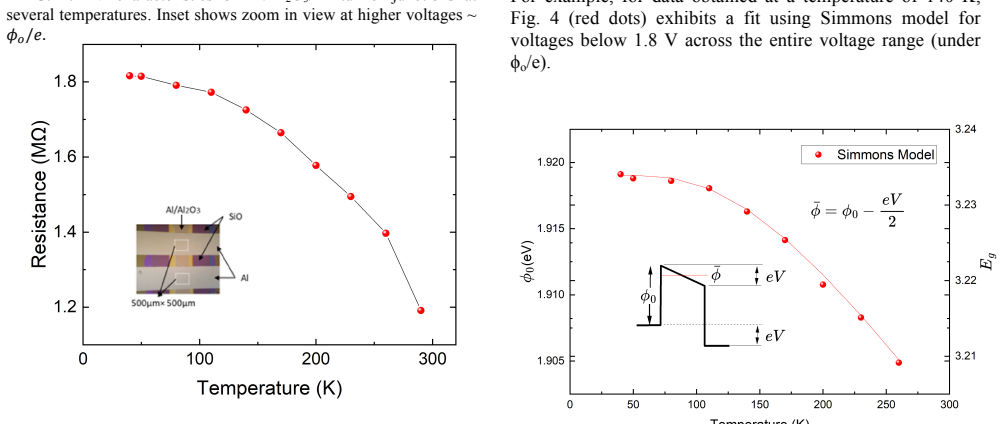
- [§III.D, Eq. (7)] The temperature trends of ΔE/E in Figs. 7b and 8 are not independent predictions: they are computed via Eq. (7) from the same fitted γ(T) and α(T) that were obtained by fitting the high-voltage I-V curves. In that sense, the 'demonstration' of the 137 K turning point is a restatement of the temperature dependence of γ and α, rather than a new physical result. The authors should explicitly acknowledge this circularity and provide an out-of-sample check, such as predicting a different observable (e.g., the voltage dependence of the differential resistance above 1.2 V) that was not used in the fit.
- [§III.D, Fig. 6] The reported relative variations of γ (~1.15%) and α (<0.4%) are extremely small, and no fit uncertainties, covariances, or confidence intervals are given for these parameters. The 137 K turning point in Fig. 7b is therefore not statistically established. The paper should propagate uncertainties from the I-V fits into γ(T), α(T), and ΔE/E, and should test the robustness of the turning point against the chosen energy fraction (E/(φ0+εF)=0.19) and applied voltage (V=0.95 V) used in Figs. 7 and 8.
- [§III.B, Eq. (2)] Equation (2) assigns a real velocity v(x) = sqrt(2(V(x)-E)/m) to the tunneling electron inside the classically forbidden barrier, where E < V(x). This conflicts with the standard WKB treatment in Eq. (3), where the tunneling momentum is imaginary. Assigning a real velocity is not justified by the tunneling formalism and makes the physical interpretation of ΔE as energy dissipated along an in-barrier trajectory questionable. The authors should either provide a derivation of this effective classical model or clearly state that it is a purely phenomenological fitting device, and discuss the limitations of interpreting γ, α, and ΔE/E literally.
- [§III, Figs. 4 and 5] The data are split at a post hoc voltage of 1.2 V, with Simmons model used below and the dissipation model above, but no physical criterion is given for this value, and the text later refers to 1.6 V in Fig. 5. Since γ and α are extracted from the high-voltage segment, an arbitrary split choice can bias their temperature dependence and hence the location of the 137 K turning point. The paper should show how γ(T), α(T), and ΔE/E change when the split voltage is varied (e.g., 1.1, 1.2, 1.3 V) and should reconcile the inconsistent 1.2 V/1.6 V statements.
minor comments (5)
- [Throughout] There are several typographical errors, including 'loosing' in the abstract, 'Simmon´s' in several places, 'Aknowledgments' in Section V, and an inverted question mark in §IV ('¿what is the effect?').
- [§II] The expression for capacitance is incomplete: 'C = ε??' lacks the geometric factor and the dielectric thickness. Please provide the full formula used to estimate C ~ 1×10⁻⁸ F.
- [§III.B, Eq. (7)] Equation (7) is labeled ΔE(s)/E but the right-hand side explicitly contains s, while the text says 'omitting s for simplicity.' Please define the notation consistently so that Eq. (7) is unambiguous.
- [Fig. 7c] The text describes the ΔE/E versus voltage curve as showing a linear reduction, but no fitted line or correlation coefficient is provided. Adding a linear fit with slope and R² would strengthen the claim.
- [§III.B vs. Fig. 5] The text states that Simmons model works well 'up about 1.2 V' and later says 'for voltages below 1.6 V' in the discussion of Fig. 5. Please reconcile these threshold values or clarify that they refer to different fits.
Circularity Check
The 137 K turning point in ΔE/E is not an independent prediction: it is computed by evaluating Eq. (7) with γ(T) and α(T) fitted to the same I-V data, so the claimed trend is a deterministic restatement of the fit.
-
fitted input called prediction
[Section III.C–D; Eq. (7); Fig. 7b and Fig. 8; Section IV]
"For intermediate voltages greater than 1.2 V, the dissipative model is applied. Here, the values of ϕo and s, as obtained from Simmons's model, are held constant at each temperature, and the data fitting is performed with γ and α as the adjustable free parameters. ... using the obtained values of the parameters the dissipated energy can be calculated from the equation ... ΔE(s)=γ{2(ε!+ϕ−E)/mc²}α/2 s. ... it decreases as the temperature increases up to a temperature around 137 K, where it rises again at higher temperatures."
The headline 'critical temperature' T=137 K is obtained by evaluating Eq. (7) with γ(T), α(T), ϕo(T) and s taken from the Simmons/dissipative fits to the same I-V curves at each temperature. No independent measurement of dissipation constrains ΔE/E; the curve in Fig. 7b is just the algebraic function in Eq. (7) evaluated with the fitted parameters. The paper itself notes that both fitted parameters 'peak around 137 K,' so the ΔE/E turning point is inherited from the fit, not discovered. Because γ and α were fitted to the high-voltage I-V data at every temperature, any temperature trend in ΔE/E at fixed E and V is forced by the fit. Calling this a 'demonstration' of a critical temperature is presenting a fitted-input function as a physical prediction.
-
self definitional
[Section III.B; Eqs. (3)–(5); Fig. 9; Section IV]
"taking the energy dissipation into account, the transmission coefficient in (3) can now be written as, T(E)=exp[−2 ∫ sqrt(2m(ε!+ϕ−E´(x)))/ℏ dx] ... where the energy of the incident particle has been modified from E→E´(x)=E−ΔE(x). ... The transmission coefficients for each of the cases revealed a notable diminution in the tunneling probability upon the introduction of dissipation, as depicted in Figure 9."
The conclusion that dissipation lowers the tunneling probability is built into Eq. (4) by construction: the WKB exponent uses E−ΔE(x) in place of E, so whenever ΔE(x)>0 the integrand sqrt(2m(V−E+ΔE))/ℏ is larger and T(E) is automatically smaller. Fig. 9 therefore does not test an independent effect; it displays the mathematical consequence of the model's definition. The 'notable diminution' is an identity of the modified transmission formula, not an empirical finding.
full rationale
The model fitting itself is legitimate empirical modeling: γ and α are explicitly fitted to I-V data, and a good fit is demonstrated. However, the paper's central physical result—the 137 K turning point in ΔE/E—is not independently predicted or measured. Eq. (7) is evaluated with the same fitted parameters that already contain all temperature dependence, and the paper admits those parameters 'peak around 137 K' before using them to infer the same turning point in dissipation. The effect is therefore a fitted-input function presented as a demonstrated critical temperature. Compounding this, the reported variations in γ (~1.15%) and α (<0.4%) are tiny and are given without error bars, covariances, or robustness checks against the post hoc 1.2 V split, so the 137 K feature has no statistical support beyond the fit itself. The claim about suppressed transmission (Fig. 9) is likewise a tautological consequence of inserting ΔE into the WKB exponent. Because the core I-V fit is not circular, the paper is not wholly circular, but the headline 'prediction' reduces by construction to the fitted parameters, warranting a partial circularity score of 6.
Assumptions & free parameters
free parameters (4)
- φ0 (barrier height) =
~1.916 eV (mean over 40-260 K)
- s (barrier width) =
~21.45 Å (constant below 290 K)
- γ (frictional coefficient) =
~5.2 eV/Å at one temperature; varies ~1.15% over 40-260 K
- α (velocity exponent) =
~0.776 at one temperature; varies ~0.4% over 40-260 K
assumptions (5)
- standard math WKB approximation gives the transmission coefficient for tunneling through the barrier
- domain assumption A tunneling electron inside the classically forbidden barrier can be assigned a real velocity v = sqrt(2(V(x)-E)/m)
- ad hoc to paper A friction force f = γ v^α with constant γ and α acts along the tunneling path
- domain assumption The barrier remains rectangular with mean height φ = φ0 - eV/2 for all voltages up to φ0/e
- domain assumption Energy lost by an electron changes only its energy in the WKB exponent, i.e., E -> E - ΔE(x)
Cite this review
Pith. "Pith review of Dissipation in quantum tunnel junctions." pith.science (2026). https://pith.science/paper/4ZI6KQ4F
@misc{pith2026241113232,
  author       = {Pith},
  title        = {Pith review of: Dissipation in quantum tunnel junctions},
  year         = {2026},
  howpublished = {\url{https://pith.science/paper/4ZI6KQ4F}},
  note         = {Machine review of arXiv:2411.13232}
}
read the original abstract
Based on experimental data, we propose a model to evaluate the energy dissipated during quantum tunneling processes in solid-state junctions. This model incorporates a nonlinear friction force expressed in the general form f(x)={\gamma} v(x)^{\alpha}, where {\gamma} is the frictional coefficient, which is fitted to data. We study this by applying voltages just below the barrier height up to near break down voltages. Furthermore, by lowering the temperature and adjusting the applied voltage to the junction, the effect on dissipation caused by the variation in barrier height is examined. We underline that the crucial dependency of dissipation on the fraction of particle energy lost is modulated by two primary mechanisms: the application of voltage and the variation of temperature. The fraction of energy dissipated decreases in general for increasing energies of the tunneling particles at a given temperature. However, for a given energy of the tunneling particle, the present work demonstrates a turning point at a temperature of 137 K, after which the dissipated energy starts increasing for higher temperatures. The latter can possibly be due to the increase of electron-phonon interactions which become predominant over barrier height reduction at higher temperatures and hence we identify T = 137 K as a critical temperature for change in dissipative characteristics of the solid-state junction under consideration. Notably, also the study identifies significant changes in dissipation parameters, {\gamma} and {\alpha}, above 137 K, exhibiting a linear decline and underscoring the importance of further research at higher temperatures.
Figures


Figures from the paper (5 more)


Reference graph
Works this paper leans on
-
[9]
This outcome underlines the significant impact of dissipation on tunneling phenomena. V. SUMMARY In summary, starting from experiments on tunneling junctions this investigation proposes a nonlinear dissipation model that fits well experimental results for large voltages close to the break down values. This model provides profound insights into the dynamic...
work page 2023
-
[1]
1 Dissipation in quantum tunnel junctions Edgar J. Patiño*, L. Rios E., N. G. Kelkar and Daniel Lopez Departamento de Física, Superconductivity and Nanodevices Laboratory, Universidad de los Andes, Carrera 1 No. 18A12, Bogotá, Colombia Based on experimental data, we propose a model to evaluate the energy dissipated during quantum tunneling processes in so...
work page 2024
-
[2]
D. Shen, R. Zhu, W. Xu, J. Chang, Z. Ji, G. Sun, C. Cao, and J. Chen, Chinese Science Bulletin 57, 409 (2012)
work page 2012
-
[3]
J. H. Park, G. S. Lee, J. Y. Yang, K. S. Yoon, C. O. Kim, J. P. Hong, and H. J. Kim, Appl Phys Lett 80, 3982 (2002)
work page 2002
- [4]
-
[5]
D. Hone, B. Mühlschlegel, and D. J. Scalapino, Appl Phys Lett 33, 203 (1978)
work page 1978
-
[6]
B. Liao, A. A. Maznev, K. A. Nelson, and G. Chen, Nat Commun 7, (2016)
work page 2016
- [7]
Show all 30 references
-
[8]
A. O. Caldeira and A. J. Leggett, Ann Phys (N Y) 149, 374 (1983)
1983
-
[10]
G. W. Ford, J. T. Lewis, and R. F. O’Connell, Phys Lett A 128, 29 (1988)
1988
-
[11]
N. G. Kelkar, D. Lozano Gómez, and E. J. Patiño, Ann Phys (N Y) 382, 11 (2017)
2017
-
[12]
J. G. Simmons, J Appl Phys 34, 1793 (1963)
1963
-
[13]
X. C. Ma, Q. Q. Shu, S. Meng, and W. G. Ma, Thin Solid Films 436, 292 (2003)
2003
-
[14]
L. S. Dorneles, D. M. Schaefer, M. Carara, and L. F. Schelp, Appl Phys Lett 82, 2832 (2003)
2003
-
[15]
Shimazawa, N
K. Shimazawa, N. Kasahara, J. J. Sun, S. Araki, H. Morita, and M. Matsuzaki, J Appl Phys 87, 5194 (2000)
2000
-
[16]
Cimpoiasu, S
E. Cimpoiasu, S. K. Tolpygo, X. Liu, N. Simonian, J. E. Lukens, K. K. Likharev, R. F. Klie, and Y. Zhu, J Appl Phys 96, 1088 (2004)
2004
-
[17]
T. A. Fulton and G. J. Dolan, Phys Rev Lett 59, 109 (1987)
1987
-
[18]
Majumdar and S
K. Majumdar and S. Hershfield, Phys Rev B 57, 11521 (1998)
1998
-
[19]
K. H. Gundlach and A. Wilkinson, Physica Status Solidi (a) 2, 295 (1970)
1970
-
[20]
Kadlec, Solid State Electronics 17, 469 (1974)
J. Kadlec, Solid State Electronics 17, 469 (1974)
1974
-
[21]
E. J. Patiño and N. G. Kelkar, Appl Phys Lett 107, (2015)
2015
-
[22]
K. M. Boden, W. P. Pratt, and N. O. Birge, Phys Rev B 84, 020510 (2011)
2011
-
[23]
Kontos, M
T. Kontos, M. Aprili, J. Lesueur, and X. Grison, Phys Rev Lett 86, 304 (2001)
2001
-
[24]
SanGiorgio, S
P. SanGiorgio, S. Reymond, M. R. Beasley, J. H. Kwon, and K. Char, Phys Rev Lett 100, 237002 (2008)
2008
-
[25]
J. G. Simmons, J Appl Phys 35, 2655 (1964)
1964
-
[26]
K. P. O’Donnell and X. Chen, Appl Phys Lett 58, 2924 (1991)
1991
-
[27]
R. C. Sousa, I. L. Prejbeanu, D. Stanescu, B. Rodmacq, O. Redon, B. Dieny, J. Wang, and P. P. Freitas, J Appl Phys 95, 6783 (2004)
2004
-
[28]
Costina and R
I. Costina and R. Franchy, Appl Phys Lett 78, 4139 (2001)
2001
-
[29]
Rossignol, B
C. Rossignol, B. Perrin, B. Bonello, P. Djemia, P. Moch, and H. Hurdequint, Phys Rev B 70, 094102 (2004)
2004
-
[30]
V. N. Matveenko and E. A. Kirsanov, Moscow University Chemistry Bulletin 66, 199 (2011)
2011
Reviewed August 12, 2026 · model on record in the stance chip above.
Discussion (0). Continue with ORCID to comment.