REVIEW 4 major objections 4 minor 2 cited by
VoxRole is presented as the first benchmark built for speech-based role-playing agents — 13,335 movie-sourced dialogues, 65.6 hours of speech, 1,228 characters — and is used to rank seven spoken-dialogue models on staying in character.
Reviewed by Pith at T0; open to challenge. T0 means a machine referee read the full paper against a public rubric. the ladder, T0–T4 →
A 65.6-hour movie-dialogue benchmark for spoken role-playing agents, with an evaluation framework whose main judge is also an evaluated model.
T0 review reviewed 2026-08-05 challenge →
load-bearing objection VoxRole's dataset construction is a real contribution, but the evaluation layer is not trustworthy: the LLM judge is also one of the evaluated models, and no release or independent validation fixes that yet. the 4 major comments →
VoxRole: A Comprehensive Benchmark for Evaluating Speech-Based Role-Playing Agents
The pith
A machine-rendered reading of the paper's core claim, the machinery that carries it, and where it could break.
The reading
Core claim
VoxRole's central claim: it is the first benchmark built for speech-based Role-Playing Conversational Agents (RPCAs), with no manual labeling in construction. Audio is transcribed, force-aligned, and matched to script sentences (semantic similarity ≥ 0.8); an LLM then infers personality and relationships from scene-event summaries, summarizes linguistic style, and bins pitch, energy, and rate into acoustic profiles. Across all seven models, scores are highest on contextual coherence and lowest on paralinguistic appropriateness; GPT-4o leads overall, and a 7B model nearly matches its speech naturalness while a 132B model trails. Judge scores track human ratings (r = 0.762); 93% of sampled pro
What carries the argument
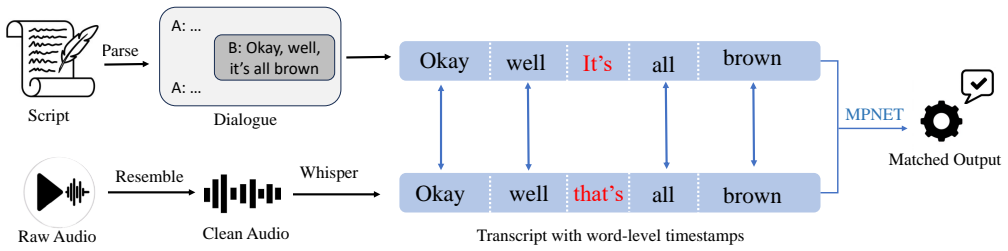
Two automated pipelines carry the argument. The extraction pipeline denoises movie audio, transcribes it, force-aligns word-level timestamps, and matches transcript to script words by minimum edit distance, accepting pairs whose MPNet semantic similarity exceeds 0.8; only consecutive two-speaker segments of at least three turns survive. The persona pipeline segments the screenplay into scenes, has an LLM summarize each scene's events, aggregates those summaries per character to infer personality and relationships, summarizes parsed dialogue lines into a linguistic-style profile, and converts measured pitch, energy, and speech rate into high/medium/low acoustic bins. Evaluation is dual: autom
Load-bearing premise
The leaderboard depends on the assumption that the AI judge used for scoring — which is itself one of the systems being scored — rates every model, including its own output, fairly and by the same standard.
What would settle it
Re-rank the seven models with a judge that is not among the evaluated systems, or one blinded to model identity, and compare with Table 3; materially different rankings would mean the scores are an artifact of self-grading. Separately, hand-check a random sample of 100 extracted dialogue segments against the film audio: high rates of speaker misattribution would undercut the benchmark's claim to contain character-rich speech.
If this is right
- Speech-based role-playing gains a common measuring stick: any future model can be scored on the same 1,228 characters and 13,335 dialogues, making persona-consistency progress measurable rather than anecdotal.
- The universal weak spot, paralinguistic appropriateness, points to expressive audio generation as the near-term bottleneck for immersive spoken role-play.
- The more than 15% gap between GPT-4o and the best open-source model on personality consistency and relational coherence quantifies how much proprietary context modeling still outpaces open systems.
- The non-monotonic context-length result implies role-play systems should tune their dialogue-history window instead of assuming more context is always better.
- Because different models win different metrics, the benchmark separates speech quality, semantic fidelity, and persona adherence instead of collapsing them into a single ranking.
Where Pith is reading between the lines
- The same pipeline should transfer to TV series, audio dramas, and dubbed content, since it needs only audio plus a script; if it does, the benchmark could scale well beyond 261 movies without new annotation — a claim the paper does not make.
- Because the judge is also a contestant, the direct stress-test is to re-rank all models with an independent judge or one blinded to model identity; a shifting leaderboard would mean the evaluation layer, not the models, produced the ordering.
- The three-bin acoustic discretization may be too coarse to capture within-scene emotional dynamics; a continuous acoustic-distance measure could sharpen the paralinguistic dimension and possibly reorder the lower-ranked systems.
- The dataset pairs ground-truth responses with rich persona profiles, so it could double as supervised fine-tuning data for open speech models — the paper proposes fine-tuning as future work but does not position VoxRole itself as a training resource.
Editorial analysis
A structured set of objections, weighed in public.
Referee Report
Summary. The paper introduces VoxRole, a large-scale benchmark for speech-based role-playing conversational agents, built by extracting 13,335 multi-turn two-speaker dialogues (65.6 hours, 1,228 characters from 261 movies) via an automated pipeline combining audio-script alignment and LLM-based persona distillation. The authors evaluate seven spoken dialogue systems using both reference-based metrics (Rouge-L, Meteor, BertScore, UTMOS) and an LLM judge that receives transcripts plus extracted acoustic features. They report rankings, cross-model comparisons, a context-length ablation, and a small human correlation study. The main claimed contributions are the benchmark resource, the automated construction pipeline, and a multi-dimensional evaluation framework for spoken RPCAs.
Significance. If the resource and evaluation framework were validated, VoxRole would address a real gap: there are few spoken RPCA benchmarks with richly profiled characters, and the 65.6-hour, 1,228-character corpus is unusually large. The two-stage pipeline (audio-script alignment plus LLM persona extraction) is a practical engineering contribution, and the multi-dimensional evaluation dimensions are sensible. However, the reliability of the evaluation layer is currently not established: the LLM judge is also an evaluated model, the 'acoustically-aware' judge never hears audio, and the metric-based evaluation compares to original movie lines despite the pipeline explicitly allowing paraphrases. These are load-bearing issues for the paper's central evaluation claims. The resource itself is promising, but the presented scores and 'crucial insights' are not yet trustworthy.
major comments (4)
- [LLM-based Evaluation (footnote 5), Table 3, Subjective experimental results] Gemini-2.5-flash is used as the LLM judge and is also one of the evaluated models in Table 3. No blinding, identity masking, self-preference control, or independent-judge comparison is reported. The human validation samples only five open-source models, so the reported Pearson correlation of 0.762 does not cover Gemini-2.5-flash or GPT-4o. Since Table 3 and the derived 'crucial insights' about model hierarchies and persona-consistency weaknesses rest entirely on these scores, this is a central validity threat. Please add an independent judge or exclude Gemini from the evaluated set, and include a self-preference analysis plus human ratings that cover proprietary models.
- [LLM-based Evaluation] The method is described as 'acoustically-aware,' but the judge never receives audio. The input is the transcribed text plus Emotion2Vec emotion labels and discretized pitch/energy/speech-rate bins. These coarse categorical features may not capture prosody, intonation, or rhythm, yet the Paralinguistic Appropriateness scores in Table 3 are used as the main evidence about spoken role-playing. No validation is provided that Emotion2Vec labels or the percentile bins agree with human perception of paralinguistic appropriateness, nor that the judge can use such features effectively. Please compare against a judge that actually processes audio or against human listening, and report the reliability of the acoustic feature representation.
- [Metric-based Evaluation; Semantic Validation (MPNet threshold, 0.8)] Rouge-L, Meteor, and BertScore are computed between the generated response and the original movie line. However, the pipeline explicitly accepts semantically matched but lexically different candidate lines as correct (MPNet similarity > 0.8). This means a faithful, in-character paraphrase is penalized by the lexical metrics, and the hierarchy in Table 2 may reflect paraphrastic divergence rather than role-playing quality. No human correlation or reference-free evaluation is reported for these metrics. The metric-based results should either be validated against human judgments or reframed as measuring divergence from the reference rather than role-playing ability.
- [Word-Level Audio-Script Alignment; Persona Distillation; Quality Validation] The alignment stage is never directly validated: the only evidence is the duration/statistics table (Table 1) and the existence of matched segments. If speaker labels or sentence boundaries are wrong, both the extracted dialogues and the persona profiles built from them are corrupted. The persona profiles are also only human-evaluated on 20 characters with 5 annotators (93% rated acceptable or satisfactory), and these LLM-generated profiles are then used as ground truth for judging model consistency. Please report alignment precision/recall on a human-annotated sample, and expand the profile validation with failure-case analysis and inter-annotator agreement.
minor comments (4)
- [Throughout] Several typos and spacing issues: 'acript' in 'Word-Level Audio-Script Alignment', 'V oxRole' and 'V oice' in headers, 'Benchmark Statics' should be 'Statistics', 'nto' in the persona synthesis sentence, and 'Results are shown in Table 2' in Section 4.2 should be Table 3.
- [Ablation study on context length, Table 4] The reported non-monotonic trend is based on very small score differences (e.g., 3.69 vs 3.72). No significance tests, confidence intervals, or repeats are provided, so the claim of an optimal context window is not statistically supported.
- [Experimental Setup] The evaluation set uses 20 movies 'randomly sampled' with no seed or sampling details, and the LLM-generated scenario summaries are not released. This limits reproducibility. Please provide the exact sampling procedure, prompt templates, and dataset release URL.
- [Quality Validation] The human evaluation uses a 3-point scale with only 100 ratings. While useful as a sanity check, this is weak evidence for a benchmark claiming comprehensive persona quality. Please report the distribution per character and inter-annotator agreement.
Circularity Check
No significant circularity: the benchmark construction and metric-based evaluation are externally anchored; the LLM-judge self-evaluation is a validity concern, not a circular reduction.
full rationale
The paper's central contribution is a data resource built from movie scripts and audio via an automated alignment pipeline (Whisper, Wav2Vec2, MPNet) and an LLM-based persona distillation. The persona profiles are anchored to external script content and independently spot-checked by human annotators (20 characters; 93% acceptable or satisfactory), which breaks any closed loop between profile generation and evaluation. The metric-based evaluation (Rouge-L, Meteor, BertScore, UTMOS) compares model outputs against ground-truth movie lines and an external speech-quality predictor, so it is not self-referential. The LLM-based evaluation is a subjective measurement: using Gemini-2.5-flash as judge while also evaluating Gemini-2.5-flash creates a potential self-preference bias, and the human-correlation check only samples five open-source models, leaving the proprietary rows unvalidated. However, this is an experimental-validity limitation, not a circular derivation: no equation or definition in the paper makes a model's score equivalent to the judge's own output, and the results are not forced by construction. The paper does not rely on any load-bearing self-citation; the one possible self-citation (Step-Audio, given a co-author's StepFun affiliation) is merely an evaluated baseline. Therefore, the derivation chain is self-contained with respect to circularity, and the score is 0.
Axiom & Free-Parameter Ledger
free parameters (4)
- MPNet similarity threshold =
0.8
- Acoustic discretization percentiles =
top 20% High, bottom 20% Low, middle 60% Medium
- Evaluation context length =
6 utterances
- Dataset filtering criteria =
minimum 5 min matched audio per movie; minimum 10 matched dialogues per speaker
axioms (4)
- domain assumption The aligned script lines and speaker labels are correct after Whisper/Wav2Vec2 alignment and MPNet validation.
- domain assumption LLM-generated persona profiles accurately represent the movie characters.
- ad hoc to paper The LLM judge (Gemini-2.5-flash) produces scores that are a valid proxy for human judgment.
- domain assumption Movie lines are a valid gold reference for open-ended role-playing responses.
Cite this review
Pith. "Pith review of VoxRole: A Comprehensive Benchmark for Evaluating Speech-Based Role-Playing Agents." pith.science (2026). https://pith.science/paper/536GUWZF
@misc{pith2026250903940,
  author       = {Pith},
  title        = {Pith review of: VoxRole: A Comprehensive Benchmark for Evaluating Speech-Based Role-Playing Agents},
  year         = {2026},
  howpublished = {\url{https://pith.science/paper/536GUWZF}},
  note         = {Machine review of arXiv:2509.03940}
}
read the original abstract
Recent significant advancements in Large Language Models (LLMs) have greatly propelled the development of Role-Playing Conversational Agents (RPCAs). These systems aim to create immersive user experiences through consistent persona adoption. However, current RPCA research faces dual limitations. First, existing work predominantly focuses on the textual modality, entirely overlooking critical paralinguistic features including intonation, prosody, and rhythm in speech, which are essential for conveying character emotions and shaping vivid identities. Second, the speech-based role-playing domain suffers from a long-standing lack of standardized evaluation benchmarks. Most current spoken dialogue datasets target only fundamental capability assessments, featuring thinly sketched or ill-defined character profiles. Consequently, they fail to effectively quantify model performance on core competencies like long-term persona consistency. To address this critical gap, we introduce VoxRole, the first comprehensive benchmark specifically designed for the evaluation of speech-based RPCAs. The benchmark comprises 13335 multi-turn dialogues, totaling 65.6 hours of speech from 1228 unique characters across 261 movies. To construct this resource, we propose a novel two-stage automated pipeline that first aligns movie audio with scripts and subsequently employs an LLM to systematically build multi-dimensional profiles for each character. Leveraging VoxRole, we conduct a multi-dimensional evaluation of contemporary spoken dialogue models, revealing crucial insights into their respective strengths and limitations in maintaining persona consistency.
Figures


Forward citations
Cited by 2 Pith papers
-
Character Beyond Speech: Leveraging Role-Playing Evaluation in Audio Large Language Models via Reinforcement Learning
RoleJudge is a multidimensional evaluation framework for speech-character alignment in audio LLMs, backed by the RoleChat dataset and multi-stage RL training with standard alignment to reduce reward issues.
-
DeSRPA: Decoupled Speech Role-Playing Agent via Inference-Time Intervention
DeSRPA introduces a dual-level control vector method for inference-time intervention on frozen backbones to improve personality consistency and speech naturalness in role-playing agents over end-to-end fine-tuned baselines.
Reference graph
Works this paper leans on
-
[3]
arXiv preprint arXiv:2410.17196
V oicebench: Benchmarking llm-based voice assis- tants. arXiv preprint arXiv:2410.17196. Cheng, X.; Hu, R.; Yang, X.; Lu, J.; Fu, D.; Wang, Z.; Ji, S.; Huang, R.; Zhang, B.; Jin, T.; et al
-
[4]
arXiv preprint arXiv:2408.04203
Mmrole: A comprehensive framework for developing and evaluating multimodal role-playing agents. arXiv preprint arXiv:2408.04203. D´efossez, A.; Mazar ´e, L.; Orsini, M.; Royer, A.; P ´erez, P.; J´egou, H.; Grave, E.; and Zeghidour, N
-
[5]
arXiv preprint arXiv:2410.00037
Moshi: a speech-text foundation model for real-time dialogue. arXiv preprint arXiv:2410.00037. Goffman, E
-
[7]
arXiv preprint arXiv:2410.21276
Gpt-4o system card. arXiv preprint arXiv:2410.21276. John, O. P.; Srivastava, S.; et al
-
[8]
arXiv preprint arXiv:2302.02083, 4:
Theory of mind may have sponta- neously emerged in large language models. arXiv preprint arXiv:2302.02083, 4:
-
[9]
arXiv preprint arXiv:2502.17239
Baichuan-audio: A unified framework for end-to-end speech interaction. arXiv preprint arXiv:2502.17239. Lin, C.-Y
-
[10]
arXiv preprint arXiv:2503.04721
Full-duplex- bench: A benchmark to evaluate full-duplex spoken dia- logue models on turn-taking capabilities. arXiv preprint arXiv:2503.04721. Liu, J.; Ni, Z.; Que, H.; Sun, S.; Wang, N.; Yang, J.; Guo, H.; Peng, Z.; Zhang, G.; Tian, J.; et al
-
[11]
Ma, Z.; Zheng, Z.; Ye, J.; Li, J.; Gao, Z.; Zhang, S.; and Chen, X
Rolemrc: A fine-grained composite benchmark for role-playing and instruction-following.arXiv preprint arXiv:2502.11387. Ma, Z.; Zheng, Z.; Ye, J.; Li, J.; Gao, Z.; Zhang, S.; and Chen, X
-
[12]
arXiv preprint arXiv:2312.15185
emotion2vec: Self-supervised pre- training for speech emotion representation. arXiv preprint arXiv:2312.15185. Shanahan, M.; McDonell, K.; and Reynolds, L
-
[13]
arXiv preprint arXiv:2401.01275
Charactereval: A chinese benchmark for role-playing conversational agent evaluation. arXiv preprint arXiv:2401.01275. Wang, L.; Ma, C.; Feng, X.; Zhang, Z.; Yang, H.; Zhang, J.; Chen, Z.; Tang, J.; Chen, X.; Lin, Y .; et al
-
[14]
arXiv preprint arXiv:2502.09082
Coser: Coordinating llm-based persona simulation of established roles. arXiv preprint arXiv:2502.09082. Wang, Z. M.; Peng, Z.; Que, H.; Liu, J.; Zhou, W.; Wu, Y .; Guo, H.; Gan, R.; Ni, Z.; Yang, J.; et al
-
[15]
arXiv preprint arXiv:2310.00746
Rolellm: Benchmarking, eliciting, and enhancing role- playing abilities of large language models. arXiv preprint arXiv:2310.00746. Xu, J.; Guo, Z.; He, J.; Hu, H.; He, T.; Bai, S.; Chen, K.; Wang, J.; Fan, Y .; Dang, K.; et al
-
[16]
Qwen2. 5-omni technical report. arXiv preprint arXiv:2503.20215. Yan, R.; Li, X.; Chen, W.; Niu, Z.; Yang, C.; Ma, Z.; Yu, K.; and Chen, X
-
[17]
Zeng, A.; Du, Z.; Liu, M.; Wang, K.; Jiang, S.; Zhao, L.; Dong, Y .; and Tang, J
Uro-bench: A comprehensive bench- mark for end-to-end spoken dialogue models.arXiv preprint arXiv:2502.17810. Zeng, A.; Du, Z.; Liu, M.; Wang, K.; Jiang, S.; Zhao, L.; Dong, Y .; and Tang, J
-
[18]
arXiv preprint arXiv:2412.02612
Glm-4-voice: Towards in- telligent and human-like end-to-end spoken chatbot. arXiv preprint arXiv:2412.02612. Zhang, H.; Luo, R.; Liu, X.; Wu, Y .; Lin, T.-E.; Zeng, P.; Qu, Q.; Fang, F.; Yang, M.; Gao, L.; et al
-
[19]
arXiv preprint arXiv:2505.20277
OmniCharac- ter: Towards Immersive Role-Playing Agents with Seamless Speech-Language Personality Interaction. arXiv preprint arXiv:2505.20277. Zhang, T.; Kishore, V .; Wu, F.; Weinberger, K. Q.; and Artzi, Y
-
[2019]
arXiv preprint arXiv:1904.09675
Bertscore: Evaluating text generation with bert. arXiv preprint arXiv:1904.09675
Pith/arXiv arXiv 1904
-
[2023]
arXiv preprint arXiv:2303.08774
Gpt-4 technical report. arXiv preprint arXiv:2303.08774. Baba, K.; Nakata, W.; Saito, Y .; and Saruwatari, H
-
[2024]
In 2024 IEEE Spo- ken Language Technology Workshop (SLT), 818–824
The t05 system for the voicemos challenge 2024: Transfer learning from deep image classifier to naturalness mos pre- diction of high-quality synthetic speech. In 2024 IEEE Spo- ken Language Technology Workshop (SLT), 818–824. IEEE. Banerjee, S.; and Lavie, A
work page 2024
-
[2025]
arXiv preprint arXiv:2502.11946
Step-audio: Unified understanding and generation in intelligent speech interaction. arXiv preprint arXiv:2502.11946. Hurst, A.; Lerer, A.; Goucher, A. P.; Perelman, A.; Ramesh, A.; Clark, A.; Ostrow, A.; Welihinda, A.; Hayes, A.; Rad- ford, A.; et al
This paper was first reviewed by deepseek-v4-flash on August 5, 2026.
discussion (0)
Sign in with ORCID, Apple, or X to comment. Anyone can read and Pith papers without signing in.