REVIEW 3 major objections 6 minor 2 cited by
Self-Disentanglement and Re-Composition for Cross-Domain Few-Shot Segmentation
T0 review · 3 major / 6 minor · reviewed 2026-08-07 · deepseek-v4-flash
Pith's one-line read The paper argues that cross-domain few-shot segmentation fails because distance-based comparison of Vision Transformer features treats every pairwise layer comparison as equally important, so meaningful matches are diluted by meaningless…
desk verdict Credible empirical gains for CD-FSS, but the causal story is under-tested; worth a serious referee if the theory and artifacts are cleaned up. read the letter →
The pith
A machine-rendered reading of the paper's core claim, the machinery that carries it, and where it could break.
The reading
What carries the argument
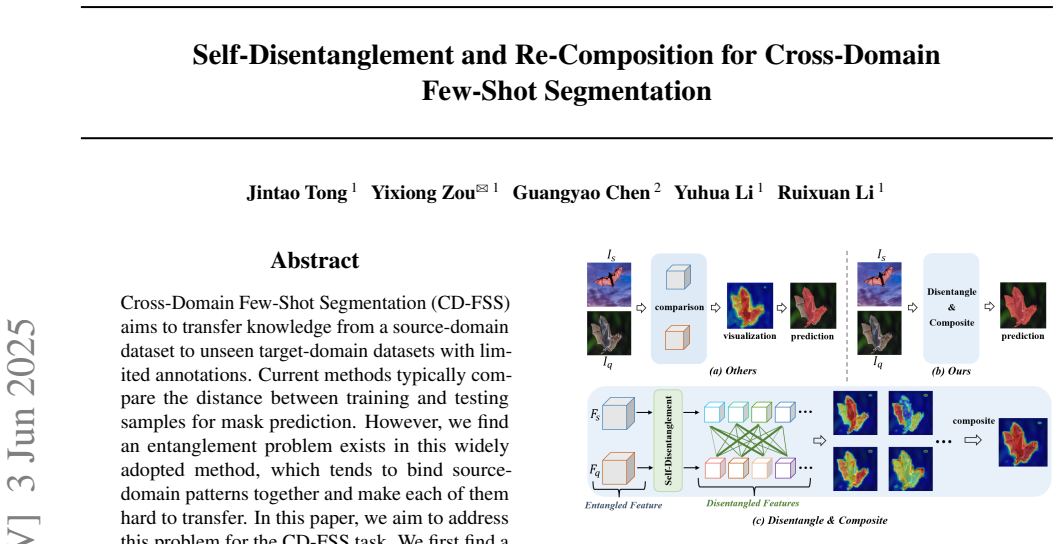
The load-bearing identity is the residual-stream decomposition of a Vision Transformer, written as $\mathrm{ViT}(I)=Z^0+\sum_{l=1}^{L}\mathrm{Layer}_l$, which treats the final output as the sum of per-layer contributions. This turns a single feature-distance computation into a matrix of all pairwise inter-layer comparisons, and it drives both the diagnosis and the remedy: the CKA measurements quantify which comparisons are meaningful, and the method learns weights over that comparison matrix. The method itself consists of three modules: Orthogonal Space Decoupling (OSD), which projects the concatenated layer features into a low-rank space with an orthogonality loss and maps them back; Cross-Pattern Comparison (CPC), which builds $L\times L$ foreground/background score maps between support prototypes and query features; and Adaptive Fusion Weight (AFW), a small ($L^2\times 2$) weight matrix learned during target finetuning to re-compose the score maps.
What would settle it
Run the CD-FSS benchmark with the fusion weights (or AFW) replaced by random fixed weights while keeping everything else identical; the paper's account predicts a large drop toward the equal-weight baseline. If accuracy stays roughly the same, then the learned weighting is not the active ingredient and the entanglement explanation is not supported.
Extended reading notes
Core claim
The central claim is that it is the equal-weight cross-match of ViT components in distance calculation that causes feature entanglement in CD-FSS, not the individual features themselves. Because residual connections keep every layer's output in the same feature space, the final ViT representation is a cumulative composition of all layers; a cosine-similarity distance between support and query therefore expands into a full matrix of pairwise layer comparisons. The paper shows that diagonal (same-layer) comparisons have much higher source–target CKA similarity than the final-output comparison, which they take as evidence that correct matches carry transferable signal, while off-diagonal matches dilute it. It further observes that some off-diagonal matches are better than the diagonal, indicating the optimal comparison is a learnable cross-match rather than strict layer-wise matching. Based on this, SDRC decouples layer features with an orthogonality constraint, cross-compares them, and re-composes the resulting score maps with weights learned during target-domain finetuning.
Load-bearing premise
The causal interpretation rests on treating a Vision Transformer's final feature as a plain sum of independent layer outputs, ignoring layer normalization and the indirect ways layers influence each other; if that simplification is not faithful, the diagnosis may not be the real mechanism even though the method still works.
Editorial extensions
If this is right
- Any distance-based CD-FSS method that compares final ViT features with equal weights is leaving transferable signal unused; reweighting the cross-layer comparison matrix should improve accuracy without changing the encoder.
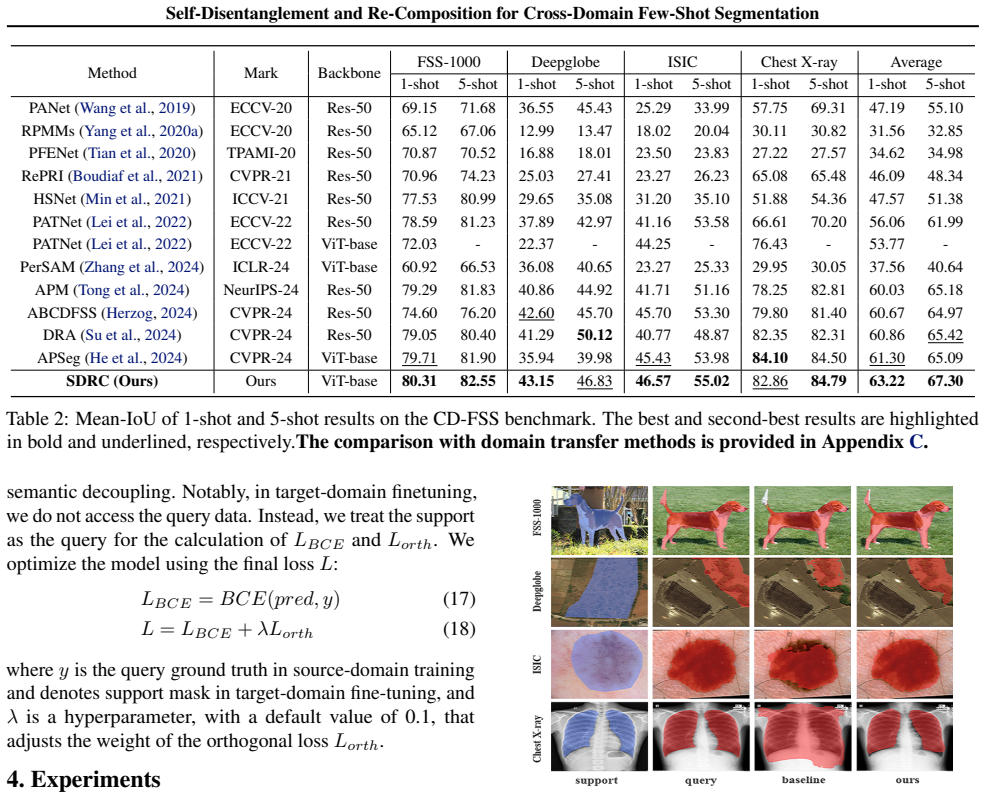
- The gains of 1.92 and 1.88 mean-IoU points under 1-shot and 5-shot indicate that comparison weighting matters more when the support set is small, and the consistent improvement across natural, satellite, skin-lesion, and X-ray domains suggests the entanglement mechanism is domain-agnostic.
- Because OSD operates on a rank-8 low-dimensional space and AFW has only a few hundred parameters, the approach can be grafted onto existing prototype-based few-shot segmenters at negligible computational cost.
- The theoretical argument in Section 6 implies the learned weights tighten the target-domain risk bound by shrinking the weighted inter-layer domain discrepancy, so the method is a form of attention over layer comparisons rather than a new feature extractor.
Reading between the lines
- The same equal-weight cross-layer comparison appears in many metric-based few-shot learners beyond segmentation, so the learned-weighting principle could transfer to few-shot classification and retrieval, though the paper does not test this.
- One diagnostic use suggested by the paper's logic: computing the CKA matrix between support and query layer features at inference time could flag when a model is relying on meaningless cross-layer matches, enabling a data-driven choice of where to apply reweighting.
- The paper's theoretical bound connects learned comparison weights to $H$-divergence; a natural extension would be to make the weights directly penalize low-CKA cross-layer pairs during source training rather than learning them only during target finetuning.
Editorial analysis
A structured set of objections, weighed in public.
Referee Report
Summary. The paper proposes a cross-domain few-shot segmentation method (SDRC) built on a decomposition of the ViT output into a sum of layer contributions. It argues that existing distance-based methods entangle meaningful and meaningless cross-layer comparisons because all comparisons are weighted equally, and proposes to fix this by (i) extracting per-layer features, (ii) an Orthogonal Space Decoupling (OSD) module that reduces feature correlation in a low-rank space, (iii) a Cross-Pattern Comparison (CPC) module that computes all L×L support-query layer comparisons, and (iv) an Adaptive Fusion Weight (AFW) for target-domain fine-tuning. Experiments on four CD-FSS target datasets report mean IoU improvements of 1.92 and 1.88 points over prior state of the art under 1-shot and 5-shot settings, with ablations over components, distance metrics, loss weights, and network architectures.
Significance. The paper's strongest contribution is empirical: it demonstrates consistent gains on the standard CD-FSS benchmark using a lightweight encoder-only ViT design, with ablations isolating the contribution of each proposed module and additional studies on Swin Transformers, FSS, and domain generalization. These results are valuable for the community even if the proposed interpretation is later refined. The causal interpretation of entanglement through equal-weight cross-layer comparisons is the paper's main conceptual novelty, and its validation currently relies on an indirect CKA proxy and an approximate additivity assumption that are not sufficient to establish the mechanism. The theoretical analysis in Section 6 is internally inconsistent and should be corrected.
major comments (3)
- [Section 2.2, Eq. (3)] The central decomposition ViT(I)=Z0+Σ_l Layer_l explicitly ignores layer normalization (stated in the text) and indirect cross-layer effects. Because LayerNorm is a nonlinear operation applied inside each block (and at the output), the final representation is not a sum of independent layer contributions. Since Eq. (7) and the notion of 'equal importance' of cross-layer comparisons rely directly on this additivity, the causal interpretation is built on an unverified approximation. The paper should either quantify the faithfulness of Eq. (3) on actual ViT features (e.g., reconstruction error or a diagnostic where uniform vs. diagonal cross-layer weights are compared in a simple baseline without OSD/AFW), or soften the causal claim. The empirical method may still be effective, but the stated interpretation is not yet supported.
- [Section 2.3, Table 1 and Fig. 4] The validation of the entanglement hypothesis uses CKA between source and target features as a proxy for overfitting/entanglement. CKA is a similarity measure between representations, not a measure of segmentation error, transferability, or 'meaningless comparison' impact. Table 1 compares final-output CKA with layer-wise average CKA, but these are different quantities (a single representation versus an average of 12 pairwise similarities), and the reported 'Top-12 Avg' and 'Bottom-12 Avg' values are not defined in the text or figure caption. Moreover, Table 5's comparison between position-wise and cross-pattern comparison is performed inside the full pipeline containing OSD and AFW, so it cannot isolate the effect of equal-weight cross-layer matching in the baseline of Eq. (6). A controlled experiment with fixed equal weights vs. diagonal-only weights, without learned modules, is needed to support the causal claim.
- [Section 6, Eq. (19)-(20)] The theoretical analysis is internally inconsistent with the method section. Mechanism 1 states that AFW 'reduces ε_S(h)' by optimizing source-domain output, but AFW is deliberately excluded from source-domain training (Section 3.2 and Table 7 show that source-trained AFW performs worse). The sentence 'as confirmed by the experiments on the source domain in Answer 3' contains a vestige of a prior exchange and should be removed. Additionally, the inequality in Eq. (20) requires 0 ≤ w_ij ≤ 1 and a well-defined decomposition of the H-divergence into per-layer terms, neither of which is established; the learned weights are unconstrained. Please either provide a rigorous derivation with stated assumptions or delete this section, as it currently undermines rather than supports the paper's claims.
minor comments (6)
- [Section 2.1 and Section 3.2] The problem definition states the model is trained solely on the source domain 'without access to the target data,' but the method includes target-domain fine-tuning on the support set. Please clarify that the episodic evaluation uses support-set fine-tuning after source training; this distinction is important for understanding the setting and for assessing the AFW results.
- [Table 1 and Fig. 4] Please define 'Top-12 Avg' and 'Bottom-12 Avg' explicitly; the current text says 'simply shift the match between layers' but does not describe the shift procedure.
- [Throughout] Several typographical errors: 'usual perform' in Section 1, 'the model is trained solely... without access to the target data' (contradicts fine-tuning), 'the layers' in Section 2.2, and the footnote 'Please see Fig. 2 for distinguishing Layer and Block' should be integrated.
- [Section 2.2] The citation to 'Gandelsman et al.' is missing the publication venue/year in the bibliography; the same reference appears incomplete.
- [Section 5, Table 6] The rank sweep row lacks a header; it is not clear what the first row (64, 32, 16, 8, 4, 2) represents until reading the text. Also, the claim that rank=8 uses 1/4 the parameters of rank=32 is not visible from the table; please state the parameter counts.
- [Section 4.2] The claim that APSeg has 'substantially lower computational costs' for the proposed method is not quantified; please include parameter counts or FLOPs for APSeg alongside Table 11.
Circularity Check
No significant circularity: SDRC's reported gains are evaluated on held-out target episodes, and the ViT decomposition is an explicitly stated approximation used for motivation rather than as evidence for itself.
full rationale
The paper's central chain is: decompose ViT output into layer components (Eq. 3), expand cosine similarity into cross-layer terms (Eq. 7), hypothesize that equal-weight cross-layer comparisons cause feature entanglement, validate this hypothesis with CKA domain-similarity measurements, and then design OSD, CPC, and AFW to reweight those comparisons. None of these steps reduces to its own input by construction. The decomposition in Eq. 3 is explicitly approximate (layer normalization and indirect downstream effects are ignored), but this is a stated modeling assumption, not a circular definition. The CKA validation uses the standard CKA metric from Kornblith et al. (2019); the self-citation to Zou et al. (2024a) is only for the choice of metric and is not load-bearing because the metric and its equations are provided in Appendix A and originate externally. The method's predictions are test-set segmentation masks, not re-displays of fitted parameters: OSD, AFW, and comparison weights are learned from support episodes and evaluated on held-out query images, and the ablations compare genuine architectural variants on the same benchmark. The main limitation is that the causal claim that cross-layer matching is the unique cause of entanglement is not fully isolated by the ablations; CKA similarity is a proxy, and the same-layer CKA differences could partly reflect known layer-function alignment rather than a demonstrated mechanism. That is a correctness or identification concern, not circularity. One unusual artifact should be noted but does not affect circularity: Section 6 contains the unsupported sentence 'as confirmed by the experiments on the source domain in Answer 3,' which appears to be a template remnant and is not a demonstrated experimental confirmation in the paper. Overall, the empirical contributions stand independently of the paper's interpretative narrative, so no circular step is present.
Assumptions & free parameters
free parameters (4)
- lambda (orthogonal loss weight) =
0.1
- r (OSD rank) =
8
- AFW weight matrix (L^2 x 2) =
Learned per target episode
- Worth (OSD convolutional layer) =
Fine-tuned on target
assumptions (4)
- domain assumption ViT final output equals the sum of per-layer outputs, ignoring layer normalization and cross-layer interactions (Eq. 2,3)
- domain assumption CKA similarity between source and target features measures feature entanglement or overfitting
- domain assumption Orthogonal regularization on a low-rank projection of concatenated layer features produces semantically disentangled patterns
- standard math Standard domain adaptation bound epsilon_T <= epsilon_S + d_H + lambda (Eq. 19)
Cite this review
Pith. "Pith review of Self-Disentanglement and Re-Composition for Cross-Domain Few-Shot Segmentation." pith.science (2026). https://pith.science/paper/55LN5SC7
@misc{pith2026250602677,
  author       = {Pith},
  title        = {Pith review of: Self-Disentanglement and Re-Composition for Cross-Domain Few-Shot Segmentation},
  year         = {2026},
  howpublished = {\url{https://pith.science/paper/55LN5SC7}},
  note         = {Machine review of arXiv:2506.02677}
}
read the original abstract
Cross-Domain Few-Shot Segmentation (CD-FSS) aims to transfer knowledge from a source-domain dataset to unseen target-domain datasets with limited annotations. Current methods typically compare the distance between training and testing samples for mask prediction. However, we find an entanglement problem exists in this widely adopted method, which tends to bind sourcedomain patterns together and make each of them hard to transfer. In this paper, we aim to address this problem for the CD-FSS task. We first find a natural decomposition of the ViT structure, based on which we delve into the entanglement problem for an interpretation. We find the decomposed ViT components are crossly compared between images in distance calculation, where the rational comparisons are entangled with those meaningless ones by their equal importance, leading to the entanglement problem. Based on this interpretation, we further propose to address the entanglement problem by learning to weigh for all comparisons of ViT components, which learn disentangled features and re-compose them for the CD-FSS task, benefiting both the generalization and finetuning. Experiments show that our model outperforms the state-of-the-art CD-FSS method by 1.92% and 1.88% in average accuracy under 1-shot and 5-shot settings, respectively.
Figures


Figures from the paper (7 more)



Forward citations
Cited by 2 Pith papers
-
Cross-Domain Few-Shot Segmentation via Multi-view Progressive Adaptation
A progressive multi-view augmentation and dual-chain prediction method improves cross-domain few-shot segmentation, reporting +7.0% mIoU over state-of-the-art while also working without source-domain training.
-
The First EgoCross Challenge at EgoVis 2026: Cross-Domain Egocentric Video Question Answering
At CVPR 2026, the EgoCross Challenge evaluated cross-domain egocentric video QA across four specialist domains, with the best system reaching 66.98% accuracy.
Reference graph
Works this paper leans on
-
[1]
I., Piantanida, P., Ben Ayed, I., and Dolz, J
Boudiaf, M., Kervadec, H., Masud, Z. I., Piantanida, P., Ben Ayed, I., and Dolz, J. Few-shot segmentation without meta-learning: A good transductive inference is all you need? In Proceedings of the IEEE/CVF conference on computer vision and pattern recognition, pp.\ 13979--13988, 2021
work page 2021
-
[2]
Candemir, S., Jaeger, S., Palaniappan, K., Musco, J. P., Singh, R. K., Xue, Z., Karargyris, A., Antani, S., Thoma, G., and McDonald, C. J. Lung segmentation in chest radiographs using anatomical atlases with nonrigid registration. IEEE transactions on medical imaging, 33 0 (2): 0 577--590, 2013
work page 2013
-
[3]
Mmfuser: Multimodal multi-layer feature fuser for fine-grained vision-language understanding
Cao, Y., Liu, Y., Chen, Z., Shi, G., Wang, W., Zhao, D., and Lu, T. Mmfuser: Multimodal multi-layer feature fuser for fine-grained vision-language understanding. arXiv preprint arXiv:2410.11829, 2024
arXiv 2024
-
[4]
Chen, W.-Y., Liu, Y.-C., Kira, Z., Wang, Y.-C. F., and Huang, J.-B. A closer look at few-shot classification. In International Conference on Learning Representations, 2019
work page 2019
-
[5]
Infogan: Interpretable representation learning by information maximizing generative adversarial nets
Chen, X., Duan, Y., Houthooft, R., Schulman, J., Sutskever, I., and Abbeel, P. Infogan: Interpretable representation learning by information maximizing generative adversarial nets. Advances in neural information processing systems, 29, 2016
2016
-
[6]
Cheng, H., Wang, Y., Li, H., Kot, A. C., and Wen, B. Disentangled feature representation for few-shot image classification. IEEE transactions on neural networks and learning systems, 2023
work page 2023
-
[7]
E., Dusza, S., Gutman, D., Helba, B., Kalloo, A., Liopyris, K., Marchetti, M., et al
Codella, N., Rotemberg, V., Tschandl, P., Celebi, M. E., Dusza, S., Gutman, D., Helba, B., Kalloo, A., Liopyris, K., Marchetti, M., et al. Skin lesion analysis toward melanoma detection 2018: A challenge hosted by the international skin imaging collaboration (isic). arXiv preprint arXiv:1902.03368, 2019
arXiv 2018
-
[8]
Deepglobe 2018: A challenge to parse the earth through satellite images
Demir, I., Koperski, K., Lindenbaum, D., Pang, G., Huang, J., Basu, S., Hughes, F., Tuia, D., and Raskar, R. Deepglobe 2018: A challenge to parse the earth through satellite images. In Proceedings of the IEEE Conference on Computer Vision and Pattern Recognition Workshops, pp.\ 172--181, 2018
work page 2018
Show all 53 references
-
[9]
and Xing, E
Dong, N. and Xing, E. P. Few-shot semantic segmentation with prototype learning. In BMVC, volume 3, 2018
2018
-
[10]
An image is worth 16x16 words: Transformers for image recognition at scale
Dosovitskiy, A., Beyer, L., Kolesnikov, A., Weissenborn, D., Zhai, X., Unterthiner, T., Dehghani, M., Minderer, M., Heigold, G., Gelly, S., et al. An image is worth 16x16 words: Transformers for image recognition at scale. arXiv preprint arXiv:2010.11929, 2020
2010 arXiv
-
[11]
K., Winn, J., and Zisserman, A
Everingham, M., Van Gool, L., Williams, C. K., Winn, J., and Zisserman, A. The pascal visual object classes (voc) challenge. International journal of computer vision, 88: 0 303--338, 2010
2010
-
[12]
Self-support few-shot semantic segmentation
Fan, Q., Pei, W., Tai, Y.-W., and Tang, C.-K. Self-support few-shot semantic segmentation. In European Conference on Computer Vision, pp.\ 701--719. Springer, 2022
2022
-
[13]
A., and Steinhardt, J
Gandelsman, Y., Efros, A. A., and Steinhardt, J. Interpreting clip's image representation via text-based decomposition. In The Twelfth International Conference on Learning Representations
-
[14]
Semantic contours from inverse detectors
Hariharan, B., Arbel \'a ez, P., Bourdev, L., Maji, S., and Malik, J. Semantic contours from inverse detectors. In 2011 international conference on computer vision, pp.\ 991--998. IEEE, 2011
2011
-
[15]
Apseg: Auto-prompt network for cross-domain few-shot semantic segmentation
He, W., Zhang, Y., Zhuo, W., Shen, L., Yang, J., Deng, S., and Sun, L. Apseg: Auto-prompt network for cross-domain few-shot semantic segmentation. In Proceedings of the IEEE/CVF Conference on Computer Vision and Pattern Recognition, pp.\ 23762--23772, 2024
2024
-
[16]
Adapt before comparison: A new perspective on cross-domain few-shot segmentation
Herzog, J. Adapt before comparison: A new perspective on cross-domain few-shot segmentation. In Proceedings of the IEEE/CVF Conference on Computer Vision and Pattern Recognition, pp.\ 23605--23615, 2024
2024
-
[17]
K., Antani, S., et al
Jaeger, S., Karargyris, A., Candemir, S., Folio, L., Siegelman, J., Callaghan, F., Xue, Z., Palaniappan, K., Singh, R. K., Antani, S., et al. Automatic tuberculosis screening using chest radiographs. IEEE transactions on medical imaging, 33 0 (2): 0 233--245, 2013
2013
-
[18]
C., Lo, W.-Y., et al
Kirillov, A., Mintun, E., Ravi, N., Mao, H., Rolland, C., Gustafson, L., Xiao, T., Whitehead, S., Berg, A. C., Lo, W.-Y., et al. Segment anything. In Proceedings of the IEEE/CVF International Conference on Computer Vision, pp.\ 4015--4026, 2023
2023
-
[19]
Similarity of neural network representations revisited
Kornblith, S., Norouzi, M., Lee, H., and Hinton, G. Similarity of neural network representations revisited. In International Conference on Machine Learning, pp.\ 3519--3529. PMLR, 2019
2019
-
[20]
Cross-domain few-shot semantic segmentation
Lei, S., Zhang, X., He, J., Chen, F., Du, B., and Lu, C.-T. Cross-domain few-shot semantic segmentation. In European Conference on Computer Vision, pp.\ 73--90. Springer, 2022
2022
-
[21]
Adaptive prototype learning and allocation for few-shot segmentation
Li, G., Jampani, V., Sevilla-Lara, L., Sun, D., Kim, J., and Kim, J. Adaptive prototype learning and allocation for few-shot segmentation. In Proceedings of the IEEE/CVF conference on computer vision and pattern recognition, pp.\ 8334--8343, 2021 a
2021
-
[22]
P., Tai, Y.-W., and Tang, C.-K
Li, X., Wei, T., Chen, Y. P., Tai, Y.-W., and Tang, C.-K. Fss-1000: A 1000-class dataset for few-shot segmentation. In Proceedings of the IEEE/CVF conference on computer vision and pattern recognition, pp.\ 2869--2878, 2020
2020
-
[23]
Generalized zero-shot learning via disentangled representation
Li, X., Xu, Z., Wei, K., and Deng, C. Generalized zero-shot learning via disentangled representation. In Proceedings of the AAAI Conference on Artificial Intelligence, volume 35, pp.\ 1966--1974, 2021 b
1966
-
[24]
Feature pyramid networks for object detection
Lin, T.-Y., Doll \'a r, P., Girshick, R., He, K., Hariharan, B., and Belongie, S. Feature pyramid networks for object detection. In Proceedings of the IEEE conference on computer vision and pattern recognition, pp.\ 2117--2125, 2017
2017
-
[25]
The devil is in low-level features for cross-domain few-shot segmentation
Liu, Y., Zou, Y., Li, Y., and Li, R. The devil is in low-level features for cross-domain few-shot segmentation. arXiv preprint arXiv:2503.21150, 2025
2025 arXiv
-
[26]
Swin transformer: Hierarchical vision transformer using shifted windows
Liu, Z., Lin, Y., Cao, Y., Hu, H., Wei, Y., Zhang, Z., Lin, S., and Guo, B. Swin transformer: Hierarchical vision transformer using shifted windows. In Proceedings of the IEEE/CVF international conference on computer vision, pp.\ 10012--10022, 2021
2021
-
[27]
Object-centric learning with slot attention
Locatello, F., Weissenborn, D., Unterthiner, T., Mahendran, A., Heigold, G., Uszkoreit, J., Dosovitskiy, A., and Kipf, T. Object-centric learning with slot attention. Advances in neural information processing systems, 33: 0 11525--11538, 2020
2020
-
[28]
Fully convolutional networks for semantic segmentation
Long, J., Shelhamer, E., and Darrell, T. Fully convolutional networks for semantic segmentation. In Proceedings of the IEEE conference on computer vision and pattern recognition, pp.\ 3431--3440, 2015
2015
-
[29]
Hypercorrelation squeeze for few-shot segmentation
Min, J., Kang, D., and Cho, M. Hypercorrelation squeeze for few-shot segmentation. In Proceedings of the IEEE/CVF international conference on computer vision, pp.\ 6941--6952, 2021
2021
-
[30]
C., and Lu, S
Nie, J., Xing, Y., Zhang, G., Yan, P., Xiao, A., Tan, Y.-P., Kot, A. C., and Lu, S. Cross-domain few-shot segmentation via iterative support-query correspondence mining. In Proceedings of the IEEE/CVF Conference on Computer Vision and Pattern Recognition, pp.\ 3380--3390, 2024
2024
-
[31]
and Kim, S
Park, N. and Kim, S. How do vision transformers work? In 10th International Conference on Learning Representations, ICLR 2022, 2022
2022
-
[32]
Imagenet large scale visual recognition challenge
Russakovsky, O., Deng, J., Su, H., Krause, J., Satheesh, S., Ma, S., Huang, Z., Karpathy, A., Khosla, A., Bernstein, M., et al. Imagenet large scale visual recognition challenge. International journal of computer vision, 115: 0 211--252, 2015
2015
-
[33]
Bridging the gap to real-world object-centric learning
Seitzer, M., Horn, M., Zadaianchuk, A., Zietlow, D., Xiao, T., Simon-Gabriel, C.-J., He, T., Zhang, Z., Sch \"o lkopf, B., Brox, T., et al. Bridging the gap to real-world object-centric learning. arXiv preprint arXiv:2209.14860, 2022
2022 arXiv
-
[34]
One-shot learning for semantic segmentation
Shaban, A., Bansal, S., Liu, Z., Essa, I., and Boots, B. One-shot learning for semantic segmentation. arXiv preprint arXiv:1709.03410, 2017
2017 arXiv
-
[35]
Prototypical networks for few-shot learning
Snell, J., Swersky, K., and Zemel, R. Prototypical networks for few-shot learning. Advances in neural information processing systems, 30, 2017
2017
-
[36]
Domain-rectifying adapter for cross-domain few-shot segmentation
Su, J., Fan, Q., Pei, W., Lu, G., and Chen, F. Domain-rectifying adapter for cross-domain few-shot segmentation. In Proceedings of the IEEE/CVF Conference on Computer Vision and Pattern Recognition, pp.\ 24036--24045, 2024
2024
-
[37]
Prior guided feature enrichment network for few-shot segmentation
Tian, Z., Zhao, H., Shu, M., Yang, Z., Li, R., and Jia, J. Prior guided feature enrichment network for few-shot segmentation. IEEE transactions on pattern analysis and machine intelligence, 44 0 (2): 0 1050--1065, 2020
2020
-
[38]
Lightweight frequency masker for cross-domain few-shot semantic segmentation
Tong, J., Zou, Y., Li, Y., and Li, R. Lightweight frequency masker for cross-domain few-shot semantic segmentation. Advances in Neural Information Processing Systems, 37: 0 96728--96749, 2024
2024
-
[39]
The ham10000 dataset, a large collection of multi-source dermatoscopic images of common pigmented skin lesions
Tschandl, P., Rosendahl, C., and Kittler, H. The ham10000 dataset, a large collection of multi-source dermatoscopic images of common pigmented skin lesions. Scientific data, 5 0 (1): 0 1--9, 2018
2018
-
[40]
Matching networks for one shot learning
Vinyals, O., Blundell, C., Lillicrap, T., Wierstra, D., et al. Matching networks for one shot learning. Advances in neural information processing systems, 29, 2016
2016
-
[41]
H., Zou, Y., Zhou, D., and Feng, J
Wang, K., Liew, J. H., Zou, Y., Zhou, D., and Feng, J. Panet: Few-shot image semantic segmentation with prototype alignment. In proceedings of the IEEE/CVF international conference on computer vision, pp.\ 9197--9206, 2019
2019
-
[42]
All you need is beyond a good init: Exploring better solution for training extremely deep convolutional neural networks with orthonormality and modulation
Xie, D., Xiong, J., and Pu, S. All you need is beyond a good init: Exploring better solution for training extremely deep convolutional neural networks with orthonormality and modulation. In Proceedings of the IEEE Conference on Computer Vision and Pattern Recognition, pp.\ 617...
2017
-
[43]
Prototype mixture models for few-shot semantic segmentation
Yang, B., Liu, C., Li, B., Jiao, J., and Ye, Q. Prototype mixture models for few-shot semantic segmentation. In Computer Vision--ECCV 2020: 16th European Conference, Glasgow, UK, August 23--28, 2020, Proceedings, Part VIII 16, pp.\ 763--778. Springer, 2020 a
2020
-
[44]
Prototype mixture models for few-shot semantic segmentation
Yang, B., Liu, C., Li, B., Jiao, J., and Ye, Q. Prototype mixture models for few-shot semantic segmentation. In Computer Vision--ECCV 2020: 16th European Conference, Glasgow, UK, August 23--28, 2020, Proceedings, Part VIII 16, pp.\ 763--778. Springer, 2020 b
2020
-
[45]
Deepemd: Few-shot image classification with differentiable earth mover's distance and structured classifiers
Zhang, C., Cai, Y., Lin, G., and Shen, C. Deepemd: Few-shot image classification with differentiable earth mover's distance and structured classifiers. In Proceedings of the IEEE/CVF conference on computer vision and pattern recognition, pp.\ 12203--12213, 2020 a
2020
-
[46]
Personalize segment anything model with one shot
Zhang, R., Jiang, Z., Guo, Z., Yan, S., Pan, J., Dong, H., Qiao, Y., Gao, P., and Li, H. Personalize segment anything model with one shot. In The Twelfth International Conference on Learning Representations, 2024
2024
-
[47]
Zhang, X., Wei, Y., Yang, Y., and Huang, T. S. Sg-one: Similarity guidance network for one-shot semantic segmentation. IEEE transactions on cybernetics, 50 0 (9): 0 3855--3865, 2020 b
2020
-
[48]
Pyramid scene parsing network
Zhao, H., Shi, J., Qi, X., Wang, X., and Jia, J. Pyramid scene parsing network. In Proceedings of the IEEE conference on computer vision and pattern recognition, pp.\ 2881--2890, 2017
2017
-
[49]
Multi-modal large language model enhanced pseudo 3d perception framework for visual commonsense reasoning
Zhu, J., Wang, H., and Shi, M. Multi-modal large language model enhanced pseudo 3d perception framework for visual commonsense reasoning. IEEE Transactions on Circuits and Systems for Video Technology, 2024
2024
-
[50]
Margin-based few-shot class-incremental learning with class-level overfitting mitigation
Zou, Y., Zhang, S., Li, Y., and Li, R. Margin-based few-shot class-incremental learning with class-level overfitting mitigation. Advances in neural information processing systems, 35: 0 27267--27279, 2022
2022
-
[51]
Flatten long-range loss landscapes for cross-domain few-shot learning
Zou, Y., Liu, Y., Hu, Y., Li, Y., and Li, R. Flatten long-range loss landscapes for cross-domain few-shot learning. In Proceedings of the IEEE/CVF Conference on Computer Vision and Pattern Recognition, pp.\ 23575--23584, 2024 a
2024
-
[52]
Compositional few-shot class-incremental learning
Zou, Y., Zhang, S., Zhou, H., Li, Y., and Li, R. Compositional few-shot class-incremental learning. In International Conference on Machine Learning, pp.\ 62964--62977. PMLR, 2024 b
2024
-
[53]
write newline
" write newline "" before.all 'output.state := FUNCTION n.dashify 't := "" t empty not t #1 #1 substring "-" = t #1 #2 substring "--" = not "--" * t #2 global.max substring 't := t #1 #1 substring "-" = "-" * t #2 global.max substring 't := while if t #1 #1 substring * t #2 gl...
Reviewed August 7, 2026 · model on record in the stance chip above.
Discussion (0). Sign in to comment.