REVIEW 5 major objections 4 minor 1 cited by
CaloTrilogy shows that high-quality calorimeter showers can be generated end-to-end in one or a few network evaluations, matching the fidelity of diffusion models that require hundreds of steps.
Reviewed by Pith at T0; open to challenge. T0 means a machine referee read the full paper against a public rubric. the ladder, T0–T4 →
T0 review · deepseek-v4-flash
2026-08-02 12:24 UTC pith:56NPXRGX
load-bearing objection CaloTrilogy's one-step shower quality claim is credible and important; missing error bars, timing, and a clean GMM ablation make it conditional. the 5 major comments →
CaloTrilogy: Toward a Breakthrough in One-Step, End-to-End, Physics-Guided Shower Generation for Modern Calorimeters
The pith
A machine-rendered reading of the paper's core claim, the machinery that carries it, and where it could break.
Core claim
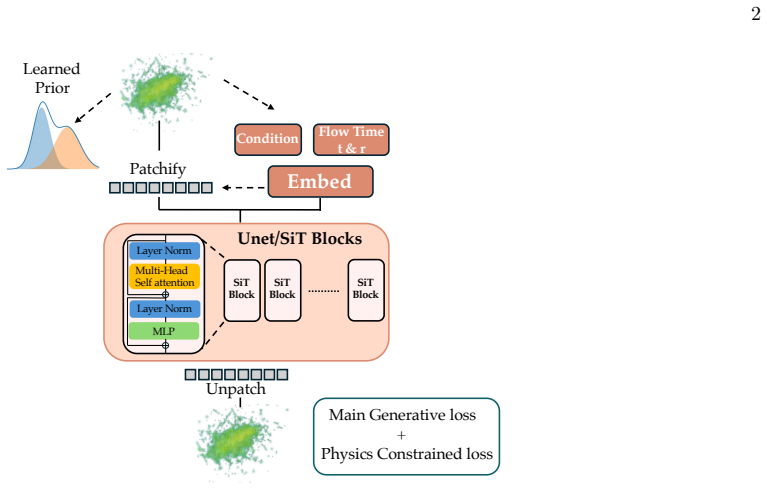
On the paper's own terms, the central discovery is that three training-time components—MeanFlow's interval-averaged velocity field, a conditional Gaussian mixture prior that starts sampling near the data manifold, and a layer-energy physics constraint optimized with a Lagrangian scheme—together let a single network produce calorimeter showers in one or six steps at a quality comparable to, and sometimes better than, current state-of-the-art methods that require on the order of hundreds of function evaluations. The physics-constrained loss is computed on a one-step surrogate sample during training, acting purely as a regularizer, so inference remains a direct map from condition to shower with
What carries the argument
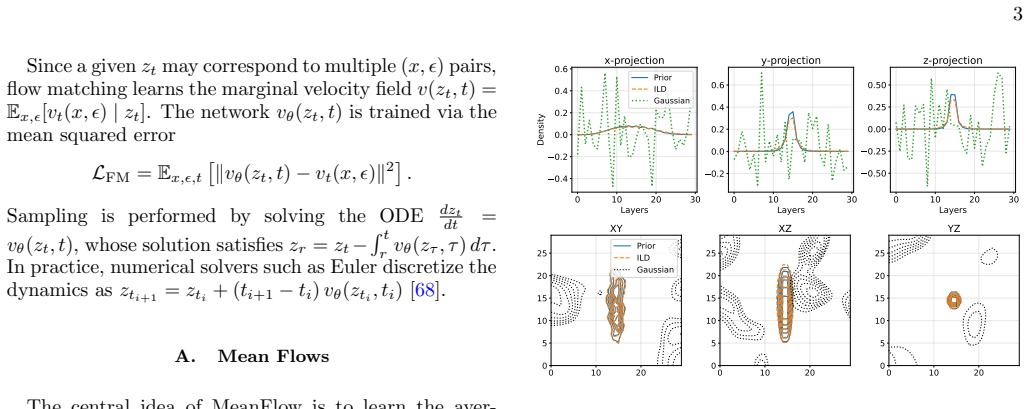
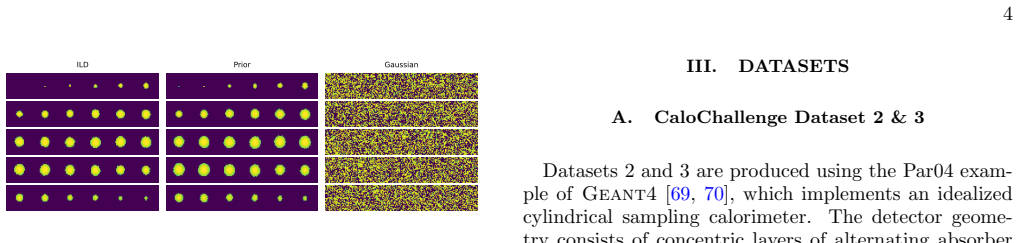
Three mechanisms carry the argument. (1) MeanFlow: instead of modeling the instantaneous velocity at each infinitesimal time step, the network learns the average velocity over a time interval, which lets one or a few Euler-like steps traverse the full probability path; the loss enforces self-consistency between a single direct mapping and two-step compositions. (2) A conditional Gaussian mixture model, predicted from the incident energy by a lightweight network, supplies a structured prior that already approximates the target shower distribution, shortening the path the flow needs to travel. (3) A physics-constrained loss, instantiated as layer-wise total energy, is evaluated on a one-step M
Load-bearing premise
The central assumption is that the one-step MeanFlow sample used during training to compute the physics-constrained loss faithfully represents the showers the model will actually generate at inference time; if the surrogate's layer energies are biased, the regularizer optimizes an inconsistent objective and the reported layer-energy improvements could be artifacts of training.
What would settle it
Generate showers with the trained model using both 1 and 6 steps, measure the layer-energy distributions of the actual outputs, and compare them with the one-step surrogate values used during training; a systematic mismatch would show the physics loss optimized the wrong quantity and would undercut the speed-quality claim.
If this is right
- End-to-end fast simulation becomes practical: one or six network evaluations replace hundreds of steps, yielding up to two orders of magnitude speed-up with no auxiliary high-level model.
- Because the physics constraints enter only through training-time regularizers, adding them does not complicate the deployed generator.
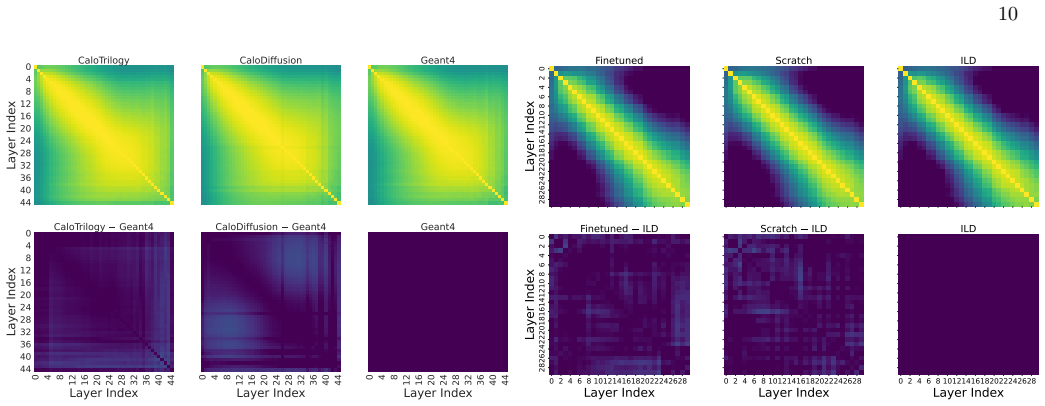
- The reported layer correlations, occupancy, and total-energy distributions suggest the generated showers could be used in production fast-simulation workflows for high-luminosity running.
- Pretraining on a wide energy and angular range and then fine-tuning improves fidelity, indicating a scalable recipe for other detector geometries.
- The physics-constrained loss is generic—layer energy is one instance—so the same mechanism can be extended to other calorimeter observables.
Where Pith is reading between the lines
- The paper leaves open whether the one-step surrogate used to compute the physics loss during training faithfully represents the showers produced by six-step sampling; a direct comparison of layer energies between the surrogate and actual outputs would settle this.
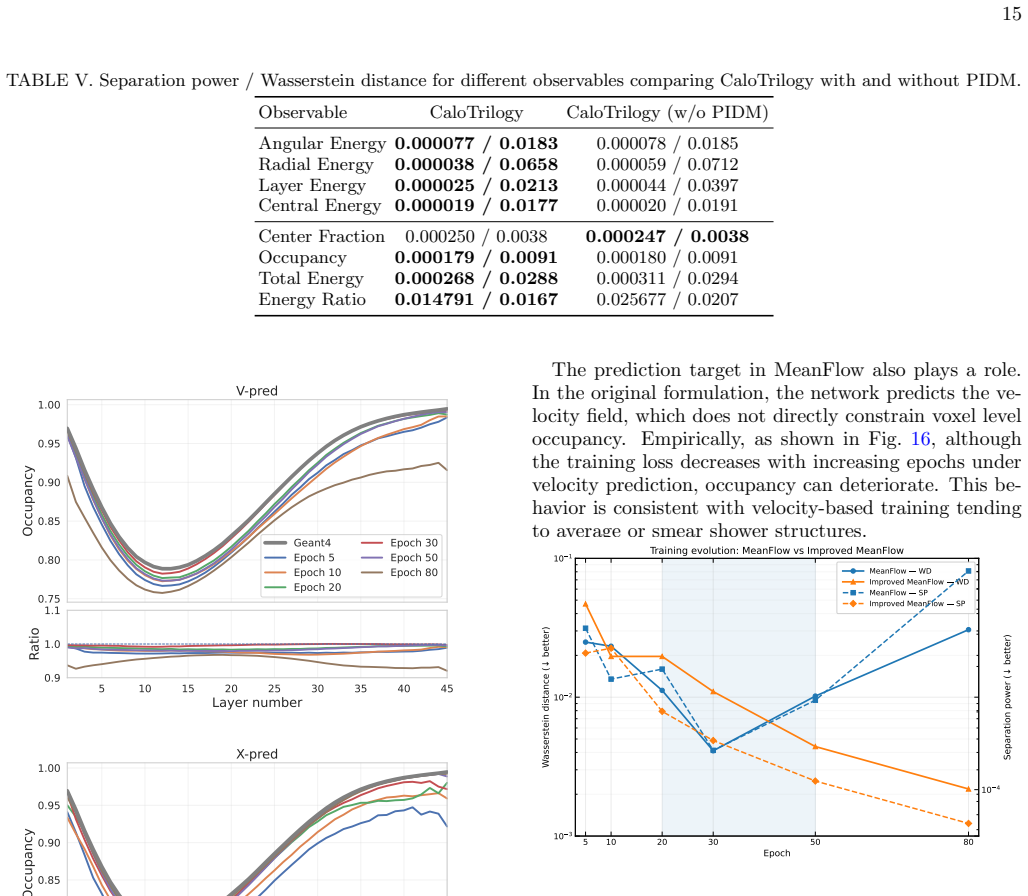
- The paper does not state which MeanFlow prediction target produced the main tables; since the appendix on occupancy shows x-prediction improves occupancy, running the full framework with x-prediction is a natural next step that could strengthen the reported results.
- The conditional GMM prior is lightweight and trained by maximum likelihood; it could be reused independently as a fast approximate simulator or as an initialization for other generative models, though the paper does not explore these uses.
- The same 'constrain a one-step surrogate' trick could be applied to other differentiable observables, such as transverse profiles or shower-core moments, where the paper's ablations suggest the largest gains appear in ratio-type observables.
Editorial analysis
A structured set of objections, weighed in public.
Referee Report
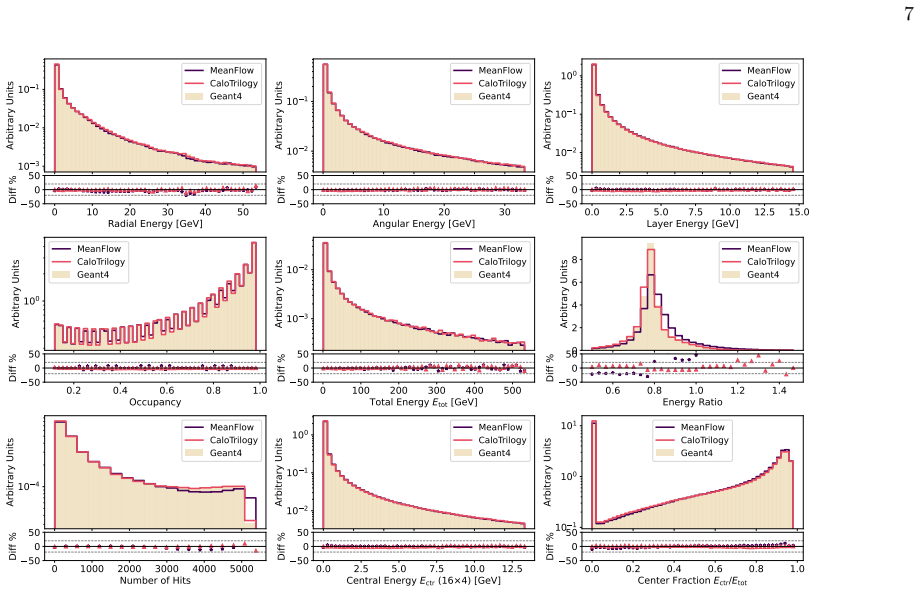
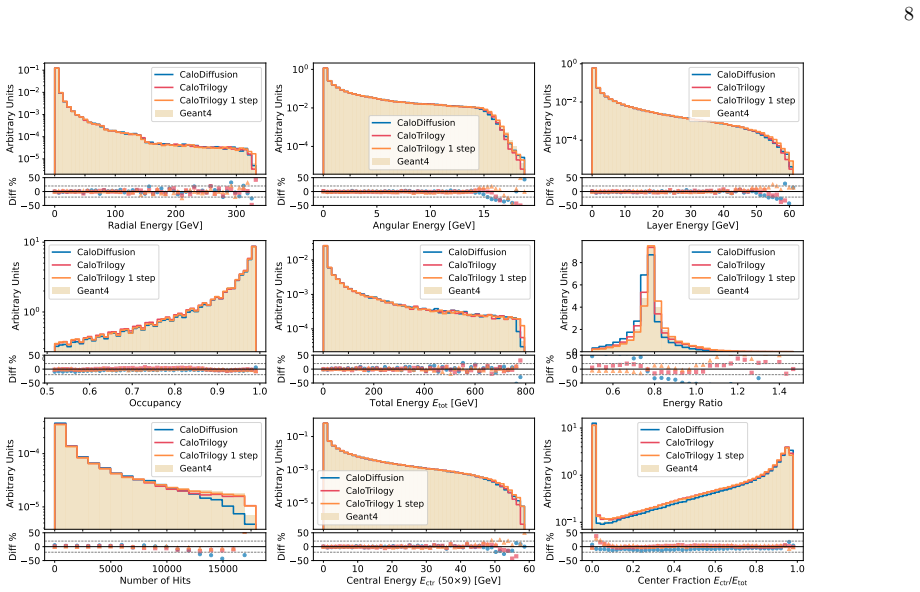
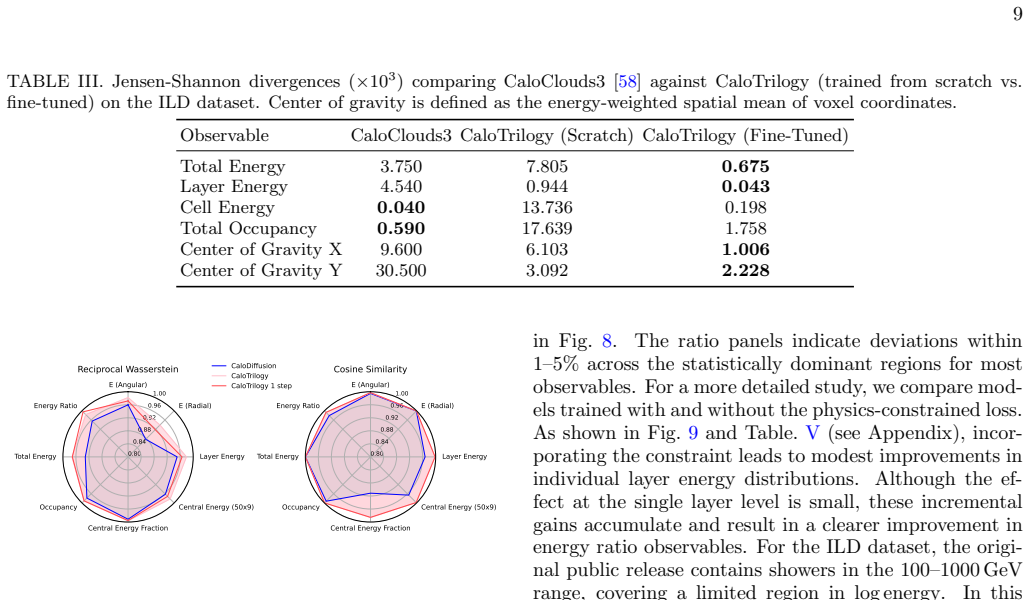
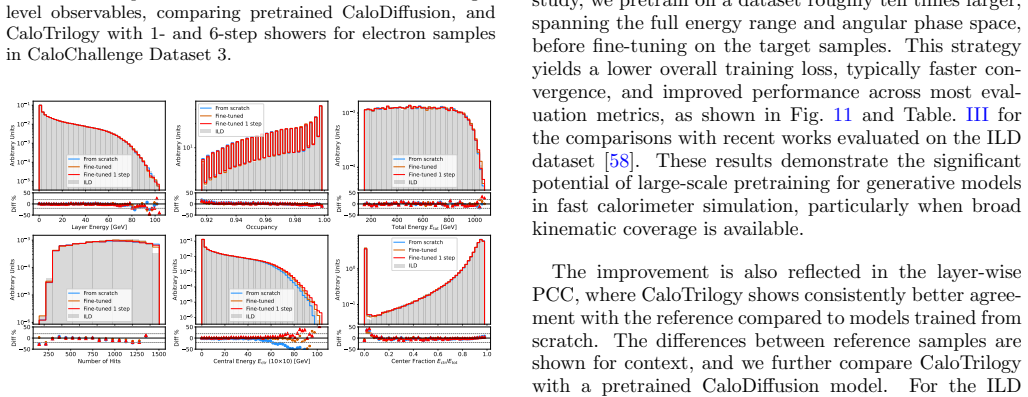
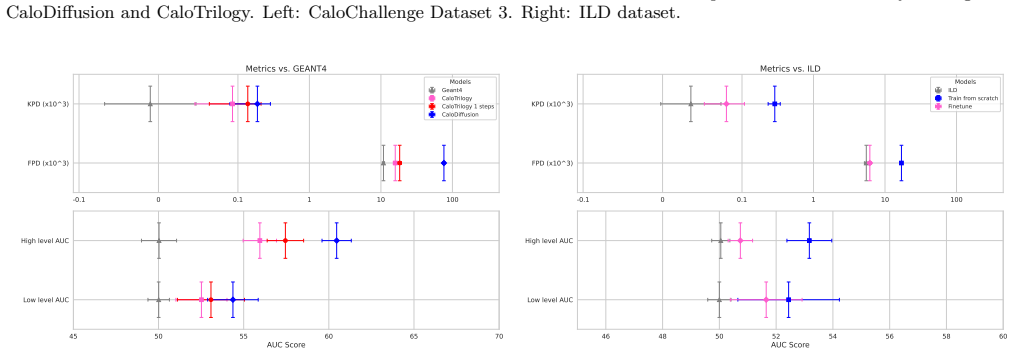
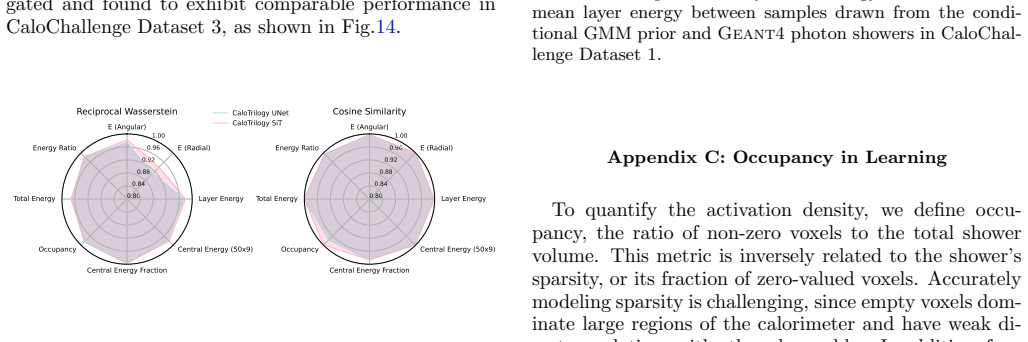
Summary. The paper proposes CaloTrilogy, a one- or few-step generative framework for calorimeter shower simulation that combines three components: a MeanFlow-based integrator that learns averaged velocity fields, a conditional Gaussian mixture model (GMM) used as a learned prior, and a physics-constrained loss term (L_PIDM) that enforces layer-energy fidelity during training. The method is evaluated on CaloChallenge datasets 2 and 3 and on the ILD photon dataset against CaloDiffusion and CaloClouds3, with claims that it reaches competitive or superior quality in one or six function evaluations, i.e., one to two orders of magnitude faster than existing diffusion baselines. The paper reports separation powers, Wasserstein distances, Jensen-Shannon divergences, FPD/KPD scores, and AUC classifier metrics, together with histograms of high-level observables.
Significance. If the claims hold, the work provides a practical resolution of the speed-quality tradeoff in fast calorimeter simulation: end-to-end generation with one or six network evaluations at quality comparable to ~200-step diffusion. The study is notable for its use of public CaloChallenge and ILD datasets, broad evaluation across binned and unbinned metrics, and for combining three distinct ideas (MeanFlow, learned GMM prior, physics-constrained loss) in a single end-to-end pipeline. The physics-constrained loss as a training-time regularizer with no inference overhead is an attractive design. However, several load-bearing points require additional evidence before the central claims can be accepted: the main numerical tables lack uncertainty estimates, the GMM component is not ablated, the trained-vs-deployed sampling distribution for the physics loss is not verified, and no timing measurements support the speed advantage.
major comments (5)
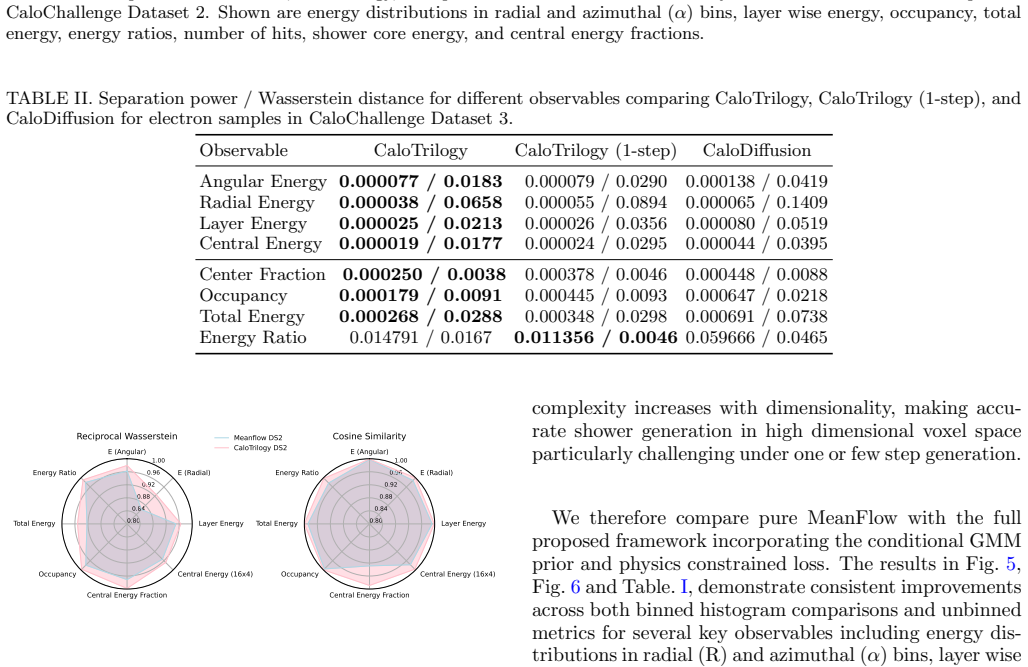
- [Tables I-III and V] The headline comparisons are reported as single numbers (separation power and Wasserstein distance) without statistical uncertainties or multiple-seed variability. Many of the claimed advantages over CaloDiffusion are small in absolute terms (e.g., Table II Angular Energy 0.000077 vs 0.000138, or Layer Energy 0.000025 vs 0.000080); without error bars it is impossible to judge whether these differences are significant. The paper should provide bootstrap uncertainties or repeat training with different seeds and report the spread. The FPD/AUC values in the text do have errors, but the central tables do not.
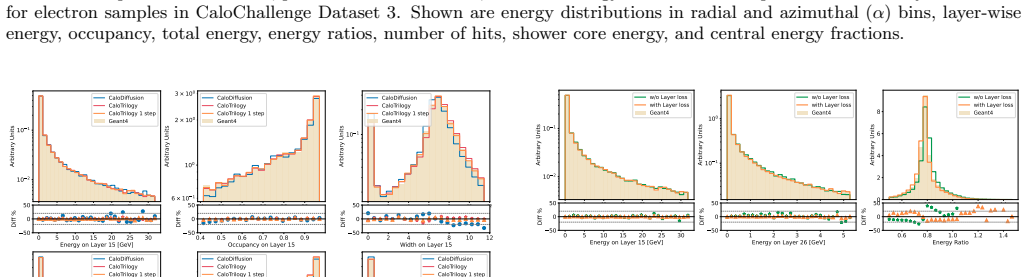
- [Section II.C, Eq. (L_PIDM)] The physics-constrained loss is computed on a one-step MeanFlow surrogate: E_gen^ell is obtained by applying the learned velocity field to a prior sample. The paper's best few-step results, however, use 6-step Euler sampling (Tables II-III, Figs. 7-10). There is no check that the layer-energy distribution of the 6-step sampler matches the one-step surrogate used to minimize L_PIDM. If multi-step integration drifts from the surrogate distribution, the reported gains in layer energy and energy ratio (Table V) could be artifacts of optimizing on a distribution different from the deployed generator. The authors should compare layer-energy distributions from the one-step surrogate and the 6-step sampler during or after training, or otherwise justify the surrogate's representativeness. In the same vein, reporting layer energy and energy ratio as successes is partly circular because these obser
- [Section II.A and Appendix C] The manuscript states in Section II.A that it follows the original MeanFlow formulation, which is v-prediction, but Appendix C demonstrates that x-prediction substantially improves occupancy and Wasserstein distance during training. It is not stated which prediction target produced the main tables and figures. If the main results are v-prediction, the occupancy results may be suboptimal; if they are x-prediction, the statement in Section II.A is misleading. This ambiguity also compounds the L_PIDM surrogate concern, since the surrogate and the final sampler could use different parameterizations. The authors must specify the variant used for each reported result and, ideally, provide the main tables for both variants.
- [Section IV.C / Appendix A] CaloTrilogy is defined as three mutually reinforcing components, but only the physics-constrained loss is ablated (Table V). The conditional GMM prior is not ablated; there is no comparison to the same MeanFlow model with a standard isotropic Gaussian prior or with the GMM components fixed. Given that the GMM is a central claimed contributor to few-step accuracy, this omission leaves the contribution of one of the three core modules unquantified and weakens the 'trilogy' claim.
- [Section I and Conclusion] The paper claims 'up to two orders of magnitude acceleration' over CaloDiffusion, but no inference timing or wall-clock measurements are reported anywhere. The number-of-function-evaluations argument is plausible, but runtime per generated shower depends on model size, hardware, batching, and data movement. The authors should report generation times (e.g., showers per second on a specified GPU) for CaloTrilogy at 1 and 6 steps and for the competing CaloDiffusion baseline.
minor comments (4)
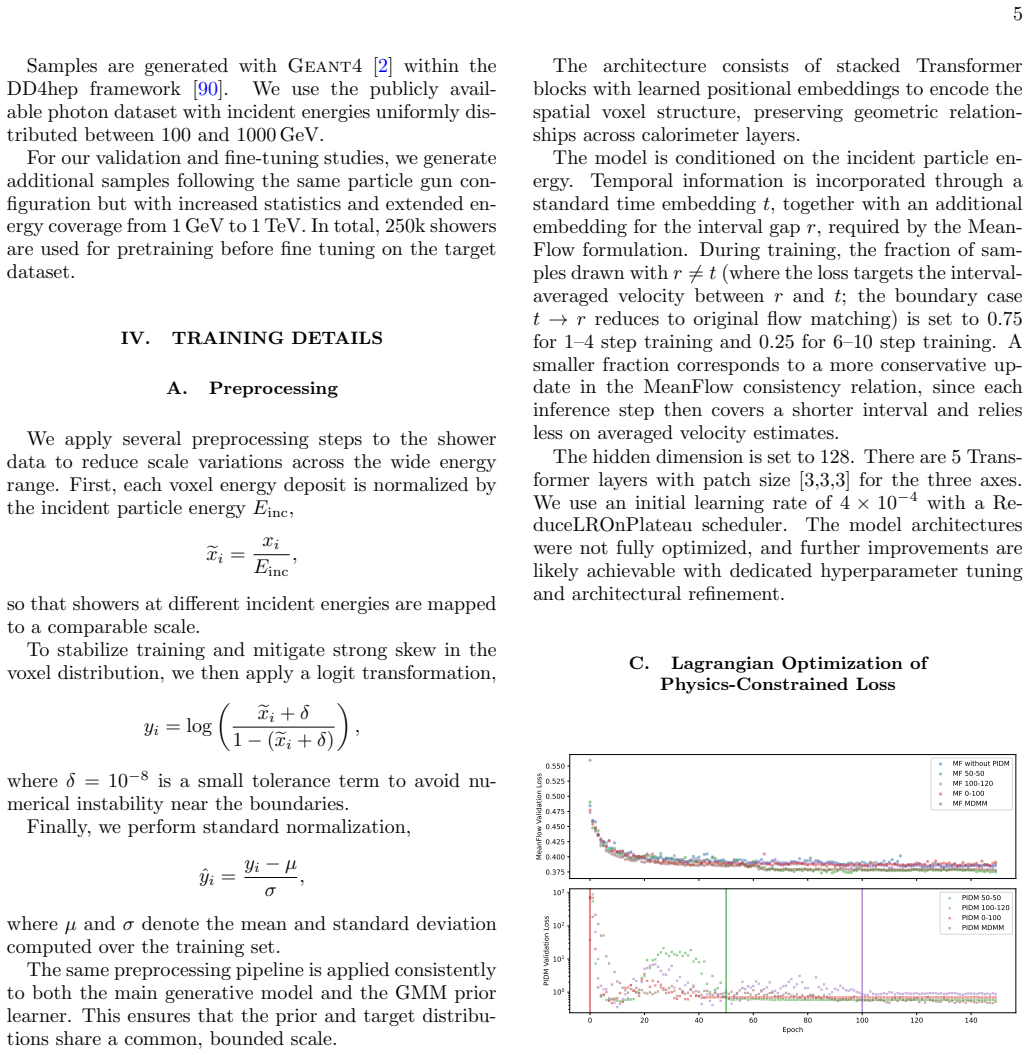
- [Section II.C / IV.C] The loss notation is inconsistent: Section II.C defines L_total = L_MF + beta L_PIDM, while Section IV.C defines L_total = L_MF + lambda(L_PIDM - xi) + sigma/2 (L_PIDM - xi)^2. The relationship between beta and the MDMM parameters should be clarified, including when beta is replaced by the multiplier update.
- [Abstract / Introduction] Minor typos: 'This simplify the whole pipeline' (Section I) and 'until the good criteria are satisfied' (Section IV.C). Also, references [10] and [11] appear to duplicate the same Erdmann et al. paper with slightly different title capitalization; one should be removed.
- [Figure 4] The figure caption for the PIDM loss panel says 'various scheduling strategies' but the color coding of the vertical lines is explained only partially. The reader must infer which curve corresponds to which schedule from the labels inside the panel; please add a legend or clearer caption.
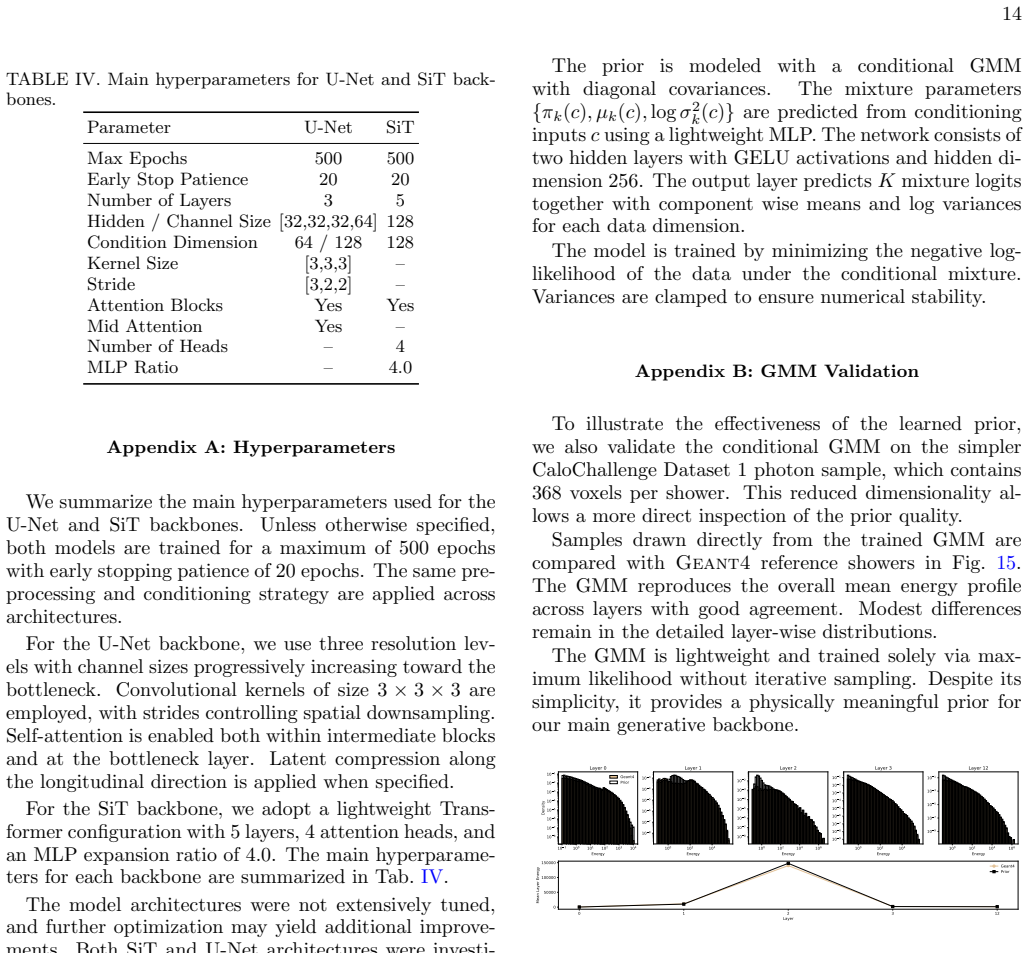
- [Appendix B] The GMM validation on Dataset 1 is useful, but Figure 15 shows only mean layer energy and a few layer distributions. Since the GMM prior is claimed to capture spatial correlations (Figure 2), a quantitative comparison (e.g., Wasserstein distance on the 1-D projections or covariance mismatch) would help substantiate the claim.
Circularity Check
Layer-energy and energy-ratio metrics are directly optimized by L_PIDM, so reporting them as successes is partly training-to-metric; the central one/few-step quality claim remains independent.
specific steps
-
fitted input called prediction
[Section II.C (Physics-Constrained Loss); Section V and Tables I, II, V; Fig. 9]
"LPIDM is instantiated as a layer-wise energy constraint, LPIDM = Σ_ℓ ||E_gen^ℓ − E_true^ℓ||², where E_ℓ denotes the total deposited energy in calorimeter layer ℓ. ... The improved agreement in energy ratio observables can be attributed to the physics-constrained loss, which aligns the global energy sum well during training."
The reported 'Layer Energy' and related 'Energy Ratio' evaluation metrics are the same quantities that L_PIDM explicitly minimizes during training: the loss is the squared difference between generated and true layer energies summed over layers. Thus the observed improvement on these metrics is, at least in part, a report of the training objective itself rather than an independent validation of the model's physics modeling. The paper is transparent about this attribution, and the headline few-step claim is supported by other, non-optimized metrics (occupancy, radial/angular energy, classifier AUC), so the circularity is partial rather than total.
full rationale
CaloTrilogy's central claim — competitive or superior one/few-step shower quality compared with CaloDiffusion and CaloClouds3 — is tested against external benchmarks and many observables that are not directly included in the training loss (occupancy, radial/angular energy profiles, FPD/KPD, AUC). Those comparisons are self-contained and independent of the authors' prior work. The physics-constrained term L_PIDM does directly optimize layer energies, so reporting layer-energy and energy-ratio agreement as evidence of fidelity is partly fitting-to-metric; this is the one genuine circular element. It is mitigated by the paper's explicit statement that the improvement is 'attributed to the physics-constrained loss,' i.e., the authors do not mislabel it as an unprompted prediction. The self-citations ([49],[51]) appear only in survey reference lists and are not load-bearing. The one-step MeanFlow surrogate used to define E_gen^ℓ during training, and the lack of a check against 6-step sampling, is a possible correctness/transfer risk but not a definitional circularity: it is an approximation that could in principle fail, not an identity. The v-prediction vs x-prediction ambiguity in Appendix C is likewise a reporting gap, not a circular step. Overall score 4 reflects one partial circular step with an otherwise independent central result.
Axiom & Free-Parameter Ledger
free parameters (5)
- β (PIDM loss weight) =
upper bound 0.03 (final value not specified)
- MDMM constants λ, ξ, σ =
not specified
- Warmup schedule =
options 0-100, 50-50, 100-120 epochs; final selection not stated
- GMM component count K =
not stated
- r ≠ t sampling fraction =
0.75 (1-4 steps), 0.25 (6-10 steps)
axioms (4)
- standard math MeanFlow training objective and self-consistency relation are correct as derived in [68].
- domain assumption Geant4 reference showers are ground truth for training and evaluation.
- domain assumption The logit preprocessing preserves the physical distances used in evaluation metrics.
- ad hoc to paper One-step surrogate sample is representative of the model's generated shower distribution during training.
read the original abstract
High-precision calorimeter simulation at current and future colliders imposes rapidly growing computational demands, motivating the development of machine-learning surrogates for traditional Monte Carlo tools such as Geant4. Flow matching and diffusion-based generative models have become leading approaches for high-dimensional fast simulation because of their sample quality, but typically require ${\cal O}(100)$ function evaluations at inference and often rely on auxiliary networks to constrain global observables, compromising streamlined end-to-end generation. We introduce a unified framework that improves the balance between speed, shower quality, and physics fidelity. The method combines: (i) an average velocity field integrator that enables sampling in one or a few evaluations; (ii) a learned generative prior in shower space, constructed from data rather than random noise; and (iii) physics-guided loss terms that impose inductive biases on key observables during training. These elements are training time regularizers, preserving end-to-end inference with no additional cost. With only one or a few evaluation steps, the model achieves shower quality competitive with state-of-the-art flow and diffusion approaches, tested on several public high granularity calorimeter datasets. The results demonstrate inter-layer shower structure consistent with the underlying physics, providing a strong candidate for future fast simulation workflows.
Figures

Forward citations
Cited by 1 Pith paper
-
Lantern: Conflict-Aware Gradient Blending for Physics-Guided Diffusion Models in Calorimeter Simulation
GradBlend anchors diffusion updates to denoising while admitting physics auxiliaries, improving calorimeter shower FPD and CFD where PCGrad, GradNorm, IMTL-G, and ConFIG inflate FPD by 2–100×.
Reference graph
Works this paper leans on
-
[1]
CMS Collaboration,The Phase-2 Upgrade of the CMS Endcap Calorimeter, Tech. Rep. CERN-LHCC-2017-023, CMS-TDR-019 (CERN, 2017)
2017
-
[2]
Agostinelliet al.(GEANT4 Collaboration), GEANT4—a simulation toolkit, Nucl
S. Agostinelliet al.(GEANT4 Collaboration), GEANT4—a simulation toolkit, Nucl. Instrum. Meth. A506, 250 (2003)
2003
-
[3]
Allisonet al., Recent developments in Geant4, Nucl
J. Allisonet al., Recent developments in Geant4, Nucl. Instrum. Meth. A835, 186 (2016)
2016
-
[4]
Allisonet al., Geant4 developments and applications, IEEE Trans
J. Allisonet al., Geant4 developments and applications, IEEE Trans. Nucl. Sci.53, 270 (2006)
2006
-
[5]
K. Pedroet al.(CMS Collaboration), Integration and performance of new technologies in the CMS simulation, EPJ Web Conf.245, 02020 (2020), arXiv:2004.02327 [hep-ex]
Pith/arXiv arXiv 2020
-
[6]
M. Paganini, L. de Oliveira, and B. Nachman, Ac- celerating science with generative adversarial networks: An application to 3D particle showers in multilayer calorimeters, Phys. Rev. Lett.120, 042003 (2018), arXiv:1705.02355 [hep-ex]
Pith/arXiv arXiv 2018
-
[7]
M. Paganini, L. de Oliveira, and B. Nachman, Calo- GAN: Simulating 3D high energy particle showers in multilayer electromagnetic calorimeters with generative adversarial networks, Phys. Rev. D97, 014021 (2018), arXiv:1712.10321 [hep-ex]
Pith/arXiv arXiv 2018
-
[8]
L. de Oliveira, M. Paganini, and B. Nachman, Control- ling physical attributes in GAN-accelerated simulation of electromagnetic calorimeters, J. Phys. Conf. Ser.1085, 042017 (2018), arXiv:1711.08813 [hep-ex]
Pith/arXiv arXiv 2018
-
[9]
M. Erdmann, L. Geiger, J. Glombitza, and D. Schmidt, Generating and refining particle detector simulations us- ing the Wasserstein distance in adversarial networks, Comput. Softw. Big Sci.2, 4 (2018), arXiv:1802.03325 [physics.ins-det]
Pith/arXiv arXiv 2018
-
[11]
M. Erdmann, J. Glombitza, and T. Quast, Precise sim- ulation of electromagnetic calorimeter showers using a wasserstein generative adversarial network, Comput. Softw. Big Sci.3, 4 (2019), arXiv:1807.01954 [physics.ins- det]
Pith/arXiv arXiv 2019
-
[12]
P. Musella and F. Pandolfi, Fast and accurate simu- lation of particle detectors using generative adversar- ial networks, Comput. Softw. Big Sci.2, 8 (2018), arXiv:1805.00850 [hep-ex]
Pith/arXiv arXiv 2018
-
[13]
D. Belaynehet al., Calorimetry with deep learning: Par- ticle simulation and reconstruction for collider physics, Eur. Phys. J. C80, 688 (2020), arXiv:1912.06794 [physics.ins-det]
Pith/arXiv arXiv 2020
-
[14]
A. Butter, S. Diefenbacher, G. Kasieczka, B. Nachman, and T. Plehn, GANplifying event samples, SciPost Phys. 10, 139 (2021), arXiv:2008.06545 [hep-ph]
Pith/arXiv arXiv 2021
-
[15]
ATLAS Collaboration,Fast Simulation of the ATLAS Calorimeter System with Generative Adversarial Net- works, Tech. Rep. ATL-SOFT-PUB-2020-006 (CERN, 2020)
2020
-
[16]
Ghosh, Deep generative models for fast shower simula- tion in ATLAS, J
A. Ghosh, Deep generative models for fast shower simula- tion in ATLAS, J. Phys. Conf. Ser.1525, 012077 (2020)
2020
-
[17]
Aadet al.(ATLAS), AtlFast3: The next generation of fast simulation in ATLAS, Comput
G. Aadet al.(ATLAS), AtlFast3: The next generation of fast simulation in ATLAS, Comput. Softw. Big Sci.6, 7 (2022), arXiv:2109.02551 [hep-ex]
Pith/arXiv arXiv 2022
-
[18]
M. Faucci Giannelli and R. Zhang, CaloShowerGAN, a generative adversarial network model for fast calorimeter shower simulation, Eur. Phys. J. Plus139, 597 (2024), arXiv:2309.06515 [hep-ex]
Pith/arXiv arXiv 2024
-
[19]
E. Simsek, B. Isildak, A. Dogru, R. Aydogan, A. B. Bayrak, and S. Ertekin, CALPAGAN: Calorime- try for particles using generative adversarial net- works, Prog. Theor. Exp. Phys.2024, 083C01 (2024), arXiv:2401.02248 [physics.ins-det]
Pith/arXiv arXiv 2024
-
[20]
J. Birk, F. Gaede, A. Hallin, G. Kasieczka, M. Mozzan- ica, and H. Rose, OmniJet-α C : Learning point cloud calorimeter simulations using generative transformers, JINST20(07), P07007, arXiv:2501.05534 [physics.ins- det]
-
[21]
J. C. Cresswell, B. L. Ross, G. Loaiza-Ganem, H. Reyes- Gonz´ alez, M. Letizia, and A. L. Caterini, CaloMan: Fast generation of calorimeter showers with density estima- tion on learned manifolds, inNeurIPS 2022 Workshop on Machine Learning and the Physical Sciences(2022) arXiv:2211.15380 [cs.LG]
Pith/arXiv arXiv 2022
-
[22]
S. Hoque, H. Jia, A. Abhishek, M. Fadaie, J. Q. Toledo- Mar ´ ın, T. Vale, R. G. Melko, M. Swiatlowski, and W. T. Fedorko, CaloQV AE: Simulating high-energy particle- calorimeter interactions using hybrid quantum-classical generative models, Eur. Phys. J. C84, 1244 (2024), arXiv:2312.03179 [hep-ph]
arXiv 2024
-
[23]
Q. Liu, C. Shimmin, X. Liu, E. Shlizerman, S.-C. Li, and S.-C. Hsu, Calo-VQ: Vector-quantized two-stage generative model in calorimeter simulation, (2024), arXiv:2405.06605 [cs.LG]
Pith/arXiv arXiv 2024
-
[24]
R. Kansal, J. Duarte, K. Duarte, and M. Pierini, Graph generative models for fast detector simulations in high energy physics 10.48550/arXiv.2106.11535 (2021), arXiv:2106.11535 [hep-ex]
-
[25]
B. Hashemi, Deep Generative Models for Ultra- High Granularity Particle Physics Detector Simu- lation: A Voyage From Emulation to Extrap- olation 10.5282/edoc.34137 (2023), arXiv:2403.13825 [physics.ins-det]
Pith/arXiv arXiv 2023
-
[26]
M. Mazurek (LHCb), Machine learning in LHCb Simu- lation: From fast to flash, PoSLHCP2025, 125 (2026), arXiv:2511.02020 [hep-ex]
arXiv 2026
-
[27]
Krause and D
C. Krause and D. Shih, CaloFlow: Fast and accurate generation of calorimeter showers with normalizing flows, Phys. Rev. D107, 113003 (2021)
2021
-
[28]
Krause and D
C. Krause and D. Shih, CaloFlow II: Even faster and still accurate generation of calorimeter showers with normal- izing flows, Phys. Rev. D107, 113004 (2021)
2021
-
[29]
C. Krause, I. Pang, and D. Shih, CaloFlow for CaloChallenge dataset 1, SciPost Phys.16, 126 (2024), arXiv:2210.14245 [cs.LG]
Pith/arXiv arXiv 2024
-
[30]
C. Krause, B. Nachman, I. Pang, D. Shih, and Y. Zhu, Anomaly detection with flow-based fast calorimeter simu- lators, Phys. Rev. D110, 10.1103/PhysRevD.110.0c5036 (2024), arXiv:2312.11618 [hep-ph]
Pith/arXiv arXiv 2024
-
[31]
F. Ernst, L. Favaro, C. Krause, T. Plehn, and D. Shih, Normalizing flows for high-dimensional detector simula- tions, SciPost Phys.18, 081 (2025), arXiv:2312.09290 [cs.LG]. 12
Pith/arXiv arXiv 2025
-
[32]
C. Gao, J. Isaacson, and C. Krause, i-flow: High- dimensional integration and sampling with normalizing flows, Mach. Learn. Sci. Technol.4, 045023 (2020)
2020
-
[33]
M. R. Buckley, C. Krause, I. Pang, and D. Shih, Inductive simulation of calorimeter showers with normalizing flows, Phys. Rev. D109, 033006 (2024), arXiv:2305.11934 [cs.LG]
Pith/arXiv arXiv 2024
-
[34]
B. K¨ ach, D. Kr¨ ucker, I. Melzer-Pellmann, M. Scham, S. Schnake, and A. Verney-Provatas, JetFlow: Generat- ing jets with conditioned and mass constrained normal- ising flows, (2022), arXiv:2211.13630 [hep-ex]
Pith/arXiv arXiv 2022
-
[35]
S. Diefenbacher, E. Eren, F. Gaede, G. Kasieczka, C. Krause, I. Shekhzadeh, and D. Shih, L2LFlows: Gen- erating high-fidelity 3D calorimeter images, JINST18 (10), P10017, arXiv:2302.11594 [cs.LG]
-
[36]
T. Heimel, R. Winterhalder, A. Butter, J. Isaacson, C. Krause, F. Maltoni, O. Mattelaer, and T. Plehn, Mad- NIS – neural multi-channel importance sampling, SciPost Phys.15, 141 (2023), arXiv:2212.06172 [hep-ph]
Pith/arXiv arXiv 2023
-
[37]
Heimel, N
T. Heimel, N. Huetsch, R. Winterhalder, A. Butter, O. Mattelaer, and T. Plehn, The MadNIS reloaded, Sci- Post Phys.17, 023 (2024)
2024
-
[38]
M. Leigh, J. A. Raine, K. Zoch, and T. Golling,ν-Flows: Conditional Neutrino Regression, SciPost Phys.14, 159 (2023), arXiv:2207.00664 [cs.LG]
Pith/arXiv arXiv 2023
-
[39]
B. K¨ ach, D. Kr¨ ucker, and I. Melzer-Pellmann, Point cloud generation using transformer encoders and normal- ising flows, (2022), arXiv:2211.13623 [cs.LG]
Pith/arXiv arXiv 2022
-
[40]
I. Pang, D. Shih, and J. A. Raine, Calorimeter shower super-resolution, Phys. Rev. D109, 092009 (2024)
2024
-
[41]
T. Buss, F. Gaede, G. Kasieczka, C. Krause, and D. Shih, Convolutional L2LFlows: generating accurate showers in highly granular calorimeters using convolutional normal- izing flows, JINST19(09), P09003, arXiv:2405.20407 [physics.ins-det]
-
[42]
H. Bahl, S. Diefenbacher, N. Elmer, T. Plehn, and J. Spinner, Forecasting generative amplification 10.48550/arXiv.2509.08048 (2025), arXiv:2509.08048 [hep-ph]
-
[43]
S. Schnake, D. Kr¨ ucker, and K. Borras, CaloPointFlow II: Generating calorimeter showers as point clouds 10.48550/arXiv.2403.15782 (2024), arXiv:2403.15782 [physics.ins-det]
-
[44]
J. Erdmann, J. Kann, F. Mausolf, and P. Wissmann, ParaFlow: Fast calorimeter simulations parameterized in upstream material configurations, Eur. Phys. J. C85, 857 (2025), arXiv:2503.21461 [hep-ph]
Pith/arXiv arXiv 2025
-
[45]
O. Amram and K. Pedro, Denoising diffusion models with geometry adaptation for high fidelity calorime- ter simulation, Physical Review D108, 072014 (2023), arXiv:2308.03876 [physics.ins-det]
Pith/arXiv arXiv 2023
-
[46]
V. Mikuni and B. Nachman, Score-based generative mod- els for calorimeter shower simulation, Phys. Rev. D106, 092009 (2022), arXiv:2206.11898 [hep-ex]
Pith/arXiv arXiv 2022
-
[47]
F. T. Acosta, V. Mikuni, B. Nachman, M. Arratia, B. Karki, R. Milton, P. Karande, and A. Angerami, Comparison of point cloud and image-based models for calorimeter fast simulation, JINST19(05), P05003, arXiv:2307.04780 [hep-ex]
-
[48]
V. Mikuni and B. Nachman, CaloScore v2: Single- shot calorimeter shower simulation with diffusion models, JINST19(02), P02001, arXiv:2308.03847 [hep-ex]
-
[49]
C. Jiang, S. Qian, and H. Qu, Choose your diffusion: Ef- ficient and flexible ways to accelerate the diffusion model in fast high energy physics simulation, SciPost Phys.18, 195 (2025), arXiv:2401.13162 [hep-ex]
Pith/arXiv arXiv 2025
-
[50]
D. Kobylianskii, N. Soybelman, E. Dreyer, and E. Gross, Graph-based diffusion model for fast shower generation in calorimeters with irregular geometry, Phys. Rev. D 110, 072003 (2024), arXiv:2402.11575 [hep-ex]
Pith/arXiv arXiv 2024
-
[51]
C. Jiang, S. Qian, and H. Qu, BUFF: Boosted decision tree based ultra-fast flow matching 10.48550/arXiv.2404.18219 (2024), arXiv:2404.18219 [hep-ex]
-
[52]
J. Brehmer, V. Bres´ o, P. de Haan, T. Plehn, H. Qu, J. Spinner, and J. Thaler, A lorentz-equivariant trans- former for all of the LHC, SciPost Phys.19, 108 (2025), arXiv:2411.00446 [hep-ph]
arXiv 2025
-
[53]
M. Leigh, D. Sengupta, G. Qu´ etant, J. A. Raine, K. Zoch, and T. Golling, PC-JeDi: Diffusion for particle cloud generation in high energy physics, SciPost Phys.16, 018 (2024), arXiv:2303.05376 [hep-ph]
Pith/arXiv arXiv 2024
-
[54]
M. Leigh, D. Sengupta, J. A. Raine, G. Qu´ etant, and T. Golling, Faster diffusion model with improved quality for particle cloud generation, Phys. Rev. D109, 012010 (2024), arXiv:2307.06836 [hep-ex]
Pith/arXiv arXiv 2024
-
[55]
L. Favaro, A. Ore, S. P. Schweitzer, and T. Plehn, CaloDREAM – Detector response emulation via at- tentive flow matching, SciPost Phys.18, 088 (2025), arXiv:2405.09629 [hep-ph]
Pith/arXiv arXiv 2025
-
[56]
F. Vaselli, C. Sun, T. Aarrestad, D. Danopoulos, R. Os- kari Niemi, M. M. Glowacki, K. Govorkova, V. Loncar, F. Pantaleo, and M. Pierini, It’s not a F AD: first demon- stration of flows for unsupervised anomaly detection at 40 MHz for use at the Large Hadron Collider, Mach. Learn. Sci. Tech.7, 025052 (2026), arXiv:2508.11594 [hep-ex]
Pith/arXiv arXiv 2026
-
[57]
L. Favaro, A. Giammanco, and C. Krause, Fast, accurate, and precise detector simulation with vision transform- ers 10.48550/arXiv.2509.25169 (2025), arXiv:2509.25169 [hep-ph]
-
[58]
T. Buss, H. Day-Hall, F. Gaede, G. Kasieczka, K. Kr¨ uger, A. Korol, T. Madlener, P. McKeown, M. Mozzanica, and L. Valente, CaloClouds3: Ultra- fast geometry-independent highly-granular calorimeter simulation, JINST21(03), P03018, arXiv:2511.01460 [physics.ins-det]
-
[59]
T. Buss, F. Gaede, G. Kasieczka, A. Korol, K. Kr¨ uger, P. McKeown, and M. Mozzanica, CaloHadronic: A diffusion model for the generation of hadronic show- ers 10.48550/arXiv.2506.21720 (2025), arXiv:2506.21720 [physics.ins-det]
-
[60]
E. Buhmann, S. Diefenbacher, E. Eren, F. Gaede, G. Kasieczka, A. Korol, W. Korcari, K. Kr¨ uger, and P. McKeown, CaloClouds: Fast geometry-independent highly-granular calorimeter simulation, JINST18(11), P11025, arXiv:2305.04847 [physics.ins-det]
-
[61]
E. Buhmann, F. Gaede, G. Kasieczka, A. Korol, W. Kor- cari, K. Kr¨ uger, and P. McKeown, CaloClouds II: Ultra- fast geometry-independent highly-granular calorimeter simulation, JINST19(04), P04020, arXiv:2309.05704 [physics.ins-det]
-
[62]
P. Raikwar, A. Zaborowska, P. McKeown, R. Cardoso, M. Piorczynski, and K. Yeo, A generalisable genera- tive model for multi-detector calorimeter simulation 10.48550/arXiv.2509.07700 (2025), arXiv:2509.07700 [physics.ins-det]
-
[63]
F. Gaede, G. Kasieczka, and L. Valente, Cross- 13 geometry transfer learning in fast electromagnetic shower simulation 10.48550/arXiv.2512.00187 (2025), arXiv:2512.00187 [physics.ins-det]
-
[64]
T. Buss, H. Day-Hall, F. Gaede, G. Kasieczka, and K. Kr¨ uger, AllShowers: One model for all calorimeter showers 10.48550/arXiv.2601.11716 (2026), arXiv:2601.11716 [physics.ins-det]
-
[65]
O. Ronneberger, P. Fischer, and T. Brox, U-net: Convo- lutional networks for biomedical image segmentation, in Medical Image Computing and Computer-Assisted Inter- vention – MICCAI 2015, edited by N. Navab, J. Horneg- ger, W. M. Wells, and A. F. Frangi (Springer Interna- tional Publishing, Cham, 2015) p. 234, arXiv:1505.04597 [cs.CV]
Pith/arXiv arXiv 2015
-
[66]
A. Vaswani, N. Shazeer, N. Parmar, J. Uszkoreit, L. Jones, A. N. Gomez, L. Kaiser, and I. Polosukhin, Attention Is All You Need, in31st International Confer- ence on Neural Information Processing Systems(2017) arXiv:1706.03762 [cs.CL]
Pith/arXiv arXiv 2017
-
[67]
Y. Song, P. Dhariwal, M. Chen, and I. Sutskever, Consistency models 10.48550/arXiv.2303.01469 (2023), arXiv:2303.01469 [cs.LG]
-
[68]
Z. Geng, M. Deng, X. Bai, J. Z. Kolter, and K. He, Mean flows for one-step generative model- ing 10.48550/arXiv.2505.13447 (2025), arXiv:2505.13447 [cs.LG]
-
[69]
CaloChallenge Collaboration, CaloChallenge dataset 2: Electromagnetic showers in a high-granularity calorime- ter, (2022)
2022
-
[70]
CaloChallenge Collaboration, CaloChallenge dataset 3: Highly granular calorimeter geometry, (2022)
2022
-
[71]
Amramet al., CaloChallenge 2022: a community chal- lenge for fast calorimeter simulation, Rept
O. Amramet al., CaloChallenge 2022: a community chal- lenge for fast calorimeter simulation, Rept. Prog. Phys. 88, 116201 (2025), arXiv:2410.21611 [physics.ins-det]
arXiv 2022
-
[72]
H. Abramowiczet al., International large detector: In- terim design report 10.48550/arXiv.2003.01116 (2020), arXiv:2003.01116 [physics.ins-det]
-
[73]
J. Repondet al., Design and electronics commission- ing of the physics prototype of a Si-W electromagnetic calorimeter for the international linear collider, JINST 3, P08001, arXiv:0805.4833 [physics.ins-det]
-
[74]
J. Ho, A. Jain, and P. Abbeel, Denoising diffusion probabilistic models 10.48550/arXiv.2006.11239 (2020), arXiv:2006.11239 [cs.LG]
-
[75]
Y. Song, J. Sohl-Dickstein, D. P. Kingma, A. Kumar, S. Ermon, and B. Poole, Score-based generative modeling through stochastic differential equations, ICLR (2021), arXiv:2011.13456 [cs.LG]
Pith/arXiv arXiv 2021
-
[76]
T. Karras, M. Aittala, T. Aila, and S. Laine, Elu- cidating the design space of diffusion-based genera- tive models, NeurIPS 10.48550/arXiv.2206.00364 (2022), arXiv:2206.00364 [cs.CV]
-
[77]
Y. Xu, Z. Zhang, Y. Song, and S. Ermon, Restart sampling for improving generative processes 10.48550/arXiv.2306.14878 (2023), arXiv:2306.14878 [cs.LG]
-
[78]
Y. Lipman, R. T. Q. Chen, H. Ben-Hamu, M. Nickel, and M. Le, Flow matching for generative model- ing 10.48550/arXiv.2210.02747 (2023), arXiv:2210.02747 [cs.LG]
-
[79]
A. Tong, Y. Lipman, R. T. Q. Chen, M. Nickel, and M. Le, Improving and generalizing flow-based generative models with minibatch optimal transport 10.48550/arXiv.2302.00482 (2023), arXiv:2302.00482 [cs.LG]
-
[80]
H. Zhang, A. Siarohin, W. Menapace, M. Vasilkovsky, S. Tulyakov, Q. Qu, and I. Skorokhodov, Al- phaFlow: Understanding and improving meanflow mod- els 10.48550/arXiv.2510.20771 (2025), arXiv:2510.20771 [cs.LG]
-
[81]
H. You, B. Liu, and H. He, Modular MeanFlow: To- wards stable and scalable one-step generative model- ing 10.48550/arXiv.2508.17426 (2025), arXiv:2508.17426 [cs.LG]
discussion (0)
Sign in with ORCID, Apple, or X to comment. Anyone can read and Pith papers without signing in.