REVIEW 3 major objections 6 minor 37 references
A thin disk around Sgr A* secularly shifts the semi-latus rectum and can fake or mask spin precession on S-stars.
Reviewed by Pith at T0; open to challenge. T0 means a machine referee read the full paper against a public rubric. the ladder, T0–T4 →
T0 review · grok-4.5
2026-07-30 23:13 UTC pith:57S64V4H
load-bearing objection Clean analytic disk accelerations and a real secular Δp signature; zero-thickness idealization is flagged but unquantified, so the order-of-magnitude claims stay prospective. the 3 major comments →
Effects of a disk structure on stellar motion at the Galactic Center
The pith
A machine-rendered reading of the paper's core claim, the machinery that carries it, and where it could break.
Core claim
A thin disk with surface density Σ ∝ r^−γ induces a secular shift in the semi-latus rectum (absent from low-order PN and spherical models), plus orientation-dependent in-plane and out-of-plane precessions. The out-of-plane term can rival Lense-Thirring precession on S301 and, because LT is negligible on S2, supplies orientation-dependent upper limits on non-luminous disk mass that can differ by up to an order of magnitude from spherical limits.
What carries the argument
Analytic Newtonian acceleration of a zero-thickness power-law disk, transformed into the Gaussian (osculating) frame and integrated over one orbit to obtain secular changes Δp, Δϖ and ΔΘ as functions of relative inclination and nodal angle.
Load-bearing premise
The disk is treated as infinitely thin, so the star’s midplane crossings produce abrupt jumps in the tangential force that drive the quoted secular shifts; any real thickness would smooth those jumps and change the amplitudes.
What would settle it
Measure the secular change in S2’s semi-latus rectum and its out-of-plane angles over successive orbits; a non-zero Δp or a ΔΘ larger than the Lense-Thirring ceiling would confirm a flattened mass component at the level the model predicts.
If this is right
- S2 out-of-plane precession can set disk-mass upper limits free of spin contamination.
- Those limits can be up to ten times looser or tighter than spherical Plummer/cusp bounds, depending on orientation and radial extent.
- Once disk mass is bounded, residual precession on S301 becomes a cleaner spin diagnostic.
- A detected secular Δp would be a morphological signature of non-spherical extended mass.
- Outer Galactic-Center structures (CND, Sgr B2) can be ignored for S-star dynamics at current precision.
Where Pith is reading between the lines
- Finite disk scale-height will reduce the amplitude of both Δp and ΔΘ, so the zero-thickness limits are optimistic ceilings rather than realistic forecasts.
- Joint fitting of S2 and S301 with free disk inclination and spin-axis angles could break the remaining degeneracy without waiting for higher-order PN terms.
- The same osculating machinery can be reused for any other flattened component (e.g., a dark remnant disk) once its surface-density slope is specified.
Editorial analysis
A structured set of objections, weighed in public.
Referee Report
Summary. The paper derives the Newtonian acceleration of a thin, axisymmetric power-law disk (Σ∝r^{-γ}) via elliptic integrals, transforms it into the Gaussian frame, and integrates the osculating equations for the orbital elements of S2 and S301. Relative to a Schwarzschild 1PN black hole (and, for comparison, a Plummer sphere and analytic Lense–Thirring terms), the disk produces three distinctive secular signatures: a nonzero orbit-averaged shift in the semi-latus rectum Δp_star, an extra in-plane pericenter precession, and an out-of-plane precession ΔΘ. Because LT is negligible for S2, the authors argue that measured out-of-plane motion can bound non-luminous disk mass in an orientation-dependent way, with limits that may differ substantially from spherical ones; for S301 the same disk term can be competitive with LT depending on mass, radial extent, and orientation. The clockwise stellar disk is treated as a concrete application, and outer structures (CND, Sgr B2) are shown to be negligible. A public Python package (PERSEO) reproduces the results.
Significance. If the qualitative conclusions hold, the work is a useful and timely contribution to Galactic Center dynamics: it shows that flattened extended mass is not interchangeable with the spherical profiles used in current GRAVITY analyses, and that disk-induced out-of-plane precession must be controlled before S301 can deliver an unbiased Sgr A* spin. Strengths include a fully analytic ring-to-disk acceleration, standard and carefully documented frame transformations (Appendices A–E), observer-independent angles (ϖ, Θ, Ξ), clean side-by-side comparison with 1PN/Plummer/LT formulae, and a publicly released reproducible code base. These make the calculation checkable and extensible. The main scientific value is the identification of Δp_star as a disk-specific secular diagnostic and the framing of S2 as a spin-free calibrator for disk mass ahead of S301 spin work.
major comments (3)
- [§2.3.1, Fig. 5, Table 1] §2.3.1 and Fig. 5: the secular Δp_star (and, to a lesser extent, the orbit-averaged |ΔΘ|) is driven by midplane crossings that produce a true discontinuity in S_disk for a zero-thickness sheet; the spikes that dominate the average sit at those crossings. A realistic CW-like disk has finite scale height, which regularizes a_z and S and must reduce the quoted amplitudes. The manuscript flags the idealization but never recomputes the secular integrals with a vertically extended density (e.g., a sech² or Gaussian vertical profile with h/r comparable to the observed CW disk). Without that estimate, the Table 1 maximizing-geometry numbers, the claim that disk limits can differ by up to an order of magnitude from spherical ones, and the statement that disk ΔΘ can compete with LT on S301 rest on an unquantified approximation. A single finite-thickness recalculation (or a controlled smoothing of
- [Abstract, §3.1–3.2, §4, Table 2] Abstract and §4 state that disk-based upper limits “might significantly differ (by a factor of up to an order of magnitude)” from spherical limits and that out-of-plane precession “can be used to place upper limits” on non-luminous disk mass. The body of the paper does not fit S2 astrometry or derive actual mass limits; it shows illustrative secular trends for fixed M_tot=10^3 M_⊙ (and one 10^4 M_⊙ curve) under maximizing orientations, plus CW-disk shifts in Table 2. The order-of-magnitude wording therefore overreaches what is demonstrated. Either (i) perform a minimal constraint exercise (e.g., require |ΔΘ_disk| and |Δω| to stay within published S2 uncertainties as a function of M_extra, i_BH, β) or (ii) soften the abstract/conclusions to “illustrative trends suggest limits can differ substantially and will be orientation-dependent,” deferring formal limits to the promised future fit.
- [§3.1, §3.2, Tables 1–2] §3.1 maximizes disk effects at i_BH≈2° (or π/2 for Δp), while the realistic CW application (§3.2) has i_BH^CW≈86° for S2 and ≈21° (or 107°) for S301. Several of the strongest statements in the abstract and introduction blend maximizing-geometry amplitudes with the CW case. Please separate more sharply, in the text and in Table 1 vs Table 2, which numbers are geometric upper envelopes and which apply to the observed CW orientation, so that the competitiveness with LT on S301 is not read as a generic result.
minor comments (6)
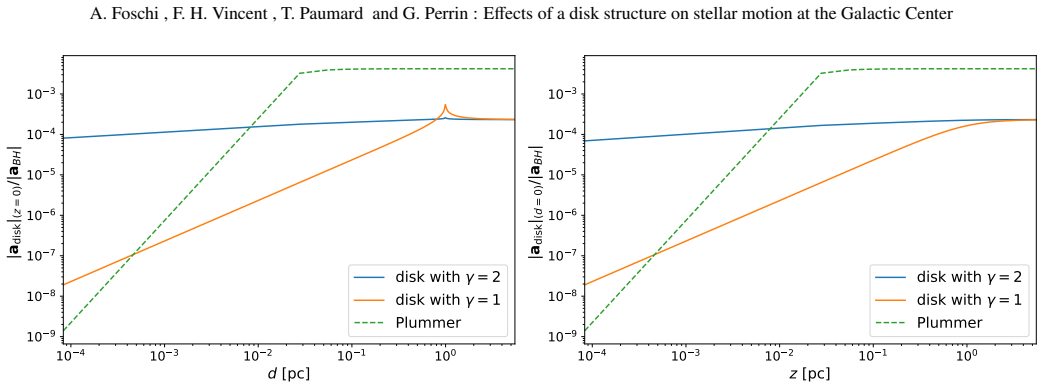
- [Fig. 3] Fig. 3 caption and axes: clarify that the left panel is |a_d|(z=0) and the right |a_z|(d=0); the singularity at d=r_max is physical only for the thin-disk model and should be noted in the caption for non-specialist readers.
- [§2.1, Appendix A] Eq. (1) and Appendix A: the relation ω_BH=π/2+ω_obs−β is central; a short inline reminder of the sign convention when β is obtained from Eq. (44)/Appendix E would help readers implementing the transformation.
- [§2.1, §3] The observer-frame convention (z_obs toward Earth) differs from GRAVITY papers by a π flip in ω and Ω; this is stated but easy to miss. Consider a one-line callout in the captions of Tables 1–2 and when quoting S2/S301 angles.
- [Throughout] Typos / wording: “GRA VITY” spacing is inconsistent; “apoastron”/“apoapsis” mixed; “is is maximised” in Fig. 6 caption; “caser min” in Table 2 caption. Abstract line “the former is neither present…” is slightly ambiguous (former = semi-latus rectum shift).
- [§4] §4 briefly dismisses CND and Sgr B2 with a single-ring / point-mass overestimate. A one-sentence quantitative ratio (a_CND/a_CW and a_SgrB2/a_CW at S2 apoapsis) would make the “negligible” claim easier to reuse.
- [References] Reference list: ensure the in-press GRAVITY+ S301 paper and Abd El Dayem et al. (2026) have stable identifiers if available at acceptance.
Circularity Check
No significant circularity: disk accelerations and secular element shifts are derived from Newtonian ring/disk integrals plus standard Gaussian perturbation equations; free parameters are not fitted to force the claimed signatures.
full rationale
The load-bearing chain is: (i) Newtonian potential/acceleration of a uniform ring via elliptic integrals (Lass & Blitzer; Fukushima), integrated over a power-law surface density Σ∝r^{-γ} to give a_d and a_z; (ii) rotation into the Gaussian frame {n,λ,z} to obtain R_disk, S_disk, W_disk; (iii) standard osculating rates (Poisson & Will) integrated over one Keplerian orbit to produce Δp_star, Δω_obs, Δϖ, ΔΘ. None of these steps defines the output in terms of itself. Disk mass M_tot, γ, r_min/r_max, and orientation (i_BH, β) are free inputs, not fitted to S2/S301 data to manufacture the secular trends. The distinctive claim—that a disk induces a secular Δp_star absent in low-order PN and spherical models—follows because S_disk is nonzero and its orbit average need not vanish, whereas spherical Gauss-law forces and 1PN terms give Δp_star=0 by construction of those models, not by circular reuse of the disk result. Self-citations (Abd El Dayem et al. 2026 for analytic LT Δϖ_LT/ΔΘ_LT; Heißel et al. for Plummer baselines) supply comparison formulae only; the disk accelerations and element shifts do not depend on those citations. Zero-thickness idealization and finite-scale-height sensitivity are modeling assumptions that affect correctness/amplitude, not circularity of the derivation. Score 0; steps empty.
Axiom & Free-Parameter Ledger
free parameters (5)
- M_tot / M_extra (disk mass) =
fiducial 10^3 M_⊙ (illustrative)
- γ (surface-density power-law index) =
1–2 (CW disk: 2)
- r_min, r_max (disk radial extent) =
CW luminous ~0.04–0.5 pc; extra mass down to 10^{-6} pc in scans
- Disk orientation (i_disk, Ω_disk) and relative β, i_BH =
CW: i_disk=127°±2°, Ω_disk=279°±2°
- Sgr A* spin parameters χ, θ for LT comparison =
χ=1 (max); θ scanned
axioms (5)
- domain assumption Disk gravity is purely Newtonian; black-hole gravity is included only through 1PN (Schwarzschild) and, for comparison, 1.5PN (Lense-Thirring) terms in harmonic coordinates.
- ad hoc to paper The extended mass is an infinitesimally thin, axisymmetric disk with Σ=B r^{-γ} between sharp r_min and r_max.
- standard math Osculating two-body perturbation equations (Poisson & Will) correctly map R,S,W force components to secular orbital-element shifts over one orbit.
- domain assumption Non-luminous mass aligned with the clockwise stellar disk need not share the luminous radial extent and may segregate inward (supported by cited simulations).
- domain assumption Outer GC structures (CND, Sgr B2) can be bounded by single-ring / point-mass overestimates and are then negligible inside the S-cluster.
read the original abstract
Stellar orbits are key for probing the environment of the supermassive black hole at the Galactic Center, Sagittarius A$^*$. So far, the mass around SgrA$^*$ has been assumed to be spherically distributed. However, the extended mass may instead be flattened, creating disk-like structures. We investigate the effects that a thin disk structure would have on stars at the Galactic Center, focusing on star S2 and S301 and the clockwise stellar disk. We derive analytically the acceleration exerted by a disk with power law density $\Sigma \propto r^{-\gamma}$. We use this acceleration to compute the osculating equations and the variations of the orbital elements, showing how the latter depend on the orientation of the disk with respect to the orbital plane. We find that the disk structure induces a secular shift in the semi-latus rectum, an extra in-plane precession and an out-of-plane precession. The former is neither present at the low-order post Newtonian description that we use for the black hole, nor when a spherical mass distribution is considered. The latter can be competitive with the Lense-Thirring precession induced by the spin of SgrA$^*$ on S301 motion, depending on the mass, the radial extent and the orientation of the disk. Since the Lense-Thirring precession is negligible in S2 motion, the out-of-plane precession can be used to place upper limits on the non luminous mass of disk-like structures at the Galactic Center. The limits might significantly differ from those obtained for spherical distributions and depend on the disk parameters. These results highlight the importance of constraining disk-like structures when using stellar orbits to probe the central black hole, in particular its spin. Once mass estimates are at hand, one can quantify the disk's effect on S301 motion and the resulting degeneracy with a future measurement of SgrA$^*$ spin.
Figures



Reference graph
Works this paper leans on
-
[1]
H., Heissel, G., Paumard, T., & Perrin, G
Abd El Dayem, K., Vincent, F. H., Heissel, G., Paumard, T., & Perrin, G. 2026, A&A, 707, A207
2026
-
[2]
2005, Phys
Alexander, T. 2005, Phys. Rept., 419, 65
2005
-
[3]
Bartko, H. et al. 2009, ApJ, 697, 1741
2009
-
[4]
E., Fish, V
Broderick, A. E., Fish, V . L., Johnson, M. D., et al. 2016, ApJ, 820, 137
2016
-
[5]
& Foschi, A
Cardoso, V . & Foschi, A. 2021, Phys. Rev. D, 104, 024004
2021
-
[6]
S., Narayan, R., et al
Cho, H., Prather, B. S., Narayan, R., et al. 2023, Astrophys. J. Lett., 959, L22
2023
-
[7]
R., Generozov, A., & Madigan, A.-M
Foote, H. R., Generozov, A., & Madigan, A.-M. 2020, ApJ, 890, 175
2020
-
[8]
Foschi, A. 2026, PERSEO: PERturbed Stellar Elements and Orbits, Zenodo, v0.1.0,https://doi.org/10.5281/zenodo.21639966
-
[9]
2019, ApJ, 883, 161
Fouvry, J.-B., Bar-Or, B., & Chavanis, P.-H. 2019, ApJ, 883, 161
2019
-
[10]
J., & Zimmerman, A
Fouvry, J.-B., Bustamante-Rosell, M. J., & Zimmerman, A. 2023, MNRAS, 526, 1471
2023
-
[11]
& Loeb, A
Fragione, G. & Loeb, A. 2020, ApJ, 901, L32
2020
-
[12]
2010, Celestial Mechanics and Dynamical Astronomy, 108, 339
Fukushima, T. 2010, Celestial Mechanics and Dynamical Astronomy, 108, 339
2010
-
[13]
Genzel, R. et al. 2003, ApJ, 594, 812
2003
-
[14]
M., Widmann, F., et al
Gillessen, S., Plewa, P. M., Widmann, F., et al. 2019, ApJ, 871, 126
2019
-
[15]
Goldwurm, A., Clavel, M., Gabici, S., & Terrier, R. 2026, Rev. Mod. Phys., 98, 025006 GRA VITY Collaboration. 2022, A&A, 657, L12 GRA VITY Collaboration. 2024, A&A, 692, A242 GRA VITY+Collaboration. 2026 [arXiv:2607.12664] Heißel, G., Paumard, T., Perrin, G., & Vincent, F. 2022, A&A, 660, A13
Pith/arXiv arXiv 2026
-
[16]
M., Kim, W.-T., et al
Hsieh, P.-Y ., Koch, P. M., Kim, W.-T., et al. 2021, ApJ, 913, 94
2021
-
[17]
2009, ApJ, 706, 960
Huang, L., Takahashi, R., & Shen, Z.-Q. 2009, ApJ, 706, 960
2009
-
[18]
& Tremaine, S
Kocsis, B. & Tremaine, S. 2011, MNRAS, 412, 187
2011
-
[19]
2018, A&A, 619, A46
Lacroix, T. 2018, A&A, 619, A46
2018
-
[20]
& Blitzer, L
Lass, H. & Blitzer, L. 1983, Celestial Mechanics, 30, 225
1983
-
[21]
2024, A&A, 686, A179
Lechien, T., Heißel, G., Grover, J., & Izzo, D. 2024, A&A, 686, A179
2024
-
[22]
& Beloborodov, A
Levin, Y . & Beloborodov, A. M. 2003, ApJ, 590, L33
2003
-
[23]
R., Ghez, A
Lu, J. R., Ghez, A. M., Hornstein, S. D., et al. 2009, Astrophys. J., 690, 1463 Máthé, G., Szölgyén, Á., & Kocsis, B. 2023, MNRAS, 520, 2204
2009
-
[24]
W., Thorne, K
Misner, C. W., Thorne, K. S., & Wheeler, J. A. 1973, Gravitation (W. H. Free- man) Mo´scibrodzka, M., Gammie, C. F., Dolence, J. C., Shiokawa, H., & Leung, P. K. 2009, ApJ, 706, 497
1973
-
[25]
1996, Astron
Narayan, R., Yi, I.-s., & Mahadevan, R. 1996, Astron. Astrophys. Suppl. Ser., 120, 287
1996
-
[26]
& Kocsis, B
Panamarev, T. & Kocsis, B. 2022, MNRAS, 517, 6205
2022
-
[27]
& Kalita, S
Paul, D. & Kalita, S. 2026, MNRAS, 547, stag318
2026
-
[28]
2006, ApJ, 643, 1011
Paumard, T., Genzel, R., Martins, F., et al. 2006, ApJ, 643, 1011
2006
-
[29]
& Will, C
Poisson, E. & Will, C. 2012, Gravity: Newtonian, Post-Newtonian, Relativistic (Cambrigde University Press)
2012
-
[30]
M., Quataert, E., & Stone, J
Ressler, S. M., Quataert, E., & Stone, J. M. 2018, MNRAS, 478, 3544
2018
-
[31]
2016, A&A, 588, A143
Schmiedeke, A., Schilke, P., Möller, T., et al. 2016, A&A, 588, A143
2016
-
[32]
2023, MNRAS, 527, 3196
Shen, Z.-Q., Yuan, G.-W., Jiang, C.-Z., et al. 2023, MNRAS, 527, 3196
2023
-
[33]
M., Murchikova, L., Stone, J
Solanki, S., Ressler, S. M., Murchikova, L., Stone, J. M., & Morris, M. R. 2023, ApJ, 953, 22 Szölgyén, Á. & Kocsis, B. 2018, Phys. Rev. Lett., 121, 101101 Szölgyén, Á., Máthé, G., & Kocsis, B. 2021, ApJ, 919, 140
2023
-
[34]
2020, MNRAS, 493, 2632 von Fellenberg, S
Tremaine, S. 2020, MNRAS, 493, 2632 von Fellenberg, S. D. et al. 2022, Astrophys. J. Lett., 932, L6
2020
-
[35]
Will, C. M. 2014, Living Rev. Rel., 17, 4
2014
-
[36]
M., Naoz, S., Hees, A., et al
Will, C. M., Naoz, S., Hees, A., et al. 2023, ApJ, 959, 58
2023
-
[37]
F., Nucita, A
Zakharov, A. F., Nucita, A. A., De Paolis, F., & Ingrosso, G. 2007, Phys. Rev. D, 76, 062001 Article number, page 12 of 12
2007
discussion (0)
Sign in with ORCID, Apple, or X to comment. Anyone can read and Pith papers without signing in.