REVIEW 4 major objections 6 minor 6 cited by
Self-Improving Transformers Overcome Easy-to-Hard and Length Generalization Challenges
T0 review · 4 major / 6 minor · reviewed 2026-08-09 · deepseek-v4-flash
Pith's one-line read By repeatedly training on its own filtered solutions to slightly harder problems, a standard transformer can learn to add 100-digit numbers and solve mazes far beyond its training distribution.
desk verdict Real results with a missing measurement: the 100-digit addition headline works, but the paper never shows the label-quality trajectory that the self-improvement loop depends on. read the letter →
The pith
A machine-rendered reading of the paper's core claim, the machinery that carries it, and where it could break.
The reading
What carries the argument
The load-bearing mechanism is the iterative self-improvement loop: train on initial supervised data $D_0$ of difficulty at most $d_0$; at round $r$, sample inputs of difficulty $d_r=d_0+r$ (or a finer schedule), let the current model generate labels, filter them, and fine-tune on $D_0\cup D_1\cup\cdots\cup D_r$. The two unsupervised filters are relative length filtering, which removes outputs shorter than the batch maximum minus a threshold, and majority voting, which keeps outputs agreed upon by at least a threshold fraction of several seed-trained models. This loop leverages the transcendence property: a model trained on easy problems can answer problems one difficulty step harder, giving the next round a stream of mostly correct self-generated labels.
What would settle it
Measure the base model's exact-match accuracy on the first out-of-distribution difficulty before any self-improvement round, for example 17-digit reverse addition after training on 1-to-16-digit examples. If this accuracy is near zero, the first self-improvement round injects mostly wrong labels and the loop cannot bootstrap, whereas the paper's account predicts it is well above zero.
Extended reading notes
Core claim
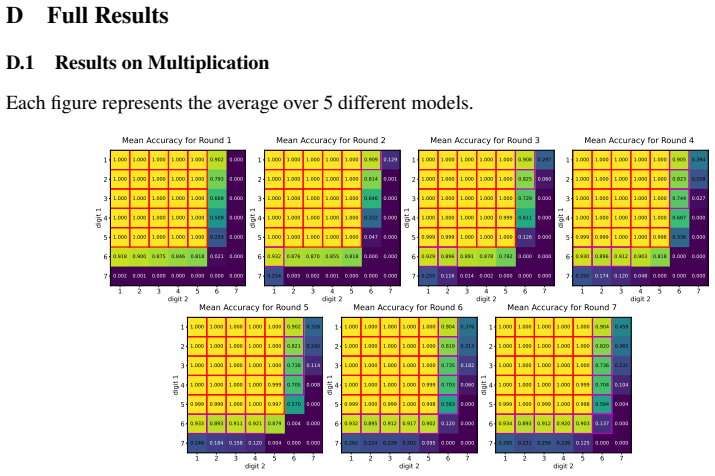
The central discovery is that the "transcendence" phenomenon, where a model trained on easy instances can solve slightly harder ones, can be chained into extreme length and difficulty generalization. By repeatedly collecting the model's predictions on the next difficulty level, filtering them, and continuing training on the combined old and new data, a standard transformer progresses one step at a time from its initial distribution to lengths and difficulties far beyond it. The authors demonstrate this on reverse addition, string copy and reverse, forward addition, chain-of-thought multiplication, and maze solving, with no changes to positional embeddings or the transformer architecture. They further show that unsupervised filtering based on relative output length and majority voting is sufficient to prevent label-noise avalanches, and that the safe range of difficulty the model can be asked to self-label widens with each round.
Load-bearing premise
The method depends on the empirical regularity that a model trained on easy problems can solve problems one step harder; if that one-step "transcendence" fails at any round, the self-generated labels become garbage and the loop breaks.
Editorial extensions
If this is right
- On reverse addition, copying, and reversing, the loop reaches near-perfect accuracy far outside the training range, such as over 100-digit addition and over 120-character strings, even without explicit filtering.
- For forward addition, multiplication, and maze solving, unsupervised length filtering and majority voting are what sustain the loop; without them, accuracy collapses after a few rounds.
- The safe difficulty range widens with each round, so an accelerated schedule that samples several difficulties per round reaches the same generalization in fewer rounds, e.g., 10-by-10 multiplication in 19 rounds instead of 41.
- Pretrained 1B and 3B models bootstrap the loop faster than a from-scratch 14M model, so the recipe composes with model scale.
- Filtered self-improvement can yield exponential growth in out-of-distribution accuracy across rounds, while the error-avalanche analysis identifies structured short-answer noise, rather than pure random label noise, as the main failure mode.
Reading between the lines
- The paper leaves implicit that the recipe only needs a difficulty ladder whose rungs are one step apart; any problem family with a monotone, quantifiable notion of hardness, such as proof length, code complexity, or planning horizon, is a candidate for this kind of bootstrapping.
- The error-avalanche simulations suggest that filters targeting structurally short or incomplete outputs may be more valuable than generic noise filters; outside arithmetic, truncation and dropped reasoning steps are common failure patterns, so a domain-agnostic "completeness" filter may substitute for exact verification.
- Because the accelerated schedule in Section 7.2 used test-set accuracy to choose next-round difficulties, a practical deployment would need an unsupervised confidence proxy, such as the agreement rate across majority-voted models or the length-filter survival rate, to decide how far to push each round.
- The majority-voting ablation shows that independent training trajectories matter more than simply training more data, which hints that diversity in the models being voted over is the active ingredient rather than ensemble size alone.
Editorial analysis
A structured set of objections, weighed in public.
Referee Report
Summary. The paper proposes an iterative self-improvement procedure for transformer models: train on an initial labeled dataset of low difficulty, then at each round generate predictions on slightly harder instances, optionally filter those predictions with unsupervised criteria (relative length filtering and/or majority voting), and fine-tune on the combined data. The authors evaluate this recipe on reverse addition, copy/reverse, forward addition, chain-of-thought multiplication, and maze solving, reporting strong out-of-distribution extrapolation (e.g., from 10-digit to 100-digit reverse addition, from length-10 to length-120 strings, and from 5-by-5 to 10-by-10 multiplication with filtering). They also analyze an "error avalanche" failure mode, show that structured label noise is more harmful than uniform noise, and demonstrate that pretrained Llama models accelerate self-improvement. The framing positions the results as evidence that standard transformers, without new positional encodings or architectural changes, can achieve extreme easy-to-hard and length generalization through self-training with simple filters.
Significance. If the reported results hold, the paper would make a strong empirical contribution: it suggests that iterative self-training with weak, task-agnostic filtering can bootstrap a vanilla decoder-only transformer far beyond its training difficulty, complementing prior work that relies on architectural or positional-encoding modifications. Strengths include the breadth of tasks, the controlled difficulty schedules, the explicit analysis of self-generated label quality in Figure 5, the synthetic noise experiments in Section 8, and the ablation of majority-voting variants in Figure 31. The paper is generally well written and the experimental setup is described in enough detail to be reproducible. However, the significance of the headline claims is currently limited by (i) the test-set-leaked accelerated schedule used to claim exponential improvement, (ii) the absence of variance estimates for the flagship length-generalization curves, and (iii) the lack of a per-round measurement of self-generated label accuracy for the 100-digit reverse-addition trajectory that supports the central transcendence mechanism.
major comments (4)
- [§7.2, Fig. 18] The claim of "exponential improvement" is not supported as stated because the accelerated schedule directly uses test-set accuracy to choose which difficulty levels to sample. The paper acknowledges this: "the sampling schedule in this proof-of-concept experiment leverages information about test set accuracy to determine the extra OOD lengths to sample." Since the training data at each round is selected from lengths that achieve above 99% test accuracy, the reported extrapolation is partly a product of oracle knowledge of the test distribution, not of the self-improvement procedure alone. Moreover, "exponential" is not established: Figure 18 shows a steeply rising but concave curve with no exponential fit or functional form. Please remove or substantially qualify the exponential claim, and provide a leak-free version that selects difficulties using only a held-out validation set or a model-based proxy.
- [Figs. 3, 4, 10, 18] The headline results—reverse addition to 100 digits, copy/reverse to length 120, forward addition to length 75, and the accelerated schedules—are reported without error bars or multiple seeds. The paper's own Figure 26 shows that 11-digit OOD accuracy varies dramatically across seeds (e.g., 0.617 for seed 44 vs. 0.998 for seed 41), so the claim of "perfect generalization" in Figure 3 is not yet convincing. Please report mean and standard deviation across at least 5 independent seeds for the central length-generalization curves, and state explicitly how many runs underlie each plotted line.
- [§4.1, §5.1, Fig. 5] The success of the reverse-addition self-improvement loop depends on the transcendence property: at each of roughly 84 rounds, the model must generate enough correct labels at difficulty 16+r to avoid an error avalanche. Figure 5 provides a scatter of data-accuracy versus next-round accuracy for some rounds, but the paper never reports the per-round label accuracy trajectory for the specific experiment behind Figure 3. Without this trajectory, one cannot verify that transcendence held throughout the loop, assess the margin of safety near each step, or rule out that the result hinges on a few early high-accuracy rounds. Please include a plot of self-generated label accuracy (and, where filtering is used, filtered-data accuracy) versus round for the reverse-addition and copy/reverse experiments.
- [§5.2, §6.1, §6.2] The filtering thresholds are chosen ad hoc and no sensitivity analysis is provided. Forward addition uses a length threshold of 2, multiplication uses 10 tokens, majority voting uses 4-out-of-5 consensus for multiplication and 3-out-of-3 for mazes. The paper presents these filters as "general-purpose" and central to success, but it does not show how performance varies with the threshold τ or with the consensus level. Without such an analysis, the positive results for forward addition, multiplication, and mazes could be knife-edge phenomena tied to particular hand-selected constants. Please add ablations over τ and over the consensus threshold for at least one task in each category.
minor comments (6)
- [Abstract, §3] The abstract states the method works "without any changes to the positional embeddings," but Section 3 explicitly removes positional embeddings and uses NoPE. This is itself a deliberate design choice (indeed, NoPE is a known technique for length generalization). Please rephrase the abstract to acknowledge that NoPE is used, or clarify that "no additional" positional encoding beyond the absence of one is meant.
- [§4.2] The fine-tuning set is written as "D1 ∪ ⋯ ∪ Dr" without D0, unlike the reverse-addition description. If the original labeled data is intentionally omitted, say so; if this is a typo, correct it.
- [§5.2, Fig. 8] The symbol τ is used both for the length-filter threshold and for the majority-vote consensus threshold. Please use distinct symbols (e.g., τ_len and τ_maj) to avoid ambiguity.
- [§8.2] The label "drop-preturb" in Figure 24 should be "drop-perturb."
- [§7.2] The statement that "the amount of extra OOD generalization increases roughly linearly" with round is not quantified; Figure 17 shows different slopes for copy and reverse addition. A linear fit or a statement of the observed range would be more precise.
- [§7.3, Appendix C.3] For the pretrained Llama experiments, the paper says "keep the embedding component unchanged" after replacing the tokenizer with a character tokenizer, which is internally inconsistent because a different vocabulary size requires a different embedding. Please clarify how the embedding layer is handled.
Circularity Check
Accelerated self-improvement claim is test-informed: the sampling schedule uses the same >99% test-accuracy metric that is then reported as the result.
-
fitted input called prediction
[Section 7.2 (Self-Improvement can be Accelerated), Figure 18 and surrounding text]
"It is important to note that the sampling schedule in this proof-of-concept experiment leverages information about test set accuracy to determine the extra OOD lengths to sample, which is not typically available in practical scenarios. ... At each round, the self-improvement dataset is uniformly sampled from all difficulty levels achieving over 99% evaluation accuracy."
The accelerated-schedule experiment defines its training distribution by the very evaluation metric it then reports: only difficulties with over 99% test accuracy are sampled into the next round, and the headline result is the maximum input length achieving over 99% test accuracy. The training data is therefore selected using the test set, and the reported exponential improvement is not an independent prediction of a fixed self-improvement loop; it is a feedback loop in which test accuracy is an input to the schedule. The paper explicitly acknowledges this test-set leakage, which confirms that the exponential extrapolation claim reduces in part to its own evaluation signal rather than to a purely self-generated curriculum.
full rationale
The core self-improvement results are not circular: in the reverse-addition, copy/reverse, forward-addition, multiplication, and maze experiments (Sections 4 and 6), the model generates pseudo-labels at difficulty d_r without using test-set answers, and final exact-match accuracy is an independent measurement. The transcendence assumption is attributed to an external prior work (Zhang et al., 2024) rather than to a self-citation chain, so it is an empirical premise, not a circular step. The one genuine circular element is the accelerated-schedule experiment in Section 7.2: the schedule is chosen using test-set accuracy ('all difficulty levels achieving over 99% evaluation accuracy'), and the reported curve is exactly the maximum length achieving over 99% test accuracy. This makes the exponential-improvement claim partly constructed from the evaluation set, as the paper itself acknowledges. Because the main 10-to-100-digit reverse-addition result remains independent of this test-informed schedule, the circularity is partial rather than total; the score reflects that specific predicted outcome rather than the whole paper.
Assumptions & free parameters
free parameters (4)
- Length filtering threshold tau =
2 tokens (forward addition), 10 tokens (multiplication)
- Majority voting consensus threshold =
4 out of 5 (multiplication), 3 out of 3 (maze)
- Number of majority-vote models k =
5 for multiplication, 3 for maze
- Accelerated sampling schedule =
all difficulty levels achieving over 99% test accuracy
assumptions (3)
- domain assumption Transcendence: models can generalize slightly beyond the difficulty of their training data, generating correct outputs for n+1 difficulty with nontrivial accuracy.
- domain assumption Length and majority-vote filtering preserve enough correct labels to keep the self-improvement process stable.
- standard math Standard arithmetic and graph-search properties, e.g., in a tree a path with no repeated nodes is the shortest path, and addition follows standard carry rules.
Cite this review
Pith. "Pith review of Self-Improving Transformers Overcome Easy-to-Hard and Length Generalization Challenges." pith.science (2026). https://pith.science/paper/57WYALBR
@misc{pith2026250201612,
  author       = {Pith},
  title        = {Pith review of: Self-Improving Transformers Overcome Easy-to-Hard and Length Generalization Challenges},
  year         = {2026},
  howpublished = {\url{https://pith.science/paper/57WYALBR}},
  note         = {Machine review of arXiv:2502.01612}
}
read the original abstract
Large language models often struggle with length generalization and solving complex problem instances beyond their training distribution. We present a self-improvement approach where models iteratively generate and learn from their own solutions, progressively tackling harder problems while maintaining a standard transformer architecture. Across diverse tasks including arithmetic, string manipulation, and maze solving, self-improving enables models to solve problems far beyond their initial training distribution-for instance, generalizing from 10-digit to 100-digit addition without apparent saturation. We observe that in some cases filtering for correct self-generated examples leads to exponential improvements in out-of-distribution performance across training rounds. Additionally, starting from pretrained models significantly accelerates this self-improvement process for several tasks. Our results demonstrate how controlled weak-to-strong curricula can systematically teach a model logical extrapolation without any changes to the positional embeddings, or the model architecture.
Figures


Figures from the paper (39 more)




Forward citations
Cited by 6 Pith papers
-
Symmetry-Aware Transformer Training for Automated Planning
A contrastive loss that aligns attention and hidden states between renamed copies helps transformers solve larger planning problems in some domains, but not all.
-
A Task-Centric Theory for Iterative Self-Improvement with Easy-to-Hard Curricula
Iterative self-improvement provably keeps improving only when initial performance lies in a moderate difficulty interval, and easy-to-hard curricula beat fixed mixtures under moderate difficulty separation and suffici...
-
Physics of Language Models: Part 4.1, Architecture Design and the Magic of Canon Layers
Canon layers—residual 1-d causal convolutions over adjacent tokens—boost synthetic reasoning depth 2-4x, lift NoPE to RoPE level, and bring GLA up to Mamba2/GDN, with qualitative real-world confirmation.
-
Maximizing Prefix-Confidence at Test-Time Efficiently Improves Mathematical Reasoning
Selecting the most confident 32-token prefix and completing only it gives better accuracy per compute than majority voting on five math reasoning datasets, using only the model's own confidence as a selector.
-
Uncovering a Universal Abstract Algorithm for Modular Addition in Neural Networks
Trained MLPs and transformers solving modular addition can be unified under an approximate Chinese Remainder Theorem, and deep or embedding-based networks learn only O(log n) frequency features.
-
Extrapolation by Association: Length Generalization Transfer in Transformers
Length generalization on a short-trained main task can be inherited from a longer-trained related auxiliary task trained jointly with it.
Reference graph
Works this paper leans on
-
[1]
write newline
" write newline "" before.all 'output.state := FUNCTION n.dashify 't := "" t empty not t #1 #1 substring "-" = t #1 #2 substring "--" = not "--" * t #2 global.max substring 't := t #1 #1 substring "-" = "-" * t #2 global.max substring 't := while if t #1 #1 substring * t #2 global.max substring 't := if while FUNCTION format.date year duplicate empty "emp...
-
[2]
Llama 3 model card
AI@Meta. Llama 3 model card. 2024. URL https://github.com/meta-llama/llama3/blob/main/MODEL_CARD.md
2024
-
[3]
Alemohammad, S., Casco-Rodriguez, J., Luzi, L., Humayun, A. I., Babaei, H. R., LeJeune, D., Siahkoohi, A., and Baraniuk, R. Self-consuming generative models go mad. ArXiv, abs/2307.01850, 2023. URL https://api.semanticscholar.org/CorpusID:259341801
arXiv 2023
-
[4]
Global lyapunov functions: a long-standing open problem in mathematics, with symbolic transformers
Alfarano, A., Charton, F., and Hayat, A. Global lyapunov functions: a long-standing open problem in mathematics, with symbolic transformers. In The Thirty-eighth Annual Conference on Neural Information Processing Systems, 2024
work page 2024
-
[5]
Exploring length generalization in large language models
Anil, C., Wu, Y., Andreassen, A., Lewkowycz, A., Misra, V., Ramasesh, V., Slone, A., Gur-Ari, G., Dyer, E., and Neyshabur, B. Exploring length generalization in large language models. Advances in Neural Information Processing Systems, 35: 0 38546--38556, 2022
work page 2022
-
[6]
Bachmann, G. and Nagarajan, V. The pitfalls of next-token prediction. arXiv preprint arXiv:2403.06963, 2024
arXiv 2024
-
[7]
End-to-end algorithm synthesis with recurrent networks: Extrapolation without overthinking
Bansal, A., Schwarzschild, A., Borgnia, E., Emam, Z., Huang, F., Goldblum, M., and Goldstein, T. End-to-end algorithm synthesis with recurrent networks: Extrapolation without overthinking. Advances in Neural Information Processing Systems, 35: 0 20232--20242, 2022
work page 2022
-
[8]
Bansal, H., Hosseini, A., Agarwal, R., Tran, V. Q., and Kazemi, M. Smaller, weaker, yet better: Training llm reasoners via compute-optimal sampling. arXiv preprint arXiv:2408.16737, 2024
arXiv 2024
Show all 71 references
-
[9]
The pitfalls of memorization: When memorization hurts generalization
Bayat, R., Pezeshki, M., Dohmatob, E., Lopez-Paz, D., and Vincent, P. The pitfalls of memorization: When memorization hurts generalization. 2024. URL https://api.semanticscholar.org/CorpusID:274610625
2024
-
[10]
J., Duplessis, A., Jiralerspong, M., and Gidel, G
Bertrand, Q., Bose, A. J., Duplessis, A., Jiralerspong, M., and Gidel, G. On the stability of iterative retraining of generative models on their own data. ArXiv, abs/2310.00429, 2023. URL https://api.semanticscholar.org/CorpusID:263334017
2023 arXiv
-
[11]
Bagging predictors
Breiman, L. Bagging predictors. Machine learning, 24: 0 123--140, 1996
1996
-
[12]
Large language models suffer from their own output: An analysis of the self-consuming training loop
Briesch, M., Sobania, D., and Rothlauf, F. Large language models suffer from their own output: An analysis of the self-consuming training loop. ArXiv, abs/2311.16822, 2023. URL https://api.semanticscholar.org/CorpusID:265466007
2023 arXiv
-
[13]
H., Baker, B., Gao, L., Aschenbrenner, L., Chen, Y., Ecoffet, A., Joglekar, M., Leike, J., et al
Burns, C., Izmailov, P., Kirchner, J. H., Baker, B., Gao, L., Aschenbrenner, L., Chen, Y., Ecoffet, A., Joglekar, M., Leike, J., et al. Weak-to-strong generalization: Eliciting strong capabilities with weak supervision. arXiv preprint arXiv:2312.09390, 2023
2023 arXiv
-
[14]
S., Wagner, A
Charton, F., Ellenberg, J. S., Wagner, A. Z., and Williamson, G. Patternboost: Constructions in mathematics with a little help from ai. arXiv preprint arXiv:2411.00566, 2024
2024 arXiv
-
[15]
Teaching large language models to self-debug
Chen, X., Lin, M., Sch \"a rli, N., and Zhou, D. Teaching large language models to self-debug. arXiv preprint arXiv:2304.05128, 2023
2023 arXiv
-
[16]
Position coupling: Improving length generalization of arithmetic transformers using task structure
Cho, H., Cha, J., Awasthi, P., Bhojanapalli, S., Gupta, A., and Yun, C. Position coupling: Improving length generalization of arithmetic transformers using task structure. 2024. URL https://api.semanticscholar.org/CorpusID:273695226
2024
-
[17]
de Arcaute, G. M. R., Watson, L., Reviriego, P., Hern \'a ndez, J. A., Ju \'a rez, M., and Sarkar, R. Combining generative artificial intelligence (ai) and the internet: Heading towards evolution or degradation? ArXiv, abs/2303.01255, 2023. URL https://api.semanticscholar.org/...
2023 arXiv
-
[18]
From explicit cot to implicit cot: Learning to internalize cot step by step
Deng, Y., Choi, Y., and Shieber, S. From explicit cot to implicit cot: Learning to internalize cot step by step. arXiv preprint arXiv:2405.14838, 2024
2024 arXiv
-
[19]
A tale of tails: Model collapse as a change of scaling laws
Dohmatob, E., Feng, Y., Yang, P., Charton, F., and Kempe, J. A tale of tails: Model collapse as a change of scaling laws. ArXiv, abs/2402.07043, 2024. URL https://api.semanticscholar.org/CorpusID:267628004
2024 arXiv
-
[20]
From interpolation to extrapolation: Complete length generalization for arithmetic transformers
Duan, S., Shi, Y., and Xu, W. From interpolation to extrapolation: Complete length generalization for arithmetic transformers. arXiv preprint arXiv:2310.11984, 2023
2023 arXiv
-
[21]
Location attention for extrapolation to longer sequences
Dubois, Y., Dagan, G., Hupkes, D., and Bruni, E. Location attention for extrapolation to longer sequences. arXiv preprint arXiv:1911.03872, 2019
1911 arXiv
-
[22]
L., Jiang, L., Lin, B
Dziri, N., Lu, X., Sclar, M., Li, X. L., Jiang, L., Lin, B. Y., Welleck, S., West, P., Bhagavatula, C., Le Bras, R., et al. Faith and fate: Limits of transformers on compositionality. Advances in Neural Information Processing Systems, 36, 2024
2024
-
[23]
Looped transformers for length generalization
Fan, Y., Du, Y., Ramchandran, K., and Lee, K. Looped transformers for length generalization. arXiv preprint arXiv:2409.15647, 2024
2024 arXiv
-
[24]
Beyond model collapse: Scaling up with synthesized data requires reinforcement
Feng, Y., Dohmatob, E., Yang, P., Charton, F., and Kempe, J. Beyond model collapse: Scaling up with synthesized data requires reinforcement. arXiv preprint arXiv:2406.07515, 2024
2024 arXiv
-
[25]
Is model collapse inevitable? breaking the curse of recursion by accumulating real and synthetic data
Gerstgrasser, M., Schaeffer, R., Dey, A., Rafailov, R., Sleight, H., Hughes, J., Korbak, T., Agrawal, R., Pai, D., Gromov, A., et al. Is model collapse inevitable? breaking the curse of recursion by accumulating real and synthetic data. arXiv preprint arXiv:2404.01413, 2024
2024 arXiv
-
[26]
Self-correcting self-consuming loops for generative model training
Gillman, N., Freeman, M., Aggarwal, D., Hsu, C.-H., Luo, C., Tian, Y., and Sun, C. Self-correcting self-consuming loops for generative model training. arXiv preprint arXiv:2402.07087, 2024
2024 arXiv
-
[27]
L., Srinivasan, S., Konyushkova, K., Weerts, L., Sharma, A., Siddhant, A., Ahern, A., Wang, M., Gu, C., et al
Gulcehre, C., Paine, T. L., Srinivasan, S., Konyushkova, K., Weerts, L., Sharma, A., Siddhant, A., Ahern, A., Wang, M., Gu, C., et al. Reinforced self-training (rest) for language modeling. arXiv preprint arXiv:2308.08998, 2023
2023 arXiv
-
[28]
The unreasonable effectiveness of easy training data for hard tasks
Hase, P., Bansal, M., Clark, P., and Wiegreffe, S. The unreasonable effectiveness of easy training data for hard tasks. arXiv preprint arXiv:2401.06751, 2024
2024 arXiv
-
[29]
Will large-scale generative models corrupt future datasets? In Proceedings of the IEEE/CVF International Conference on Computer Vision (ICCV), pp.\ 20555--20565, October 2023
Hataya, R., Bao, H., and Arai, H. Will large-scale generative models corrupt future datasets? In Proceedings of the IEEE/CVF International Conference on Computer Vision (ICCV), pp.\ 20555--20565, October 2023
2023
-
[30]
V-star: Training verifiers for self-taught reasoners
Hosseini, A., Yuan, X., Malkin, N., Courville, A., Sordoni, A., and Agarwal, R. V-star: Training verifiers for self-taught reasoners. arXiv preprint arXiv:2402.06457, 2024
2024 arXiv
-
[31]
E., Shen, Y., Wallis, P., Allen-Zhu, Z., Li, Y., Wang, S., and Chen, W
Hu, J. E., Shen, Y., Wallis, P., Allen-Zhu, Z., Li, Y., Wang, S., and Chen, W. Lora: Low-rank adaptation of large language models. ArXiv, abs/2106.09685, 2021. URL https://api.semanticscholar.org/CorpusID:235458009
2021 arXiv
-
[32]
J., Rohatgi, D., Zhang, C., Simchowitz, M., Ash, J
Huang, A., Block, A., Foster, D. J., Rohatgi, D., Zhang, C., Simchowitz, M., Ash, J. T., and Krishnamurthy, A. Self-improvement in language models: The sharpening mechanism, 2024. URL https://arxiv.org/abs/2412.01951
2024 arXiv
-
[33]
S., Hou, L., Wu, Y., Wang, X., Yu, H., and Han, J
Huang, J., Gu, S. S., Hou, L., Wu, Y., Wang, X., Yu, H., and Han, J. Large language models can self-improve. arXiv preprint arXiv:2210.11610, 2022
2022 arXiv
-
[34]
Compositionality decomposed: How do neural networks generalise? Journal of Artificial Intelligence Research, 67: 0 757--795, 2020
Hupkes, D., Dankers, V., Mul, M., and Bruni, E. Compositionality decomposed: How do neural networks generalise? Journal of Artificial Intelligence Research, 67: 0 757--795, 2020
2020
-
[35]
Length generalization in arithmetic transformers
Jelassi, S., d'Ascoli, S., Domingo-Enrich, C., Wu, Y., Li, Y., and Charton, F. Length generalization in arithmetic transformers. arXiv preprint arXiv:2306.15400, 2023
2023 arXiv
-
[36]
The impact of positional encoding on length generalization in transformers
Kazemnejad, A., Padhi, I., Natesan Ramamurthy, K., Das, P., and Reddy, S. The impact of positional encoding on length generalization in transformers. Advances in Neural Information Processing Systems, 36, 2024
2024
-
[37]
D., Lee, K., and Papailiopoulos, D
Lee, N., Sreenivasan, K., Lee, J. D., Lee, K., and Papailiopoulos, D. Teaching arithmetic to small transformers. arXiv preprint arXiv:2307.03381, 2023
2023 arXiv
-
[38]
Functional interpolation for relative positions improves long context transformers
Li, S., You, C., Guruganesh, G., Ainslie, J., Ontanon, S., Zaheer, M., Sanghai, S., Yang, Y., Kumar, S., and Bhojanapalli, S. Functional interpolation for relative positions improves long context transformers. arXiv preprint arXiv:2310.04418, 2023
-
[39]
I-sheep: Self-alignment of llm from scratch through an iterative self-enhancement paradigm
Liang, Y., Zhang, G., Qu, X., Zheng, T., Guo, J., Du, X., Yang, Z., Liu, J., Lin, C., Ma, L., et al. I-sheep: Self-alignment of llm from scratch through an iterative self-enhancement paradigm. arXiv preprint arXiv:2408.08072, 2024
2024 arXiv
-
[40]
Let's verify step by step
Lightman, H., Kosaraju, V., Burda, Y., Edwards, H., Baker, B., Lee, T., Leike, J., Schulman, J., Sutskever, I., and Cobbe, K. Let's verify step by step. arXiv preprint arXiv:2305.20050, 2023
2023 arXiv
-
[41]
Self-refine: Iterative refinement with self-feedback
Madaan, A., Tandon, N., Gupta, P., Hallinan, S., Gao, L., Wiegreffe, S., Alon, U., Dziri, N., Prabhumoye, S., Yang, Y., et al. Self-refine: Iterative refinement with self-feedback. Advances in Neural Information Processing Systems, 36, 2024
2024
-
[42]
R., Kailkhura, B., Bhatele, A., Geiping, J., Schwarzschild, A., et al
McLeish, S., Bansal, A., Stein, A., Jain, N., Kirchenbauer, J., Bartoldson, B. R., Kailkhura, B., Bhatele, A., Geiping, J., Schwarzschild, A., et al. Transformers can do arithmetic with the right embeddings. arXiv preprint arXiv:2405.17399, 2024
2024 arXiv
-
[43]
Newman, B., Hewitt, J., Liang, P., and Manning, C. D. The eos decision and length extrapolation. arXiv preprint arXiv:2010.07174, 2020
2010 arXiv
-
[44]
Y., Yuan, W., Cho, K., He, H., Sukhbaatar, S., and Weston, J
Pang, R. Y., Yuan, W., Cho, K., He, H., Sukhbaatar, S., and Weston, J. Iterative reasoning preference optimization, 2024. URL https://arxiv.org/abs/2404.19733
2024 arXiv
-
[45]
Regenesis: Llms can grow into reasoning generalists via self-improvement
Peng, X., Xia, C., Yang, X., Xiong, C., Wu, C.-S., and Xing, C. Regenesis: Llms can grow into reasoning generalists via self-improvement. arXiv preprint arXiv:2410.02108, 2024
2024 arXiv
-
[46]
A., and Lewis, M
Press, O., Smith, N. A., and Lewis, M. Train short, test long: Attention with linear biases enables input length extrapolation. arXiv preprint arXiv:2108.12409, 2021
2021 arXiv
-
[47]
Recursive introspection: Teaching language model agents how to self-improve
Qu, Y., Zhang, T., Garg, N., and Kumar, A. Recursive introspection: Teaching language model agents how to self-improve. arXiv preprint arXiv:2407.18219, 2024
2024 arXiv
-
[48]
and Barez, F
Quirke, P. and Barez, F. Understanding addition in transformers. arXiv preprint arXiv:2310.13121, 2023
2023 arXiv
-
[49]
Deep learning is robust to massive label noise
Rolnick, D. Deep learning is robust to massive label noise. arXiv preprint arXiv:1705.10694, 2017
2017 arXiv
-
[50]
Randomized positional encodings boost length generalization of transformers
Ruoss, A., Del \'e tang, G., Genewein, T., Grau-Moya, J., Csord \'a s, R., Bennani, M., Legg, S., and Veness, J. Randomized positional encodings boost length generalization of transformers. arXiv preprint arXiv:2305.16843, 2023
2023 arXiv
-
[51]
Explicitly encoding structural symmetry is key to length generalization in arithmetic tasks
Sabbaghi, M., Pappas, G., Hassani, H., and Goel, S. Explicitly encoding structural symmetry is key to length generalization in arithmetic tasks. arXiv preprint arXiv:2406.01895, 2024
2024 arXiv
-
[52]
Can you learn an algorithm? generalizing from easy to hard problems with recurrent networks
Schwarzschild, A., Borgnia, E., Gupta, A., Huang, F., Vishkin, U., Goldblum, M., and Goldstein, T. Can you learn an algorithm? generalizing from easy to hard problems with recurrent networks. Advances in Neural Information Processing Systems, 34: 0 6695--6706, 2021
2021
-
[53]
T., Li, Y., and Zhang, Y
Shen, R., Bubeck, S., Eldan, R., Lee, Y. T., Li, Y., and Zhang, Y. Positional description matters for transformers arithmetic. arXiv preprint arXiv:2311.14737, 2023
2023 arXiv
-
[54]
Weak-to-strong generalization through the data-centric lens
Shin, C., Cooper, J., and Sala, F. Weak-to-strong generalization through the data-centric lens. arXiv preprint arXiv:2412.03881, 2024
2024 arXiv
-
[55]
The curse of recursion: Training on generated data makes models forget
Shumailov, I., Shumaylov, Z., Zhao, Y., Gal, Y., Papernot, N., and Anderson, R. The curse of recursion: Training on generated data makes models forget. arXiv preprint arXiv:2305.17493, 2023
2023 arXiv
-
[56]
Ai models collapse when trained on recursively generated data
Shumailov, I., Shumaylov, Z., Zhao, Y., Papernot, N., Anderson, R., and Gal, Y. Ai models collapse when trained on recursively generated data. Nature, 631 0 (8022): 0 755--759, 2024
2024
-
[57]
D., Agarwal, R., Anand, A., Patil, P., Garcia, X., Liu, P
Singh, A., Co-Reyes, J. D., Agarwal, R., Anand, A., Patil, P., Garcia, X., Liu, P. J., Harrison, J., Lee, J., Xu, K., et al. Beyond human data: Scaling self-training for problem-solving with language models. arXiv preprint arXiv:2312.06585, 2023
2023 arXiv
-
[58]
Mind the gap: Examining the self-improvement capabilities of large language models
Song, Y., Zhang, H., Eisenach, C., Kakade, S., Foster, D., and Ghai, U. Mind the gap: Examining the self-improvement capabilities of large language models. arXiv preprint arXiv:2412.02674, 2024
2024 arXiv
-
[59]
Easy-to-hard generalization: Scalable alignment beyond human supervision
Sun, Z., Yu, L., Shen, Y., Liu, W., Yang, Y., Welleck, S., and Gan, C. Easy-to-hard generalization: Scalable alignment beyond human supervision. arXiv preprint arXiv:2403.09472, 2024
2024 arXiv
-
[60]
N., Kaiser, ., and Polosukhin, I
Vaswani, A., Shazeer, N., Parmar, N., Uszkoreit, J., Jones, L., Gomez, A. N., Kaiser, ., and Polosukhin, I. Attention is all you need. Advances in neural information processing systems, 30, 2017
2017
-
[61]
Self-consistency improves chain of thought reasoning in language models
Wang, X., Wei, J., Schuurmans, D., Le, Q., Chi, E., and Zhou, D. Self-consistency improves chain of thought reasoning in language models. arXiv preprint arXiv:2203.11171, 2022 a
2022 arXiv
-
[62]
A., Khashabi, D., and Hajishirzi, H
Wang, Y., Kordi, Y., Mishra, S., Liu, A., Smith, N. A., Khashabi, D., and Hajishirzi, H. Self-instruct: Aligning language models with self-generated instructions. arXiv preprint arXiv:2212.10560, 2022 b
2022 arXiv
-
[63]
Understanding warmup-stable-decay learning rates: A river valley loss landscape perspective
Wen, K., Li, Z., Wang, J., Hall, D., Liang, P., and Ma, T. Understanding warmup-stable-decay learning rates: A river valley loss landscape perspective. arXiv preprint arXiv:2410.05192, 2024
2024 arXiv
-
[64]
From local structures to size generalization in graph neural networks
Yehudai, G., Fetaya, E., Meirom, E., Chechik, G., and Maron, H. From local structures to size generalization in graph neural networks. In International Conference on Machine Learning, pp.\ 11975--11986. PMLR, 2021
2021
-
[65]
Y., Cho, K., Sukhbaatar, S., Xu, J., and Weston, J
Yuan, W., Pang, R. Y., Cho, K., Sukhbaatar, S., Xu, J., and Weston, J. Self-rewarding language models. arXiv preprint arXiv:2401.10020, 2024
2024 arXiv
-
[66]
Zelikman, E., Wu, Y., and Goodman, N. D. Star: Bootstrapping reasoning with reasoning. 2022. URL https://api.semanticscholar.org/CorpusID:247762790
2022
-
[67]
L., Tambe, M., Kakade, S
Zhang, E., Zhu, V., Saphra, N., Kleiman, A., Edelman, B. L., Tambe, M., Kakade, S. M., and Malach, E. Transcendence: Generative models can outperform the experts that train them. arXiv preprint arXiv:2406.11741, 2024
2024 arXiv
-
[68]
and Parkes, D
Zhang, H. and Parkes, D. C. Chain-of-thought reasoning is a policy improvement operator. arXiv preprint arXiv:2309.08589, 2023
2023 arXiv
-
[69]
Be your own teacher: Improve the performance of convolutional neural networks via self distillation
Zhang, L., Song, J., Gao, A., Chen, J., Bao, C., and Ma, K. Be your own teacher: Improve the performance of convolutional neural networks via self distillation. In Proceedings of the IEEE/CVF international conference on computer vision, pp.\ 3713--3722, 2019
2019
-
[70]
What algorithms can transformers learn? a study in length generalization
Zhou, H., Bradley, A., Littwin, E., Razin, N., Saremi, O., Susskind, J., Bengio, S., and Nakkiran, P. What algorithms can transformers learn? a study in length generalization. arXiv preprint arXiv:2310.16028, 2023
2023 arXiv
-
[71]
Transformers can achieve length generalization but not robustly
Zhou, Y., Alon, U., Chen, X., Wang, X., Agarwal, R., and Zhou, D. Transformers can achieve length generalization but not robustly. arXiv preprint arXiv:2402.09371, 2024
2024 arXiv
Reviewed August 9, 2026 · model on record in the stance chip above.
Discussion (0). Continue with ORCID to comment.