REVIEW 5 major objections 5 minor 1 cited by
Parameter-Efficient Fine-Tuning of 3D DDPM for MRI Image Generation Using Tensor Networks
T0 review · 5 major / 5 minor · reviewed 2026-08-06 · deepseek-v4-flash
Pith's one-line read TenVOO fine-tunes a 3D U-Net diffusion model for brain MRI by encoding convolution updates as tensor networks, matching low-rank baselines on structural fidelity with only about 0.3% of the original trainable parameters.
desk verdict TenVOO is a plausible tensor-network PEFT extension to 3D convolutions with open code, but the SOTA claim rests on an underspecified MS-SSIM evaluation and needs major revision before the headline can be trusted. read the letter →
The pith
A machine-rendered reading of the paper's core claim, the machinery that carries it, and where it could break.
The reading
What carries the argument
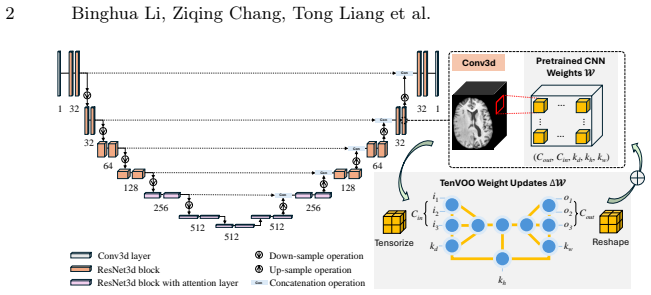
The load-bearing object is the tensor network $T_\theta$ in Eq. (5): a graph of small core tensors whose contractions produce the full 3D convolution update tensor $\Delta W$. TenVOO-L factorizes the input and output channel dimensions into products $C_{\mathrm{in}} = i_1 i_2 i_3$ and $C_{\mathrm{out}} = o_1 o_2 o_3$, then strands the spatial dimensions $k_d, k_h, k_w$ as separate legs so spatial information is carried by contraction rather than by a dense low-rank factor. TenVOO-Q instead assigns spatial dimensions to different cores in a QuanTA-style circuit. The rank $r$ sets the parameter count and, the ablation suggests, the representational capacity; the paper fixes $r=4$ for the main experiments. Initialization keeps the update at zero by subtracting a frozen copy of the initial tensor network, following QuanTA's routine.
What would settle it
Train TenVOO on a synthetic 3D convolution task where the correct update is a known rank-8 kernel, such as a depth shift combined with channel mixing. If the model's loss or structural similarity plateaus below an unconstrained fine-tune at matched data and budget, the rank-4 constraint, not the tensor-network idea, is the active limit.
Extended reading notes
Core claim
The central claim is that a tensor-network parameterization of 3D convolution weight updates—called the Tensor Volumetric Operator—can serve as a parameter-efficient fine-tuning mechanism for U-Net-based DDPMs. For each 3D convolutional layer, TenVOO writes the update as $\Delta W = \mathrm{reshape}(T_\theta(t_1,\ldots,t_k), [C_{\mathrm{out}}, C_{\mathrm{in}}, k_d, k_h, k_w])$, where $T_\theta$ is a tensor network built from small core tensors. Two variants are given: TenVOO-L, which tensorizes the channel dimensions and keeps spatial dimensions separate, and TenVOO-Q, an extension of the QuanTA structure that assigns spatial dimensions to different cores. Fine-tuning updates only the core tensors. The paper reports that on three downstream brain MRI datasets—an Alzheimer's cohort, a Parkinson's cohort, and a brain-tumor cohort—TenVOO matches or improves FID/MMD and achieves the highest MS-SSIM among the tested PEFT methods, with 0.58–0.60 million trainable parameters versus 166.67 million for full fine-tuning.
Load-bearing premise
The load-bearing premise is that the chosen tensor-network layout with rank 4 can express the 3D-convolution adjustments each dataset needs; the paper does not prove this, and its own ablation shows structural similarity still rising at higher ranks.
Editorial extensions
If this is right
- One pretrained 3D brain-MRI diffusion model can be reused across many clinical datasets by storing only small tensor cores per task, cutting per-task storage from hundreds of millions of parameters to under a million.
- Tensor-network adapters can express spatial structure that plain low-rank LoRA misses, making them a natural fit for convolutional backbones where low-rank updates are too rigid.
- Because the update is an additive correction, the fine-tuned weights can be merged back into the pretrained model at inference, so the adapted model runs at the same speed as the original.
- The same decomposition applies to any 3D convolutional layer, so the method generalizes beyond MRI to other 3D generative and medical-imaging models.
Reading between the lines
- Beyond the paper, the rank-4 ceiling is the most likely failure point: the paper's own rank ablation shows MS-SSIM still climbing at rank 6, so on tasks demanding larger convolution shifts a rank-4 network may underperform.
- Beyond the paper, TenVOO's largest gains appear on the dataset most distant from the pretraining distribution, suggesting tensor-network adapters help most when adaptation requires structural rather than intensity-level changes.
- Beyond the paper, because the decomposition places each spatial dimension on its own leg, the same construction extends to 4D data or to latent-space generators, with parameter growth roughly linear in the number of added dimensions at fixed rank.
Editorial analysis
A structured set of objections, weighed in public.
Referee Report
Summary. The paper proposes TenVOO, a parameter-efficient fine-tuning (PEFT) method for 3D U-Net-based denoising diffusion probabilistic models (DDPMs) in MRI image generation. TenVOO represents each 3D convolution weight update as a tensor network (TenVOO-L and TenVOO-Q variants), with an initialization scheme that keeps the initial effective update at zero, and it also applies QuanTA-style updates to linear layers. The method is evaluated by fine-tuning a DDPM pretrained on 59,830 UK Biobank scans on three downstream datasets (ADNI, PPMI, BraTS2021), comparing FID, MMD, and MS-SSIM against LoRA, LoKr, LoHa, and full fine-tuning. The paper claims state-of-the-art MS-SSIM performance with only about 0.3% of the original model's trainable parameters, and the ablation study examines the effect of tensor rank on parameter count and MS-SSIM.
Significance. If the empirical claims are substantiated, TenVOO would be a useful demonstration that tensor-network-structured updates can capture spatial dependencies in 3D medical image generation more effectively than low-rank baselines at a lower parameter count. The paper is, to my knowledge, the first to apply tensor-network PEFT to 3D DDPMs for MRI, and it ships a public code link, which is a concrete strength. However, the evidence as presented is mixed: the method does not consistently outperform baselines on FID/MMD, its MS-SSIM advantage is not accompanied by a specification of how the metric is computed in an unconditional generation setting, and there are no error bars or multiple-seed results. The central claim is therefore defensible but not yet established.
major comments (5)
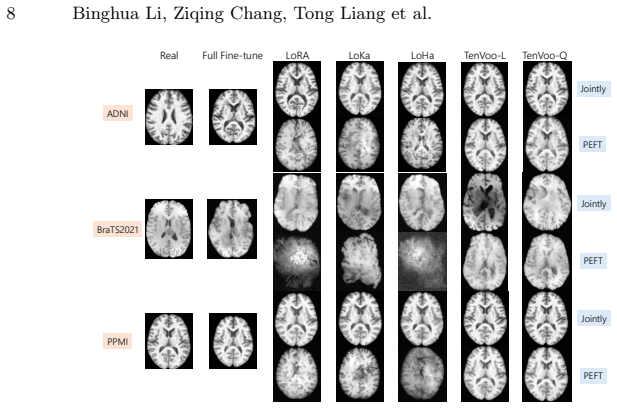
- [Section 3.1, Table 1] The MS-SSIM evaluation protocol is not specified. MS-SSIM is a full-reference metric and the paper never states how generated volumes are paired with real volumes when the DDPM is unconditional. Without this pairing rule, the reported MS-SSIM values cannot be interpreted, and the observed profile (e.g., TenVOO-L on ADNI and PPMI having worse FID but better MS-SSIM than LoRA) is exactly what an over-smoothed 'average brain' output would produce. Please specify the pairing rule (e.g., random pairing, nearest-neighbor in some embedding, or per-real-volume matching) and, ideally, include a smoothing baseline to show that the MS-SSIM gain is not simply a smoothness artifact.
- [Tables 1 and 2] There are no error bars or multiple-seed runs, so the reported improvements cannot be distinguished from training noise. For example, TenVOO-L's ADNI MS-SSIM of 0.663 is below Full-FT's 0.701, TenVOO-Q's PPMI FID of 19.585 is worse than LoRA's 14.609, and the BraTS2021 MS-SSIM differences are large but based on a single run. Please report means and standard deviations over at least three seeds, or otherwise justify why single-run numbers support the stated conclusions.
- [Section 3.2, Figure 4(b)] The rank ablation does not support the choice of rank 4. Figure 4(b) shows MS-SSIM continuing to increase as rank goes from 4 to 6, with no plateau, so the reported configuration is a capacity ceiling rather than a converged optimum. The text says 'We set tensor rank as 4 and constrain our TenVOO to have the least number of trainable parameters,' but this conflates a chosen hyperparameter with an optimized one. Please either justify rank 4 as a deliberate trade-off with evidence that higher ranks do not change the conclusions, or report results at a rank where performance saturates.
- [Abstract and Section 3.2] The claim of 'state-of-the-art performance in MS-SSIM' is overstated. In Table 1, Full-FT achieves MS-SSIM 0.701 on ADNI, higher than TenVOO-L's 0.663, and TenVOO-Q's ADNI MS-SSIM of 0.504 is below LoRA's 0.511. The statement is only defensible if restricted to 'state-of-the-art among PEFT baselines,' and even then it must be reconciled with the fact that FID and MMD are not consistently favorable (e.g., TenVOO-L ADNI FID 17.349 vs LoRA 16.794; TenVOO-L PPMI FID 16.605 vs LoRA 14.609). Please qualify the claim and discuss the metric-dependent nature of the results.
- [Section 3.1] The BraTS2021 evaluation uses only 327 of 1,251 training samples after filtering 'based on visual quality,' following reference [11]. This subjective filter could bias results, and BraTS2021 is precisely the dataset where TenVOO shows its largest improvements. Please specify the exact filtering criteria, report how many samples were excluded for each reason, and ideally show that the main conclusions are robust to including the unfiltered set or to using a principled exclusion rule.
minor comments (5)
- [Section 3.2] The sentence 'Notably, we observe that TenVOOs yield much lower FID and MMD scores on PPMI' contradicts Table 1, where TenVOO-L has PPMI FID 16.605 versus LoRA's 14.609 and TenVOO-Q has FID 19.585. Please correct this statement.
- [Equation (6)] The notation 'r2', 'r3', 'r4' in Eq. (6) should be written as r^2, r^3, r^4 to avoid ambiguity, and the parameter-count expressions would benefit from a derivation or a worked example for one layer.
- [Section 2.1] There are minor typos in the text, including 'backword process' and 'covolution'; please proofread for these and similar errors.
- [Section 2.4] The initialization in Eq. (8) is clear, but the sentence 'Here only core tensors {t_i^(0)} in ∆W are updated' is confusing because ∆W is defined as the full TN and the frozen copy is Tbar. Please clarify that t_i are the trainable cores and Tbar is frozen.
- [Figure 2] The caption uses inconsistent capitalization ('TenVoo-L' vs 'TenVOO-L'); also, panel (b) is referred to as 'LoRA 3D' but the text calls it 'LoCon' from Lycoris; please make the terminology consistent.
Circularity Check
No circularity: TenVOO's claims are parameterization definitions plus externally benchmarked empirical results.
full rationale
The paper's derivation chain consists of parameterization definitions (Eqs. 5-8) followed by empirical comparisons. There is no fitted parameter that is later relabeled as a prediction; the tensor rank r=4 is a hyperparameter, and the ablation in Fig. 4b explicitly varies it, which is the opposite of fitting it to the target metric. The only external load-bearing ingredient is QuanTA's initialization, and that is cited to external prior work rather than to this paper's own results. Numeric claims (Table 1) are held-out empirical benchmarks against independent baselines. Concerns about the unspecified MS-SSIM pairing protocol in unconditional generation are evaluation validity issues, not circularity; they affect how much weight the SOTA claim carries but do not make the derivation reduce to its inputs.
Assumptions & free parameters
free parameters (3)
- Tensor rank r =
4
- Learning rate =
0.00005
- BraTS2021 visual quality filter =
327 of 1,251 training scans retained
assumptions (6)
- standard math DDPM forward and reverse process equations (1)-(2) are adopted without modification.
- domain assumption A TN-parameterized ΔW can be reshaped into a 3D convolution kernel and the sum W+ΔW captures the needed adaptation.
- ad hoc to paper The chosen initialization with a frozen copy of the TN maintains stable fine-tuning.
- domain assumption MS-SSIM between generated and reference scans is a valid proxy for capturing spatial dependencies.
- domain assumption Med3D embeddings provide a meaningful feature space for FID and MMD in these MRI datasets.
- domain assumption All datasets are preprocessed to the same MNI152 space and resolution, making voxel-level comparisons valid.
Cite this review
Pith. "Pith review of Parameter-Efficient Fine-Tuning of 3D DDPM for MRI Image Generation Using Tensor Networks." pith.science (2026). https://pith.science/paper/5BAE7UPR
@misc{pith2026250718112,
  author       = {Pith},
  title        = {Pith review of: Parameter-Efficient Fine-Tuning of 3D DDPM for MRI Image Generation Using Tensor Networks},
  year         = {2026},
  howpublished = {\url{https://pith.science/paper/5BAE7UPR}},
  note         = {Machine review of arXiv:2507.18112}
}
read the original abstract
We address the challenge of parameter-efficient fine-tuning (PEFT) for three-dimensional (3D) U-Net-based denoising diffusion probabilistic models (DDPMs) in magnetic resonance imaging (MRI) image generation. Despite its practical significance, research on parameter-efficient representations of 3D convolution operations remains limited. To bridge this gap, we propose Tensor Volumetric Operator (TenVOO), a novel PEFT method specifically designed for fine-tuning DDPMs with 3D convolutional backbones. Leveraging tensor network modeling, TenVOO represents 3D convolution kernels with lower-dimensional tensors, effectively capturing complex spatial dependencies during fine-tuning with few parameters. We evaluate TenVOO on three downstream brain MRI datasets-ADNI, PPMI, and BraTS2021-by fine-tuning a DDPM pretrained on 59,830 T1-weighted brain MRI scans from the UK Biobank. Our results demonstrate that TenVOO achieves state-of-the-art performance in multi-scale structural similarity index measure (MS-SSIM), outperforming existing approaches in capturing spatial dependencies while requiring only 0.3% of the trainable parameters of the original model. Our code is available at: https://github.com/xiaovhua/tenvoo
Figures

Figures from the paper (1 more)

Forward citations
Cited by 1 Pith paper
-
GUST: Quantifying Free-Form Geometric Uncertainty of Metamaterials Using Small Data
GUST combines synthetic-data pretraining with transfer learning on a conditional diffusion model to quantify free-form geometric uncertainty in manufactured metamaterials from small real-world datasets.
Reference graph
Works this paper leans on
-
[11]
IEEE Journal of Biomedical and Health Informatics (2024)
Dorjsembe, Z., Pao, H.K., Odonchimed, S., Xiao, F.: Conditional diffusion models for semantic 3D brain MRI synthesis. IEEE Journal of Biomedical and Health Informatics (2024)
work page 2024
- [1]
-
[2]
arXiv preprint arXiv:2107.02314 (2021)
Baid, U., Ghodasara, S., Mohan, S., Bilello, M., Calabrese, E., Colak, E., Fara- hani, K., Kalpathy-Cramer, J., Kitamura, F.C., Pati, S., et al.: The RSNA-ASNR- MICCAI BraTS 2021 benchmark on brain tumor segmentation and radiogenomic classification. arXiv preprint arXiv:2107.02314 (2021)
arXiv 2021
-
[3]
arXiv preprint arXiv:2402.01376 (2024)
Bershatsky, D., Cherniuk, D., Daulbaev, T., Mikhalev, A., Oseledets, I.: LoTR: Low tensor rank weight adaptation. arXiv preprint arXiv:2402.01376 (2024)
arXiv 2024
-
[4]
Burton, E.J., McKeith, I.G., Burn, D.J., Williams, E.D., O’Brien, J.T.: Cerebral atrophy in Parkinson’s disease with and without dementia: a comparison with Alzheimer’s disease, dementia with lewy bodies and controls. Brain127(4), 791– 800 (2004)
work page 2004
-
[5]
arXiv preprint arXiv:2211.02701 (2022)
Cardoso, M.J., Li, W., Brown, R., Ma, N., Kerfoot, E., Wang, Y., Murrey, B., Myronenko, A., Zhao, C., Yang, D., et al.: MONAI: An open-source framework for deep learning in healthcare. arXiv preprint arXiv:2211.02701 (2022)
arXiv 2022
-
[6]
arXiv preprint arXiv:2306.07967 (2023)
Chavan, A., Liu, Z., Gupta, D., Xing, E., Shen, Z.: One-for-all: Generalized LoRA for parameter-efficient fine-tuning. arXiv preprint arXiv:2306.07967 (2023)
arXiv 2023
-
[7]
arXiv preprint arXiv:1904.00625 (2019)
Chen, S., Ma, K., Zheng, Y.: Med3D: Transfer learning for 3D medical image analysis. arXiv preprint arXiv:1904.00625 (2019)
arXiv 2019
Show all 34 references
-
[8]
In: NeurIPS (2024),https://openreview.net/forum?id=EfpZNpkrm2
Chen, Z., Dangovski, R., Loh, C., Dugan, O.M., Luo, D., Soljacic, M.: QuanTA: Efficient high-rank fine-tuning of LLMs with quantum-informed tensor adaptation. In: NeurIPS (2024),https://openreview.net/forum?id=EfpZNpkrm2
2024
-
[9]
IEEE Transactions on Medical Imaging42(4), 922– 934 (2022)
Chung, H., Lee, E.S., Ye, J.C.: MR image denoising and super-resolution using regularized reverse diffusion. IEEE Transactions on Medical Imaging42(4), 922– 934 (2022)
2022
-
[10]
arXiv preprint arXiv:1407.3124 (2014)
Cichocki, A.: Tensor networks for big data analytics and large-scale optimization problems. arXiv preprint arXiv:1407.3124 (2014)
2014 arXiv
-
[12]
arXiv preprint arXiv:2212.10650 (2022) 10 Binghua Li, Ziqing Chang, Tong Liang et al
Edalati, A., Tahaei, M., Kobyzev, I., Nia, V.P., Clark, J.J., Rezagholizadeh, M.: Krona: Parameter efficient tuning with Kronecker adapter. arXiv preprint arXiv:2212.10650 (2022) 10 Binghua Li, Ziqing Chang, Tong Liang et al
2022 arXiv
-
[13]
Gigascience 13, giae049 (2024)
Gaser, C., Dahnke, R., Thompson, P.M., Kurth, F., Luders, E., Initiative, A.D.N., et al.: CAT: a computational anatomy toolbox for the analysis of structural MRI data. Gigascience 13, giae049 (2024)
2024
-
[14]
The Journal of Machine Learning Research13(1), 723–773 (2012)
Gretton, A., Borgwardt, K.M., Rasch, M.J., Schölkopf, B., Smola, A.: A kernel two-sample test. The Journal of Machine Learning Research13(1), 723–773 (2012)
2012
-
[15]
In: ISBI
Guo, X., Yang, Y., Ye, C., Lu, S., Peng, B., Huang, H., Xiang, Y., Ma, T.: Acceler- ating diffusion models via pre-segmentation diffusion sampling for medical image segmentation. In: ISBI. pp. 1–5. IEEE (2023)
2023
-
[16]
In: NeurIPS (2017)
Heusel, M., Ramsauer, H., Unterthiner, T., Nessler, B., Hochreiter, S.: GANs trained by a two time-scale update rule converge to a local Nash equilibrium. In: NeurIPS (2017)
2017
-
[17]
In: NeurIPS
Ho, J., Jain, A., Abbeel, P.: Denoising diffusion probabilistic models. In: NeurIPS. pp. 6840–6851 (2020)
2020
-
[18]
In: ICML
Houlsby, N., Giurgiu, A., Jastrzebski, S., Morrone, B., De Laroussilhe, Q., Ges- mundo, A., Attariyan, M., Gelly, S.: Parameter-efficient transfer learning for NLP. In: ICML. pp. 2790–2799. PMLR (2019)
2019
-
[19]
In: ICLR (2022),https: //openreview.net/forum?id=nZeVKeeFYf9
Hu, E.J., Shen, Y., Wallis, P., Allen-Zhu, Z., Li, Y., Wang, S., Wang, L., Chen, W.: LoRA: Low-rank adaptation of large language models. In: ICLR (2022),https: //openreview.net/forum?id=nZeVKeeFYf9
2022
-
[20]
arXiv preprint arXiv:2108.06098 (2021)
Hyeon-Woo, N., Ye-Bin, M., Oh, T.H.: Fedpara: Low-rank hadamard product for communication-efficient federated learning. arXiv preprint arXiv:2108.06098 (2021)
2021 arXiv
-
[21]
Journal of Magnetic Res- onance Imaging 27(4), 685–691 (2008)
Jack Jr, C.R., Bernstein, M.A., Fox, N.C., Thompson, P., Alexander, G., Harvey, D., Borowski, B., Britson, P.J., Whitwell, J.L., Ward, C., et al.: The Alzheimer’s disease neuroimaging initiative (ADNI): MRI methods. Journal of Magnetic Res- onance Imaging 27(4), 685–691 (2008)
2008
-
[22]
In: AAAI
Jie, S., Deng, Z.H.: Fact: Factor-tuning for lightweight adaptation on vision trans- former. In: AAAI. vol. 37, pp. 1060–1068 (2023)
2023
-
[23]
arXiv preprint arXiv:1412.6980 (2014)
Kingma, D.P., Ba, J.: Adam: A method for stochastic optimization. arXiv preprint arXiv:1412.6980 (2014)
2014 arXiv
-
[24]
Progress in Neurobiology95(4), 629–635 (2011)
Marek, K., Jennings, D., Lasch, S., Siderowf, A., Tanner, C., Simuni, T., Coffey, C., Kieburtz, K., Flagg, E., Chowdhury, S., et al.: The Parkinson progression marker initiative (PPMI). Progress in Neurobiology95(4), 629–635 (2011)
2011
-
[25]
Journal of Neurology, Neurosurgery & Psychiatry 83(2), 188–194 (2012)
Melzer, T.R., Watts, R., MacAskill, M.R., Pitcher, T.L., Livingston, L., Keenan, R.J., Dalrymple-Alford, J.C., Anderson, T.J.: Grey matter atrophy in cognitively impaired Parkinson’s disease. Journal of Neurology, Neurosurgery & Psychiatry 83(2), 188–194 (2012)
2012
-
[26]
In: ISBI
Packhäuser, K., Folle, L., Thamm, F., Maier, A.: Generation of anonymous chest radiographs using latent diffusion models for training thoracic abnormality classi- fication systems. In: ISBI. pp. 1–5. IEEE (2023)
2023
-
[27]
In: MICCAI Workshop
Pinaya, W.H., Tudosiu, P.D., Dafflon, J., Da Costa, P.F., Fernandez, V., Nachev, P., Ourselin, S., Cardoso, M.J.: Brain imaging generation with latent diffusion models. In: MICCAI Workshop. pp. 117–126. Springer (2022)
2022
-
[28]
In: MICCAI
Ronneberger, O., Fischer, P., Brox, T.: U-net: Convolutional networks for biomed- ical image segmentation. In: MICCAI. pp. 234–241. Springer (2015)
2015
-
[29]
In: ICML
Sohl-Dickstein, J., Weiss, E., Maheswaranathan, N., Ganguli, S.: Deep unsuper- vised learning using nonequilibrium thermodynamics. In: ICML. pp. 2256–2265. PMLR (2015)
2015
-
[30]
PLoS medicine 12(3), e1001779 (2015)
Sudlow, C., Gallacher, J., Allen, N., Beral, V., Burton, P., Danesh, J., Downey, P., Elliott, P., Green, J., Landray, M., et al.: UK biobank: an open access resource for TenVOO: PEFT of 3D DDPM for MRI Image Generation Using TNs 11 identifying the causes of a wide range of com...
2015
-
[31]
In: Asilomar Conference on Signals, Systems & Computers
Wang, Z., Simoncelli, E.P., Bovik, A.C.: Multiscale structural similarity for image quality assessment. In: Asilomar Conference on Signals, Systems & Computers. vol. 2, pp. 1398–1402. IEEE (2003)
2003
-
[32]
In: MIDL
Wu, J., Fu, R., Fang, H., Zhang, Y., Yang, Y., Xiong, H., Liu, H., Xu, Y.: Med- segdiff: Medical image segmentation with diffusion probabilistic model. In: MIDL. pp. 1623–1639. PMLR (2024)
2024
-
[33]
In: ICLR (2024), https://openreview.net/forum?id=wfzXa8e783
Yeh, S.Y., Hsieh, Y.G., Gao, Z., Yang, B.B., Oh, G., Gong, Y.: Navigating text- to-image customization: From lyCORIS fine-tuning to model evaluation. In: ICLR (2024), https://openreview.net/forum?id=wfzXa8e783
2024
-
[34]
arXiv preprint arXiv:2106.10199 (2021)
Zaken, E.B., Ravfogel, S., Goldberg, Y.: Bitfit: Simple parameter-efficient fine-tuning for transformer-based masked language-models. arXiv preprint arXiv:2106.10199 (2021)
2021
Reviewed August 6, 2026 · model on record in the stance chip above.
Discussion (0). Continue with ORCID to comment.