REVIEW 3 major objections 4 minor 64 references
Strange quark stars in mimetic gravitational theory
T0 review · 3 major / 4 minor · reviewed 2026-08-04 · deepseek-v4-flash
Pith's one-line read A strange quark star model in mimetic gravity, built from the Buchdahl metric and MIT bag equation of state, is claimed to satisfy energy conditions, TOV equilibrium with an extra force, and stability criteria.
desk verdict Routine Buchdahl quark-star model in mimetic gravity, but the mimetic constraint is never checked and the 'extra force' is invented; the central validation collapses. read the letter →
The pith
A machine-rendered reading of the paper's core claim, the machinery that carries it, and where it could break.
The reading
What carries the argument
The load-bearing pieces are the Buchdahl metric ansatz for g_tt, the MIT bag model equation of state, and the mimetic scalar field η = ∫ dr/√(e^i). The scalar field is meant to satisfy the mimetic constraint g^{αβ}∂_αη∂_βη = −1, which ties η to the metric; the Buchdahl ansatz supplies a non-singular, center-regular g_tt; the MIT bag EoS links pressure to density through the bag constant B; the junction conditions determine Ξ. Together they close the field equations so that ρ, pr, pt, and e^j can be computed.
What would settle it
Compute e^j(r) from the field equations for the chosen parameters and compare it with e^{-i(r)} over the stellar interior. Any interior radius where e^j differs from e^{-i} would violate the mimetic scalar constraint, eliminating the configuration as a mimetic gravity solution.
Extended reading notes
Core claim
The central claim is that the Buchdahl metric potential e^i(r) = Σ(Ξr²+1)/(Σ+Ξr²), with Ξ fixed by junction conditions with the Schwarzschild exterior, together with the MIT-bag relation pr = (ρ−4B)/3, yields an anisotropic strange quark star solution in mimetic gravity. For the values of Σ and Ξ corresponding to the five candidate stars, the density and pressures remain positive, all energy conditions hold, the EoS parameters stay between 0 and 1, the modified TOV equation balances when a small extra mimetic force is included, the adiabatic index exceeds 4/3, the surface redshift stays below 2, and the squared sound speed lies between 0 and 1.
Load-bearing premise
The scalar field ansatz η = ∫ dr/√(e^i) satisfies the mimetic constraint only if e^{i+j}=1 everywhere, and the paper does not establish this for the interior Buchdahl metric; if e^j differs from e^{-i}, the resulting solution is not a solution of mimetic gravity.
Editorial extensions
If this is right
- If correct, mimetic gravity can reproduce observed pulsar-like compact object properties with strange quark matter without abandoning GR's successes at low density.
- The extra mimetic force FE that enters the TOV equation acts as an additional balancing agent, so stability analyses in mimetic gravity must include it.
- The Buchdahl metric function, used previously in other modified theories, transfers to mimetic gravity, suggesting a family of non-singular quark star models.
- The parameter Σ controls stability: the paper notes that larger Σ may destabilize near the core, implying an upper bound on Σ for physically admissible mimetic strange stars.
- These models predict surface redshift values below 2 and subluminal sound speeds that could be compared with future observational constraints.
Reading between the lines
- The mimetic constraint requires e^{i+j}=1, so the scalar field ansatz is consistent only if the computed e^j equals e^{-i} at every interior point; a direct numerical check of this equality would settle whether the solution genuinely belongs to mimetic gravity rather than to GR with an auxiliary scalar.
- A natural extension would be to test other non-singular metric potentials, such as Kuchowicz or Durgapal–Fuloria forms, in the same mimetic framework; the current work indicates the machinery transfers once the constraint is handled rigorously.
- Mapping the allowed (Σ, B) region from the stability bounds could yield an exclusion curve for strange quark stars in mimetic gravity.
- Since TOV equilibrium requires a small extra force, future work could seek an analytic expression for FE in terms of the mimetic scalar and check whether its magnitude is tied to dark-matter-like effects.
Editorial analysis
A structured set of objections, weighed in public.
Referee Report
Summary. The paper constructs anisotropic strange quark star models in mimetic gravity, using a Buchdahl-type metric potential and the MIT bag equation of state. The interior Buchdahl metric is matched to the exterior Schwarzschild spacetime, and the field equations are solved numerically for several candidate stars (PSR J1614−2230, 4U 1608−52, etc.). The authors then verify energy conditions, EoS parameters, TOV equilibrium with an added 'extra force', adiabatic stability, surface redshift, and causality. The central claim is that the Buchdahl metric plus MIT bag EoS yields a physically valid and stable strange quark star configuration in mimetic gravity.
Significance. If the construction were valid, it would provide a new family of quark star solutions in mimetic gravity and extend the literature on non-singular compact star models in modified gravity. The paper does provide explicit matching conditions and numerical plots for several physical quantities, which is a useful template. However, the central validation is not sound: the mimetic scalar field ansatz is not shown to satisfy the defining constraint of the theory, and the TOV equilibrium is enforced by an unexplained extra force rather than derived from the field equations. As a result, the paper does not currently establish that the presented configuration is a solution of mimetic gravity, nor does it provide a testable prediction.
major comments (3)
- [Section 2, Eqs. (2), (6), (16)] The scalar field choice η=∫1/√(e^i)dr is claimed to satisfy the mimetic constraint (2), but this is not shown. For the diagonal metric (6), g^{αβ}∂_αη∂_βη = -e^{-j}(η')² = -e^{-(i+j)}. The constraint (2) therefore requires e^{i+j}=1, i.e., j(r)=-i(r) for all r. The paper only imposes the matching condition e^j(R)=e^{-i}(R) at the surface, while j(r) is obtained by integrating (7)–(8) with the MIT bag EoS. No interior relation j=-i is derived or checked. If j≠-i in the interior, the solution does not belong to mimetic gravity; if j=-i is enforced, the analysis below shows a negative central density. This is the central defect of the paper.
- [Section 4.3, Eq. (21)] The modified TOV equation (21) introduces an 'extra force' F_E without any derivation from the mimetic field equations (4) or (7)–(9). The term is not present in the field equations, and no explicit expression for F_E is given. The subsequent statement that 'without the extra force, solutions seem to be unstable, however introducing a small positive extra force renders them stable' is circular: F_E is evidently chosen to make the balance equation (21) hold. A stability test whose central ingredient is an unconstrained free function does not validate the model. The authors must derive F_E from the conservation of the effective energy-momentum tensor in mimetic gravity, or demonstrate that (21) follows from (4); otherwise the TOV analysis is an assumption, not a test.
- [Section 2, Eq. (7) and Section 4.1] Even if one attempted to enforce the mimetic constraint by setting j=-i, the resulting central energy density is negative. With e^i = Σ(1+Ξr²)/(Σ+Ξr²) and the small-r expansion e^i ≈ 1 + [Ξ(Σ-1)/Σ]r², Eq. (7) gives 8πρ(0) = -3Ξ(Σ-1)/Σ. For Ξ<0 (as stated below Eq. (15)) and 0<Σ<1, this is negative. This contradicts the weak energy condition and the positive ρ+p_r, ρ+p_t plots in Figures 3–4. Thus the scalar ansatz (16) either violates the mimetic constraint or forces a negative central density; the energy-condition figures are therefore not derived from a valid mimetic solution.
minor comments (4)
- [Section 5.1] The stability criterion is stated inconsistently: 'the adiabatic index must not exceed 4/3' is immediately followed by 'Γ > 4/3 within the stellar interior confirms adiabatic stability.' The standard condition is Γ > 4/3, and the plotted values (≈1.8–1.95) satisfy it. Please correct the wording and cite the standard criterion consistently.
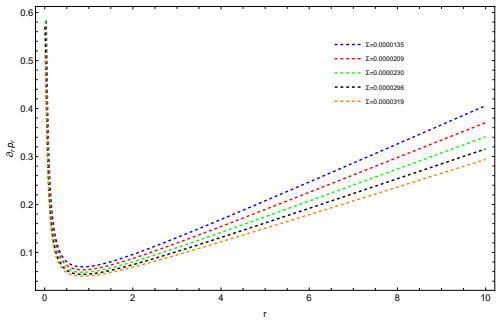
- [Figure 18 / Section 5.3] The speed-of-sound plot axis label is garbled, and the values shown seem inconsistent with the MIT bag EoS pr=(ρ-4B)/3, which gives dpr/dρ=1/3 identically. If the numerical solution does not exactly satisfy the MIT bag EoS, this should be stated explicitly; otherwise the figure and the claim of a 0-to-1 range are misleading.
- [Various] There are numerous typographical and formatting errors (e.g., 'spactime', incomplete reference [2], garbled equation lines in Eqs. (8)–(9), and the unlabeled vertical line in Figure 1). These should be corrected in a revision.
- [Section 4.3, Eq. (22)] The definitions of F_H, F_A, F_G are given, but F_E is not defined or given units. A precise definition and its physical origin are necessary for reproducibility.
Circularity Check
The TOV-equilibrium validation is a fitted residual (F_E balances the equation by construction), and the mimetic constraint is asserted for the η ansatz rather than verified; the physical-validity checks therefore do not independently test the model.
-
self definitional
[Sec. 2, Eq. (16) and discussion following Eq. (2)]
"Now we choose a scalar field form which would satisfy equation (2), that is given by η = ∫ 1√ ei dr."
For the line element (6), the mimetic constraint (2) reads g^{rr}(η')^2 = -e^{-(i+j)} = -1, i.e. e^{i+j}=1 throughout the interior. The chosen η' = e^{-i/2} makes the constraint equivalent to j(r) = -i(r). The paper never enforces or verifies this inside the star: e^j is integrated from Eqs. (7)-(8) using only the surface condition e^j(R)=e^{-i}(R), and no interior identity j=-i is shown. At r=0 the identity fails with the quoted parameters: using (10) and (15), j=-i would give 8πρ(0)=3Ξ(Σ-1)/Σ < 0 for Ξ<0 and 0<Σ<1, contradicting the WEC plots. Thus the mimetic constraint is not a derived consequence but a definitional input that is inconsistent with the reported solution.
-
fitted input called prediction
[Sec. 4.3, Eq. (21) and the paragraph defining F_E]
"The equation differs from the standard TOV equilibrium due to the additional force FE which is crucial for accurately modeling the stable quark star configurations in mimetic gravity. Equilibrium is ensured by the extra force term in the modified equations... Without the extra force, solutions seem to be unstable, however introducing a small positive extra force renders them stable."
F_E is introduced in Eq. (21) without any expression derived from the mimetic field equations (4). After F_H, F_A, and F_G are computed from the ansatz, Eq. (21) simply defines F_E as the negative of the other three terms, so the equilibrium condition is satisfied identically by construction. The paper then presents the resulting balance as a validation of stability, but it is a restatement of the fitted residual: the 'extra force' is chosen precisely to make the TOV sum zero, and stability is not an independent prediction. This is a fitted input renamed as a consistency check.
full rationale
The paper is not circular in the strongest sense: it does not merely rename a known result, and the energy-condition profiles are computed from the field equations rather than being adopted as inputs. However, two load-bearing steps make the central validation partly self-fulfilling. First, the scalar field ansatz (16) is declared to satisfy the mimetic constraint (2), but for the metric (6) that claim is equivalent to imposing e^{i+j}=1; the paper integrates e^j without enforcing this interior relation, and the small-r limit shows the relation would force a negative central density. The model's status as a mimetic solution is therefore asserted by definition rather than demonstrated. Second, the modified TOV equation (21) includes an extra force F_E with no independent formula; 'equilibrium' is guaranteed by construction, so the stability conclusion in Figs. 13-15 reduces to the choice of F_E. Self-citations in the references are contextual and not load-bearing; the adiabatic-index and sound-speed checks inherit the constructed quantities, and the reported values (e.g. Γ≈1.8-1.95) appear inconsistent with the MIT-bag EoS fixing dpr/dρ=1/3, which is an additional internal inconsistency rather than a separate circularity. Overall, the claimed validation is partially circular because the TOV test is fitted by definition and the mimetic constraint is an unverified input, warranting a score of 6.
Assumptions & free parameters
free parameters (2)
- Σ (Buchdahl metric parameter) =
1.35e-5, 2.09e-5, 2.30e-5, 2.96e-5, 3.19e-5
- Extra force F_E in TOV equation =
unspecified 'small positive'
assumptions (4)
- domain assumption Mimetic field equations (4) and constraint (2) from Chamseddine-Mukhanov
- domain assumption MIT bag equation of state pr = (ρ - 4B)/3 (Eq. 19)
- ad hoc to paper Scalar field choice η = ∫ 1/√(e^i) dr satisfies Eq. (2)
- ad hoc to paper Existence of extra force F_E in TOV equilibrium
invented entities (1)
-
Extra force F_E
Cite this review
Pith. "Pith review of Strange quark stars in mimetic gravitational theory." pith.science (2026). https://pith.science/paper/5DJUHPJO
@misc{pith2026250910583,
  author       = {Pith},
  title        = {Pith review of: Strange quark stars in mimetic gravitational theory},
  year         = {2026},
  howpublished = {\url{https://pith.science/paper/5DJUHPJO}},
  note         = {Machine review of arXiv:2509.10583}
}
read the original abstract
This paper presents a novel anisotropic quark star model in the backdrop of mimetic gravitational theory. Our study focuses on the strange quark stars using the MIT bag equation of state (EoS) admitting non-singular Buchdahl metric function. The proposed model matches the interior spacetime of the strange quark star with the exterior Schwarzschild spacetime. Our analysis of the energy conditions, radial and tangential EoSs along with the energy momentum tensor gradients and TOV equilibrium condition analysis support the model's physical validity. Further study of adiabatic index, surface redshift function and speed of sound analysis have demonstrated the stability of the strange quark star in mimetic gravity. Thus, we can say that the model stability and consistency have been validated for various parameter values of the Buchdahl function throughout our study in the context of mimetic gravity.
Figures


Figures from the paper (15 more)




Reference graph
Works this paper leans on
-
[1]
Akiyama, et al., Event Horizon Telescope, Astrophys
K. Akiyama, et al., Event Horizon Telescope, Astrophys. J. Lett . 875 (2019) L1, arXiv:1906.11238 [astro-ph.GA]
arXiv 2019
-
[2]
Abbott, et al., LIGO Scientific, Virgo, Phys
B.P. Abbott, et al., LIGO Scientific, Virgo, Phys. Rev. Lett. 116 0 61102 (2016), arXiv:1602.03837 [gr-qc]
arXiv 2016
-
[3]
A. H. Guth, Phy. Rev. D, 23, 347 (1981). 14
1981
-
[4]
Albrecht, and P
A. Albrecht, and P. J. Steinhardt, 1982, Phy. Rev. Lett, 48, 1 220 (1982)
1982
-
[5]
A. D. Linde, Phy. Lett. B, 108, 389 (1982)
1982
-
[6]
V. F. Mukhanov, and G. V. Chibisov, JETPL, 33, 532 (1981)
1981
-
[7]
S. W. Hawking, Phy. Lett. B, 115, 295 (1982)
1982
-
[8]
A. A. Starobinsky, Phy. Lett. B, 117, 175 (1982)
1982
Show all 64 references
-
[9]
M. W. Hossain, R. Myrzakulov, M. Sami, and E. N. Saridakis, Phy. R ev. D, 89, 123513 (2014)
2014
-
[10]
Martin, C
J. Martin, C. Ringeval, R. Trotta, and V. Vennin, JCAP, 2014, 0 39 (2014)
2014
-
[11]
A. G. Riess, A. V. Filippenko, P. Challis, AJ, 116, 1009 (1998)
1998
-
[12]
Perlmutter, G
S. Perlmutter, G. Aldering, R. A. Knop, et al., ApJ, 517, 565 (19 99)
-
[13]
P. A. R. Ade, R. A. Aghanim, M. Arnaud, et al., Astronomy and As trophysics, 594, A1 (2016)
2016
-
[14]
G. G. L. Nashed, MPLA, 22, 1047 (2007)
2007
-
[15]
Nojiri, and S
S. Nojiri, and S. D. Odintsov, Phy. Rev., 505, 59 (2011)
2011
-
[16]
Nojiri, S
S. Nojiri, S. D. Odintsov, and V. K. Oikonomou, 2017, Phy. Rev. , 692, 1 (2017)
2017
-
[17]
A. V. Astashenok, and S. D. Odintsov, MNRAS, 498, 3616 (202 0)
-
[18]
A. H. Chamseddine, and V. Mukhanov, JHEP, 11, 135 (2013)
2013
-
[19]
A. H. Chamseddine, and V. Mukhanov, EPJC, 77, 183 (2017)
2017
-
[20]
Sinha, S
M. Sinha, S. Sanasam. Behaviour of gravastar model in mimetic g ravity. Physica Scripta, Volume 100, 2025, 055012, 5 (2025). https://doi.org/10.1088/1402-48 96/adca5d
2025 doi
-
[21]
A. H. Chamseddine, and V. Mukhanov, JCAP, 1703, 009 (2017)
2017
-
[22]
A. H. Chamseddine, and V. Mukhanov, JHEP, 06, 060 (2018)
2018
-
[23]
S. D. Odintsov, and V. K. Oikonomou, Phys. Rev. D 93 023517 (2 016)
-
[24]
Zhong, and D
Y. Zhong, and D. S /acute.ts1aez-Chill/acute.ts1on G /acute.ts1omez, Symmetry. 10 170 (2018)
2018
-
[25]
Vagnozzi, Class
S. Vagnozzi, Class. Quantum Grav. 34 185006 (2018)
2018
-
[26]
Casalino, M
A. Casalino, M. Rinaldi, L. Sebastiani, and S. Vagnozzi, Class. Qua ntum Grav. 36 017001 (2018)
2018
-
[27]
S. L. Shapiro, S. A. Teukolsky, Black holes, white dwarfs, and n eutron stars: The physics of compact objects. Wiley, New York, p. 645 (1983)
1983
-
[28]
Psaltis, Living Rev
D. Psaltis, Living Rev. Rel. 11, 9 (2008). arXiv:0806.1531 [astrop h]
2008 arXiv
-
[29]
D. R. Lorimer, Living Rev. Rel. 11, 8 (2008). arXiv:0811.0762
2008 arXiv
-
[30]
Sinha, S
M. Sinha, S. Surendra Singh. Gravastar model in the structur e of f (R, Lm, T ) modi- fied theory of gravity, Modern Physics Letters A 40, 05n06, 2450 227, 0217-7323 (2025). doi:10.1142/S0217732324502274. 15
2025 doi
-
[31]
Sinha, and S
M. Sinha, and S. Surendra Singh. Cylindrical gravastars with Ku chowicz metric potential, Interna- tional Journal of Modern Physics A, 2550129, (2025). doi:10.1142 /S0217751X25501295
2025
-
[32]
Sinha, S
M. Sinha, S. Surendra Singh, A gravastar model with Durgapal— Fuloria metric potential, Annals of Physics, Volume 480, 170129, ISSN 0003-4916 (2025). https:/ /doi.org/10.1016/j.aop.2025.170129
2025
-
[33]
Ghosh, D
S. Ghosh, D. Shee, S. Ray, F. Rahaman, B. K. Guha, Gravasta rs with Kuchow- icz metric potential, Results in Physics, Volume 14, 102473, ISSN 221 1-3797, (2019). https://doi.org/10.1016/j.rinp.2019.102473
2019
-
[34]
Kettner, F
Ch. Kettner, F. Weber, M. K. Weigel et al., Phys. Rev. D 51, 144 0 (1995)
1995
-
[35]
M. Dey, I. Bombaci, J. Dey et al., Phys. Lett. B 438, 123 (1998)
1998
-
[36]
Witten, Phys
E. Witten, Phys. Rev. D 30, 272 (1984)
1984
-
[37]
A. R. Bodmer, Phys. Rev. D 4, 1601 (1971)
1971
-
[38]
Farhi, R.L
E. Farhi, R.L. Jaffe, Phys. Rev. D 30, 2379 (1984)
1984
-
[39]
O. E. Nicotra et al., Phys. Rev. D 74, 123001 (2006)
2006
-
[40]
Joshi, S
S. Joshi, S. Sau, S. Sanyal, JHEAp 30, 16 (2021)
2021
-
[41]
J. D. V. Arba˜ nil, C. V. Flores, C. H. Lenzi, J. M. Z. Pretel, Phys . Rev. D 107, 124016 (2023)
2023
-
[42]
I. G. Salako et al., Theor. Math. Phys. 208, 1299 (2021)
2021
-
[43]
J. M. Z. Pretel, T. Tangphati, A. Banerjee, Ann. Phys. 458, 1 69440 (2023)
2023
-
[44]
K. P. Das, A. Karmakar, U. Debnath. Color flavor locked stran ge stars in de Rham–Gabadadze–Tolley like massive gravity. Eur. Phys. J. C 84, 12 13 (2024). https://doi.org/10.1140/epjc/s10052-024-13556-1
2024 doi
-
[45]
Sinha, S
M. Sinha, S. S. Singh. Strange Quark Stars with Kuchowicz Metr ic Function in Modified Gravita- tional Theory. Int J Theor Phys 64, 197 (2025). https://doi.org/ 10.1007/s10773-025-06069-4
2025 doi
-
[46]
Panotopoulos, D
G. Panotopoulos, D. Vernieri, I. Lopes. Quark stars with isotr opic matter in Hoˇ rava gravity and Einstein–æther theory. Eur. Phys. J. C 80, 537 (2020). https:// doi.org/10.1140/epjc/s10052-020- 8105-5
2020 doi
-
[47]
Sokoliuk, S
O. Sokoliuk, S. Pradhan, P. K. Sahoo, A. Baransky. Buchdahl quark stars within f (Q) theory. The European Physical Journal Plus, 137(9), 1-15 (2022)
2022
-
[48]
Capozziello, J
S. Capozziello, J. Matsumoto, S. Nojiri, and S. D. Odintsov, Phy . Lett. B, 693, 198 (2010)
2010
-
[49]
E. A. Lim, I. Sawicki, and A. Vikman, JCAP, 05, 012 (2010)
2010
-
[50]
C. Gao, Y. Gong, X. Wang, and X. Chen, X, Phy. Lett. B, 702, 1 07 (2011)
2011
-
[51]
Kumar Prasad and J
A. Kumar Prasad and J. Kumar, Charged Analogues of Isotrop ic Compact Stars Model with Buchdahl Metric in General Relativity, Astrophys. Space Sci. 366, 26 (2021), arXiv:1910.10471 [physics.gen-ph]. 16
2021 arXiv
-
[52]
Chodos, R
A. Chodos, R. L. Jaffe, K. Johnson, C. B. Thorn, V. F. Weissko pf, Phys. Rev. D 9, 3471 (1974)
1974
-
[53]
Alcock, E
C. Alcock, E. Farhi, and A. Olinto, Strange Stars, ApJ 310, 261 (1986)
1986
-
[54]
Alcock and A
C. Alcock and A. Olinto, Exotic phases of hadronic matter and th eir astrophys- ical application, Annual Review of Nuclear and Particle Science 38, 16 1 (1988), https://doi.org/10.1146/annurev.ns.38.120188.001113
1988
-
[55]
Chakraborty, A
K. Chakraborty, A. Aziz, F. Rahaman, S. Ray. Quark matter s upported wormhole in third order Lovelock gravity. Chinese Journal of Physics, 83, 315-324 (2023 )
2023
-
[56]
Creminelli, M
P. Creminelli, M. A. Luty, A. Nicolis, and L. Senatore, Starting th e Universe: Stable Violation of the Null Energy Condition and Non-standard Cosmologies, JHEP 12, 080, arXiv:hep-th/0606090
-
[57]
Hochberg and M
D. Hochberg and M. Visser, Dynamic wormholes, anti-trapped s urfaces, and energy conditions, Phys. Rev. D 58, 044021 (1998), arXiv:gr-qc/9802046
1998 arXiv
-
[58]
J. R. Oppenheimer and G. M. Volkoff, On massive neutron cores, Phys. Rev. 55, 374 (1939)
1939
-
[59]
Ponce de Leon, Limiting configurations allowed by the energy c onditions, Gen
J. Ponce de Leon, Limiting configurations allowed by the energy c onditions, Gen. Relativ. Gravit 25, 1123 (1993)
1993
-
[60]
Rahaman, P
F. Rahaman, P. K. F. Kuhfittig, S. Ray, and N. Islam, Possible ex istence of wormholes in the galactic halo region, Eur. Phys. J. C 74, 2750 (2014), arXiv:1307.1237 [gr-q c]
2014 arXiv
-
[61]
R. C. Tolman, Static solutions of einstein’s field equations for sph eres of fluid, Phys. Rev. 55, 364 (1939)
1939
-
[62]
Chandrasekhar, Dynamical instability of gaseous masses ap proaching the schwarzschild limit in general relativity, Phys
S. Chandrasekhar, Dynamical instability of gaseous masses ap proaching the schwarzschild limit in general relativity, Phys. Rev. Lett. 12, 114 (1964)
1964
-
[63]
S. K. Maurya and S. D. Maharaj, Anisotropic fluid spheres of em bedding class one using Karmarkar condition, Eur. Phys. J. C 77, 328 (2017), arXiv:1702.04192 [physic s.gen-ph]
2017 arXiv
-
[64]
Heintzmann, W
H. Heintzmann, W. Hillebrandt, Astron. Astrophys. 38(1), p. 51-55 (1975). Research supported by the Deutsche Forschungsgemeinschaft. 38, 51 (1975). 17
1975
Reviewed August 4, 2026 · model on record in the stance chip above.
Discussion (0). Continue with ORCID to comment.