REVIEW 2 major objections 4 minor 54 references
Quantum Mechanics of Particle on a torus knot: Curvature and Torsion Effects
T0 review · 2 major / 4 minor · reviewed 2026-08-14 · deepseek-v4-flash
Pith's one-line read A particle confined to a torus knot feels the knot's winding number in its energy spectrum.
desk verdict Worth a look for the GIP curvature/torsion computation on a torus knot, but the central cancellation identity is false and the advertised spectrum is unsupported. read the letter →
The pith
A machine-rendered reading of the paper's core claim, the machinery that carries it, and where it could break.
The reading
What carries the argument
The central object is the effective Hamiltonian of the geometry-induced potential approach, $\hat{H}_{\mathrm{eff}}=-(\hbar^2/2m)(\nabla_s^2+\kappa^2/4-\tau^2/2)$, applied to the torus-knot embedding. The derivation reparametrizes arc length to the angle $\varphi$ through $d\varphi/ds=1/(a\beta\sigma^2)$, writes the wavefunction as $\psi=\sigma(\varphi)G(\varphi)$ with $\sigma(\varphi)=1/\sqrt{b-\cos(\alpha\varphi)}$, and relies on the identity that the metric term plus the curvature term equals the constant $\Gamma$ in (26)-(27), eliminating all $\varphi$-dependence from the geometric part of the equation. That reduction produces the Hill equation, and in the thin-torus limit the Mathieu equation (31); periodic boundary conditions fix the fractional order $\nu=2n/q$ and lead to the energy eigenvalues (33).
What would settle it
Substitute the paper's own expressions (19) for $\kappa^2/4$ and (25) for $(\sigma\sigma''-2\sigma'^2)/\sigma^2$ into the left side of (26) with $\alpha=3/2$ and $b=2$. At $\cos(\alpha\varphi)=0$ the sum is about $0.338$ and at $\cos(\alpha\varphi)=1$ about $0.097$, while the claimed $\Gamma$ is about $0.384$; these three numbers disagree, so the identity fails for this parameter choice.
Extended reading notes
Core claim
The paper's central claim is that a spinless particle constrained to move on a torus knot acquires a geometry-induced potential—specifically the $\kappa^2/4$ curvature term (and, before it is dropped, the $-\tau^2/2$ torsion term)—which earlier treatments of a particle on a knot omitted. In the large-winding-number, thin-torus regime the torsion term is numerically subdominant, and the time-independent Schrödinger equation reduces to a Mathieu equation whose coefficients contain $\alpha=q/p$. Enforcing $2\pi p$ periodicity selects Mathieu functions of fractional order $\nu=2n/q$ and yields the energy formula (33), so the knot's shape enters the spectrum through both $p$ and $q$. A second claim is that the geometric terms combine into the $\varphi$-independent constant $\Gamma=(b^2+\alpha^4-1)/(4(b^2+\alpha^2-1))$, which the authors call a topological invariant. If these claims are correct, knottedness is not erased by taking the thin-torus limit.
Load-bearing premise
The derivation stands on one algebraic identity—the angle-dependent geometric terms in the Schrödinger equation cancel to a constant independent of $\varphi$—and if that identity fails, the Mathieu reduction and the energy formula do not follow.
Editorial extensions
If this is right
- Energy levels of a particle on a $(p,q)$ torus knot depend on both winding numbers $p$ and $q$ through $\alpha=q/p$, even in the thin-torus limit.
- For large $\alpha$, the energy formula reduces to $E_n=\hbar^2 n^2\cosh^2(\eta_0)/(2ma^2q^2)$, so the poloidal winding number $q$ takes over from $p$.
- For small $\alpha$ with $\alpha^2\ll\cosh^2(\eta_0)$, the result degenerates to the familiar particle-on-a-ring spectrum, recovering the known limit.
- The full wavefunctions are Mathieu functions of fractional order $\nu=2n/q$ multiplied by $\sigma(\varphi)$, with $2\pi p$ periodicity imposed by the boundary conditions.
- If the constant $\Gamma$ is genuinely independent of $\varphi$, it provides a new invariant combining the knot's winding number with the host torus's aspect ratio.
Reading between the lines
- The identity (26) is the step where the whole reduction lives; if direct substitution of the paper's own curvature and metric formulas fails for some parameters, the Mathieu equation and the closed-form energy formula would not follow, and the numerical comparison in Section 6 should be checked against the exact equation (28) rather than the reduced one.
- The name 'topological invariant' is attached to a quantity shown to be constant in $\varphi$ for one parametrization; showing that $\Gamma$ is unchanged by reparametrization or ambient isotopy would be a natural next step, and the paper does not provide that proof.
- Because the torsion term is dropped on numerical grounds, an extension that keeps $-\tau^2/2$ could test whether the $\alpha$-dependence of the spectrum survives for small winding numbers, where torsion dominates curvature.
- The same parameterization strategy could be applied to other curves with toroidal coordinate expressions, such as torus links or helical wires, to see whether an analogous constant $\Gamma$ appears.
Signed reviews
Editorial analysis
A structured set of objections, weighed in public.
Referee Report
Summary. This paper studies the quantum mechanics of a spinless particle constrained to move on a (p,q) torus knot embedded in R^3. The authors use the geometry-induced potential (GIP) approach, starting from an effective Hamiltonian with curvature and torsion terms, present explicit expressions for the curvature and torsion of their knot parameterization, and argue that for large winding number α=q/p on a thin torus the torsion term is negligible. They then derive a one-dimensional Schrödinger equation for the angular coordinate and claim that the metric and curvature contributions add up to a φ-independent constant Γ depending only on b=cosh(η0) and α. On this basis they reduce the equation to Mathieu's equation in the thin-torus limit and obtain the energy eigenvalues E_n = ℏ^2 n^2 cosh^2(η0)/(2 m a^2 p^2(α^2+sinh^2(η0)−1)), which depends on both p and q through α. A short numerical comparison using six eigenvalues is presented as confirmation. The central claim of the paper is the φ-independence asserted in Eq. (26).
Significance. The topic is of genuine interest: curvature-induced potentials for constrained quantum systems are physically relevant, and a clean analytic spectrum for a torus knot would be a useful contribution. The manuscript is largely self-contained and has the merit of writing its key formulas explicitly, so the algebraic claims can be checked directly. The use of the established GIP effective Hamiltonian is appropriate, and the intended comparison with Sreedhar's results for a particle on a knot defines a clear benchmark. However, the main result rests on a single algebraic cancellation that, on substitution of the paper's own expressions, does not hold. Since Eq. (26) is the step that converts a variable-coefficient equation into a constant-coefficient one, the subsequent Hill/Mathieu treatment and the spectrum (33) are not established. The advertised 'topological invariant' Γ is therefore an algebraic artifact rather than a demonstrated invariant. The research question remains plausible, but the submitted version does not provide a valid derivation of its central claim.
major comments (2)
- [Section 4, Eq. (26)] The claimed cancellation identity is false. Using the paper's own expressions (19) and (25), with x=cos(αφ), D=b^2+α^2−1, and A=(α^2−1)(2bx−x^2)+b^2+α^4−α^2, the left-hand side of Eq. (26) equals [α^2 D^2 (1−2bx+x^2) + (D−1)(b^2−1)A] / [4D^2 (b−x)^2], which is not independent of x. For example, take α=3/2 and b=2: the right-hand side is Γ=43/112≈0.3839, whereas the left-hand side is approximately 0.3376 at x=0 and approximately 0.0965 at x=1. Since Eqs. (28), (29), (31), and (33) all follow from the asserted φ-independence, the constant-coefficient reduction and the thin-torus spectrum are unsupported.
- [Section 5.1, Eqs. (29)–(31)] Independently of the cancellation error, the binomial expansion and the change of variable contain further errors. Since σ^4=(b−cos(αφ))^{-2}=b^{-2}(1−cos(αφ)/b)^{-2}=b^{-2} Σ_{k≥0} (k+1)(cos(αφ)/b)^k, there is no (−1)^k factor in Eq. (29). Moreover, with the substitution 2z=αφ, one has d^2/dφ^2=(α^2/4)d^2/dz^2, so the coefficient of cos(2z) in Eq. (31) should contain an additional factor 4/α^2 relative to the expression written. The Mathieu equation stated in (31) is therefore not the thin-torus limit of (28), even if Eq. (26) were correct.
minor comments (4)
- [Section 5.1, Eqs. (32)–(33)] The step from Eq. (32) to Eq. (33) drops an n-independent term while shifting the zero of energy. This is legitimate for level spacings, but the absolute eigenvalues of Eq. (31) contain that constant, and the numerical comparison in Section 6 appears to use absolute energies; the distinction should be stated explicitly.
- [Section 4, Eq. (27)] The name 'topological invariant' for Γ is not substantiated. The quantity depends on the geometric parameters b and α, and no invariance under continuous deformations of the knot or the torus is demonstrated.
- [Section 6, Eq. (42) and Fig. 6] A quadratic fit with an ad hoc linear term and only six data points, without error bars or residuals, is insufficient to support the quantitative claim of agreement between the analytic and numerical spectra; the authors should at least report fit residuals and the fitted parameters.
- [Section 5.1, Eqs. (37)–(38)] The correction term written as ℏ^2/(16 m b p^2) inside the Mathieu function expansions has dimensions and is not consistent with an expansion in powers of 1/b; it should be checked and corrected.
Circularity Check
No significant circularity: the central identity (26) is an algebraic assertion with no fitted parameters, and all load-bearing inputs are external citations or direct substitutions.
full rationale
The derivation chain is self-contained in the relevant sense. The effective Hamiltonian (14) is imported from external prior work by da Costa [8] and Wang et al. [9,10], not from the present authors. The torus-knot parametrization (15) comes from an external paper [44]. The curvature and torsion expressions (19) and (22) are obtained by direct substitution into standard differential-geometry formulas. The pivotal step is Eq. (26), which asserts that the sum of the metric term (25) and the curvature term equals the constant Γ of Eq. (27). This is an algebraic identity claim, not a fitted parameter and not a quantity defined in terms of the target energy spectrum. Γ is an explicit function of the knot parameter α and torus parameter b, and it is not adjusted to reproduce the energy eigenvalues. The energy formula (33) follows from the Mathieu-equation analysis of (31) using an external stability condition (32) from Ince/McLachlan. The self-citations [53,54] appear only in the conclusion as plans for future work and play no load-bearing role in the derivation. The numerical fit (42) is a display of validation data, not a fitted parameter later renamed as a prediction. The reader's concern that Eq. (26) may fail numerically is a correctness issue, not a circularity issue: a false algebraic premise invalidates a derivation, but it does not make the derivation circular. Under the stated rules, circularity requires exhibiting a specific reduction of a claimed prediction to its own input, by construction or by fitted-parameter renaming, and no such reduction is present here.
Assumptions & free parameters
free parameters (1)
- B (linear term in numerical fit) =
Not stated; fitted to six numerical eigenvalues
assumptions (5)
- domain assumption Effective Hamiltonian H_eff = -(ℏ^2/2m)(Delta_s + κ^2/4 - τ^2/2), imported from da Costa and Wang
- domain assumption Torsion term can be neglected for large alpha on a thin torus
- domain assumption Thin-torus approximation: b approximately c, with O(1/b^2) terms neglected
- domain assumption Periodic boundary conditions G(0)=G(2πp) and G'(0)=G'(2πp)
- ad hoc to paper The sum in Eq. (26) is a constant Gamma independent of phi
invented entities (1)
-
Topological invariant Gamma
Cite this review
Pith. "Pith review of Quantum Mechanics of Particle on a torus knot: Curvature and Torsion Effects." pith.science (2026). https://pith.science/paper/5FFHV62Z
@misc{pith2026190806423,
  author       = {Pith},
  title        = {Pith review of: Quantum Mechanics of Particle on a torus knot: Curvature and Torsion Effects},
  year         = {2026},
  howpublished = {\url{https://pith.science/paper/5FFHV62Z}},
  note         = {Machine review of arXiv:1908.06423}
}
read the original abstract
Constraints play an important role in dynamical systems. However, the subtle effect of constraints in quantum mechanics is not very well studied. In the present work we concentrate on the quantum dynamics of a point particle moving on a non-trivial torus knot. We explicitly take into account the role of curvature and torsion, generated by the constraints that keep the particle on the knot. We exploit the "Geometry Induced Potential (GIP) approach" to construct the Schrodinger equation for the dynamical system, obtaining thereby new results in terms of particle energy eigenvalues and eigenfunctions. We compare our results with existing literature that completely ignored the contributions of curvature and torsion. In particular, we explicitly show how the "knottedness" of the path influences the results. In the process we have revealed a (possibly un-noticed) "topological invariant".
Figures

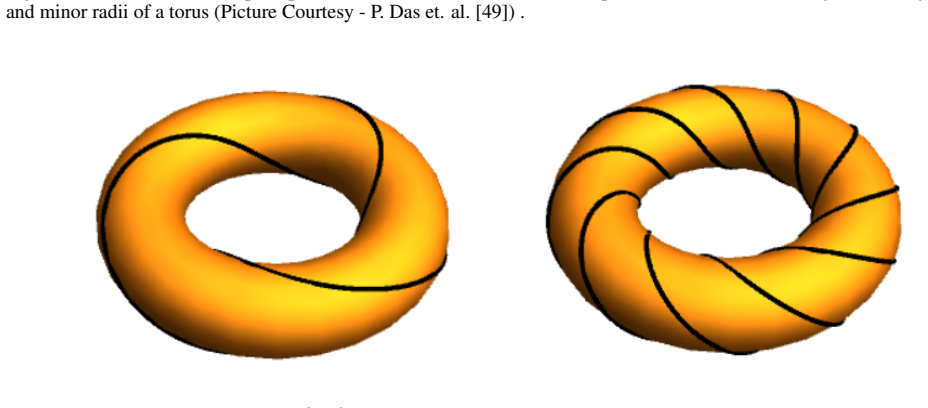

Figures from the paper (3 more)


Reference graph
Works this paper leans on
-
[1]
O. G. Schmidt and K. Eberl. Thin solid films roll up into nanotubes Nature (London) 410, 168 (2001)
work page 2001
- [2]
-
[3]
Mei et.al.High Performance Silicon Nanowire Field Effect Transistors, Nano Lett
Y . Mei et.al.High Performance Silicon Nanowire Field Effect Transistors, Nano Lett. 7, 1676 (2007)
work page 2007
- [4]
- [5]
-
[6]
B. S. DeWitt, Rev. Mod. Phys. 29, 377 (1957)
1957
-
[7]
H. Jensen and H. Koppe. Quantum mechanics with constraints. Annals of Physics, V olume 63, Issue 2, Pages 586-591, April 1971
work page 1971
- [8]
Show all 54 references
-
[9]
Physical Review A
Yong-Long Wang, Meng-Yun Lai, Fan Wang, Hong-Shi Zong, and Yan-Feng Chen.Geometric effects resulting from square and circular confinements for a particle constrained to a space curve. Physical Review A. V ol-97, (042108), 2018
2018
-
[10]
Ortix Quantum mechanics of a spin-orbit coupled electron constrained to a space curve.PHYSICAL REVIEW B 91, 245412 (2015)
C. Ortix Quantum mechanics of a spin-orbit coupled electron constrained to a space curve.PHYSICAL REVIEW B 91, 245412 (2015)
2015
-
[11]
Bastos , and F.G
L.C.B da Silva, C.C. Bastos , and F.G. Ribeiro. Quantum mechanics of a constrained particle and the problem of prescribed geometry-induced potential. Annals of Physics, V olume 379, Pages 13-33, April 2017
2017
-
[12]
Matsutani
S. Matsutani. , Path integral formulation of curved low dimensional space, J. Phys. Soc. Japan 61 (1992) 3825; Quantum field theory on curved low-dimensional space embedded in three-dimensional space, Phys. Rev. A 47 (1993) 686
1992
-
[13]
Encinosa, B
M. Encinosa, B. Etemadi., Energy shifts resulting from surface curvature of quantum nanostructures., Phys. Rev. A 58 (1998) 77
1998
-
[14]
Gravesen, M
J. Gravesen, M. Willatzen. Eigenstates of Mobius nanostructures including curvature effects., Phys. Rev. A 72 (2005) 032108
2005
-
[15]
Ikegami, Y
M. Ikegami, Y . Nagaoka., Electron motion on a curved interface, Surface Science 263 (1992) 193
1992
-
[16]
Ferrari, G
G. Ferrari, G. Cuoghi. Quantum mechanics on curved 2d systems with electric and magnetic fields, Phys. Rev. Lett. 100 (2008) 230403
2008
-
[17]
de Oliveira
G. de Oliveira. Quantum dynamics of a particle constrained to lie on a surface, J. Math. Phys. 55 (2014) 092106
2014
-
[18]
E. O. Silva, S. C. Ulhoa, F. M. Andrade, C. Filgueiras, R. G. G. Amorim. Quantum motion of a point particle in the presence of the Aharonov-Bohm potential in curved space, Ann. Phys. 362 (2015) 739. 12 Quantum Mechanics of Particle on a torus knot: Curvature and Torsion Effect...
2015
-
[19]
Filgueiras, F
C. Filgueiras, F. Moraes. On the quantum dynamics of a point particle in conical space, Ann. Phys. 323 (2008) 3150
2008
-
[20]
Filgueiras, E
C. Filgueiras, E. O. Silva, F. M. Andrade. Nonrelativistic quantum dynamics on a cone with and without a constraining potential, J. Math. Phys. 53 (2012) 122106
2012
-
[21]
Du, Y .-L
L. Du, Y .-L. Wang, G.-H. Liang, G.-Z. Kang, X.-J. Liu, H.-S. Zong.Curvature-induced bound states and coherent electron transport on the surface of a truncated cone, Physical E 76 (2016) 28
2016
-
[22]
M. V . Entin, L. I. Magarill.Spin-orbit interaction of electrons on a curved surface, Phys. Rev. B 64 (2001) 085330
2001
-
[23]
Gentile, M
P. Gentile, M. Cuoco, C. Ortix. Curvature-induced Rashba spin-orbit interaction in strain-driven nanostructures, SPIN 3 (2013) 1340002
2013
-
[24]
Santos, S
F. Santos, S. Fumeron, B. Berche, F. Moraes.Geometric effects in the electronic transport of deformed nanotubes, Nanotechnology 27 (2016) 135302
2016
-
[25]
Marchi, S
A. Marchi, S. Reggiani, M. Rudan, A. Bertoni. Coherent electron transport in bent cylindrical surfaces, Phys. Rev. B 72 (2005) 035403
2005
-
[26]
Krejcirık
D. Krejcirık. Quantum strips on surfaces, J. Geom. Phys. 45 (2003) 203
2003
-
[27]
Stockhofe and P
J. Stockhofe and P. Schmelcher. Nonadiabatic couplings and gauge-theoretical structure of curved quantum waveguides, Physical Review A 89, 033630 (2014)
2014
-
[28]
del Campo, M
A. del Campo, M. G. Boshier, A. Saxena. Bent waveguides for matter-waves: supersymmetric potentials and reflectionless geometries, Sci. Rep. 4 (2014) 5274
2014
-
[29]
S. Haag, J. Lampart, S. Teufel, Generalised quantum waveguides, Ann. Henri Poincare 16 (2015) 2535
2015
-
[30]
Zhang, C.M
H.F. Zhang, C.M. Wang, and L.S. Wang.Helical Crystalline SiC, SiO2 Core-Shell Nanowires, Nano. Lett. 2, 941 (2002)
2002
-
[31]
Xu et.al
S. Xu et.al. Assembly of micro/nanomaterials into complex, three-dimensional architectures by compressive buckling. Science 347, 154 (2015)
2015
-
[32]
Jones.A new polynomial invariant of knots and links, Bull
V .F.R. Jones.A new polynomial invariant of knots and links, Bull. Amer. Math. Soc. 12 103112 (1985)
1985
-
[33]
E. Witten. Quantum field theory and the Jones polynomial, Comm. Math. Phys. 121 (1989), no. 3, 351399
1989
-
[34]
E. Witten. Topological quantum field theory, Comm. Math. Phys. 117 (1988), no. 3, 353386
1988
-
[35]
E. H. Lieb. Relations between the ‘percolation’ and ‘colouring’ problem and other graph-theoretical problems associated with regular planar lattices: some exact results for the ‘percolation’ problem, Proc. Roy. Soc. London Ser. A 322 (1971), no. 1549, 251280
1971
-
[36]
Faddeev and A
L. Faddeev and A. J. Niemi. Knots and Particles , Nature 387:58,1997 DOI: 10.1038/387058a0 (arXiv:hepth/9610193)
1997
-
[37]
Kedia, I
H. Kedia, I. Bialynicki-Birula, D. Peralta-Salas, and W. T. M. Irvine.Tying Knots in Light Fields, Phys. Rev. Lett. 111, 150404
-
[38]
D’Ambroise, P
J. D’Ambroise, P. G. Kevrekidis and P. Schmelcher.Bright Solitary Waves on a Torus: Existence, Stability and Dynamics for the Nonlinear Schrödinger Model, arXiv:1906.06001
1906 arXiv
-
[39]
Khanna, A.P.C
F.C. Khanna, A.P.C. Malbouisson, J.M.C. Malbouisson, A.E. Santana. Quantum field theory on toroidal topology: Algebraic structure and applications , Physics Reports, vol. 539, p. 135-224, 2014 DOI: 10.1016/j.physrep.2014.02.002 arXiv:1409.1245
2014 arXiv
-
[40]
Ohnuki and S
Y . Ohnuki and S. Kitakado, OnQuantum Mechanics on a Compact Space, Modern Physics Letters A 7 (1992) 2477
1992
-
[41]
S. Coleman. Aspects of Symmetry, Cambridge University Press, (1988)
1988
-
[42]
Rajaraman
R. Rajaraman. Solitons and Instantons, North-Holland Personal Library, (2003)
2003
-
[43]
Wilczek.Fractional Statistics and Anyon Superconductivity, World Scientific Publishing Company Pvt
F. Wilczek.Fractional Statistics and Anyon Superconductivity, World Scientific Publishing Company Pvt. Ltd. (1990)
1990
-
[44]
Sreedhar.The classical and quantum mechanics of a particle on a knot
V .V . Sreedhar.The classical and quantum mechanics of a particle on a knot . Annals of Physics, V olume 359, Pages 20-30, August 2015
2015
-
[45]
Ohnuki and S
Y . Ohnuki and S. Kitakado.On Quantum Mechanics on Compact Space. Modern Physics Letters A, V ol. 07, No. 27, pp. 2477-2482 (1992)
1992
-
[46]
Floreanini, R
R. Floreanini, R. Peracci, E. Sezgin. Quantum Mechanics on the circle andW (1 +∞), Phys.Lett. B271 (1991) 372-376. 13 Quantum Mechanics of Particle on a torus knot: Curvature and Torsion Effects A PREPRINT
1991
-
[47]
Takagi and T
S. Takagi and T. Tanzawa,Quantum Mechanics of a Particle Confined to a Twisted Ring, Progress of Theoretical Physics, V ol. 87, No.3, March 1992
1992
-
[48]
Moore The birth of topological insulators
J.E. Moore The birth of topological insulators. Nature, V ol-464, 11 March 2010
2010
-
[49]
P. Das, S. Pramanik, S.Ghosh. Particle on a Torus Knot: Constrained Dynamics and Semi-Classical Quantization in a Magnetic Field. Annals of Physics, V olume 374, p:67-83.(2016)
2016
-
[50]
Wilkinson, N
S.A. Wilkinson, N. V ogt, D.S. Golubev, J.H. Cole.Approximate solutions to Mathieu’s equation. arXiv:1710.00657(2017)
2017 arXiv
-
[51]
McLachlan
N.W. McLachlan. Theory and Application of Mathieu Functions New York, Dover Publications (1964, 1947)
1964
-
[52]
E.L. Ince. On a general solution of Hills Equation Monthly Notices of the Royal Astronomical Society, V ol. 75, p.436-448,(1915)
1915
-
[53]
S. Ghosh. Particle on a Torus Knot: Anholonomy and Hannay Angle , Int.J.Geom.Meth.Mod.Phys. 15 (2018) no.06, 1850097
2018
-
[54]
S. Ghosh. Geometric Phases for Classical and Quantum Dynamics: Hannay angle and Berry Phase for Loops on a Torus, Int. J. Theo. Phys. (2019). https://doi.org/10.1007/s10773-019-04169-6, (arXiv:1905.03491). 14
2019 arXiv
Reviewed August 14, 2026 · model on record in the stance chip above.
Discussion (0). Continue with ORCID to comment.