REVIEW 5 major objections 9 minor 2 cited by
Satellite Observations Guided Diffusion Model for Accurate Meteorological States at Arbitrary Resolution
T0 review · 5 major / 9 minor · reviewed 2026-08-08 · deepseek-v4-flash
Pith's one-line read A GridSat-conditioned diffusion model downscales ERA5 fields to 6.25 km and, in the paper's station-level tests, reduces MAE and MSE for U10, T2M, and MSL relative to interpolation, GDP, and DDNM.
desk verdict The method is coherent and the paper is readable, but the headline accuracy numbers are inflated because the station observations used as sampling guidance are the same ones used as evaluation ground truth; the central claim needs a proper held-out evaluation. read the letter →
The pith
A machine-rendered reading of the paper's core claim, the machinery that carries it, and where it could break.
The reading
What carries the argument
The central mechanism is the guided reverse sampling step of a conditional DDPM: the optimizable convolutional kernel $D_\phi$ simulates the upscaling (degradation) operator that maps the candidate high-resolution field to the low-resolution grid, and the distance function $L(z, D_\phi(\tilde{x}_0))$ links the generated field to the observed LR reanalysis and station data. Gradients of $L$ with respect to $\tilde{x}_0$ update the sampling mean (the 'zero-shot guidance' term), and gradients with respect to $\phi$ update the kernel itself online, so the model learns the resolution-conversion operator at test time. The satellite conditioning enters through cross-attention between ERA5-map queries and features from a pretrained GridSat encoder, fusing brightness-temperature information into the denoiser. A patch-based weighting scheme averages per-patch gradient updates so that the method scales to arbitrary output resolutions.
What would settle it
Recompute the main station-level MAE/MSE table using only Weather5k stations that were excluded from the guidance set during sampling; if SGD's advantage over interpolation, GDP, and DDNM shrinks or vanishes on that held-out subset, the station-level result is driven by feedback from the evaluation stations. If no excluded stations remain, the paper's own Weather2k evaluation (Table 5) is the natural check, but it covers only T2M.
Extended reading notes
Core claim
SGD's central discovery is that coupling a satellite-conditioned diffusion prior with zero-shot guidance at sampling time yields downscaled meteorological fields that are simultaneously more detailed and more station-accurate than direct super-resolution or interpolation baselines. The model is a conditional DDPM whose UNet receives, via cross-attention, features from a pretrained encoder applied to GridSat brightness-temperature maps; training minimizes the standard noise-prediction objective. At inference, the reverse process is modified following classifier-guidance logic: at each step an optimizable convolutional kernel degrades the current estimate of the high-resolution field to the low-resolution grid, a distance function (MSE against the LR ERA5 map, optionally plus MAE against Weather5k stations) is evaluated, and gradients of that distance update both the sampling mean and the kernel parameters. A patch-based extension makes the guidance local, so fields can be generated at arbitrary resolutions. Reported results show station-level MSE/MAE reductions for U10, T2M, and MSL versus interpolation, GDP, DDNM, SwinRDM, Ref-SR, C2-Matching, and HyperDS, and the ablation attributes the gains to both the GridSat conditioning and the pretrained encoder.
Load-bearing premise
The station-level evaluation assumes that using Weather5k station observations as sampling guidance (Sections 3.3 and 4.5) does not unfairly advantage SGD when the same stations are the ground truth for the reported errors (Sections 4.3 and 4.4); if that assumption fails, the reported superiority over methods that never see the station data is an artifact of fitting to the evaluation labels.
Editorial extensions
If this is right
- At the evaluated variables, SGD produces 6.25 km maps whose station-level biases are smaller than those of interpolation and prior diffusion downscaling, so downscaled fields can serve as a higher-fidelity prior for station-scale forecasts.
- Because guidance is zero-shot, the same pretrained model can be re-pointed at different low-resolution inputs or different resolutions without retraining, limited only by the patch sampling routine.
- The GridSat conditioning makes the model useful in data-sparse regions where station observations are absent, since the satellite signal is the physical driver of the downscaled detail.
- The ablation suggests brightness temperature is the dominant conditioning variable: using IrWinCDR alone recovers most of the benefit, and the biggest gains are in T2M and MSL.
Reading between the lines
- The paper does not hold out the guidance stations from the evaluation set; a fair comparison against observation-free baselines would require either a held-out station subset or reporting error only at stations never used as guidance.
- If the station-guidance advantage survives a held-out test, the same 'reanalysis prior plus observation steering' recipe could be applied to other reanalysis products or to radar/precipitation nowcasting, where the paper's framework is modality-agnostic.
- The patch-based guidance opens a path to on-demand regional downscaling (generating only a target watershed or city), but the paper does not characterize boundary artifacts or quality at patch seams.
- The Weather2k result hints that station guidance generalizes beyond the guiding stations, but only for T2M; extending this check to U10, V10, and MSL would be the natural next experiment.
Editorial analysis
A structured set of objections, weighed in public.
Referee Report
Summary. The paper proposes SGD, a conditional diffusion model for downscaling ERA5 reanalysis fields from 25 km to 6.25 km resolution. The method conditions a diffusion model on GridSat satellite observations via cross-attention and performs zero-shot guided sampling with an optimizable convolutional kernel, using low-resolution ERA5 maps and, optionally, station observations as guidance. The authors report station-level MAE and MSE for U10, V10, T2M, and MSL, claiming that SGD outperforms interpolation, GDP, DDNM, SwinRDM, and other baselines. A patch-based strategy is introduced to support arbitrary output resolutions. The paper also contains ablations on the satellite conditioning and on the distance-function guidance.
Significance. If the empirical claims were valid, the paper would make a useful contribution by demonstrating that satellite observations can guide diffusion-based downscaling of reanalysis fields and that patch-based sampling enables variable output resolutions. The methodological idea of combining a pre-trained conditional diffusion prior with test-time optimization of a convolutional kernel is interesting and worth exploring. However, the central evaluation is currently undermined by a circular protocol: station observations are used both as sampling guidance and as ground truth for the headline metrics. The additional issue of a baseline row that is numerically identical to ERA5 1°, the unexplained mismatch between the main results and the ablation table, and the absence of error bars further weaken the support for the paper's claims. The only out-of-sample evaluation, in the appendix, covers a single variable. The strengths of the paper are the clear presentation of the algorithm and the attempt to incorporate satellite observations, but the evidence presented is not sufficient to support the stated conclusions.
major comments (5)
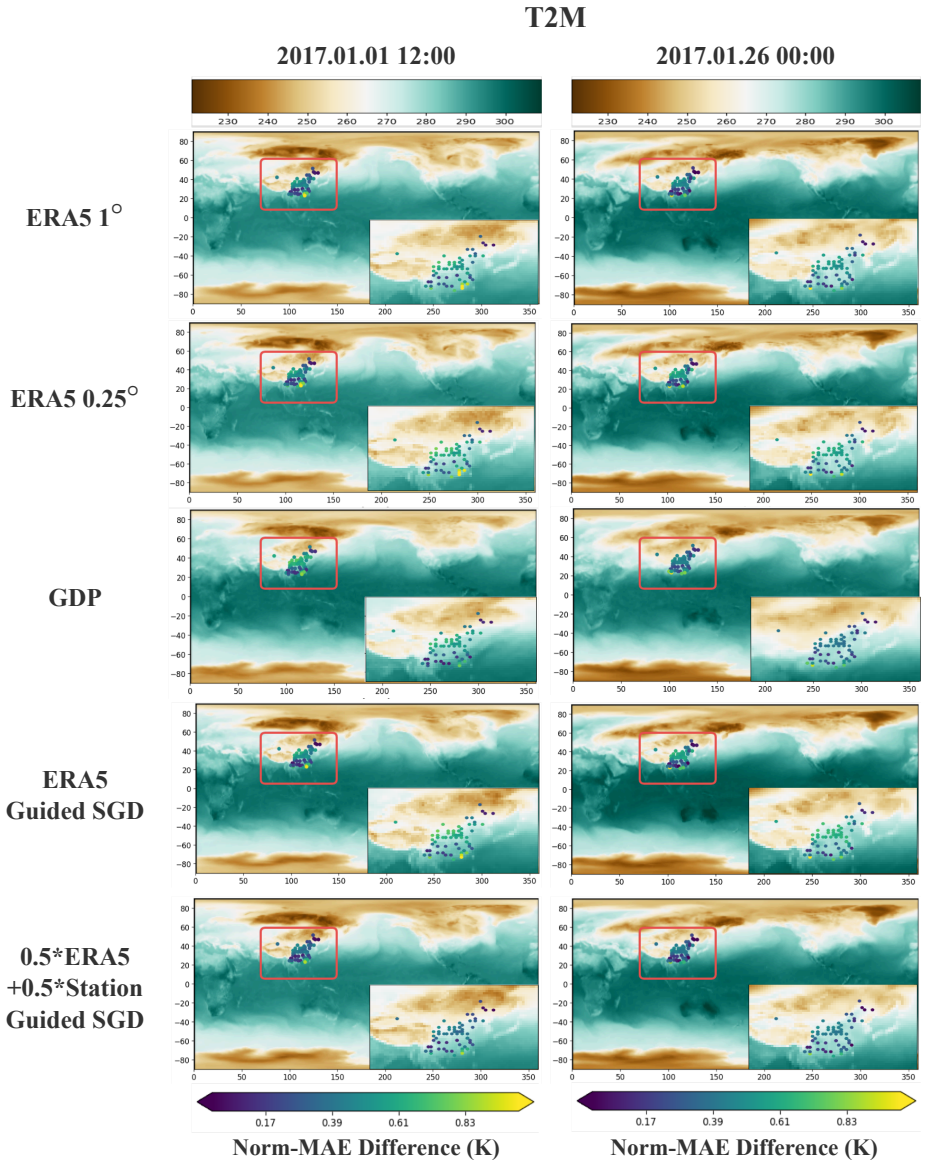
- [Sec. 4.5 and Table 2] The evaluation of the main result is circular. In Sec. 4.5, the sampling procedure is described as integrating a station-level MAE loss computed against Weather5k observations into the distance function used for reverse-sampling guidance; Fig. 4 and Tab. 4 confirm that this station-guided variant is the configuration used for the reported downscaling results. The evaluation in Secs. 4.3–4.4 then computes station-level MAE and MSE against the same Weather5k stations and reports them in Table 2. A method that is given the evaluation labels at inference time will appear more accurate than baselines that never see those labels, so the reported superiority of SGD over GDP, DDNM, and other baselines is in substantial part an in-sample fit rather than a measured downscaling skill. To support the claim, the authors should either remove station observations from the guidance for the main comparison, or evaluate all four variables on a held-out station set such as Weather2K, with an explicit statement that the station sets are disjoint and that the guidance does not use any information from the evaluation period.
- [Table 2, SwinRDM row] The SwinRDM row in Table 2 is numerically identical to the ERA5 1° row for all four variables (U10: MSE 53.18, MAE 5.95; V10: MSE 38.51, MAE 4.95; T2M: MSE 216.27, MAE 11.39; MSL: MSE 470.06, MAE 15.78). This is not a plausible output of a trained diffusion-based super-resolution model and indicates that the baseline was not actually executed but its results were copied from the ERA5 1° row. The claim that SGD outperforms SwinRDM is therefore unsupported. The authors must either run the SwinRDM baseline correctly and report its actual metrics, or remove it from the comparison.
- [Tables 2 and 4] The headline numbers for SGD in Table 2 do not match any configuration in the ablation study of Table 4. For example, Table 2 reports U10 MSE 51.65 and MAE 5.84, while the closest configuration, 'ERA5 + Station Guided SGD' in Table 4, reports U10 MSE 48.78 and MAE 5.64. The distance-function weighting used to produce Table 2 is never stated; Fig. 5 shows several possible weights (e.g., 0.25/0.75, 0.5/0.5) but the text does not specify which one corresponds to the main result. Without a precise description of the distance function and its weights for each reported result, the reader cannot determine which variant is being evaluated or why the numbers differ. The authors should reconcile the two tables and state the exact configuration used for the main results.
- [Sec. 4.4, Table 2] No error bars, confidence intervals, or multiple-seed results are reported for any method. Since SGD involves stochastic sampling and stochastic gradient-guided updates during inference, the observed differences over baselines (e.g., U10 MSE 51.65 vs. 53.18) may be within run-to-run variation. The authors should run each method multiple times and report the mean and standard error, or provide a paired significance test, for both MAE and MSE metrics.
- [Title, Abstract, Sec. 3.3 and Algorithm 2] The claim that SGD generates meteorological states 'at arbitrary resolution' is not demonstrated by any experiment. The paper only evaluates downscaling to 6.25 km; no results at other target resolutions are reported. The patch-based method in Algorithm 2 is described but never validated at a different resolution. To support the title and the abstract, the authors should include experiments at at least one other resolution (e.g., 12.5 km or 3.125 km) with station-level metrics.
minor comments (9)
- [Sec. 2, title] The section title 'Related Workds' should be 'Related Works'.
- [Sec. 3.3, Eq. (4)] The expression 'log p(w)' is undefined because w is not defined; the authors should write the distribution explicitly, e.g., log p_theta(xt | xt+1, y').
- [Algorithm 1, line 1] The notation 'N(0, I)' should include parentheses around the pair, i.e., 'N(0, I)' is acceptable but the paper often writes 'N (0, I)' with a space; ensure consistent notation.
- [Sec. 4.5] The exact form of the distance function is not specified: the paper says it uses 'average mean absolute error (MAE) loss across two maps for each variable at global stations' but does not state how many stations are used, how the station coordinates are incorporated into the differentiable loss, or how the ERA5 and station terms are weighted. Please provide the precise loss expression.
- [Appendix, Table 5] The T2M MAE values in Table 5 (e.g., 355.31) are in different units or scale from those in Table 2 (e.g., 11.39). The units for each metric should be defined consistently across all tables.
- [Sec. 4.4] The text states that 'SGD surpasses existing methods in terms of both MAE and MSE metrics across variables U10, T2M and MSL', but Table 2 shows that for V10, SGD is worse than ERA5 1° (MSE 39.82 vs. 38.51; MAE 5.05 vs. 4.95) and worse than bicubic interpolation on MAE (5.05 vs. 4.98). This should be acknowledged in the discussion.
- [References, [38]] The reference for GridSat is incorrect: [38] is about the GPM Cold Season Precipitation Experiment, not the GridSat dataset. A proper GridSat reference (e.g., Knapp et al., 2011, Bull. Amer. Meteor. Soc.) should be provided.
- [Sec. 4.2] The sentence 'All the training task are conducted on NVIDIA A100 80GB GPU' should read 'All training tasks were conducted on NVIDIA A100 80GB GPUs' and should specify the number of GPUs and batch size.
- [Appendix, Sec. 10] The Weather2K evaluation is only reported in the appendix and covers only T2M. The main text should either include this evaluation or at least cite it, and the authors should verify and state that the Weather5k and Weather2K station sets are disjoint and that the Weather2K evaluation period (2017–2021) does not overlap with the guidance data used during sampling.
Circularity Check
The headline station-level comparison is in-sample: Weather5k station observations guide the diffusion sampling and then serve as the ground truth for the reported MAE/MSE, so the claimed superiority over methods that never see those labels is partly enforced by construction.
-
fitted input called prediction
[Sec. 3.3 (Algorithm 1), Sec. 4.3, Sec. 4.5, Table 2]
"Sec. 3.3: 'The latter employs average mean absolute error (MAE) loss across two maps for each variable at global stations, thereby ensuring that SGD yields more precise numerical results at each station.' Sec. 4.3: 'We select MAE loss and MSE loss to quantify the inherent bias between the ERA5 maps derived from various downscaling methods and station observations.'"
Algorithm 1 updates the generated high-resolution map by following the gradient of the distance function L with respect to the estimated clean image x0, and Sec. 3.3 states that L can be, and in the full method is, the MAE between the downscaled field and Weather5k station observations. Sec. 4.3 then evaluates exactly that same quantity: MAE and MSE between the downscaled ERA5-derived fields and Weather5k station observations, and Table 2 reports those values as the headline accuracies against GDP, DDNM, and other baselines. Those baselines never see the Weather5k labels at inference, while SGD's sampled output is gradient-updated to reduce the very loss being measured.
full rationale
The central station-level evaluation is circular in a specific, quotable way: the sampling algorithm minimizes a distance function that includes MAE against Weather5k station observations, and the same Weather5k observations are used as ground truth for the MAE/MSE in Table 2. This matches the fitted-input-called-prediction pattern. The circularity is partial rather than total: the GridSat conditioning, the ERA5-map guidance, and the arbitrary-resolution patch scheme provide independent machinery, and the supplementary Weather2K evaluation (Tab. 5) is an external holdout for T2M. However, that holdout covers only one of the four headline variables and cannot rescue the U10/V10/MSL station-level claims of Table 2. No separate load-bearing self-citation chain was found; the GDP citation is methodological rather than definitional. Score 7 reflects that the principal quantitative claim is substantially enforced by construction while some independent content remains.
Assumptions & free parameters
free parameters (7)
- guidance scale s
- kernel update learning rate l
- distance function mixing weight =
figures show 0.5*ERA5 + 0.5*station
- number of sampling steps T
- patch stride r
- noise schedule beta =
linear 1e-4 to 0.02
- convolution kernel size =
9x9
assumptions (6)
- standard math The DDPM forward and reverse process equations (Eq. 7-9) correctly model the data distribution.
- ad hoc to paper The heuristic guidance approximation log p(z|xt) approx -sL(D(x0),z) in Eq. 5-6 is accurate enough for sampling.
- domain assumption GridSat brightness temperature is sufficiently coupled to ERA5 surface states that cross-attention conditioning improves downscaling.
- domain assumption A learned convolutional kernel with parameters phi can emulate the inverse of the downscaling process for arbitrary upscaling factors.
- domain assumption Weather5k station observations can serve simultaneously as sampling guidance and as independent evaluation truth.
- domain assumption Patch-based averaging over overlapping binary masks produces valid global maps without boundary artifacts.
Cite this review
Pith. "Pith review of Satellite Observations Guided Diffusion Model for Accurate Meteorological States at Arbitrary Resolution." pith.science (2026). https://pith.science/paper/5GJ7JEWR
@misc{pith2026250207814,
  author       = {Pith},
  title        = {Pith review of: Satellite Observations Guided Diffusion Model for Accurate Meteorological States at Arbitrary Resolution},
  year         = {2026},
  howpublished = {\url{https://pith.science/paper/5GJ7JEWR}},
  note         = {Machine review of arXiv:2502.07814}
}
read the original abstract
Accurate acquisition of surface meteorological conditions at arbitrary locations holds significant importance for weather forecasting and climate simulation. Due to the fact that meteorological states derived from satellite observations are often provided in the form of low-resolution grid fields, the direct application of spatial interpolation to obtain meteorological states for specific locations often results in significant discrepancies when compared to actual observations. Existing downscaling methods for acquiring meteorological state information at higher resolutions commonly overlook the correlation with satellite observations. To bridge the gap, we propose Satellite-observations Guided Diffusion Model (SGD), a conditional diffusion model pre-trained on ERA5 reanalysis data with satellite observations (GridSat) as conditions, which is employed for sampling downscaled meteorological states through a zero-shot guided sampling strategy and patch-based methods. During the training process, we propose to fuse the information from GridSat satellite observations into ERA5 maps via the attention mechanism, enabling SGD to generate atmospheric states that align more accurately with actual conditions. In the sampling, we employed optimizable convolutional kernels to simulate the upscale process, thereby generating high-resolution ERA5 maps using low-resolution ERA5 maps as well as observations from weather stations as guidance. Moreover, our devised patch-based method promotes SGD to generate meteorological states at arbitrary resolutions. Experiments demonstrate SGD fulfills accurate meteorological states downscaling to 6.25km.
Figures


Figures from the paper (5 more)


Forward citations
Cited by 2 Pith papers
-
ReconMOST: Multi-Layer Sea Temperature Reconstruction with Observations-Guided Diffusion
A guided diffusion model pre-trained on climate simulations reconstructs multi-layer global ocean temperature from sparse observations, reporting low MSE on CMIP6 and EN4 data.
-
MODS: Multi-source Observations Conditional Diffusion Model for Meteorological State Downscaling
A multi-source satellite-conditioned diffusion model for ERA5 downscaling reports improved station-level metrics, but the evaluation is compromised because station observations are used as sampling guidance and as the...
Reference graph
Works this paper leans on
-
[1]
Conditional diffusion models for downscaling & bias correction of earth system model precipitation
Michael Aich, Philipp Hess, Baoxiang Pan, Sebastian Bathi- any, Yu Huang, and Niklas Boers. Conditional diffusion models for downscaling & bias correction of earth system model precipitation. arXiv preprint arXiv:2404.14416, 2024. 1
arXiv 2024
-
[2]
Unpaired downscaling of fluid flows with diffusion bridges
Tobias Bischoff and Katherine Deck. Unpaired downscaling of fluid flows with diffusion bridges. Artificial Intelligence for the Earth Systems, 3(2):e230039, 2024. 3
work page 2024
-
[3]
Fatemeh Chajaei and Hossein Bagheri. Machine learning framework for high-resolution air temperature downscaling using lidar-derived urban morphological features. Urban Climate, 57:102102, 2024. 2
work page 2024
-
[4]
Chiranjib Chaudhuri and Colin Robertson. Cligan: A struc- turally sensitive convolutional neural network model for sta- tistical downscaling of precipitation from multi-model en- sembles. Water, 12(12):3353, 2020. 2
work page 2020
-
[5]
Lei Chen, Fei Du, Yuan Hu, Zhibin Wang, and Fan Wang. Swinrdm: integrate swinrnn with diffusion model towards high-resolution and high-quality weather forecasting. InPro- ceedings of the AAAI Conference on Artificial Intelligence , pages 322–330, 2023. 1, 6
work page 2023
-
[6]
Foundation models for weather and climate data understanding: A comprehensive survey
Shengchao Chen, Guodong Long, Jing Jiang, Dikai Liu, and Chengqi Zhang. Foundation models for weather and climate data understanding: A comprehensive survey. arXiv preprint arXiv:2312.03014, 2023. 1
arXiv 2023
-
[7]
Adversarial-learning-based image-to-image transformation: A survey
Yuan Chen, Yang Zhao, Wei Jia, Li Cao, and Xiaoping Liu. Adversarial-learning-based image-to-image transformation: A survey. Neurocomputing, 411:468–486, 2020. 2
work page 2020
-
[8]
Estimating daily me- teorological data and downscaling climate models over land- scapes
Miquel De Caceres, Nicolas Martin-StPaul, Marco Turco, Antoine Cabon, and Victor Granda. Estimating daily me- teorological data and downscaling climate models over land- scapes. Environmental Modelling & Software, 108:186–196,
Show all 55 references
-
[9]
Diffusion models beat gans on image synthesis
Prafulla Dhariwal and Alexander Nichol. Diffusion models beat gans on image synthesis. Advances in Neural Informa- tion Processing Systems, 34:8780–8794, 2021. 5
2021
-
[10]
Stream- flow intermittence in europe: Estimating high-resolution monthly time series by downscaling of simulated runoff and random forest modeling
Petra D ¨oll, Mahdi Abbasi, Mathis Lo¨ıc Messager, Tim Traut- mann, Bernhard Lehner, and Nicolas Lamouroux. Stream- flow intermittence in europe: Estimating high-resolution monthly time series by downscaling of simulated runoff and random forest modeling. Water Resources Resea...
2024
-
[11]
Spatial downscaling of trmm precipitation data based on the orographical effect and meteorological conditions in a mountainous area
Jian Fang, Juan Du, Wei Xu, Peijun Shi, Man Li, and Xi- aodong Ming. Spatial downscaling of trmm precipitation data based on the orographical effect and meteorological conditions in a mountainous area. Advances in Water Re- sources, 61:42–50, 2013. 1
2013
-
[12]
Generative dif- fusion prior for unified image restoration and enhancement
Ben Fei, Zhaoyang Lyu, Liang Pan, Junzhe Zhang, Weidong Yang, Tianyue Luo, Bo Zhang, and Bo Dai. Generative dif- fusion prior for unified image restoration and enhancement. In Proceedings of the IEEE/CVF Conference on Computer Vision and Pattern Recognition, pages 9935–9946, 2...
2023
-
[13]
Training-free structured diffusion guidance for compositional text-to-image synthesis
Weixi Feng, Xuehai He, Tsu-Jui Fu, Varun Jampani, Arjun Akula, Pradyumna Narayana, Sugato Basu, Xin Eric Wang, and William Yang Wang. Training-free structured diffusion guidance for compositional text-to-image synthesis. arXiv preprint arXiv:2212.05032, 2022. 2
2022 arXiv
-
[14]
Implicit diffusion models for continu- ous super-resolution
Sicheng Gao, Xuhui Liu, Bohan Zeng, Sheng Xu, Yan- jing Li, Xiaoyan Luo, Jianzhuang Liu, Xiantong Zhen, and Baochang Zhang. Implicit diffusion models for continu- ous super-resolution. In Proceedings of the IEEE/CVF con- ference on computer vision and pattern recognition , pag...
2023
-
[15]
Weather-5k: A large-scale global station weather dataset towards comprehensive time-series forecast- ing benchmark
Tao Han, Song Guo, Zhenghao Chen, Wanghan Xu, and Lei Bai. Weather-5k: A large-scale global station weather dataset towards comprehensive time-series forecast- ing benchmark. arXiv preprint arXiv:2406.14399, 2024. 6, 2
2024 arXiv
-
[16]
The era5 global reanalysis
Hans Hersbach, Bill Bell, Paul Berrisford, Shoji Hirahara, Andr´as Hor ´anyi, Joaqu ´ın Mu ˜noz-Sabater, Julien Nicolas, Carole Peubey, Raluca Radu, Dinand Schepers, et al. The era5 global reanalysis. Quarterly Journal of the Royal Mete- orological Society, 146(730):1999–2049, 2020. 5
1999
-
[17]
Fast, scale-adaptive, and uncertainty-aware down- scaling of earth system model fields with generative foun- dation models
Philipp Hess, Michael Aich, Baoxiang Pan, and Niklas Boers. Fast, scale-adaptive, and uncertainty-aware down- scaling of earth system model fields with generative foun- dation models. arXiv preprint arXiv:2403.02774, 2024. 2
2024 arXiv
-
[18]
Denoising dif- fusion probabilistic models
Jonathan Ho, Ajay Jain, and Pieter Abbeel. Denoising dif- fusion probabilistic models. Advances in neural information processing systems, 33:6840–6851, 2020. 1
2020
-
[19]
Cascaded diffu- sion models for high fidelity image generation
Jonathan Ho, Chitwan Saharia, William Chan, David J Fleet, Mohammad Norouzi, and Tim Salimans. Cascaded diffu- sion models for high fidelity image generation. Journal of Machine Learning Research, 23(47):1–33, 2022. 3
2022
-
[20]
Task decoupled framework for reference-based super-resolution
Yixuan Huang, Xiaoyun Zhang, Yu Fu, Siheng Chen, Ya Zhang, Yan-Feng Wang, and Dazhi He. Task decoupled framework for reference-based super-resolution. InProceed- ings of the IEEE/CVF Conference on Computer Vision and Pattern Recognition, pages 5931–5940, 2022. 6
2022
-
[21]
Ccnet: Criss-cross attention for semantic segmentation
Zilong Huang, Xinggang Wang, Lichao Huang, Chang Huang, Yunchao Wei, and Wenyu Liu. Ccnet: Criss-cross attention for semantic segmentation. In Proceedings of the IEEE/CVF international conference on computer vision, pages 603–612, 2019. 2
2019
-
[22]
Robust reference-based super-resolution via c2-matching
Yuming Jiang, Kelvin CK Chan, Xintao Wang, Chen Change Loy, and Ziwei Liu. Robust reference-based super-resolution via c2-matching. In Proceedings of the IEEE/CVF Confer- ence on Computer Vision and Pattern Recognition , pages 2103–2112, 2021. 6 9
2021
-
[23]
Srdiff: Single image super-resolution with diffusion probabilistic models
Haoying Li, Yifan Yang, Meng Chang, Shiqi Chen, Huajun Feng, Zhihai Xu, Qi Li, and Yueting Chen. Srdiff: Single image super-resolution with diffusion probabilistic models. Neurocomputing, 479:47–59, 2022. 3
2022
-
[24]
Deepphysinet: Bridging deep learning and atmospheric physics for ac- curate and continuous weather modeling
Wenyuan Li, Zili Liu, Keyan Chen, Hao Chen, Shunlin Liang, Zhengxia Zou, and Zhenwei Shi. Deepphysinet: Bridging deep learning and atmospheric physics for ac- curate and continuous weather modeling. arXiv preprint arXiv:2401.04125, 2024. 1
2024 arXiv
-
[25]
Diffusion model with detail complement for super-resolution of remote sensing
Jinzhe Liu, Zhiqiang Yuan, Zhaoying Pan, Yiqun Fu, Li Liu, and Bin Lu. Diffusion model with detail complement for super-resolution of remote sensing. Remote Sensing, 14(19): 4834, 2022. 3
2022
-
[26]
Patch- scaler: An efficient patch-independent diffusion model for super-resolution
Yong Liu, Hang Dong, Jinshan Pan, Qingji Dong, Kai Chen, Rongxiang Zhang, Xing Mei, Lean Fu, and Fei Wang. Patch- scaler: An efficient patch-independent diffusion model for super-resolution. arXiv preprint arXiv:2405.17158, 2024. 3
2024 arXiv
-
[27]
Deriving accurate surface meteorological states at arbi- trary locations via observation-guided continous neural field modeling
Zili Liu, Hao Chen, Lei Bai, Wenyuan Li, Keyan Chen, Zhengyi Wang, Wanli Ouyang, Zhengxia Zou, and Zhenwei Shi. Deriving accurate surface meteorological states at arbi- trary locations via observation-guided continous neural field modeling. IEEE Transactions on Geoscience and ...
2024
-
[28]
Observation-guided meteorological field downscaling at station scale: A benchmark and a new method
Zili Liu, Hao Chen, Lei Bai, Wenyuan Li, Keyan Chen, Zhengyi Wang, Wanli Ouyang, Zhengxia Zou, and Zhenwei Shi. Observation-guided meteorological field downscaling at station scale: A benchmark and a new method. arXiv preprint arXiv:2401.11960, 2024. 6
2024 arXiv
-
[29]
Mambads: Near-surface meteorological field downscaling with topography con- strained selective state space modeling
Zili Liu, Hao Chen, Lei Bai, Wenyuan Li, Wanli Ouyang, Zhengxia Zou, and Zhenwei Shi. Mambads: Near-surface meteorological field downscaling with topography con- strained selective state space modeling. arXiv preprint arXiv:2408.10854, 2024. 1
2024 arXiv
-
[30]
Dynamical-generative downscaling of climate model ensem- bles
Ignacio Lopez-Gomez, Zhong Yi Wan, Leonardo Zepeda- N´u˜nez, Tapio Schneider, John Anderson, and Fei Sha. Dynamical-generative downscaling of climate model ensem- bles. arXiv preprint arXiv:2410.01776, 2024. 3
2024 arXiv
-
[31]
Bias correcting climate change simulations-a critical review
Douglas Maraun. Bias correcting climate change simulations-a critical review. Current Climate Change Re- ports, 2(4):211–220, 2016. 2
2016
-
[32]
Data driven weather forecasts trained and initialised directly from observations
Anthony McNally, Christian Lessig, Peter Lean, Eulalie Boucher, Mihai Alexe, Ewan Pinnington, Matthew Chantry, Simon Lang, Chris Burrows, Marcin Chrust, et al. Data driven weather forecasts trained and initialised directly from observations. arXiv preprint arXiv:2407.15586, 2024. 2
2024 arXiv
-
[33]
Pulse: Self-supervised photo upsam- pling via latent space exploration of generative models
Sachit Menon, Alexandru Damian, Shijia Hu, Nikhil Ravi, and Cynthia Rudin. Pulse: Self-supervised photo upsam- pling via latent space exploration of generative models. In Proceedings of the ieee/cvf conference on computer vision and pattern recognition, pages 2437–2445, 2020. 2
2020
-
[34]
Ai foundation models for weather and climate: Applications, design, and implementation
S Karthik Mukkavilli, Daniel Salles Civitarese, Johannes Schmude, Johannes Jakubik, Anne Jones, Nam Nguyen, Christopher Phillips, Sujit Roy, Shraddha Singh, Campbell Watson, et al. Ai foundation models for weather and climate: Applications, design, and implementation. arXiv pr...
2023 arXiv
-
[35]
Exploiting deep generative prior for versatile image restoration and manipulation
Xingang Pan, Xiaohang Zhan, Bo Dai, Dahua Lin, Chen Change Loy, and Ping Luo. Exploiting deep generative prior for versatile image restoration and manipulation. IEEE Transactions on Pattern Analysis and Machine Intelligence, 44(11):7474–7489, 2021. 6
2021
-
[36]
A dynamically downscaled ensemble of fu- ture projections for the california current system
Mercedes Pozo Buil, Michael G Jacox, Jerome Fiechter, Michael A Alexander, Steven J Bograd, Enrique N Cur- chitser, Christopher A Edwards, Ryan R Rykaczewski, and Charles A Stock. A dynamically downscaled ensemble of fu- ture projections for the california current system. Fron...
2021
-
[37]
Fatezero: Fus- ing attentions for zero-shot text-based video editing
Chenyang Qi, Xiaodong Cun, Yong Zhang, Chenyang Lei, Xintao Wang, Ying Shan, and Qifeng Chen. Fatezero: Fus- ing attentions for zero-shot text-based video editing. In Proceedings of the IEEE/CVF International Conference on Computer Vision, pages 15932–15942, 2023. 2
2023
-
[38]
Global precipitation measurement cold season pre- cipitation experiment (gcpex): For measurement’s sake, let it snow
Gail Skofronick-Jackson, David Hudak, Walter Petersen, Stephen W Nesbitt, V Chandrasekar, Stephen Durden, Kirstin J Gleicher, Gwo-Jong Huang, Paul Joe, Pavlos Kol- lias, et al. Global precipitation measurement cold season pre- cipitation experiment (gcpex): For measurement’s s...
2015
-
[39]
Deep learning in statistical down- scaling for deriving high spatial resolution gridded meteoro- logical data: A systematic review
Yongjian Sun, Kefeng Deng, Kaijun Ren, Jia Liu, Chongjiu Deng, and Yongjun Jin. Deep learning in statistical down- scaling for deriving high spatial resolution gridded meteoro- logical data: A systematic review. ISPRS Journal of Pho- togrammetry and Remote Sensing, 208:14–38, 2024. 1
2024
-
[40]
Taming genera- tive diffusion for universal blind image restoration
Siwei Tu, Weidong Yang, and Ben Fei. Taming genera- tive diffusion for universal blind image restoration. arXiv preprint arXiv:2408.11287, 2024. 3
2024 arXiv
-
[41]
Global atmospheric data as- similation with multi-modal masked autoencoders
Thomas J Vandal, Kate Duffy, Daniel McDuff, Yoni Nach- many, and Chris Hartshorn. Global atmospheric data as- similation with multi-modal masked autoencoders. arXiv preprint arXiv:2407.11696, 2024. 2
2024 arXiv
-
[42]
Aardvark weather: end-to-end data-driven weather forecasting
Anna Vaughan, Stratis Markou, Will Tebbutt, James Re- queima, Wessel P Bruinsma, Tom R Andersson, Michael Herzog, Nicholas D Lane, Matthew Chantry, J Scott Hosk- ing, et al. Aardvark weather: end-to-end data-driven weather forecasting. arXiv preprint arXiv:2404.00411, 2024. 2
2024 arXiv
-
[43]
A method for land surface temperature retrieval based on model-data-knowledge-driven and deep learning
Han Wang, Kebiao Mao, Zijin Yuan, Jiancheng Shi, Meng- meng Cao, Zhihao Qin, Sibo Duan, and Bohui Tang. A method for land surface temperature retrieval based on model-data-knowledge-driven and deep learning. Remote sensing of environment, 265:112665, 2021. 1
2021
-
[44]
Zero-shot im- age restoration using denoising diffusion null-space model
Yinhuai Wang, Jiwen Yu, and Jian Zhang. Zero-shot im- age restoration using denoising diffusion null-space model. arXiv preprint arXiv:2212.00490, 2022. 6
2022 arXiv
-
[45]
Spatial downscaling of grace-derived groundwater storage changes across diverse climates and human interventions with random forests.Jour- nal of Hydrology, 640:131708, 2024
Yiming Wang, Chen Li, Yingjie Cui, Yanhong Cui, Yuancheng Xu, Tejasvi Hora, Esha Zaveri, Aude-Sophie Rodella, Liangliang Bai, and Di Long. Spatial downscaling of grace-derived groundwater storage changes across diverse climates and human interventions with random forests.Jour-...
2024
-
[46]
Weather2k: A multivariate spatio- temporal benchmark dataset for meteorological forecasting based on real-time observation data from ground weather sta- tions
Xun Zhu, Yutong Xiong, Ming Wu, Gaozhen Nie, Bin Zhang, and Ziheng Yang. Weather2k: A multivariate spatio- temporal benchmark dataset for meteorological forecasting based on real-time observation data from ground weather sta- tions. arXiv preprint arXiv:2302.10493, 2023. 2 10
2023 arXiv
-
[47]
A downscaling-and-fusion framework for generating spatio-temporally complete and fine resolution remotely sensed surface soil moisture
Zhongzheng Zhu, Yanchen Bo, Tongtong Sun, Xiaoran Zhang, Mei Sun, Aojie Shen, Yusha Zhang, Jia Tang, Meng- fan Cao, and Chenyu Wang. A downscaling-and-fusion framework for generating spatio-temporally complete and fine resolution remotely sensed surface soil moisture. Agri- cu...
2024
-
[48]
The former aims to gradually introduce random Gaussian noise into the original images over T dif- fusion steps, ultimately resulting in pure Gaussian noise xT ∼ N(0, I)
Preliminary Unconditional diffusion model, proposed by [18], is a pow- erful generative model composed of a forward process and a reverse process. The former aims to gradually introduce random Gaussian noise into the original images over T dif- fusion steps, ultimately resulti...
-
[49]
To address the downscaling task at this reso- lution, we employed a patch-based method during the sam- pling process of the conditional DDPM
Patch-based Methods The scale of the ERA5 maps used as input for SGD reaches 25km×25km. To address the downscaling task at this reso- lution, we employed a patch-based method during the sam- pling process of the conditional DDPM. The detailed intro- duction of this method is s...
-
[50]
The pre-trained encoder aims to enhance the feature extraction capabilities of SGD and its downscaling performance
Pre-trained Encoder Before utilizing cross attention for feature fusion, SGD ne- cessitates the extraction of features from GridSat maps by an encoder. The pre-trained encoder aims to enhance the feature extraction capabilities of SGD and its downscaling performance. The pre-t...
-
[51]
Additional Visualization Results In this section, we present the downscaling results of SGD for the variables V10 and M SL. Fig. 7 shows that SGD exhibits more faithful details in the maps as compared to interpolation-based and diffusion-based methods. Further- more, SGD exhib...
2000
-
[52]
Station observation-guided downscaling bias with stations in Weather2K In this section, we endeavor to integrate the MSE loss from ERA5 LR maps and MAE loss from the observation sta- tions in Weather5K within the distance function utilized in the sampling process. Subsequently...
2017
-
[54]
6 shows the running time and resource consumption of SGD during the training and the sampling process
Running Time and Resource Consumption Tab. 6 shows the running time and resource consumption of SGD during the training and the sampling process. To en- hance the inference efficiency, we have also tested our SGD 2 SGD (Ours) ERA5 1∘ Bicubic GDP DDNM 2023.01.02 12:00 2023.06.0...
2023
-
[55]
Ablation Studies on the Relationship of Variables When only the brightness temperature variables from Grid- Sat (IrWin Cdr or IrWin VZA Adj) are employed as the condition, a satisfactory performance can be obtained, demonstrating that brightness temperature is an important con...
-
[2021]
It encompasses the meteorological data from 2130 ground weather stations across 40896 time steps, with each data incorporates 3 position variables and 20 meteorologi- cal variables. Specifically, we incorporate the MAE loss between the generated HR ERA5 maps and station observ...
Reviewed August 8, 2026 · model on record in the stance chip above.
Discussion (0). Continue with ORCID to comment.