REVIEW 4 major objections 7 minor 74 references
LittleLearner: Language Models Under Pedagogically Controlled Knowledge Exposure
T0 review · 4 major / 7 minor · reviewed 2026-08-14 · deepseek-v4-flash
Pith's one-line read The paper argues that a model's pretraining knowledge boundary, set by a K-5-filtered corpus, acts as a hard ceiling that scaling, post-training, and in-context learning cannot break through.
desk verdict A genuinely useful controlled-exposure resource whose strongest claim about the ceiling on post-training and ICL is still entangled with the post-hoc MathCAMPS evaluation filters. read the letter →
The pith
A machine-rendered reading of the paper's core claim, the machinery that carries it, and where it could break.
The reading
What carries the argument
The mechanism that carries the argument is the multi-stage LittleCurriculum filter, which turns a large web-scale educational corpus into a sharply bounded K-5 corpus. It works in layers: an age-of-acquisition prefilter with frequency-based imputation removes texts whose vocabulary is learned after age 12; a lightweight text classifier and then a stronger classifier, trained on LLM-as-judge annotations grounded in curriculum standards, assign grade bands; a symbolic regular-expression stage removes mathematical notation such as equations, exponents, and integrals; and a final frequency-sampling stage drops documents concentrated with beyond-K-5 terms. Validation on a held-out curriculum-aligned benchmark and an external grade-labeled corpus is what makes the boundary interpretable and grounds the ceiling claims.
What would settle it
Train a matched 5B model on a version of the released corpus spiked with a small, measured fraction of grade-8 mathematics content, for example 1%, then evaluate it on the paper's grade-8 math questions. If accuracy stays at the original model's floor, the ceiling is not caused by content exposure alone; if it rises, the paper's attribution of the ceiling to the pretraining filter is falsified.
Extended reading notes
Core claim
The paper's central claim is that a deliberately restricted pretraining corpus creates a sharp, interpretable capability boundary, and that the boundary is set by the filter that built the corpus rather than by the model or by subsequent training. LittleLearner answers grade-school questions comparably to an unfiltered control, but on questions beyond grade 5 it collapses, producing plausible but wrong answers such as describing an out-of-scope quantum mechanics thought experiment as a literal cat with fabricated attributes. Scaling the model from 0.6B to 5B parameters improves in-scope and boundary performance but leaves grade-8 math at floor; SFT followed by GRPO post-training, even when the post-training data are unfiltered, does not close the gap; and few-shot demonstrations with hand-written reasoning traces give at most a small in-scope boost. The paper reads the consistent pattern as evidence that the pretraining filter, not the intervention, sets the effective capability ceiling in these tested settings.
Load-bearing premise
The filtering pipeline's measured leakage rates on validation sets, near-zero beyond-K-5 retention, 2.48% on an external corpus, and 0.09% phrase matches, are representative of the actual 88B-token corpus, so that the K-5 boundary is genuinely clean.
Editorial extensions
If this is right
- A model trained under K-5 exposure performs on par with an unfiltered model on in-scope math and factual questions, so the filtering does not destroy elementary competence.
- Increasing model parameters from 0.6B to 5B yields strong in-scope gains but leaves fully out-of-scope grade-8 performance at floor, so scale does not by itself extend the knowledge boundary.
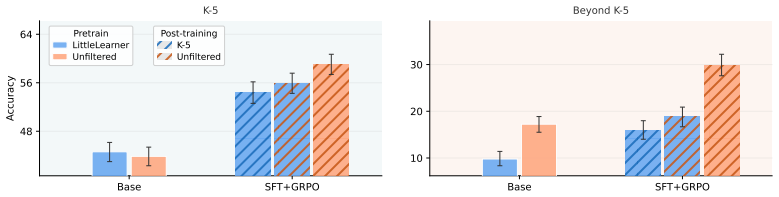
- SFT plus GRPO post-training lifts in-scope math accuracy for both the restricted and unfiltered models but does not close the beyond-K-5 gap, even when the restricted model is post-trained on unrestricted data.
- Few-shot in-context learning with hand-written chain-of-thought examples can steer output format but does not unlock new out-of-scope reasoning for this 5B model.
- For the tested settings, the pretraining filter, not the later intervention, is the effective capability ceiling.
Reading between the lines
- The same design can be reused to test whether other post-training paradigms, such as long-horizon reinforcement learning, verifier-guided search, or retrieval, can genuinely introduce new capabilities rather than elicit latent ones, since the model's prior is fully known.
- The K-5 boundary is a content boundary, not a human-developmental claim; the model's skill ordering differs from curriculum progression, so any prerequisite reasoning should be tested against the filter's actual content rather than grade-level labels.
- The ceiling result may be scale-dependent: at frontier scales with stronger in-context learning, the same filter might show more boundary flexibility, so the sandbox should be re-run at larger sizes before generalizing to all language models.
- A direct way to test the mechanism is to spike a small fraction of out-of-scope math content into a filtered corpus and measure whether grade-8 accuracy rises; if it stays at floor, the ceiling is not solely about content exposure.
Editorial analysis
A structured set of objections, weighed in public.
Referee Report
Summary. The paper introduces LITTLECURRICULUM, an 88B-token pretraining corpus derived from FineWeb-Edu and filtered to U.S. elementary-school (K-5) content via a multi-stage pipeline (Age-of-Acquisition pre-filtering, LLM-as-a-judge annotation with FastText/ModernBERT classifiers, symbolic filtering, and frequency sampling), together with LITTLELEARNER, a 5B-parameter model trained from scratch on this corpus. The filter is validated on CommonCoreText (0% Beyond-K-5 retention), on the external WeeBit corpus (2.48% retention), and via a 126-term n-gram audit of the retained corpus (0.09% of passages). LITTLELEARNER performs comparably to an unfiltered control within K-5 across language-complexity (CLEAR), math-familiarity (CoMTA), fact-retrieval (Jeopardy), and math-reasoning (MathCAMPS) measures, while degrading on Beyond-K-5 content. Three intervention studies—model scaling from 0.6B to 5B, SFT+GRPO post-training, and few-shot in-context learning—improve in-scope performance but do not close the Beyond-K-5 gap, and the paper concludes in Section 4.4 that the pretraining filter, rather than any tested intervention, sets the effective capability ceiling. The authors release the corpus and model as a developmentally restricted sandbox for controlled-exposure research.
Significance. The work is significant as a community resource: if the K-5 boundary is as clean as claimed, LITTLECURRICULUM and LITTLELEARNER enable controlled studies of knowledge acquisition, transfer, post-training, and in-context learning that are otherwise confounded by unknown pretraining exposure. Strengths include the release of corpus and model, a precision-first filter with staged validation, an external WeeBit check and a corpus-level n-gram audit, matched baselines for the main comparisons, honest disclosure of boundary fuzziness (e.g., the non-monotonic skill orderings in Section C.2.2), and careful pass@k analysis showing that the Beyond-K-5 gap persists at high sampling budgets. The headline negative result—that scaling, SFT+GRPO, and ICL amplify in-scope capability but do not extend the boundary—is interesting, falsifiable, and useful even if later work qualifies it. The main risk is that the intervention results rest on a single benchmark whose Beyond-K-5 split is partly constructed post hoc in Section C.2.1.
major comments (4)
- [§4.4 and §C.2.1] The central claim of Section 4.4—that 'the pretraining filter, rather than the intervention, sets the effective capability ceiling'—is evaluated on MathCAMPS, but the Beyond-K-5 split used in Figures 7-9 is constructed by the post-hoc filters of Section C.2.1. In particular, standard 6.EE.B.7 is excluded explicitly because its items are 'structurally indistinguishable from grade-3 add/sub word problems,' which is precisely the class of crossover items where a K-5-pretrained model with post-training or ICL might most plausibly show out-of-scope gains, and standards with fewer than 30 unique gold answers (including perfect squares, cubes, and cube roots, which are grade-8 content) are dropped. Excluding these items from the aggregate Beyond-K-5 score makes the ceiling look harder than the pretraining filter alone would produce, so the attribution in Section 4.4 is not separable from the evaluation filter. The authors should report the aggregate Beyond-K-5 numbers for the scaling, post-training, and ICL experiments with 6.EE.B.7 re-included and, ideally, with the low-entropy standards re-included, as a sensitivity analysis.
- [§4, Figures 7-9] The three intervention claims are tested on a single benchmark: MathCAMPS. The Jeopardy, CLEAR, and CoMTA experiments characterize the base model's boundary but do not test scaling, post-training, or in-context learning, so the claim that 'each lever ... provides limited gains in Beyond-K-5' is supported by only one evaluation instrument. I ask the authors to run at least one additional Beyond-K-5 evaluation (for example, the Jeopardy or CoMTA protocol) for at least the post-training condition, or, failing that, to narrow the summary and abstract claims to the MathCAMPS setting. This is not a request for exhaustive evaluation, but the single-benchmark basis is thin for the paper's headline negative result.
- [§3.3, §B, Figure 7] The UNFILTERED control and the scaling runs are said to share LITTLELEARNER's training recipe, but the token budgets, number of epochs, and total compute for each model are not reported. If UNFILTERED, or the 0.6B and 1.3B models, saw different amounts of data than LITTLELEARNER, the divergences in Figures 3-8 cannot be attributed solely to the K-5 filter, because data quantity is a confound. The paper should state the exact token counts, step budgets, and data mixtures for every model in the comparisons.
- [§3.1.6, §A.5, §A.6] CommonCoreText is used during pipeline construction—for rule-based metric selection in Section A.1 and for the LLMJ 'precision-on-validation' prompt optimization in Section A.2—so the 0% Beyond-K-5 retention on CommonCoreText is a development-set result rather than an independent validation; the Figure 2 caption discloses this role, but the main text of Section 3.1.6 presents it as validation. The genuinely independent checks (WeeBit at 2.48% retention with 0.05% genuinely out-of-scope after manual inspection, and the 126-n-gram corpus scan at 0.09%) are reassuring but narrow relative to the claim that the 88B-token corpus respects the K-5 boundary. I recommend an additional corpus-level audit, such as a broader grade-6+ vocabulary or classifier-based scan of the released corpus, or an explicit statement of what the 126-n-gram audit can and cannot detect.
minor comments (7)
- [§3.3.1] The sentence 'This divergence can be attributed to pretraining data, since UNFILTERED shares LITTLELEARNER's training recipe but Gemma 2B's BPB' is garbled and should be rephrased.
- [§4.2 and Figure 8] The text claims 'no difference between LITTLELEARNER post-trained on K-5 data versus Beyond-K-5 data' in Beyond-K-5 performance, but Figure 8's legend ('Pretrain / Post-training K-5 / Unfiltered') does not clearly show the K-5-versus-unfiltered GRPO ablation; the figure should label each condition explicitly so the claimed null result is visible.
- [§3.1.2] The paper does not state how many samples were LLMJ-annotated or the accuracy of the trained FastText and ModernBERT classifiers on held-out LLMJ labels; these numbers are needed to assess classifier quality and to reproduce the pipeline.
- [§3.1.5 and §A.4] The frequency-sampling stage is underspecified: the minimum frequency threshold, the blocklist size, and the downsampling rule are not reported, even though this stage removes documents from the final corpus and could affect the boundary.
- [§C.2.2] The phrase 'diverge framing-dependent at Grade 7' is ungrammatical and should be rewritten, for example as 'diverge depending on the framing of the problem at Grade 7.'
- [Figure 1] Figure 1 labels 'ln(0) = -1' as an out-of-scope example, but ln(0) is undefined rather than equal to -1; since the paper is about mathematical boundaries, this is a distracting error.
- [§4.2 and §3.2] The naming of the post-training data variants is inconsistent between the text ('K-5 data versus Beyond-K-5 data') and the figure legends ('K-5 / Unfiltered'); the authors should use one terminology throughout.
Circularity Check
Minor validation circularity: CommonCoreText is both a construction input and the headline 'held-out' validation set, though external WeeBit and n-gram checks independently support the corpus boundary.
-
self definitional
[Section 3.1.6 and Figure 2 caption]
"We validate our pipeline using CommonCoreText, a held-out ground-truth dataset constructed from publicly available recommended reading materials and textbooks paired with grade-level labels ... The pipeline successfully reduces the retention of Beyond-K–5 content to 0% ... contrast Figure 2 caption: "CommonCoreText contains CCSS-aligned reading materials (see Section A.5) used during the construction of the filtering pipeline.""
The paper's headline filter-precision result (0% Beyond-K–5 retention on CommonCoreText) is presented as a held-out validation, yet the Figure 2 caption states that CommonCoreText was used during construction of the filtering pipeline. Section A.1 confirms this: CommonCoreText was used to select AoA as the pre-filter metric, making the 0% retention on that benchmark partly a self-consistency check rather than an independent test of the boundary. The circularity is limited because the paper separately reports external support: WeeBit retention of 2.48% with manual inspection, and a corpus-wide n-gram audit finding matches in only 0.09% of retained passages.
full rationale
The paper's central interventions (scaling, SFT+GRPO, ICL) are tested on external benchmarks, chiefly MathCAMPS, CLEAR, CoMTA, and Jeopardy, and the results come from models trained from scratch under filtered versus unfiltered corpora. The claim that the pretraining filter sets the capability ceiling is an empirical finding of that controlled comparison, not an equation-level reduction of the output to its input. The MathCAMPS post-hoc filters (Section C.2.1) remove low-entropy items, gold-string-in-question items, and standard 6.EE.B.7, but those filters are applied identically to LITTLELEARNER and UNFILTERED and are not fitted to the intervention outcomes, so they do not make the ceiling claim tautological; at most they narrow the tested Beyond-K–5 band, which is a validity caveat rather than circularity. The one genuine circular step is the CommonCoreText validation overlap: the corpus is described as held out while the figure caption and Section A.1 show it was used during pipeline construction. Because the external WeeBit and n-gram checks provide independent support for the corpus boundary, and because the capability experiments are self-contained against external benchmarks, the overall circularity score is low (2). Self-citations in Section 2 motivate the framing but are not load-bearing for the empirical results.
Assumptions & free parameters
free parameters (7)
- AoA age threshold =
12 years
- AoA imputation model =
linear coefficients of log Zipf frequency on AoA
- LLMJ prompt set and grade bands =
four grade bands (K-5, 6-8, 9-12, OOS)
- Classifier decision thresholds =
not reported
- Symbolic filter pattern set =
fixed regex list, e.g., equations, exponents, roots
- Frequency sampling blocklist thresholds =
not reported
- MathCAMPS evaluation filters =
drop standards with <30 unique gold answers; drop questions with verbatim gold answer; exclude 6.EE.B.7
assumptions (6)
- domain assumption AoA scores are a valid proxy for the grade level of a document's content.
- domain assumption Common Core State Standards and NGSS define the K-5 knowledge boundary.
- domain assumption FineWeb-Edu contains enough K-5 material to serve as the source corpus.
- domain assumption Bits-per-byte on unseen text reflects the model's familiarity with that content.
- domain assumption LLM-judge annotations by Gemini 3 Flash are accurate enough to train the downstream classifiers.
- domain assumption Pass@k with k up to 1024 is sufficient to expose latent capabilities.
Cite this review
Pith. "Pith review of LittleLearner: Language Models Under Pedagogically Controlled Knowledge Exposure." pith.science (2026). https://pith.science/paper/5H2R2DL2
@misc{pith2026260813545,
  author       = {Pith},
  title        = {Pith review of: LittleLearner: Language Models Under Pedagogically Controlled Knowledge Exposure},
  year         = {2026},
  howpublished = {\url{https://pith.science/paper/5H2R2DL2}},
  note         = {Machine review of arXiv:2608.13545}
}
read the original abstract
Modern language models are trained on heterogeneous web-scale text corpora. Consequently, studying knowledge and skill acquisition is difficult, as prior exposure to related content is hard to characterize. To address this challenge, we introduce LITTLECURRICULUM, a curated 88B-token pretraining corpus tailored to U.S. elementary school material, explicitly excluding concepts, facts, and vocabulary taught above Grade 5. Training a 5B-parameter LLM from scratch on LITTLECURRICULUM yields LITTLELEARNER, a model with sufficient language competence for open-ended evaluation, yet with clear knowledge and capability boundaries mapped to interpretable curriculum guidelines. We release LITTLECURRICULUM and LITTLELEARNER as a developmentally restricted sandbox to study how models acquire, represent, and use data under a well-defined training scope. We illustrate the sandbox's utility in a first suite of experiments on injecting new knowledge through post-training and in-context learning. These methods let LITTLELEARNER better utilize existing knowledge, but do not raise out-of-scope capabilities. Our findings underscore the value of this controlled environment for future investigations.
Figures


Figures from the paper (12 more)






Reference graph
Works this paper leans on
-
[1]
FineWeb-edu: the finest col- lection of educational content, 2024,
Anton Lozhkov, Loubna Ben Allal, Leandro von Werra, and Thomas Wolf. FineWeb-edu: the finest col- lection of educational content, 2024,. URL https://huggingface.co/datasets/HuggingFaceFW/ fineweb-edu
work page 2024
-
[2]
Shuo Yang, Wei-Lin Chiang, Lianmin Zheng, Joseph E. Gonzalez, and Ion Stoica. Rethinking benchmark and contamination for language models with rephrased samples, 2023. URL https://arxiv.org/abs/ 2311.04850
arXiv 2023
-
[3]
Investigating data contamination in modern benchmarks for large language models
Chunyuan Deng, Yilun Zhao, Xiangru Tang, Mark Gerstein, and Arman Cohan. Investigating data contamination in modern benchmarks for large language models. InProceedings of the 2024 Conference of the North American Chapter of the Association for Computational Linguistics: Human Language Technologies (Volume 1: Long Papers), page 8706–8719. Association for C...
-
[4]
Ricardo Dominguez-Olmedo, Florian E. Dorner, and Moritz Hardt. Training on the test task confounds evaluation and emergence, 2025. URLhttps://arxiv.org/abs/2407.07890
arXiv 2025
-
[5]
Zimmermann, Thaddäus Wiedemer, Evgenia Rusak, Attila Juhos, Matthias Bethge, and Wieland Brendel
Prasanna Mayilvahanan, Roland S. Zimmermann, Thaddäus Wiedemer, Evgenia Rusak, Attila Juhos, Matthias Bethge, and Wieland Brendel. In search of forgotten domain generalization, 2025. URL https://arxiv.org/abs/2410.08258
arXiv 2025
-
[6]
LLMs on the line: Data determines loss-to-loss scaling laws, 2025
Prasanna Mayilvahanan, Thaddäus Wiedemer, Sayak Mallick, Matthias Bethge, and Wieland Brendel. LLMs on the line: Data determines loss-to-loss scaling laws, 2025. URL https://arxiv.org/abs/ 2502.12120
arXiv 2025
-
[7]
Lukas Berglund, Meg Tong, Max Kaufmann, Mikita Balesni, Asa Cooper Stickland, Tomasz Korbak, and Owain Evans. The reversal curse: LLMs trained on "a is b" fail to learn "b is a", 2024. URL https://arxiv.org/abs/2309.12288
arXiv 2024
-
[8]
LESS: Selecting influential data for targeted instruction tuning, 2024
Mengzhou Xia, Sadhika Malladi, Suchin Gururangan, Sanjeev Arora, and Danqi Chen. LESS: Selecting influential data for targeted instruction tuning, 2024. URLhttps://arxiv.org/abs/2402.04333
arXiv 2024
Show all 74 references
-
[9]
Skill-it! a data-driven skills framework for understanding and training language models
Mayee Chen, Nicholas Roberts, Kush Bhatia, Jue Wang, Ce Zhang, Frederic Sala, and Christopher Ré. Skill-it! a data-driven skills framework for understanding and training language models. InAdvances in Neural Information Processing Systems 36, NeurIPS 2023, page 36000–36040. Ne...
2023 doi
-
[10]
Llm2llm: Boosting LLMs with novel iterative data enhancement
Nicholas Lee, Thanakul Wattanawong, Sehoon Kim, Karttikeya Mangalam, Sheng Shen, Gopala Anu- manchipalli, Michael Mahoney, Kurt Keutzer, and Amir Gholami. Llm2llm: Boosting LLMs with novel iterative data enhancement. InFindings of the Association for Computational Linguistics ...
2024 doi
-
[11]
LIMA: Less is more for alignment
Chunting Zhou, Pengfei Liu, Puxin Xu, Srinivasan Iyer, Jiao Sun, Yuning Mao, Xuezhe Ma, Avia Efrat, Ping Yu, Lili Yu, Susan Zhang, Gargi Ghosh, Mike Lewis, Luke Zettlemoyer, and Omer Levy. LIMA: Less is more for alignment. InAdvances in Neural Information Processing Systems 36...
2023 doi
-
[12]
Sewon Min, Xinxi Lyu, Ari Holtzman, Mikel Artetxe, Mike Lewis, Hannaneh Hajishirzi, and Luke Zettlemoyer. Rethinking the role of demonstrations: What makes in-context learning work? In Yoav Goldberg, Zornitsa Kozareva, and Yue Zhang, editors,Proceedings of the 2022 Conference ...
2022 doi
-
[13]
What in-context learning “learns” in-context: Disentangling task recognition and task learning
Jane Pan, Tianyu Gao, Howard Chen, and Danqi Chen. What in-context learning “learns” in-context: Disentangling task recognition and task learning. InFindings of the Association for Computational Linguistics: ACL 2023, page 8298–8319. Association for Computational Linguistics, ...
2023 doi
-
[14]
Beyond alignment: Expanding reasoning capacity via manifold-reshaping policy optimization.arXiv preprint arXiv:2602.02545, 2026
Dayu Wang, Jiaye Yang, Weikang Li, Jiahui Liang, and Yang Li. Beyond alignment: Expanding reasoning capacity via manifold-reshaping policy optimization.arXiv preprint arXiv:2602.02545, 2026. 11
2026
-
[15]
Operationalising the superficial alignment hypothesis via task complexity.arXiv preprint arXiv:2602.15829, 2026
Tomás Vergara-Browne, Darshan Patil, Ivan Titov, Siva Reddy, Tiago Pimentel, and Marius Mosbach. Operationalising the superficial alignment hypothesis via task complexity.arXiv preprint arXiv:2602.15829, 2026
2026 arXiv
-
[16]
Reasoning or reciting? exploring the capabilities and limitations of language models through counterfactual tasks
Zhaofeng Wu, Linlu Qiu, Alexis Ross, Ekin Akyürek, Boyuan Chen, Bailin Wang, Najoung Kim, Jacob Andreas, and Yoon Kim. Reasoning or reciting? exploring the capabilities and limitations of language models through counterfactual tasks. InProceedings of the 2024 Conference of the...
2024 doi
-
[17]
MATH- beyond: A benchmark for RL to expand beyond the base model, 2025
Prasanna Mayilvahanan, Ricardo Dominguez-Olmedo, Thaddäus Wiedemer, and Wieland Brendel. MATH- beyond: A benchmark for RL to expand beyond the base model, 2025. URL https://arxiv.org/abs/ 2510.11653
2025
-
[18]
Introducing talkie: a 13b vintage language model from
Nick Levine, David Duvenaud, and Alec Radford. Introducing talkie: a 13b vintage language model from
-
[19]
Knowledge boundary of large language models: A survey
Moxin Li, Yong Zhao, Wenxuan Zhang, Shuaiyi Li, Wenya Xie, See-Kiong Ng, Tat-Seng Chua, and Yang Deng. Knowledge boundary of large language models: A survey. InProceedings of the 63rd Annual Meeting of the Association for Computational Linguistics (Volume 1: Long Papers), page...
2025 doi
-
[20]
Knowing isn’t understanding: Re-grounding generative proactivity with epistemic and behavioral insight.arXiv preprint arXiv:2602.15259, 2026
Kirandeep Kaur, Xingda Lyu, and Chirag Shah. Knowing isn’t understanding: Re-grounding generative proactivity with epistemic and behavioral insight.arXiv preprint arXiv:2602.15259, 2026
2026 arXiv
-
[21]
Language models (mostly) know what they know.arXiv preprint arXiv:2207.05221, 2022
Saurav Kadavath, Tom Conerly, Amanda Askell, Tom Henighan, Dawn Drain, Ethan Perez, Nicholas Schiefer, Zac Hatfield-Dodds, Nova DasSarma, Eli Tran-Johnson, et al. Language models (mostly) know what they know.arXiv preprint arXiv:2207.05221, 2022
2022 arXiv
-
[22]
Investigating the factual knowledge boundary of large language models with retrieval augmentation
Ruiyang Ren, Yuhao Wang, Yingqi Qu, Wayne Xin Zhao, Jing Liu, Hua Wu, Ji-Rong Wen, and Haifeng Wang. Investigating the factual knowledge boundary of large language models with retrieval augmentation. InProceedings of the 31st international conference on computational linguisti...
2025
-
[23]
Benchmarking knowledge boundary for large language models: A different perspective on model evaluation
Xunjian Yin, Xu Zhang, Jie Ruan, and Xiaojun Wan. Benchmarking knowledge boundary for large language models: A different perspective on model evaluation. InProceedings of the 62nd Annual Meeting of the Association for Computational Linguistics (Volume 1: Long Papers), page 227...
2024 doi
-
[24]
Princeton University Press, 2026
Moritz Hardt.The Emerging Science of Machine Learning Benchmarks. Princeton University Press, 2026
2026
-
[25]
Data determines distributional robustness in contrastive language image pre-training (CLIP),
Alex Fang, Gabriel Ilharco, Mitchell Wortsman, Yuhao Wan, Vaishaal Shankar, Achal Dave, and Ludwig Schmidt. Data determines distributional robustness in contrastive language image pre-training (CLIP),
-
[26]
Does reinforcement learning really incentivize reasoning capacity in LLMs beyond the base model?, 2025
Yang Yue, Zhiqi Chen, Rui Lu, Andrew Zhao, Zhaokai Wang, Yang Yue, Shiji Song, and Gao Huang. Does reinforcement learning really incentivize reasoning capacity in LLMs beyond the base model?, 2025. URLhttps://arxiv.org/abs/2504.13837
2025 arXiv
-
[27]
Echo chamber: RL post-training amplifies behaviors learned in pretraining, 2025
Rosie Zhao, Alexandru Meterez, Sham Kakade, Cengiz Pehlevan, Samy Jelassi, and Eran Malach. Echo chamber: RL post-training amplifies behaviors learned in pretraining, 2025. URL https://arxiv.org/ abs/2504.07912
2025 arXiv
-
[28]
On the interplay of pre-training, mid-training, and RL on reasoning language models, 2025
Charlie Zhang, Graham Neubig, and Xiang Yue. On the interplay of pre-training, mid-training, and RL on reasoning language models, 2025. URLhttps://arxiv.org/abs/2512.07783
2025
-
[29]
A benchmark of expert-level academic questions to assess AI capabilities
Long Phan, Alice Gatti, Nathaniel Li, Adam Khoja, Ryan Kim, Richard Ren, Jason Hausenloy, Oliver Zhang, Mantas Mazeika, Dan Hendrycks, Ziwen Han, Josephina Hu, Hugh Zhang, Chen Bo Calvin Zhang, Mohamed Shaaban, John Ling, Sean Shi, Michael Choi, Anish Agrawal, Arnav Chopra, Aa...
2026
-
[30]
Gpqa: A graduate-level google-proof q&a benchmark.arXiv preprint arXiv:2311.12022, 2023
David Rein, Betty Li Hou, Asa Cooper Stickland, Jackson Petty, Richard Yuanzhe Pang, Julien Dirani, Julian Michael, and Samuel R Bowman. Gpqa: A graduate-level google-proof q&a benchmark.arXiv preprint arXiv:2311.12022, 2023. 12
2023 arXiv
-
[31]
MMLU-pro: A more robust and challenging multi-task language understanding benchmark
Aaran Arulraj, Abhranil Chandra, Wenhu Chen, Rongqi Fan, Shiguang Guo, Xuan He, Ziyan Jiang, Max Ku, Tianle Li, Xueguang Ma, Yuansheng Ni, Weiming Ren, Kai Wang, Yubo Wang, Xiang Yue, Ge Zhang, and Alex Zhuang. MMLU-pro: A more robust and challenging multi-task language unders...
2024 doi
-
[32]
Call for papers – the BabyLM challenge: Sample-efficient pretraining on a developmentally plausible corpus, 2023
Alex Warstadt, Leshem Choshen, Aaron Mueller, Adina Williams, Ethan Wilcox, and Chengxu Zhuang. Call for papers – the BabyLM challenge: Sample-efficient pretraining on a developmentally plausible corpus, 2023. URLhttps://arxiv.org/abs/2301.11796
2023 arXiv
-
[33]
Age-of-acquisition ratings for 30,000 english words.Behavior Research Methods, 44(4):978–990, 5 2012
Victor Kuperman, Hans Stadthagen-Gonzalez, and Marc Brysbaert. Age-of-acquisition ratings for 30,000 english words.Behavior Research Methods, 44(4):978–990, 5 2012. ISSN 1554-3528. doi: 10.3758/ s13428-012-0210-4. URLhttp://dx.doi.org/10.3758/s13428-012-0210-4
2012 doi
-
[34]
rspeer/wordfreq: v3.0, 9 2022,
Robyn Speer. rspeer/wordfreq: v3.0, 9 2022,. URLhttps://doi.org/10.5281/zenodo.7199437
2022 doi
-
[35]
Common core state standards
National Governors Association and CCSSO. Common core state standards. https://www. corestandards.org/, 2010. Washington, DC
2010
-
[36]
Joshi, Hanna Moazam, Heather Miller, Matei Zaharia, and Christopher Potts
Omar Khattab, Arnav Singhvi, Paridhi Maheshwari, Zhiyuan Zhang, Keshav Santhanam, Sri Vardhamanan, Saiful Haq, Ashutosh Sharma, Thomas T. Joshi, Hanna Moazam, Heather Miller, Matei Zaharia, and Christopher Potts. DSPy: Compiling declarative language model calls into self-impro...
2024
-
[37]
OpenEvolve: an open-source evolutionary coding agent, 2025
Asankhaya Sharma. OpenEvolve: an open-source evolutionary coding agent, 2025. URL https:// github.com/algorithmicsuperintelligence/openevolve
2025
-
[38]
Bag of tricks for efficient text classification
Armand Joulin, Edouard Grave, Piotr Bojanowski, and Tomas Mikolov. Bag of tricks for efficient text classification. InProceedings of the 15th Conference of the European Chapter of the Association for Computational Linguistics: Volume 2, Short Papers, page 427–431. Association ...
2017 doi
-
[39]
Smarter, better, faster, longer: A modern bidirectional encoder for fast, memory efficient, and long context finetuning and inference, 2024
Benjamin Warner, Antoine Chaffin, Benjamin Clavié, Orion Weller, Oskar Hallström, Said Taghadouini, Alexis Gallagher, Raja Biswas, Faisal Ladhak, Tom Aarsen, Nathan Cooper, Griffin Adams, Jeremy Howard, and Iacopo Poli. Smarter, better, faster, longer: A modern bidirectional e...
2024 arXiv
-
[40]
Procedural knowledge in pretraining drives reasoning in large language models.arXiv preprint arXiv:2411.12580, 2024
Laura Ruis, Maximilian Mozes, Juhan Bae, Siddhartha Rao Kamalakara, Dwarak Talupuru, Acyr Locatelli, Robert Kirk, Tim Rocktäschel, Edward Grefenstette, and Max Bartolo. Procedural knowledge in pretraining drives reasoning in large language models.arXiv preprint arXiv:2411.12580, 2024
2024 arXiv
-
[41]
On improving the accuracy of readability classification using insights from second language acquisition
Sowmya Vajjala and Detmar Meurers. On improving the accuracy of readability classification using insights from second language acquisition. InProceedings of the Seventh Workshop on Building Educational Applications Using NLP, pages 163–173, Montréal, Canada, 6 2012. Associatio...
2012
-
[42]
Qwen3 technical report, 2025
An Yang, Anfeng Li, Baosong Yang, Beichen Zhang, Binyuan Hui, Bo Zheng, Bowen Yu, Chang Gao, Chengen Huang, Chenxu Lv, Chujie Zheng, Dayiheng Liu, Fan Zhou, Fei Huang, Feng Hu, Hao Ge, Haoran Wei, Huan Lin, Jialong Tang, Jian Yang, Jianhong Tu, Jianwei Zhang, Jianxin Yang, Jia...
2025 arXiv
-
[43]
Gemma 2: Improving open language models at a practical size.arXiv preprint arXiv:2408.00118, 2024
Gemma Team, Morgane Riviere, Shreya Pathak, Pier Giuseppe Sessa, Cassidy Hardin, Surya Bhupatiraju, Léonard Hussenot, Thomas Mesnard, Bobak Shahriari, Alexandre Ramé, et al. Gemma 2: Improving open language models at a practical size.arXiv preprint arXiv:2408.00118, 2024
2024 arXiv
-
[44]
A large-scaled corpus for assessing text readability.Behavior Research Methods, 55(2):491–507, 3
Scott Crossley, Aron Heintz, Joon Suh Choi, Jordan Batchelor, Mehrnoush Karimi, and Agnes Malatinszky. A large-scaled corpus for assessing text readability.Behavior Research Methods, 55(2):491–507, 3
-
[45]
Ralph Allan Bradley and Milton E. Terry. Rank analysis of incomplete block designs: I. the method of paired comparisons.Biometrika, 39(3/4):324, 12 1952. ISSN 0006-3444. doi: 10.2307/2334029. URL http://dx.doi.org/10.2307/2334029. 13
1952 doi
-
[46]
Byt5: Towards a token-free future with pre-trained byte-to-byte models.Transactions of the Association for Computational Linguistics, 10:291–306, 2022
Linting Xue, Aditya Barua, Noah Constant, Rami Al-Rfou, Sharan Narang, Mihir Kale, Adam Roberts, and Colin Raffel. Byt5: Towards a token-free future with pre-trained byte-to-byte models.Transactions of the Association for Computational Linguistics, 10:291–306, 2022. ISSN 2307-...
2022 doi
-
[47]
doi: 10.3758/s13428-022-01802-x
ISSN 1554-3528. doi: 10.3758/s13428-022-01802-x. URL http://dx.doi.org/10.3758/ s13428-022-01802-x
-
[48]
200,000+ jeopardy! questions
Pavle Tunguz. 200,000+ jeopardy! questions. https://www.kaggle.com/datasets/tunguz/ 200000-jeopardy-questions, 2019. Accessed: 2026-05-01
2019
-
[49]
Gemini 2.5 Flash and native capabilities – audio & image model card
Google DeepMind. Gemini 2.5 Flash and native capabilities – audio & image model card. https:// storage.googleapis.com/deepmind-media/Model-Cards/Gemini-2-5-Flash-Model-Card. pdf, 2025. Accessed: 2026-01-09
2025
-
[50]
CoMTA: Conversation-Based Math Tutoring Accuracy Dataset
Khan Academy. CoMTA: Conversation-Based Math Tutoring Accuracy Dataset. https://github.com/ Khan/tutoring-accuracy-dataset/blob/main/CoMTA_dataset.json , 2024. GitHub repository. Accessed: 2026-04-28
2024
-
[51]
From next-token to mathematics: The learning dynamics of mathematical reasoning in language models.arXiv preprint arXiv:2407.00900, 2024
Shubhra Mishra, Gabriel Poesia, and Noah D Goodman. From next-token to mathematics: The learning dynamics of mathematical reasoning in language models.arXiv preprint arXiv:2407.00900, 2024
2024
-
[52]
DeepSeekMath: Pushing the limits of mathematical reasoning in open language models.arXiv preprint arXiv:2402.03300, 2024
Zhihong Shao, Peiyi Wang, Qihao Zhu, Runxin Xu, Junxiao Song, Xiao Bi, Haowei Zhang, Mingchuan Zhang, Y K Li, Y Wu, and Daya Guo. DeepSeekMath: Pushing the limits of mathematical reasoning in open language models.arXiv preprint arXiv:2402.03300, 2024
2024 arXiv
-
[53]
National Academies Press, Washington, DC, 2013
NGSS Lead States.Next Generation Science Standards: For States, By States. National Academies Press, Washington, DC, 2013
2013
-
[54]
The proper approach to proactivity: Benchmarking and advancing knowledge gap navigation.arXiv preprint arXiv:2601.09926, 2026
Kirandeep Kaur, Vinayak Gupta, Aditya Gupta, and Chirag Shah. The proper approach to proactivity: Benchmarking and advancing knowledge gap navigation.arXiv preprint arXiv:2601.09926, 2026
2026 arXiv
-
[55]
A new readability yardstick.Journal of Applied Psychology, 32(3):221–233, 1948
Rudolph Flesch. A new readability yardstick.Journal of Applied Psychology, 32(3):221–233, 1948. ISSN 0021-9010. doi: 10.1037/h0057532. URLhttp://dx.doi.org/10.1037/h0057532
1948 doi
-
[56]
Chang and Benjamin K
Tyler A. Chang and Benjamin K. Bergen. Word acquisition in neural language models.Transactions of the Association for Computational Linguistics, 10:1–16, 2022. ISSN 2307-387X. doi: 10.1162/tacl_a_00444. URLhttp://dx.doi.org/10.1162/tacl_a_00444
2022 doi
-
[57]
The new academic word list
Charles Browne and Brent Culligan. The new academic word list. http://www. newgeneralservicelist.org, 2013. Retrieved from http://www.newgeneralservicelist.org
2013
-
[58]
Wikipedia TF-IDF Dataset
Smart Data Analytics. Wikipedia TF-IDF Dataset. https://github.com/SmartDataAnalytics/ Wikipedia_TF_IDF_Dataset, 1 2020. Pre-computed IDF statistics over 5,989,879 English Wikipedia articles from the 2020-01-01 Wikipedia dump. MIT License. Accessed 2026-05-06
2020
-
[59]
A formula for predicting readability: Instructions.Educational research bulletin, pages 37–54, 1948
Edgar Dale and Jeanne S Chall. A formula for predicting readability: Instructions.Educational research bulletin, pages 37–54, 1948
1948
-
[60]
Megatron-LM: Training multi-billion parameter language models using model parallelism.arXiv preprint arXiv:1909.08053, 2019
Mohammad Shoeybi, Mostofa Patwary, Raul Puri, Patrick LeGresley, Jared Casper, and Bryan Catanzaro. Megatron-LM: Training multi-billion parameter language models using model parallelism.arXiv preprint arXiv:1909.08053, 2019
1909 arXiv
-
[61]
Muon: An optimizer for hidden layers in neural networks, 2024
Keller Jordan, Yuchen Jin, Vlado Boza, You Jiacheng, Franz Cesista, Laker Newhouse, and Jeremy Bern- stein. Muon: An optimizer for hidden layers in neural networks, 2024. URL https://kellerjordan. github.io/posts/muon/
2024
-
[62]
Marc Brysbaert and Boris New. Moving beyond ku ˇcera and francis: A critical evaluation of current word frequency norms and the introduction of a new and improved word frequency measure for american english.Behavior Research Methods, 41(4):977–990, 2009. doi: 10.3758/BRM.41.4....
2009 doi
-
[63]
Training verifiers to solve math word problems.arXiv preprint arXiv:2110.14168, 2021
Karl Cobbe, Vineet Kosaraju, Mohammad Bavarian, Mark Chen, Heewoo Jun, Lukasz Kaiser, Matthias Plappert, Jerry Tworek, Jacob Hilton, Reiichiro Nakano, Christopher Hesse, and John Schulman. Training verifiers to solve math word problems.arXiv preprint arXiv:2110.14168, 2021. 14...
-
[65]
OctoThinker: Mid-training incentivizes reinforce- ment learning scaling.arXiv preprint arXiv:2506.20512, 2025
Zengzhi Wang, Fan Zhou, Xuefeng Li, and Pengfei Liu. OctoThinker: Mid-training incentivizes reinforce- ment learning scaling.arXiv preprint arXiv:2506.20512, 2025. Preprint
2025 arXiv
-
[72]
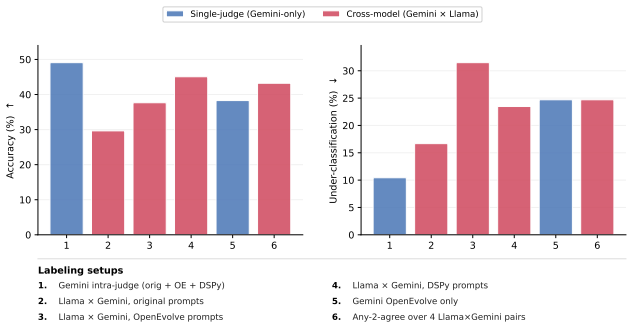
Any-2-agree over 4 Llama×Gemini pairs Single-judge (Gemini-only) Cross-model (Gemini × Llama) Figure 13:The single-judge Gemini setup (1) outperforms cross-model agreement on both accuracy (↑) and under-classification (↓) 0 5 10 15 20 25 30 Under-classification (%) 25 30 35 40...
-
[73]
Gemini intra-judge (orig + OE + DSPy)
-
[74]
Llama × Gemini, original prompts
-
[75]
Llama × Gemini, OpenEvolve prompts
-
[76]
Llama × Gemini, DSPy prompts
-
[77]
Gemini OpenEvolve only
-
[78]
kinetic energy,
Any-2-agree over 4 Llama×Gemini pairs Unadjusted Safety-adjusted Figure 14:The safety adjustment trades under-classification gain for a large accuracy loss and collapses recall on K–5 and 6–8 content on formal notation rather than advanced vocabulary. The low removal rate indi...
1984
-
[286]
We need to find the answer
This method works like an area model where you find the missing side of a rectangle by taking away known chunks of the total area until zero is left. C.5.2 Creating Hand-Authored Natural-Prose CoT For the in-context demonstrations themselves, we hand-authored the solutions rat...
1935
-
[1930]
URLhttps://talkie-lm.com/introducing-talkie
April 2026. URLhttps://talkie-lm.com/introducing-talkie
2026
-
[2022]
URLhttps://arxiv.org/abs/2205.01397
Reviewed August 14, 2026 · model on record in the stance chip above.
Discussion (0). Continue with ORCID to comment.