REVIEW 2 major objections 5 minor 43 references
Anomalous Microwave Response in YBCO Resonators beyond the Two-Level-System Model
T0 review · 2 major / 5 minor · reviewed 2026-08-01 · deepseek-v4-flash
Pith's one-line read YBCO microwave resonators show a low-temperature response that the two-level-system model cannot explain: power-independent loss, no saturation, and a frequency upturn consistent with a paramagnetic contribution.
desk verdict The TLS-negative result is solid and worth publishing; the paramagnetic interpretation is an honest but under-supported guess, and the paper should be reviewed rather than desk-rejected. read the letter →
The pith
A machine-rendered reading of the paper's core claim, the machinery that carries it, and where it could break.
The reading
What carries the argument
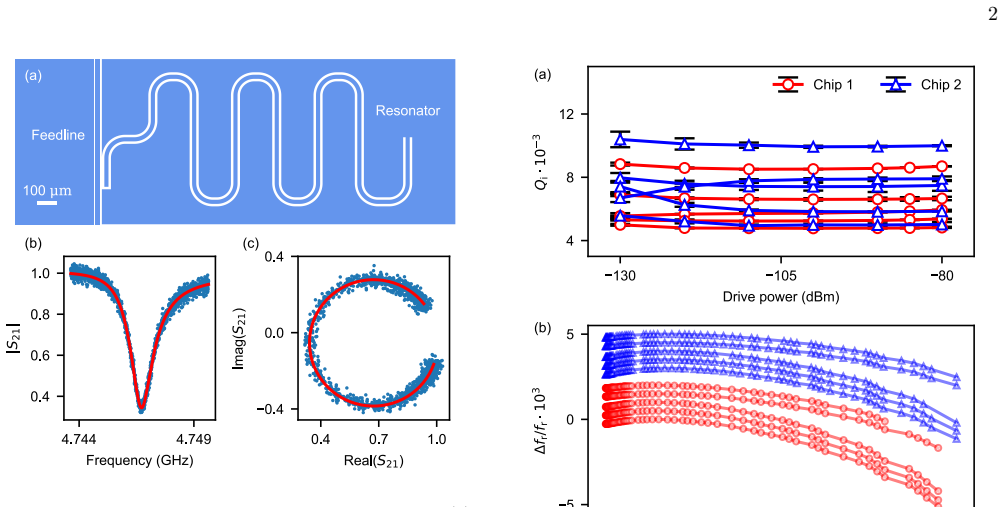
The central object is the kinetic inductance L'_k of the coplanar waveguide, whose temperature dependence converts material response into frequency shift via Δf_r/f_r. The load-bearing modification is Eq. 6, where the vacuum permeability is replaced by μ_0 μ_r with μ_r = 1 + c/(T+θ), a Curie-Weiss-like paramagnetic contribution; this single term is what lets the model fit the low-temperature frequency upturn. On the loss side, the standard TLS expression with its saturation scale h f_r/k_B is the model that the data reject, and Q_i = A + B ln(T/1 K) is the empirical replacement. The absence of microwave-power dependence in Q_i is the key experimental discriminator.
What would settle it
Measure the same film's microwave frequency shift under a small DC magnetic field, or perform a magnetization measurement at 70 mK–6 K: if the 1/(T+θ) term is a true local-moment response, both should show a field-dependent change that tracks c. Alternatively, fabricate resonators from a film with thickness d ≪ λ_ab, where the local-moment permeability correction cancels but a surface Andreev-bound-state response persists; if the low-temperature upturn survives, the local-moment version of the paramagnetic explanation is ruled out.
Extended reading notes
Core claim
On its own terms, the paper's discovery is that in YBCO thin-film coplanar-waveguide resonators between 70 mK and 6 K, both Q_i and Δf_r/f_r rise with temperature, yet this rise is not a TLS effect. The evidence: Q_i is power-independent up to −80 dBm, and the response continues well beyond h f_r/k_B, where a TLS bath would thermally saturate and produce a resolved dip near 100 mK. Adding a Curie-Weiss permeability correction μ_r = 1 + c/(T+θ) inside the kinetic inductance lets the model reproduce the frequency shift over 70 mK–40 K; the TLS-plus-quasiparticle model cannot. The authors deliberately stop short of identifying the microscopic source, since local moments and Andreev bound states
Load-bearing premise
The load-bearing premise is that a Curie-Weiss permeability term μ_r = 1 + c/(T+θ) slipped into the kinetic inductance formula is the right description of the low-temperature frequency shift; the parameters c and θ are fit to the very data they explain, with no independent magnetization, field-dependence, or surface-state measurement to confirm that a paramagnetic mechanism is present.
Editorial extensions
If this is right
- If the response is not TLS-dominated, the usual TLS extraction procedure—checking power dependence and h f/k_B saturation—will misattribute low-temperature loss in YBCO devices to dielectric defects when the film itself is responsible.
- The measured peak Q_i of roughly 8×10^3 to 1.7×10^4 near 6–8 K provides a concrete loss benchmark for whether YBCO resonators are usable in parametric amplifiers, detectors, and hybrid quantum circuits at millikelvin temperatures.
- Because the paramagnetic term is fit to the frequency data alone, device modeling that uses the extracted λ_ab(0) (232±6 nm for chip 1, 160±9 nm for chip 2) and β values inherits the assumption that the paramagnetic interpretation is correct.
- Thinner-film resonators should distinguish the two candidate mechanisms: a local-moment permeability correction cancels in the thin-film limit d ≪ λ_ab, whereas a surface Andreev-bound-state response persists.
- Magnetic-field and stronger microwave-power studies would test whether the same low-temperature degrees of freedom produce the logarithmic loss.
Reading between the lines
- Editorial inference: if the same degrees of freedom cause both the frequency upturn and the logarithmic loss, then deliberately introducing controlled disorder into YBCO films, for example by ion irradiation, should scale c, θ, and the logarithmic slope together; one such measurement set would test the connection the authors leave implicit.
- Editorial inference: the systematic difference between the two films—Cu-excess versus Y-excess growth—in both λ_ab(0) and the Curie-Weiss parameters hints that defect chemistry controls the moment density; comparing a series of stoichiometries could turn the phenomenological c and θ into a materials variable without needing magnetometry.
- Editorial inference: the absence of power dependence does not eliminate Andreev bound states, since the drive used is far below the reported suppression power scale; a high-power sweep across the nonlinear Meissner regime would be a sharper falsifier than the temperature data alone.
- Editorial inference: because the frequency-shift fits require a global λ_ab(0) per chip across different resonator geometries, the extracted parameters likely reflect the film rather than the circuit, so the same paramagnetic correction should appear in other YBCO geometries such as microstrip or 3D cavities.
Editorial analysis
A structured set of objections, weighed in public.
Referee Report
Summary. The paper reports measurements of coplanar-waveguide (CPW) resonators fabricated from YBCO thin films at temperatures from ~70 mK to 40 K. The authors find that the internal quality factor Q_i and the fractional frequency shift Δf_r/f_r both increase with temperature at low temperature, a behavior superficially resembling that of two-level-system (TLS) defects. However, they observe no microwave-power dependence of Q_i, and neither quantity saturates on the characteristic temperature scale h f_r / k_B. The high-temperature response is consistent with quasiparticle losses and the London penetration-depth variation of a d-wave superconductor. The authors show that a conventional TLS model cannot describe the low-temperature data and propose that the frequency upturn is consistent with a paramagnetic contribution from local moments or Andreev bound states, while the loss has an approximately logarithmic temperature dependence of unknown origin. The central negative claim—that TLS alone cannot explain the response—is supported by direct data features, whereas the positive paramagnetic interpretation is presented as one possible explanation with acknowledged ambiguity.
Significance. If the negative claim holds, the paper provides an important benchmark for millikelvin microwave performance of patterned YBCO resonators and a clear demonstration that the TLS framework, developed for conventional superconducting circuits, is insufficient for high-T_c devices. The absence of power dependence and the failure of TLS temperature scales are strong, direct empirical results. The paper also offers a plausible speculative mechanism for the low-temperature anomaly, but the positive interpretation is not uniquely established. The measurements are of good quality and the paper is clearly written. The significance would be enhanced if the paramagnetic model were tested against alternative functional forms or supported by independent measurements.
major comments (2)
- [§III, Eq. (6)] The paramagnetic interpretation of the frequency upturn rests on the ad hoc insertion of μ_r = 1 + c/(T+θ) into the kinetic-inductance formula. The parameters c and θ are fit to the same Δf_r/f_r data they are intended to explain, and the paper itself states that localized moments and Andreev bound states produce nearly indistinguishable corrections. No independent measurement (magnetization, field dependence, or control of surface Andreev states) verifies the presence of a paramagnetic response. To make the 'paramagnetic response' label more than a curve fit, the authors should compare Eq. (6) against alternative low-temperature reactive models (power-law, logarithmic, or a second kinetic-inductance term) and report appropriate goodness-of-fit or evidence metrics. Lacking this, the abstract and conclusions should be worded more cautiously, e.g., 'consistent with a paramagnetic-like cont
- [§V, thin-film limit discussion] The authors note that in the thin-film limit d ≪ λ_ab, the μ_r dependence in Eq. (6) cancels, leaving L'_k ≃ G μ_0 λ_ab^2/d. For the actual films, d = 210 nm and λ_ab(0) = 160–232 nm, so d/λ_ab ≈ 1.3–1.9, and the sensitivity to μ_r is suppressed relative to the thick-film case but not negligible. The paper does not quantify how strongly the fitted c and θ values modify L'_k for the measured d/λ_ab, nor whether the extracted paramagnetic susceptibility is physically plausible. A quantitative assessment of the magnitude and uncertainty of this correction is needed to support the paramagnetic model and to motivate the proposed thin-film differentiation experiment.
minor comments (5)
- [§IV, Kondo scattering paragraph] The argument that Kondo scattering is in the opposite direction is incorrect as stated. If 1/τ ∝ −ln T, then as T increases, 1/τ decreases and τ increases, so Q_i ∝ τ would increase with T, which is the observed trend. The sign is therefore consistent, not opposite. The conclusion that Kondo scattering is unlikely may still be correct, but it needs a different justification (e.g., the magnitude of the effect or the known τ ≈ 1 ps in YBCO).
- [Appendix A] The text says 'fit Δf_r/f_r to obtain a, c, θ, and n', but n is not defined in the model of Eqs. (3)–(5). This should be β or another clearly defined parameter.
- [§III, Eq. (3)] The definition of Δf_r/f_r lacks an explicit reference temperature. The normalization constant C is described as a small offset but is not reported; please state the reference and include C in the fit table.
- [§III–IV, TLS fits] For the TLS frequency-shift fit (Eq. 2) and TLS loss fit (Eq. 10), the text claims failure but does not provide fit parameters or goodness-of-fit statistics. Reporting reduced χ² or residuals would quantitatively support the central negative claim.
- [§II, power dependence] The statement that Q_i shows 'negligible dependence' on power would be strengthened by quoting the maximum relative variation over the measured power range (e.g., ≤ 2%) and the power range in dBm.
Circularity Check
No circularity: the TLS-incompatibility claim rests on direct data, and the paramagnetic/logarithmic models are explicit phenomenological fits, not predictions.
full rationale
The central negative claim—that the low-temperature response cannot be understood within the conventional TLS framework—is supported by direct, model-independent observations: Q_i is power-independent (Fig. 2a), and neither Q_i nor Δf_r/f_r saturates on the hf/k_B scale, with the standard TLS expressions (Eqs. 2 and 10) failing to reproduce the data (§III–IV). This part of the argument is self-contained and does not depend on the later fits. The positive interpretation of the Δf_r/f_r upturn uses μ_r = 1 + c/(T+θ) in Eq. 6 with c and θ fit to the same Δf_r/f_r data, and Eq. 11 fits A and B to Q_i; the paper explicitly calls these descriptions rather than predictions ('may be better described', 'phenomenological model'), and states the data 'do not distinguish whether it originates from localized magnetic moments or surface Andreev bound states' while the loss's 'microscopic origin remains unresolved.' An in-sample fit, even a speculative one, is not equivalent by definition to a derivation unless it is relabeled as an out-of-sample prediction; no such relabeling occurs here. There is also no load-bearing self-citation or imported uniqueness theorem. Accordingly no circular step is established.
Assumptions & free parameters
free parameters (7)
- λ_ab(0) =
232±6 nm (chip 1), 160±9 nm (chip 2)
- a =
0.35–0.68 across resonators
- β =
1.96–2.32 across resonators
- c =
0.45–1.55 K (Table A1)
- θ =
5.3–10.8 K (Table A1)
- A and B (log-loss intercept/slope) =
A ≈ 6–13 ×10^-3, B ≈ 5–15 ×10^-2 (Table A1)
- Normalization constant C =
≈1
assumptions (6)
- standard math Two-level-system model equations for frequency shift and loss (Eqs. 2, 9) describe dielectric TLS baths in superconducting resonators.
- domain assumption Penetration depth of d-wave YBCO follows λab(T)=λab(0)(1+a(T/Tc)^β) with β≈2 over the measured range.
- domain assumption CPW kinetic inductance formula L'_k = G μ0 λab coth(d/λab) with geometric factor G from ANSYS simulations.
- ad hoc to paper Paramagnetic response can be modeled by μ_r = 1 + c/(T+θ) multiplying the London term (Eq. 6).
- domain assumption Quasiparticle conductivity follows Drude form σ1 = n_qp e^2 τ/(m*(1+ω^2τ^2)) (Eq. 8).
- standard math Measured S21 resonance features are accurately described by the complex-Qc circle fit Eq. (1).
Cite this review
Pith. "Pith review of Anomalous Microwave Response in YBCO Resonators beyond the Two-Level-System Model." pith.science (2026). https://pith.science/paper/5HQZANJ2
@misc{pith2026260727392,
  author       = {Pith},
  title        = {Pith review of: Anomalous Microwave Response in YBCO Resonators beyond the Two-Level-System Model},
  year         = {2026},
  howpublished = {\url{https://pith.science/paper/5HQZANJ2}},
  note         = {Machine review of arXiv:2607.27392}
}
abstract
We report the microwave response of coplanar-waveguide (CPW) resonators fabricated from $\mathrm{YBa_2Cu_3O_{7-\delta}}$ (YBCO) thin films over temperatures from approximately $70~\mathrm{mK}$ to $40~\mathrm{K}$. The resonators exhibit internal quality factors $Q_\mathrm{i}$ in the range of $4\times10^3$ to $10^4$ at 70 mK, which increase to a maximum of approximately $8\times10^3$ to $1.2\times10^4$ near $6~\mathrm{K}$. At low temperatures, both $Q_\mathrm{i}$ and the fractional shift of the resonance frequency $\Delta f_\mathrm{r}/f_\mathrm{r}$ increases with temperature, qualitatively resembling behavior commonly associated with two-level-system (TLS) defects. However, neither response saturates on the temperature scale set by the resonator frequency, and the loss exhibits no observable microwave-power dependence. We show that low-temperature frequency upturn may be better described by an additional paramagnetic response associated with defect-induced local moments or Andreev bound states, while the low-temperature loss follows an approximately logarithmic temperature dependence whose microscopic origin remains unresolved. These measurements establish the millikelvin performance of patterned YBCO resonators and show that their low-temperature response cannot be understood within the conventional TLS framework alone.
Figures


Figures from the paper (1 more)

Reference graph
Works this paper leans on
-
[1]
Gao,The physics of superconducting microwave res- onators, Ph.D
J. Gao,The physics of superconducting microwave res- onators, Ph.D. thesis, California Institute of Technology (2008). 7
2008
-
[2]
Blais, A
A. Blais, A. L. Grimsmo, S. M. Girvin, and A. Wallraff, Circuit quantum electrodynamics, Rev. Mod. Phys.93, 025005 (2021)
2021
-
[3]
C. G. L. Bøttcher, N. R. Poniatowski, A. Grankin, M. E. Wesson, Z. Yan, U. Vool, V. M. Galitski, and A. Yacoby, Circuit quantum electrodynamics detection of induced two-fold anisotropic pairing in a hybrid superconductor– ferromagnet bilayer, Nature Physics20, 1609 (2024)
2024
-
[4]
M. Kreidel, J. Ingham, X. Chu, J. Balgley, T. S. Chung, A. Antony, N. Verma, L. N. Holtzman, K. Barmak, R. Queiroz, J. Hone, R. M. Westervelt, and K. C. Fong, Observing unconventional superconductivity via kinetic inductance in weyl semimetal MoTe 2 (2025), arXiv:2512.24671 [cond-mat.supr-con]
arXiv 2025
-
[5]
S. Zaman, J. I.-J. Wang, T. Werkmeister, M. Tanaka, T. Dinh, M. Hays, D. Rodan-Legrain, A. Goswami, R. Assouly, A. K. Demir, D. K. Kim, B. M. Niedzielski, K. Serniak, M. E. Schwartz, K. Watanabe, T. Taniguchi, P. Kim, R. Comin, J. A. Grover, T. P. Orlando, P. Jarillo-Herrero, and W. D. Oliver, Kinetic inductance of few-layer NbSe 2 in the two-dimensional ...
arXiv 2026
-
[6]
H. Jin, G. Serpico, Y. Lee, T. Confalone, C. N. Saggau, F. Lo Sardo, G. Gu, B. H. Goodge, E. Lesne, D. Mon- temurro, K. Nielsch, N. Poccia, and U. Vool, Exploring van der waals cuprate superconductors using a hybrid microwave circuit, Nano Letters25, 3191 (2025)
2025
-
[7]
Banerjee, Z
A. Banerjee, Z. Hao, M. Kreidel, P. Ledwith, I. Phinney, J. M. Park, A. Zimmerman, M. E. Wesson, K. Watanabe, T. Taniguchi, R. M. Westervelt, A. Yacoby, P. Jarillo- Herrero, P. A. Volkov, A. Vishwanath, K. C. Fong, and P. Kim, Superfluid stiffness of twisted trilayer graphene superconductors, Nature638, 93 (2025)
2025
-
[8]
C. R. H. McRae, H. Wang, J. Gao, M. R. Vissers, T. Brecht, A. Dunsworth, D. P. Pappas, and J. Mutus, Materials loss measurements using superconducting mi- crowave resonators, Review of Scientific Instruments91, 091101 (2020)
2020
Show all 43 references
-
[9]
Kreidel, X
M. Kreidel, X. Chu, J. Balgley, A. Antony, N. Verma, J. Ingham, L. Ranzani, R. Queiroz, R. M. Westervelt, J. Hone, and K. C. Fong, Measuring kinetic inductance and superfluid stiffness of two-dimensional supercon- ductors using high-quality transmission-line resonators, Phys. ...
2024
-
[10]
X. Chu, J. Park, J. Balgley, S. Clemons, T. S. Chung, K. Watanabe, T. Taniguchi, L. Ranzani, M. V. Gustafs- son, K. C. Fong, and J. Hone, Measuring reactive-load impedance with transmission-line resonators beyond the perturbative limit, Phys. Rev. Appl.25, 044071 (2026)
2026
-
[11]
M¨ uller, J
C. M¨ uller, J. H. Cole, and J. Lisenfeld, Towards under- standing two-level-systems in amorphous solids: insights from quantum circuits, Reports on Progress in Physics 82, 124501 (2019)
2019
-
[12]
K. D. Crowley, R. A. McLellan, A. Dutta, N. Shumiya, A. P. M. Place, X. H. Le, Y. Gang, T. Madhavan, M. P. Bland, R. Chang, N. Khedkar, Y. C. Feng, E. A. Um- barkar, X. Gui, L. V. H. Rodgers, Y. Jia, M. M. Feldman, S. A. Lyon, M. Liu, R. J. Cava, A. A. Houck, and N. P. de Leon...
2023
-
[13]
P. J. Hirschfeld and N. Goldenfeld, Effect of strong scat- tering on the low-temperature penetration depth of a d- wave superconductor, Phys. Rev. B48, 4219(R) (1993)
1993
-
[14]
Prozorov and R
R. Prozorov and R. W. Giannetta, Magnetic penetration depth in unconventional superconductors, Superconduc- tor Science and Technology19, R41 (2006)
2006
-
[15]
Bobroff, W
J. Bobroff, W. A. MacFarlane, H. Alloul, P. Mendels, N. Blanchard, G. Collin, and J.-F. Marucco, Spinless im- purities in high-T c cuprates: Kondo-like behavior, Phys. Rev. Lett.83, 4381 (1999)
1999
-
[16]
Y. S. Barash, M. S. Kalenkov, and J. Kurkij¨ arvi, Low- temperature magnetic penetration depth in d-wave su- perconductors: Zero-energy bound state and impurity effects, Phys. Rev. B62, 6665 (2000)
2000
-
[17]
A. P. Zhuravel, B. G. Ghamsari, C. Kurter, P. Jung, S. Remillard, J. Abrahams, A. V. Lukashenko, A. V. Ustinov, and S. M. Anlage, Imaging the anisotropic non- linear meissner effect in nodal yba 2cu3o7−δ thin-film su- perconductors, Phys. Rev. Lett.110, 087002 (2013)
2013
-
[18]
Hosseini, R
A. Hosseini, R. Harris, S. Kamal, P. Dosanjh, J. Pre- ston, R. Liang, W. N. Hardy, and D. A. Bonn, Mi- crowave spectroscopy of thermally excited quasiparticles in YBa2Cu3O6.99, Phys. Rev. B60, 1349 (1999)
1999
-
[19]
Velluire-Pellat, E
Z. Velluire-Pellat, E. Mar´ echal, N. Moulonguet, G. Sa ¨ ız, G. C. M´ enard, S. Kozlov, F. Cou¨ edo, P. Amari, C. Medous, J. Paris, R. Hostein, J. Lesueur, C. Feuillet- Palma, and N. Bergeal, Hybrid quantum systems with high-tc superconducting resonators, Scientific Reports 1...
2023
-
[20]
Ghirri, C
A. Ghirri, C. Bonizzoni, D. Gerace, S. Sanna, A. Cassi- nese, and M. Affronte, Yba2cu3o7 microwave resonators for strong collective coupling with spin ensembles, Ap- plied Physics Letters106, 184101 (2015)
2015
-
[21]
Fohmann, T
K. Fohmann, T. J. Glebe-M¨ arklin, B. Wilde, M. Ka- zouini, C. Schmid, D. Koelle, R. Kleiner, and D. Both- ner, Dually tunable ybco coplanar waveguide resonators based on helium-ion-generated josephson inductances (2026), arXiv:2605.30425 [quant-ph]
2026 arXiv
-
[22]
Duthaluru, K
S. Duthaluru, K. Zheng, E. A. Henriksen, and K. W. Murch, Real-time monitoring of neon film growth for electron-on-neon qubits (2025), arXiv:2511.20765 [quant- ph]
2025 arXiv
-
[23]
M. W. Denhoff and J. P. McCaffrey, Epitaxial Y1Ba2Cu3O7 thin films on CeO 2 buffer layers on sap- phire substrates, Journal of Applied Physics70, 3986 (1991)
1991
-
[24]
J. Gao, B. B. G. Klopman, W. A. M. Aarnink, A. E. Reitsma, G. J. Gerritsma, and H. Rogalla, Epitaxial YBa2Cu3Ox thin films on sapphire with a PrBa2Cu3Ox buffer layer, Journal of Applied Physics71, 2333 (1992)
1992
-
[25]
M. S. Khalil, M. J. A. Stoutimore, F. C. Wellstood, and K. D. Osborn, An analysis method for asymmetric res- onator transmission applied to superconducting devices, Journal of Applied Physics111, 054510 (2012)
2012
-
[26]
Probst, F
S. Probst, F. B. Song, P. A. Bushev, A. V. Ustinov, and M. Weides, Efficient and robust analysis of complex scat- tering data under noise in microwave resonators, Review of Scientific Instruments86, 024706 (2015)
2015
-
[27]
P. J. Hirschfeld, W. O. Putikka, and D. J. Scalapino, Mi- crowave conductivity of d-wave superconductors, Phys. Rev. Lett.71, 3705 (1993)
1993
-
[28]
P. w. Anderson, B. I. Halperin, and c. M. Varma, Anoma- lous low-temperature thermal properties of glasses and spin glasses, The Philosophical Magazine: A Journal of Theoretical Experimental and Applied Physics25, 1 (1972), https://doi.org/10.1080/14786437208229210
1972 doi
-
[29]
W. A. Phillips, Tunneling states in amorphous solids, Journal of Low Temperature Physics7, 351 (1972). 8
1972
-
[30]
L´ opez-N´ u˜ nez, A
D. L´ opez-N´ u˜ nez, A. Torras-Coloma, Q. Portell- Montserrat, E. Bertoldo, L. Cozzolino, G. A. Um- marino, A. Zaccone, G. Rius, M. Mart ´ ınez, and P. Forn- D ´ ıaz, Superconducting penetration depth of aluminum thin films, Superconductor Science and Technology38, 095004 (2025)
2025
-
[31]
Klein, H
N. Klein, H. Chaloupka, G. M¨ uller, S. Orbach, H. Piel, B. Roas, L. Schultz, U. Klein, and M. Peiniger, The effec- tive microwave surface impedance of high tc thin films, Journal of Applied Physics67, 6940 (1990)
1990
-
[32]
Wang and P
Z. Wang and P. A. Lee, Local moment formation in the superconducting state of a doped mott insulator, Phys. Rev. Lett.89, 217002 (2002)
2002
-
[33]
A. V. Mahajan, H. Alloul, G. Collin, and J. F. Marucco, 89y nmr probe of zn induced local magnetism in YBa2(Cu1−yZny)3O6+x, The European Physical Journal B - Condensed Matter and Complex Systems13, 457 (2000)
2000
-
[34]
Bobroff, H
J. Bobroff, H. Alloul, W. A. MacFarlane, P. Mendels, N. Blanchard, G. Collin, and J.-F. Marucco, Persistence of li induced kondo moments in the superconducting state of cuprates, Phys. Rev. Lett.86, 4116 (2001)
2001
-
[35]
A. P. Zhuravel, S. Bae, S. N. Shevchenko, A. N. Omelyan- chouk, A. V. Lukashenko, A. V. Ustinov, and S. M. An- lage, Imaging the paramagnetic nonlinear meissner effect in nodal gap superconductors, Phys. Rev. B97, 054504 (2018)
2018
-
[36]
D. A. Bonn, R. Liang, T. M. Riseman, D. J. Baar, D. C. Morgan, K. Zhang, P. Dosanjh, T. L. Duty, A. Mac- Farlane, G. D. Morris, J. H. Brewer, W. N. Hardy, C. Kallin, and A. J. Berlinsky, Microwave determination of the quasiparticle scattering time in YBa 2Cu3O6.95, Phys. Rev. ...
1993
-
[37]
Kondo, Resistance minimum in dilute mag- netic alloys, Progress of Theoretical Physics32, 37 (1964), https://academic.oup.com/ptp/article- pdf/32/1/37/5193092/32-1-37.pdf
J. Kondo, Resistance minimum in dilute mag- netic alloys, Progress of Theoretical Physics32, 37 (1964), https://academic.oup.com/ptp/article- pdf/32/1/37/5193092/32-1-37.pdf
1964
-
[38]
Sekitani, M
T. Sekitani, M. Naito, and N. Miura, Kondo effect in underdoped n-type superconductors, Phys. Rev. B67, 174503 (2003)
2003
-
[39]
Rullier-Albenque, H
F. Rullier-Albenque, H. Alloul, F. Balakirev, and C. Proust, Disorder, metal-insulator crossover and phase diagram in high-tc cuprates, Europhysics Letters81, 37008 (2008)
2008
-
[40]
Rullier-Albenque, H
F. Rullier-Albenque, H. Alloul, and R. Tourbot, Disorder and transport in cuprates: Weak localization and mag- netic contributions, Phys. Rev. Lett.87, 157001 (2001)
2001
-
[41]
Ho Eom, P
B. Ho Eom, P. K. Day, H. G. LeDuc, and J. Zmuidzinas, A wideband, low-noise superconducting amplifier with high dynamic range, Nature Physics8, 623 (2012)
2012
-
[42]
P. K. Day, H. G. LeDuc, B. A. Mazin, A. Vayonakis, and J. Zmuidzinas, A broadband superconducting detector suitable for use in large arrays, Nature425, 817 (2003)
2003
-
[43]
Confalone, F
T. Confalone, F. Lo Sardo, Y. Lee, S. Shokri, G. Serpico, A. Coppo, L. Chirolli, V. M. Vinokur, V. Brosco, U. Vool, D. Montemurro, F. Tafuri, K. Nielsch, G. Haider, and N. Poccia, Cuprate twistronics for quantum hardware, Advanced Quantum Technologies8, 2500203 (2025)
2025
Reviewed August 1, 2026 · model on record in the stance chip above.
Discussion (0). Continue with ORCID to comment.