REVIEW 3 major objections 7 minor 39 references
Decay asymmetries could expose or kill a dark-matter model
Reviewed by Pith at T0; open to challenge. T0 means a machine referee read the full paper against a public rubric. the ladder, T0–T4 →
T0 review · glm-5.2
2026-07-09 09:29 UTC pith:5JDSBU6O
load-bearing objection Solid phenomenological study of cLFV in a specific scotogenic variant; the tau asymmetry prediction is the headline result but rests on thin sampling. the 3 major comments →
Revisiting cLFV in "T1-2-A" scotogenic models: asymmetries in three-body lepton decays
The pith
A machine-rendered reading of the paper's core claim, the machinery that carries it, and where it could break.
Core claim
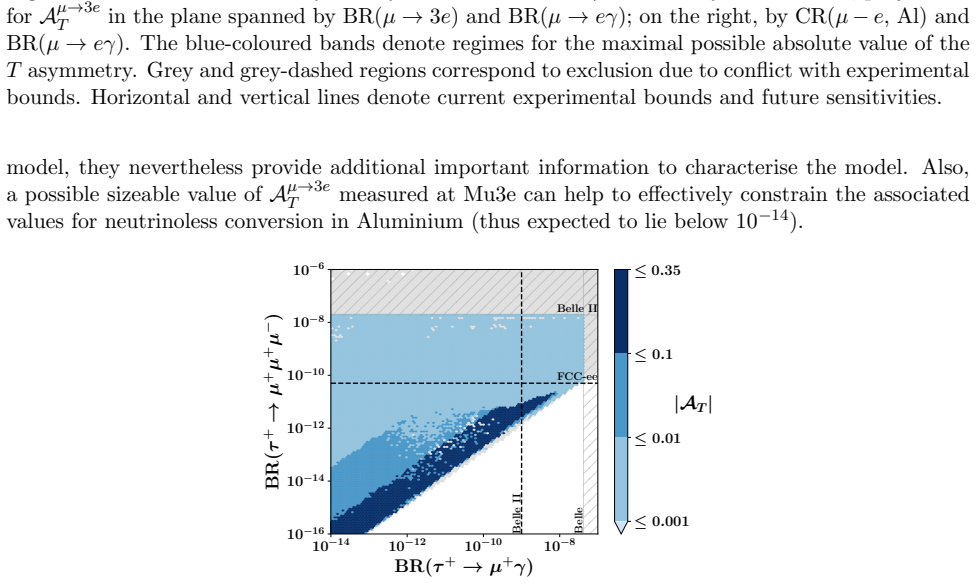
The central finding is that once the T1-2-A scotogenic model is explored without requiring it to explain the muon g-2 anomaly, the dipole-dominated regime that previously produced tight correlations between cLFV observables gives way to a multi-operator regime. In this new regime, the T, P, and P' angular asymmetries in three-body lepton decays become the discriminating observables. The tau-to-3-mu channel is the most predictive: phenomenologically viable points within future FCC-ee sensitivity cluster at A_T approximately 0 and |A_P| up to 90 percent, while the muon-to-3e channel allows asymmetries up to 25 percent or more across a broader ellipse reflecting interference among at leastthree
What carries the argument
The T1-2-A scotogenic model adds one scalar doublet, one real scalar singlet, two Majorana fermion singlets, and two vector-like Dirac fermion doublets to the Standard Model, all odd under a Z2 symmetry whose lightest state is the dark-matter candidate. Neutrino masses arise at one loop. The cLFV three-body decay amplitudes receive contributions from dipole, anapole, Z-penguin, Higgs-penguin, and box diagrams, and the T, P, and P' asymmetries are constructed from the spin-dependent angular distribution of the decay products of a polarised lepton. A modified Casas-Ibarra parametrisation enforces neutrino oscillation data, and a differential-evolution Markov-Chain Monte Carlo scan explores the
Load-bearing premise
The parameter-space scan uses bonus weights that favour points within future experimental sensitivity and points satisfying all constraints, which means the reported distributions of asymmetries and rates reflect a non-uniform sampling rather than an unbiased survey; the paper does not verify whether the qualitative asymmetry patterns (especially the tau-to-3-mu signature) survive a change of weighting scheme.
What would settle it
Observation of a non-zero T asymmetry in tau-to-3-mu decays at a level clearly above approximately one percent, for decay rates within FCC-ee reach, would contradict the model's prediction of A_T near zero in that region and thus falsify the T1-2-A scotogenic variant.
If this is right
- If tau-to-3-mu decays are observed at FCC-ee with a sizeable T asymmetry, the T1-2-A scotogenic model would be strongly disfavoured, since its viable parameter space predicts A_T near zero for points within experimental reach.
- If muon-to-3e is observed at Mu3e, the measured asymmetries can constrain the expected rate of muon-to-electron conversion in aluminium, providing a cross-check between different experimental programmes.
- The loss of dipole-dominance correlations means that observing a single cLFV channel no longer pins down the model; multiple observables, including asymmetries, are needed to characterise or exclude it.
- The identification of box-diagram and anapole contributions as dominant in certain flavour channels suggests that future experimental strategies should target not just branching ratios but angular distributions to disentangle the underlying operators.
Editorial analysis
A structured set of objections, weighed in public.
Referee Report
Summary. This manuscript presents a comprehensive reassessment of charged lepton flavour violation (cLFV) in the T1-2-A scotogenic model, motivated by the recent resolution of the (g-2)_mu anomaly. The authors perform a differential evolution MCMC (DE-MCMC) scan of the model's parameter space, treating neutrino oscillation data as the sole input (via a Casas-Ibarra parametrisation) and all cLFV observables as outputs. The study finds that, freed from the requirement of saturating (g-2)_mu, the model predicts sizeable cLFV rates within reach of future experiments, particularly in muon transitions. The novel element is the computation of T, P, and P' asymmetries in three-body lepton decays (mu->3e and tau->3mu), which serve as additional discriminating observables. The authors identify a distinctive pattern for tau->3mu decays within FCC-ee reach: A_T ~ 0 and |A_P| up to 90%, presented as a falsifiable prediction of the model.
Significance. The paper makes a timely contribution by revisiting the cLFV phenomenology of the T1-2-A scotogenic model in light of the resolved (g-2)_mu tension. The computation of asymmetries in three-body cLFV decays using full numerical integration (rather than asymptotic expansions) is a methodological strength, and the identification of falsifiable patterns in the tau sector is phenomenologically valuable. The analytical expressions for branching ratios and asymmetries (Eqs. 15-19) are clearly presented and consistent with the effective operator framework. The study of CP-sensitive invariants (Eq. 20) as a diagnostic for A_T is a nice addition. The work provides concrete, testable predictions that complement existing cLFV correlation studies.
major comments (3)
- Section 2.3 (DE-MCMC scan): The weighting scheme assigns 'bonus weights' to points within future experimental sensitivity and to points satisfying all constraints. This non-uniform sampling directly affects which regions of parameter space appear in the final results, yet the paper does not discuss whether the qualitative conclusions — particularly the tau asymmetry pattern (A_T ~ 0, |A_P| up to 90%) — are robust under alternative weighting choices. Since this pattern is presented as a falsifiable prediction, its dependence on the sampling procedure should be addressed. At minimum, the authors should clarify whether the A_T ~ 0 pattern for FCC-ee-reachable points is driven by a physical argument (operator dominance structure) or by the sampling. The statement in Section 4.3 that FCC-ee-reachable points are 'either strongly box dominated or dipole dominated' is plausible but unquantified;
- Section 4.2 and Fig. 11: The number of sampled points within FCC-ee sensitivity (BR(tau->3mu) >= 5e-11) is not reported and appears very small from the figure. The claim that A_T ~ 0 for these points is presented as a distinctive prediction, but its statistical significance is unclear. The authors should state the number of points in this subset and provide some measure of whether the A_T ~ 0 pattern is a robust feature or an artefact of small statistics. Footnote 11 acknowledges that alternative patterns exist but are 'statistically disfavoured (almost singular)' — in a weighted scan, 'statistically disfavoured' is a property of the sampling, not necessarily of the model. Providing the operator decomposition for the FCC-ee-reachable subset (analogous to Fig. 7 for mu->3e) would strengthen the claim.
- Footnote 11: The acknowledgement that points with large A_T within experimental reach exist but are 'statistically disfavoured' is important and should be promoted to the main text. As currently placed in a footnote, it risks being overlooked. The physical argument for why these cases are 'almost singular' (requiring specific cancellations in the Casas-Ibarra parametrisation) should be elaborated, and the authors should clarify whether a flavour symmetry could render these cases less fine-tuned, which would weaken the A_T ~ 0 prediction. This is directly relevant to the falsifiability claim.
minor comments (7)
- Table 3: The parameter ranges for the quartic couplings (lambda_S, lambda_eta, etc.) span 10^-10 to 1. The lower bound of 10^-10 seems unusually small; the authors should clarify whether this is physically motivated or a scanning artefact, and whether perturbativity is enforced as an upper cut and at what scale.
- Section 2.3: The chi^2 construction is described only qualitatively. A more precise specification of which observables enter the chi^2 and how the 'bonus weights' are numerically implemented would help reproducibility.
- Fig. 8: The distinction between 'Beyond experimental reach' and 'Within Mu3e/FCC-ee future reach' points is made by colour, but the colour coding is not easily distinguishable in the printed version. Using different marker styles in addition to colour would improve clarity.
- Eq. (12): The notation for the asymmetry definitions in Eq. (13) uses integration regions that are somewhat unusual. A brief comment on the physical meaning of each integration region (or a reference to where this is derived) would help the reader.
- Section 4.1: The statement that points within reach for tau->3e decays are 'not statistically significant' should be quantified — how many points are there, and at what level?
- The reference to [17] (Darricau, Kriewald, Teixeira) appears to be a companion paper. The overlap in methodology and results between the two papers should be clarified to ensure that novelty is properly delineated.
- Fig. 2: The colour palette for the third-generation coupling variation is described but the actual colour-to-value mapping is not clearly indicated in the figure caption. A colour bar or explicit statement of which colour corresponds to which coupling value would help.
Simulated Author's Rebuttal
We thank the referee for a careful and constructive report, and for recognizing the timeliness and methodological contributions of our work. The three major comments all concern the robustness and presentation of the tau asymmetry pattern (A_T ~ 0, |A_P| up to 90%) for FCC-ee-reachable points. We agree that these are important points that warrant clarification and, in two cases, revision of the manuscript. Below we address each comment in turn.
read point-by-point responses
-
Referee: Section 2.3 (DE-MCMC scan): The weighting scheme assigns 'bonus weights' to points within future experimental sensitivity and to points satisfying all constraints. This non-uniform sampling directly affects which regions of parameter space appear in the final results, yet the paper does not discuss whether the qualitative conclusions — particularly the tau asymmetry pattern (A_T ~ 0, |A_P| up to 90%) — are robust under alternative weighting choices. Since this pattern is presented as a falsifiable prediction, its dependence on the sampling procedure should be addressed. At minimum, the authors should clarify whether the A_T ~ 0 pattern for FCC-ee-reachable points is driven by a physical argument (operator dominance structure) or by the sampling. The statement in Section 4.3 that FCC-ee-reachable points are 'either strongly box dominated or dipole dominated' is plausible but unquantified.
Authors: The referee raises a valid concern. We agree that the physical origin of the A_T ~ 0 pattern must be distinguished from any artifact of the sampling procedure, and that the statement in Section 4.3 regarding box/dipole dominance is unquantified. We will revise the manuscript to address both points. First, we will clarify that the A_T ~ 0 pattern for FCC-ee-reachable tau->3mu points is driven by the operator structure, not by the sampling: from Eq. (19), A_T requires interference between the dipole form factor (K_{2}^{L/R}) and the vector/scalar four-fermion operators (A^{V,S}_{XY}). For tau->3mu, the FCC-ee-reachable points are dominated by either the right-right vector box (B^V_{RR}, proportional to g_R^alpha g_R^{beta*}) or the dipole (K_2^R). In the box-dominated regime, the dipole contribution is subdominant, suppressing A_T which requires dipole-vector interference. In the dipole-dominated regime, A_T vanishes because it requires interference between two distinct operators. Thus A_T ~ 0 follows from the operator dominance structure, not from the weighting. Second, we will quantify the operator decomposition for the FCC-ee-reachable subset, providing the fraction of points that are box-dominated versus dipole-dominated, and the typical ratio of subdominant to dominant operator contributions. This will be added to Section 4.3. revision: yes
-
Referee: Section 4.2 and Fig. 11: The number of sampled points within FCC-ee sensitivity (BR(tau->3mu) >= 5e-11) is not reported and appears very small from the figure. The claim that A_T ~ 0 for these points is presented as a distinctive prediction, but its statistical significance is unclear. The authors should state the number of points in this subset and provide some measure of whether the A_T ~ 0 pattern is a robust feature or an artefact of small statistics. Footnote 11 acknowledges that alternative patterns exist but are 'statistically disfavoured (almost singular)' — in a weighted scan, 'statistically disfavoured' is a property of the sampling, not necessarily of the model. Providing the operator decomposition for the FCC-ee-reachable subset (analogous to Fig. 7 for mu->3e) would strengthen the claim.
Authors: We agree that the number of FCC-ee-reachable points should be stated explicitly and that the operator decomposition for this subset would strengthen the claim. We will add both to the revised manuscript. Specifically, we will report the number of sampled points with BR(tau->3mu) >= 5e-11 and provide an operator decomposition plot analogous to Fig. 7, showing the relative contributions of B^V_{RR}, B^V_{LL}, K_2, and other operators for this subset. This will make clear that the A_T ~ 0 pattern is a consequence of single-operator dominance (either box or dipole) at each point, rather than a statistical artifact. Regarding the referee's important observation that 'statistically disfavoured' is a property of the sampling rather than of the model: we concede this point. We will rephrase the discussion to distinguish clearly between (i) the physical statement that A_T ~ 0 arises from operator dominance structure for the generic FCC-ee-reachable points, and (ii) the fact that points with large A_T within experimental reach do exist in the parameter space but require specific cancellations in the Casas-Ibarra parametrisation. We will avoid the term 'statistically disfavoured' in this context and instead describe these cases as requiring fine-tuned relations among the R-matrix angles, quantifying the degree of tuning where possible. revision: yes
-
Referee: Footnote 11: The acknowledgement that points with large A_T within experimental reach exist but are 'statistically disfavoured' is important and should be promoted to the main text. As currently placed in a footnote, it risks being overlooked. The physical argument for why these cases are 'almost singular' (requiring specific cancellations in the Casas-Ibarra parametrisation) should be elaborated, and the authors should clarify whether a flavour symmetry could render these cases less fine-tuned, which would weaken the A_T ~ 0 prediction. This is directly relevant to the falsifiability claim.
Authors: We agree that this caveat is important for the falsifiability claim and should not be relegated to a footnote. We will promote this discussion to the main text of Section 4.3 and elaborate on the physical argument. Specifically, we will explain that large A_T within experimental reach requires comparable contributions from both the dipole and the box operators (since A_T ~ Im(K_2 * A^{V*})), which in turn demands specific relations among the Casas-Ibarra R-matrix angles that simultaneously enhance both operator contributions while keeping the branching ratio within experimental bounds. These relations are 'almost singular' in the sense that they require near-cancellations among the R-matrix angles that are not generically satisfied. Regarding the question of whether a flavour symmetry could render these cases less fine-tuned: this is a pertinent observation. We will add a discussion noting that imposing a flavour symmetry (for example, a U(1)_{mu-tau} or similar structure) could in principle align the couplings in a way that makes the required interference more natural, thereby weakening the A_T ~ 0 prediction. We will explicitly state that our falsifiability claim applies to the generic (unprotected) parameter space of the T1-2-A model as defined in this work, and that a dedicated study of flavour-symmetric variants would be needed to assess whether the prediction survives such modifications. This honestly scopes the falsifiability claim. revision: yes
Circularity Check
No significant circularity: the Casas-Ibarra parametrisation is an explicit input (not a disguised prediction), and all cLFV observables and asymmetries are computed outputs of the scan.
full rationale
The paper's derivation chain is self-contained against external benchmarks. The Casas-Ibarra parametrisation (Eq. 4) is used to ensure compliance with neutrino oscillation data by construction, but the paper explicitly states in Section 2.3 that 'Only neutrino oscillation data is treated as an input via the Casas-Ibarra parametrisation' and that 'all observables (flavoured rates and ratios, electric and magnetic moments) are now strictly outputs.' This is a transparent input-output separation, not a hidden circularity. The cLFV branching ratios (Eq. 15), asymmetries (Eqs. 17-19), and form factors (Appendix B) are all computed from the model's particle content and couplings via loop diagrams, not fitted to cLFV data. The self-citations to [10] (for form factor computation and EW precision observables) and [17] (for asymmetry formalism) are methodological references, not load-bearing uniqueness theorems invoked to forbid alternatives. The DE-MCMC scan explores the parameter space and evaluates observables as outputs; the weighting scheme (Section 2.3) affects sampling distribution but does not make any prediction equivalent to its inputs by construction. The tau asymmetry pattern (A_T ~ 0, |A_P| up to 90%) is a genuine output of the scan, not a fitted quantity renamed as a prediction. The only minor concern is that the Casas-Ibarra parametrisation ensures neutrino mass compliance by construction, but this is standard practice and explicitly acknowledged as an input rather than claimed as a prediction.
Axiom & Free-Parameter Ledger
free parameters (9)
- alpha (trilinear S-H-eta coupling) =
range [1e-2, 1e4] GeV
- M_S, M_eta (scalar mass parameters) =
range [sqrt(5e5), sqrt(5e6)] GeV
- M_1, M_2 (Majorana fermion masses) =
range [100, 20000] GeV
- M_Psi (Dirac fermion mass) =
range [700, 2000] GeV
- lambda quartic couplings (lambda_S, lambda_eta, lambda_Seta, lambda_eta, lambda_eta', lambda_eta'') =
range [1e-10, 1]
- y_11, y_12, y_21, y_22 (Yukawa couplings) =
range [1e-10, 1]
- theta_R angles (3 complex) =
|theta| in [1e-8, 1e3], arg in [0, 2pi)
- g_R couplings (3 complex) =
|g_R| in [1e-10, sqrt(4pi)], arg in [0, 2pi)
- m_nu1 (lightest neutrino mass) =
range [1e-19, 1e-10] GeV
axioms (6)
- domain assumption Normal ordering of light neutrino spectrum
- domain assumption CP conservation in the scalar sector (alpha and lambda_eta'' real)
- domain assumption Z2 symmetry ensures dark matter stability and forbids tree-level neutrino masses
- domain assumption Perturbativity of all new couplings (g_R up to sqrt(4pi))
- standard math Effective operator basis of [50] is valid for computing cLFV observables
- domain assumption micrOMEGAs correctly computes relic density and direct detection cross-sections for this model
invented entities (4)
-
Scalar doublet eta and real singlet S
no independent evidence
-
Majorana fermion singlets F_1, F_2
no independent evidence
-
Vector-like Dirac fermion doublets Psi_1, Psi_2
no independent evidence
-
Z2 discrete symmetry
no independent evidence
read the original abstract
We consider a well-motivated class of scotogenic models (the "T1-2-A" variant), and carry out a comprehensive reassessment of its prospects regarding charged lepton flavour violating (cLFV) observables. Aiming only at explaining neutrino oscillation data and putting forward a viable dark matter candidate, a thorough exploration of the model's parameter space suggests that one can have sizeable rates for cLFV observables, especially in rare muon transitions. We have further considered the role of parity and time-reversal asymmetries for cLFV 3-body decays, $\ell_\alpha^+ \to \ell_\beta^+ \ell_\gamma^+ \ell_\delta^-$, which can be potentially studied in association with polarised muon and tau decays. The new set of observables offers further complementarity information on the scotogenic model under consideration, and possible means of testing it.
Figures


Reference graph
Works this paper leans on
-
[1]
Radiative Seesaw Mechanism at Weak Scale
Z.-j. Tao,Radiative seesaw mechanism at weak scale,Phys. Rev. D54(1996) 5693 [hep-ph/9603309]
work page internal anchor Pith review Pith/arXiv arXiv 1996
-
[2]
Verifiable Radiative Seesaw Mechanism of Neutrino Mass and Dark Matter
E. Ma,Verifiable radiative seesaw mechanism of neutrino mass and dark matter,Phys. Rev. D73(2006) 077301 [hep-ph/0601225]
work page internal anchor Pith review Pith/arXiv arXiv 2006
-
[3]
Scotogenic Inverse Seesaw Model of Neutrino Mass
S. Fraser, E. Ma and O. Popov,Scotogenic Inverse Seesaw Model of Neutrino Mass,Phys. Lett. B737 (2014) 280 [1408.4785]
work page internal anchor Pith review Pith/arXiv arXiv 2014
-
[4]
Models with radiative neutrino masses and viable dark matter candidates
D. Restrepo, O. Zapata and C.E. Yaguna,Models with radiative neutrino masses and viable dark matter candidates,JHEP11(2013) 011 [1308.3655]
work page internal anchor Pith review Pith/arXiv arXiv 2013
-
[5]
Dark matter and lepton flavour phenomenology in a singlet-doublet scotogenic model
M. Sarazin, J. Bernigaud and B. Herrmann,Dark matter and lepton flavour phenomenology in a singlet-doublet scotogenic model,JHEP12(2021) 116 [2107.04613]
work page internal anchor Pith review Pith/arXiv arXiv 2021
-
[6]
The anomalous magnetic moment of the muon in the Standard Model
T. Aoyama et al.,The anomalous magnetic moment of the muon in the Standard Model,Phys. Rept.887 (2020) 1 [2006.04822]
work page internal anchor Pith review Pith/arXiv arXiv 2020
-
[7]
Accommodating muon $\boldsymbol{(g-2)}$ and leptogenesis in a scotogenic model
A. Alvarez, A. Banik, R. Cepedello, B. Herrmann, W. Porod, M. Sarazin et al.,Accommodating muon (g −2) and leptogenesis in a scotogenic model,JHEP06(2023) 163 [2301.08485]
work page internal anchor Pith review Pith/arXiv arXiv 2023
-
[8]
Charged Lepton Flavour Violation: An Experimental and Theoretical Introduction
L. Calibbi and G. Signorelli,Charged Lepton Flavour Violation: An Experimental and Theoretical Introduction,Riv. Nuovo Cim.41(2018) 71 [1709.00294]
work page internal anchor Pith review Pith/arXiv arXiv 2018
-
[9]
Lepton Flavor Violation in the Scotogenic Model
T. Toma and A. Vicente,Lepton Flavor Violation in the Scotogenic Model,JHEP01(2014) 160 [1312.2840]
work page internal anchor Pith review Pith/arXiv arXiv 2014
-
[10]
Flavour and precision probes of a class of scotogenic models
A. Darricau, H. Lee, J. Orloff and A.M. Teixeira,Flavour and precision probes of a class of scotogenic models,Eur. Phys. J. C85(2025) 1234 [2506.23383]
work page internal anchor Pith review Pith/arXiv arXiv 2025
-
[11]
The anomalous magnetic moment of the muon in the Standard Model: an update
R. Aliberti et al.,The anomalous magnetic moment of the muon in the Standard Model: an update,Phys. Rept.1143(2025) 1 [2505.21476]. [12]Muon g-2collaboration,Measurement of the Positive Muon Anomalous Magnetic Moment to 127 ppb, Phys. Rev. Lett.135(2025) 101802 [2506.03069]
work page internal anchor Pith review Pith/arXiv arXiv 2025
-
[12]
LFV Higgs and $Z$-boson decays: leptonic CPV phases and CP asymmetries
A. Abada, J. Kriewald, E. Pinsard, S. Rosauro-Alcaraz and A.M. Teixeira,LFV Higgs and Z-boson decays: leptonic CPV phases and CP asymmetries,Eur. Phys. J. C83(2023) 494 [2207.10109]
work page internal anchor Pith review Pith/arXiv arXiv 2023
-
[13]
T. Goto, Y. Okada and Y. Yamamoto,Tau and muon lepton flavor violations in the littlest Higgs model with T-parity,Phys. Rev. D83(2011) 053011 [1012.4385]
work page internal anchor Pith review Pith/arXiv arXiv 2011
-
[14]
Measurements of $\mu\to 3e$ Decay with Polarised Muons as a Probe of New Physics
P.D. Bolton and S.T. Petcov,Measurements ofµ→3e decay with polarised muons as a probe of new physics,Phys. Lett. B833(2022) 137296 [2204.03468]
work page internal anchor Pith review Pith/arXiv arXiv 2022
-
[15]
Large CP violation in flavor violating muon decays
D. Redigolo, M. Tammaro and A. Tesi,Large CP violation in flavor violating muon decays,Eur. Phys. J. C85(2025) 103 [2408.00847]. 24
work page internal anchor Pith review Pith/arXiv arXiv 2025
-
[16]
A. Darricau, J. Kriewald and A.M. Teixeira,Exploring asymmetries in three-body cLFV lepton decays: probing CP violation in HNL extensions of the SM,JHEP03(2026) 263 [2512.05032]. [18]Mu3ecollaboration,Technical design of the phase I Mu3e experiment,Nucl. Instrum. Meth. A1014 (2021) 165679 [2009.11690]
-
[17]
K. Hagiwara, A.D. Martin and D. Zeppenfeld,Tau Polarization Measurements at LEP and SLC,Phys. Lett. B235(1990) 198
work page 1990
-
[18]
R. Alemany, N. Rius, J. Bernabeu, J.J. Gomez-Cadenas and A. Pich,Tau polarization at the Z peak from the acollinearity between both tau decay products,Nucl. Phys. B379(1992) 3
work page 1992
-
[19]
Oscillating neutrinos and mu --> e, gamma
J.A. Casas and A. Ibarra,Oscillating neutrinos andµ→e, γ,Nucl. Phys. B618(2001) 171 [hep-ph/0103065]
work page internal anchor Pith review Pith/arXiv arXiv 2001
-
[20]
L. Basso, A. Belyaev, D. Chowdhury, M. Hirsch, S. Khalil, S. Moretti et al.,Proposal for generalised Supersymmetry Les Houches Accord for see-saw models and PDG numbering scheme,Comput. Phys. Commun.184(2013) 698 [1206.4563]
work page internal anchor Pith review Pith/arXiv arXiv 2013
-
[21]
NuFit-6.0: Updated global analysis of three-flavor neutrino oscillations
I. Esteban, M.C. Gonzalez-Garcia, M. Maltoni, I. Martinez-Soler, J.P. Pinheiro and T. Schwetz, NuFit-6.0: updated global analysis of three-flavor neutrino oscillations,JHEP12(2024) 216 [2410.05380]
work page internal anchor Pith review Pith/arXiv arXiv 2024
-
[22]
micrOMEGAs 6.0: N-component dark matter
G. Alguero, G. Belanger, F. Boudjema, S. Chakraborti, A. Goudelis, S. Kraml et al.,micrOMEGAs 6.0: N-component dark matter,Comput. Phys. Commun.299(2024) 109133 [2312.14894]. [25]LZcollaboration,First Dark Matter Search Results from the LUX-ZEPLIN (LZ) Experiment,Phys. Rev. Lett.131(2023) 041002 [2207.03764]. [26]ALEPH, DELPHI, L3, OPAL, SLD, LEP Electrow...
work page internal anchor Pith review Pith/arXiv arXiv 2024
-
[23]
Higher-order electroweak corrections to the partial widths and branching ratios of the Z boson
A. Freitas,Higher-order electroweak corrections to the partial widths and branching ratios of the Z boson, JHEP04(2014) 070 [1401.2447]. [28]Particle Data Groupcollaboration,Review of particle physics,Phys. Rev. D110(2024) 030001. [29]LHC Higgs Cross Section Working Groupcollaboration,Handbook of LHC Higgs Cross Sections:
work page internal anchor Pith review Pith/arXiv arXiv 2014
-
[24]
Handbook of LHC Higgs Cross Sections: 4. Deciphering the Nature of the Higgs Sector
Deciphering the Nature of the Higgs Sector,CERN Yellow Rep. Monogr.2(2017) 1 [1610.07922]
work page internal anchor Pith review Pith/arXiv arXiv 2017
-
[25]
Standard Model Higgs-Boson Branching Ratios with Uncertainties
A. Denner, S. Heinemeyer, I. Puljak, D. Rebuzzi and M. Spira,Standard Model Higgs-Boson Branching Ratios with Uncertainties,Eur. Phys. J. C71(2011) 1753 [1107.5909]
work page internal anchor Pith review Pith/arXiv arXiv 2011
-
[26]
F.A. de Souza, N.F. Castro, M. Crispim Rom˜ ao and W. Porod,Exploring scotogenic parameter spaces and mapping uncharted dark matter phenomenology with multi-objective search algorithms,JHEP10 (2025) 116 [2505.08862]. [32]ATLAScollaboration,ATLAS Run 2 searches for electroweak production of supersymmetric particles interpreted within the pMSSM,JHEP05(2024)...
-
[27]
Research Proposal for an Experiment to Search for the Decay {\mu} -> eee
A. Blondel et al.,Research Proposal for an Experiment to Search for the Decayµ→eee,1301.6113
work page internal anchor Pith review Pith/arXiv arXiv
-
[28]
K. Hayasaka et al.,Search for Lepton Flavor Violating Tau Decays into Three Leptons with 719 Million Produced Tau+Tau- Pairs,Phys. Lett. B687(2010) 139 [1001.3221]. [41]Belle-IIcollaboration,Search for lepton-flavor-violatingτ −→µ −µ+µ− decays at Belle II,JHEP09 (2024) 062 [2405.07386]. 25
work page internal anchor Pith review Pith/arXiv arXiv 2010
-
[29]
Achasov et al.,STCF conceptual design report (Volume 1): Physics & detector,Front
M. Achasov et al.,STCF conceptual design report (Volume 1): Physics & detector,Front. Phys. (Beijing) 19(2024) 14701 [2303.15790]. [43]FCCcollaboration,FCC Physics Opportunities: Future Circular Collider Conceptual Design Report Volume 1,Eur. Phys. J. C79(2019) 474. [44]SINDRUM IIcollaboration,A Search for muon to electron conversion in muonic gold,Eur. P...
-
[30]
Lepton flavor violation in low-scale seesaw models: SUSY and non-SUSY contributions
A. Abada, M.E. Krauss, W. Porod, F. Staub, A. Vicente and C. Weiland,Lepton flavor violation in low-scale seesaw models: SUSY and non-SUSY contributions,JHEP11(2014) 048 [1408.0138]
work page internal anchor Pith review Pith/arXiv arXiv 2014
-
[31]
Probing the scotogenic model with lepton flavor violating processes
A. Vicente and C.E. Yaguna,Probing the scotogenic model with lepton flavor violating processes,JHEP 02(2015) 144 [1412.2545]
work page internal anchor Pith review Pith/arXiv arXiv 2015
-
[32]
Lepton Flavor Violation in the singlet-triplet scotogenic model
P. Rocha-Moran and A. Vicente,Lepton Flavor Violation in the singlet-triplet scotogenic model,JHEP 07(2016) 078 [1605.01915]
work page internal anchor Pith review Pith/arXiv arXiv 2016
-
[33]
Lepton flavor violation and leptogenesis in discrete flavor symmetric scotogenic model
B.B. Boruah, L. Sarma and M.K. Das,Lepton flavor violation and leptogenesis in discrete flavor symmetric scotogenic model,2103.05295
work page internal anchor Pith review Pith/arXiv arXiv
-
[34]
D.W. Kang, J. Kim and H. Okada,Muon g−2 in U(1)µ−τsymmetric gauged radiative neutrino mass model,Phys. Lett. B822(2021) 136666 [2107.09960]
work page internal anchor Pith review Pith/arXiv arXiv 2021
-
[35]
Scotogenic $U(1)_{L_{\mu}-L_{\tau}}$ origin of $(g-2)_\mu$, W-mass anomaly and 95 GeV excess
D. Borah, S. Mahapatra, P.K. Paul and N. Sahu,Scotogenic U(1)Lµ-Lτorigin of (g-2)µ, W-mass anomaly and 95 GeV excess,Phys. Rev. D109(2024) 055021 [2310.11953]. [56]Belle-IIcollaboration,The Belle II Physics Book,PTEP2019(2019) 123C01 [1808.10567]
work page internal anchor Pith review Pith/arXiv arXiv 2024
-
[36]
S. Banerjee, A.Y. Korchin and Z. Was,Spin correlations inτ-lepton pair production due to anomalous magnetic and electric dipole moments,Phys. Rev. D106(2022) 113010 [2209.06047]
work page internal anchor Pith review Pith/arXiv arXiv 2022
-
[37]
Low-Scale Leptogenesis in the Scotogenic Neutrino Mass Model
T. Hugle, M. Platscher and K. Schmitz,Low-Scale Leptogenesis in the Scotogenic Neutrino Mass Model, Phys. Rev. D98(2018) 023020 [1804.09660]
work page internal anchor Pith review Pith/arXiv arXiv 2018
-
[38]
Detailed calculation of lepton flavor violating muon-electron conversion rate for various nuclei
R. Kitano, M. Koike and Y. Okada,Detailed calculation of lepton flavor violating muon electron conversion rate for various nuclei,Phys. Rev. D66(2002) 096002 [hep-ph/0203110]
work page internal anchor Pith review Pith/arXiv arXiv 2002
-
[39]
Muon-electron conversion in strange quark sea
T.S. Kosmas, S. Kovalenko and I. Schmidt,Nuclear muon- e- conversion in strange quark sea,Phys. Lett. B511(2001) 203 [hep-ph/0102101]. 26
work page internal anchor Pith review Pith/arXiv arXiv 2001
discussion (0)
Sign in with ORCID, Apple, or X to comment. Anyone can read and Pith papers without signing in.